2020 Toyota Corolla Reviews, Pricing & Specs
Write a review
Known for decades as an affordable, reliable, efficient, and practical compact sedan, the redesigned 2020 Toyota Corolla added “stylish” and “enjoyable” to that list of attributes.

Looking like malevolent aliens suffering hunger pangs, modern Toyotas are not pretty. That goes for the redesigned 2020 Corolla, too.
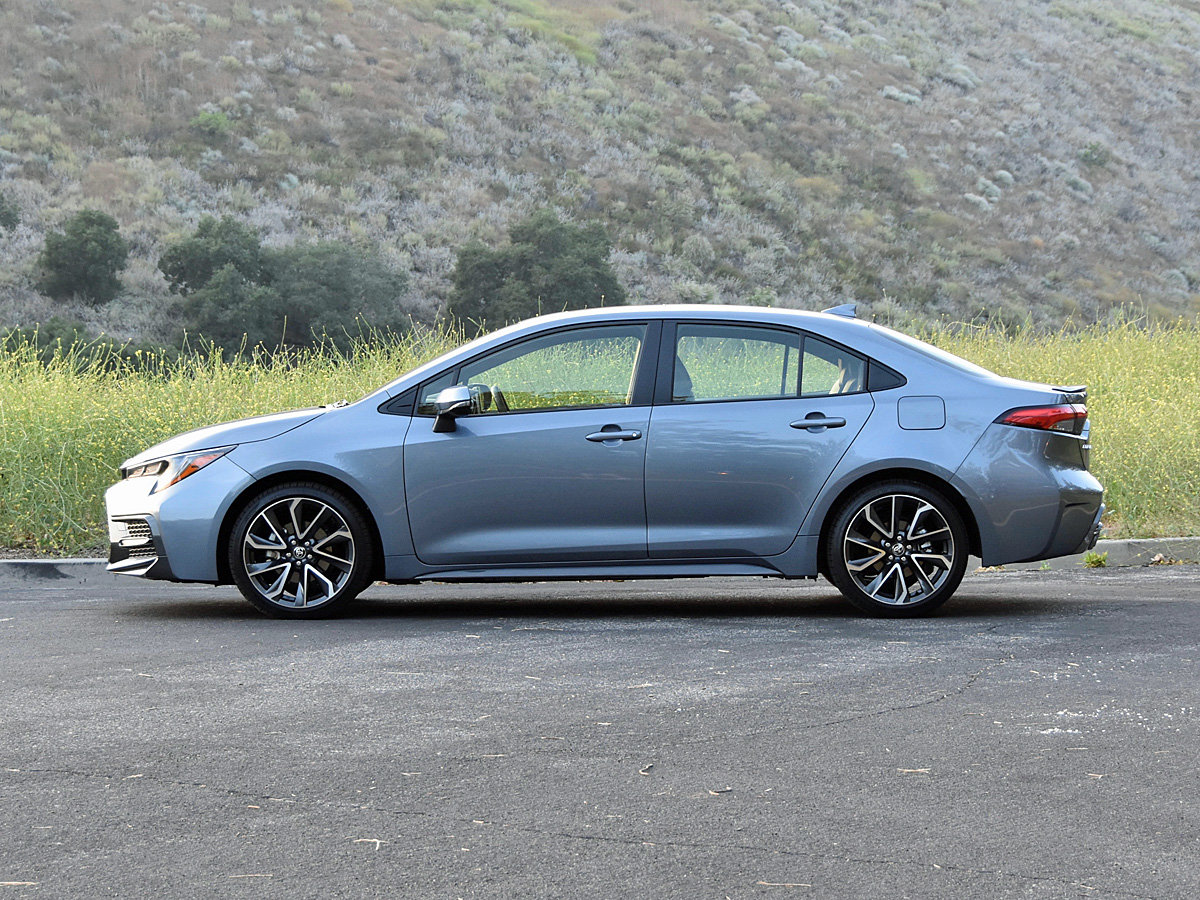
But if you equip the car with SE or XSE trim, add the mighty attractive Celestite paint colour I enjoyed on my test car, and get past the headlamps, you’ve got a compact sedan that looks terrific. Even its face is more palatable than what you’ll find on other Toyota sedans. Perhaps with time, we’ll all get used to it, as we did with the latest Honda Civic... and the Demogorgon from “Stranger Things.”
Based on my experience in a top-of-the-line XSE version, Toyota has clearly improved the perceived level of quality inside of the latest Corolla. Gone (mostly) are the cheap, hard, and glossy plastics that made the interior of the previous version resemble a McDonald’s Happy Meal's free toy. In their place, soft-touch surfaces abound, and the plastic panels that remain are finished in such a way that they don’t glisten like a bodybuilder in the sun.
Unfortunately, the transmission shifter will remind you that the Corolla is an economy car. This component lacks the solid and secure feel common within a Hyundai or Kia, and because you’ll use it every single time you drive the Corolla, it will remind you of the car’s low-rung position on the automotive ladder.
Speaking of which, the Corolla starts at a base MSRP of $18,990 plus fees of $2,184. That’s for the L trim level with a manual transmission. With the CVT, that goes up to $20,790. You can upgrade to Corolla LE or Corolla XLE trim or, if you want more power and a great looking set of 18-inch aluminum wheels, you can choose the sportier SE or XSE trim. People seeking maximum fuel efficiency can get a Toyota Corolla Hybrid LE, which Natural Resources Canada says will burn 4.5 litres per 100 kilometres in combined driving. Choose the XSE, and you’ll spend $28,490 before fees.

Toyota equips the Corolla L, LE, and XLE with a tame 1.8-litre 4-cylinder engine good for power specs of 139 horsepower. A continuously variable transmission (CVT) powers the front wheels, and the cars sit on 16-inch wheels wrapped in all-season rubber. Granted, I haven’t driven one of these, but this trio sounds just as exciting as turkey on white, no mayo.
Upgrade to SE or XSE trim, and the Corolla adds a hint of Sriracha. These trims have a more powerful 169-horsepower, 2.0-litre 4-cylinder engine, a more sophisticated CVT with paddle shifters and a physical launch gear to improve off-the-line acceleration response, and styling upgrades including a great looking set of 18-inch aluminum alloy wheels on the XSE. You can even get a six-speed manual gearbox with the SE trim. That’s something you can’t get in a BMW 3 Series anymore, let alone most of the Corolla’s competitors.
Starting with the good stuff, the Corolla XSE’s sporty driving experience is expertly tuned. Because you’re going to drive this car every day, it’s not stiff. And Toyota's switch to an independent rear suspension for 2020 gives the car a smooth and stable ride.
At the same time, however, the Corolla XSE isn’t soft. You feel and—because this car lacks adequate sound insulation—hear what’s happening at the road surface. There isn’t much feedback through the steering, but inputs are accurately conveyed to the front wheels, giving the Corolla XSE confidence-inspiring handling.
Regardless of the situation—threading through heavy traffic, thrumming down highways, or thrilling around corners—the Corolla can put a smile on your face. The brakes are excellent, too, withstanding abuse on a writhing mountain road without suffering a hint of fade.
Indeed, the XSE can convince an enthusiastic driver that it’s a sport sedan. Until it comes time to accelerate.
Begging for a turbocharger, the Corolla XSE struggles to take advantage of holes in traffic. It has trouble passing slower vehicles on two-lane roads and climbing mountains at a rapid clip.
During commutes, the dearth of power isn’t a big deal, and the CVT performs unobtrusively. It even sounds and feels like a traditional automatic transmission the majority of the time. But while the ride and handling qualities encourage more dynamic driving, the powertrain simply isn’t ready to play, detracting from what otherwise could be a truly impressive experience in this segment.
With that said, if you want a fun little sedan, get the Corolla SE with the 6-speed manual gearbox. That’s why Toyota bothers to build it in the first place.
As far as fuel efficiency goes, my XSE test car was rated by Natural Resources Canada to get 7.7 litres per 100 kilometres in the city, 6.1 on the highway, and 7.0 combined. I averaged 7.9 L/100 km on my testing loop. Keep in mind that my loop includes mountain driving, and I used Sport mode and manual mode with paddle shifters to keep the 2.0-litre revved up. Chances are that you’ll extract greater efficiency from this car than I did.

Dimensionally, the Corolla is smaller than a Camry. Practically speaking, however, my family of four had no trouble using one for a week of summer trips to the beach, shopping excursions, and runs into the city. Well, almost no trouble.
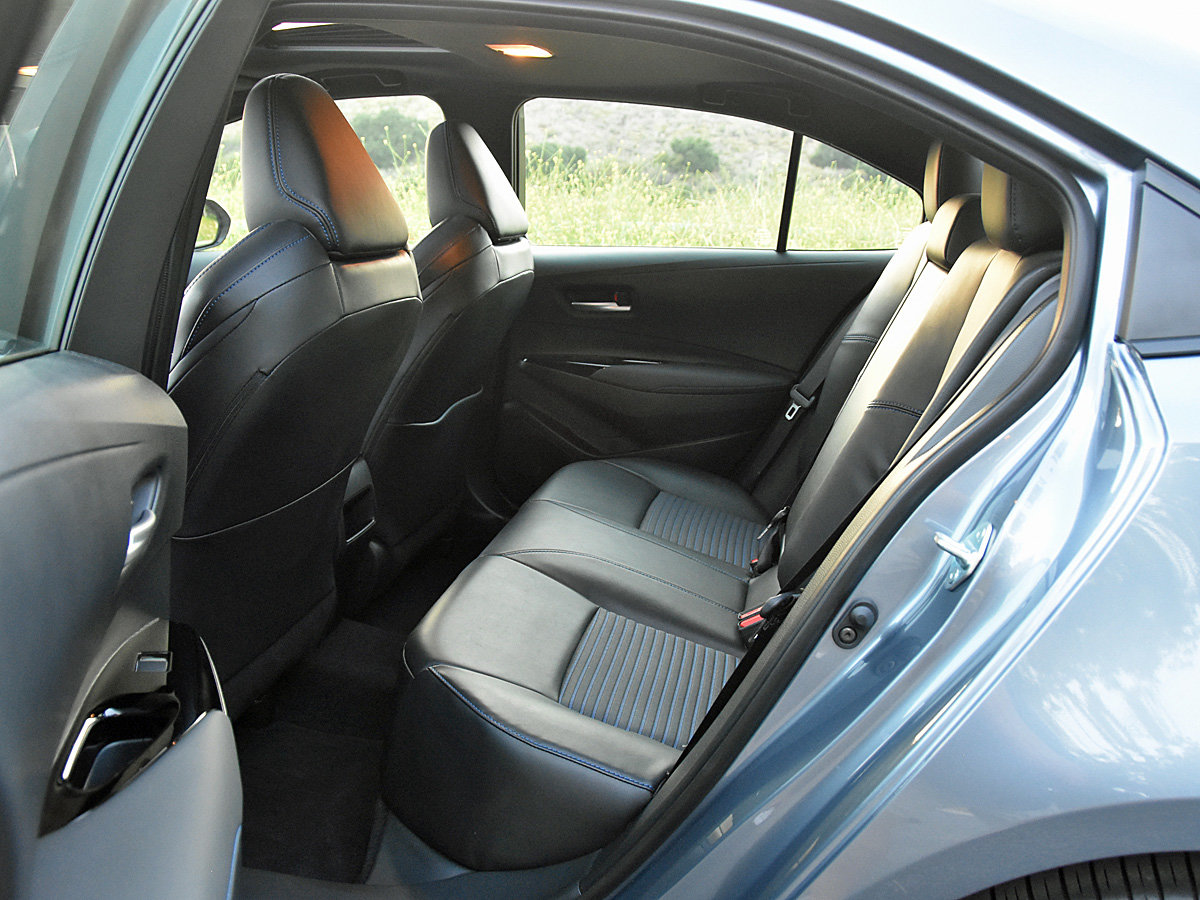
My kids, aged eight and eleven, hated riding in this car. A heat wave baked the black SofTex leatherette to a temperature that produced tears. The Corolla XSE lacks rear air-conditioning vents, too, and there aren’t any USB charging ports. Whoever sat on the sunny side of the car roasted due to the lack of privacy-tinted rear glass. Also, it’s worth noting that my younger child’s booster seat scraped the heck out of the plastic trim where the seat's bottom cushion meets its backrest.
My wife wasn’t fond of the Corolla, either, because it lacks a front seat height adjuster. Already low to the ground due to the Corolla’s move to the Toyota New Global Architecture (TNGA) platform, she felt like she was skimming along just inches above the pavement. And because the seating hip point is quite low, graceful entry and exit eluded her.
So, everyone was unhappy except me. The Corolla XSE’s 8-way power-adjustable driver’s seat is quite comfortable, and while SofTex does have a reputation for trapping sweat, the XSE’s cloth seat inserts help. Plus, the car’s single-zone automatic climate control system is mighty effective at cooling the cabin in short order, and in winter people will appreciate the available heated front seats and heated steering wheel.
I gave the front passenger’s seat a try. Thanks to its good thigh support, I found it acceptable. The back seat is comfortable, too, thanks to a tall bottom cushion, decent legroom, and softly padded front seatbacks. You sit up high in this car’s back seat, though, which means taller people are going to have a problem with headroom. They’ll also need to duck when exiting the car.
More than anything else, what bothered me about the Corolla’s interior is the lack of storage bins and cubbies. Even the cupholders are small, though they worked fine for the largest size iced coffee drink from my favorite café and Hydro Flask water bottles taken for a hike. Slide the centre armrest forward for added comfort, though, and you effectively eliminate one of the two cupholders.
Trunk space measures 371 litres, not much less than a Camry. You can fit a couple of suitcases, a couple of roll-aboard bags, and a compact folding stroller into the space, and there’s still some room for a duffle bag and several backpacks. Toyota does not, however, provide a handle to use to shut the trunk without putting your hands on the dirty lid.
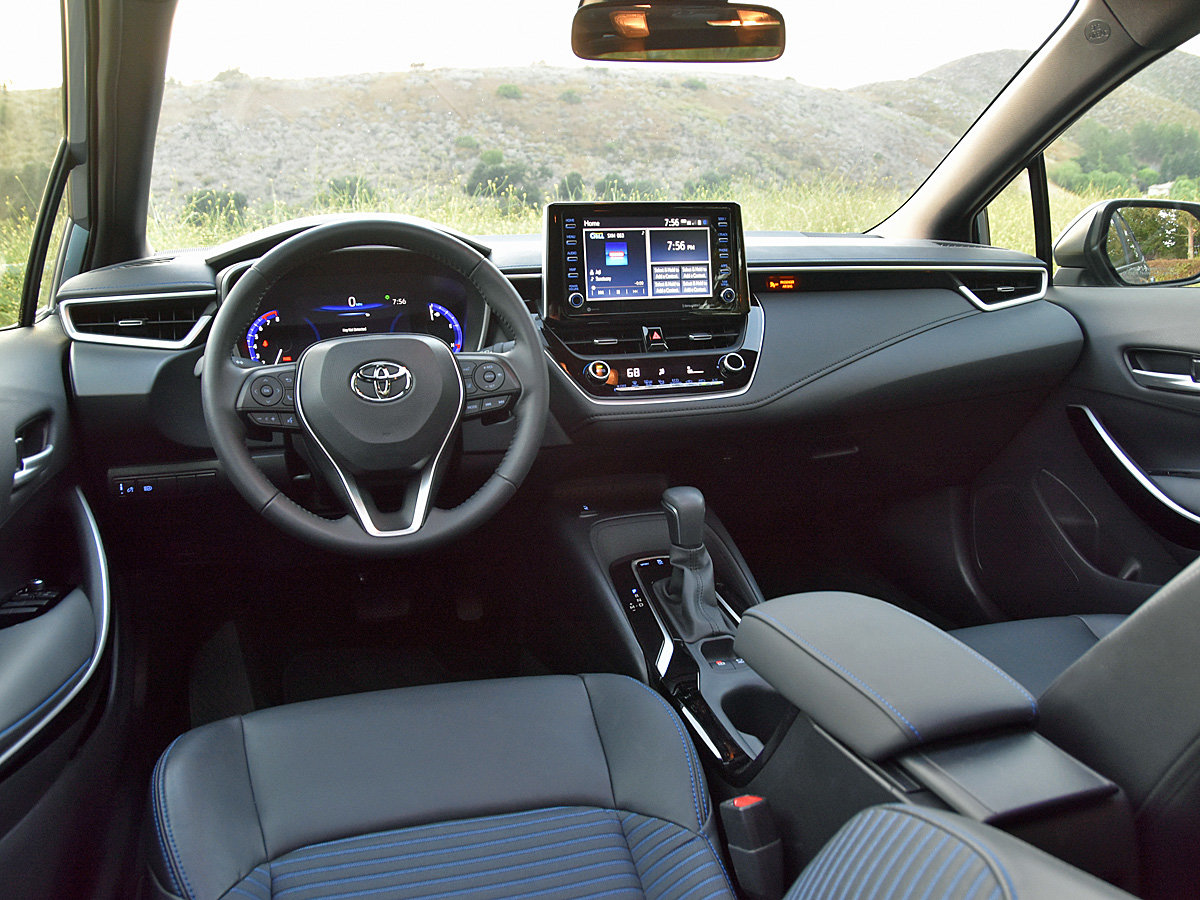
The redesigned Corolla includes Toyota’s family of next-generation Entune 3.0 infotainment systems. The most important thing for you to know is that Apple CarPlay is finally available. Android Auto is not. As far as user-friendliness is concerned, Entune 3.0 is a delight. The touchscreen sits up high, where it is easy to see and reach while driving. Stereo volume and tuning knobs are instantly familiar, and main menu access buttons line each side of the screen. The voice-recognition system worked well with Apple CarPlay, too, and the USB port is located near a smartphone shelf tucked under the dashboard.
All versions of the Corolla's infotainment system get Bluetooth, Siri Eyes Free and a 3-year free trial of Safety Connect services. Higher trims feature an 8-inch display instead of a 7-inch screen and a USB charging port in addition to the standard USB media port.
My test car came with Entune 3.0 Plus, which adds advanced voice recognition, HD Radio, a 3-month trial of SiriusXM satellite radio, a 3-year trial of Service Connect services, and a 6-month trial of Remote Connect services.
If you have an iPhone, you don’t need this stuff. The standard setup, with either the 7-inch or 8-inch touchscreen, provides what you need. If you have an Android device, well, consider leasing in order to leverage all of those free 3-year trial periods.
Toyota equips every 2020 Corolla with Toyota Safety Sense 2.0 (TSS 2.0). This next-generation suite of active driver-assistance systems (ADAS) is enhanced with new low-light pedestrian detection, daytime cyclist detection, road-sign recognition, and Lane Tracing Assist on top of lane departure alert, automatic emergency braking, adaptive cruise control, and automatic high beams.
Lane Tracing Assist is a lane-centring assist technology. It works when the adaptive cruise control is on, helping to keep the Corolla in the middle of the lane of intended travel.
Generally speaking, TSS 2.0 operates with an impressive level of refinement and accuracy. For the most part, it is subtle, too. It would be nice, however, if the lane-departure warning system used a steering-wheel vibration instead of a short, sharp aural alert. The alert is irritating, prompting the driver to shut off the system.
On my usual testing loop, the new Lane Tracing Assist technology proved accurate and refined. But during a late Saturday night drive home, my worn-out self was let down by it. Instead of relying on the tech, on the narrow lanes of the highways, I continually second-guessed and fought it, adding to—rather than solving—my fatigue.
My test car also had a blind-spot monitoring system. In my opinion, this is one of the most significant safety features of the past decade. It is standard on all but the base trims. It does not, however, include a rear cross-traffic alert feature.
The National Highway Traffic Safety Administration (NHTSA) gives the new Corolla sedan a 5-star rating for frontal-impact protection and side-impact testing. The Insurance Institute for Highway Safety (IIHS) named the redesigned Corolla sedan a Top Safety Pick for the 2019 calendar year.
Most people buy more expensive new cars than they really need, which makes a compact sedan like the 2020 Corolla a truly cost-effective solution to your transportation requirements.
However, complaints from my family members deserve consideration. Space wasn’t an issue inside the cabin or the trunk. Comfort, however, was a problem for the people I love most. And with the Corolla, Toyota offers no solutions to their complaints.
Comfort, not space, is an issue in most compact cars. Cloth seats are usually restricted to lower trim levels. Rear-seat air-conditioning vents are typically absent. Front-passenger seat height adjusters are rare. And none of them come with factory tinted rear glass, like a crossover SUV.
So, while cars like the Corolla are cost-effective when compared to their SUV counterparts, like Toyota’s own RAV4, they can’t provide the same level of comfort or utility. And that’s why the traditional sedan has become a dying breed.
SUVs, however, typically aren’t as much fun to drive as a car. The new 2020 Toyota Corolla XSE is entertaining as far as its ride and handling go. With a turbocharger and a different transmission, it would at least back up its racy appearance and athletic driving dynamics with genuine performance.
And with some more attention to passenger comfort, Android Auto smartphone integration, and extra cabin storage space, Toyota would be closer to setting the bar among compact cars rather than merely coming close to hitting it.
Note: Images show a US model.

User reviews for 2020 Toyota Corolla
Write a review2020 Toyota Corolla Pricing
Trims & specs
Air Conditioning
Single front air conditioning zones
Airbags
Dual front airbags · Driver knee airbags · Passenger airbag deactivation: occupant sensing deactivation · Front side airbags · Rear side curtain airbags
Audio System
Antenna Type: mast · Voice recognition audio system · Bluetooth auxiliary audio input · IHeartRadio internet radio · AM/FM radio · Total Number of Speakers: 6
Brakes
ABS: 4-wheel · Braking assist: hill start assist · Electronic parking brake: auto off · Front brake diameter: 10.8 · Front brakes: ventilated disc · Rear brake diameter: 10.2 · Rear brakes: disc
Comfort Features
Floor Material: carpet · Shift knob trim: urethane · Steering wheel trim: urethane
Convenience Features
Adaptive stop and go cruise control: semi-automatic · Assist handle: front · Autonomous lane guidance: lane centering · Center console: front console with armrest and storage · Cruise control: adaptive · Cupholders: front · One-touch windows: 4 · Power outlet(s): 12V front · Power steering: electric · Power windows: lockout button · Reading lights: rear · Steering wheel: tilt and telescopic · Steering wheel mounted controls: cruise controls · Storage: accessory hook · Vanity mirrors: dual illuminating
Driver Seat
Manual adjustments: 6
Drivetrain
Axle ratio: 4.76
Engine
Battery: maintenance-free
Exterior Features
Door handle color: body-color · Front bumper color: body-color · Grille color: black · Mirror color: body-color · Rear bumper color: body-color · Rocker panel color: body-color · Window trim: black
Headrests
Front headrests: adjustable · Number of front headrests: 2 · Number of rear headrests: 3
In Car Entertainment
Connected in-car apps: Amazon Alexa · Infotainment: Apply CarPlay ready · Infotainment screen size: 7 in.
Instrumentation
Fuel economy display: MPG · Instrument cluster screen size: 4.2 in. · Warnings and reminders: low fuel level
Lights
Daytime running lights: LED · Headlights: wiper activated · Tail and brake lights: LED
Mirrors
Exterior mirrors: power · Inside rearview mirror: manual day/night
Passenger Seat
Manual Adjustments: 4
Rear Seats
Type: 60-40 split bench
Safety
Automatic emergency braking: front · Camera system: rearview · Child seat anchors: LATCH system · Crumple zones: rear · Impact absorbing seats: dual front · Impact sensor: post-collision safety system · Pre-Collision Warning System: visual warning · Pre-collision warning system: pedestrian detection · Rearview monitor: in dash
Seatbelts
Emergency locking retractors: front · Front seatbelts: 3-point · Seatbelt force limiters: front · Seatbelt pretensioners: front · Seatbelt warning sensor: driver and passenger · Second row seatbelts: 3-point
Seats
Driver seat manual adjustments: height · Front seat type: bucket · Passenger seat manual adjustments: reclining · Rear headrests: adjustable · Rear seat folding: split · Upholstery: cloth
Spare Tire
Mount Location: inside · Size: temporary
Spare Wheel
Rim Type: steel
Suspension
Front Arm Type: lower control arms · Front Shock Type: gas shock absorbers · Front Spring Type: coil springs · Front Suspension Classification: independent · Front Suspension Type: MacPherson struts · Rear Shock Type: gas shock absorbers · Rear Spring Type: coil springs · Rear Suspension Classification: independent · Rear Suspension Type: multi-link · Stabilizer bar(s): rear
Telematics
Electronic messaging assistance: with voice recognition · Navigation app: Scout · Phone: voice activated · Phone wireless data link: Bluetooth · Smart device app compatibility: Toyota Connected Services · Wifi: hotspot
Tires
Type: all season
Tires and Rims
Wheels: steel
Wheels
Wheel covers: full
Windows
Front wipers: intermittent · Power windows: with safety reverse
Air Conditioning
Automatic climate control front air conditioning · Single front air conditioning zones
Airbags
Dual front airbags · Driver knee airbags · Passenger airbag deactivation: occupant sensing deactivation · Front side airbags · Rear side curtain airbags
Audio System
Antenna Type: mast · Voice recognition audio system · Bluetooth auxiliary audio input · Slacker internet radio · Touch screen display radio · Total Number of Speakers: 6
Brakes
ABS: 4-wheel · Braking assist: hill start assist · Electronic parking brake: auto off · Front brake diameter: 10.8 · Front brakes: ventilated disc · Rear brake diameter: 10.2 · Rear brakes: disc
Comfort Features
Armrests: rear center with cupholders · Floor Material: carpet · Shift knob trim: urethane · Steering wheel trim: urethane
Convenience Features
Adaptive stop and go cruise control: semi-automatic · Assist handle: front · Autonomous lane guidance: lane centering · Center console: front console with armrest and storage · Cruise control: adaptive · Cupholders: front · Multi-function remote: keyless entry · One-touch windows: 4 · Power outlet(s): 12V front · Power steering: electric · Power windows: lockout button · Reading lights: rear · Steering wheel: tilt and telescopic · Steering wheel mounted controls: cruise controls · Storage: door pockets · Vanity mirrors: dual illuminating
Driver Seat
Manual adjustments: 6
Drivetrain
Axle ratio: 4.76
Engine
Battery: maintenance-free
Exterior Features
Door handle color: body-color · Front bumper color: body-color · Grille color: black · Mirror color: body-color · Rear bumper color: body-color · Rocker panel color: body-color · Window trim: black
Headrests
Front headrests: adjustable · Number of front headrests: 2 · Number of rear headrests: 3
In Car Entertainment
Connected in-car apps: Amazon Alexa · Infotainment: Apply CarPlay ready · Infotainment screen size: 8 in.
Instrumentation
Fuel economy display: MPG · Instrument cluster screen size: 4.2 in. · Warnings and reminders: maintenance reminder
Lights
Daytime running lights: LED · Headlights: auto delay off · Tail and brake lights: LED
Mirrors
Exterior mirrors: manual folding · Inside rearview mirror: manual day/night
Passenger Seat
Manual Adjustments: 4
Rear Seats
Type: 60-40 split bench
Safety
Automatic emergency braking: front · Camera system: rearview · Child seat anchors: LATCH system · Crumple zones: front · Impact absorbing seats: dual front · Impact sensor: post-collision safety system · Pre-Collision Warning System: visual warning · Pre-collision warning system: pedestrian detection · Rearview monitor: in dash
Seatbelts
Emergency locking retractors: front · Front seatbelts: 3-point · Seatbelt force limiters: front · Seatbelt pretensioners: front · Seatbelt warning sensor: driver and passenger · Second row seatbelts: 3-point
Seats
Driver seat manual adjustments: height · Front seat type: bucket · Passenger seat manual adjustments: reclining · Rear headrests: adjustable · Rear seat folding: split · Upholstery: premium cloth
Spare Tire
Mount Location: inside · Size: temporary
Spare Wheel
Rim Type: steel
Suspension
Front Arm Type: lower control arms · Front Shock Type: gas shock absorbers · Front Spring Type: coil springs · Front Suspension Classification: independent · Front Suspension Type: MacPherson struts · Rear Shock Type: gas shock absorbers · Rear Spring Type: coil springs · Rear Suspension Classification: independent · Rear Suspension Type: multi-link · Stabilizer bar(s): rear
Telematics
Electronic messaging assistance: with read function · Navigation app: Scout · Phone: voice activated · Phone wireless data link: Bluetooth · Smart device app compatibility: Toyota Connected Services · Wifi: hotspot
Tires
Type: all season
Tires and Rims
Wheels: steel
Wheels
Wheel covers: full
Windows
Front wipers: variable intermittent · Power windows: with safety reverse
Air Conditioning
Automatic climate control front air conditioning · Single front air conditioning zones
Airbags
Dual front airbags · Driver knee airbags · Passenger airbag deactivation: occupant sensing deactivation · Front side airbags · Front side curtain airbags
Audio System
Antenna Type: mast · Voice recognition audio system · Bluetooth auxiliary audio input · Slacker internet radio · Touch screen display radio · Total Number of Speakers: 6
Brakes
ABS: 4-wheel · Braking assist: hill start assist · Electronic parking brake: auto off · Front brake diameter: 10.8 · Front brakes: ventilated disc · Rear brake diameter: 10.2 · Rear brakes: disc
Comfort Features
Armrests: rear center with cupholders · Floor Material: carpet · Shift knob trim: urethane · Steering wheel trim: leather
Convenience Features
Adaptive stop and go cruise control: semi-automatic · Assist handle: rear · Autonomous lane guidance: lane centering · Center console: front console with armrest and storage · Cruise control: adaptive · Cupholders: front · Multi-function remote: trunk release · One-touch windows: 4 · Power outlet(s): 12V front · Power steering: electric · Power windows: lockout button · Reading lights: rear · Steering wheel: tilt and telescopic · Steering wheel mounted controls: audio · Storage: door pockets · Vanity mirrors: dual illuminating
Driver Seat
Manual adjustments: 6
Drivetrain
Axle ratio: 3.79
Engine
Battery: maintenance-free
Exterior Features
Door handle color: body-color · Exhaust: dual exhaust tips · Exhaust tip color: chrome · Front bumper color: body-color · Grille color: black · Mirror color: body-color · Rear bumper color: body-color · Rear spoiler: lip · Rear spoiler color: body-color · Rocker panel color: black · Window trim: black
Headrests
Front headrests: adjustable · Number of front headrests: 2 · Number of rear headrests: 3
In Car Entertainment
Connected in-car apps: Amazon Alexa · Infotainment: Apply CarPlay ready · Infotainment screen size: 8 in.
Instrumentation
Fuel economy display: range · Instrument cluster screen size: 4.2 in. · Warnings and reminders: low fuel level
Lights
Daytime running lights: LED · Headlights: LED · Tail and brake lights: LED
Mirrors
Exterior mirrors: power · Inside rearview mirror: manual day/night
Passenger Seat
Manual Adjustments: 4
Rear Seats
Type: 60-40 split bench
Roof
Moonroof: tilt/slide
Safety
Automatic emergency braking: front · Camera system: rearview · Child seat anchors: LATCH system · Crumple zones: front · Impact absorbing seats: dual front · Impact sensor: post-collision safety system · Pre-Collision Warning System: audible warning · Pre-collision warning system: pedestrian detection · Rearview monitor: in dash
Seatbelts
Emergency locking retractors: front and rear · Front seatbelts: 3-point · Seatbelt force limiters: front · Seatbelt pretensioners: front · Seatbelt warning sensor: driver and passenger · Second row seatbelts: 3-point
Seats
Driver seat manual adjustments: reclining · Front seat type: sport bucket · Passenger seat manual adjustments: reclining · Rear headrests: adjustable · Rear seat folding: split · Upholstery: premium cloth
Security
Power door locks: anti-lockout
Spare Tire
Mount Location: inside · Size: temporary
Spare Wheel
Rim Type: steel
Suspension
Front Arm Type: lower control arms · Front Shock Type: gas shock absorbers · Front Spring Type: coil springs · Front Suspension Classification: independent · Front Suspension Type: MacPherson struts · Rear Shock Type: gas shock absorbers · Rear Spring Type: coil springs · Rear Suspension Classification: independent · Rear Suspension Type: multi-link · Stabilizer bar(s): rear
Telematics
Electronic messaging assistance: with voice recognition · Navigation app: Scout · Phone: voice activated · Phone wireless data link: Bluetooth · Smart device app compatibility: Toyota Connected Services · Wifi: hotspot
Tires
Type: all season
Tires and Rims
Wheels: painted aluminum
Windows
Front wipers: variable intermittent · Power windows: with safety reverse
Air Conditioning
Automatic climate control front air conditioning · Single front air conditioning zones
Airbags
Passenger seat cushion front airbags · Driver knee airbags · Passenger airbag deactivation: occupant sensing deactivation · Front side airbags · Front side curtain airbags
Audio System
Antenna Type: mast · Voice recognition audio system · Bluetooth auxiliary audio input · Slacker internet radio · AM/FM radio · Total Number of Speakers: 6
Brakes
ABS: 4-wheel · Braking assist: hill start assist · Electronic parking brake: auto off · Front brake diameter: 10.8 · Front brakes: ventilated disc · Rear brake diameter: 10.2 · Rear brakes: disc
Comfort Features
Armrests: rear center with cupholders · Floor Material: carpet · Shift knob trim: urethane · Steering wheel trim: leather
Convenience Features
Adaptive stop and go cruise control: semi-automatic · Assist handle: rear · Autonomous lane guidance: lane centering · Center console: front console with armrest and storage · Cruise control: adaptive · Cupholders: rear · Multi-function remote: keyless entry · One-touch windows: 4 · Power outlet(s): USB front · Power steering: electric · Power windows: lockout button · Reading lights: rear · Steering wheel: tilt and telescopic · Steering wheel mounted controls: cruise controls · Storage: front seatback · Vanity mirrors: dual illuminating
Driver Seat
Manual adjustments: 6
Drivetrain
Axle ratio: 3.79
Engine
Battery: maintenance-free
Exterior Features
Door handle color: black · Exhaust: dual exhaust tips · Exhaust tip color: chrome · Front bumper color: body-color · Grille color: black · Mirror color: black · Rear bumper color: body-color · Rear spoiler: lip · Rear spoiler color: black · Rocker panel color: black · Window trim: black
Headrests
Front headrests: adjustable · Number of front headrests: 2 · Number of rear headrests: 3
In Car Entertainment
Connected in-car apps: Amazon Alexa · Infotainment: Apply CarPlay ready · Infotainment screen size: 8 in.
Instrumentation
Fuel economy display: MPG · Instrument cluster screen size: 4.2 in. · Warnings and reminders: coolant temperature warning
Lights
Daytime running lights: LED · Headlights: LED · Tail and brake lights: LED
Mirrors
Exterior mirrors: manual folding · Inside rearview mirror: manual day/night
Passenger Seat
Manual Adjustments: 4
Rear Seats
Type: 60-40 split bench
Safety
Automatic emergency braking: front pedestrian · Camera system: rearview · Child seat anchors: LATCH system · Crumple zones: front · Impact absorbing seats: dual front · Impact sensor: post-collision safety system · Pre-Collision Warning System: visual warning · Pre-collision warning system: pedestrian detection · Rearview monitor: in dash
Seatbelts
Emergency locking retractors: front and rear · Front seatbelts: 3-point · Seatbelt force limiters: front · Seatbelt pretensioners: front · Seatbelt warning sensor: driver and passenger · Second row seatbelts: 3-point
Seats
Driver seat manual adjustments: height · Front seat type: sport bucket · Passenger seat manual adjustments: reclining · Rear headrests: adjustable · Rear seat folding: split · Upholstery: premium cloth
Spare Tire
Mount Location: inside · Size: temporary
Spare Wheel
Rim Type: steel
Suspension
Front Arm Type: lower control arms · Front Shock Type: gas shock absorbers · Front Spring Type: coil springs · Front Suspension Classification: independent · Front Suspension Type: MacPherson struts · Rear Shock Type: gas shock absorbers · Rear Spring Type: coil springs · Rear Suspension Classification: independent · Rear Suspension Type: multi-link · Stabilizer bar(s): front
Telematics
Electronic messaging assistance: with voice recognition · Navigation app: Scout · Phone: voice activated · Phone wireless data link: Bluetooth · Smart device app compatibility: Toyota Connected Services · Wifi: hotspot
Tires
Type: all season
Tires and Rims
Wheels: painted aluminum
Windows
Front wipers: variable intermittent · Power windows: with safety reverse
Air Conditioning
Automatic climate control front air conditioning · Single front air conditioning zones
Airbags
Passenger seat cushion front airbags · Driver knee airbags · Passenger airbag deactivation: occupant sensing deactivation · Front side airbags · Rear side curtain airbags
Audio System
Antenna Type: diversity · Voice recognition audio system · USB auxiliary audio input · IHeartRadio internet radio · HD radio · Satellite Radio: SiriusXM · Total Number of Speakers: 6
Brakes
ABS: 4-wheel · Braking assist: hill start assist · Electronic parking brake: auto off · Front brake diameter: 10.8 · Front brakes: ventilated disc · Rear brake diameter: 10.2 · Rear brakes: disc
Comfort Features
Armrests: rear center with cupholders · Floor Material: carpet · Shift knob trim: urethane · Steering wheel trim: leather
Convenience Features
Adaptive stop and go cruise control: semi-automatic · Assist handle: front · Autonomous lane guidance: lane centering · Center console: front console with armrest and storage · Cruise control: adaptive · Cupholders: front · Multi-function remote: keyless entry with panic alarm · One-touch windows: 4 · Power outlet(s): 12V front · Power steering: electric · Power windows: lockout button · Reading lights: front · Steering wheel: tilt and telescopic · Steering wheel mounted controls: multi-function screen controls · Storage: door pockets · Vanity mirrors: dual illuminating
Driver Seat
Adjustable lumbar support: power · Power adjustments: 8
Drivetrain
Axle ratio: 4.76
Engine
Battery: maintenance-free
Exterior Features
Door handle color: body-color · Front bumper color: body-color · Grille color: black · Mirror color: body-color · Rear bumper color: body-color · Rocker panel color: body-color · Window trim: black
Headrests
Front headrests: adjustable · Number of front headrests: 2 · Number of rear headrests: 3
In Car Entertainment
Connected in-car apps: Yelp · Infotainment: Apply CarPlay ready · Infotainment screen size: 8 in.
Instrumentation
Fuel economy display: range · Instrument cluster screen size: 7 in. · Warnings and reminders: low fuel level
Lights
Daytime running lights: LED · Headlights: automatic high beam dimmer · Tail and brake lights: LED
Mirrors
Exterior mirrors: power · Inside rearview mirror: manual day/night
Passenger Seat
Manual Adjustments: 4
Rear Seats
Type: 60-40 split bench
Roof
Moonroof: power glass
Safety
Automatic emergency braking: front pedestrian · Camera system: rearview · Child seat anchors: LATCH system · Crumple zones: front · Impact absorbing seats: dual front · Impact sensor: fuel cut-off · Pre-Collision Warning System: visual warning · Pre-collision warning system: pedestrian detection · Rearview monitor: in dash
Seatbelts
Emergency locking retractors: front · Front seatbelts: 3-point · Seatbelt force limiters: front · Seatbelt pretensioners: front · Seatbelt warning sensor: driver and passenger · Second row seatbelts: 3-point
Seats
Driver seat power adjustments: reclining · Front seat type: bucket · Passenger seat manual adjustments: reclining · Rear headrests: adjustable · Rear seat folding: split · Upholstery: leatherette · Upholstery accents: cloth
Security
Power door locks: anti-lockout
Spare Tire
Mount Location: inside · Size: temporary
Spare Wheel
Rim Type: steel
Suspension
Front Arm Type: lower control arms · Front Shock Type: gas shock absorbers · Front Spring Type: coil springs · Front Suspension Classification: independent · Front Suspension Type: MacPherson struts · Rear Shock Type: gas shock absorbers · Rear Spring Type: coil springs · Rear Suspension Classification: independent · Rear Suspension Type: multi-link · Stabilizer bar(s): rear
Telematics
Driver assistance app: roadside assistance · Electronic messaging assistance: with voice recognition · Navigation app: Scout · Phone: voice activated · Phone wireless data link: Bluetooth · Smart device app compatibility: Toyota Connected Services · Smart device app function: maintenance scheduling · Wifi: hotspot
Tires
Type: all season
Tires and Rims
Wheel type: aluminum alloy
Windows
Front wipers: variable intermittent · Power windows: with safety reverse
Air Conditioning
Automatic climate control front air conditioning · Single front air conditioning zones
Airbags
Passenger seat cushion front airbags · Driver knee airbags · Passenger airbag deactivation: occupant sensing deactivation · Front side airbags · Rear side curtain airbags
Audio System
Antenna Type: mast · Voice recognition audio system · Auxiliary audio input: jack · IHeartRadio internet radio · HD radio · Satellite Radio: SiriusXM · Total Number of Speakers: 6
Brakes
ABS: 4-wheel · Braking assist: hill start assist · Electronic parking brake: auto off · Front brake diameter: 10.8 · Front brakes: ventilated disc · Rear brake diameter: 10.2 · Rear brakes: disc
Comfort Features
Armrests: rear center with cupholders · Floor Material: carpet · Shift knob trim: urethane · Steering wheel trim: leather
Convenience Features
Adaptive stop and go cruise control: semi-automatic · Assist handle: front · Autonomous lane guidance: lane centering · Center console: front console with armrest and storage · Cruise control: adaptive · Cupholders: rear · Multi-function remote: keyless entry with panic alarm · One-touch windows: 4 · Power outlet(s): 12V front · Power steering: electric · Power windows: lockout button · Reading lights: rear · Steering wheel: tilt and telescopic · Steering wheel mounted controls: paddle shifter · Storage: front seatback · Vanity mirrors: dual illuminating
Driver Seat
Adjustable lumbar support: power · Power adjustments: 8
Drivetrain
Axle ratio: 3.79
Engine
Battery: maintenance-free
Exterior Features
Door handle color: body-color · Exhaust: dual exhaust tips · Exhaust tip color: chrome · Front bumper color: body-color · Grille color: black · Mirror color: body-color · Rear bumper color: body-color · Rear spoiler: lip · Rear spoiler color: black · Rocker panel color: black · Window trim: black
Headrests
Front headrests: adjustable · Number of front headrests: 2 · Number of rear headrests: 3
In Car Entertainment
Connected in-car apps: Yelp · Infotainment: Apply CarPlay ready · Infotainment screen size: 8 in.
Instrumentation
Fuel economy display: MPG · Instrument cluster screen size: 7 in. · Warnings and reminders: low fuel level
Lights
Daytime running lights: LED · Headlights: wiper activated · Tail and brake lights: LED
Mirrors
Exterior mirrors: power · Inside rearview mirror: manual day/night
Passenger Seat
Manual Adjustments: 4
Rear Seats
Type: 60-40 split bench
Roof
Moonroof: tilt/slide
Safety
Automatic emergency braking: front · Camera system: rearview · Child seat anchors: LATCH system · Crumple zones: front · Impact absorbing seats: dual front · Impact sensor: fuel cut-off · Pre-Collision Warning System: visual warning · Pre-collision warning system: pedestrian detection · Rearview monitor: in dash
Seatbelts
Emergency locking retractors: front and rear · Front seatbelts: 3-point · Seatbelt force limiters: front · Seatbelt pretensioners: front · Seatbelt warning sensor: driver and passenger · Second row seatbelts: 3-point
Seats
Driver seat power adjustments: reclining · Front seat type: sport bucket · Passenger seat manual adjustments: reclining · Rear headrests: adjustable · Rear seat folding: split · Upholstery: leatherette · Upholstery accents: cloth
Security
Power door locks: anti-lockout
Spare Tire
Mount Location: inside · Size: temporary
Spare Wheel
Rim Type: steel
Suspension
Front Arm Type: lower control arms · Front Shock Type: gas shock absorbers · Front Spring Type: coil springs · Front Suspension Classification: independent · Front Suspension Type: MacPherson struts · Rear Shock Type: gas shock absorbers · Rear Spring Type: coil springs · Rear Suspension Classification: independent · Rear Suspension Type: multi-link · Stabilizer bar(s): rear
Telematics
Driver assistance app: roadside assistance · Electronic messaging assistance: with read function · Navigation app: Scout · Phone: voice activated · Phone wireless data link: Bluetooth · Smart device app compatibility: Toyota Connected Services · Smart device app function: maintenance scheduling · Wifi: hotspot
Tires
Type: all season
Tires and Rims
Wheels: painted aluminum
Windows
Front wipers: variable intermittent · Power windows: with safety reverse
