2021 Nissan Rogue Reviews, Pricing & Specs
Write a review
The award-winning 2021 Nissan Rogue offers one of the best value propositions in its segment.

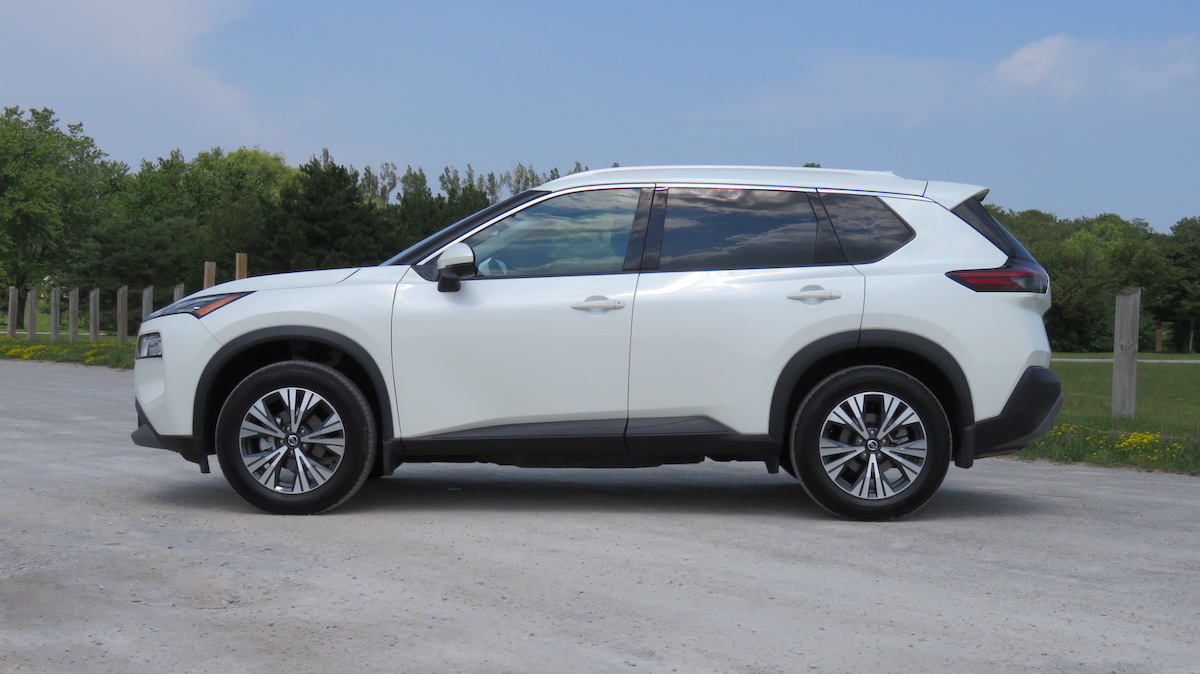
The 2021 Nissan Rogue comes with a complete redesign that gives this compact SUV's styling a muscular and imposing presence. The updated nose is much more squared off and features a deeper interpretation of Nissan’s V-Motion grille design. This is flanked by standard LED headlamps in a narrow and angled configuration, separate LED daytime running lights, and functional forward air vents and active grille shutters. The latter elements contribute to giving the Rogue a lower coefficient of drag than its previous generation despite its boxier proportions: though a Cd of 0.33 is nothing to write home about on its own, it’s a respectable figure for this body style.
The exterior colour palette has been pared down to four or five colours – essentially black, white, grey, red, and blue – with a sixth pearl grey option available on the SV with all-wheel drive. On the Platinum grade, four two-tone colour configurations are available that combine a lower paint colour with a blacked-out roof (white, blue, pearl grey, and a champagne exterior colour exclusive to this grade and paint style).
Seating surfaces are covered in cloth in most grades. A leatherette upholstery is offered in the SV AWD model with the $2,200 Premium Package—as shown on our evaluation unit, with an as-tested price of $39,088 including a $1,990 destination charge—which also includes heated rear seats, manual rear sunshades, and a power liftgate. (This package, available only on this specific configuration, is the only package offered within the Rogue line-up.) On the Platinum model, semi-aniline quilted Nappa leather ups the ante on the Rogue’s interior, bringing it to a level that just might win over Nissan’s skeptics.

A quick scan might lead those familiar with Nissan’s line-up to believe the 2.5-litre four-cylinder engine is a carry-over from a previous generation. However, this is not the same powerplant as before: it’s one of the brand’s newer direct-injected engines, which is applied here to help improve both performance and fuel efficiency. Its 181 horsepower and 181 lb-ft of torque, which becomes fully available at a pleasantly attainable 3,600 rpm, represent improvements of six and three per cent respectively over the outgoing version.
The good news is that these engine specs are a good match for the Rogue’s curb weight, which varies from 1,536 kilograms (3,386 pounds) for the front-wheel-drive S grade to 1,653 kilograms (3,644 pounds) for the all-wheel drive Platinum model. This is in spite of the continuously variable transmission (CVT)'s role in the drivetrain, which isn’t as unpleasantly droning as some. There’s also no alternate powertrain offered, which means this level of performance is standard across the entire line-up. On the other hand, those who might prefer a higher displacement or a turbocharger can’t buy their way into higher power figures, and Nissan doesn’t have plans as of now to release a hybrid version of the Rogue in North America despite having sold one in the U.S. in the previous generation. The company is focusing its attention on fully battery-powered releases, we’re told, but it’s a shame not to have more fuel-efficient offerings available in the meantime.
Speaking of fuel efficiency, though, the Rogue doesn’t perform too badly in this department, all things considered. Natural Resources Canada says the 2021 Rogue can be expected to use 8.9 litres per 100 kilometres in city driving, 7.0 on the highway, and 8.1 combined in its front-wheel drive configuration, and adding all-wheel drive (as the vast majority of Canadians will) increases those figures to 9.2 city, 7.2 hwy, and 8.3 combined.
Front-wheel drive (FWD) is the default for both the S and SV grades with an upgrade to all-wheel drive (AWD) adding $2,300 to the cost of each. Adding all-wheel drive is the only way to access the SV grade’s Premium Package. On the top Platinum grade, all-wheel drive and all of the Premium Package’s features are included.
The handing of the new Rogue is also significantly better than that of the previous generation thanks to the new design’s 27% improvement in torsional rigidity, 40-kilogram lower weight, revamped multi-link rear suspension, and updated set of stability control systems. Road feel is very planted and stable, demonstrating minimal pitch or roll.

Like other aspects of the Rogue, many of its strongest functional updates are applied at every price point. For example, the cabin has been made three decibels quieter on average, and a new shift-by-wire system means that a compartment large enough to stow a sizeable handbag has been added under the centre stack. (Some critics have said they don’t enjoy the action on the new shifter; this writer will take it over the push-button style used by Honda or Hyundai every day of the week.)
In the second row, the rear doors now open to 85 degrees, which dramatically improves access. The updated design has also improved second-row headroom for a total of 996 mm without the moonroof or 960 mm with it installed.
Standard features are plentiful with heated front seats, steering wheel, and exterior mirrors all being included with the base price along with 17-inch alloy wheels. Upgrading to the SV trim adds Nissan’s 360-degree Around View Monitor (typically a premium feature), remote start with intelligent climate control, a panoramic sunroof, and 18-inch wheels, while the aforementioned Premium Package adds leatherette upholstery, heated outboard rear seats, rear window sunshades, and a power liftgate.
The Platinum grade also integrates some desirable features, though at this point in the line-up Nissan’s competitors are driving a harder bargain. On the Rogue, the Premium Package’s features become included, along with a redesigned Divide and Hide cargo system for the cargo space, which holds a generous 1,028 litres with the second row seats upright and 2,064 litres with them folded (and slightly more without the moonroof). According to Nissan, people weren’t making much use of the topmost shelf setting in this system’s previous iteration, so it’s been removed here. This means most of its benefit is a roughly 5 cm cargo floor height adjustment, which is offered in several other vehicles in this segment. However, one of the panels can still be positioned vertically to separate cargo, and this panel now uses a rail system rather than straps. It’s a little awkward to get into position, but it’s solid once in place. This change also means the rear seat splits 60/40 instead of the 40/20/40 that was part of the previous Divide and Hide configuration.

Most Rogues are equipped with an 8-inch touchscreen infotainment system, which includes wired Apple CarPlay and Android Auto, Bluetooth, hands-free text messaging, and SiriusXM satellite radio with a three-month subscription included. Nissan’s system is not flashy, but it is functional and easy to use with a logical layout and clear graphics.
An available in-car Wi-Fi hotspot and an upgrade from two to four USB ports—two each of USB-A and USB-C—come with the SV grade, as does access to NissanConnect services, including trial access to five-year Plus and six-month Premium package.
Opting for the Platinum grade bumps the screen size up to 9 inches and integrates a wireless phone charging pad and wireless Apple CarPlay compatibility, though wireless Android Auto is not yet available. The Platinum grade also introduces other significant technology upgrades. On the upside is the 10.8-inch head-up display, which is well-configured and puts important information within the driver’s field of vision, and the Bose 10-speaker audio system, which features two subwoofers and is a notable upgrade over the four- and six-speaker configurations in lower trims. On the downside, the 12.3-inch digital instrument cluster feature graphics that are hard to read at a glance, in large part due to the lack of contrast between the speed notations and the background, and there’s no setting to get around these issues.

Nissan’s Safety Shield 360 suite of safety features and advanced driver assistance technologies is standard on every Nissan Rogue. This suite includes forward emergency braking with pedestrian detection, rear emergency braking, blind-spot warning, rear cross-traffic alert, lane departure warning, and high beam assist. Forward collision warning and a driver alertness feature are also standard.
Upgrading to the SV model introduces ProPILOT Assist, Nissan’s hands-on highway driving assist feature. This incorporates adaptive cruise control and the features of Safety Shield 360 to assist the driver with highway driving, so long as his or her hands stay on the wheel, and with the Navi-link addition in the Platinum grade includes actions like assisting with steering and slowing down through curves.
The 2021 Rogue received a rating of “Top Safety Pick+” from the Insurance Institute for Highway Safety (IIHS), scoring the best possible ratings in every category. The National Highway Traffic Safety Administration gives the 2021 Rogue a four-star safety rating overall regardless of configuration, though FWD and AWD are tested separately, as are early- and late-release versions, and each has unique ratings for the organizations various crash tests. Most notably, earlier examples of the Rogue scored only three stars in frontal crash testing, but later versions were upgraded to four stars following Nissan’s adjustments.
In Canada, pricing for the 2021 Nissan Rogue starts at an MSRP of $28,798 (all prices in this section exclude the $1,990 destination charge), representing an increase of $1,000 over the previous generation. Adding all-wheel drive (AWD) brings this cost up to $31,098. The middle-tier Nissan Rogue SV is priced at $32,298 with front-wheel drive and $34,598 with all-wheel drive. Adding the Premium Package to the SV AWD brings the price up by another $2,200 to $36,798. To get the Nissan Rogue Platinum trim level, where all-wheel drive is standard, requires spending $40,798.
Nissan Canada offers a three-year, 60,000-kilometre basic warranty and a five-year, 100,000-kilometre powertrain warranty on the 2021 Rogue, which is roughly on par for the segment.
With a lack of powertrain options, including a hybrid options such as those offered in the Toyota RAV4 and Ford Escape, and room for improvement on execution of premium features, the Nissan Rogue’s greatest strengths in its third generation are for those buyers working with a sub-$30,000 budget. Shoppers searching in this range will still benefit from the advancements made with this third generation of Nissan’s compact crossover, while enjoying feature content that’s well above the average for its price.

User reviews for 2021 Nissan Rogue
Write a review2021 Nissan Rogue Pricing
Trims & specs
Air Conditioning
Single front air conditioning zones
Airbags
Dual front airbags · Dual front knee airbags · Passenger airbag deactivation: occupant sensing deactivation · Front side airbags · Rear side curtain airbags
Audio System
Antenna Type: diversity · Voice recognition audio system · USB auxiliary audio input · IHeartRadio internet radio · Touch screen display radio · Satellite Radio: SiriusXM · Total Number of Speakers: 4
Brakes
ABS: 4-wheel · Braking assist: hill start assist · Electronic parking brake: auto off · Front brake diameter: 11.7 · Front brake width: 1.02 · Front brakes: ventilated disc · Rear brake diameter: 11.5 · Rear brake width: .63 · Rear brakes: ventilated disc
Comfort Features
Armrests: rear center folding with pass-thru · Floor Material: cargo area carpet · Shift knob trim: urethane · Steering wheel trim: urethane
Convenience Features
Assist handle: front · Cargo area power outlet: 12V · Cargo cover: hard · Center console: front console with armrest and storage · Cupholders: rear · Multi-function remote: keyless entry with panic alarm · One-touch windows: 1 · Power outlet(s): 12V front · Power steering: electric · Power windows: lockout button · Reading lights: rear · Steering wheel: tilt and telescopic · Steering wheel mounted controls: audio · Storage: cargo tie-down anchors and hooks · Vanity mirrors: dual illuminating
Driver Seat
Manual adjustments: 6
Drivetrain
Axle ratio: 5.69
Engine
Alternator: 120 amps
Exterior Features
Door handle color: black · Exhaust tip color: stainless-steel · Fender lip moldings: black · Front bumper color: body-color · Grille color: black with chrome accents · Mirror color: black · Rear bumper color: body-color · Rear spoiler: roofline spoiler · Rear spoiler color: body-color · Rear trunk/liftgate: liftgate · Rocker panel color: black · Window trim: chrome
Headrests
Front headrests: adjustable · Number of front headrests: 2 · Number of rear headrests: 3
In Car Entertainment
Connected in-car apps: Google POIs · Infotainment: NissanConnect · Infotainment screen size: 8 in.
Instrumentation
Fuel economy display: MPG · Instrument cluster screen size: 7 in. · Warnings and reminders: maintenance reminder
Lights
Daytime running lights: LED · Headlights: LED · Tail and brake lights: LED
Mirrors
Exterior mirrors: manual folding · Inside rearview mirror: manual day/night
Passenger Seat
Manual Adjustments: 4
Rear Seats
Type: 60-40 split bench
Safety
Automatic emergency braking: front · Camera system: rearview · Child seat anchors: LATCH system · Cross Traffic Alert: rear · Crumple zones: rear · Parking sensors: rear · Pre-Collision Warning System: audible warning · Pre-collision warning system: pedestrian detection · Rearview monitor: in dash
Seatbelts
Emergency locking retractors: front and rear · Front seatbelts: 3-point · Seatbelt force limiters: front · Seatbelt pretensioners: front · Seatbelt warning sensor: driver and passenger · Second row seatbelts: 3-point
Seats
Driver seat manual adjustments: height · Front seat type: bucket · Passenger seat manual adjustments: reclining · Rear headrests: adjustable · Rear seat folding: split · Rear seat manual adjustments: reclining · Upholstery: cloth
Security
Power door locks: anti-lockout
Spare Tire
Mount Location: inside · Size: temporary
Spare Wheel
Rim Type: steel
Steering
Steering ratio: 14.3 · Turns lock-to-lock: 2.5
Suspension
Front Arm Type: lower control arms · Front Shock Type: twin-tube gas shock absorbers · Front Spring Type: coil springs · Front Stabilizer Bar: diameter 24 mm · Front Suspension Classification: independent · Front Suspension Type: MacPherson struts · Rear Shock Type: twin-tube gas shock absorbers · Rear Spring Type: coil springs · Rear Stabilizer Bar: diameter 28 mm · Rear Suspension Classification: independent · Rear Suspension Type: multi-link
Telematics
Electronic messaging assistance: with read function · Phone: voice activated · Phone wireless data link: Bluetooth
Tires
Type: all season
Tires and Rims
Wheel type: aluminum alloy
Windows
Front wipers: variable intermittent · Liftgate window: fixed · Power windows: with safety reverse · Rear wiper: intermittent · Solar-tinted glass: front
Air Conditioning
Single front air conditioning zones
Airbags
Dual front airbags · Dual front knee airbags · Passenger airbag deactivation: occupant sensing deactivation · Front side airbags · Front side curtain airbags
Audio System
Antenna Type: diversity · Voice recognition audio system · USB auxiliary audio input · Pandora internet radio · Touch screen display radio · Satellite Radio: SiriusXM · Total Number of Speakers: 4
Brakes
ABS: 4-wheel · Braking assist: hill start assist · Electronic parking brake: auto off · Front brake diameter: 11.7 · Front brake width: 1.02 · Front brakes: ventilated disc · Rear brake diameter: 11.5 · Rear brake width: .63 · Rear brakes: ventilated disc
Comfort Features
Armrests: rear center with cupholders · Floor Material: carpet · Shift knob trim: urethane · Steering wheel trim: urethane
Convenience Features
Assist handle: rear · Cargo area power outlet: 12V · Cargo cover: hard · Center console: front console with armrest and storage · Cupholders: rear · Multi-function remote: keyless entry · One-touch windows: 1 · Power outlet(s): 12V front · Power steering: electric · Power windows: lockout button · Reading lights: front · Steering wheel: tilt and telescopic · Steering wheel mounted controls: cruise controls · Storage: front seatback · Vanity mirrors: dual illuminating
Driver Seat
Manual adjustments: 6
Drivetrain
4WD Type: on demand · Axle ratio: 5.69
Engine
Alternator: 120 amps
Exterior Features
Door handle color: black · Exhaust tip color: stainless-steel · Fender lip moldings: black · Front bumper color: body-color · Grille color: black with chrome accents · Mirror color: black · Rear bumper color: body-color · Rear spoiler: roofline spoiler · Rear spoiler color: body-color · Rear trunk/liftgate: liftgate · Rocker panel color: black · Window trim: chrome
Headrests
Front headrests: adjustable · Number of front headrests: 2 · Number of rear headrests: 3
In Car Entertainment
Connected in-car apps: Facebook · Infotainment: Android Auto ready · Infotainment screen size: 8 in.
Instrumentation
Fuel economy display: MPG · Instrument cluster screen size: 7 in. · Warnings and reminders: coolant temperature warning
Lights
Daytime running lights: LED · Headlights: LED · Tail and brake lights: LED
Mirrors
Exterior mirrors: manual folding · Inside rearview mirror: manual day/night
Passenger Seat
Manual Adjustments: 4
Rear Seats
Type: 60-40 split bench
Safety
Automatic emergency braking: front pedestrian · Camera system: rearview · Child seat anchors: LATCH system · Cross Traffic Alert: rear · Crumple zones: front · Parking sensors: rear · Pre-Collision Warning System: visual warning · Pre-collision warning system: pedestrian detection · Rearview monitor: in dash
Seatbelts
Emergency locking retractors: front and rear · Front seatbelts: 3-point · Seatbelt force limiters: front · Seatbelt pretensioners: front · Seatbelt warning sensor: driver and passenger · Second row seatbelts: 3-point
Seats
Driver seat manual adjustments: height · Front seat type: bucket · Passenger seat manual adjustments: reclining · Rear headrests: adjustable · Rear seat folding: split · Rear seat manual adjustments: reclining · Upholstery: cloth
Security
Power door locks: anti-lockout
Spare Tire
Mount Location: inside · Size: temporary
Spare Wheel
Rim Type: steel
Steering
Steering ratio: 14.3 · Turns lock-to-lock: 2.5
Suspension
Front Arm Type: lower control arms · Front Shock Type: twin-tube gas shock absorbers · Front Spring Type: coil springs · Front Stabilizer Bar: diameter 24 mm · Front Suspension Classification: independent · Front Suspension Type: MacPherson struts · Rear Shock Type: twin-tube gas shock absorbers · Rear Spring Type: coil springs · Rear Stabilizer Bar: diameter 28 mm · Rear Suspension Classification: independent · Rear Suspension Type: multi-link
Telematics
Electronic messaging assistance: with read function · Phone: voice activated · Phone wireless data link: Bluetooth
Tires
Type: all season
Tires and Rims
Wheel type: aluminum alloy
Windows
Front wipers: variable intermittent · Liftgate window: fixed · Power windows: with safety reverse · Rear wiper: with washer · Solar-tinted glass: front
Air Conditioning
Automatic climate control front air conditioning · Dual front air conditioning zones
Airbags
Dual front airbags · Dual front knee airbags · Passenger airbag deactivation: occupant sensing deactivation · Rear side airbags · Rear side curtain airbags
Audio System
Antenna Type: mast · Voice recognition audio system · Bluetooth auxiliary audio input · Pandora internet radio · AM/FM radio · Satellite Radio: SiriusXM · Total Number of Speakers: 6
Brakes
ABS: 4-wheel · Braking assist: hill start assist · Electronic parking brake: auto off · Front brake diameter: 11.7 · Front brake width: 1.02 · Front brakes: ventilated disc · Rear brake diameter: 11.5 · Rear brake width: .63 · Rear brakes: ventilated disc
Comfort Features
Armrests: rear center folding with pass-thru · Floor Material: cargo area carpet · Shift knob trim: urethane · Steering wheel trim: urethane
Convenience Features
Adaptive stop and go cruise control: semi-automatic · Assist handle: front · Autonomous lane guidance: lane centering · Cargo area power outlet: 12V · Cargo cover: hard · Center console: front console with armrest and storage · Cruise control: adaptive · Cupholders: rear · Multi-function remote: proximity entry system · One-touch windows: 1 · Power outlet(s): USB rear · Power steering: speed-proportional · Power windows: lockout button · Reading lights: rear · Steering wheel: tilt and telescopic · Steering wheel mounted controls: audio · Storage: dual level cargo area · Vanity mirrors: dual illuminating
Driver Seat
Adjustable lumbar support: power · Power adjustments: 8
Drivetrain
Axle ratio: 5.69
Engine
Alternator: 120 amps
Exterior Features
Door handle color: chrome · Exhaust tip color: stainless-steel · Fender lip moldings: black · Front bumper color: body-color · Grille color: black with chrome accents · Mirror color: body-color · Rear bumper color: body-color · Rear spoiler: roofline spoiler · Rear spoiler color: body-color · Rear trunk/liftgate: liftgate · Rocker panel color: black · Window trim: chrome
Headrests
Front headrests: adjustable · Number of front headrests: 2 · Number of rear headrests: 3
In Car Entertainment
Connected in-car apps: Google search · Infotainment: NissanConnect · Infotainment screen size: 8 in.
Instrumentation
Fuel economy display: range · Instrument cluster screen size: 7 in. · Warnings and reminders: low oil pressure
Lights
Daytime running lights: LED · Headlights: wiper activated · Tail and brake lights: LED
Mirrors
Exterior mirrors: integrated turn signals · Inside rearview mirror: manual day/night
Passenger Seat
Manual Adjustments: 4
Rear Seats
Type: 60-40 split bench
Safety
Automatic emergency braking: front pedestrian · Camera system: surround view · Child seat anchors: LATCH system · Cross Traffic Alert: rear · Crumple zones: front · Impact sensor: post-collision safety system · Parking sensors: rear · Pre-Collision Warning System: visual warning · Pre-collision warning system: pedestrian detection · Rearview monitor: in dash
Seatbelts
Emergency locking retractors: front and rear · Front seatbelts: 3-point · Seatbelt force limiters: front · Seatbelt pretensioners: front · Seatbelt warning sensor: driver and passenger · Second row seatbelts: 3-point
Seats
Driver seat power adjustments: reclining · Front seat type: bucket · Passenger seat manual adjustments: reclining · Rear headrests: adjustable · Rear seat folding: split · Rear seat manual adjustments: reclining · Upholstery: cloth
Security
Power door locks: anti-lockout
Spare Tire
Mount Location: inside · Size: temporary
Spare Wheel
Rim Type: steel
Steering
Steering ratio: 14.3 · Turns lock-to-lock: 2.5
Suspension
Front Arm Type: lower control arms · Front Shock Type: twin-tube gas shock absorbers · Front Spring Type: coil springs · Front Stabilizer Bar: diameter 24 mm · Front Suspension Classification: independent · Front Suspension Type: MacPherson struts · Rear Shock Type: twin-tube gas shock absorbers · Rear Spring Type: coil springs · Rear Stabilizer Bar: diameter 28 mm · Rear Suspension Classification: independent · Rear Suspension Type: multi-link
Telematics
Driver assistance app: roadside assistance · Electronic messaging assistance: with read function · Phone: voice activated · Phone wireless data link: Bluetooth · Smart device app compatibility: NissanConnect · Smart device app function: maintenance status · Wifi: hotspot
Tires
Type: all season
Tires and Rims
Wheel type: aluminum alloy
Windows
Front wipers: variable intermittent · Liftgate window: fixed · Power windows: with safety reverse · Rear wiper: with washer · Solar-tinted glass: front
Air Conditioning
Automatic climate control front air conditioning · Dual front air conditioning zones
Airbags
Dual front airbags · Dual front knee airbags · Passenger airbag deactivation: occupant sensing deactivation · Front side airbags · Front side curtain airbags
Audio System
Antenna Type: diversity · Voice recognition audio system · USB auxiliary audio input · Pandora internet radio · Touch screen display radio · Satellite Radio: SiriusXM · Total Number of Speakers: 6
Brakes
ABS: 4-wheel · Braking assist: hill start assist · Electronic parking brake: auto off · Front brake diameter: 11.7 · Front brake width: 1.02 · Front brakes: ventilated disc · Rear brake diameter: 11.5 · Rear brake width: .63 · Rear brakes: ventilated disc
Comfort Features
Armrests: rear center with cupholders · Floor Material: carpet · Shift knob trim: urethane · Steering wheel trim: urethane
Convenience Features
Adaptive stop and go cruise control: semi-automatic · Assist handle: rear · Autonomous lane guidance: lane centering · Cargo area power outlet: 12V · Cargo cover: hard · Center console: front console with armrest and storage · Cruise control: adaptive · Cupholders: front · Multi-function remote: trunk release · One-touch windows: 1 · Power outlet(s): 12V front · Power steering: electric · Power windows: lockout button · Reading lights: rear · Steering wheel: tilt and telescopic · Steering wheel mounted controls: audio · Storage: in-floor · Vanity mirrors: dual illuminating
Driver Seat
Adjustable lumbar support: power · Power adjustments: 8
Drivetrain
4WD Type: on demand · Axle ratio: 5.69
Engine
Alternator: 120 amps
Exterior Features
Door handle color: chrome · Exhaust tip color: stainless-steel · Fender lip moldings: black · Front bumper color: body-color · Grille color: black with chrome accents · Mirror color: body-color · Rear bumper color: body-color · Rear spoiler: roofline spoiler · Rear spoiler color: body-color · Rear trunk/liftgate: liftgate · Rocker panel color: black · Window trim: chrome
Headrests
Front headrests: adjustable · Number of front headrests: 2 · Number of rear headrests: 3
In Car Entertainment
Connected in-car apps: Google search · Infotainment: Android Auto ready · Infotainment screen size: 8 in.
Instrumentation
Fuel economy display: MPG · Instrument cluster screen size: 7 in. · Warnings and reminders: coolant temperature warning
Lights
Daytime running lights: LED · Headlights: auto delay off · Tail and brake lights: LED
Mirrors
Exterior mirrors: heated · Inside rearview mirror: manual day/night
Passenger Seat
Manual Adjustments: 4
Rear Seats
Type: 60-40 split bench
Safety
Automatic emergency braking: front · Camera system: surround view · Child seat anchors: LATCH system · Cross Traffic Alert: rear · Crumple zones: front · Impact sensor: alert system · Parking sensors: rear · Pre-Collision Warning System: visual warning · Pre-collision warning system: pedestrian detection · Rearview monitor: in dash
Seatbelts
Emergency locking retractors: front · Front seatbelts: 3-point · Seatbelt force limiters: front · Seatbelt pretensioners: front · Seatbelt warning sensor: driver and passenger · Second row seatbelts: 3-point
Seats
Driver seat power adjustments: reclining · Front seat type: bucket · Passenger seat manual adjustments: reclining · Rear headrests: adjustable · Rear seat folding: split · Rear seat manual adjustments: reclining · Upholstery: cloth
Security
Power door locks: anti-lockout
Spare Tire
Mount Location: inside · Size: temporary
Spare Wheel
Rim Type: steel
Steering
Steering ratio: 14.3 · Turns lock-to-lock: 2.5
Suspension
Front Arm Type: lower control arms · Front Shock Type: twin-tube gas shock absorbers · Front Spring Type: coil springs · Front Stabilizer Bar: diameter 24 mm · Front Suspension Classification: independent · Front Suspension Type: MacPherson struts · Rear Shock Type: twin-tube gas shock absorbers · Rear Spring Type: coil springs · Rear Stabilizer Bar: diameter 28 mm · Rear Suspension Classification: independent · Rear Suspension Type: multi-link
Telematics
Driver assistance app: roadside assistance · Electronic messaging assistance: with voice recognition · Phone: voice activated · Phone wireless data link: Bluetooth · Smart device app compatibility: NissanConnect · Smart device app function: lock operation · Wifi: hotspot
Tires
Type: all season
Tires and Rims
Wheel type: aluminum alloy
Windows
Front wipers: variable intermittent · Liftgate window: fixed · Power windows: with safety reverse · Rear wiper: intermittent · Solar-tinted glass: front
Air Conditioning
Automatic climate control front air conditioning · Dual front air conditioning zones · Automatic climate control rear air conditioning · Single rear air conditioning zones
Airbags
Dual front airbags · Dual front knee airbags · Passenger airbag deactivation: occupant sensing deactivation · Rear side airbags · Rear side curtain airbags
Audio System
Antenna Type: mast · Voice recognition audio system · Bluetooth auxiliary audio input · Pandora internet radio · AM/FM radio · Satellite Radio: SiriusXM · Total Number of Speakers: 6
Brakes
ABS: 4-wheel · Braking assist: hill start assist · Electronic parking brake: auto off · Front brake diameter: 11.7 · Front brake width: 1.02 · Front brakes: ventilated disc · Rear brake diameter: 11.5 · Rear brake width: .63 · Rear brakes: ventilated disc
Comfort Features
Armrests: rear center folding with pass-thru · Floor Material: cargo area carpet · Shift knob trim: leather · Steering wheel trim: leather
Convenience Features
Adaptive stop and go cruise control: semi-automatic · Assist handle: front · Autonomous lane guidance: lane centering · Cargo area power outlet: 12V · Cargo cover: hard · Center console: front console with armrest and storage · Cruise control: adaptive · Cupholders: front · Dimming rearview mirror: auto-dimming · Memorized settings: liftgate · Multi-function remote: proximity entry system · One-touch windows: 1 · Power outlet(s): USB-C front · Power steering: speed-proportional · Power windows: lockout button · Reading lights: front · Steering wheel: tilt and telescopic · Steering wheel mounted controls: phone · Storage: door pockets · Sunshade: side window · Universal garage door opener: Homelink · Vanity mirrors: dual illuminating
Driver Seat
Adjustable lumbar support: power · Power adjustments: 8
Drivetrain
Axle ratio: 5.69
Engine
Alternator: 120 amps
Exterior Features
Door handle color: chrome · Exhaust tip color: stainless-steel · Fender lip moldings: black · Front bumper color: body-color · Grille color: black with chrome accents · Mirror color: body-color · Rear bumper color: body-color · Rear spoiler: roofline spoiler · Rear spoiler color: body-color · Rear trunk/liftgate: power operated · Rocker panel color: black · Window trim: chrome
Headrests
Front headrests: adjustable · Number of front headrests: 2 · Number of rear headrests: 3
In Car Entertainment
Connected in-car apps: SiriusXM Stocks · Infotainment: Apply CarPlay ready · Infotainment screen size: 8 in.
Instrumentation
Fuel economy display: range · Instrument cluster screen size: 7 in. · Warnings and reminders: low fuel level
Lights
Daytime running lights: LED · Headlights: wiper activated · Tail and brake lights: LED
Mirrors
Exterior mirrors: power
Passenger Seat
Power adjustments: 4
Rear Seats
Type: 60-40 split bench
Roof
Moonroof: tilt/slide · Roof rails: chrome
Safety
Automatic emergency braking: rear · Camera system: surround view · Child seat anchors: LATCH system · Cross Traffic Alert: rear · Crumple zones: rear · Impact sensor: alert system · Parking sensors: rear · Pre-Collision Warning System: visual warning · Pre-collision warning system: pedestrian detection · Rearview monitor: in dash
Seatbelts
Emergency locking retractors: front · Front seatbelts: 3-point · Seatbelt force limiters: front · Seatbelt pretensioners: front · Seatbelt warning sensor: driver and passenger · Second row seatbelts: 3-point
Seats
Driver seat power adjustments: height · Front seat type: bucket · Passenger seat power adjustments: reclining · Rear headrests: adjustable · Rear seat folding: split · Rear seat manual adjustments: reclining · Upholstery: leather-trimmed
Security
Power door locks: anti-lockout
Spare Tire
Mount Location: inside · Size: temporary
Spare Wheel
Rim Type: steel
Steering
Steering ratio: 14.3 · Turns lock-to-lock: 2.5
Suspension
Front Arm Type: lower control arms · Front Shock Type: twin-tube gas shock absorbers · Front Spring Type: coil springs · Front Stabilizer Bar: diameter 24 mm · Front Suspension Classification: independent · Front Suspension Type: MacPherson struts · Rear Shock Type: twin-tube gas shock absorbers · Rear Spring Type: coil springs · Rear Stabilizer Bar: diameter 28 mm · Rear Suspension Classification: independent · Rear Suspension Type: multi-link
Telematics
Driver assistance app: roadside assistance · Electronic messaging assistance: with voice recognition · Phone: voice activated · Phone wireless data link: Bluetooth · Smart device app compatibility: NissanConnect · Smart device app function: maintenance status · Wifi: hotspot
Tires
Type: all season
Tires and Rims
Wheel type: aluminum alloy
Windows
Front wipers: variable intermittent · Liftgate window: fixed · Power windows: with safety reverse · Rear wiper: with washer · Solar-tinted glass: front
Air Conditioning
Automatic climate control front air conditioning · Dual front air conditioning zones · Automatic climate control rear air conditioning · Single rear air conditioning zones
Airbags
Dual front airbags · Dual front knee airbags · Passenger airbag deactivation: occupant sensing deactivation · Rear side airbags · Rear side curtain airbags
Audio System
Antenna Type: mast · Voice recognition audio system · Bluetooth auxiliary audio input · IHeartRadio internet radio · AM/FM radio · Satellite Radio: SiriusXM · Total Number of Speakers: 6
Brakes
ABS: 4-wheel · Braking assist: hill start assist · Electronic parking brake: auto off · Front brake diameter: 11.7 · Front brake width: 1.02 · Front brakes: ventilated disc · Rear brake diameter: 11.5 · Rear brake width: .63 · Rear brakes: ventilated disc
Comfort Features
Armrests: rear center folding with pass-thru · Floor Material: cargo area carpet · Shift knob trim: leather · Steering wheel trim: leather
Convenience Features
Adaptive stop and go cruise control: semi-automatic · Assist handle: front · Autonomous lane guidance: lane centering · Cargo area power outlet: 12V · Cargo cover: hard · Center console: front console with armrest and storage · Cruise control: adaptive · Cupholders: front · Dimming rearview mirror: auto-dimming · Memorized settings: 2 driver · Multi-function remote: trunk release · One-touch windows: 1 · Power outlet(s): 12V front · Power steering: speed-proportional · Power windows: lockout button · Reading lights: rear · Steering wheel: tilt and telescopic · Steering wheel mounted controls: audio · Storage: front seatback · Sunshade: side window · Universal garage door opener: Homelink · Vanity mirrors: dual illuminating
Driver Seat
Adjustable lumbar support: power · Power adjustments: 8
Drivetrain
4WD Type: on demand · Axle ratio: 5.69
Engine
Alternator: 120 amps
Exterior Features
Door handle color: chrome · Exhaust tip color: stainless-steel · Fender lip moldings: black · Front bumper color: body-color · Grille color: black with chrome accents · Mirror color: body-color · Rear bumper color: body-color · Rear spoiler: roofline spoiler · Rear spoiler color: body-color · Rear trunk/liftgate: sensor-activated · Rocker panel color: black · Window trim: chrome
Headrests
Front headrests: adjustable · Number of front headrests: 2 · Number of rear headrests: 3
In Car Entertainment
Connected in-car apps: Twitter · Infotainment: NissanConnect · Infotainment screen size: 8 in.
Instrumentation
Fuel economy display: MPG · Instrument cluster screen size: 7 in. · Warnings and reminders: coolant temperature warning
Lights
Daytime running lights: LED · Headlights: LED · Tail and brake lights: LED
Mirrors
Exterior mirrors: reverse gear tilt
Passenger Seat
Power adjustments: 4
Rear Seats
Type: 60-40 split bench
Roof
Moonroof: power panoramic · Roof rails: chrome
Safety
Automatic emergency braking: rear · Camera system: surround view · Child seat anchors: LATCH system · Cross Traffic Alert: rear · Crumple zones: front · Impact sensor: post-collision safety system · Parking sensors: rear · Pre-Collision Warning System: visual warning · Pre-collision warning system: pedestrian detection · Rearview monitor: in dash
Seatbelts
Emergency locking retractors: front · Front seatbelts: 3-point · Seatbelt force limiters: front · Seatbelt pretensioners: front · Seatbelt warning sensor: driver and passenger · Second row seatbelts: 3-point
Seats
Driver seat power adjustments: reclining · Front seat type: bucket · Passenger seat power adjustments: reclining · Rear headrests: adjustable · Rear seat folding: split · Rear seat manual adjustments: reclining · Upholstery: leather-trimmed
Security
Power door locks: anti-lockout
Spare Tire
Mount Location: inside · Size: temporary
Spare Wheel
Rim Type: steel
Steering
Steering ratio: 14.3 · Turns lock-to-lock: 2.5
Suspension
Front Arm Type: lower control arms · Front Shock Type: twin-tube gas shock absorbers · Front Spring Type: coil springs · Front Stabilizer Bar: diameter 24 mm · Front Suspension Classification: independent · Front Suspension Type: MacPherson struts · Rear Shock Type: twin-tube gas shock absorbers · Rear Spring Type: coil springs · Rear Stabilizer Bar: diameter 28 mm · Rear Suspension Classification: independent · Rear Suspension Type: multi-link
Telematics
Driver assistance app: roadside assistance · Electronic messaging assistance: with voice recognition · Phone: voice activated · Phone wireless data link: Bluetooth · Smart device app compatibility: NissanConnect · Smart device app function: lock operation · Wifi: hotspot
Tires
Type: all season
Tires and Rims
Wheel type: aluminum alloy
Windows
Front wipers: variable intermittent · Liftgate window: fixed · Power windows: with safety reverse · Rear wiper: intermittent · Solar-tinted glass: front
Air Conditioning
Automatic climate control front air conditioning · Dual front air conditioning zones · Automatic climate control rear air conditioning · Single rear air conditioning zones
Airbags
Dual front airbags · Dual front knee airbags · Passenger airbag deactivation: occupant sensing deactivation · Front side airbags · Front side curtain airbags
Audio System
Antenna Type: mast · Voice recognition audio system · USB auxiliary audio input · Pandora internet radio · Premium Brand: Bose · Touch screen display radio · Satellite Radio: SiriusXM · 2 subwoofers · Total Number of Speakers: 8
Brakes
ABS: 4-wheel · Braking assist: hill start assist · Electronic parking brake: auto off · Front brake diameter: 11.7 · Front brake width: 1.02 · Front brakes: ventilated disc · Rear brake diameter: 11.5 · Rear brake width: .63 · Rear brakes: ventilated disc
Comfort Features
Armrests: rear center folding with pass-thru · Floor Material: cargo area carpet · Shift knob trim: leather · Steering wheel trim: leather
Convenience Features
Adaptive stop and go cruise control: fully automated · Assist handle: rear · Autonomous lane guidance: lane centering · Cargo area power outlet: 12V · Cargo cover: hard · Center console: front console with armrest and storage · Cruise control: adaptive · Cupholders: front · Dimming rearview mirror: auto-dimming · Memorized settings: side mirrors · Multi-function remote: trunk release · One-touch windows: 1 · Power outlet(s): 12V front · Power steering: speed-proportional · Power windows: lockout button · Reading lights: rear · Steering wheel: tilt and telescopic · Steering wheel mounted controls: voice recognition controls · Storage: sunglasses holder · Sunshade: side window · Universal garage door opener: Homelink · Vanity mirrors: dual illuminating
Driver Seat
Adjustable lumbar support: power · Power adjustments: 8
Drivetrain
Axle ratio: 5.69
Engine
Alternator: 120 amps
Exterior Features
Door handle color: chrome · Exhaust tip color: stainless-steel · Fender lip moldings: black · Front bumper color: body-color · Grille color: black with chrome accents · Mirror color: body-color · Rear bumper color: body-color · Rear spoiler: roofline spoiler · Rear spoiler color: body-color · Rear trunk/liftgate: liftgate · Rocker panel color: black · Window trim: chrome
Headrests
Front headrests: adjustable · Number of front headrests: 2 · Number of rear headrests: 3
In Car Entertainment
Connected in-car apps: Google POIs · Infotainment: NissanConnect · Infotainment screen size: 9 in. · Smartphone integration: wireless Apple CarPlay
Instrumentation
Fuel economy display: MPG · Instrument cluster screen size: 12 in. · Warnings and reminders: low fuel level
Lights
Daytime running lights: LED · Headlights: Auto on/off · Tail and brake lights: LED
Mirrors
Exterior mirrors: manual folding
Passenger Seat
Power adjustments: 4
Rear Seats
Type: 60-40 split bench
Roof
Moonroof: sliding sunshade · Roof rails: chrome
Safety
Automatic emergency braking: front · Camera system: surround view · Child seat anchors: LATCH system · Cross Traffic Alert: rear · Crumple zones: rear · Impact sensor: post-collision safety system · Parking sensors: rear · Pre-Collision Warning System: audible warning · Pre-collision warning system: pedestrian detection · Rearview monitor: in dash · Traffic sign recognition: adaptive speed limiting
Seatbelts
Emergency locking retractors: front · Front seatbelts: 3-point · Seatbelt force limiters: front · Seatbelt pretensioners: front · Seatbelt warning sensor: driver and passenger · Second row seatbelts: 3-point
Seats
Driver seat power adjustments: height · Front seat type: bucket · Passenger seat power adjustments: reclining · Rear headrests: adjustable · Rear seat folding: split · Rear seat manual adjustments: reclining · Upholstery: leather-trimmed
Security
Power door locks: anti-lockout
Spare Tire
Mount Location: inside · Size: temporary
Spare Wheel
Rim Type: steel
Steering
Steering ratio: 14.3 · Turns lock-to-lock: 2.5
Suspension
Front Arm Type: lower control arms · Front Shock Type: twin-tube gas shock absorbers · Front Spring Type: coil springs · Front Stabilizer Bar: diameter 24 mm · Front Suspension Classification: independent · Front Suspension Type: MacPherson struts · Rear Shock Type: twin-tube gas shock absorbers · Rear Spring Type: coil springs · Rear Stabilizer Bar: diameter 28 mm · Rear Suspension Classification: independent · Rear Suspension Type: multi-link
Telematics
Driver assistance app: roadside assistance · Electronic messaging assistance: with read function · Navigation system: with voice recognition · Phone: voice activated · Phone wireless data link: Bluetooth · Smart device app compatibility: NissanConnect · Smart device app function: maintenance status · Wifi: hotspot
Tires
Type: all season
Tires and Rims
Wheel type: aluminum alloy
Windows
Front wipers: variable intermittent · Liftgate window: fixed · Power windows: with safety reverse · Rear wiper: intermittent · Solar-tinted glass: front
Air Conditioning
Automatic climate control front air conditioning · Dual front air conditioning zones · Automatic climate control rear air conditioning · Single rear air conditioning zones
Airbags
Dual front airbags · Dual front knee airbags · Passenger airbag deactivation: occupant sensing deactivation · Front side airbags · Front side curtain airbags
Audio System
Antenna Type: diversity · Voice recognition audio system · Bluetooth auxiliary audio input · IHeartRadio internet radio · Premium Brand: Bose · Touch screen display radio · Satellite Radio: SiriusXM · 2 subwoofers · Total Number of Speakers: 8
Brakes
ABS: 4-wheel · Braking assist: hill start assist · Electronic parking brake: auto off · Front brake diameter: 11.7 · Front brake width: 1.02 · Front brakes: ventilated disc · Rear brake diameter: 11.5 · Rear brake width: .63 · Rear brakes: ventilated disc
Comfort Features
Armrests: rear center with cupholders · Floor Material: cargo area carpet · Shift knob trim: leather · Steering wheel trim: leather
Convenience Features
Adaptive stop and go cruise control: fully automated · Assist handle: rear · Autonomous lane guidance: lane centering · Cargo area power outlet: 12V · Cargo cover: hard · Center console: front console with armrest and storage · Cruise control: adaptive · Cupholders: rear · Dimming rearview mirror: auto-dimming · Memorized settings: side mirrors · Multi-function remote: proximity entry system · One-touch windows: 1 · Power outlet(s): USB-C front · Power steering: electric · Power windows: lockout button · Reading lights: front · Steering wheel: tilt and telescopic · Steering wheel mounted controls: phone · Storage: dual level cargo area · Sunshade: side window · Universal garage door opener: Homelink · Vanity mirrors: dual illuminating
Driver Seat
Adjustable lumbar support: power · Power adjustments: 8
Drivetrain
4WD Type: on demand · Axle ratio: 5.69
Engine
Alternator: 120 amps
Exterior Features
Door handle color: chrome · Exhaust tip color: stainless-steel · Fender lip moldings: black · Front bumper color: body-color · Grille color: black with chrome accents · Mirror color: body-color · Rear bumper color: body-color · Rear spoiler: roofline spoiler · Rear spoiler color: body-color · Rear trunk/liftgate: liftgate · Rocker panel color: black · Window trim: chrome
Headrests
Front headrests: adjustable · Number of front headrests: 2 · Number of rear headrests: 3
In Car Entertainment
Connected in-car apps: SiriusXM Weather · Infotainment: Android Auto ready · Infotainment screen size: 9 in. · Smartphone integration: wireless Apple CarPlay
Instrumentation
Fuel economy display: MPG · Instrument cluster screen size: 12 in. · Warnings and reminders: low fuel level
Lights
Daytime running lights: LED · Headlights: Auto on/off · Tail and brake lights: LED
Mirrors
Exterior mirrors: integrated turn signals
Passenger Seat
Power adjustments: 4
Rear Seats
Type: 60-40 split bench
Roof
Moonroof: anti-trapping feature · Roof rails: chrome
Safety
Automatic emergency braking: front pedestrian · Camera system: surround view · Child seat anchors: LATCH system · Cross Traffic Alert: rear · Crumple zones: rear · Impact sensor: post-collision safety system · Parking sensors: rear · Pre-Collision Warning System: visual warning · Pre-collision warning system: pedestrian detection · Rearview monitor: in dash · Traffic sign recognition: adaptive speed limiting
Seatbelts
Emergency locking retractors: front · Front seatbelts: 3-point · Seatbelt force limiters: front · Seatbelt pretensioners: front · Seatbelt warning sensor: driver and passenger · Second row seatbelts: 3-point
Seats
Driver seat power adjustments: reclining · Front seat type: bucket · Passenger seat power adjustments: reclining · Rear headrests: adjustable · Rear seat folding: split · Rear seat manual adjustments: reclining · Upholstery: leather-trimmed
Security
Power door locks: anti-lockout
Spare Tire
Mount Location: inside · Size: temporary
Spare Wheel
Rim Type: steel
Steering
Steering ratio: 14.3 · Turns lock-to-lock: 2.5
Suspension
Front Arm Type: lower control arms · Front Shock Type: twin-tube gas shock absorbers · Front Spring Type: coil springs · Front Stabilizer Bar: diameter 24 mm · Front Suspension Classification: independent · Front Suspension Type: MacPherson struts · Rear Shock Type: twin-tube gas shock absorbers · Rear Spring Type: coil springs · Rear Stabilizer Bar: diameter 28 mm · Rear Suspension Classification: independent · Rear Suspension Type: multi-link
Telematics
Driver assistance app: roadside assistance · Electronic messaging assistance: with read function · Navigation system: with voice recognition · Phone: voice activated · Phone wireless data link: Bluetooth · Smart device app compatibility: NissanConnect · Smart device app function: send destination to vehicle · Wifi: hotspot
Tires
Type: all season
Tires and Rims
Wheel type: aluminum alloy
Windows
Front wipers: variable intermittent · Liftgate window: fixed · Power windows: with safety reverse · Rear wiper: intermittent · Solar-tinted glass: front
