2021 Subaru Crosstrek Reviews, Pricing & Specs
Write a review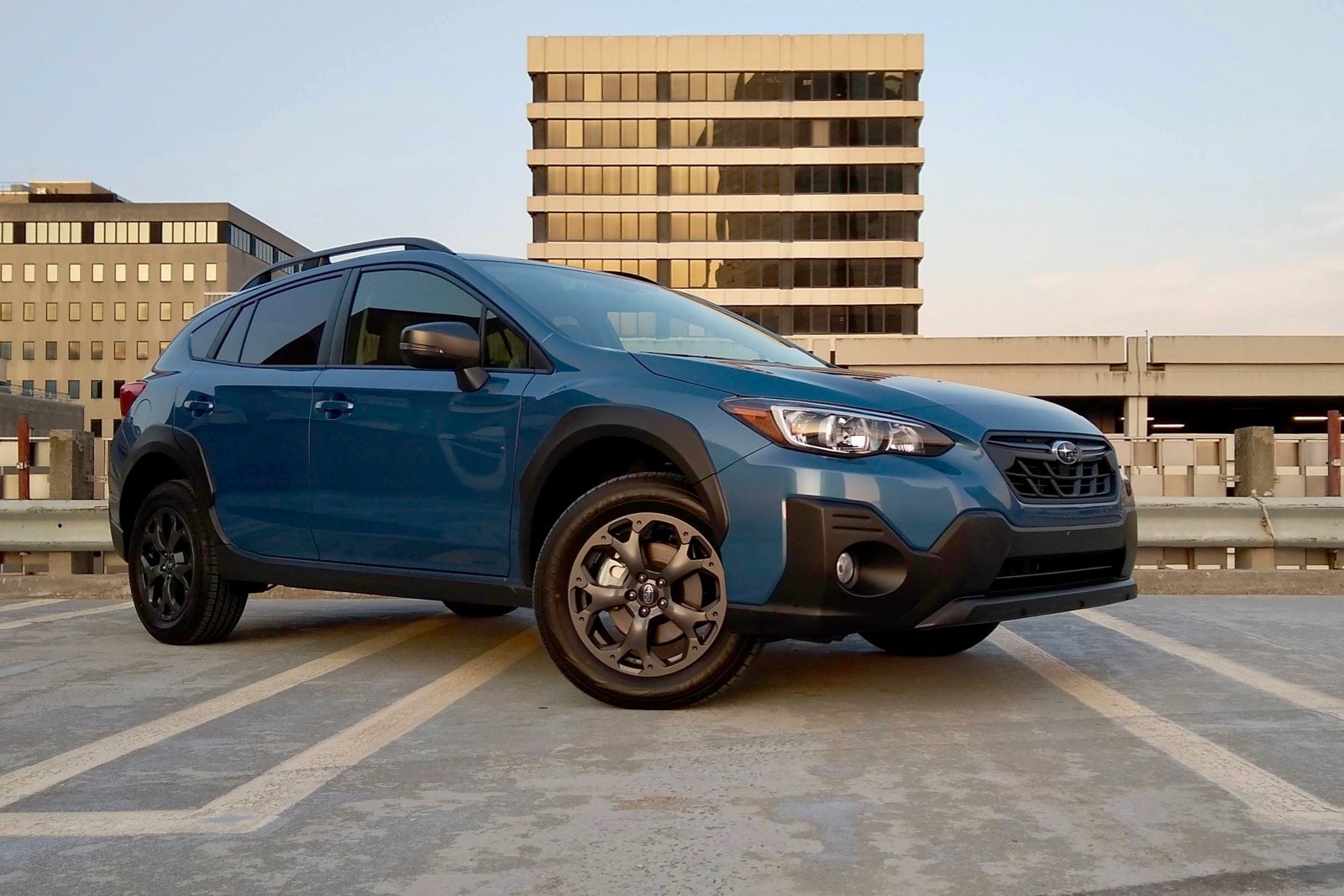
The 2021 Subaru Crosstrek is a hatchback in hiking boots.
The Crosstrek applies the successful formula of the Subaru Outback to a smaller vehicle. Like the Outback, the Crosstrek is an ordinary car that gets a raised ride height and plastic body cladding to make it look like an SUV, plus standard all-wheel drive. But while the Outback is based on the Subaru Legacy, the Crosstrek is a derivative of the Subaru Impreza.
Subaru launched the Crosstrek for the 2013 model year as a replacement for the Outback Sport. The current Crosstrek was introduced for the 2018 model year as the second generation of the model.
The 2021 Subaru Crosstrek is the same basic vehicle as before, but gets a handful of notable updates. In Canada, new Outdoor trim level joins the previous Convenience, Touring, and Sport, and Limited trim levels, and a 2.5-litre engine is now available alongside the previous 2.0-litre engine. The 2021 Crosstrek also gets an upgraded version of Subaru’s EyeSight driver-assistance system.

The Crosstrek embodies the adage “if you can’t beat ‘em, join ‘em.” Car shoppers are flocking to crossovers for their rugged looks, available all-wheel drive (AWD), and tall driving positions, so Subaru decided to imbue its Impreza hatchback with those same characteristics. It’s the same strategy that has allowed the larger Outback to outlast nearly every other station wagon in the United States.
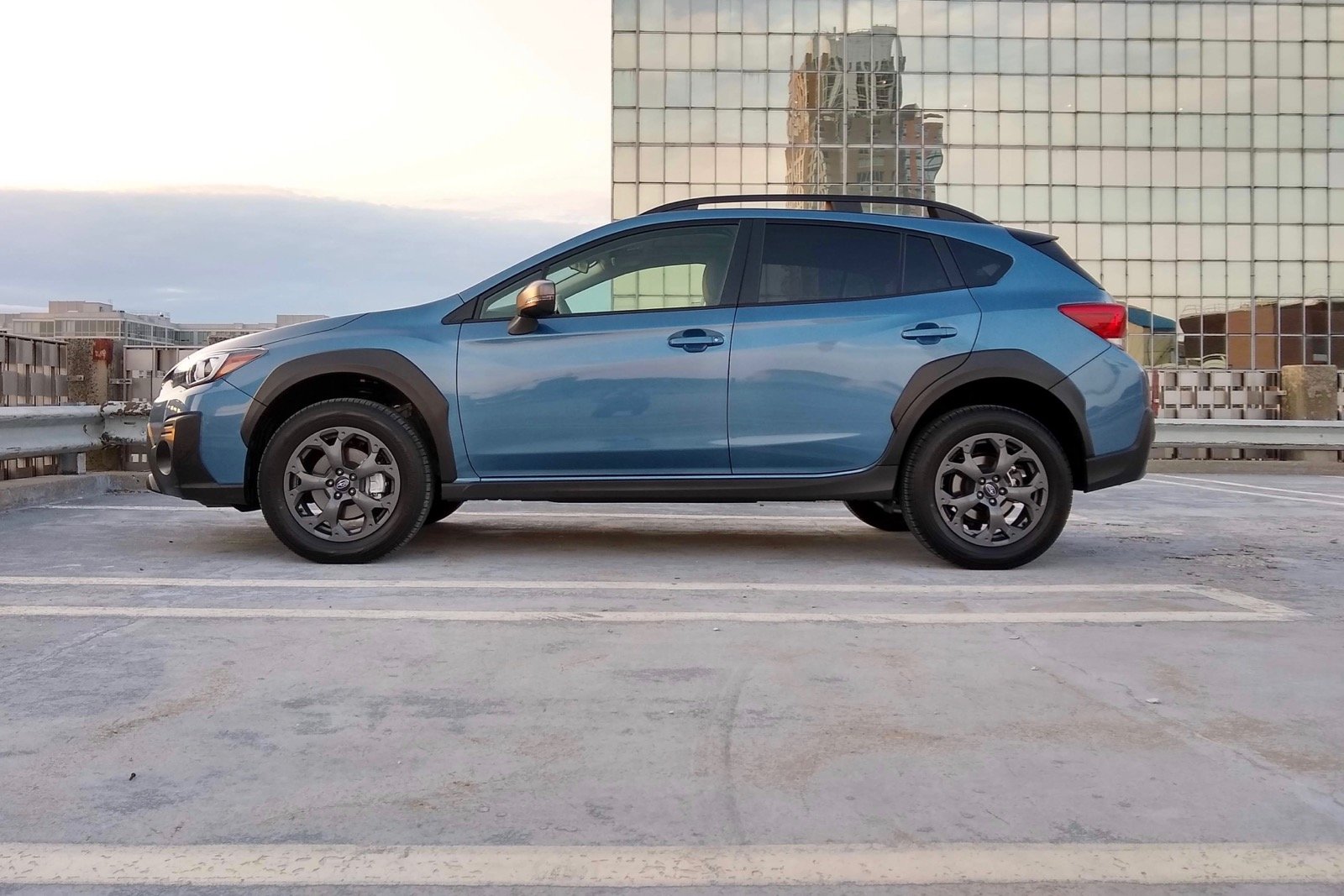
Like most Subaru models, the Impreza hatch already comes standard with AWD. Visually, the Crosstrek is differentiated from an Impreza by black body cladding model-specific 17-inch alloy wheels (18-inch on Limited) and a taller ride height that affords 22 centimetres of ground clearance, according to Subaru. That’s a pretty good number for dedicated SUVs, let alone an ordinary car.
The changes have a big impact, allowing the Crosstrek to do a reasonably good impression of an SUV, and giving it more character than the base Impreza hatch. It also helps that Subaru typically offers more vibrant colours on the Crosstrek, including Plasma Yellow Pearl for the 2021 model year.
Under the plastic body cladding, the Crosstrek rides on the same Subaru Global Platform as most of the automaker’s other models, including the Legacy/Outback, Ascent, and Forester. It’s proven to be a fairly good design across the board, with all models exhibiting a greater level of polish and refinement than their predecessors.
The interior is virtually unchanged from the Impreza hatchback. That means it’s functional but somewhat plain-looking. Subaru makes Plasma Yellow Pearl accents standard on the Outdoor grade’s interior, which clashed with the Horizon Blue Pearl exterior on our tester (which is not offered in Canada; U.S. Subaru Crosstrek Sport model shown). The simulated carbon-fibre trim pieces included on the Crosstrek Outdoor also looked cheap, but the model does get water-repellant upholstery, which should come in handy on trips to the beach.
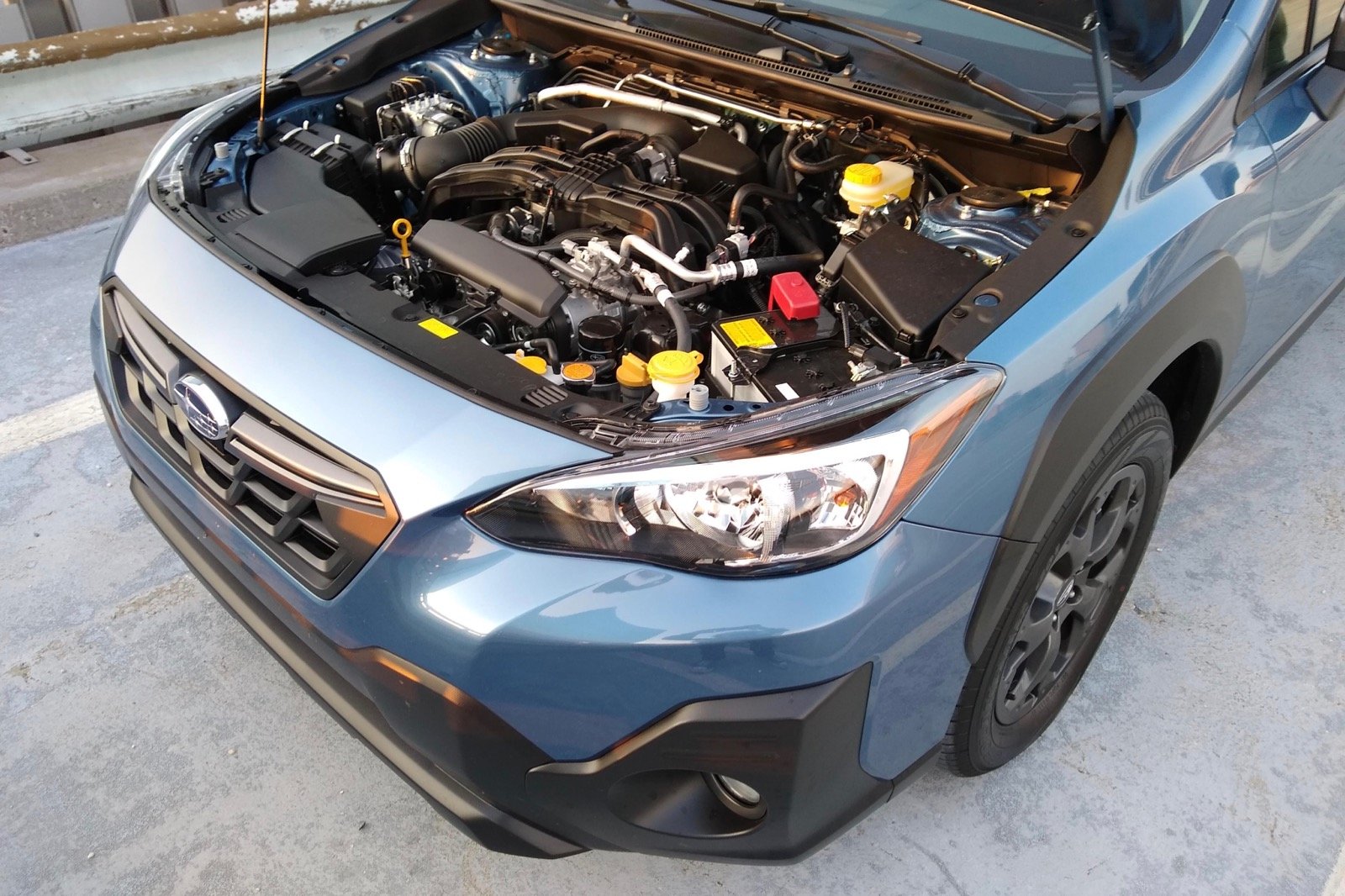
For 2021, the Crosstrek gets a second gasoline powertrain option. Standard on the Outdoor and Limited trim levels, the new 2.5-litre boxer-four engine makes 182 horsepower and 176 pound-feet of torque. The rest of the trim levels continue with the previous 2.0-litre boxer-four, which produces 152 hp and 145 lb-ft of torque.
The boxer engine, with cylinders running parallel to the ground, is a Subaru trademark. It has a lower profile than the upright inline-four engines used in most other small cars, providing a lower centre of gravity that can improve handling. Granted, raising the ride height to create an SUV-like stance likely negates some of that benefit.
A six-speed manual transmission is still offered with the 2.0-litre engine, but most buyers will likely opt for the continuously variable transmission (CVT). The Sport and Limited trim levels are CVT only, so you have to go with that transmission to get the bigger engine.
All trim levels get standard AWD—something that can’t be said of many of the small crossovers the Crosstrek competes with. X-Mode is designed to help the Crosstrek navigate more effectively over loose surfaces, and it incorporates hill descent control. The new-for-2021 Outdoor trim level also gets Snow/Dirt and Deep Snow/Mud modes. These features don’t exactly make the Crosstrek super capable off-road, but they may come in handy during bad weather.
Despite the gestures at SUV ruggedness, most Crosstreks will probably spend their entire lives on the pavement, and this hatchback is fairly well suited to that as well. In corners, it has the predictable handling feel of the standard Impreza, although the higher centre of gravity is noticeable in the form of increased body roll. This was at least balanced with a comfortable ride and a low level of wind noise—even at highway speeds.
Our Outdoor test car had the new 2.5-litre engine which, despite an additional 30 hp and 31 lb-ft of torque over the base engine, didn’t feel dramatically different. Acceleration is still adequate, but accompanied with plenty of droning from the CVT.

The Crosstrek offers the same front and rear legroom as the Impreza hatchback. Front headroom is the same as well, but Subaru lists the Crosstrek as having slightly more rear headroom than the Impreza. At 588 litres with the rear seats in place, and 1,565 litres with the rear seats folded (the rear bench seat has a 60/40 split fold), both models have the same amount of cargo space.
This also means the Crosstrek is competitive against other small crossovers on passenger space, but not cargo space. While the Subaru does offer more total cargo space than the Hyundai Kona and Jeep Renegade, it’s behind the Honda HR-V, Kia Seltos, and Nissan Qashqai. It’s worth noting that, despite being marketed as SUVs, all of these vehicles are fairly stingy on passenger space and cargo space due to their compact footprints.
CVT-equipped Crosstrek models also get a rear-seat reminder intended to stop drivers from leaving children or pets unattended in the back seats. It sounds a chime and displays a message in the instrument cluster when the ignition is turned off. Subaru is not the first automaker to offer this feature, and it’s unclear how effective it is. If a person is already distracted enough to forget their child or pet, will they notice the alerts?
Up front, Subaru provided a handy cubby hole ahead of the shifter to place a phone—complete with USB port and auxiliary port. The maximum number of USB ports available is two, however, and they’re both located in this space. That’s not good for rear-seat passengers. Other storage space is minimal—another reminder that the Crosstrek is more compact car than crossover—but that at least includes decent-sized bottle holders in the doors.
While the driving position feels appreciably higher than an Impreza’s, the Crosstrek doesn’t allow you to tower over other vehicles like traditional crossovers or SUVs. However, outward visibility is good, thanks to a large amount of side glass that comes down fairly low for a modern vehicle, and that car-like front fascia and hood.

The Crosstrek uses Subaru’s Starlink infotainment system, with a standard 6.5-inch touchscreen, Apple CarPlay/Android Auto compatibility, and Bluetooth, with SiriusXM satellite radio included on all but the base model. Outdoor, Sport, and Limited trim levels get an 8-inch touchscreen, with navigation standard on the latter.
Subaru is unusual in displaying some information on a second screen above the main touchscreen. It seems a bit redundant, as much of the same information can be displayed in the instrument cluster as well.
Our test car had the 8-inch touchscreen, which was easy to navigate and responsive. Just as important as the screen itself, Subaru equipped the Crosstrek with large analog knobs and buttons for vital functions like audio volume and climate control. Chunky buttons on the steering wheel control EyeSight driver-assistance features, helping to ensure the driver doesn’t make mistakes.
The 2021 Subaru Crosstrek received a five-star overall safety rating from the National Highway Traffic Safety Administration (NHTSA), with five stars in side crash tests and four stars in frontal and rollover crash tests.
The Insurance Institute for Highway Safety (IIHS) rates the 2021 Crosstrek with the organization’s “Top Safety Pick” award, with the highest “good” rating in all crash tests, and for front-crash prevention tech. However, that rating only applies to models with some available EyeSight driver-assist features, as well as Steering Responsive Headlights.
EyeSight, a driver assist technology that uses stereo cameras mounted behind the windshield, offers standard features comparable to the likes of Honda and Toyota. For 2021, CVT-equipped Crosstrek models get standard adaptive cruise control with lane centring, automatic emergency braking, and lane-departure warning. Automatic high beams and reverse automatic braking are included on CVT-equipped Sport and Limited grades, and lane-change assist, blind-spot monitoring, and rear cross-traffic alert are offered on those as well as the Outdoor grade.
Subaru’s adaptive cruise control works just about as well as systems from other mainstream brands, which is to say, it’s not perfect. It was able to keep the car centred in its lane while driving in a straight line, but steering inputs weren’t sufficient for even gentle highway curves. However, the optional blind-spot monitoring system featured big warning lights on the exterior mirrors that were impossible to miss—making the feature more effective.
It’s also worth noting that the positioning of EyeSight’s cameras limits the system’s functionality. They get blocked by the windshield wipers and can wash out in direct sunlight as well (the car automatically disables driver aids if this occurs). The flipside is that the cameras are much better protected than the grille-mounted cameras and radar used by other automakers—potentially avoiding expensive repair bills after a fender bender.

Crosstrek models with the 2.5-litre engine have Natural Resources Canada fuel consumption ratings of 8.0 litres per 100 kilometres combined (8.8 city, 7.0 highway). With the smaller 2.0-litre engine, the Crosstrek is rated at 7.9 L/100 km combined (8.5 city, 7.0 highway) with the CVT, and 9.4 L/100 km combined (10.5 city, 8.1 hwy) with the manual transmission. Fuel efficiency ratings are fairly good, nosing ahead of small AWD crossovers like the Honda HR-V, Hyundai Kona, and Chevrolet Trailblazer.
Subaru offers a five-year/100,000-kilometre major component warranty and three-year/60,000 km basic warranty, which are average for this segment. However, Hyundai and Kia offer a five-year/100,000 km new-vehicle warranty for their growing crop of small crossovers, including the Hyundai Kona and Kia Seltos.
The Crosstrek’s size, AWD, and styling put it in the same arena as those subcompact crossovers, and so does its price. The 2021 Crosstrek starts at an MSRP of $23,795 for a base model with the manual transmission (a mandatory $1,800 destination charge is extra). The range-topping Crosstrek Limited model starts at $34,495.
Our Outdoor test car had an all-in base price of $29,995. Along with the destination charge and other fees, that brought the as-tested price to $32,174.
This pricing makes the Crosstrek a fairly good value. It’s well equipped, with a much more sophisticated AWD drivetrain than most crossovers in this segment, and plenty of safety tech. Subaru also has a fairly good reputation for reliability, so it’s likely the Crosstrek will make a good long-term investment.
However, if a small, AWD vehicle is what you want, you might also want to consider an Impreza hatchback. It doesn’t have the Crosstrek’s SUV-like looks, but it does have the same amount of cargo space and similar features—all at a base price of a few thousand dollars lower than the Crosstrek’s.

User reviews for 2021 Subaru Crosstrek
Write a review2021 Subaru Crosstrek Pricing
Trims & specs
Air Conditioning
Automatic climate control front air conditioning · Dual front air conditioning zones
Airbags
Dual front airbags · Driver knee airbags · Passenger airbag deactivation: occupant sensing deactivation · Front side airbags · Rear side curtain airbags
Audio System
Antenna Type: mast · Voice recognition audio system · USB auxiliary audio input · Aha internet radio · Pandora internet radio · Touch screen display radio · Total Number of Speakers: 4
Brakes
ABS: 4-wheel · Braking assist: hill start assist · Front brake diameter: 11.6 · Front brakes: ventilated disc · Rear brake diameter: 10.8 · Rear brakes: disc
Comfort Features
Center console trim: leatherette · Dash trim: simulated carbon fiber · Door trim: leatherette · Floor Mat Material: carpet · Floor Material: carpet · Floor Mats: front · Shift knob trim: urethane · Steering wheel trim: urethane
Convenience Features
Adaptive stop and go cruise control: semi-automatic · Assist handle: rear · Autonomous lane guidance: lane centering · Center console: front console with armrest and storage · Console Insert: organizer tray · Cruise control: adaptive · Cupholders: rear · Multi-function remote: keyless entry with panic alarm · One-touch windows: 2 · Power outlet(s): USB front · Power steering: electric · Power windows: lockout button · Reading lights: front · Steering wheel: tilt and telescopic · Steering wheel mounted controls: phone · Storage: front seatback · Vanity mirrors: dual
Driver Seat
Manual adjustments: 6
Drivetrain
4WD Type: full time · Axle ratio: 4.44 · Locking differential: center
Engine
Alternator: 130 amps · Battery: maintenance-free
Exterior Features
Door handle color: body-color · Exhaust tip color: stainless-steel · Fender lip moldings: black · Front bumper color: black · Grille color: black with chrome accents · Headlamp bezel color: black · Mirror color: black · Rear bumper color: body-color · Rear spoiler: roofline spoiler · Rear spoiler color: black · Rear trunk/liftgate: liftgate · Rocker panel color: black · Window trim: black
Headrests
Front headrests: adjustable · Number of front headrests: 2 · Number of rear headrests: 3
In Car Entertainment
Connected in-car apps: Google search · Infotainment: STARLINK · Infotainment screen size: 6.5 in.
Instrumentation
Fuel economy display: range · Instrument cluster screen size: 4.5 in. · Warnings and reminders: low fuel level
Lights
Exterior entry lights: security approach lamps · Headlights: Auto off
Mirrors
Exterior mirrors: power · Inside rearview mirror: manual day/night
Passenger Seat
Manual Adjustments: 4
Rear Seats
Type: 60-40 split bench
Roof
Roof rails: black
Safety
Automatic emergency braking: front · Camera system: rearview · Child seat anchors: LATCH system · Crumple zones: front · Impact absorbing seats: dual front · Impact sensor: door unlock · Pre-Collision Warning System: audible warning · Rearview monitor: in dash
Seatbelts
Emergency locking retractors: front and rear · Front seatbelts: 3-point · Seatbelt force limiters: front · Seatbelt pretensioners: front · Seatbelt warning sensor: driver and passenger · Second row seatbelts: 3-point
Seats
Driver seat manual adjustments: reclining · Front seat type: bucket · Passenger seat manual adjustments: reclining · Rear headrests: adjustable · Rear seat folding: split · Upholstery: cloth
Security
Power door locks: anti-lockout
Spare Tire
Mount Location: inside · Size: temporary
Spare Wheel
Rim Type: steel
Steering
Steering ratio: 13.1 · Turns lock-to-lock: 2.6
Suspension
Front Arm Type: lower control arms · Front Shock Type: gas shock absorbers · Front Spring Type: coil springs · Front Suspension Classification: independent · Front Suspension Type: MacPherson struts · Rear Shock Type: gas shock absorbers · Rear Spring Type: coil springs · Rear Stabilizer Bar: diameter 16 mm · Rear Suspension Classification: independent · Rear Suspension Type: double wishbone · Stabilizer bar(s): front
Telematics
Electronic messaging assistance: with voice recognition · Phone: voice activated · Phone wireless data link: Bluetooth · Satellite communications: Turn-by-Turn Navigation
Tires
Type: all season
Tires and Rims
Wheel type: aluminum alloy
Windows
Front wipers: variable intermittent · Liftgate window: fixed · Power windows: with safety reverse · Rear wiper: with washer
Air Conditioning
Automatic climate control front air conditioning · Dual front air conditioning zones
Airbags
Dual front airbags · Driver knee airbags · Passenger airbag deactivation: occupant sensing deactivation · Front side airbags · Front side curtain airbags
Audio System
Antenna Type: diversity · Voice recognition audio system · Auxiliary audio input: jack · Single disc in-Dash CD · Aha internet radio · Pandora internet radio · MP3 player: CD MP3 Playback · AM/FM radio · Satellite Radio: SiriusXM · Total Number of Speakers: 6
Brakes
ABS: 4-wheel · Braking assist: hill start assist · Front brake diameter: 11.6 · Front brakes: ventilated disc · Rear brake diameter: 10.8 · Rear brakes: disc
Comfort Features
Cargo area floor mat: rubber/vinyl · Center console trim: leatherette · Dash trim: simulated carbon fiber · Door trim: simulated carbon fiber · Floor Mat Material: carpet · Floor Material: carpet · Floor Mats: front · Shift knob trim: leather · Steering wheel trim: leather
Convenience Features
Adaptive stop and go cruise control: semi-automatic · Assist handle: rear · Autonomous lane guidance: lane centering · Cargo cover: retractable · Center console: with lighting · Console Insert: organizer tray · Cruise control: adaptive · Cupholders: rear · Multi-function remote: trunk release · One-touch windows: 2 · Power outlet(s): USB front · Power steering: speed-proportional · Power windows: lockout button · Reading lights: front · Steering wheel: tilt and telescopic · Steering wheel mounted controls: phone · Storage: grocery bag holder · Vanity mirrors: dual illuminating
Driver Seat
Manual adjustments: 6
Drivetrain
4WD Type: full time · Axle ratio: 3.90 · Locking differential: center
Engine
Alternator: 130 amps · Battery: maintenance-free
Exterior Features
Door handle color: body-color · Exhaust tip color: stainless-steel · Fender lip moldings: black · Front bumper color: black · Grille color: black with chrome accents · Headlamp bezel color: black · Mirror color: body-color · Rear bumper color: body-color · Rear spoiler: roofline spoiler · Rear spoiler color: black · Rear trunk/liftgate: liftgate · Rocker panel color: black · Window trim: black
Headrests
Front headrests: adjustable · Number of front headrests: 2 · Number of rear headrests: 3
In Car Entertainment
Connected in-car apps: SiriusXM Travel Link · Infotainment: STARLINK · Infotainment screen size: 6.5 in.
Instrumentation
Fuel economy display: range · Instrument cluster screen size: 4.5 in. · Warnings and reminders: maintenance reminder
Lights
Exterior entry lights: security approach lamps · Headlights: wiper activated
Mirrors
Exterior mirrors: manual folding · Inside rearview mirror: manual day/night
Passenger Seat
Manual Adjustments: 4
Rear Seats
Type: 60-40 split bench
Roof
Roof rails: black
Safety
Automatic emergency braking: front · Camera system: rearview · Child seat anchors: LATCH system · Crumple zones: rear · Impact absorbing seats: dual front · Impact sensor: fuel cut-off · Pre-Collision Warning System: visual warning · Rearview monitor: in dash
Seatbelts
Emergency locking retractors: front and rear · Front seatbelts: 3-point · Seatbelt force limiters: front · Seatbelt pretensioners: front · Seatbelt warning sensor: driver and passenger · Second row seatbelts: 3-point
Seats
Driver seat manual adjustments: reclining · Front seat type: bucket · Passenger seat manual adjustments: reclining · Rear headrests: adjustable · Rear seat folding: split · Upholstery: contrast stitching
Security
Power door locks: anti-lockout
Spare Tire
Mount Location: inside · Size: temporary
Spare Wheel
Rim Type: steel
Steering
Steering ratio: 13.1 · Turns lock-to-lock: 2.6
Suspension
Front Arm Type: lower control arms · Front Shock Type: gas shock absorbers · Front Spring Type: coil springs · Front Suspension Classification: independent · Front Suspension Type: MacPherson struts · Rear Shock Type: gas shock absorbers · Rear Spring Type: coil springs · Rear Stabilizer Bar: diameter 16 mm · Rear Suspension Classification: independent · Rear Suspension Type: double wishbone · Stabilizer bar(s): front
Telematics
Driver assistance app: roadside assistance · Electronic messaging assistance: with read function · Phone: voice activated · Phone wireless data link: Bluetooth · Satellite communications: Turn-by-Turn Navigation · Smart device app compatibility: MySubaru · Smart device app function: maintenance status · Wifi: hotspot
Tires
Type: all season
Tires and Rims
Wheel type: aluminum alloy
Windows
Front wipers: variable intermittent · Laminated glass: acoustic · Liftgate window: fixed · Power windows: with safety reverse · Rear wiper: with washer
Air Conditioning
Automatic climate control front air conditioning · Dual front air conditioning zones
Airbags
Dual front airbags · Driver knee airbags · Passenger airbag deactivation: occupant sensing deactivation · Front side airbags · Rear side curtain airbags
Audio System
Antenna Type: diversity · Voice recognition audio system · Bluetooth auxiliary audio input · Single disc in-Dash CD · Aha internet radio · Pandora internet radio · MP3 player: CD MP3 Playback · HD radio · Satellite Radio: SiriusXM · Total Number of Speakers: 6
Brakes
ABS: 4-wheel · Braking assist: hill start assist · Front brake diameter: 11.6 · Front brakes: ventilated disc · Rear brake diameter: 10.8 · Rear brakes: disc
Comfort Features
Cargo area floor mat: rubber/vinyl · Center console trim: leatherette · Dash trim: metallic · Door trim: leatherette · Floor Mat Material: carpet · Floor Material: carpet · Floor Mats: front · Shift knob trim: alloy · Steering wheel trim: leather
Convenience Features
Adaptive stop and go cruise control: semi-automatic · Assist handle: rear · Autonomous lane guidance: lane centering · Cargo cover: retractable · Center console: front console with armrest and storage · Console Insert: organizer tray · Cruise control: adaptive · Cupholders: front · Multi-function remote: proximity entry system · One-touch windows: 2 · Power outlet(s): two 12V front · Power steering: speed-proportional · Power windows: lockout button · Reading lights: rear · Steering wheel: tilt and telescopic · Steering wheel mounted controls: paddle shifter · Storage: accessory hook · Vanity mirrors: dual illuminating
Driver Seat
Manual adjustments: 6
Drivetrain
4WD Type: full time
Engine
Alternator: 130 amps · Battery: maintenance-free
Exterior Features
Door handle color: body-color · Exhaust tip color: stainless-steel · Fender lip moldings: black · Front bumper color: black · Grille color: black with chrome accents · Headlamp bezel color: black · Mirror color: black · Rear bumper color: body-color · Rear spoiler: roofline spoiler · Rear spoiler color: black · Rear trunk/liftgate: liftgate · Rocker panel color: black · Window trim: black
Headrests
Front headrests: adjustable · Number of front headrests: 2 · Number of rear headrests: 3
In Car Entertainment
Connected in-car apps: Yelp · Infotainment: STARLINK · Infotainment screen size: 6.5 in.
Instrumentation
Fuel economy display: MPG · Instrument cluster screen size: 4.5 in. · Warnings and reminders: low fuel level
Lights
Exterior entry lights: security approach lamps · Headlights: wiper activated
Mirrors
Exterior mirrors: power · Inside rearview mirror: manual day/night
Passenger Seat
Manual Adjustments: 4
Rear Seats
Type: 60-40 split bench
Roof
Roof rails: black
Safety
Automatic emergency braking: front · Camera system: rearview · Child seat anchors: LATCH system · Crumple zones: rear · Impact absorbing seats: dual front · Impact sensor: fuel cut-off · Pre-Collision Warning System: audible warning · Rearview monitor: in dash
Seatbelts
Emergency locking retractors: driver · Front seatbelts: 3-point · Seatbelt force limiters: front · Seatbelt pretensioners: front · Seatbelt warning sensor: driver and passenger · Second row seatbelts: 3-point
Seats
Driver seat manual adjustments: reclining · Front seat type: bucket · Passenger seat manual adjustments: reclining · Rear headrests: adjustable · Rear seat folding: split · Upholstery: contrast stitching
Security
Power door locks: anti-lockout
Spare Tire
Mount Location: inside · Size: temporary
Spare Wheel
Rim Type: steel
Steering
Steering ratio: 13.1 · Turns lock-to-lock: 2.6
Suspension
Front Arm Type: lower control arms · Front Shock Type: gas shock absorbers · Front Spring Type: coil springs · Front Suspension Classification: independent · Front Suspension Type: MacPherson struts · Rear Shock Type: gas shock absorbers · Rear Spring Type: coil springs · Rear Stabilizer Bar: diameter 16 mm · Rear Suspension Classification: independent · Rear Suspension Type: double wishbone · Stabilizer bar(s): front
Telematics
Driver assistance app: roadside assistance · Electronic messaging assistance: with read function · Phone: voice activated · Phone wireless data link: Bluetooth · Satellite communications: Turn-by-Turn Navigation · Smart device app compatibility: MySubaru · Smart device app function: maintenance status · Wifi: hotspot
Tires
Type: all season
Tires and Rims
Wheels: painted aluminum
Windows
Front wipers: variable intermittent · Laminated glass: acoustic · Liftgate window: fixed · Power windows: with safety reverse · Rear wiper: with washer
Air Conditioning
Automatic climate control front air conditioning · Dual front air conditioning zones
Airbags
Dual front airbags · Driver knee airbags · Passenger airbag deactivation: occupant sensing deactivation · Front side airbags · Front side curtain airbags
Audio System
Antenna Type: mast · Voice recognition audio system · Bluetooth auxiliary audio input · Single disc in-Dash CD · Aha internet radio · Stitcher internet radio · MP3 player: CD MP3 Playback · HD radio · Satellite Radio: SiriusXM · Total Number of Speakers: 6
Brakes
ABS: 4-wheel · Braking assist: hill start assist · Front brake diameter: 11.6 · Front brakes: ventilated disc · Rear brake diameter: 10.8 · Rear brakes: disc
Comfort Features
Armrests: rear center with cupholders · Cargo area floor mat: rubber/vinyl · Center console trim: leatherette · Dash trim: metallic · Door trim: leatherette · Floor Mat Material: carpet · Floor Material: carpet · Floor Mats: front · Shift knob trim: leather · Steering wheel trim: leather
Convenience Features
Adaptive stop and go cruise control: semi-automatic · Assist handle: rear · Autonomous lane guidance: lane centering · Cargo cover: retractable · Center console: front console with armrest and storage · Console Insert: organizer tray · Cruise control: adaptive · Cupholders: rear · Multi-function remote: keyless entry with panic alarm · One-touch windows: 2 · Power outlet(s): USB-C rear · Power steering: electric · Power windows: lockout button · Reading lights: front · Steering wheel: tilt and telescopic · Steering wheel mounted controls: voice recognition controls · Storage: accessory hook · Vanity mirrors: dual illuminating
Driver Seat
Power adjustments: 6
Drivetrain
4WD Type: full time
Engine
Alternator: 130 amps · Battery: maintenance-free
Exterior Features
Door handle color: body-color · Exhaust tip color: stainless-steel · Fender lip moldings: black · Front bumper color: black · Grille color: black with chrome accents · Headlamp bezel color: black · Mirror color: body-color · Rear bumper color: body-color · Rear spoiler: roofline spoiler · Rear spoiler color: black · Rear trunk/liftgate: liftgate · Rocker panel color: black · Window trim: chrome
Headrests
Front headrests: adjustable · Number of front headrests: 2 · Number of rear headrests: 3
In Car Entertainment
Connected in-car apps: SiriusXM Travel Link · Infotainment: STARLINK · Infotainment screen size: 8 in.
Instrumentation
Fuel economy display: range · Instrument cluster screen size: 4.2 in. · Warnings and reminders: coolant temperature warning
Lights
Exterior entry lights: security approach lamps · Front fog lights: LED · Headlights: auto delay off
Mirrors
Exterior mirrors: heated · Inside rearview mirror: manual day/night
Passenger Seat
Manual Adjustments: 4
Rear Seats
Type: 60-40 split bench
Roof
Roof rails: black
Safety
Automatic emergency braking: rear · Camera system: rearview · Child seat anchors: LATCH system · Cross Traffic Alert: rear · Crumple zones: front · Impact absorbing seats: dual front · Impact sensor: door unlock · Parking sensors: rear · Pre-Collision Warning System: audible warning · Rearview monitor: in dash
Seatbelts
Emergency locking retractors: front and rear · Front seatbelts: 3-point · Seatbelt force limiters: front · Seatbelt pretensioners: front · Seatbelt warning sensor: driver and passenger · Second row seatbelts: 3-point
Seats
Driver seat power adjustments: height · Front seat type: bucket · Passenger seat manual adjustments: reclining · Rear headrests: adjustable · Rear seat folding: split · Upholstery: leather-trimmed
Security
Power door locks: anti-lockout
Spare Tire
Mount Location: inside · Size: temporary
Spare Wheel
Rim Type: steel
Steering
Steering ratio: 13.1 · Turns lock-to-lock: 2.6
Suspension
Front Arm Type: lower control arms · Front Shock Type: gas shock absorbers · Front Spring Type: coil springs · Front Suspension Classification: independent · Front Suspension Type: MacPherson struts · Rear Shock Type: gas shock absorbers · Rear Spring Type: coil springs · Rear Stabilizer Bar: diameter 16 mm · Rear Suspension Classification: independent · Rear Suspension Type: double wishbone · Stabilizer bar(s): front
Telematics
Driver assistance app: roadside assistance · Electronic messaging assistance: with voice recognition · Phone: voice activated · Phone wireless data link: Bluetooth · Satellite communications: Turn-by-Turn Navigation · Smart device app compatibility: MySubaru · Smart device app function: engine start · Wifi: hotspot
Tires
Type: all season
Tires and Rims
Wheel type: aluminum alloy
Windows
Front wipers: variable intermittent · Laminated glass: acoustic · Liftgate window: fixed · Power windows: with safety reverse · Rear wiper: auto-on in reverse
