2021 Toyota Highlander Hybrid Reviews, Pricing & Specs
Write a review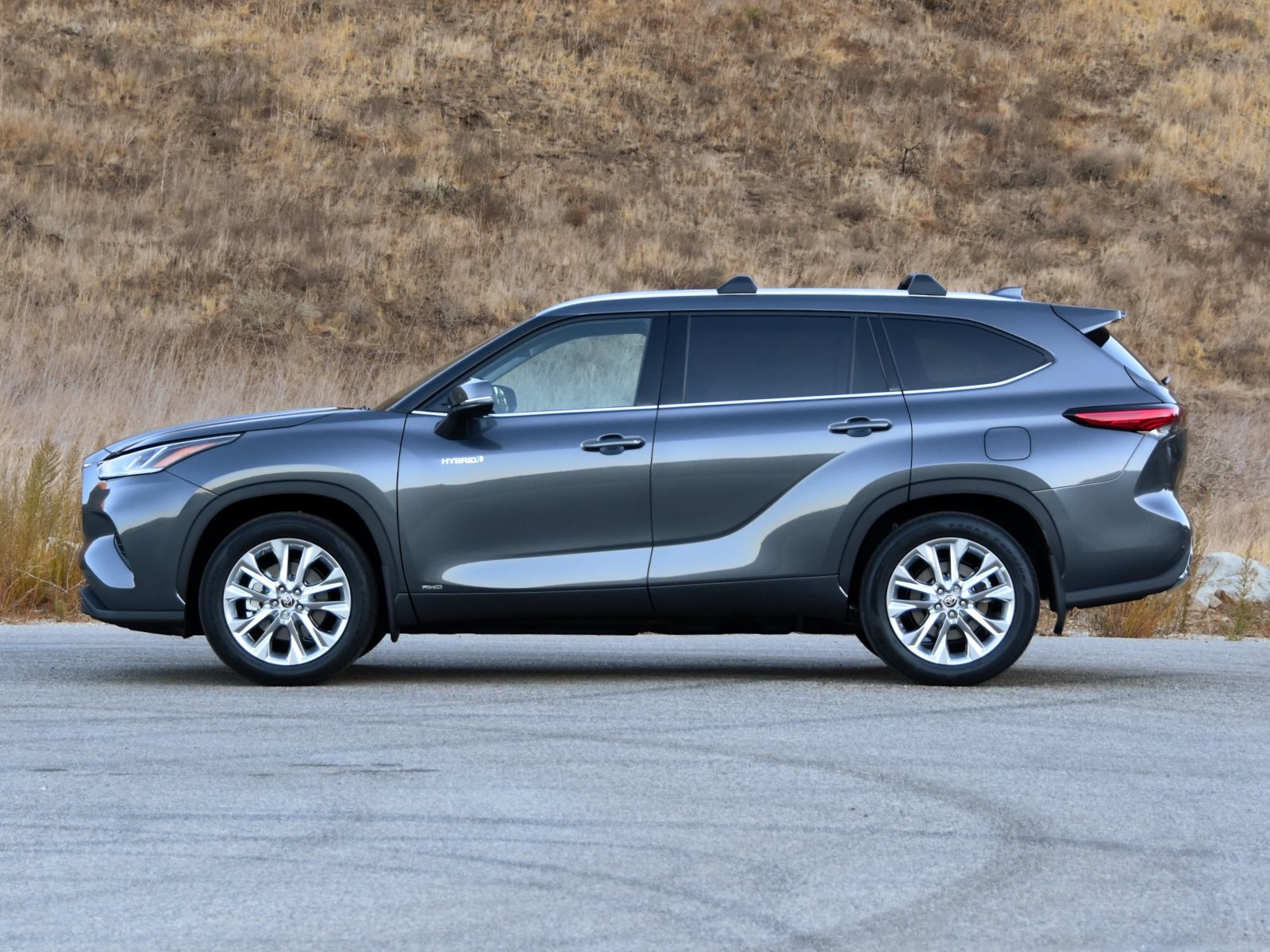
The 2021 Toyota Highlander Hybrid is a dream car for those who want to carry eight people and still achieve good fuel economy.

Ubiquity begets ordinary. What looks sharply polarizing at first will, over time and with regular exposure, become indistinctly familiar. This might help to explain why modern Toyotas require, shall we say, an acclimation period. The automaker wants them to remain distinctive even after putting hundreds of thousands of examples of them on North American roads.
Still fresh enough to look funky, the 2021 Toyota Highlander’s blunt and bulbous nose presents an angry visage while placing a bunch of visual weight over the SUV’s front wheels. Black windshield pillars that make the roof appear to float over the SUV’s window glass magnifies this impression. Swollen haunches help to balance the Highlander's styling, but even when equipped with 20-inch alloy wheels, the cartoonishly-flared quarter panels overwhelm the design. But with time, it’s possible the Highlander will look tame.
The 2021 Highlander Hybrid is offered with LE, XLE, Limited, or Platinum specifications. Canadian pricing ranges from $45,950 to $56,450, plus an $1,860 destination charge.
For this review, we evaluated a 2021 Highlander Hybrid Platinum with electronic all-wheel drive (AWD), which is standard in Canada and uses a separate electric motor to power the rear wheels. Our tester also included a no-cost second-row bench seat (U.S. model shown; the equivalent in Canada comes with second-row captain’s chairs), a 12.3-inch touchscreen infotainment system, a surround-view camera system, a cargo liner, carpeted floor mats, and roof rack crossbars. With the MSRP plus the $1,860 destination fee, it came to $59,082 (Canadian, estimated).
For that kind of money, you rightly expect quality. Overall, Toyota executes this well, but as we noticed while sitting at a traffic light drumming fingers to music on the instrument-panel shroud, the company missed this detail. It sounds loud and hollow under each impact of your fingertips, which equates to cheap.
When you choose an interior colour other than black, the cabin features an appealingly upscale two-tone look, with standard soft and supple leather for Limited and Platinum trim levels. An asymmetrical element housing the infotainment and climate controls dominates the dashboard, but the larger 12.3-inch screen and its surrounding gloss black detailing can suffer from significant reflections on sunny days. Controls are sensibly laid out, but at night the mix of white, blue, and green illumination and graphics gives the gauges a busy appearance.

Prior to its most recent redesign, the Toyota Highlander Hybrid used a V6 engine that averaged 8.3 litres per 100 kilometres combined, according to Natural Resources Canada. Total output measured 306 horsepower.
Now, the Highlander Hybrid uses a 2.5-litre four-cylinder engine and is rated to use 6.7 L/100 km in combined driving. Total output measures 243 hp. As before, the hybrid uses what Toyota calls an "E-CVT," which uses the electric motors to mimic an automatic transmission.
Is this progress? Let’s compare the new Highlander Hybrid to the previous-generation version. When we last tested a previous-generation Highlander Hybrid, it returned an average of 9.5 L/100 km, coming up short of its NRCan rating by more than a full litre. The 2021 test vehicle averaged 7.4 L/100 km, falling short of expectations by 0.7 L/100 km.
So, yes, in terms of efficiency, this is progress. Where else are you going to get an SUV of this size that effortlessly delivers fuel-efficient numbers befitting a small car? Just know that you pay a price for the improved efficiency. The 2021 Toyota Highlander Hybrid SUV is absolutely no fun to drive unless hypermiling gets you all hot and bothered.
Power is adequate, and no more. You’ll be able to climb hills and mountain grades in the Highlander Hybrid, and you’ll get it up to freeway speeds by the end of the ramp. But this drivetrain sounds strained when accelerating hard or simply ascending a hill, droning and groaning in an unbecoming way. On flat terrain, under low-load circumstances, you won’t notice much racket. But if you live in a hilly area, it’s a regular assault on your ears.
Lifeless and dull steering doesn’t help matters, but fortunately, the regenerative brakes operate in a transparent fashion the majority of the time and represent an improvement over the previous-generation version. The softly sprung Highlander Hybrid isn’t shy about throwing its up to 2,075 kilograms (4,575 pounds) of curb weight around, either. There is plenty of unwanted body movement in the ride and handling, which means an adaptive damping or air-suspension option would be swell.
On glass-smooth mountain roads with properly banked corners, this SUV adopts a flat cornering stance and demonstrates capable handling. Add bumps, dips, and other pavement undulations and the Highlander Hybrid devolves into a sloppy mess in no time at all.
Around town, the immediate electric motor torque and the electric-only EV Mode reveal the Highlander Hybrid’s greatest strengths, and while cruising on the freeway the SUV is a cushy and quiet conveyance. But at no time is this SUV enjoyable to drive, and if you or a member of your family suffers motion sickness, make sure you carry barf bags on board.
When we reviewed a 2019 Highlander Hybrid, we lauded the SUV’s power and fairly athletic driving dynamics. After last year’s redesign, both have vanished. But hey, the new Highlander Hybrid does get better fuel consumption figures.

In terms of comfort, the Highlander Hybrid Platinum provides roomy and supportive accommodations for the driver and front passenger. The driver enjoys 10-way power seat adjustment, while the front passenger settles for six fewer ways to move the seat. The test vehicle included a heated steering wheel, leather upholstery, and both front seats offered heating and ventilation.
Our test vehicle had the no-cost bench seat option, which is standard on most Highlander Hybrid models in Canada. This increases seating capacity to eight people, but the Highlander feels narrow, and putting three adults in the second row is unlikely to make any of them happy. Also, the overhead air vents blow directly on occupants’ heads, which is a source of irritation. The seat is comfortable, though, and slides back and forth on a track to maximize room or make extra space for third-row passengers.
The third-row seat is not comfortable. It is low, flat, and lacking in support, and with the second-row bench seat installed occupants cannot stretch their legs during the trip. Headroom is tight for grown-ups, too, and getting in and out requires Barnum and Bailey degrees of contortion. If you’re looking for a three-row midsize SUV good for six adults, check out the Volkswagen Atlas.
Storage is plentiful but not as generous as the previous-generation Highlander. The handy dashboard shelf isn’t as accommodating, and while the latest version of the SUV retains the useful roll-top centre armrest and storage bin design, it seems smaller than it used to be. Plus, in the test vehicle, it opened to reveal a wireless smartphone charger that blocked access to the storage area below. Toyota really ought to relocate the charger to a position forward of the transmission shifter.
Cargo space behind the third-row seat measures 453 litres. Fold it down (it’s almost useless anyway) and the Highlander holds a generous 1,370 litres of your stuff. Maximum capacity measures 2,387 litres. Toyota provides a shallow storage tray under the cargo floor, but anything you place there will mix with the tire changing tools.
Inexplicably, Toyota does not offer storage wells on either side of the cargo floor where you can securely place milk jugs or wine bottles after a grocery-shopping trip, but perhaps that’s just an issue for versions of the SUV that have the JBL sound system’s subwoofer taking up space in the left cargo panel.

At a minimum, every 2021 Highlander is equipped with Bluetooth, Apple CarPlay and Android Auto compatibility, and SiriusXM satellite radio. The standard infotainment system also includes a year-long trial of Safety Connect, which includes features such as automatic collision notification. A head-up display (HUD) is available on the Platinum trim level, along with rain-sensing wipers.
The Platinum test vehicle had the top infotainment system, a 12.3-inch touchscreen display, which replaces the standard 8-inch display, along with an 11-speaker JBL premium audio system, a navigation system, and one-year trial periods of Remote Connect and Destination Assist connected services.
From a user-experience perspective, Toyota does a good job with the infotainment system and its controls. Large stereo volume and tuning knobs flank an array of climate controls. Four main-menu shortcut buttons line up underneath the display for quick access to the home screen, settings menu, audio system, and navigation map. The Highlander’s voice recognition system works well, but it does not operate the climate controls.
Boasting 1,200 watts of power and Clari-Fi digital music restoration technology, the 11-speaker JBL sound system promised good things. Placed in all default settings, the system sounded boomy and muddy with bass-heavy music and tinny and brassy with other types we listened to. But I’m no audiophile, so your results may vary.
Toyota offers its Driver Easy Speak technology in the Highlander, which projects the driver’s voice through the stereo speakers to ease conversation with rear passengers. A video rearview mirror is also available, providing an unobstructed 180-degree view of what’s behind the Highlander. This is great to have when exiting slanted parking spaces because when you turn around to look to the rear you cannot see past the second-row head restraints and through the SUV’s rear quarter glass.
Between the gauges, a driver information display offers a wealth of detail as you scroll through various menus and data panels, including a page for adjusting the driver-assist settings.

Toyota Safety Sense 2.5+ (TSS 2.5+), with its automatic high beams, dynamic radar cruise control, automatic emergency braking with pedestrian detection, and lane departure with steering assist, is an impressive collection of driver-assist tech. For 2021, it adds intersection support to the forward-collision warning system, which means it can prevent you from making an ill-advised left turn across traffic when it isn’t safe. Emergency steering assistance is also new (usually called evasive steering assistance by other car companies). It helps to keep the Highlander stable when the driver takes sudden evasive action to avoid an obstacle.
A blind-spot monitor and rear cross-traffic alert system are both standard on Canadian Highlander Hybrids. A surround-view camera system with a perimeter-scanning function is included on the Platinum trim.
In use, the Highlander’s TSS 2.5+ is effective. The adaptive cruise control can occasionally feel uneven as it applies inconsistent braking to maintain distance, and it can slightly overreact when vehicles cut into the gap ahead. A curve speed adaptation function offers three driver-selected settings, but with it set to medium sensitivity it didn’t start to slow the SUV until I’d already turned the Highlander into a long, sweeping curve on a freeway transition ramp, making the vehicle feel a little unsettled in the process. Evidently, it is not a predictive technology.
During testing, the Highlander’s lane-centring assistance system seemed overly sensitive, trying too hard to put the Highlander in the exact centre of the lane with regular steering corrections and a bit of a nervous pinball sensation. However, we observed this while driving in moderately heavy traffic, so it is possible that vehicles ahead limited the distance down the road that the system could “see.” Fortunately, you can shut the lane-centring assistance off, leaving the lane-departure warning and lane-keep assist systems standing ready to correct any wandering.
For 2021, the Insurance Institute for Highway Safety (IIHS) gave the Highlander a “Top Safety Pick+” rating, an improved score thanks to new standard headlights. The National Highway Traffic Safety Administration (NHTSA) gave the Highlander a five-star overall rating, but in frontal-impact crash tests, the SUV earned four-star ratings for the driver and front passenger.

Math isn’t our strongest suit, but based on our calculations, it will take just over two years and four months to recoup the added cost of the Highlander Hybrid’s powertrain when compared to the standard V6 engine. Thereafter, it can save its owners more than $900 annually. We based this on NRCan’s cost per year for fuel on each model as shown in the 2021 Fuel Consumption Guide.
If you’re leasing, a Highlander Hybrid doesn’t make much sense. But if you’re buying, especially with the intent to keep the SUV for a long time, it certainly is cost-effective to pay for the $2,000 upgrade to the hybrid powertrain.
Unfortunately for Toyota, there is more to an enjoyable ownership experience than just saving money.
The previous-generation Highlander Hybrid was easy to recommend, even though its value proposition was harder to justify. That’s because it didn’t compromise power and driving dynamics in the pursuit of maximum fuel efficiency. Now, the Highlander Hybrid delivers fantastic fuel consumption figures, seemingly at the expense of any semblance of driving enjoyment.
These need not be mutually exclusive characteristics. If Toyota can find a way to eliminate the incessant powertrain droning, tighten up the ride and handling, and add some life to the steering, while also addressing some of the “form and function” issues discussed in this review, the Highlander Hybrid would be a far more compelling family-sized SUV.

User reviews for 2021 Toyota Highlander Hybrid
Write a review2021 Toyota Highlander Hybrid Pricing
Trims & specs
Air Conditioning
Automatic climate control front air conditioning · Dual front air conditioning zones · Rear air conditioning: with independent controls · Single rear air conditioning zones · Second and third row rear heat vents
Airbags
Dual front airbags · Driver knee airbags · Passenger airbag deactivation: occupant sensing deactivation · Front side airbags · Rear side curtain airbags
Audio System
Antenna Type: mast · Voice recognition audio system · Bluetooth auxiliary audio input · AM/FM radio · Satellite Radio: SiriusXM · Total Number of Speakers: 6
Brakes
ABS: 4-wheel · Braking assist: hill start assist · Electronic parking brake: auto off · Front brake diameter: 13.3 · Front brakes: ventilated disc · Rear brake diameter: 13.3 · Rear brakes: disc
Comfort Features
Armrests: rear center with cupholders · Door trim: simulated alloy · Floor Material: carpet · Shift knob trim: leather · Steering wheel trim: leather
Convenience Features
Adaptive stop and go cruise control: semi-automatic · Assist handle: rear · Autonomous lane guidance: lane centering · Center console: front console with armrest and storage · Console Insert: organizer tray · Cruise control: adaptive · Cupholders: front, rear and third row · Easy entry: manual rear seat · Memorized settings: liftgate · Multi-function remote: proximity entry system · One-touch windows: 4 · Power outlet(s): USB front · Power steering: speed-proportional · Power windows: lockout button · Reading lights: rear · Steering wheel: tilt and telescopic · Steering wheel mounted controls: multi-function screen controls · Storage: grocery bag holder · Vanity mirrors: dual illuminating
Driver Seat
Power adjustments: 8
Engine
EV battery capacity: 1.9 kWh · Electric Motor Battery Type: nickel-metal hydride · Electric Motor HP: 180 · Electric Motor Power Output (Kilowatts): 134 · Electric Motor Torque: 199 · Hybrid Gas Engine HP: 186 · Hybrid Gas Engine HP@RPM: 6000 · Hybrid Gas Engine Torque: 175 · Hybrid gas Engine Torque@RPM: 4400
Exterior Features
Door handle color: body-color · Exhaust tip color: stainless-steel · Fender lip moldings: black · Front bumper color: body-color · Grille color: grey surround · Mirror color: body-color · Rear bumper color: black · Rear spoiler: roofline spoiler · Rear spoiler color: body-color · Rear trunk/liftgate: liftgate · Rocker panel color: body-color · Window trim: chrome
Headrests
Front headrests: adjustable · Number of front headrests: 2 · Number of rear headrests: 3 · Number of third row headrests: 3
Hybrid
Starter Type: motor/generator
In Car Entertainment
Connected in-car apps: Google search · Infotainment: Apply CarPlay ready · Infotainment screen size: 8 in.
Instrumentation
Fuel economy display: MPG · Instrument cluster screen size: 4.2 in. · Warnings and reminders: maintenance reminder
Lights
Daytime running lights: LED · Exterior entry lights: security approach lamps · Front fog lights: LED · Headlights: wiper activated · Tail and brake lights: LED
Mirrors
Exterior mirrors: integrated turn signals · Inside rearview mirror: manual day/night
Passenger Seat
Manual Adjustments: 4
Rear Seats
Type: 60-40 split bench
Safety
Automatic emergency braking: intersection/junction turn · Camera system: rearview · Camera system washer: rear · Child seat anchors: LATCH system · Cross Traffic Alert: rear · Crumple zones: front · Impact absorbing seats: dual front · Impact sensor: fuel cut-off · Pre-Collision Warning System: audible warning · Pre-collision warning system: intersection/junction turn · Rearview monitor: in dash
Seatbelts
Emergency locking retractors: front and rear · Front seatbelts: 3-point · Seatbelt force limiters: front · Seatbelt pretensioners: front · Seatbelt warning sensor: driver and passenger · Second row seatbelts: 3-point · Third row seatbelts: 3-point
Seats
Driver seat power adjustments: height · Front seat type: bucket · Passenger seat manual adjustments: reclining · Rear headrests: adjustable · Rear seat folding: split · Rear seat manual adjustments: reclining · Third row headrests: adjustable · Third row seat folding: split · Upholstery: cloth
Security
Power door locks: anti-lockout
Spare Tire
Mount Location: underbody · Size: temporary
Spare Wheel
Rim Type: steel
Stability and Traction
Traction control: with trailer stability control
Steering
Steering ratio: 14.2
Suspension
Front Arm Type: lower control arms · Front Shock Type: gas shock absorbers · Front Spring Type: coil springs · Front Suspension Classification: independent · Front Suspension Type: MacPherson struts · Rear Shock Type: gas shock absorbers · Rear Spring Type: coil springs · Rear Suspension Classification: independent · Rear Suspension Type: multi-link · Stabilizer bar(s): rear
Telematics
Driver assistance app: roadside assistance · Electronic messaging assistance: with read function · Phone: voice activated · Phone wireless data link: Bluetooth · Smart device app compatibility: Toyota Connected Services · Smart device app function: vehicle location · Wifi: hotspot
Third Row Seat
Type: 40-60 split bench
Tires
Type: all season
Tires and Rims
Wheels: painted aluminum
Windows
Front wipers: variable intermittent · Laminated glass: acoustic · Liftgate window: fixed · Power windows: with safety reverse · Rear wiper: with washer
Air Conditioning
Automatic climate control front air conditioning · Dual front air conditioning zones · Rear air conditioning: with independent controls · Single rear air conditioning zones · Second and third row rear heat vents
Airbags
Dual front airbags · Driver knee airbags · Passenger airbag deactivation: occupant sensing deactivation · Front side airbags · Rear side curtain airbags
Audio System
Antenna Type: diversity · Voice recognition audio system · Bluetooth auxiliary audio input · Touch screen display radio · Satellite Radio: SiriusXM · Total Number of Speakers: 6
Brakes
ABS: 4-wheel · Braking assist: hill start assist · Electronic parking brake: auto off · Front brake diameter: 13.3 · Front brakes: ventilated disc · Rear brake diameter: 13.3 · Rear brakes: disc
Comfort Features
Armrests: rear center with cupholders · Door trim: simulated alloy · Floor Material: carpet · Shift knob trim: leather · Steering wheel trim: leather
Convenience Features
Adaptive stop and go cruise control: semi-automatic · Assist handle: front · Autonomous lane guidance: lane centering · Center console: front console with armrest and storage · Console Insert: organizer tray · Cruise control: adaptive · Cupholders: rear · Easy entry: manual rear seat · Memorized settings: liftgate · Multi-function remote: proximity entry system · One-touch windows: 4 · Power outlet(s): USB front · Power steering: speed-proportional · Power windows: lockout button · Reading lights: rear · Steering wheel: tilt and telescopic · Steering wheel mounted controls: audio · Storage: grocery bag holder · Vanity mirrors: dual illuminating
Driver Seat
Power adjustments: 8
Drivetrain
4WD Type: on demand
Engine
EV battery capacity: 1.9 kWh · Electric Motor Battery Type: nickel-metal hydride · Electric Motor HP: 180 · Electric Motor Power Output (Kilowatts): 134 · Electric Motor Torque: 199 · Hybrid Gas Engine HP: 186 · Hybrid Gas Engine HP@RPM: 6000 · Hybrid Gas Engine Torque: 175 · Hybrid gas Engine Torque@RPM: 4400
Exterior Features
Door handle color: body-color · Exhaust tip color: stainless-steel · Fender lip moldings: black · Front bumper color: body-color · Grille color: black · Mirror color: body-color · Mudguards: rear · Rear bumper color: black · Rear spoiler: roofline spoiler · Rear spoiler color: body-color · Rear trunk/liftgate: liftgate · Rocker panel color: body-color · Window trim: chrome
Headrests
Front headrests: adjustable · Number of front headrests: 2 · Number of rear headrests: 3 · Number of third row headrests: 3
Hybrid
Starter Type: motor/generator
In Car Entertainment
Connected in-car apps: Google POIs · Infotainment: Apply CarPlay ready · Infotainment screen size: 8 in.
Instrumentation
Fuel economy display: range · Instrument cluster screen size: 4.2 in. · Warnings and reminders: low fuel level
Lights
Daytime running lights: LED · Exterior entry lights: security approach lamps · Front fog lights: LED · Headlights: Auto on/off · Tail and brake lights: LED
Mirrors
Exterior mirrors: integrated turn signals · Inside rearview mirror: manual day/night
Passenger Seat
Manual Adjustments: 4
Rear Seats
Type: 60-40 split bench
Safety
Automatic emergency braking: intersection/junction turn · Camera system: rearview · Camera system washer: rear · Child seat anchors: LATCH system · Cross Traffic Alert: rear · Crumple zones: rear · Impact absorbing seats: dual front · Impact sensor: post-collision safety system · Pre-Collision Warning System: audible warning · Pre-collision warning system: intersection/junction turn · Rearview monitor: in dash
Seatbelts
Emergency locking retractors: front and rear · Front seatbelts: 3-point · Seatbelt force limiters: front · Seatbelt pretensioners: front · Seatbelt warning sensor: driver and passenger · Second row seatbelts: 3-point · Third row seatbelts: 3-point
Seats
Driver seat power adjustments: height · Front seat type: bucket · Passenger seat manual adjustments: reclining · Rear headrests: adjustable · Rear seat folding: flat · Rear seat manual adjustments: reclining · Third row headrests: adjustable · Third row seat folding: split · Upholstery: cloth
Security
Power door locks: anti-lockout
Spare Tire
Mount Location: underbody · Size: temporary
Spare Wheel
Rim Type: steel
Stability and Traction
Traction control: with trailer stability control
Steering
Steering ratio: 14.2
Suspension
Front Arm Type: lower control arms · Front Shock Type: gas shock absorbers · Front Spring Type: coil springs · Front Suspension Classification: independent · Front Suspension Type: MacPherson struts · Rear Shock Type: gas shock absorbers · Rear Spring Type: coil springs · Rear Suspension Classification: independent · Rear Suspension Type: multi-link · Stabilizer bar(s): rear
Telematics
Driver assistance app: roadside assistance · Electronic messaging assistance: with read function · Phone: voice activated · Phone wireless data link: Bluetooth · Smart device app compatibility: Toyota Connected Services · Smart device app function: vehicle location · Wifi: hotspot
Third Row Seat
Type: 40-60 split bench
Tires
Type: all season
Tires and Rims
Wheels: painted aluminum
Windows
Front wipers: variable intermittent · Laminated glass: acoustic · Liftgate window: fixed · Power windows: with safety reverse · Rear wiper: with washer
Air Conditioning
Automatic climate control front air conditioning · Dual front air conditioning zones · Rear air conditioning: with independent controls · Single rear air conditioning zones · Second and third row rear heat vents
Airbags
Passenger seat cushion front airbags · Driver knee airbags · Passenger airbag deactivation: occupant sensing deactivation · Front side airbags · Rear side curtain airbags
Audio System
Antenna Type: diversity · Voice recognition audio system · Bluetooth auxiliary audio input · HD radio · Satellite Radio: SiriusXM · Total Number of Speakers: 6
Brakes
ABS: 4-wheel · Braking assist: hill start assist · Electronic parking brake: auto off · Front brake diameter: 13.3 · Front brakes: ventilated disc · Rear brake diameter: 13.3 · Rear brakes: disc
Comfort Features
Armrests: rear outboard seats · Door trim: simulated alloy · Floor Material: carpet · Shift knob trim: leather · Steering wheel trim: leather
Convenience Features
Adaptive stop and go cruise control: semi-automatic · Assist handle: front · Autonomous lane guidance: lane centering · Center console: front console with armrest and storage · Console Insert: organizer tray · Cruise control: adaptive · Cupholders: rear · Dimming rearview mirror: auto-dimming · Easy entry: manual rear seat · Memorized settings: liftgate · Multi-function remote: keyless entry with panic alarm · One-touch windows: 4 · Power outlet(s): USB front · Power steering: speed-proportional · Power windows: lockout button · Reading lights: front · Steering wheel: tilt and telescopic · Steering wheel mounted controls: voice recognition controls · Storage: in-floor · Sunshade: side window · Universal garage door opener: Homelink · Vanity mirrors: dual illuminating
Driver Seat
Adjustable lumbar support: power · Power adjustments: 10
Engine
EV battery capacity: 1.9 kWh · Electric Motor Battery Type: nickel-metal hydride · Electric Motor HP: 180 · Electric Motor Power Output (Kilowatts): 134 · Electric Motor Torque: 199 · Hybrid Gas Engine HP: 186 · Hybrid Gas Engine HP@RPM: 6000 · Hybrid Gas Engine Torque: 175 · Hybrid gas Engine Torque@RPM: 4400
Exterior Features
Door handle color: body-color · Exhaust tip color: stainless-steel · Fender lip moldings: black · Front bumper color: body-color · Grille color: grey surround · Mirror color: body-color · Rear bumper color: black · Rear spoiler: roofline spoiler · Rear spoiler color: body-color · Rear trunk/liftgate: power operated · Rocker panel color: body-color · Window trim: chrome
Headrests
Front headrests: adjustable · Number of front headrests: 2 · Number of rear headrests: 2 · Number of third row headrests: 3
Hybrid
Starter Type: motor/generator
In Car Entertainment
Connected in-car apps: Google POIs · Infotainment: Apply CarPlay ready · Infotainment screen size: 8 in.
Instrumentation
Fuel economy display: MPG · Instrument cluster screen size: 7 in. · Warnings and reminders: low fuel level
Lights
Daytime running lights: LED · Exterior entry lights: security approach lamps · Front fog lights: LED · Headlights: automatic high beam dimmer · Tail and brake lights: LED
Mirrors
Exterior mirrors: power
Passenger Seat
Power adjustments: 4
Rear Seats
Type: captains chairs
Roof
Moonroof: sliding sunshade · Roof rails: silver
Safety
Automatic emergency braking: intersection/junction turn · Camera system: rearview · Camera system washer: rear · Child seat anchors: LATCH system · Cross Traffic Alert: rear · Crumple zones: front · Impact absorbing seats: dual front · Impact sensor: battery disconnect · Pre-Collision Warning System: audible warning · Pre-collision warning system: intersection/junction turn · Rearview monitor: in dash
Seatbelts
Emergency locking retractors: front, rear, third, and fourth row · Front seatbelts: 3-point · Seatbelt force limiters: front · Seatbelt pretensioners: front · Seatbelt warning sensor: driver and passenger · Second row seatbelts: 3-point · Third row seatbelts: 3-point
Seats
Driver seat power adjustments: reclining · Front seat type: bucket · Passenger seat power adjustments: reclining · Rear headrests: adjustable · Rear seat folding: flat · Rear seat manual adjustments: reclining · Third row headrests: adjustable · Third row seat folding: split · Upholstery: leatherette
Security
Power door locks: anti-lockout
Spare Tire
Mount Location: underbody · Size: temporary
Spare Wheel
Rim Type: steel
Stability and Traction
Traction control: with trailer stability control
Steering
Steering ratio: 14.2
Suspension
Front Arm Type: lower control arms · Front Shock Type: gas shock absorbers · Front Spring Type: coil springs · Front Suspension Classification: independent · Front Suspension Type: MacPherson struts · Rear Shock Type: gas shock absorbers · Rear Spring Type: coil springs · Rear Suspension Classification: independent · Rear Suspension Type: multi-link · Stabilizer bar(s): rear
Telematics
Driver assistance app: roadside assistance · Electronic messaging assistance: with read function · Phone: voice activated · Phone wireless data link: Bluetooth · Smart device app compatibility: Toyota Connected Services · Smart device app function: engine start · Wifi: hotspot
Third Row Seat
Type: 40-60 split bench
Tires
Type: all season
Tires and Rims
Wheels: polished aluminum
Windows
Front wipers: variable intermittent · Laminated glass: acoustic · Liftgate window: fixed · Power windows: with safety reverse · Rear wiper: intermittent
Air Conditioning
Automatic climate control front air conditioning · Dual front air conditioning zones · Automatic climate control rear air conditioning · Single rear air conditioning zones · Second and third row rear heat vents
Airbags
Dual front airbags · Driver knee airbags · Passenger airbag deactivation: occupant sensing deactivation · Front side airbags · Rear side curtain airbags
Audio System
Antenna Type: mast · Voice recognition audio system · USB auxiliary audio input · AM/FM radio · Satellite Radio: SiriusXM · Total Number of Speakers: 6
Brakes
ABS: 4-wheel · Braking assist: hill start assist · Electronic parking brake: auto off · Front brake diameter: 13.3 · Front brakes: ventilated disc · Rear brake diameter: 13.3 · Rear brakes: disc
Comfort Features
Armrests: rear outboard seats · Door trim: simulated alloy · Floor Material: carpet · Shift knob trim: leather · Steering wheel trim: leather
Convenience Features
Adaptive stop and go cruise control: semi-automatic · Assist handle: rear · Autonomous lane guidance: lane centering · Center console: front console with armrest and storage · Console Insert: organizer tray · Cruise control: adaptive · Cupholders: rear · Dimming rearview mirror: auto-dimming · Easy entry: manual rear seat · Memorized settings: liftgate · Multi-function remote: proximity entry system · One-touch windows: 4 · Power outlet(s): USB front · Power steering: speed-proportional · Power windows: lockout button · Reading lights: third row · Steering wheel: tilt and telescopic · Steering wheel mounted controls: cruise controls · Storage: accessory hook · Sunshade: side window · Universal garage door opener: Homelink · Vanity mirrors: dual illuminating
Driver Seat
Adjustable lumbar support: power · Power adjustments: 10
Drivetrain
4WD Type: on demand
Engine
EV battery capacity: 1.9 kWh · Electric Motor Battery Type: nickel-metal hydride · Electric Motor HP: 180 · Electric Motor Power Output (Kilowatts): 134 · Electric Motor Torque: 199 · Hybrid Gas Engine HP: 186 · Hybrid Gas Engine HP@RPM: 6000 · Hybrid Gas Engine Torque: 175 · Hybrid gas Engine Torque@RPM: 4400
Exterior Features
Door handle color: body-color · Exhaust tip color: stainless-steel · Fender lip moldings: black · Front bumper color: body-color · Grille color: black · Mirror color: body-color · Mudguards: front · Rear bumper color: black · Rear spoiler: roofline spoiler · Rear spoiler color: body-color · Rear trunk/liftgate: liftgate · Rocker panel color: body-color · Window trim: chrome
Headrests
Front headrests: adjustable · Number of front headrests: 2 · Number of rear headrests: 2 · Number of third row headrests: 3
Hybrid
Starter Type: motor/generator
In Car Entertainment
Connected in-car apps: Google POIs · Infotainment: Android Auto ready · Infotainment screen size: 8 in.
Instrumentation
Fuel economy display: MPG · Instrument cluster screen size: 7 in. · Warnings and reminders: low battery
Lights
Daytime running lights: LED · Exterior entry lights: security approach lamps · Front fog lights: LED · Headlights: Auto on/off · Tail and brake lights: LED
Mirrors
Exterior mirrors: integrated turn signals
Passenger Seat
Power adjustments: 4
Rear Seats
Type: captains chairs
Roof
Moonroof: anti-trapping feature · Roof rails: silver
Safety
Automatic emergency braking: intersection/junction turn · Camera system: rearview · Camera system washer: rear · Child seat anchors: LATCH system · Cross Traffic Alert: rear · Crumple zones: rear · Impact absorbing seats: dual front · Impact sensor: alert system · Pre-Collision Warning System: audible warning · Pre-collision warning system: intersection/junction turn · Rearview monitor: in dash
Seatbelts
Emergency locking retractors: front and rear · Front seatbelts: 3-point · Seatbelt force limiters: front · Seatbelt pretensioners: front · Seatbelt warning sensor: driver and passenger · Second row seatbelts: 3-point · Third row seatbelts: 3-point
Seats
Driver seat power adjustments: height · Front seat type: bucket · Passenger seat power adjustments: reclining · Rear headrests: adjustable · Rear seat folding: flat · Rear seat manual adjustments: reclining · Third row headrests: adjustable · Third row seat folding: flat · Upholstery: leatherette
Security
Power door locks: anti-lockout
Spare Tire
Mount Location: underbody · Size: temporary
Spare Wheel
Rim Type: steel
Stability and Traction
Traction control: with trailer stability control
Steering
Steering ratio: 14.2
Suspension
Front Arm Type: lower control arms · Front Shock Type: gas shock absorbers · Front Spring Type: coil springs · Front Suspension Classification: independent · Front Suspension Type: MacPherson struts · Rear Shock Type: gas shock absorbers · Rear Spring Type: coil springs · Rear Suspension Classification: independent · Rear Suspension Type: multi-link · Stabilizer bar(s): rear
Telematics
Driver assistance app: roadside assistance · Electronic messaging assistance: with read function · Phone: voice activated · Phone wireless data link: Bluetooth · Smart device app compatibility: Toyota Connected Services · Smart device app function: vehicle location · Wifi: hotspot
Third Row Seat
Type: 40-60 split bench
Tires
Type: all season
Tires and Rims
Wheels: polished aluminum
Windows
Front wipers: variable intermittent · Laminated glass: acoustic · Liftgate window: fixed · Power windows: with safety reverse · Rear wiper: with washer
Air Conditioning
Automatic climate control front air conditioning · Dual front air conditioning zones · Rear air conditioning: with independent controls · Single rear air conditioning zones · Second and third row rear heat vents
Airbags
Passenger seat cushion front airbags · Driver knee airbags · Passenger airbag deactivation: occupant sensing deactivation · Front side airbags · Third row side curtain airbags
Audio System
Antenna Type: diversity · Voice recognition audio system · USB auxiliary audio input · Premium Brand: JBL · AM/FM radio · Satellite Radio: SiriusXM · 1 subwoofer · Total Number of Speakers: 10
Brakes
ABS: 4-wheel · Braking assist: hill start assist · Electronic parking brake: auto off · Front brake diameter: 13.3 · Front brakes: ventilated disc · Rear brake diameter: 13.3 · Rear brakes: disc
Comfort Features
Armrests: rear outboard seats · Door sill trim: scuff plate · Door trim: simulated alloy · Floor Material: carpet · Shift knob trim: leather · Steering wheel trim: leather
Convenience Features
Adaptive stop and go cruise control: semi-automatic · Assist handle: rear · Autonomous lane guidance: lane centering · Cargo area power outlet: 115V · Cargo cover: retractable · Center console: front console with armrest and storage · Console Insert: organizer tray · Cruise control: adaptive · Cupholders: rear · Dimming rearview mirror: auto-dimming · Easy entry: manual rear seat · Memorized settings: 2 driver · Multi-function remote: proximity entry system · One-touch windows: 4 · Power outlet(s): two 12V front · Power steering: speed-proportional · Power windows: lockout button · Reading lights: third row · Rear power outlet: 115V · Steering wheel: tilt and telescopic · Steering wheel mounted controls: audio · Storage: cargo tie-down anchors and hooks · Sunshade: side window · Universal garage door opener: Homelink · Vanity mirrors: dual illuminating
Driver Seat
Adjustable lumbar support: power · Power adjustments: 10
Engine
EV battery capacity: 1.9 kWh · Electric Motor Battery Type: nickel-metal hydride · Electric Motor HP: 180 · Electric Motor Power Output (Kilowatts): 134 · Electric Motor Torque: 199 · Hybrid Gas Engine HP: 186 · Hybrid Gas Engine HP@RPM: 6000 · Hybrid Gas Engine Torque: 175 · Hybrid gas Engine Torque@RPM: 4400
Exterior Features
Door handle color: body-color · Exhaust tip color: stainless-steel · Fender lip moldings: black · Front bumper color: body-color · Grille color: black · Mirror color: body-color · Rear bumper color: black · Rear spoiler: roofline spoiler · Rear spoiler color: body-color · Rear trunk/liftgate: power operated · Rocker panel color: body-color · Window trim: chrome
Headrests
Front headrests: adjustable · Number of front headrests: 2 · Number of rear headrests: 2 · Number of third row headrests: 3
Hybrid
Starter Type: motor/generator
In Car Entertainment
Connected in-car apps: Google search · Infotainment: Android Auto ready · Infotainment screen size: 8 in.
Instrumentation
Fuel economy display: range · Instrument cluster screen size: 7 in. · Warnings and reminders: low battery
Lights
Daytime running lights: LED · Exterior entry lights: security approach lamps · Front fog lights: LED · Headlights: LED · Tail and brake lights: LED
Mirrors
Exterior mirrors: manual folding
Passenger Seat
Power adjustments: 4
Rear Seats
Type: captains chairs
Roof
Moonroof: one-touch open/close · Roof rails: silver
Safety
Automatic emergency braking: intersection/junction turn · Camera system: rearview · Camera system washer: rear · Child seat anchors: LATCH system · Cross Traffic Alert: rear · Crumple zones: front · Impact absorbing seats: dual front · Impact sensor: post-collision safety system · Parking sensors: rear · Pre-Collision Warning System: visual warning · Pre-collision warning system: intersection/junction turn · Rearview monitor: in dash
Seatbelts
Emergency locking retractors: front and rear · Front seatbelts: 3-point · Seatbelt force limiters: front · Seatbelt pretensioners: front · Seatbelt warning sensor: driver and passenger · Second row seatbelts: 3-point · Third row seatbelts: 3-point
Seats
Driver seat power adjustments: reclining · Front seat type: bucket · Passenger seat power adjustments: reclining · Rear headrests: adjustable · Rear seat folding: flat · Rear seat manual adjustments: reclining · Third row headrests: adjustable · Third row seat folding: split · Third row seat upholstery: leatherette · Upholstery: leather-trimmed
Security
Power door locks: anti-lockout
Spare Tire
Mount Location: underbody · Size: temporary
Spare Wheel
Rim Type: steel
Stability and Traction
Traction control: with trailer stability control
Steering
Steering ratio: 14.2
Suspension
Front Arm Type: lower control arms · Front Shock Type: gas shock absorbers · Front Spring Type: coil springs · Front Suspension Classification: independent · Front Suspension Type: MacPherson struts · Rear Shock Type: gas shock absorbers · Rear Spring Type: coil springs · Rear Suspension Classification: independent · Rear Suspension Type: multi-link · Stabilizer bar(s): front
Telematics
Driver assistance app: roadside assistance · Electronic messaging assistance: with read function · Navigation system: touch screen display · Phone: voice activated · Phone wireless data link: Bluetooth · Smart device app compatibility: Toyota Connected Services · Smart device app function: lock operation · Wifi: hotspot
Third Row Seat
Type: 40-60 split bench
Tires
Type: all season
Tires and Rims
Wheels: chrome alloy
Windows
Front wipers: variable intermittent · Laminated glass: acoustic front side · Liftgate window: fixed · Power windows: with safety reverse · Rear wiper: with washer
Air Conditioning
Automatic climate control front air conditioning · Dual front air conditioning zones · Rear air conditioning: with independent controls · Single rear air conditioning zones · Second and third row rear heat vents
Airbags
Dual front airbags · Driver knee airbags · Passenger airbag deactivation: occupant sensing deactivation · Front side airbags · Rear side curtain airbags
Audio System
Antenna Type: diversity · Voice recognition audio system · Bluetooth auxiliary audio input · Premium Brand: JBL · Touch screen display radio · Satellite Radio: SiriusXM · 1 subwoofer · Total Number of Speakers: 10
Brakes
ABS: 4-wheel · Braking assist: hill start assist · Electronic parking brake: auto off · Front brake diameter: 13.3 · Front brakes: ventilated disc · Rear brake diameter: 13.3 · Rear brakes: disc
Comfort Features
Armrests: rear outboard seats · Door sill trim: scuff plate · Door trim: simulated alloy · Floor Material: carpet · Shift knob trim: leather · Steering wheel trim: leather
Convenience Features
Adaptive stop and go cruise control: semi-automatic · Assist handle: front · Autonomous lane guidance: lane centering · Cargo area power outlet: 115V · Cargo cover: retractable · Center console: front console with armrest and storage · Console Insert: organizer tray · Cruise control: adaptive · Cupholders: front · Dimming rearview mirror: auto-dimming · Easy entry: manual rear seat · Memorized settings: driver seat · Multi-function remote: keyless entry with panic alarm · One-touch windows: 4 · Power outlet(s): two 12V front · Power steering: electric · Power windows: lockout button · Reading lights: third row · Rear power outlet: 115V · Steering wheel: tilt and telescopic · Steering wheel mounted controls: multi-function screen controls · Storage: door pockets · Sunshade: side window · Universal garage door opener: Homelink · Vanity mirrors: dual illuminating
Driver Seat
Adjustable lumbar support: power · Power adjustments: 10
Drivetrain
4WD Type: on demand
Engine
EV battery capacity: 1.9 kWh · Electric Motor Battery Type: nickel-metal hydride · Electric Motor HP: 180 · Electric Motor Power Output (Kilowatts): 134 · Electric Motor Torque: 199 · Hybrid Gas Engine HP: 186 · Hybrid Gas Engine HP@RPM: 6000 · Hybrid Gas Engine Torque: 175 · Hybrid gas Engine Torque@RPM: 4400
Exterior Features
Door handle color: body-color · Exhaust tip color: stainless-steel · Fender lip moldings: black · Front bumper color: body-color · Grille color: chrome surround · Mirror color: body-color · Mudguards: rear · Rear bumper color: black · Rear spoiler: roofline spoiler · Rear spoiler color: body-color · Rear trunk/liftgate: liftgate · Rocker panel color: body-color · Window trim: chrome
Headrests
Front headrests: adjustable · Number of front headrests: 2 · Number of rear headrests: 2 · Number of third row headrests: 3
Hybrid
Starter Type: motor/generator
In Car Entertainment
Connected in-car apps: Google search · Infotainment: Apply CarPlay ready · Infotainment screen size: 8 in.
Instrumentation
Fuel economy display: MPG · Instrument cluster screen size: 7 in. · Warnings and reminders: maintenance reminder
Lights
Daytime running lights: LED · Exterior entry lights: security approach lamps · Front fog lights: LED · Headlights: automatic high beam dimmer · Tail and brake lights: LED
Mirrors
Exterior mirrors: power
Passenger Seat
Power adjustments: 4
Rear Seats
Type: captains chairs
Roof
Moonroof: tilt/slide · Roof rails: silver
Safety
Automatic emergency braking: rear · Camera system: rearview · Camera system washer: rear · Child seat anchors: LATCH system · Cross Traffic Alert: rear · Crumple zones: rear · Impact absorbing seats: dual front · Impact sensor: door unlock · Parking sensors: rear · Pre-Collision Warning System: audible warning · Pre-collision warning system: intersection/junction turn · Rearview monitor: in dash
Seatbelts
Emergency locking retractors: front, rear, third, and fourth row · Front seatbelts: 3-point · Seatbelt force limiters: front · Seatbelt pretensioners: front · Seatbelt warning sensor: driver and passenger · Second row seatbelts: 3-point · Third row seatbelts: 3-point
Seats
Driver seat power adjustments: height · Front seat type: bucket · Passenger seat power adjustments: reclining · Rear headrests: adjustable · Rear seat folding: flat · Rear seat manual adjustments: reclining · Third row headrests: adjustable · Third row seat folding: flat · Third row seat upholstery: leatherette · Upholstery: leather-trimmed
Security
Power door locks: anti-lockout
Spare Tire
Mount Location: underbody · Size: temporary
Spare Wheel
Rim Type: steel
Stability and Traction
Traction control: with trailer stability control
Steering
Steering ratio: 14.2
Suspension
Front Arm Type: lower control arms · Front Shock Type: gas shock absorbers · Front Spring Type: coil springs · Front Suspension Classification: independent · Front Suspension Type: MacPherson struts · Rear Shock Type: gas shock absorbers · Rear Spring Type: coil springs · Rear Suspension Classification: independent · Rear Suspension Type: multi-link · Stabilizer bar(s): rear
Telematics
Driver assistance app: roadside assistance · Electronic messaging assistance: with read function · Navigation system: hard drive navigation system · Phone: voice activated · Phone wireless data link: Bluetooth · Smart device app compatibility: Toyota Connected Services · Smart device app function: engine start · Wifi: hotspot
Third Row Seat
Type: 40-60 split bench
Tires
Type: all season
Tires and Rims
Wheels: chrome alloy
Windows
Front wipers: variable intermittent · Laminated glass: acoustic front side · Liftgate window: fixed · Power windows: with safety reverse · Rear wiper: intermittent
Air Conditioning
Automatic climate control front air conditioning · Dual front air conditioning zones · Rear air conditioning: with independent controls · Single rear air conditioning zones · Second and third row rear heat vents
Airbags
Dual front airbags · Driver knee airbags · Passenger airbag deactivation: occupant sensing deactivation · Front side airbags · Rear side curtain airbags
Audio System
Antenna Type: diversity · Voice recognition audio system · Bluetooth auxiliary audio input · Premium Brand: JBL · HD radio · Satellite Radio: SiriusXM · 1 subwoofer · Total Number of Speakers: 10
Brakes
ABS: 4-wheel · Braking assist: hill start assist · Electronic parking brake: auto off · Front brake diameter: 13.3 · Front brakes: ventilated disc · Rear brake diameter: 13.3 · Rear brakes: disc
Comfort Features
Armrests: rear outboard seats · Door sill trim: illuminated scuff plate · Door trim: simulated alloy · Floor Material: carpet · Shift knob trim: leather · Steering wheel trim: leather
Convenience Features
Adaptive stop and go cruise control: semi-automatic · Assist handle: front · Autonomous lane guidance: lane centering · Cargo area power outlet: 115V · Cargo cover: retractable · Center console: front console with armrest and storage · Console Insert: organizer tray · Cruise control: adaptive · Cupholders: rear · Easy entry: manual rear seat · Memorized settings: liftgate · Multi-function remote: proximity entry system · One-touch windows: 4 · Power outlet(s): USB front · Power steering: speed-proportional · Power windows: lockout button · Reading lights: front · Rear power outlet: 115V · Rearview mirror: camera-based · Steering wheel: tilt and telescopic · Steering wheel mounted controls: phone · Storage: door pockets · Sunshade: side window · Universal garage door opener: Homelink · Vanity mirrors: dual illuminating
Driver Seat
Adjustable lumbar support: power · Power adjustments: 10
Engine
EV battery capacity: 1.9 kWh · Electric Motor Battery Type: nickel-metal hydride · Electric Motor HP: 180 · Electric Motor Power Output (Kilowatts): 134 · Electric Motor Torque: 199 · Hybrid Gas Engine HP: 186 · Hybrid Gas Engine HP@RPM: 6000 · Hybrid Gas Engine Torque: 175 · Hybrid gas Engine Torque@RPM: 4400
Exterior Features
Door handle color: body-color · Exhaust tip color: stainless-steel · Fender lip moldings: black · Front bumper color: body-color · Grille color: chrome surround · Mirror color: body-color · Rear bumper color: gray · Rear spoiler: roofline spoiler · Rear spoiler color: body-color · Rear trunk/liftgate: power operated · Rocker panel color: body-color · Window trim: chrome
Headrests
Front headrests: adjustable · Number of front headrests: 2 · Number of rear headrests: 2 · Number of third row headrests: 3
Hybrid
Starter Type: motor/generator
In Car Entertainment
Connected in-car apps: Google search · Infotainment: Apply CarPlay ready · Infotainment screen size: 12.3 in.
Instrumentation
Fuel economy display: MPG · Instrument cluster screen size: 7 in. · Warnings and reminders: low fuel level
Lights
Daytime running lights: LED · Exterior entry lights: puddle lamps · Front fog lights: LED · Headlights: wiper activated · Tail and brake lights: LED
Mirrors
Exterior mirrors: power
Passenger Seat
Power adjustments: 4
Rear Seats
Type: captains chairs
Roof
Moonroof: power panoramic · Moonroof / Sunroof: power sunshade · Roof rails: silver
Safety
Automatic emergency braking: intersection/junction turn · Camera system: surround view · Camera system washer: rear · Child seat anchors: LATCH system · Cross Traffic Alert: rear · Crumple zones: rear · Impact absorbing seats: dual front · Impact sensor: post-collision safety system · Parking sensors: front · Pre-Collision Warning System: visual warning · Pre-collision warning system: intersection/junction turn · Rearview monitor: in mirror
Seatbelts
Emergency locking retractors: front · Front seatbelts: 3-point · Seatbelt force limiters: front · Seatbelt pretensioners: front · Seatbelt warning sensor: driver and passenger · Second row seatbelts: 3-point · Third row seatbelts: 3-point
Seats
Driver seat power adjustments: reclining · Front seat type: bucket · Passenger seat power adjustments: reclining · Rear headrests: adjustable · Rear seat folding: flat · Rear seat manual adjustments: reclining · Third row headrests: adjustable · Third row seat folding: split · Third row seat upholstery: leatherette · Upholstery: leather-trimmed
Security
Power door locks: anti-lockout
Spare Tire
Mount Location: underbody · Size: temporary
Spare Wheel
Rim Type: steel
Stability and Traction
Traction control: with trailer stability control
Steering
Steering ratio: 14.2
Suspension
Front Arm Type: lower control arms · Front Shock Type: gas shock absorbers · Front Spring Type: coil springs · Front Suspension Classification: independent · Front Suspension Type: MacPherson struts · Rear Shock Type: gas shock absorbers · Rear Spring Type: coil springs · Rear Suspension Classification: independent · Rear Suspension Type: multi-link · Stabilizer bar(s): rear
Telematics
Driver assistance app: roadside assistance · Electronic messaging assistance: with read function · Navigation system: with voice recognition · Phone: voice activated · Phone wireless data link: Bluetooth · Smart device app compatibility: Toyota Connected Services · Smart device app function: vehicle location · Wifi: hotspot
Third Row Seat
Type: 40-60 split bench
Tires
Type: all season
Tires and Rims
Wheel type: aluminum alloy
Windows
Front wipers: rain sensing · Laminated glass: acoustic · Liftgate window: fixed · Power windows: with safety reverse · Rear wiper: with washer
Air Conditioning
Automatic climate control front air conditioning · Dual front air conditioning zones · Automatic climate control rear air conditioning · Single rear air conditioning zones · Second and third row rear heat vents
Airbags
Passenger seat cushion front airbags · Driver knee airbags · Passenger airbag deactivation: occupant sensing deactivation · Front side airbags · Front side curtain airbags
Audio System
Antenna Type: mast · Voice recognition audio system · Bluetooth auxiliary audio input · Premium Brand: JBL · HD radio · Satellite Radio: SiriusXM · 1 subwoofer · Total Number of Speakers: 10
Brakes
ABS: 4-wheel · Braking assist: hill start assist · Electronic parking brake: auto off · Front brake diameter: 13.3 · Front brakes: ventilated disc · Rear brake diameter: 13.3 · Rear brakes: disc
Comfort Features
Armrests: rear outboard seats · Door sill trim: illuminated scuff plate · Door trim: simulated wood · Floor Material: carpet · Shift knob trim: leather · Steering wheel trim: leather
Convenience Features
Adaptive stop and go cruise control: semi-automatic · Assist handle: front · Autonomous lane guidance: lane centering · Cargo area power outlet: 115V · Cargo cover: retractable · Center console: front console with armrest and storage · Console Insert: organizer tray · Cruise control: adaptive · Cupholders: rear · Easy entry: manual rear seat · Memorized settings: side mirrors · Multi-function remote: proximity entry system · One-touch windows: 4 · Power outlet(s): USB front · Power steering: electric · Power windows: lockout button · Reading lights: front · Rear power outlet: 115V · Rearview mirror: camera-based · Steering wheel: tilt and telescopic · Steering wheel mounted controls: cruise controls · Storage: grocery bag holder · Sunshade: side window · Universal garage door opener: Homelink · Vanity mirrors: dual illuminating
Driver Seat
Adjustable lumbar support: power · Power adjustments: 10
Drivetrain
4WD Type: on demand
Engine
EV battery capacity: 1.9 kWh · Electric Motor Battery Type: nickel-metal hydride · Electric Motor HP: 180 · Electric Motor Power Output (Kilowatts): 134 · Electric Motor Torque: 199 · Hybrid Gas Engine HP: 186 · Hybrid Gas Engine HP@RPM: 6000 · Hybrid Gas Engine Torque: 175 · Hybrid gas Engine Torque@RPM: 4400
Exterior Features
Door handle color: body-color · Exhaust tip color: stainless-steel · Fender lip moldings: black · Front bumper color: body-color · Grille color: black · Mirror color: body-color · Mudguards: front · Rear bumper color: gray · Rear spoiler: roofline spoiler · Rear spoiler color: body-color · Rear trunk/liftgate: sensor-activated · Rocker panel color: body-color · Window trim: chrome
Headrests
Front headrests: adjustable · Number of front headrests: 2 · Number of rear headrests: 2 · Number of third row headrests: 3
Hybrid
Starter Type: motor/generator
In Car Entertainment
Connected in-car apps: Amazon Alexa · Infotainment: Apply CarPlay ready · Infotainment screen size: 12.3 in.
Instrumentation
Fuel economy display: MPG · Instrument cluster screen size: 7 in. · Warnings and reminders: low oil pressure
Lights
Daytime running lights: LED · Exterior entry lights: puddle lamps · Front fog lights: LED · Headlights: Auto on/off · Tail and brake lights: LED
Mirrors
Exterior mirrors: integrated turn signals
Passenger Seat
Power adjustments: 4
Rear Seats
Type: captains chairs
Roof
Moonroof: one-touch open/close · Moonroof / Sunroof: power sunshade · Roof rails: silver
Safety
Automatic emergency braking: front pedestrian · Camera system: surround view · Camera system washer: rear · Child seat anchors: LATCH system · Cross Traffic Alert: rear · Crumple zones: rear · Impact absorbing seats: dual front · Impact sensor: battery disconnect · Parking sensors: front · Pre-Collision Warning System: visual warning · Pre-collision warning system: pedestrian detection · Rearview monitor: in mirror
Seatbelts
Emergency locking retractors: front and rear · Front seatbelts: 3-point · Seatbelt force limiters: front · Seatbelt pretensioners: front · Seatbelt warning sensor: driver and passenger · Second row seatbelts: 3-point · Third row seatbelts: 3-point
Seats
Driver seat power adjustments: height · Front seat type: bucket · Passenger seat power adjustments: reclining · Rear headrests: adjustable · Rear seat folding: flat · Rear seat manual adjustments: reclining · Third row headrests: adjustable · Third row seat folding: split · Third row seat upholstery: leatherette · Upholstery: leather-trimmed
Security
Power door locks: anti-lockout
Spare Tire
Mount Location: underbody · Size: temporary
Spare Wheel
Rim Type: steel
Stability and Traction
Traction control: with trailer stability control
Steering
Steering ratio: 14.2
Suspension
Front Arm Type: lower control arms · Front Shock Type: gas shock absorbers · Front Spring Type: coil springs · Front Suspension Classification: independent · Front Suspension Type: MacPherson struts · Rear Shock Type: gas shock absorbers · Rear Spring Type: coil springs · Rear Suspension Classification: independent · Rear Suspension Type: multi-link · Stabilizer bar(s): front
Telematics
Driver assistance app: roadside assistance · Electronic messaging assistance: with voice recognition · Navigation system: with voice recognition · Phone: voice activated · Phone wireless data link: Bluetooth · Smart device app compatibility: Toyota Connected Services · Smart device app function: maintenance status · Wifi: hotspot
Third Row Seat
Type: 40-60 split bench
Tires
Type: all season
Tires and Rims
Wheel type: aluminum alloy
Windows
Front wipers: variable intermittent · Laminated glass: acoustic · Liftgate window: fixed · Power windows: with safety reverse · Rear wiper: auto-on in reverse
