2021 Volkswagen Atlas Cross Sport Reviews, Pricing & Specs





The CarGurus verdict
The 2021 Volkswagen Atlas Cross Sport is a two-row version of the Atlas. It's a car you might think you need, but probably don’t.
Launched for the 2020 model year, the Volkswagen Atlas Cross Sport is a two-row, five-seat version of the Volkswagen Atlas family crossover, itself a fairly new model, having launched for the 2018 model year.
The two-row midsize crossover segment is experiencing a resurgence, with newer models like the Cross Sport, Toyota Venza, Honda Passport, and Chevrolet Blazer joining the aging Ford Edge and Nissan Murano. VW also named the Jeep Grand Cherokee as a competitor to the Cross Sport, but the Jeep is a more traditional SUV.
Typically for a model entering its sophomore year, the Cross Sport doesn’t get many updates for 2021. The only change is VW’s new MIB3 infotainment system for most trim levels, and two new driver-assist features: Travel Assist and Emergency Assist.
The 2021 Volkswagen Atlas Cross Sport is available in four trim levels: Trendline, Comfortline, Highline, and Execline. In Canada, 4Motion all-wheel drive (AWD) is standard while front-wheel drive (FWD) is not offered. The option to choose between the four-cylinder and six-cylinder engines is available on all trims but the base model. Our test car was a U.S. model, the approximate Canadian equivalent being the Execline grade with the six-cylinder engine.
out of 10 expert review
Look & feel
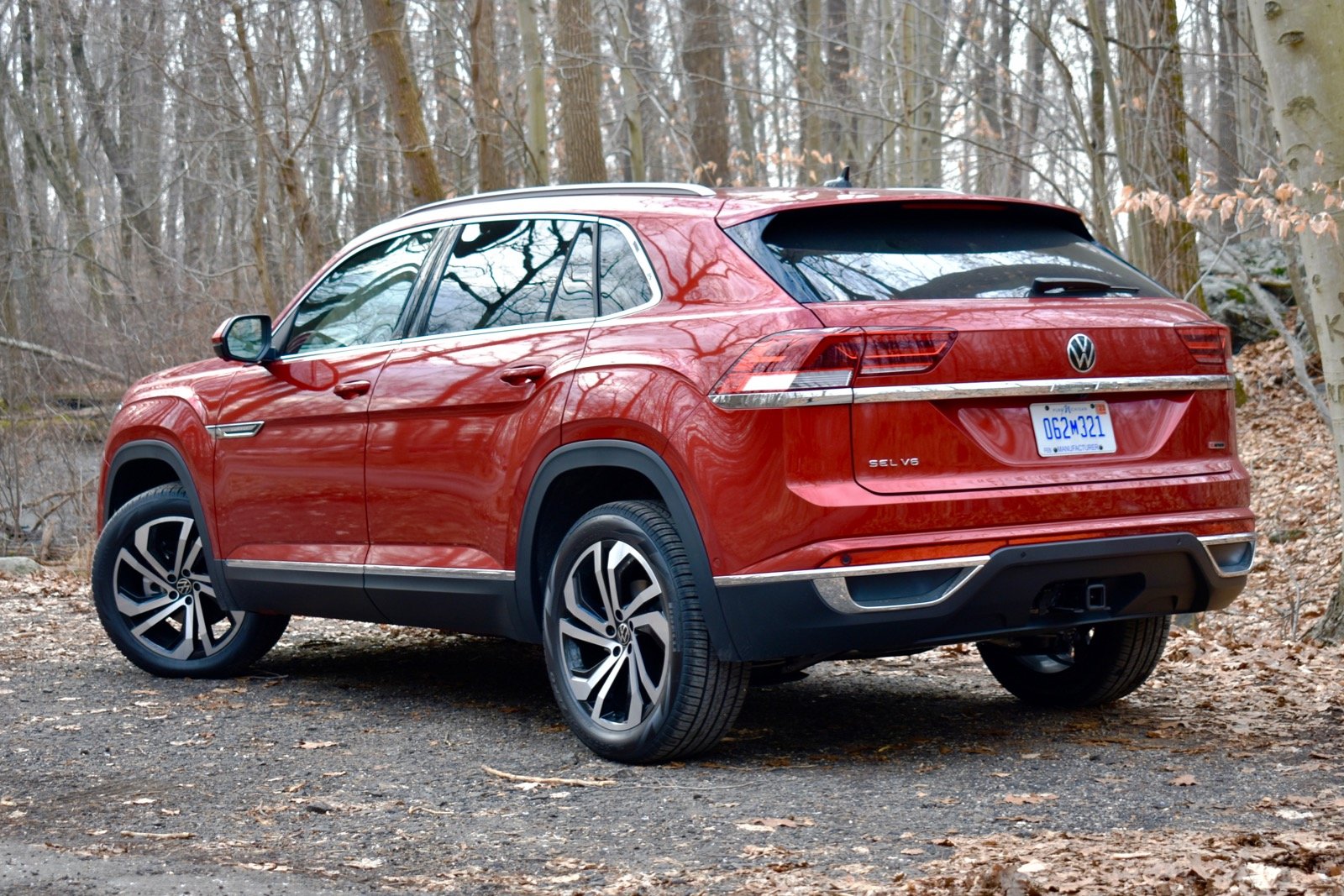
The Cross Sport carries over most of the same sheet metal from the regular Atlas, but with a low roofline and aggressively raked rear hatch. That makes it a bit like the “crossover coupes” offered by luxury automakers but, as with those vehicles, the styling is an odd mix of SUV ruggedness and more car-like features. The fake exhaust tips carved into the rear bumper of our test vehicle also looked tacky.
The Cross Sport is 7.1 centimetres shorter and 5.8 centimetres lower than the seven-seat Atlas, with the same 2,980-millimetre wheelbase as the three-row model. Both Atlas models ride on VW’s MQB platform, which underpins most of the automaker’s current lineup, including the smaller Jetta and Golf.
All Cross Sport models get standard LED exterior lighting, including headlights, taillights, and daytime running lights. The Atlas Trendline and Comfortline get 18-inch alloy wheels, while the Highline gets 20-inch wheels and the Execline offers optional 21-inch wheels. As with other VW models, the R-Line package offered on Execline adds sportier exterior styling features. For the Cross Sport, that includes different front and rear bumpers, a fake rear diffuser, and side skirts.
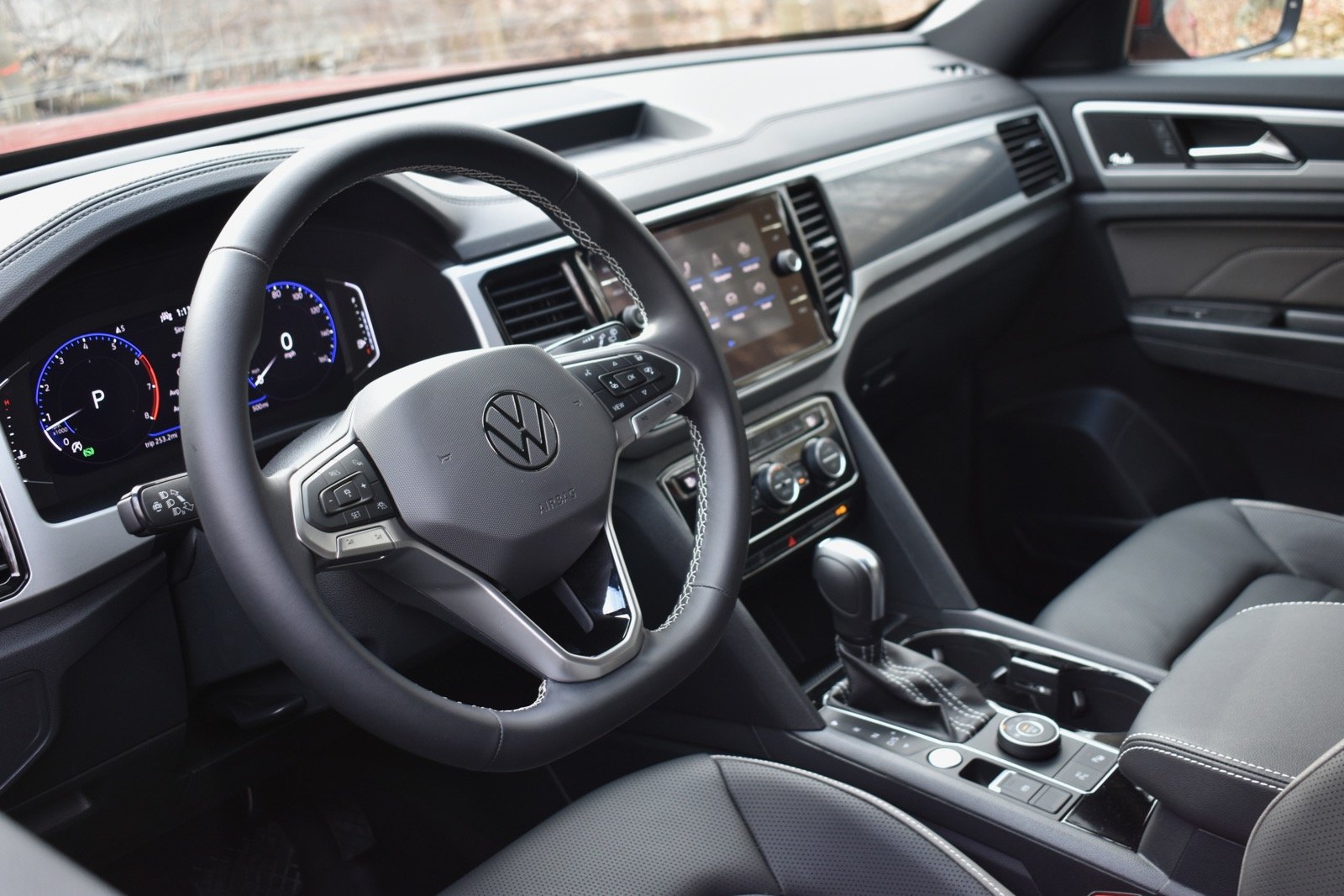
The interior features VW’s typical minimalist design, which is both nice to look at and functional. However, the design is let down by subpar materials. Even with our test unit’s leather upholstery (Highline also gets leather, while lower trim levels get cloth or leatherette upholstery), and contrast stitching, the interior felt cheap. Besides the rubbery-feeling leather, all you really get is hard plastic or shiny plastic that’s vulnerable to fingerprint smudges.
VW also chose multiple colours that blended together. It took a while to notice that the seat and door inserts were actually brown, not black, like the surrounding pieces. So many dark colours didn’t exactly provide a welcoming feel, either, and the flat-bottom steering wheel seemed like an odd choice for a non-performance model.
Performance
The Cross Sport gets the same powertrain options as the seven-seat Atlas, meaning a standard 2.0-litre turbocharged inline-four, and an optional naturally-aspirated 3.6-litre V6 engine. Both engines come with an eight-speed automatic transmission and start-stop systems for better fuel efficiency.
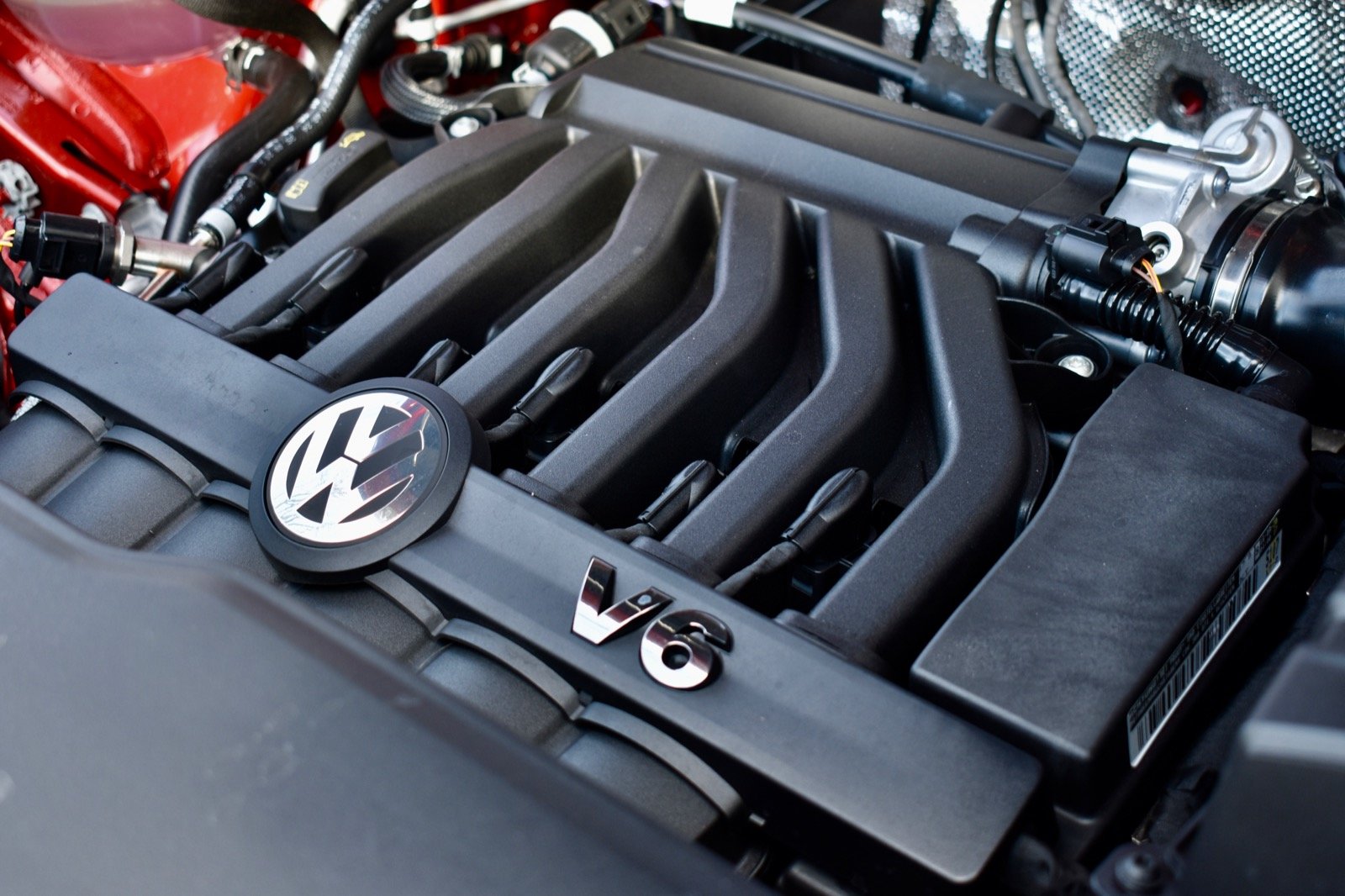
The turbo-four engine is part of the EA888 family used in most of VW’s other models. In the Cross Sport, it makes 235 horsepower and 258 pound-feet of torque (on premium fuel). The V6 is actually a VR6, with a very narrow “V” angle. VW developed the VR6 so it could cram six-cylinder engines into small cars, but that wasn’t necessary given the Cross Sport’s cavernous engine bay, which made the VR6 look tiny by comparison. Output is 276 hp and 266 lb-ft of torque.
With the VR6 engine and AWD, our test car felt appreciably livelier when accelerating away from a stop than a four-cylinder Atlas seven-seater we previously tested. The VR6 made a nice sound, too. However, the engine seemed to run out of steam pretty quickly; midrange acceleration didn’t feel nearly as robust as the horsepower and torque figures might indicate. The transmission was also a bit slow to react, but that can be cured by manually shifting using the shift lever (paddle shifters aren’t available).
As with the seven-seat Atlas, ride quality was among the worst we’ve experienced in a modern crossover. Every bump and pothole made its presence felt, and wheels dropping into potholes produced a fairly loud bang, even at low speeds. While other MQB-based Volkswagens have shown luxury-car levels of refinement, the Atlas Cross Sport’s cabin also lets in plenty of wind and tire noise. And while it has “Sport” in its name (plus the same four-wheel independent suspension as the seven-seat Atlas), this SUV didn't feel sporty at all. It handled like a truck, with lots of body roll, and steering so loose it felt like the wheel wasn’t fully attached.
VR6 models have a 2,268-kilogram (5,000-pound) towing capacity, about as much as you can expect from a midsize crossover, and get a standard factory-installed hitch. Four-cylinder models are only rated to tow 907 kilograms (2,000 pounds), and don’t come with a hitch from the factory (it can be added when ordering or by the dealership, however).
Like the seven-seat Atlas, AWD versions of the Cross Sport get Active Control with multiple drive modes (including Onroad, Snow, Offroad, and Custom Offroad), and 20.3 centimetres of ground clearance. If you’re planning to go off-road, though, the Jeep Grand Cherokee is a better choice, thanks to its more sophisticated four-wheel drive (4WD) system and better approach and departure angles.
Form & function
Thanks to a fairly large footprint, the Cross Sport is competitive with other two-row midsize crossovers on interior space. Front-seat and rear-seat legroom are near the top of the class, while front headroom is above average. However, rear headroom is the worst among the VW’s competitive set, thanks to that steeply sloping roofline. Even medium-height people won’t find much clearance—not something you should have to worry about in a vehicle this big.
At 1,141 litres with the rear seats in place, and 2,203 litres with the rear seats folded, cargo space is above average for the segment, but still behind the leading Honda Passport. The second-row seats come standard with a 60/40 split-fold, and 14-degree backrest recline. Highline and Execline trim levels add a foot-activated tailgate.
VW provided the expected array of cargo nets, cupholders, and storage bins, including a decent-sized centre console and a second-row armrest with integrated cupholders. A large, angled cubbyhole ahead of the shifter houses charge ports and should be big enough to hold most phones without allowing them to slide around.

Technology
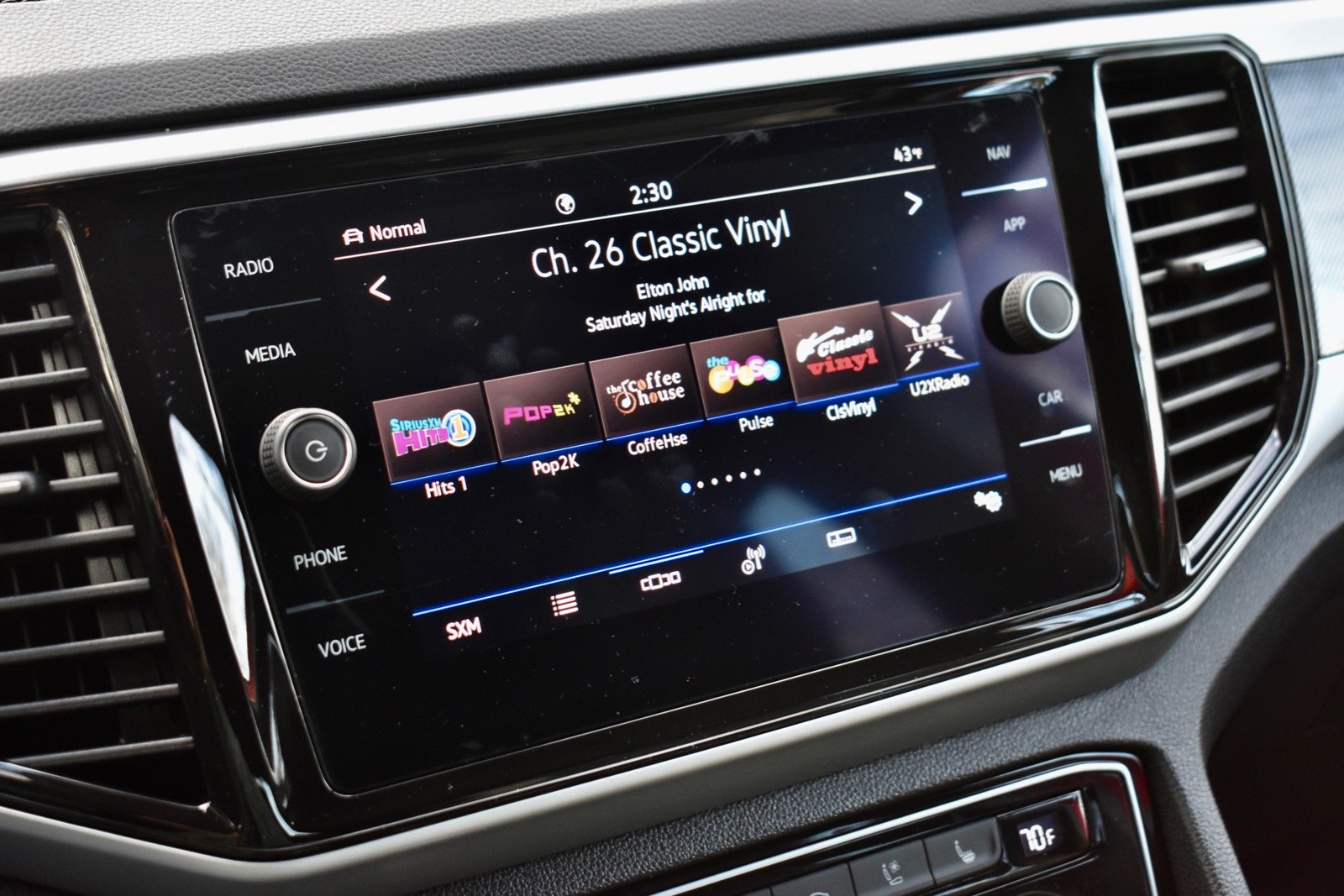
The Cross Sport is sold with two infotainment systems. The base Atlas Cross Sport Trendline trim level carries over the MIB2 system from the 2020 model year, with a 6.5-inch touchscreen. All other trim levels get the new MIB3 infotainment system, with an 8-inch touchscreen.
Both systems include two USB-C ports for newer devices, pinch-to-zoom screens, Bluetooth, SiriusXM satellite radio, and wireless Apple CarPlay/Android Auto connectivity through App-Connect. MIB3 adds multiple-device pairing and updated voice recognition. Execline models get the Volkswagen Digital Cockpit instrument cluster, which replaces the analog gauges with a 10-inch reconfigurable display screen, and a 12-speaker Fender premium audio system.
Our test car had the new MIB3 system, which didn’t seem dramatically different from MIB2. Multiple-device pairing is an important addition, but the menus and graphics all looked pretty much the same as what you got in the old system. MIB3 was also very slow to load after starting the car, while the Fender audio system sounded decidedly lo-fi. The voice recognition could be activated only by reaching over and pressing a button on the touchscreen and it still required specific prompts.
The Digital Cockpit display, at least, did feel like a worthwhile piece of tech, allowing the driver to switch from traditional gauges to text-based configurations that put more information on display. Well-designed analog controls also made the touchscreen largely unnecessary for basic functions like climate control, which might make the Cross Sport a good choice for less tech-savvy buyers.
Safety
The 2021 VW Atlas Cross Sport earned top “Good” scores in all Insurance Institute for Highway Safety (IIHS) crash tests, but with mixed headlight ratings. Only headlights for higher-level grades earned a “Good” score. The Cross Sport also got a “Marginal” rating for child-seat anchor ease of use.
The National Highway Traffic Safety Administration (NHTSA) gave the 2021 Cross Sport a five-star overall rating, with a five-star rating for side crash tests, and four-star ratings for frontal and rollover crash tests.
Standard safety features include forward-collision warning, automatic emergency braking, blind-spot monitor, and rear cross-traffic alert. Optional features include adaptive cruise control, lane-keep assist, traffic-sign recognition, automatic high beams, parking sensors, and parking assist. It’s worth noting that some of these features—such as adaptive cruise control—are standard on competitor vehicles.
However, most competitors don’t have an equivalent to the Cross Sport’s standard Automatic Post-Collision Braking System and Intelligent Crash Response System, which automatically switches off the fuel pump, unlocks the doors, and turns on the hazard lights after a crash.
For the 2021 model year, the Cross Sport adds two new driver-assist features. Available on Execline, Travel Assist enables automated lane centring at speeds up to 150 kilometres per hour. Drivers still have to keep their hands on the steering wheel, which has capacitive sensors to detect grip. As with similar systems from other mainstream brands, Travel Assist had trouble with even the gentle curves encountered on highways, and it even had to make lots of small corrections on straight stretches of highway.
The other new driver aid for 2021 is Emergency Assist, which will automatically slow the car to a stop if sensors don’t detect any control inputs. Also limited to Execline, it’s designed to prevent the car from running off the road if the driver is incapacitated. This kind of tech was previously seen only on luxury cars.

Cost-effectiveness
Natural Resources Canada fuel consumption ratings for the four-cylinder Atlas Cross Sport are 10.9 litres per 100 kilometres combined (11.7 city, 9.9 highway). The bigger VR6 engine uses 12.3 L/100 km combined (13.8 city, 10.4 hwy). Those numbers are a bit behind most competitors, but not by much. If you want good fuel efficiency, the Toyota Venza has a standard hybrid powertrain and uses 6.1 L/100 km combined.
Pricing for the 2021 VW Atlas Cross Sport ranges from $38,995 for a base four-cylinder Cross Sport Trendline, to $55,985 for an Execline R-Line model with the VR6 engine (all prices are before a mandatory $1,950 destination charge). The equivalent of our Execline test car, with the VR6 but not the R-Line package, has a base pre-fees MSRP of $54,295. That makes the Cross Sport a poor value proposition. Base models are not very well equipped and, as the more than $20,000 difference between base and fully-loaded versions shows, you’ll need to spend a lot more to get the full complement of tech and convenience features.
VW offers a four-year, 80,000-kilometre new-vehicle warranty.
The Cross Sport might seem like the perfect choice for new-car buyers who want a roomy SUV, but don’t need the standard Atlas’s third row. That logic falls apart once you get behind the wheel. The Cross Sport has the same problems as the standard Atlas—terrible ride quality, underwhelming powertrains, and a low-rent interior—but with less rear-seat space. It loses some practicality but gains nothing.
What owners say
"Overall, owners of the 2021 Volkswagen Atlas Cross Sport are very pleased with their purchase, highlighting its impressive handling, stylish appearance, and spacious interior. They appreciate the technology features and comfort it offers, making it ideal for families or those who enjoy long trips. However, some owners pointed out that the fuel economy could be better, and there have been minor complaints about noise in certain areas."
The fact that there's No sunroof is obviously a minus
May 16, 2025Elegant car. Suitable for growing families. Durable and smooth drive. It is a pleasure to drive this SUV
October 26, 2023Purchased the Atlas Cross Sport SE with V6 and technology package. Love the way the car handles! Impressive outside appearance. I have the Aurora Red and get compliments on the color almost daily Lots of technology and features for the money! Gas mileage isnt as good as I would have hoped but its not horrible. After 2 weeks, there is a wind noise around the driver window but that is the only complaint so far. For a beefy looking SUV, the horn is weak. lol Overall, very impressive vehicle!
April 1, 2021What owners say
The fact that there's No sunroof is obviously a minus
May 16, 2025Elegant car. Suitable for growing families. Durable and smooth drive. It is a pleasure to drive this SUV
October 26, 2023Purchased the Atlas Cross Sport SE with V6 and technology package. Love the way the car handles! Impressive outside appearance. I have the Aurora Red and get compliments on the color almost daily Lots of technology and features for the money! Gas mileage isnt as good as I would have hoped but its not horrible. After 2 weeks, there is a wind noise around the driver window but that is the only complaint so far. For a beefy looking SUV, the horn is weak. lol Overall, very impressive vehicle!
April 1, 2021Great car! Rides amazing, has great features, very roomie.
December 12, 2022I purchased a 2021 VW Atlas Cross Sport to replace my previous SUV and I could not be more pleased with the outcome. It rides well and is extremely spacious. I wanted a sporty SUV to get away from the soccer mom vibe and this delivered.
October 13, 2022We took a road trip of over 2000 miles in a 2021 Atlas earlier this year. We had to have one. So far it’s all what we expect and more. We’re loving our 2021 Atlas Cross Sports.
August 9, 2023Trims & specs
Base MSRP N/A | Seating 5 |
Engine 2.0L 235 hp I4 | Cargo Capacity 1141 L |
Combined MPG 22 | Drivetrain AWD |
Base MSRP N/A | Seating 5 |
Engine 3.6L 276 hp V6 | Cargo Capacity 1141 L |
Combined MPG 20 | Drivetrain AWD |
Base MSRP N/A | Seating 5 |
Engine 3.6L 276 hp V6 | Cargo Capacity 1141 L |
Combined MPG 20 | Drivetrain FWD |
Base MSRP N/A | Seating 5 |
Engine 3.6L 276 hp V6 | Cargo Capacity 1141 L |
Combined MPG 20 | Drivetrain FWD |
Base MSRP N/A | Seating 5 |
Engine 2.0L 235 hp I4 | Cargo Capacity 1141 L |
Combined MPG 22 | Drivetrain FWD |
Base MSRP N/A | Seating 5 |
Engine 3.6L 276 hp V6 | Cargo Capacity 1141 L |
Combined MPG 20 | Drivetrain AWD |
Base MSRP N/A | Seating 5 |
Engine 3.6L 276 hp V6 | Cargo Capacity 1141 L |
Combined MPG 20 | Drivetrain AWD |
Base MSRP N/A | Seating N/A |
Engine N/A | Cargo Capacity N/A |
Combined MPG N/A | Drivetrain N/A |
Base MSRP N/A | Seating 5 |
Engine 2.0L 235 hp I4 | Cargo Capacity 1141 L |
Combined MPG 22 | Drivetrain AWD |
Base MSRP N/A | Seating 5 |
Engine 2.0L 235 hp I4 | Cargo Capacity 1141 L |
Combined MPG 22 | Drivetrain AWD |
Base MSRP N/A | Seating 5 |
Engine 3.6L 276 hp V6 | Cargo Capacity 1141 L |
Combined MPG 20 | Drivetrain AWD |
Base MSRP N/A | Seating 5 |
Engine 2.0L 235 hp I4 | Cargo Capacity 1141 L |
Combined MPG 22 | Drivetrain AWD |
Base MSRP N/A | Seating 5 |
Engine 3.6L 276 hp V6 | Cargo Capacity 1141 L |
Combined MPG 20 | Drivetrain AWD |
Base MSRP N/A | Seating 5 |
Engine 3.6L 276 hp V6 | Cargo Capacity 1141 L |
Combined MPG 20 | Drivetrain FWD |
Base MSRP N/A | Seating 5 |
Engine 2.0L 235 hp I4 | Cargo Capacity 1141 L |
Combined MPG 22 | Drivetrain AWD |
Base MSRP N/A | Seating 5 |
Engine 2.0L 235 hp I4 | Cargo Capacity 1141 L |
Combined MPG 22 | Drivetrain FWD |
Base MSRP N/A | Seating N/A |
Engine N/A | Cargo Capacity N/A |
Combined MPG N/A | Drivetrain N/A |
Base MSRP N/A | Seating 5 |
Engine 3.6L 276 hp V6 | Cargo Capacity 1141 L |
Combined MPG 20 | Drivetrain AWD |
Base MSRP N/A | Seating 5 |
Engine 2.0L 235 hp I4 | Cargo Capacity 1141 L |
Combined MPG 22 | Drivetrain FWD |
Base MSRP N/A | Seating 5 |
Engine 3.6L 276 hp V6 | Cargo Capacity 1141 L |
Combined MPG 20 | Drivetrain FWD |
Base MSRP N/A | Seating N/A |
Engine N/A | Cargo Capacity N/A |
Combined MPG N/A | Drivetrain N/A |


Pricing trends
Current avg. market price
$26,860
Trending up by 0.3% this month
May 2026 - November 2026

