2022 Ford Explorer Reviews, Pricing & Specs
Write a review
The 2022 Ford Explorer remains worthy of the adoration of its loyal fans. It's a solid choice of three-row SUV.
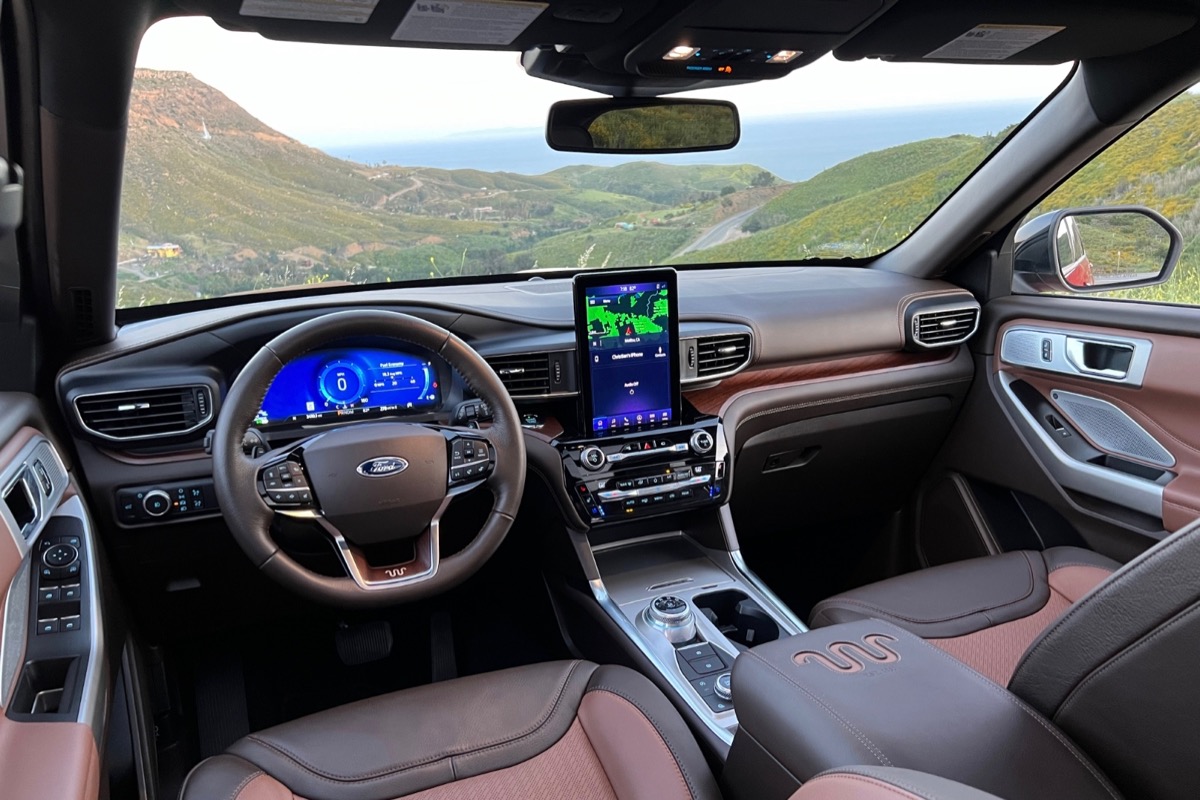
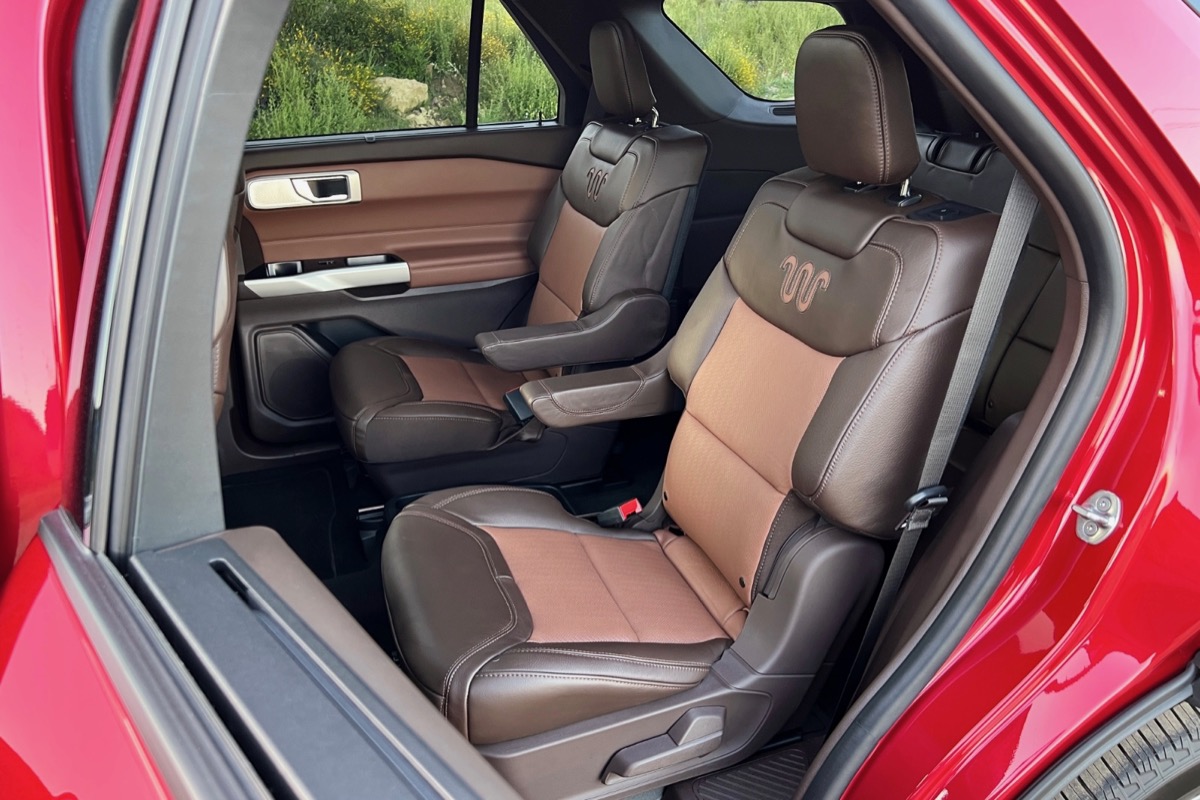
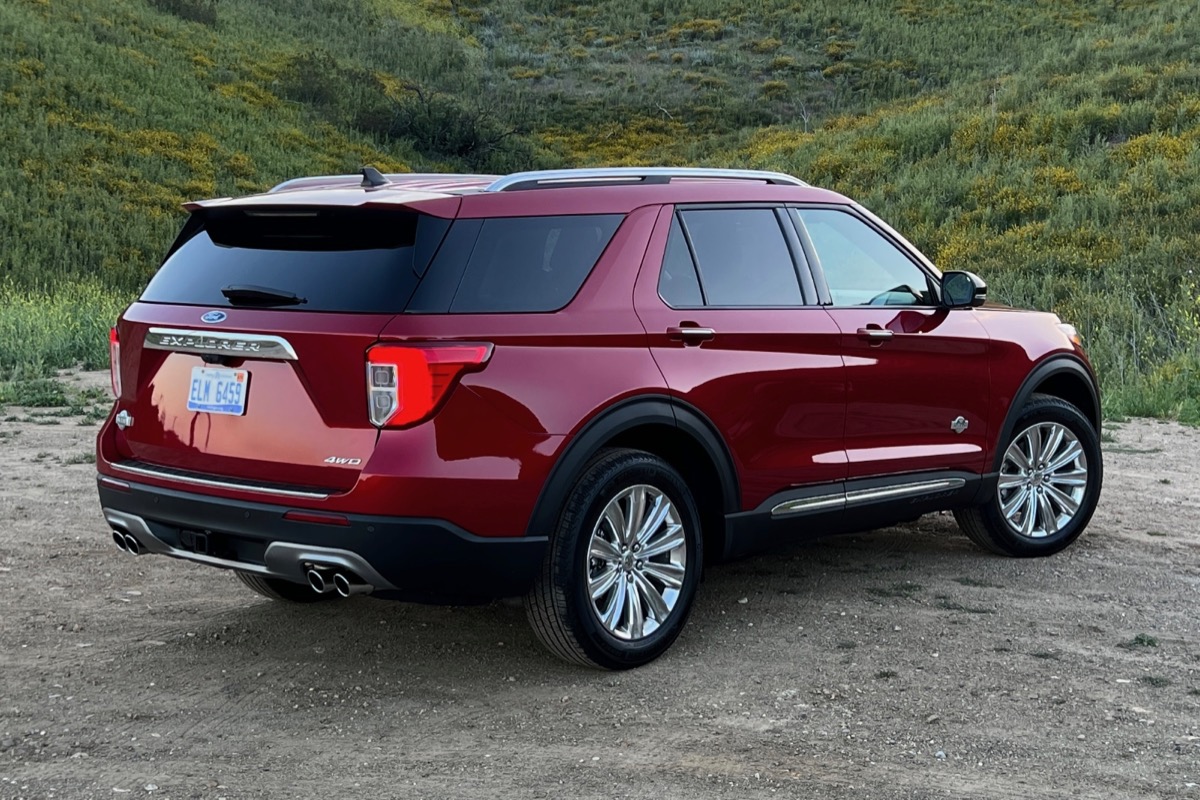
There are six 2022 Explorer models available to Canadians, priced from MSRPs of $47,799 to $66,759, not including the $2,095 destination charge. Last year, the Explorer lineup expanded with the rugged Timberline trim level, and for the 2022 model year the Explorer ST-Line is new, adding a sporty look to the popular Ford Explorer XLT version of the SUV. Our test vehicle was the U.S.-spec Explorer King Ranch, a model not sold in Canada, meaning that some features shown in the accompanying photos are not available here. The closest Canadian equivalent is the top-of-the-line Ford Explorer Platinum.
The Ford Explorer’s basis on a rear-drive platform allowed designers to craft a long and tall hood, short front overhang, rakish roofline, and tapering greenhouse for a taut, athletic appearance. At the same time, blacked-out roof pillars (save for those directly behind the back doors) give the Explorer the familiar “floating roof” visual effect that proved popular on the previous-generation version of the SUV.
As is commonly the case with vehicles that have broadly diverse model lineups, the cabin in higher-trim Explorers exhibits a mix of quality and questionable materials for the price point. Mostly, it looks and feels worthy of its window sticker, but you will get whiffs of the Explorer’s base trim from time to time.
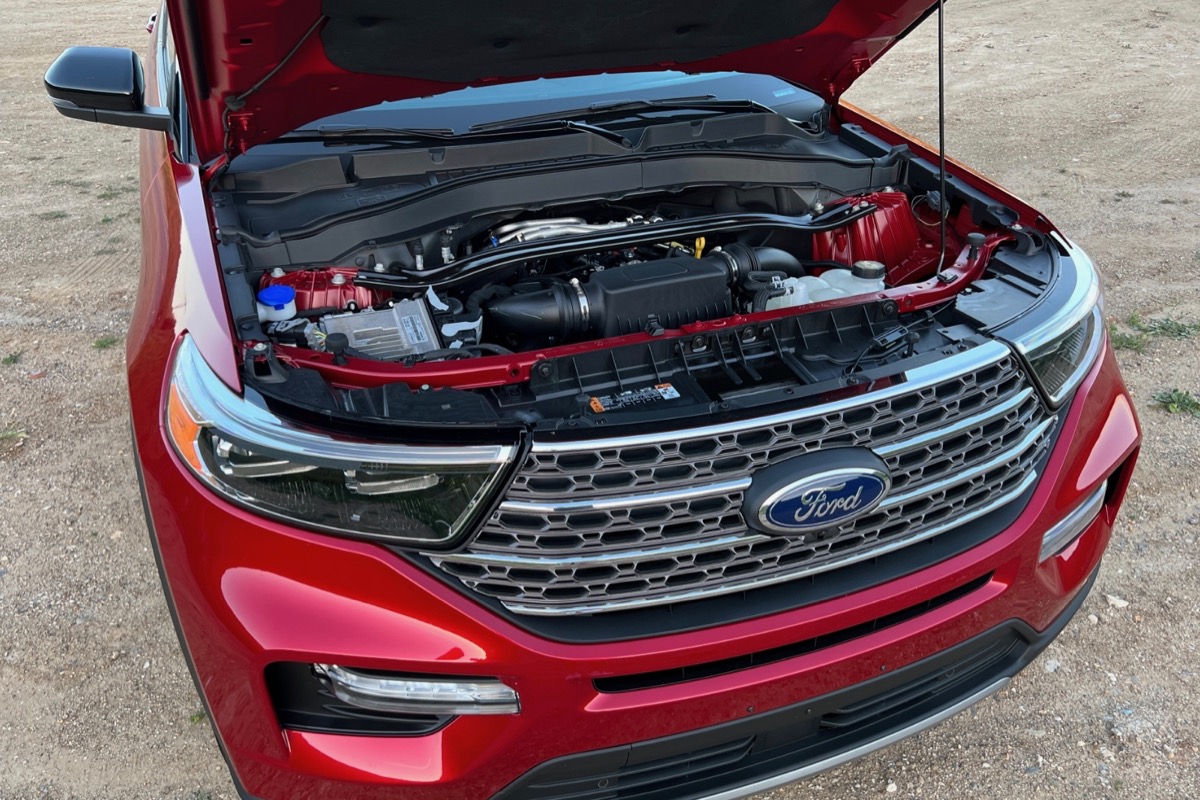
Ford offers three powertrains for the 2022 Explorer. The XLT, ST-Line, and Timberline trim levels come with a turbocharged 2.3-litre EcoBoost four-cylinder engine generating 300 horsepower and 310 pound-feet of torque. It pairs with a 10-speed automatic and, in Canada, standard four-wheel drive (4WD), while rear-wheel drive (RWD) is not available. Maximum towing capacity amounts to 2,400 kilograms (5,300 pounds), and this engine consumes between 10.3 and 11.8 litres per 100 kilometres in combined driving, depending on trim and whether stop-start is equipped.
An efficient hybrid drivetrain is an option for the Ford Explorer Limited. It is based on a 3.3-litre V6 engine and makes a combined 318 hp and 322 lb-ft of torque, tows up to 2,268 kg (5,000 lbs), and burns as little as 9.6 L/100 km in combined driving. It also comes with a 10-speed automatic transmission, this one tuned for hybrid efficiency.
If you’re willing to trade fuel economy for acceleration and maximum towing capacity, a twin-turbocharged 3.0-litre V6 engine is available. It is standard with the Ford Explorer ST and Platinum, and for 2022 all applications of the engine generate 400 hp and 415 lb-ft of torque. Previously, Ford restricted these output figures to the racy Explorer ST. This engine pairs with a 10-speed automatic and can tow as much as 2,540 kg (5,600 lbs). Fuel consumption is 11.8 L/100 km in combined driving, according to Natural Resources Canada.
Our test vehicle, which has the same V6 powertrain as the Platinum, averaged 11.4 L/100 km on the testing loop. In return for lower efficiency, the twin-turbo V6 supplies plenty of power, satisfying acceleration, and a more pleasing exhaust note compared to the standard turbo-four. However, unless you require the added 600 lbs of towing capacity or the sheer grunt of the V6, we think the hybrid powertrain that’s available on the Limited offers the best blend of power, efficiency, and capability.
As far as the ride is concerned, the Explorer feels more like a traditional SUV than a typical crossover, but without the usual skittishness over bumps and holes in the pavement. The result is a remarkably robust sensation from behind the wheel, and that extends to off-roading situations. We tackled moderately challenging terrain using the Trail setting, and the Explorer got us up and then back down a mountainside even though it supplies just 20 centimetres of ground clearance. Ford Explorer Timberline models are even better equipped for this type of travel, supplying 22.1 centimetres of ground clearance along with improved angles of approach, breakover, and departure.
For daily driving, the Explorer feels good in your hands, proving athletic if you decide to take a corner or a curve with enthusiasm. Of course, if you truly love to drive, you’ll want the sport-tuned Explorer ST for its available ST Street option package that installs black 21-inch wheels, performance brakes, and red brake calipers. Still, any 2022 Explorer should prove more engaging to drive than your typical midsize, three-row crossover SUV.
For families of four, the 2022 Ford Explorer offers plenty of comfort. Get one with the second-row bench seat, and you can occasionally carry five people. Unfortunately, the Explorer’s rear-drive platform, low rear roofline, and tapered tail make its third-row seat useful only for children.
Fully equipped models have all of the extras including triple-zone automatic climate control, a power-adjustable heated steering wheel, heated and ventilated front seats, and heated second-row captain’s chairs. The front seats are exceptionally comfortable with available massaging and are suitable for long-distance driving. The second-row seats are nearly as accommodating, and manual second-row side window sunshades are standard on higher models. But the third-row seat is difficult for adults to access and its low, flat cushion and lack of legroom make any grown-ups assigned to this location mighty unhappy.
Practical storage space within the cabin could be better. Ford has missed several opportunities to make up for the Explorer’s stingy centre console storage bin. For example, the front door armrests lack a tray and simulated wood trim resides where a dashboard shelf would come in handy. The wireless charging pad and a smartphone holder near the cupholders are helpfully shaped and located, though it’s easy to forget your phone in the SUV since it is hidden from view while charging.
Thoughtfully, Ford added built-in cupholders in the rear seat door panels and there is a shallow tray with more cupholders located between the captain’s chairs. But the interior’s lack of practical pockets, shelves, cubbies, and hooks is palpable. Maybe Ford decided early on to emphasize the “sport” portion of the sport/utility equation.
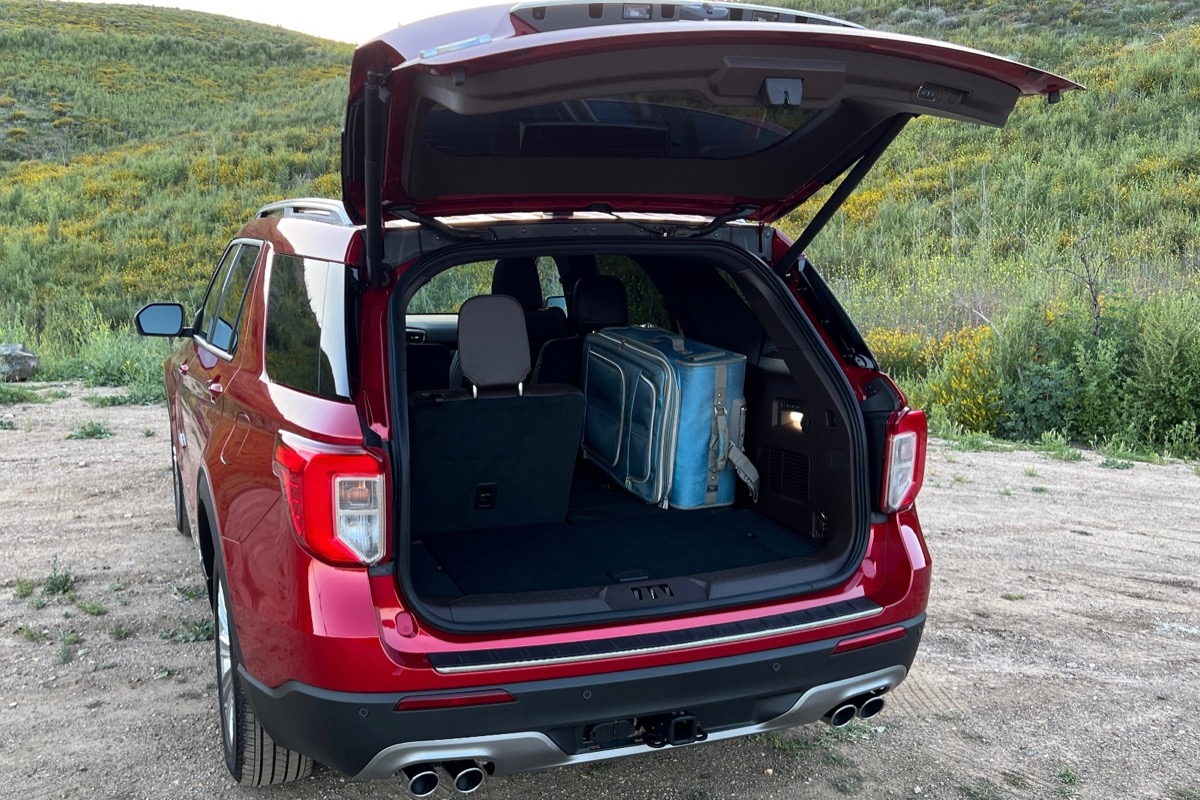
Around the back, our King Ranch test vehicle had a hands-free power liftgate that rose to reveal 528 litres of cargo space behind the third-row seat. Flatten the 50/50-split, power-folding third-row seats down, and you’ll create 1,264 litres of cargo space. Fold both rear rows of seats down to make a maximum of 2,132 litres of cargo volume.
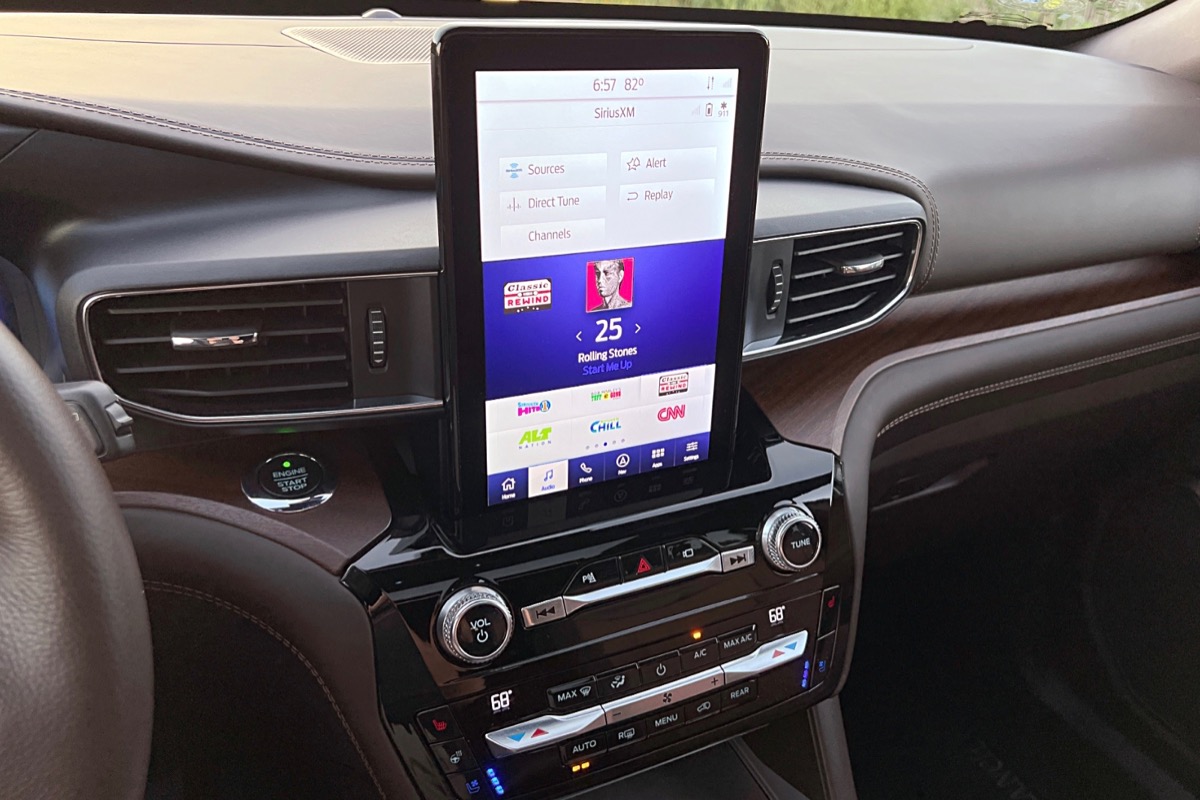
Ford offers two versions of its Sync 3 infotainment system in the 2022 Explorer. The first has an 8-inch touchscreen display mounted horizontally between the centre dashboard air vents. The second is a 10.1-inch touchscreen affixed portrait style.
The smaller screen is well integrated with the Explorer’s interior design, while the larger screen looks like someone glued an iPad to the dashboard. It appears to be an afterthought, like someone decided late in the current-generation Explorer’s gestation period that a bigger screen would be necessary to make the SUV competitive.
Our test vehicle had the full menu of Sync 3 technology, including FordPass Connect services with remote engine starting, a 4G LTE WiFi hotspot (service costs extra), Apple CarPlay, Android Auto, Bluetooth, satellite radio, and a navigation system. Additionally, Ford equips higher-trim Explorers with wireless smartphone charging, a surround-view camera system, and an outstanding 14-speaker Bang and Olufsen premium sound system.
Ford offers next-generation Sync 4 technology in many of its models, and the differences between it and the Explorer’s old Sync 3 system are significant. This is especially evident when it comes to the voice recognition system and operating various features using spoken commands.
For example, one of our standard test prompts is to get directions to a location at the opposite side of the country. On our first attempt, the Explorer tried to direct us to our local rental car agency offices. On our second attempt, it gave us what it thought were the closest matches to soundalike locations nearby.
Furthermore, trying to find a favourite local restaurant using nothing but the establishment’s name and street took several tries. You cannot request a genre of music, such as alternative rock or reggae, but if you have a specific station in mind, you can switch using voice commands. Want to change the cabin temperature or turn on the seat heaters? Use your fingers, not the spoken word.
Clearly, Ford needs to upgrade the Explorer to Sync 4 ASAP. While it’s at it, a new dashboard accommodating larger touchscreen displays would be nice.
Additional tech for the Platinum includes a nicely executed 12.3-inch digital instrumentation display and Active Park Assist 2.0, which can autonomously park the Explorer as long as you’re sitting in the driver’s seat ready to take control if necessary. A dual-headrest rear entertainment system is also available.
According to the Insurance Institute for Highway Safety (IIHS), every version of the 2022 Explorer earns a Top Safety Pick+ safety rating. It doesn’t matter if you buy the base trim or a loaded-up Platinum.
Unfortunately, as this review is written, the National Highway Traffic Safety Administration (NHTSA) has not published complete crash-test ratings for the 2022 Explorer. Last year, the SUV earned five-star ratings across the board except for rollover resistance, where the Explorer got a four-star rating. It is unclear why the frontal-impact ratings are not carried forward for 2022.
Ford equips every 2022 Explorer with Ford Co-Pilot360, a collection of driver-assist and collision-avoidance safety features. All of the most useful ones are standard features: forward-collision warning, automatic emergency braking, lane-departure warning, lane-keeping assist, blind-spot monitoring, and rear cross-traffic alert. The Ford Explorer also has standard automatic high-beam headlights.
Choose an Explorer equipped with Co-Pilot360 Assist+ and you’ll get adaptive cruise control with stop-and-go capability, lane-centring assist, and evasive steering assist that can add stability when the driver takes sudden action to steer around a pedestrian, cyclist, or other obstacles.
Beyond these Co-Pilot360 features, the Explorer has a standard post-collision braking system and MyKey programmable vehicle functions. MyKey is helpful to parents of teenage drivers, while post-collision braking automatically attempts to bring the Explorer to a stop as soon as possible following a collision. This is important to prevent secondary impacts after the SUV’s airbags have already deployed and deflated.
Overall, as applied to the 2022 Explorer, Co-Pilot360 and Co-Pilot360 Assist+ work well, operating smoothly and accurately in a refined manner. The most aggravating thing about it is a lack of steering wheel sensitivity to the presence of the driver’s hands. We got numerous warnings to hold the steering wheel even though we’d never let go of it.
When vehicles tuck into the space ahead in moderate traffic, the SUV can brake a little too much, but when traffic clears, it doesn’t hesitate to kick down a gear or two and quickly accelerate back up to the pre-selected speed. When driving on a road with sharper bends and curves, the lane-centring assist system regularly shuts off and re-engages when the pavement straightens out.
However, parts of the highway where two lanes narrow to one or one lane widens into two did not cause confusion in Ford Co-Pilot360 Assist+. Similarly, off- and on-ramps didn’t produce any indecisiveness in the Explorer’s semi-autonomous driving tech.
When you research a new 2022 Explorer, you might find that when this SUV is equipped with the features you most want, you’ll be spending at least $55,000. Lower trims offer lots of desirable options, while higher trims come with plenty of those features as standard equipment, which considerably reduces the Explorer lineup’s price spread.
The good news is that the price range represents the heart of the midsize, three-row SUV market. But when equivalently equipped, the Explorer does command a premium compared to some rivals, especially the surprisingly affordable Hyundai Palisade and Kia Telluride.
Over 30 years ago, the first Ford Explorer kick-started the SUV buying trend in America. Now, there are more alternatives to a new Explorer than ever before, and many of them are worthy of your consideration. Still, the SUV that first showed us how sport utility vehicles can offer style, practicality, and adventure in a comfortable daily driver remains among the better choices for a new vehicle in the segment.
Note: Images show a US model.

User reviews for 2022 Ford Explorer
Write a review2022 Ford Explorer Pricing
Trims & specs
Air Conditioning
Automatic climate control front air conditioning · Dual front air conditioning zones · Rear air conditioning: with independent controls · Single rear air conditioning zones
Airbags
Dual front airbags · Dual front knee airbags · Passenger airbag deactivation: occupant sensing deactivation · Front side airbags · Rear side curtain airbags
Audio System
Antenna Type: mast · Voice recognition audio system · Bluetooth auxiliary audio input · Touch screen display radio · Satellite Radio: SiriusXM · Total Number of Speakers: 6
Brakes
ABS: 4-wheel · Braking assist: hill start assist · Electronic parking brake: auto off · Front brake diameter: 13.6 · Front brake width: 1.26 · Front brakes: ventilated disc · Rear brake diameter: 12.6 · Rear brake width: 0.47 · Rear brakes: disc
Comfort Features
Dash trim: alloy · Door sill trim: scuff plate · Door trim: alloy · Floor Mat Material: carpet · Floor Material: carpet · Floor Mats: front · Steering wheel trim: urethane
Convenience Features
Assist handle: front · Cargo area power outlet: 12V · Center console: front console with armrest and storage · Cupholders: front · Memorized settings: liftgate · Multi-function remote: trunk release · One-touch windows: 2 · Power outlet(s): 12V front · Power steering: speed-proportional · Power windows: lockout button · Reading lights: front · Rear power outlet: 12V · Steering wheel: tilt and telescopic · Steering wheel mounted controls: multi-function screen controls · Storage: door pockets · Vanity mirrors: dual illuminating
Driver Seat
Power adjustments: 8
Drivetrain
Axle ratio: 3.58
Engine
Battery: maintenance-free · Oil cooler: auxiliary
Exterior Features
Door handle color: black · Fender lip moldings: black · Front bumper color: body-color · Grille color: black · Mirror color: black · Rear bumper color: black · Rear spoiler: roofline spoiler · Rear spoiler color: body-color · Rear trunk/liftgate: power operated · Rocker panel color: black · Window trim: black
Headrests
Front headrests: adjustable · Number of front headrests: 2 · Number of rear headrests: 3 · Number of third row headrests: 2
In Car Entertainment
Connected in-car apps: Google POIs · Infotainment: Android Auto ready · Infotainment screen size: 8 in.
Instrumentation
Fuel economy display: MPG · Instrument cluster screen size: 4.2 in. · Warnings and reminders: low oil level
Lights
Daytime running lights: LED · Exterior entry lights: security approach lamps · Headlights: wiper activated · Tail and brake lights: LED
Mirrors
Exterior mirrors: power · Inside rearview mirror: manual day/night
Passenger Seat
Manual Adjustments: 4
Rear Seats
Type: 35-30-35 split bench
Safety
Automatic emergency braking: front · Camera system: rearview · Camera system washer: rear · Child seat anchors: LATCH system · Cross Traffic Alert: rear · Crumple zones: front · Impact sensor: post-collision safety system · Parking sensors: rear · Pre-Collision Warning System: visual warning · Pre-collision warning system: pedestrian detection · Programmable safety key: MyKey · Rearview monitor: in dash
Seatbelts
Emergency locking retractors: front · Front seatbelts: 3-point · Seatbelt force limiters: front · Seatbelt pretensioners: front · Seatbelt warning sensor: driver and passenger · Second row seatbelts: 3-point · Third row seatbelts: 3-point
Seats
Driver seat power adjustments: height · Front seat type: bucket · Passenger seat manual adjustments: reclining · Rear headrests: adjustable · Rear seat folding: split · Rear seat manual adjustments: reclining · Third row headrests: adjustable · Third row seat folding: split · Upholstery: cloth
Security
Power door locks: anti-lockout
Spare Tire
Mount Location: inside · Size: temporary
Spare Wheel
Rim Type: steel
Stability and Traction
Traction control: with trailer stability control
Steering
Steering ratio: 16.5
Suspension
Front Arm Type: lower control arms · Front Shock Type: gas shock absorbers · Front Spring Type: coil springs · Front Stabilizer Bar: diameter 35 mm · Front Suspension Classification: independent · Front Suspension Type: MacPherson struts · Rear Shock Type: gas shock absorbers · Rear Spring Type: coil springs · Rear Stabilizer Bar: diameter 22 mm · Rear Suspension Classification: independent · Rear Suspension Type: multi-link
Telematics
Electronic messaging assistance: with voice recognition · Phone: voice activated · Phone wireless data link: Bluetooth · Smart device app compatibility: FordPass Connect · Smart device app function: maintenance status · Wifi: hotspot
Third Row Seat
Type: 50-50 split bench
Tires
Type: all season
Tires and Rims
Wheels: painted aluminum
Windows
Front wipers: variable intermittent · Liftgate window: fixed · Power windows: with safety reverse · Rear wiper: with washer
Air Conditioning
Automatic climate control front air conditioning · Dual front air conditioning zones · Rear air conditioning: with independent controls · Single rear air conditioning zones
Airbags
Dual front airbags · Dual front knee airbags · Passenger airbag deactivation: occupant sensing deactivation · Front side airbags · Third row side curtain airbags
Audio System
Antenna Type: diversity · Voice recognition audio system · USB auxiliary audio input · AM/FM radio · Satellite Radio: SiriusXM · Total Number of Speakers: 6
Brakes
ABS: 4-wheel · Braking assist: hill start assist · Electronic parking brake: auto off · Front brake diameter: 13.6 · Front brake width: 1.26 · Front brakes: ventilated disc · Rear brake diameter: 12.6 · Rear brake width: 0.47 · Rear brakes: disc
Comfort Features
Dash trim: alloy · Door sill trim: scuff plate · Door trim: alloy · Floor Mat Material: carpet · Floor Material: carpet · Floor Mats: front · Steering wheel trim: urethane
Convenience Features
Assist handle: rear · Cargo area power outlet: 12V · Center console: front console with armrest and storage · Cupholders: rear · Memorized settings: liftgate · Multi-function remote: trunk release · One-touch windows: 2 · Power outlet(s): 12V front · Power steering: electric · Power windows: lockout button · Reading lights: rear · Rear power outlet: 12V · Steering wheel: tilt and telescopic · Steering wheel mounted controls: cruise controls · Storage: front seatback · Vanity mirrors: dual illuminating
Driver Seat
Power adjustments: 8
Drivetrain
4WD Type: on demand · Axle ratio: 3.58
Engine
Battery: maintenance-free · Oil cooler: auxiliary
Exterior Features
Door handle color: black · Fender lip moldings: black · Front bumper color: body-color · Grille color: black · Mirror color: black · Rear bumper color: black · Rear spoiler: roofline spoiler · Rear spoiler color: body-color · Rear trunk/liftgate: liftgate · Rocker panel color: black · Window trim: black
Headrests
Front headrests: adjustable · Number of front headrests: 2 · Number of rear headrests: 3 · Number of third row headrests: 2
In Car Entertainment
Connected in-car apps: Amazon Alexa · Infotainment: SYNC · Infotainment screen size: 8 in.
Instrumentation
Fuel economy display: MPG · Instrument cluster screen size: 4.2 in. · Warnings and reminders: maintenance reminder
Lights
Daytime running lights: LED · Exterior entry lights: security approach lamps · Headlights: LED · Tail and brake lights: LED
Mirrors
Exterior mirrors: power · Inside rearview mirror: manual day/night
Passenger Seat
Manual Adjustments: 4
Rear Seats
Type: 35-30-35 split bench
Safety
Automatic emergency braking: front · Camera system: rearview · Camera system washer: rear · Child seat anchors: LATCH system · Cross Traffic Alert: rear · Crumple zones: front · Impact sensor: door unlock · Parking sensors: rear · Pre-Collision Warning System: audible warning · Pre-collision warning system: pedestrian detection · Programmable safety key: MyKey · Rearview monitor: in dash
Seatbelts
Emergency locking retractors: front and rear · Front seatbelts: 3-point · Seatbelt force limiters: front · Seatbelt pretensioners: front · Seatbelt warning sensor: driver and passenger · Second row seatbelts: 3-point · Third row seatbelts: 3-point
Seats
Driver seat power adjustments: reclining · Front seat type: bucket · Passenger seat manual adjustments: reclining · Rear headrests: adjustable · Rear seat folding: flat · Rear seat manual adjustments: reclining · Third row headrests: adjustable · Third row seat folding: split · Upholstery: cloth
Security
Power door locks: anti-lockout
Spare Tire
Mount Location: inside · Size: temporary
Spare Wheel
Rim Type: steel
Stability and Traction
Traction control: with trailer stability control
Steering
Steering ratio: 16.5
Suspension
Front Arm Type: lower control arms · Front Shock Type: gas shock absorbers · Front Spring Type: coil springs · Front Stabilizer Bar: diameter 35 mm · Front Suspension Classification: independent · Front Suspension Type: MacPherson struts · Rear Shock Type: gas shock absorbers · Rear Spring Type: coil springs · Rear Stabilizer Bar: diameter 22 mm · Rear Suspension Classification: independent · Rear Suspension Type: multi-link
Telematics
Electronic messaging assistance: with read function · Phone: voice activated · Phone wireless data link: Bluetooth · Smart device app compatibility: FordPass Connect · Smart device app function: lock operation · Wifi: hotspot
Third Row Seat
Type: 50-50 split bench
Tires
Type: all season
Tires and Rims
Wheels: painted aluminum
Windows
Front wipers: variable intermittent · Liftgate window: fixed · Power windows: with safety reverse · Rear wiper: intermittent
Air Conditioning
Automatic climate control front air conditioning · Dual front air conditioning zones
Airbags
Dual front airbags · Front passenger knee airbags · Passenger airbag deactivation: occupant sensing deactivation · Front side airbags · Rear side curtain airbags
Audio System
Antenna Type: mast · Voice recognition audio system · Bluetooth auxiliary audio input · AM/FM radio · Total Number of Speakers: 4
Brakes
ABS: 4-wheel · Front brake diameter: 14.29 · Front brake width: 1.26 · Front brakes: ventilated disc · Rear brake diameter: 13.8 · Rear brake width: 1.02 · Rear brakes: ventilated disc
Comfort Features
Door sill trim: scuff plate · Floor Material: rubber · Shift knob trim: urethane · Steering wheel trim: urethane
Convenience Features
Assist handle: rear · One-touch windows: 2 · Power outlet(s): 12V front · Power windows: lockout button · Reading lights: rear · Steering wheel: tilt and telescopic · Steering wheel mounted controls: voice recognition controls · Storage: door pockets
Driver Seat
Adjustable lumbar support: manual · Power adjustments: 6
Drivetrain
4WD Type: full time · Axle ratio: 3.73
Engine
Alternator: 250 amps · Battery: heavy duty · Oil cooler: auxiliary
Exterior Features
Door handle color: black · Exhaust: dual exhaust tips · Fender lip moldings: black · Front bumper color: body-color · Grille color: black · Mirror color: black · Rear bumper color: body-color · Rear spoiler: roofline spoiler · Rear spoiler color: black · Rear trunk/liftgate: liftgate · Rocker panel color: black · Window trim: black
Headrests
Front headrests: adjustable · Number of front headrests: 2 · Number of rear headrests: 3
In Car Entertainment
Infotainment screen size: 4.2 in.
Instrumentation
Instrument cluster screen size: 4.2 in. · Warnings and reminders: maintenance reminder
Lights
Daytime running lights: LED · Headlights: auto delay off · Tail and brake lights: LED
Mirrors
Exterior mirrors: manual folding · Inside rearview mirror: manual day/night
Passenger Seat
Manual Adjustments: 4
Rear Seats
Type: 35-30-35 split bench · Upholstery: vinyl
Safety
Camera system: rearview · Camera system washer: rear · Child seat anchors: LATCH system · Crumple zones: front · Impact sensor: post-collision safety system · Rearview monitor: in dash
Seatbelts
Emergency locking retractors: front · Front seatbelts: 3-point · Seatbelt force limiters: front · Seatbelt pretensioners: front · Seatbelt warning sensor: driver and passenger · Second row seatbelts: 3-point
Seats
Driver seat manual adjustments: reclining · Driver seat power adjustments: height · Front seat type: bucket · Passenger seat manual adjustments: reclining · Rear headrests: adjustable · Rear seat folding: split · Rear seat manual adjustments: reclining · Upholstery: cloth
Spare Tire
Mount Location: underbody · Size: full-size
Spare Wheel
Rim Type: steel
Steering
Steering ratio: 16.5
Suspension
Front Arm Type: lower control arms · Front Shock Type: gas shock absorbers · Front Spring Type: coil springs · Front Stabilizer Bar: diameter 35 mm · Front Suspension Classification: independent · Front Suspension Type: MacPherson struts · Rear Shock Type: gas shock absorbers · Rear Spring Type: coil springs · Rear Stabilizer Bar: diameter 23 mm · Rear Suspension Classification: independent · Rear Suspension Type: multi-link
Telematics
Phone: voice activated · Phone wireless data link: Bluetooth
Tires
Type: all season
Tires and Rims
Wheels: steel
Towing and Hauling
Tow hooks: front · Trailer hitch: Class III
Wheels
Wheel covers: partial
Windows
Front wipers: variable intermittent · Laminated glass: acoustic · Liftgate window: fixed · Power windows: front · Rear wiper: dual speed
Air Conditioning
Automatic climate control front air conditioning · Dual front air conditioning zones · Rear air conditioning: with independent controls · Single rear air conditioning zones
Airbags
Dual front airbags · Dual front knee airbags · Passenger airbag deactivation: occupant sensing deactivation · Front side airbags · Rear side curtain airbags
Audio System
Antenna Type: mast · Voice recognition audio system · Bluetooth auxiliary audio input · Touch screen display radio · Satellite Radio: SiriusXM · Total Number of Speakers: 6
Brakes
ABS: 4-wheel · Braking assist: hill start assist · Electronic parking brake: auto off · Front brake diameter: 13.6 · Front brake width: 1.26 · Front brakes: ventilated disc · Rear brake diameter: 12.6 · Rear brake width: 0.47 · Rear brakes: disc
Comfort Features
Armrests: rear outboard seats · Dash trim: alloy · Door sill trim: scuff plate · Door trim: alloy · Floor Mat Material: carpet · Floor Material: carpet · Floor Mats: front · Steering wheel trim: leather
Convenience Features
Assist handle: front · Cargo area power outlet: 12V · Center console: front console with armrest and storage · Cupholders: rear · Easy entry: manual rear seat · Keyless entry: keypad · Memorized settings: liftgate · Multi-function remote: proximity entry system · One-touch windows: 2 · Power outlet(s): 12V front · Power steering: speed-proportional · Power windows: lockout button · Reading lights: front · Rear power outlet: 12V · Steering wheel: tilt and telescopic · Steering wheel mounted controls: multi-function screen controls · Storage: door pockets · Vanity mirrors: dual illuminating
Driver Seat
Adjustable lumbar support: power · Power adjustments: 10
Drivetrain
Axle ratio: 3.58
Engine
Battery: maintenance-free · Oil cooler: auxiliary
Exterior Features
Door handle color: body-color · Fender lip moldings: black · Front bumper color: body-color · Grille color: black with chrome accents · Mirror color: black · Rear bumper color: black · Rear spoiler: roofline spoiler · Rear spoiler color: body-color · Rear trunk/liftgate: power operated · Rocker panel color: black · Window trim: black
Headrests
Front headrests: adjustable · Number of front headrests: 2 · Number of rear headrests: 2 · Number of third row headrests: 2
In Car Entertainment
Connected in-car apps: Google POIs · Infotainment: Android Auto ready · Infotainment screen size: 8 in.
Instrumentation
Fuel economy display: range · Instrument cluster screen size: 6.5 in. · Warnings and reminders: maintenance reminder
Lights
Daytime running lights: LED · Exterior entry lights: puddle lamps · Headlights: Auto on/off · Tail and brake lights: LED
Mirrors
Exterior mirrors: integrated turn signals · Inside rearview mirror: manual day/night
Passenger Seat
Power adjustments: 4
Rear Seats
Type: bucket
Roof
Roof rails: black
Safety
Automatic emergency braking: front pedestrian · Camera system: rearview · Camera system washer: rear · Child seat anchors: LATCH system · Cross Traffic Alert: rear · Crumple zones: front · Impact sensor: door unlock · Parking sensors: rear · Pre-Collision Warning System: audible warning · Pre-collision warning system: pedestrian detection · Programmable safety key: MyKey · Rearview monitor: in dash
Seatbelts
Emergency locking retractors: front and rear · Front seatbelts: 3-point · Seatbelt force limiters: front · Seatbelt pretensioners: front · Seatbelt warning sensor: driver and passenger · Second row seatbelts: 3-point · Third row seatbelts: 3-point
Seats
Driver seat power adjustments: reclining · Front seat type: bucket · Passenger seat manual adjustments: reclining · Passenger seat power adjustments: height · Rear headrests: adjustable · Rear seat folding: flat · Rear seat manual adjustments: reclining · Third row headrests: adjustable · Third row seat folding: split · Upholstery: cloth
Security
Power door locks: anti-lockout
Spare Tire
Mount Location: inside · Size: temporary
Spare Wheel
Rim Type: steel
Stability and Traction
Traction control: with trailer stability control
Steering
Steering ratio: 16.5
Suspension
Front Arm Type: lower control arms · Front Shock Type: gas shock absorbers · Front Spring Type: coil springs · Front Stabilizer Bar: diameter 35 mm · Front Suspension Classification: independent · Front Suspension Type: MacPherson struts · Rear Shock Type: gas shock absorbers · Rear Spring Type: coil springs · Rear Stabilizer Bar: diameter 22 mm · Rear Suspension Classification: independent · Rear Suspension Type: multi-link
Telematics
Electronic messaging assistance: with read function · Phone: voice activated · Phone wireless data link: Bluetooth · Smart device app compatibility: FordPass Connect · Smart device app function: maintenance status · Wifi: hotspot
Third Row Seat
Type: 50-50 split bench
Tires
Type: all season
Tires and Rims
Wheels: painted aluminum
Windows
Front wipers: variable intermittent · Liftgate window: fixed · Power windows: with safety reverse · Rear wiper: intermittent
Air Conditioning
Automatic climate control front air conditioning · Dual front air conditioning zones · Automatic climate control rear air conditioning · Single rear air conditioning zones
Airbags
Dual front airbags · Dual front knee airbags · Passenger airbag deactivation: occupant sensing deactivation · Front side airbags · Front side curtain airbags
Audio System
Antenna Type: diversity · Voice recognition audio system · USB auxiliary audio input · AM/FM radio · Satellite Radio: SiriusXM · Total Number of Speakers: 6
Brakes
ABS: 4-wheel · Braking assist: hill start assist · Electronic parking brake: auto off · Front brake diameter: 13.6 · Front brake width: 1.26 · Front brakes: ventilated disc · Rear brake diameter: 12.6 · Rear brake width: 0.47 · Rear brakes: disc
Comfort Features
Armrests: rear outboard seats · Dash trim: alloy · Door sill trim: scuff plate · Door trim: alloy · Floor Mat Material: carpet · Floor Material: carpet · Floor Mats: front · Steering wheel trim: leather
Convenience Features
Assist handle: front · Cargo area power outlet: 12V · Center console: front console with armrest and storage · Cupholders: front, rear and third row · Easy entry: manual rear seat · Keyless entry: keypad · Memorized settings: liftgate · Multi-function remote: proximity entry system · One-touch windows: 2 · Power outlet(s): 12V front · Power steering: electric · Power windows: lockout button · Reading lights: front · Rear power outlet: 12V · Steering wheel: tilt and telescopic · Steering wheel mounted controls: voice recognition controls · Storage: cargo net · Vanity mirrors: dual illuminating
Driver Seat
Adjustable lumbar support: power · Power adjustments: 10
Drivetrain
4WD Type: on demand · Axle ratio: 3.58
Engine
Battery: maintenance-free · Oil cooler: auxiliary
Exterior Features
Door handle color: body-color · Fender lip moldings: black · Front bumper color: body-color · Grille color: black with chrome accents · Mirror color: black · Rear bumper color: black · Rear spoiler: roofline spoiler · Rear spoiler color: body-color · Rear trunk/liftgate: power operated · Rocker panel color: black · Window trim: black
Headrests
Front headrests: adjustable · Number of front headrests: 2 · Number of rear headrests: 2 · Number of third row headrests: 2
In Car Entertainment
Connected in-car apps: app marketplace integration · Infotainment: SYNC · Infotainment screen size: 8 in.
Instrumentation
Fuel economy display: MPG · Instrument cluster screen size: 6.5 in. · Warnings and reminders: low fuel level
Lights
Daytime running lights: LED · Exterior entry lights: puddle lamps · Headlights: LED · Tail and brake lights: LED
Mirrors
Exterior mirrors: manual folding · Inside rearview mirror: manual day/night
Passenger Seat
Power adjustments: 4
Rear Seats
Type: bucket
Roof
Roof rails: black
Safety
Automatic emergency braking: front pedestrian · Camera system: rearview · Camera system washer: rear · Child seat anchors: LATCH system · Cross Traffic Alert: rear · Crumple zones: front · Impact sensor: post-collision safety system · Parking sensors: rear · Pre-Collision Warning System: visual warning · Pre-collision warning system: pedestrian detection · Programmable safety key: MyKey · Rearview monitor: in dash
Seatbelts
Emergency locking retractors: front · Front seatbelts: 3-point · Seatbelt force limiters: front · Seatbelt pretensioners: front · Seatbelt warning sensor: driver and passenger · Second row seatbelts: 3-point · Third row seatbelts: 3-point
Seats
Driver seat power adjustments: reclining · Front seat type: bucket · Passenger seat manual adjustments: reclining · Passenger seat power adjustments: height · Rear headrests: adjustable · Rear seat folding: flat · Rear seat manual adjustments: reclining · Third row headrests: adjustable · Third row seat folding: split · Upholstery: cloth
Security
Power door locks: anti-lockout
Spare Tire
Mount Location: inside · Size: temporary
Spare Wheel
Rim Type: steel
Stability and Traction
Traction control: with trailer stability control
Steering
Steering ratio: 16.5
Suspension
Front Arm Type: lower control arms · Front Shock Type: gas shock absorbers · Front Spring Type: coil springs · Front Stabilizer Bar: diameter 35 mm · Front Suspension Classification: independent · Front Suspension Type: MacPherson struts · Rear Shock Type: gas shock absorbers · Rear Spring Type: coil springs · Rear Stabilizer Bar: diameter 22 mm · Rear Suspension Classification: independent · Rear Suspension Type: multi-link
Telematics
Electronic messaging assistance: with voice recognition · Phone: voice activated · Phone wireless data link: Bluetooth · Smart device app compatibility: FordPass Connect · Smart device app function: lock operation · Wifi: hotspot
Third Row Seat
Type: 50-50 split bench
Tires
Type: all season
Tires and Rims
Wheels: painted aluminum
Windows
Front wipers: variable intermittent · Liftgate window: fixed · Power windows: with safety reverse · Rear wiper: with washer
Air Conditioning
Automatic climate control front air conditioning · Dual front air conditioning zones · Rear air conditioning: with independent controls · Single rear air conditioning zones
Airbags
Dual front airbags · Dual front knee airbags · Passenger airbag deactivation: occupant sensing deactivation · Front side airbags · Third row side curtain airbags
Audio System
Antenna Type: diversity · Voice recognition audio system · Bluetooth auxiliary audio input · Premium Brand: Bang & Olufsen · HD radio · Satellite Radio: SiriusXM · 1 subwoofer · Total Number of Speakers: 11
Brakes
ABS: 4-wheel · Braking assist: hill start assist · Electronic parking brake: auto off · Front brake diameter: 13.6 · Front brake width: 1.26 · Front brakes: ventilated disc · Rear brake diameter: 12.6 · Rear brake width: 0.47 · Rear brakes: disc
Comfort Features
Armrests: rear outboard seats · Dash trim: alloy · Door sill trim: scuff plate · Door trim: alloy · Floor Mat Material: carpet · Floor Material: carpet · Floor Mats: front · Steering wheel trim: leather
Convenience Features
Adaptive stop and go cruise control: semi-automatic · Assist handle: front · Autonomous lane guidance: lane centering · Cargo area power outlet: 12V · Center console: front console with armrest and storage · Cruise control: adaptive · Cupholders: front, rear and third row · Dimming rearview mirror: auto-dimming · Easy entry: manual rear seat · Keyless entry: keypad · Memorized settings: liftgate · Multi-function remote: proximity entry system · One-touch windows: 2 · Power outlet(s): 12V front · Power steering: speed-proportional · Power windows: lockout button · Reading lights: rear · Rear power outlet: 12V · Steering wheel: tilt and telescopic · Steering wheel mounted controls: phone · Storage: sunglasses holder · Vanity mirrors: dual illuminating
Driver Seat
Adjustable lumbar support: power · Power adjustments: 10
Drivetrain
Axle ratio: 3.58
Engine
Battery: maintenance-free · Oil cooler: auxiliary
Exterior Features
Door handle color: body-color · Exhaust: dual exhaust tips · Exhaust tip color: chrome · Fender lip moldings: black · Front bumper color: body-color · Grille color: black · Mirror color: black · Rear bumper color: black · Rear spoiler: roofline spoiler · Rear spoiler color: body-color · Rear trunk/liftgate: liftgate · Rocker panel color: black · Window trim: black
Headrests
Front headrests: adjustable · Number of front headrests: 2 · Number of rear headrests: 2 · Number of third row headrests: 2
In Car Entertainment
Connected in-car apps: Google search · Infotainment: SYNC · Infotainment screen size: 8 in.
Instrumentation
Fuel economy display: MPG · Instrument cluster screen size: 6.5 in. · Warnings and reminders: maintenance reminder
Lights
Daytime running lights: LED · Exterior entry lights: puddle lamps · Front fog lights: LED · Headlights: wiper activated · Tail and brake lights: LED
Mirrors
Exterior mirrors: integrated turn signals
Passenger Seat
Power adjustments: 4
Rear Seats
Type: bucket
Safety
Automatic emergency braking: front pedestrian · Camera system: surround view · Camera system washer: rear · Child seat anchors: LATCH system · Cross Traffic Alert: rear · Crumple zones: front · Impact sensor: post-collision safety system · Parking sensors: rear · Pre-Collision Warning System: visual warning · Pre-collision warning system: pedestrian detection · Programmable safety key: MyKey · Rearview monitor: in dash · Traffic sign recognition: adaptive speed limiting
Seatbelts
Emergency locking retractors: front and rear · Front seatbelts: 3-point · Seatbelt force limiters: front · Seatbelt pretensioners: front · Seatbelt warning sensor: driver and passenger · Second row seatbelts: 3-point · Third row seatbelts: 3-point
Seats
Driver seat power adjustments: reclining · Front seat type: bucket · Passenger seat manual adjustments: reclining · Passenger seat power adjustments: height · Rear headrests: adjustable · Rear seat folding: split · Rear seat manual adjustments: reclining · Third row headrests: adjustable · Third row seat folding: split · Upholstery: leatherette · Upholstery accents: faux suede
Security
Power door locks: anti-lockout
Spare Tire
Mount Location: inside · Size: temporary
Spare Wheel
Rim Type: steel
Stability and Traction
Traction control: with trailer stability control
Steering
Steering ratio: 16.5
Suspension
Front Arm Type: lower control arms · Front Shock Type: gas shock absorbers · Front Spring Type: coil springs · Front Stabilizer Bar: diameter 35 mm · Front Suspension Classification: independent · Front Suspension Type: MacPherson struts · Rear Shock Type: gas shock absorbers · Rear Spring Type: coil springs · Rear Stabilizer Bar: diameter 22 mm · Rear Suspension Classification: independent · Rear Suspension Type: multi-link
Telematics
Electronic messaging assistance: with read function · Navigation system: touch screen display · Phone: voice activated · Phone wireless data link: Bluetooth · Smart device app compatibility: FordPass Connect · Smart device app function: vehicle location · Wifi: hotspot
Third Row Seat
Type: 50-50 split bench
Tires
Type: all season
Tires and Rims
Wheels: painted aluminum
Windows
Front wipers: variable intermittent · Laminated glass: acoustic · Liftgate window: fixed · Power windows: remote operation · Rear wiper: with washer
Air Conditioning
Automatic climate control front air conditioning · Dual front air conditioning zones · Automatic climate control rear air conditioning · Single rear air conditioning zones
Airbags
Dual front airbags · Dual front knee airbags · Passenger airbag deactivation: occupant sensing deactivation · Front side airbags · Rear side curtain airbags
Audio System
Antenna Type: diversity · Voice recognition audio system · Bluetooth auxiliary audio input · Premium Brand: Bang & Olufsen · HD radio · Satellite Radio: SiriusXM · 1 subwoofer · Total Number of Speakers: 11
Brakes
ABS: 4-wheel · Braking assist: hill start assist · Electronic parking brake: auto off · Front brake diameter: 13.6 · Front brake width: 1.26 · Front brakes: ventilated disc · Rear brake diameter: 12.6 · Rear brake width: 0.47 · Rear brakes: disc
Comfort Features
Armrests: rear outboard seats · Dash trim: alloy · Door sill trim: chrome · Door trim: alloy · Floor Mat Material: carpet · Floor Material: carpet · Floor Mats: front · Steering wheel trim: leather
Convenience Features
Adaptive stop and go cruise control: semi-automatic · Assist handle: front · Autonomous lane guidance: lane centering · Cargo area power outlet: 12V · Center console: front console with armrest and storage · Cruise control: adaptive · Cupholders: rear · Dimming rearview mirror: auto-dimming · Easy entry: manual rear seat · Keyless entry: keypad · Multi-function remote: proximity entry system · One-touch windows: 2 · Power outlet(s): 12V front · Power steering: speed-proportional · Power windows: lockout button · Reading lights: front · Steering wheel: tilt and telescopic · Steering wheel mounted controls: voice recognition controls · Storage: sunglasses holder · Sunshade: side window · Vanity mirrors: dual illuminating
Driver Seat
Adjustable lumbar support: power · Power adjustments: 10
Drivetrain
Axle ratio: 3.58
Engine
Battery: maintenance-free · Oil cooler: auxiliary
Exterior Features
Door handle color: body-color with chrome accents · Exhaust: dual exhaust tips · Exhaust tip color: chrome · Fender lip moldings: black · Front bumper color: body-color · Grille color: black with chrome accents · Mirror color: black · Rear bumper color: black · Rear spoiler: roofline spoiler · Rear spoiler color: body-color · Rear trunk/liftgate: power operated · Rocker panel color: black · Window trim: black
Headrests
Front headrests: adjustable · Number of front headrests: 2 · Number of rear headrests: 2 · Number of third row headrests: 2
In Car Entertainment
Connected in-car apps: Google search · Infotainment: Android Auto ready · Infotainment screen size: 8 in.
Instrumentation
Fuel economy display: range · Instrument cluster screen size: 6.5 in. · Warnings and reminders: low oil level
Lights
Daytime running lights: LED · Exterior entry lights: puddle lamps · Headlights: wiper activated · Tail and brake lights: LED
Mirrors
Exterior mirrors: heated
Passenger Seat
Adjustable lumbar support: power · Power adjustments: 8
Rear Seats
Type: bucket
Roof
Roof rails: chrome
Safety
Automatic emergency braking: front pedestrian · Camera system: surround view · Camera system washer: rear · Child seat anchors: LATCH system · Cross Traffic Alert: rear · Crumple zones: front · Impact sensor: post-collision safety system · Parking sensors: rear · Pre-Collision Warning System: visual warning · Pre-collision warning system: pedestrian detection · Programmable safety key: MyKey · Rearview monitor: in dash · Traffic sign recognition: adaptive speed limiting
Seatbelts
Emergency locking retractors: front and rear · Front seatbelts: 3-point · Seatbelt force limiters: front · Seatbelt pretensioners: front · Seatbelt warning sensor: driver and passenger · Second row seatbelts: 3-point · Third row seatbelts: 3-point
Seats
Driver seat power adjustments: height · Front seat type: bucket · Passenger seat power adjustments: height · Rear headrests: adjustable · Rear seat folding: split · Rear seat manual adjustments: reclining · Third row headrests: adjustable · Third row seat folding: split · Upholstery: contrast stitching
Security
Power door locks: anti-lockout
Spare Tire
Mount Location: inside · Size: temporary
Spare Wheel
Rim Type: steel
Stability and Traction
Traction control: with trailer stability control
Steering
Steering ratio: 16.5
Suspension
Front Arm Type: lower control arms · Front Shock Type: gas shock absorbers · Front Spring Type: coil springs · Front Stabilizer Bar: diameter 35 mm · Front Suspension Classification: independent · Front Suspension Type: MacPherson struts · Rear Shock Type: gas shock absorbers · Rear Spring Type: coil springs · Rear Stabilizer Bar: diameter 22 mm · Rear Suspension Classification: independent · Rear Suspension Type: multi-link
Telematics
Electronic messaging assistance: with read function · Navigation system: with voice recognition · Phone: voice activated · Phone wireless data link: Bluetooth · Smart device app compatibility: FordPass Connect · Smart device app function: maintenance status · Wifi: hotspot
Third Row Seat
Type: 50-50 split bench
Tires
Type: all season
Tires and Rims
Wheels: painted aluminum
Windows
Front wipers: variable intermittent · Laminated glass: acoustic · Liftgate window: fixed · Power windows: with safety reverse · Rear wiper: with washer
Air Conditioning
Automatic climate control front air conditioning · Dual front air conditioning zones · Automatic climate control rear air conditioning · Single rear air conditioning zones
Airbags
Dual front airbags · Dual front knee airbags · Passenger airbag deactivation: occupant sensing deactivation · Front side airbags · Front side curtain airbags
Audio System
Antenna Type: diversity · Voice recognition audio system · USB auxiliary audio input · Premium Brand: Bang & Olufsen · Touch screen display radio · Satellite Radio: SiriusXM · 1 subwoofer · Total Number of Speakers: 11
Brakes
ABS: 4-wheel · Braking assist: hill start assist · Electronic parking brake: auto off · Front brake diameter: 13.6 · Front brake width: 1.26 · Front brakes: ventilated disc · Rear brake diameter: 12.6 · Rear brake width: 0.47 · Rear brakes: disc
Comfort Features
Armrests: rear outboard seats · Dash trim: alloy · Door sill trim: scuff plate · Door trim: alloy · Floor Mat Material: carpet · Floor Material: carpet · Floor Mats: front · Steering wheel trim: leather
Convenience Features
Adaptive stop and go cruise control: semi-automatic · Assist handle: rear · Autonomous lane guidance: lane centering · Cargo area power outlet: 12V · Center console: front console with armrest and storage · Cruise control: adaptive · Cupholders: front · Dimming rearview mirror: auto-dimming · Easy entry: manual rear seat · Keyless entry: keypad · Memorized settings: liftgate · Multi-function remote: trunk release · One-touch windows: 2 · Power outlet(s): 12V front · Power steering: speed-proportional · Power windows: lockout button · Reading lights: rear · Rear power outlet: 12V · Steering wheel: tilt and telescopic · Steering wheel mounted controls: cruise controls · Storage: door pockets · Vanity mirrors: dual illuminating
Driver Seat
Adjustable lumbar support: power · Power adjustments: 10
Drivetrain
4WD Type: on demand · Axle ratio: 3.58
Engine
Battery: maintenance-free · Oil cooler: auxiliary
Exterior Features
Door handle color: body-color · Exhaust: dual exhaust tips · Exhaust tip color: chrome · Fender lip moldings: black · Front bumper color: body-color · Grille color: black · Mirror color: black · Rear bumper color: black · Rear spoiler: roofline spoiler · Rear spoiler color: body-color · Rear trunk/liftgate: liftgate · Rocker panel color: black · Window trim: black
Headrests
Front headrests: adjustable · Number of front headrests: 2 · Number of rear headrests: 2 · Number of third row headrests: 2
In Car Entertainment
Connected in-car apps: Amazon Alexa · Infotainment: Apply CarPlay ready · Infotainment screen size: 8 in.
Instrumentation
Fuel economy display: MPG · Instrument cluster screen size: 6.5 in. · Warnings and reminders: maintenance reminder
Lights
Daytime running lights: LED · Exterior entry lights: security approach lamps · Front fog lights: LED · Headlights: wiper activated · Tail and brake lights: LED
Mirrors
Exterior mirrors: power folding
Passenger Seat
Power adjustments: 4
Rear Seats
Type: bucket
Safety
Automatic emergency braking: front · Camera system: surround view · Camera system washer: rear · Child seat anchors: LATCH system · Cross Traffic Alert: rear · Crumple zones: front · Impact sensor: post-collision safety system · Parking sensors: rear · Pre-Collision Warning System: visual warning · Pre-collision warning system: pedestrian detection · Programmable safety key: MyKey · Rearview monitor: in dash · Traffic sign recognition: adaptive speed limiting
Seatbelts
Emergency locking retractors: front and rear · Front seatbelts: 3-point · Seatbelt force limiters: front · Seatbelt pretensioners: front · Seatbelt warning sensor: driver and passenger · Second row seatbelts: 3-point · Third row seatbelts: 3-point
Seats
Driver seat power adjustments: height · Front seat type: bucket · Passenger seat manual adjustments: reclining · Passenger seat power adjustments: height · Rear headrests: adjustable · Rear seat folding: flat · Rear seat manual adjustments: reclining · Third row headrests: adjustable · Third row seat folding: split · Upholstery: leatherette · Upholstery accents: faux suede
Security
Power door locks: anti-lockout
Spare Tire
Mount Location: inside · Size: temporary
Spare Wheel
Rim Type: steel
Stability and Traction
Traction control: with trailer stability control
Steering
Steering ratio: 16.5
Suspension
Front Arm Type: lower control arms · Front Shock Type: gas shock absorbers · Front Spring Type: coil springs · Front Stabilizer Bar: diameter 35 mm · Front Suspension Classification: independent · Front Suspension Type: MacPherson struts · Rear Shock Type: gas shock absorbers · Rear Spring Type: coil springs · Rear Stabilizer Bar: diameter 22 mm · Rear Suspension Classification: independent · Rear Suspension Type: multi-link
Telematics
Electronic messaging assistance: with read function · Navigation system: touch screen display · Phone: voice activated · Phone wireless data link: Bluetooth · Smart device app compatibility: FordPass Connect · Smart device app function: vehicle location · Wifi: hotspot
Third Row Seat
Type: 50-50 split bench
Tires
Type: all season
Tires and Rims
Wheels: painted aluminum
Windows
Front wipers: rain sensing · Laminated glass: acoustic · Liftgate window: fixed · Power windows: remote operation · Rear wiper: intermittent
Air Conditioning
Automatic climate control front air conditioning · Dual front air conditioning zones · Rear air conditioning: with independent controls · Single rear air conditioning zones
Airbags
Dual front airbags · Dual front knee airbags · Passenger airbag deactivation: occupant sensing deactivation · Front side airbags · Rear side curtain airbags
Audio System
Antenna Type: mast · Voice recognition audio system · USB auxiliary audio input · AM/FM radio · Satellite Radio: SiriusXM · Total Number of Speakers: 6
Brakes
ABS: 4-wheel · Braking assist: hill start assist · Electronic parking brake: auto off · Front brake diameter: 13.6 · Front brake width: 1.26 · Front brakes: ventilated disc · Rear brake diameter: 12.6 · Rear brake width: 0.47 · Rear brakes: disc
Comfort Features
Armrests: rear outboard seats · Dash trim: alloy · Door sill trim: scuff plate · Door trim: leatherette · Floor Mat Material: vinyl/rubber · Floor Material: carpet · Floor Mats: front · Steering wheel trim: leather
Convenience Features
Adaptive stop and go cruise control: semi-automatic · Assist handle: rear · Autonomous lane guidance: lane centering · Cargo area power outlet: 12V · Center console: front console with armrest and storage · Cruise control: adaptive · Cupholders: front · Easy entry: manual rear seat · Keyless entry: keypad · Memorized settings: liftgate · Multi-function remote: trunk release · One-touch windows: 2 · Power outlet(s): 12V front · Power steering: electric · Power windows: lockout button · Reading lights: third row · Rear power outlet: 12V · Steering wheel: tilt and telescopic · Steering wheel mounted controls: phone · Storage: cargo net · Vanity mirrors: dual illuminating
Driver Seat
Adjustable lumbar support: power · Power adjustments: 10
Drivetrain
4WD Type: on demand · Axle ratio: 3.58 · Limited slip differential: rear
Engine
Battery: maintenance-free · Oil cooler: auxiliary
Exterior Features
Door handle color: body-color · Fender lip moldings: black · Front bumper color: body-color · Grille color: black · Mirror color: black · Rear bumper color: black · Rear spoiler: roofline spoiler · Rear spoiler color: body-color · Rear trunk/liftgate: liftgate · Rocker panel color: black · Skid plate(s): front and rear · Window trim: black
Headrests
Front headrests: adjustable · Number of front headrests: 2 · Number of rear headrests: 2 · Number of third row headrests: 2
In Car Entertainment
Connected in-car apps: SiriusXM Travel Link · Infotainment: SYNC · Infotainment screen size: 8 in.
Instrumentation
Fuel economy display: MPG · Instrument cluster screen size: 6.5 in. · Warnings and reminders: maintenance reminder
Lights
Daytime running lights: LED · Exterior entry lights: security approach lamps · Front fog lights: LED · Headlights: LED · Tail and brake lights: LED
Mirrors
Exterior mirrors: power · Inside rearview mirror: manual day/night
Passenger Seat
Adjustable lumbar support: manual · Power adjustments: 8
Rear Seats
Type: bucket
Roof
Roof rails: black
Safety
Automatic emergency braking: front pedestrian · Camera system: surround view · Camera system washer: front · Child seat anchors: LATCH system · Cross Traffic Alert: rear · Crumple zones: front · Impact sensor: door unlock · Parking sensors: rear · Pre-Collision Warning System: audible warning · Pre-collision warning system: pedestrian detection · Programmable safety key: MyKey · Rearview monitor: in dash · Traffic sign recognition: adaptive speed limiting
Seatbelts
Emergency locking retractors: front · Front seatbelts: 3-point · Seatbelt force limiters: front · Seatbelt pretensioners: front · Seatbelt warning sensor: driver and passenger · Second row seatbelts: 3-point · Third row seatbelts: 3-point
Seats
Driver seat power adjustments: reclining · Front seat type: bucket · Passenger seat power adjustments: reclining · Rear headrests: adjustable · Rear seat folding: flat · Rear seat manual adjustments: reclining · Third row headrests: adjustable · Third row seat folding: split · Upholstery: leatherette · Upholstery accents: cloth
Security
Power door locks: anti-lockout
Spare Tire
Mount Location: inside · Size: temporary
Spare Wheel
Rim Type: steel
Stability and Traction
Traction control: with trailer stability control
Steering
Steering ratio: 16.5
Suspension
Front Arm Type: lower control arms · Front Shock Type: gas shock absorbers · Front Spring Type: coil springs · Front Stabilizer Bar: diameter 35 mm · Front Suspension Classification: independent · Front Suspension Type: MacPherson struts · Rear Shock Type: gas shock absorbers · Rear Spring Type: coil springs · Rear Stabilizer Bar: diameter 22 mm · Rear Suspension Classification: independent · Rear Suspension Type: multi-link
Telematics
Electronic messaging assistance: with voice recognition · Navigation system: touch screen display · Phone: voice activated · Phone wireless data link: Bluetooth · Smart device app compatibility: FordPass Connect · Smart device app function: lock operation · Wifi: hotspot
Third Row Seat
Type: 50-50 split bench
Tires
Type: all terrain
Tires and Rims
Wheels: painted aluminum
Towing and Hauling
Tow hooks: front · Trailer hitch: Class IV · Trailer wiring: 4-pin
Windows
Front wipers: variable intermittent · Laminated glass: acoustic · Liftgate window: fixed · Power windows: with safety reverse · Rear wiper: intermittent
Air Conditioning
Automatic climate control front air conditioning · Dual front air conditioning zones · Rear air conditioning: with independent controls · Single rear air conditioning zones
Airbags
Dual front airbags · Dual front knee airbags · Passenger airbag deactivation: occupant sensing deactivation · Front side airbags · Front side curtain airbags
Audio System
Antenna Type: mast · Voice recognition audio system · USB auxiliary audio input · Premium Brand: Bang & Olufsen · Touch screen display radio · Satellite Radio: SiriusXM · 1 subwoofer · Total Number of Speakers: 11
Brakes
ABS: 4-wheel · Braking assist: hill start assist · Electronic parking brake: auto off · Front brake diameter: 13.6 · Front brake width: 1.26 · Front brakes: ventilated disc · Rear brake diameter: 12.6 · Rear brake width: 0.47 · Rear brakes: disc
Comfort Features
Armrests: rear outboard seats · Dash trim: alloy · Door sill trim: chrome · Door trim: alloy · Floor Mat Material: carpet · Floor Material: carpet · Floor Mats: front · Steering wheel trim: leather
Convenience Features
Adaptive stop and go cruise control: semi-automatic · Assist handle: front · Autonomous lane guidance: lane centering · Cargo area power outlet: 12V · Center console: front console with armrest and storage · Cruise control: adaptive · Cupholders: rear · Dimming rearview mirror: auto-dimming · Easy entry: manual rear seat · Keyless entry: keypad · Multi-function remote: proximity entry system · One-touch windows: 2 · Power outlet(s): 12V front · Power steering: speed-proportional · Power windows: lockout button · Reading lights: front · Steering wheel: tilt and telescopic · Steering wheel mounted controls: voice recognition controls · Storage: front seatback · Sunshade: side window · Vanity mirrors: dual illuminating
Driver Seat
Adjustable lumbar support: power · Power adjustments: 10
Drivetrain
4WD Type: on demand · Axle ratio: 3.58
Engine
Battery: maintenance-free · Oil cooler: auxiliary
Exterior Features
Door handle color: body-color with chrome accents · Exhaust: dual exhaust tips · Exhaust tip color: chrome · Fender lip moldings: black · Front bumper color: body-color · Grille color: black with chrome accents · Mirror color: black · Rear bumper color: black · Rear spoiler: roofline spoiler · Rear spoiler color: body-color · Rear trunk/liftgate: power operated · Rocker panel color: black · Window trim: black
Headrests
Front headrests: adjustable · Number of front headrests: 2 · Number of rear headrests: 2 · Number of third row headrests: 2
In Car Entertainment
Connected in-car apps: Amazon Alexa · Infotainment: Android Auto ready · Infotainment screen size: 8 in.
Instrumentation
Fuel economy display: range · Instrument cluster screen size: 6.5 in. · Warnings and reminders: maintenance reminder
Lights
Daytime running lights: LED · Exterior entry lights: puddle lamps · Headlights: Auto on/off · Tail and brake lights: LED
Mirrors
Exterior mirrors: heated
Passenger Seat
Adjustable lumbar support: power · Power adjustments: 8
Rear Seats
Type: bucket
Roof
Roof rails: chrome
Safety
Automatic emergency braking: front pedestrian · Camera system: surround view · Camera system washer: rear · Child seat anchors: LATCH system · Cross Traffic Alert: rear · Crumple zones: front · Impact sensor: post-collision safety system · Parking sensors: front · Pre-Collision Warning System: visual warning · Pre-collision warning system: pedestrian detection · Programmable safety key: MyKey · Rearview monitor: in dash · Traffic sign recognition: adaptive speed limiting
Seatbelts
Emergency locking retractors: front and rear · Front seatbelts: 3-point · Seatbelt force limiters: front · Seatbelt pretensioners: front · Seatbelt warning sensor: driver and passenger · Second row seatbelts: 3-point · Third row seatbelts: 3-point
Seats
Driver seat power adjustments: height · Front seat type: bucket · Passenger seat power adjustments: height · Rear headrests: adjustable · Rear seat folding: flat · Rear seat manual adjustments: reclining · Third row headrests: adjustable · Third row seat folding: split · Upholstery: perforated
Security
Power door locks: anti-lockout
Spare Tire
Mount Location: inside · Size: temporary
Spare Wheel
Rim Type: steel
Stability and Traction
Traction control: with trailer stability control
Steering
Steering ratio: 16.5
Suspension
Front Arm Type: lower control arms · Front Shock Type: gas shock absorbers · Front Spring Type: coil springs · Front Stabilizer Bar: diameter 35 mm · Front Suspension Classification: independent · Front Suspension Type: MacPherson struts · Rear Shock Type: gas shock absorbers · Rear Spring Type: coil springs · Rear Stabilizer Bar: diameter 22 mm · Rear Suspension Classification: independent · Rear Suspension Type: multi-link
Telematics
Electronic messaging assistance: with voice recognition · Navigation system: with voice recognition · Phone: voice activated · Phone wireless data link: Bluetooth · Smart device app compatibility: FordPass Connect · Smart device app function: vehicle location · Wifi: hotspot
Third Row Seat
Type: 50-50 split bench
Tires
Type: all season
Tires and Rims
Wheels: painted aluminum
Windows
Front wipers: rain sensing · Laminated glass: acoustic · Liftgate window: fixed · Power windows: with safety reverse · Rear wiper: with washer
Air Conditioning
Automatic climate control front air conditioning · Dual front air conditioning zones · Rear air conditioning: with independent controls · Single rear air conditioning zones
Airbags
Dual front airbags · Dual front knee airbags · Passenger airbag deactivation: occupant sensing deactivation · Front side airbags · Front side curtain airbags
Audio System
Antenna Type: diversity · Voice recognition audio system · Bluetooth auxiliary audio input · Touch screen display radio · Satellite Radio: SiriusXM · Total Number of Speakers: 6
Brakes
ABS: 4-wheel · Braking assist: hill start assist · Electronic parking brake: auto off · Front brake diameter: 13.6 · Front brake width: 1.26 · Front brakes: ventilated disc · Rear brake diameter: 12.6 · Rear brake width: 0.47 · Rear brakes: disc
Comfort Features
Armrests: rear outboard seats · Dash trim: alloy · Door sill trim: chrome · Door trim: leatherette · Floor Mat Material: carpet · Floor Material: carpet · Floor Mats: front · Steering wheel trim: leather
Convenience Features
Assist handle: front · Cargo area power outlet: 12V · Center console: front console with armrest and storage · Cupholders: front, rear and third row · Easy entry: manual rear seat · Keyless entry: keypad · Memorized settings: liftgate · Multi-function remote: keyless entry with panic alarm · One-touch windows: 2 · Power outlet(s): 12V front · Power steering: electric · Power windows: lockout button · Reading lights: third row · Rear power outlet: 12V · Steering wheel: tilt and telescopic · Steering wheel mounted controls: cruise controls · Storage: sunglasses holder · Vanity mirrors: dual illuminating
Driver Seat
Adjustable lumbar support: power · Power adjustments: 10
Drivetrain
Axle ratio: 3.58
Engine
Battery: maintenance-free · Oil cooler: auxiliary
Exterior Features
Door handle color: body-color · Exhaust: quad exhaust tips · Exhaust tip color: chrome · Fender lip moldings: black · Front bumper color: body-color · Grille color: black · Mirror color: black · Rear bumper color: black · Rear spoiler: roofline spoiler · Rear spoiler color: body-color · Rear trunk/liftgate: liftgate · Rocker panel color: black · Window trim: black
Headrests
Front headrests: adjustable · Number of front headrests: 2 · Number of rear headrests: 2 · Number of third row headrests: 2
In Car Entertainment
Connected in-car apps: app marketplace integration · Infotainment: Apply CarPlay ready · Infotainment screen size: 8 in.
Instrumentation
Fuel economy display: MPG · Instrument cluster screen size: 12.3 in. · Warnings and reminders: low oil level
Lights
Daytime running lights: LED · Exterior entry lights: puddle lamps · Headlights: wiper activated · Tail and brake lights: LED
Mirrors
Exterior mirrors: heated · Inside rearview mirror: manual day/night
Passenger Seat
Adjustable lumbar support: power · Power adjustments: 8
Rear Seats
Type: bucket
Safety
Automatic emergency braking: front pedestrian · Camera system: rearview · Camera system washer: rear · Child seat anchors: LATCH system · Cross Traffic Alert: rear · Crumple zones: front · Impact sensor: post-collision safety system · Parking sensors: rear · Pre-Collision Warning System: audible warning · Pre-collision warning system: pedestrian detection · Programmable safety key: MyKey · Rearview monitor: in dash
Seatbelts
Emergency locking retractors: front · Front seatbelts: 3-point · Seatbelt force limiters: front · Seatbelt pretensioners: front · Seatbelt warning sensor: driver and passenger · Second row seatbelts: 3-point · Third row seatbelts: 3-point
Seats
Driver seat power adjustments: height · Front seat type: bucket · Passenger seat power adjustments: height · Rear headrests: adjustable · Rear seat folding: flat · Rear seat manual adjustments: reclining · Third row headrests: adjustable · Third row seat folding: fold flat into floor · Upholstery: perforated · Upholstery accents: faux suede
Security
Power door locks: anti-lockout
Spare Tire
Mount Location: inside · Size: temporary
Spare Wheel
Rim Type: steel
Stability and Traction
Traction control: with trailer stability control
Steering
Steering ratio: 16.5
Suspension
Front Arm Type: lower control arms · Front Shock Type: gas shock absorbers · Front Spring Type: coil springs · Front Stabilizer Bar: diameter 35 mm · Front Suspension Classification: independent · Front Suspension Type: MacPherson struts · Rear Shock Type: gas shock absorbers · Rear Spring Type: coil springs · Rear Stabilizer Bar: diameter 22 mm · Rear Suspension Classification: independent · Rear Suspension Type: multi-link
Telematics
Electronic messaging assistance: with voice recognition · Phone: voice activated · Phone wireless data link: Bluetooth · Smart device app compatibility: FordPass Connect · Smart device app function: vehicle location · Wifi: hotspot
Third Row Seat
Type: 50-50 split bench
Tires
Type: all season
Tires and Rims
Wheel type: aluminum alloy
Towing and Hauling
Trailer hitch: Class IV · Trailer wiring: 7-pin
Windows
Front wipers: variable intermittent · Laminated glass: acoustic · Liftgate window: fixed · Power windows: remote operation · Rear wiper: with washer
Air Conditioning
Automatic climate control front air conditioning · Dual front air conditioning zones · Automatic climate control rear air conditioning · Single rear air conditioning zones
Airbags
Dual front airbags · Dual front knee airbags · Passenger airbag deactivation: occupant sensing deactivation · Front side airbags · Front side curtain airbags
Audio System
Antenna Type: mast · Voice recognition audio system · USB auxiliary audio input · Touch screen display radio · Satellite Radio: SiriusXM · Total Number of Speakers: 6
Brakes
ABS: 4-wheel · Braking assist: hill start assist · Electronic parking brake: auto off · Front brake diameter: 13.6 · Front brake width: 1.26 · Front brakes: ventilated disc · Rear brake diameter: 12.6 · Rear brake width: 0.47 · Rear brakes: disc
Comfort Features
Armrests: rear outboard seats · Dash trim: alloy · Door sill trim: chrome · Door trim: leatherette · Floor Mat Material: carpet · Floor Material: carpet · Floor Mats: front · Steering wheel trim: leather
Convenience Features
Assist handle: front · Cargo area power outlet: 12V · Center console: front console with armrest and storage · Cupholders: front · Easy entry: manual rear seat · Keyless entry: keypad · Memorized settings: liftgate · Multi-function remote: keyless entry with panic alarm · One-touch windows: 2 · Power outlet(s): 12V front · Power steering: electric · Power windows: lockout button · Reading lights: third row · Rear power outlet: 12V · Steering wheel: tilt and telescopic · Steering wheel mounted controls: voice recognition controls · Storage: cargo tie-down anchors and hooks · Vanity mirrors: dual illuminating
Driver Seat
Adjustable lumbar support: power · Power adjustments: 10
Drivetrain
4WD Type: on demand · Axle ratio: 3.58
Engine
Battery: maintenance-free · Oil cooler: auxiliary
Exterior Features
Door handle color: body-color · Exhaust: quad exhaust tips · Exhaust tip color: chrome · Fender lip moldings: black · Front bumper color: body-color · Grille color: black · Mirror color: black · Rear bumper color: black · Rear spoiler: roofline spoiler · Rear spoiler color: body-color · Rear trunk/liftgate: liftgate · Rocker panel color: black · Window trim: black
Headrests
Front headrests: adjustable · Number of front headrests: 2 · Number of rear headrests: 2 · Number of third row headrests: 2
In Car Entertainment
Connected in-car apps: Amazon Alexa · Infotainment: Android Auto ready · Infotainment screen size: 8 in.
Instrumentation
Fuel economy display: range · Instrument cluster screen size: 12.3 in. · Warnings and reminders: maintenance reminder
Lights
Daytime running lights: LED · Exterior entry lights: puddle lamps · Headlights: auto delay off · Tail and brake lights: LED
Mirrors
Exterior mirrors: heated · Inside rearview mirror: manual day/night
Passenger Seat
Adjustable lumbar support: power · Power adjustments: 8
Rear Seats
Type: bucket
Safety
Automatic emergency braking: front · Camera system: rearview · Camera system washer: rear · Child seat anchors: LATCH system · Cross Traffic Alert: rear · Crumple zones: front · Impact sensor: door unlock · Parking sensors: rear · Pre-Collision Warning System: audible warning · Pre-collision warning system: pedestrian detection · Programmable safety key: MyKey · Rearview monitor: in dash
Seatbelts
Emergency locking retractors: front and rear · Front seatbelts: 3-point · Seatbelt force limiters: front · Seatbelt pretensioners: front · Seatbelt warning sensor: driver and passenger · Second row seatbelts: 3-point · Third row seatbelts: 3-point
Seats
Driver seat power adjustments: height · Front seat type: bucket · Passenger seat power adjustments: height · Rear headrests: adjustable · Rear seat folding: flat · Rear seat manual adjustments: reclining · Third row headrests: adjustable · Third row seat folding: fold flat into floor · Upholstery: perforated · Upholstery accents: faux suede
Security
Power door locks: anti-lockout
Spare Tire
Mount Location: inside · Size: temporary
Spare Wheel
Rim Type: steel
Stability and Traction
Traction control: with trailer stability control
Steering
Steering ratio: 16.5
Suspension
Front Arm Type: lower control arms · Front Shock Type: gas shock absorbers · Front Spring Type: coil springs · Front Stabilizer Bar: diameter 35 mm · Front Suspension Classification: independent · Front Suspension Type: MacPherson struts · Rear Shock Type: gas shock absorbers · Rear Spring Type: coil springs · Rear Stabilizer Bar: diameter 22 mm · Rear Suspension Classification: independent · Rear Suspension Type: multi-link
Telematics
Electronic messaging assistance: with read function · Phone: voice activated · Phone wireless data link: Bluetooth · Smart device app compatibility: FordPass Connect · Smart device app function: lock operation · Wifi: hotspot
Third Row Seat
Type: 50-50 split bench
Tires
Type: all season
Tires and Rims
Wheel type: aluminum alloy
Towing and Hauling
Trailer hitch: Class IV · Trailer wiring: 4-pin
Windows
Front wipers: variable intermittent · Laminated glass: acoustic · Liftgate window: fixed · Power windows: with safety reverse · Rear wiper: intermittent
Air Conditioning
Automatic climate control front air conditioning · Dual front air conditioning zones · Automatic climate control rear air conditioning · Single rear air conditioning zones
Airbags
Dual front airbags · Dual front knee airbags · Passenger airbag deactivation: occupant sensing deactivation · Front side airbags · Front side curtain airbags
Audio System
Antenna Type: diversity · Voice recognition audio system · USB auxiliary audio input · Premium Brand: Bang & Olufsen · HD radio · Satellite Radio: SiriusXM · 1 subwoofer · Total Number of Speakers: 11
Brakes
ABS: 4-wheel · Braking assist: hill start assist · Electronic parking brake: auto off · Front brake diameter: 13.6 · Front brake width: 1.26 · Front brakes: ventilated disc · Rear brake diameter: 12.6 · Rear brake width: 0.47 · Rear brakes: disc
Comfort Features
Armrests: rear outboard seats · Center console trim: leather · Dash trim: leather · Door sill trim: chrome · Door trim: leather · Floor Mat Material: carpet · Floor Material: carpet · Floor Mats: front · Steering wheel trim: leather
Convenience Features
Adaptive stop and go cruise control: semi-automatic · Assist handle: rear · Autonomous lane guidance: lane centering · Cargo area power outlet: 12V · Center console: front console with armrest and storage · Cruise control: adaptive · Cupholders: rear · Dimming rearview mirror: auto-dimming · Easy entry: manual rear seat · Keyless entry: keypad · Memorized settings: liftgate · Multi-function remote: keyless entry with panic alarm · One-touch windows: 2 · Power outlet(s): 12V front · Power steering: electric · Power windows: lockout button · Reading lights: front · Rear power outlet: 115V · Steering wheel: power tilt and telescopic · Steering wheel mounted controls: paddle shifter · Storage: door pockets · Sunshade: side window · Vanity mirrors: dual illuminating
Driver Seat
Adjustable lumbar support: power · Power adjustments: 10
Drivetrain
Axle ratio: 3.31
Engine
Battery: maintenance-free · Oil cooler: auxiliary
Exterior Features
Door handle color: body-color with chrome accents · Exhaust: quad exhaust tips · Exhaust tip color: chrome · Fender lip moldings: black · Front bumper color: body-color · Grille color: chrome accents · Mirror color: black · Rear bumper color: black · Rear spoiler: roofline spoiler · Rear spoiler color: body-color · Rear trunk/liftgate: liftgate · Rocker panel color: black · Window trim: black
Headrests
Front headrests: adjustable · Number of front headrests: 2 · Number of rear headrests: 2 · Number of third row headrests: 2
In Car Entertainment
Connected in-car apps: SiriusXM Travel Link · Infotainment: Android Auto ready · Infotainment screen size: 8 in.
Instrumentation
Fuel economy display: MPG · Instrument cluster screen size: 12.3 in. · Warnings and reminders: low oil level
Lights
Daytime running lights: LED · Exterior entry lights: security approach lamps · Headlights: automatic high beam dimmer · Tail and brake lights: LED
Mirrors
Exterior mirrors: integrated turn signals
Passenger Seat
Adjustable lumbar support: power · Power adjustments: 8
Rear Seats
Type: bucket
Roof
Roof rails: chrome
Safety
Automatic emergency braking: front pedestrian · Camera system: surround view · Camera system washer: front · Child seat anchors: LATCH system · Cross Traffic Alert: rear · Crumple zones: front · Impact sensor: door unlock · Parking sensors: front · Pre-Collision Warning System: visual warning · Pre-collision warning system: pedestrian detection · Programmable safety key: MyKey · Rear pre-collision warning system: pedestrian detection · Rearview monitor: in dash · Traffic sign recognition: adaptive speed limiting
Seatbelts
Emergency locking retractors: front · Front seatbelts: 3-point · Seatbelt force limiters: front · Seatbelt pretensioners: front · Seatbelt warning sensor: driver and passenger · Second row seatbelts: 3-point · Third row seatbelts: 3-point
Seats
Driver seat power adjustments: reclining · Front seat type: bucket · Passenger seat power adjustments: reclining · Rear headrests: adjustable · Rear seat folding: power · Rear seat manual adjustments: reclining · Third row headrests: adjustable · Third row seat folding: split · Upholstery: embroidered
Security
Power door locks: anti-lockout
Spare Tire
Mount Location: inside · Size: temporary
Spare Wheel
Rim Type: steel
Stability and Traction
Traction control: with trailer stability control
Steering
Steering ratio: 16.5
Suspension
Front Arm Type: lower control arms · Front Shock Type: gas shock absorbers · Front Spring Type: coil springs · Front Stabilizer Bar: diameter 35 mm · Front Suspension Classification: independent · Front Suspension Type: MacPherson struts · Rear Shock Type: gas shock absorbers · Rear Spring Type: coil springs · Rear Stabilizer Bar: diameter 22 mm · Rear Suspension Classification: independent · Rear Suspension Type: multi-link
Telematics
Electronic messaging assistance: with voice recognition · Navigation system: touch screen display · Phone: voice activated · Phone wireless data link: Bluetooth · Smart device app compatibility: FordPass Connect · Smart device app function: engine start · Wifi: hotspot
Third Row Seat
Type: 50-50 split bench
Tires
Type: all season
Tires and Rims
Wheels: polished aluminum
Towing and Hauling
Trailer hitch: Class IV · Trailer wiring: 7-pin
Windows
Front wipers: rain sensing · Laminated glass: acoustic · Liftgate window: fixed · Power windows: remote operation · Rear wiper: intermittent
Air Conditioning
Automatic climate control front air conditioning · Dual front air conditioning zones · Automatic climate control rear air conditioning · Single rear air conditioning zones
Airbags
Dual front airbags · Dual front knee airbags · Passenger airbag deactivation: occupant sensing deactivation · Front side airbags · Third row side curtain airbags
Audio System
Antenna Type: diversity · Voice recognition audio system · USB auxiliary audio input · Premium Brand: Bang & Olufsen · AM/FM radio · Satellite Radio: SiriusXM · 1 subwoofer · Total Number of Speakers: 11
Brakes
ABS: 4-wheel · Braking assist: hill start assist · Electronic parking brake: auto off · Front brake diameter: 13.6 · Front brake width: 1.26 · Front brakes: ventilated disc · Rear brake diameter: 12.6 · Rear brake width: 0.47 · Rear brakes: disc
Comfort Features
Armrests: rear outboard seats · Center console trim: leather · Dash trim: leather · Door sill trim: illuminated scuff plate · Door trim: alloy · Floor Mat Material: carpet · Floor Material: carpet · Floor Mats: front · Interior accents: wood · Steering wheel trim: leather
Convenience Features
Active parking system: fully automated · Adaptive stop and go cruise control: semi-automatic · Assist handle: rear · Autonomous lane guidance: lane centering · Cargo area power outlet: 12V · Center console: front console with armrest and storage · Cruise control: adaptive · Cupholders: front · Dimming rearview mirror: auto-dimming · Easy entry: manual rear seat · Keyless entry: keypad · Memorized settings: 3 driver · Multi-function remote: keyless entry with panic alarm · One-touch windows: 2 · Power outlet(s): 12V front · Power steering: electric · Power windows: lockout button · Reading lights: rear · Rear power outlet: 115V · Steering wheel: power tilt and telescopic · Steering wheel mounted controls: audio · Storage: accessory hook · Sunshade: side window · Vanity mirrors: dual illuminating
Driver Seat
Adjustable lumbar support: power · Power adjustments: 10
Drivetrain
Axle ratio: 3.31
Engine
Battery: maintenance-free · Oil cooler: auxiliary
Exterior Features
Door handle color: body-color with chrome accents · Exhaust: quad exhaust tips · Exhaust tip color: chrome · Fender lip moldings: black · Front bumper color: body-color · Grille color: aluminum · Mirror color: aluminum · Rear bumper color: black · Rear spoiler: roofline spoiler · Rear spoiler color: body-color · Rear trunk/liftgate: power operated · Rocker panel color: chrome accents · Window trim: black
Headrests
Front headrests: adjustable · Number of front headrests: 2 · Number of rear headrests: 2 · Number of third row headrests: 2
In Car Entertainment
Connected in-car apps: SiriusXM Travel Link · Infotainment: Apply CarPlay ready · Infotainment screen size: 8 in.
Instrumentation
Fuel economy display: MPG · Instrument cluster screen size: 12.3 in. · Warnings and reminders: low fuel level
Lights
Daytime running lights: LED · Exterior entry lights: security approach lamps · Headlights: wiper activated · Tail and brake lights: LED
Mirrors
Exterior mirrors: power
Passenger Seat
Adjustable lumbar support: power · Power adjustments: 8
Rear Seats
Type: bucket
Roof
Roof rails: aluminum
Safety
Automatic emergency braking: front pedestrian · Camera system: surround view · Camera system washer: rear · Child seat anchors: LATCH system · Cross Traffic Alert: rear · Crumple zones: front · Impact sensor: post-collision safety system · Parking sensors: rear · Pre-Collision Warning System: visual warning · Pre-collision warning system: pedestrian detection · Programmable safety key: MyKey · Rear pre-collision warning system: pedestrian detection · Rearview monitor: in dash · Traffic sign recognition: adaptive speed limiting
Seatbelts
Emergency locking retractors: front · Front seatbelts: 3-point · Seatbelt force limiters: front · Seatbelt pretensioners: front · Seatbelt warning sensor: driver and passenger · Second row seatbelts: 3-point · Third row seatbelts: 3-point
Seats
Driver seat power adjustments: height · Front seat type: bucket · Passenger seat power adjustments: height · Rear headrests: adjustable · Rear seat folding: split · Rear seat manual adjustments: reclining · Third row headrests: adjustable · Third row seat folding: power · Upholstery: leather-trimmed
Security
Power door locks: anti-lockout
Spare Tire
Mount Location: inside · Size: temporary
Spare Wheel
Rim Type: steel
Stability and Traction
Traction control: with trailer stability control
Steering
Steering ratio: 16.5
Suspension
Front Arm Type: lower control arms · Front Shock Type: gas shock absorbers · Front Spring Type: coil springs · Front Stabilizer Bar: diameter 35 mm · Front Suspension Classification: independent · Front Suspension Type: MacPherson struts · Rear Shock Type: gas shock absorbers · Rear Spring Type: coil springs · Rear Stabilizer Bar: diameter 22 mm · Rear Suspension Classification: independent · Rear Suspension Type: multi-link
Telematics
Electronic messaging assistance: with voice recognition · Navigation system: touch screen display · Phone: voice activated · Phone wireless data link: Bluetooth · Smart device app compatibility: FordPass Connect · Smart device app function: engine start · Wifi: hotspot
Third Row Seat
Type: 50-50 split bench
Tires
Type: all season
Tires and Rims
Wheels: polished aluminum
Towing and Hauling
Trailer hitch: Class IV · Trailer wiring: 7-pin
Windows
Front wipers: rain sensing · Laminated glass: acoustic · Liftgate window: fixed · Power windows: remote operation · Rear wiper: intermittent
Air Conditioning
Automatic climate control front air conditioning · Dual front air conditioning zones · Rear air conditioning: with independent controls · Single rear air conditioning zones
Airbags
Dual front airbags · Dual front knee airbags · Passenger airbag deactivation: occupant sensing deactivation · Front side airbags · Third row side curtain airbags
Audio System
Antenna Type: mast · Voice recognition audio system · Bluetooth auxiliary audio input · Premium Brand: Bang & Olufsen · Touch screen display radio · Satellite Radio: SiriusXM · 1 subwoofer · Total Number of Speakers: 11
Brakes
ABS: 4-wheel · Braking assist: hill start assist · Electronic parking brake: auto off · Front brake diameter: 13.6 · Front brake width: 1.26 · Front brakes: ventilated disc · Rear brake diameter: 12.6 · Rear brake width: 0.47 · Rear brakes: disc
Comfort Features
Armrests: rear outboard seats · Center console trim: leather · Dash trim: wood · Door sill trim: chrome · Door trim: leather · Floor Mat Material: carpet · Floor Material: carpet · Floor Mats: front · Steering wheel trim: leather
Convenience Features
Adaptive stop and go cruise control: semi-automatic · Assist handle: rear · Autonomous lane guidance: lane centering · Cargo area power outlet: 12V · Center console: front console with armrest and storage · Cruise control: adaptive · Cupholders: front, rear and third row · Dimming rearview mirror: auto-dimming · Easy entry: manual rear seat · Keyless entry: keypad · Memorized settings: 3 driver · Multi-function remote: proximity entry system · One-touch windows: 2 · Power outlet(s): 12V front · Power steering: speed-proportional · Power windows: lockout button · Reading lights: front · Rear power outlet: 115V · Steering wheel: power tilt and telescopic · Steering wheel mounted controls: multi-function screen controls · Storage: accessory hook · Sunshade: side window · Vanity mirrors: dual illuminating
Driver Seat
Adjustable lumbar support: power · Power adjustments: 10
Drivetrain
4WD Type: on demand · Axle ratio: 3.31
Engine
Battery: maintenance-free · Oil cooler: auxiliary
Exterior Features
Door handle color: body-color with chrome accents · Exhaust: quad exhaust tips · Exhaust tip color: chrome · Fender lip moldings: black · Front bumper color: body-color · Grille color: chrome accents · Mirror color: black · Rear bumper color: black · Rear spoiler: roofline spoiler · Rear spoiler color: body-color · Rear trunk/liftgate: liftgate · Rocker panel color: black · Window trim: black
Headrests
Front headrests: adjustable · Number of front headrests: 2 · Number of rear headrests: 2 · Number of third row headrests: 2
In Car Entertainment
Connected in-car apps: Google search · Infotainment: Android Auto ready · Infotainment screen size: 8 in.
Instrumentation
Fuel economy display: range · Instrument cluster screen size: 12.3 in. · Warnings and reminders: maintenance reminder
Lights
Daytime running lights: LED · Exterior entry lights: security approach lamps · Headlights: wiper activated · Tail and brake lights: LED
Mirrors
Exterior mirrors: integrated turn signals
Passenger Seat
Adjustable lumbar support: power · Power adjustments: 8
Rear Seats
Type: bucket
Roof
Roof rails: chrome
Safety
Automatic emergency braking: rear pedestrian · Camera system: surround view · Camera system washer: rear · Child seat anchors: LATCH system · Cross Traffic Alert: rear · Crumple zones: front · Impact sensor: post-collision safety system · Parking sensors: rear · Pre-Collision Warning System: audible warning · Pre-collision warning system: pedestrian detection · Programmable safety key: MyKey · Rear pre-collision warning system: pedestrian detection · Rearview monitor: in dash · Traffic sign recognition: adaptive speed limiting
Seatbelts
Emergency locking retractors: front · Front seatbelts: 3-point · Seatbelt force limiters: front · Seatbelt pretensioners: front · Seatbelt warning sensor: driver and passenger · Second row seatbelts: 3-point · Third row seatbelts: 3-point
Seats
Driver seat power adjustments: height · Front seat type: bucket · Passenger seat power adjustments: height · Rear headrests: adjustable · Rear seat folding: split · Rear seat manual adjustments: reclining · Third row headrests: adjustable · Third row seat folding: fold flat into floor · Upholstery: perforated
Security
Power door locks: anti-lockout
Spare Tire
Mount Location: inside · Size: temporary
Spare Wheel
Rim Type: steel
Stability and Traction
Traction control: with trailer stability control
Steering
Steering ratio: 16.5
Suspension
Front Arm Type: lower control arms · Front Shock Type: gas shock absorbers · Front Spring Type: coil springs · Front Stabilizer Bar: diameter 35 mm · Front Suspension Classification: independent · Front Suspension Type: MacPherson struts · Rear Shock Type: gas shock absorbers · Rear Spring Type: coil springs · Rear Stabilizer Bar: diameter 22 mm · Rear Suspension Classification: independent · Rear Suspension Type: multi-link
Telematics
Electronic messaging assistance: with read function · Navigation system: with voice recognition · Phone: voice activated · Phone wireless data link: Bluetooth · Smart device app compatibility: FordPass Connect · Smart device app function: maintenance status · Wifi: hotspot
Third Row Seat
Type: 50-50 split bench
Tires
Type: all season
Tires and Rims
Wheels: polished aluminum
Towing and Hauling
Trailer hitch: Class IV · Trailer wiring: 7-pin
Windows
Front wipers: rain sensing · Laminated glass: acoustic · Liftgate window: fixed · Power windows: with safety reverse · Rear wiper: with washer
Air Conditioning
Automatic climate control front air conditioning · Dual front air conditioning zones · Rear air conditioning: with independent controls · Single rear air conditioning zones
Airbags
Dual front airbags · Dual front knee airbags · Passenger airbag deactivation: occupant sensing deactivation · Front side airbags · Rear side curtain airbags
Audio System
Antenna Type: mast · Voice recognition audio system · Bluetooth auxiliary audio input · Premium Brand: Bang & Olufsen · HD radio · Satellite Radio: SiriusXM · 1 subwoofer · Total Number of Speakers: 11
Brakes
ABS: 4-wheel · Braking assist: hill start assist · Electronic parking brake: auto off · Front brake diameter: 13.6 · Front brake width: 1.26 · Front brakes: ventilated disc · Rear brake diameter: 12.6 · Rear brake width: 0.47 · Rear brakes: disc
Comfort Features
Armrests: rear outboard seats · Center console trim: leather · Dash trim: leather · Door sill trim: illuminated scuff plate · Door trim: leather · Floor Mat Material: carpet · Floor Material: carpet · Floor Mats: front · Interior accents: wood · Steering wheel trim: leather
Convenience Features
Active parking system: fully automated · Adaptive stop and go cruise control: semi-automatic · Assist handle: front · Autonomous lane guidance: lane centering · Cargo area power outlet: 12V · Center console: front console with armrest and storage · Cruise control: adaptive · Cupholders: front, rear and third row · Dimming rearview mirror: auto-dimming · Easy entry: manual rear seat · Keyless entry: keypad · Memorized settings: side mirrors · Multi-function remote: trunk release · One-touch windows: 2 · Power outlet(s): 12V front · Power steering: speed-proportional · Power windows: lockout button · Reading lights: rear · Rear power outlet: 115V · Steering wheel: power tilt and telescopic · Steering wheel mounted controls: phone · Storage: door pockets · Sunshade: side window · Vanity mirrors: dual illuminating
Driver Seat
Adjustable lumbar support: power · Power adjustments: 10
Drivetrain
4WD Type: on demand · Axle ratio: 3.31
Engine
Battery: maintenance-free · Oil cooler: auxiliary
Exterior Features
Door handle color: body-color with chrome accents · Exhaust: quad exhaust tips · Exhaust tip color: chrome · Fender lip moldings: black · Front bumper color: body-color · Grille color: aluminum · Mirror color: aluminum · Rear bumper color: black · Rear spoiler: roofline spoiler · Rear spoiler color: body-color · Rear trunk/liftgate: liftgate · Rocker panel color: black · Window trim: black
Headrests
Front headrests: adjustable · Number of front headrests: 2 · Number of rear headrests: 2 · Number of third row headrests: 2
In Car Entertainment
Connected in-car apps: Google search · Infotainment: SYNC · Infotainment screen size: 8 in.
Instrumentation
Fuel economy display: MPG · Instrument cluster screen size: 12.3 in. · Warnings and reminders: maintenance reminder
Lights
Daytime running lights: LED · Exterior entry lights: security approach lamps · Headlights: cornering · Tail and brake lights: LED
Mirrors
Exterior mirrors: power
Passenger Seat
Adjustable lumbar support: power · Power adjustments: 8
Rear Seats
Type: bucket
Roof
Roof rails: aluminum
Safety
Automatic emergency braking: rear pedestrian · Camera system: surround view · Camera system washer: rear · Child seat anchors: LATCH system · Cross Traffic Alert: rear · Crumple zones: front · Impact sensor: post-collision safety system · Parking sensors: rear · Pre-Collision Warning System: visual warning · Pre-collision warning system: pedestrian detection · Programmable safety key: MyKey · Rear pre-collision warning system: pedestrian detection · Rearview monitor: in dash · Traffic sign recognition: adaptive speed limiting
Seatbelts
Emergency locking retractors: front and rear · Front seatbelts: 3-point · Seatbelt force limiters: front · Seatbelt pretensioners: front · Seatbelt warning sensor: driver and passenger · Second row seatbelts: 3-point · Third row seatbelts: 3-point
Seats
Driver seat power adjustments: height · Front seat type: bucket · Passenger seat power adjustments: height · Rear headrests: adjustable · Rear seat folding: split · Rear seat manual adjustments: reclining · Third row headrests: adjustable · Third row seat folding: power · Upholstery: embroidered
Security
Power door locks: anti-lockout
Spare Tire
Mount Location: inside · Size: temporary
Spare Wheel
Rim Type: steel
Stability and Traction
Traction control: with trailer stability control
Steering
Steering ratio: 16.5
Suspension
Front Arm Type: lower control arms · Front Shock Type: gas shock absorbers · Front Spring Type: coil springs · Front Stabilizer Bar: diameter 35 mm · Front Suspension Classification: independent · Front Suspension Type: MacPherson struts · Rear Shock Type: gas shock absorbers · Rear Spring Type: coil springs · Rear Stabilizer Bar: diameter 22 mm · Rear Suspension Classification: independent · Rear Suspension Type: multi-link
Telematics
Electronic messaging assistance: with voice recognition · Navigation system: touch screen display · Phone: voice activated · Phone wireless data link: Bluetooth · Smart device app compatibility: FordPass Connect · Smart device app function: vehicle location · Wifi: hotspot
Third Row Seat
Type: 50-50 split bench
Tires
Type: all season
Tires and Rims
Wheels: polished aluminum
Towing and Hauling
Trailer hitch: Class IV · Trailer wiring: 7-pin
Windows
Front wipers: rain sensing · Laminated glass: acoustic · Liftgate window: fixed · Power windows: remote operation · Rear wiper: intermittent
