2022 Hyundai Kona N Reviews, Pricing & Specs


Pros & cons
What we like
Powerful engine
Fun to drive
Great handling
What to consider
All-wheel drive not available
Manual transmission not available
The CarGurus verdict
The 2022 Hyundai Kona N is a performance-tuned small SUV with an endless supply of enthusiasm.
The Hyundai Kona adds a track-capable variant to its 2022 lineup with the new Kona N. With the dynamics of a hot hatch but the practicality of a small crossover, the Kona N is an affordable, high-performance sports SUV that is more fun than is should be.
out of 10 expert review
Look & feel
Since its introduction in 2017, the Hyundai Kona has been a relatively strong seller for the South Korean automaker. In Canada, it’s been near or at the top of Hyundai’s sales chart in any given month for several years.
For 2022, the small SUV is significantly refreshed and welcomes two new variants to the family—both of the sport-enthusiast variety. The Kona N Line has a fun-to-drive look and character while the Kona N takes whatever driving enjoyment the N Line offers and cranks it up to eleven. We’re talking excess energy, excitement, and engagement. Think of the Kona N as the Veloster N, but with more doors and more space.
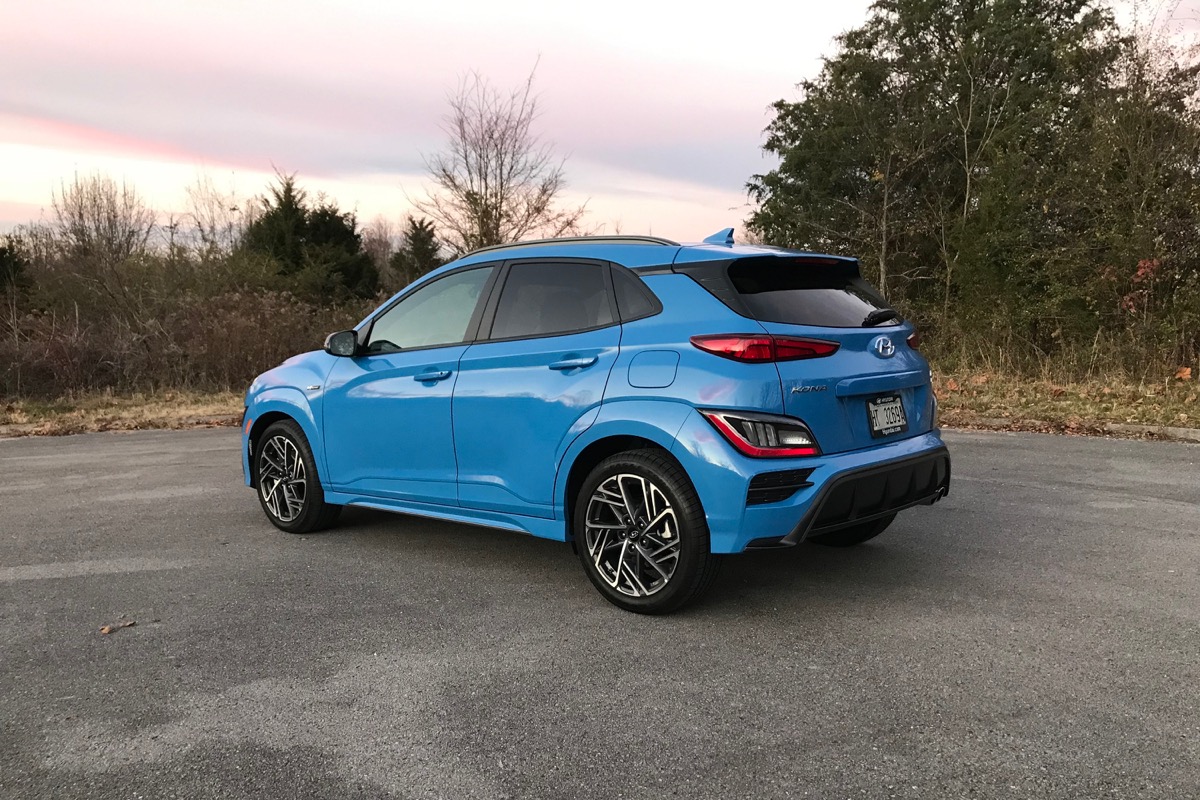
In spite of its high-performance underbelly, the Kona N exterior design is rather muted. The most noticeable difference between the Kona N and the standard Kona and N Line variant is the former's lack of body cladding. This is significant for a couple of reasons. One, the Kona N looks sleeker than its counterparts, especially since all enjoy a 4 cm extended wheelbase. And two, there is no postulation that the Kona N can go off-road. Because it can’t. Not on purpose, anyway. The purpose-built Hyundai Kona N is front-wheel-drive (FWD) only.
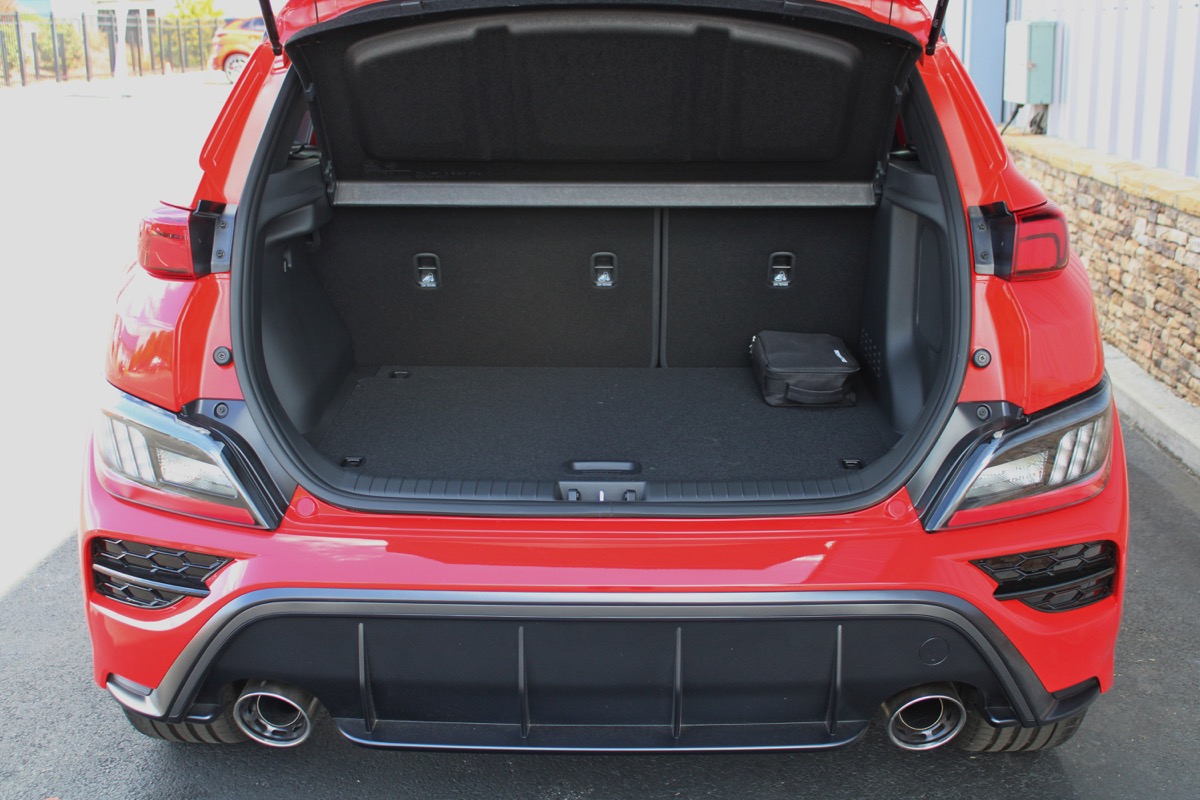
Giveaways as to its high-po tendencies are flashes of red along the vehicle’s lower body moldings and on the brake covers, large bore exhaust outlets, a specialized lower bumper and diffuser, a rear wing spoiler, an exclusive front fascia, and “N” branding on the grille, wheel caps, calipers, and moldings. The Kona N also sits on 19-inch aluminum-alloy wheels wrapped in Pirelli P-Zero summer sport tires. Six exterior colour choices are offered in Canada, including the Kona N-exclusive Sonic Blue. Note that if you opt for Ignite Flame red like our test vehicle, the red accents on the lower part of the bumpers and side skirts go away. Instead, these pieces are in gloss black. And understandably so, otherwise, you’d have a vehicle that basically looks like a tomato.
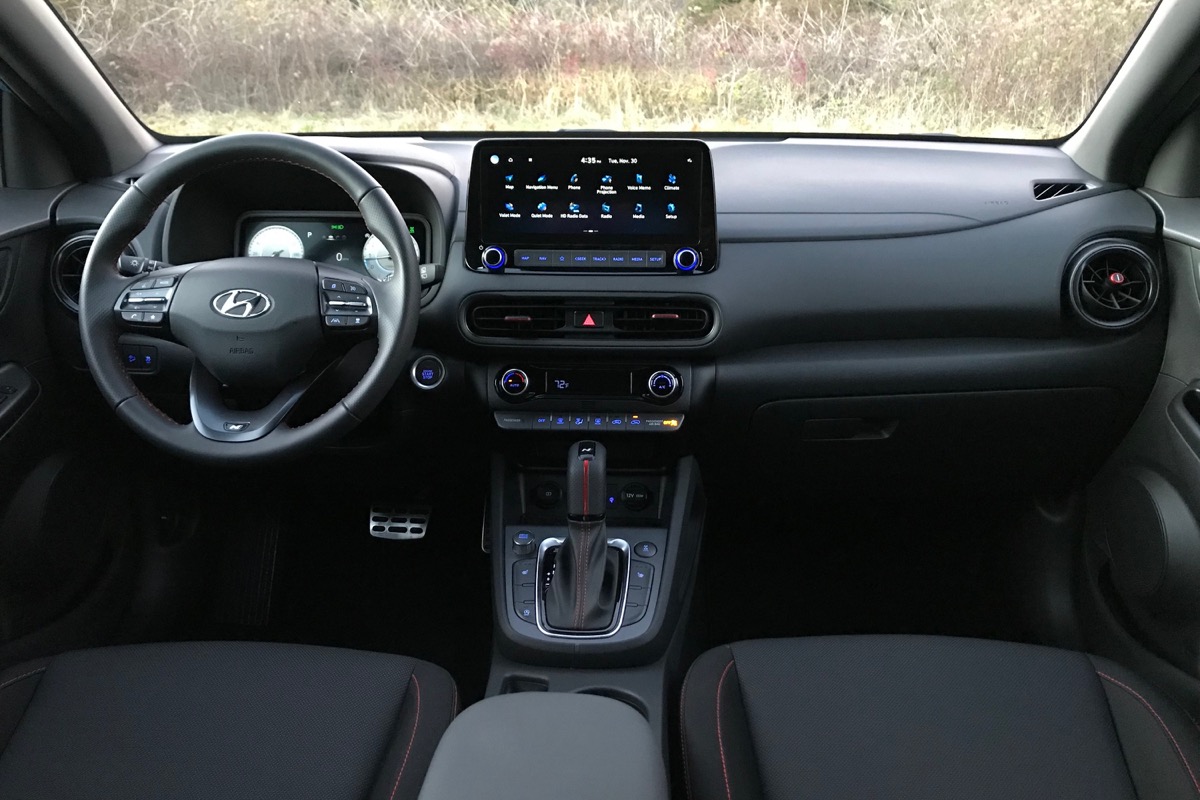
The Kona N interior is about as low-key as the exterior but, again, with unique sporty subtleties. Like the Kona N Line, the Kona N cabin comes in one variety: black. However, where the Kona N Line has red accents and contrast stitching on the seats and shifter assembly, the Kona N features a soothing Performance Blue. Also in light blue are two distinctive steering wheel-mounted buttons simply labeled “N.” The only bit of red within the Kona N cabin is another steering wheel-mounted button labeled “NGS.” We’ll explain those later.
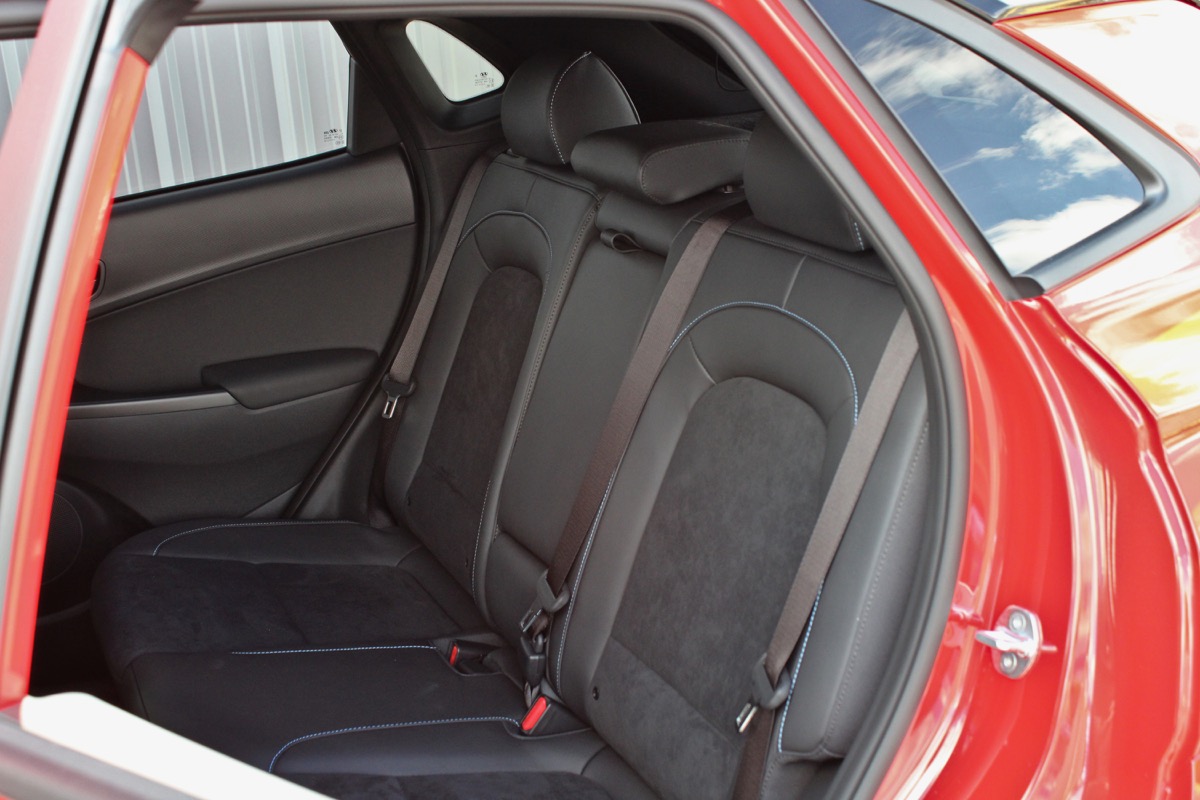
The N Brand logo also makes an appearance on the shift knob, steering wheel spoke, and front bucket N sport seats. The sport-fashioned upholstery is leather with suede inserts in both the front and rear for added comfort and support during exuberant driving (which is guaranteed to happen). While the Hyundai Kona N design hints at a sporty characteristic, the vehicle truly boasts its worth with what lies underneath the hood in addition to modifications made to the body, chassis, and suspension.
Performance
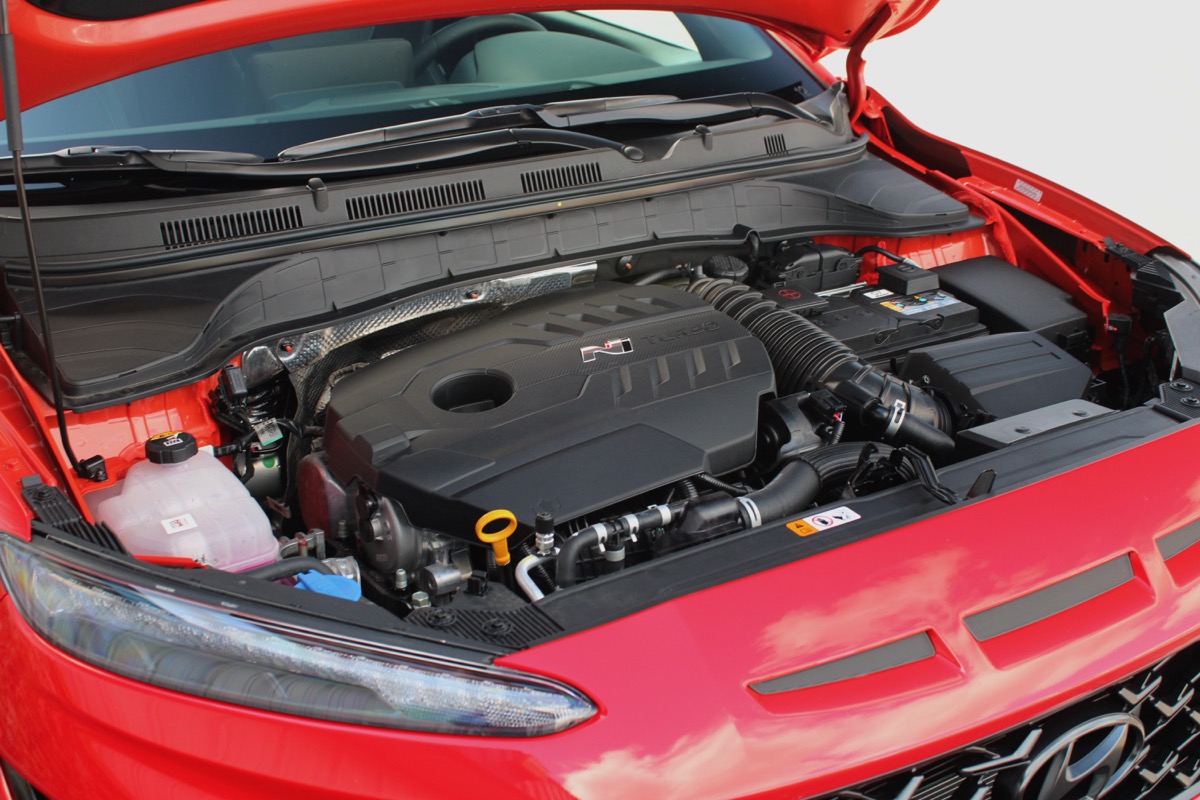
As the most powerful Kona in the lineup, the Kona N features the same turbocharged 2.0-litre four-cylinder engine found in the new-for-2022 Elantra N and Veloster N. The powertrain is tuned to match the output and sound of the Elantra N, which is 276 horsepower and 289 pound-feet of torque. That’s 129 hp more than the standard Kona and 81 hp more than the Kona N Line. Regarding torque, the Kona N adds 157 lb-ft and 95 lb-ft to the Kona and Kona N Line figures, respectively.
The Kona N is also equipped with an eight-speed “wet” dual-clutch transmission (N DCT), the same one used in the Elantra and Veloster N variants. For some, having no manual transmission in what’s essentially a hot hatch sounds counterintuitive. It also means the Kona N is the only Hyundai N model without a manual. But keep in mind that no Hyundai Kona trim is offered with a stick shift and that the N DCT is a phenomenal transmission.
Hyundai’s N DCT is available only in its N Brand cars. In the U.S., that currently means the Elantra N, Kona N, and Veloster N. The transmission utilizes oil to help with lubrication, cooling, and smoother gear changes. It’s also fitted with electronic actuators to quicken gear changes as well as enhance fuel efficiency. With the quick shifts and tons of power, the Kona N accelerates from zero to 100 kilometres per hour in 5.5 seconds.
When put to the test on a track and autocross, the FWD configuration does lend itself to some torque steer but not so much that you’ll be wrangling with the steering wheel. Instead, the electronic limited-slip differential will kick in, allowing for some responsive handling. We genuinely forgot we were behind the wheel of a small crossover.
For added stability, the Kona N received extra strengthening and reinforcements thanks to more spot welds. And performance features came by way of an electronically-controlled suspension, a motor-driven steering system as well as large, high-power brakes that were borrowed from the Sonata but tuned for dynamic driving situations.
If that weren’t enough, you get not one but two customizable N driving modes (remember, the light blue buttons). In addition to Eco, Normal, and Sport, the N modes come in Hyundai-spec or can be changed to your liking. When selecting the other drive modes, you get the expected colour change of the digital instrument cluster and the infotainment screen. Blue for Eco and Normal; red for Sport. N mode changes everything—from the tachometer style to the on-screen control settings. You’re presented with vehicle stats up the yazoo and track-day diagnostics (i.e., lap timer, G-forces, etc.). Plus, N mode turns up the sport exhaust system for some snap cracklin’ pop backfire goodness.
Want to really go nuts? Hit that lone NGS button and you’ll get an instant burst of 10 extra hp for 20 seconds. Say what? Say yes. The N Grin Shift, or NGS, shifts the Kona N into the lowest gear to create an overboost effect, which brings about the additional horsepower. There’s a 40-second cooldown time but it really means you’ve got 286 total hp for every lap.
Between the autocross course, track laps, and street drive, the Kona N was surprisingly fun and engaging to drive. It hit the track apexes with an unexpected quickness and turned through autocross corners with significant grip. And with about 2.5 cm more ground clearance than your standard sedan, it rides more like a hooligan hatchback than a sluggish SUV. Holy Hyundai is the Kona N a riot.
Form & function
The Veloster N is a neat little ditty to throw around corners and canyons. Its power-to-fun ratio is enormous but its everyday practicality leaves a lot to be desired. With a strange three-door setup and little cargo space, it’s a subcompact hatch without a whole lot of usefulness. But now you have the Kona N as an option.
Performance-tuning aside, the Kona N is a standard Kona in every other way. Its total interior volume is 3,208 litres. The 60/40-split rear seats fold flat for up to 1,296 litres of cargo capacity or 544 litres with the rear seats up. Not cavernous by any stretch but definitely plenty enough for a couple of pieces of luggage. If you need to carry more gear or large items, roof rails are standard with cross rails an available accessory.
The Kona N front seats are also very comfortable and well-bolstered for whatever drive mode your mood decides on. Legroom up front is ample at 1,054 mm but rear-seat occupants could feel a bit squeezed in, especially those who are taller than average. This is a subcompact car, after all. The Kona N's backseat offers only 893 mm of legroom, which is less than the Elantra compact sedan’s 964 mm.
The ergonomics of the N-designed steering wheel is good, the infotainment system isn’t a stretch, and interior materials don’t feel cheap. It’s still pretty dark in there, though. And the Kona N can’t be optioned with a sunroof for more natural light because of weight savings and all.
Technology
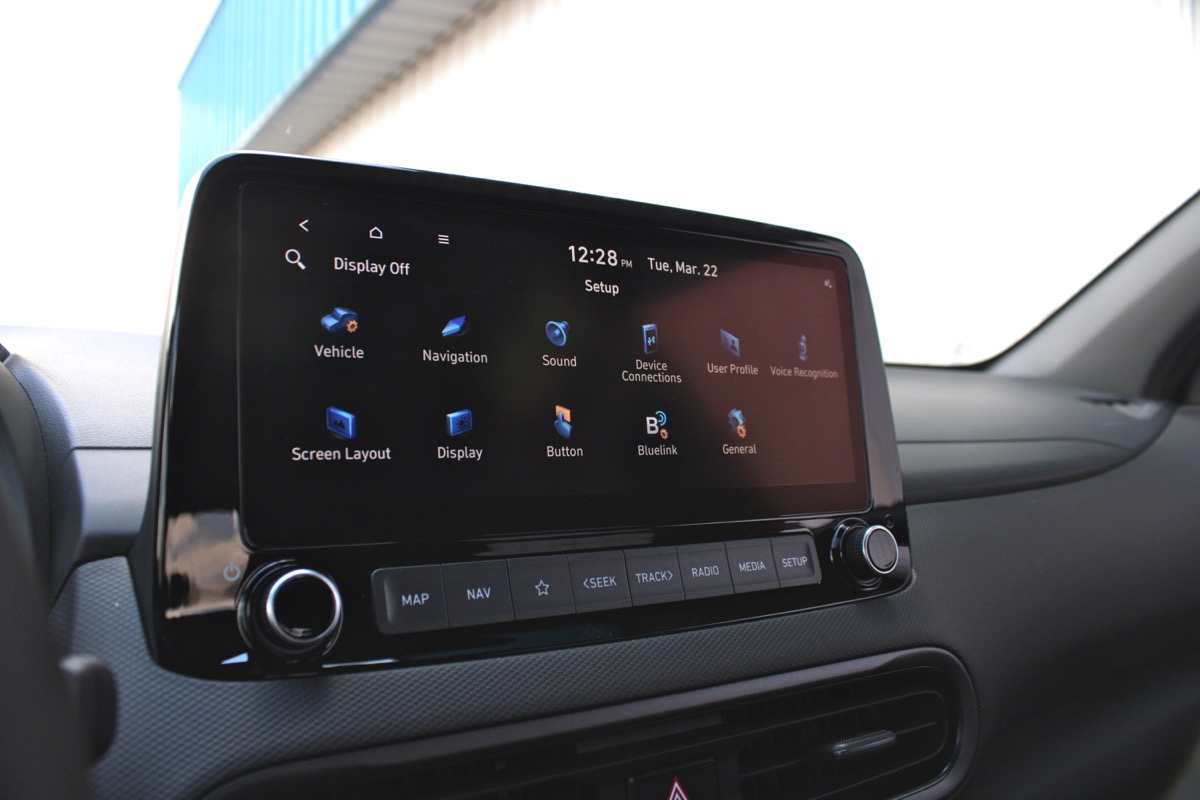
For 2022, the Hyundai Kona upgraded its digital instrument cluster and infotainment display options. The standard infotainment screen increased from 7 inches to 8 inches with the option for a 10.25-inch navigation-infotainment system. The instrument panel comes as a standard 4.2-inches multi-information screen or an optional fully digital 10.25-inch touchscreen. The Kona N is equipped with the larger screens. With responsive sensitivity and clear graphics, the touchscreen was intuitive to use.
Specific to the Kona N is the performance data access. Appearing on both the instrument panel and centre stack display, the quick-access N mode buttons open up vehicle status and control settings screens. From here, drivers can see not only performance statistics but also easily configure the N drive mode. Some of the available adjustments include engine tuning, steering feel, suspension stiffness, transmission mapping, and exhaust sound. Oh, you can also activate Launch Control from the performance page, too.
In terms of connectivity, the Kona N is compatible with Android Auto and Apple CarPlay but via a wired connection. This is the same as in other Kona trims with the larger infotainment screen. Wireless device charging is standard, however, and other charge points include two USB hubs in the front and one in the rear as well as a 12-volt outlet. Also standard is a Harman Kardon premium audio system that features 8 speakers and an external amp. A 90-day complimentary trial to SiriusXM is included.
The Hyundai Digital Key app (currently only available for Android-based smartphones) and three years of free access to enhanced Hyundai Blue Link Connected Services and Remote Start packages are standard. Owners are able to remotely manage vehicle control settings like remote start and climate control as well as access vehicle maintenance reports. Lots of high-end tech in a non-luxury, entry-level vehicle.
Safety
Like all Kona models, the Hyundai Kona N is equipped with a suite of driving assistance systems. Standard on the Kona N are automatic high beams, a driver attention warning, forward-collision avoidance with pedestrian detection, lane-keeping assist, lane-following assist, rear occupant alert, and safe exit assist. Other active safety features like blind-spot monitoring and rear cross-traffic alert also are standard.
The 2022 Hyundai Kona N has not yet been rated by the National Highway Traffic Safety Administration (NHTSA) but the standard Kona was tested and received a 5-Star overall crash safety rating, the highest possible. Considering the Kona N is equipped with the same safety features but also adds structural reinforcements, it is likely to score similarly.
The Insurance Institute for Highway Safety (IIHS) doesn’t consider the Kona N as a separate vehicle from the greater Kona lineup. However, the Kona did not rate as highly in IIHS crash tests, falling short of the coveted Top Safety Pick designation. The vehicle did earn the highest possible rating of “Good” in all crashworthiness tests but missed top marks with second-best “Acceptable” scores in small overlap tests and dropped another notch to “Marginal” with regards to the vehicle’s child seat anchors (LATCH) system.
Also worth noting is that the Kona N—and only the Kona N—does not come equipped with a spare tire. The rest of the Kona lineup, including the Kona N Line, has a compact spare. In lieu of this, the Kona N is equipped with a tire mobility kit and 24-hour roadside assistance courtesy of Hyundai Blue Link.
Cost-effectiveness
The 2022 Hyundai Kona N is offered in one maxed-out trim level. As the all-inclusive, top-of-the-line model, the Kona N has an MSRP of $39,999 (not including the $1,825 destination fee). That’s a $17,650 markup from a base FWD Kona, which starts at $22,349. Compared to the Kona N Line, which the Kona N shares many amenities with, the price jump is $10,300. And the Kona N’s power advantage versus the N Line trim is about 90 in both horsepower and pound-feet of torque. Don’t forget the added performance modifications. There aren’t any options packages either. Just a $200 premium for any colour but white.
Certainly, if your needs are price and practicality, and you have little to no interest in a sports car then, yes, the Kona N doesn’t make much sense compared to the rest of the lineup. It also returns unimpressive fuel economy with a Natural Resources Canada-estimated 11.8 litres per 100 kilometres in city driving, 8.7 on the highway, and 10.4 combined when compared to its Kona siblings. FWD models with non-turbo 2.0-litre engines offer 8.0/6.6/7.4 L/100 km while 1.6-litre turbo-four vehicles, sold only with AWD in Canada, average 8.8/7.4/8.2 L/100 km.
But when looking for an affordable hot hatch or small sports SUV, then the Kona N delivers exceptional value. Especially since, at the moment, it doesn’t have any direct competitors. From the mass market, you can probably look at the Honda Civic Type R, for which Canadian pricing hasn’t yet been announced for the next generation.
Closer to specs and style, though, are the Mini Cooper and Mercedes-Benz performance SUV options. Mini offers the John Cooper Works All4 trim on its Clubman and Countryman models. Fraternal Benz twins the AMG GLA 35 and AMG GLB 35 also fall into similar numbers with regards to power, performance, and dynamics. Of course, you’re going to pay a premium price for the luxury labels. The Minis start in the mid-40s while the Mercs are closer to the mid-55 to 60-grand range.
As a hopped-up, hatchback-like motorsports aficionado, the 2022 Kona N is welcome addition to carry the Hyundai N badge. It may not be the biggest and brawniest thing on a racetrack, but it does provide genuine racing capability which invariably means pure joy behind the wheel. N Grin Shift optional (but it doesn’t hurt).
Note: Images show a US model.
What owners say
This car is a blast to drive! Worth every penny! The only thing I think this car is missing is an AWD option and the forged wheels available in the European Markets. This car definitely competes with the Golf R at a lower price point with comparable if not better features.
June 24, 2022Trims & specs
Base MSRP N/A | Seating 5 |
Engine N/A | Cargo Capacity 544 L |
Combined MPG N/A | Drivetrain N/A |


Pricing trends
Current avg. market price
$25,311
Trending down by 3.1% this month
May 2026 - November 2026

