2022 Hyundai Palisade Reviews, Pricing & Specs
Write a reviewPros
Quiet cabin
Spacious third row
Stylish design
Cons
Unintuitive technology
Sluggish touchscreen response
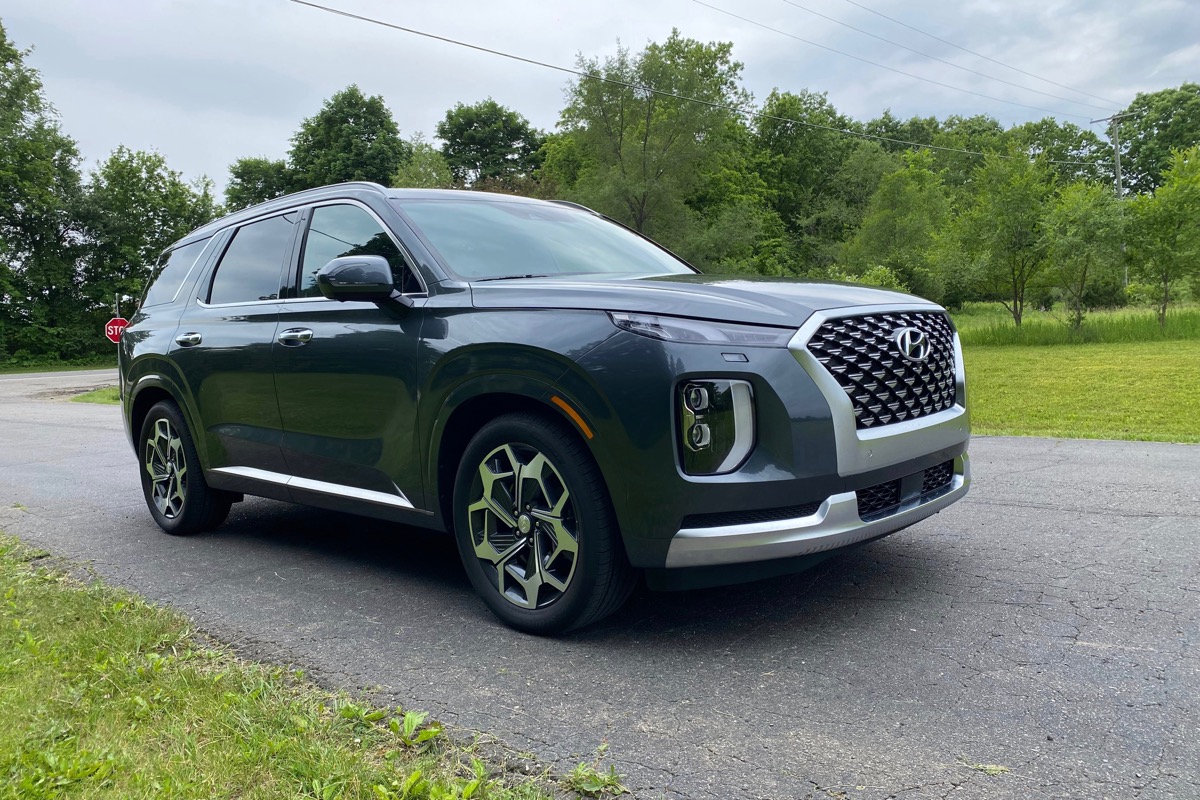
The 2022 Hyundai Palisade offers a spacious, attractive form of family transportation with impressive features all around.

The Palisade joined the Hyundai lineup for the 2020 model year, replacing the Santa Fe XL as the brand's SUV flagship. Hyundai has had a bit of a rotation going through the flagship position over the years, with the Santa Fe, Veracruz, and Santa Fe XL taking turns. The Palisade now stands atop a broad lineup of crossovers and SUVs, including the Venue, Kona, Tucson and (non-XL) Santa Fe, with the battery-electric Ioniq 5 and hydrogen fuel-cell Nexo thrown in for good measure.
The Palisade presents an elegant, striking exterior design. While it was possible to criticize earlier Hyundai designs for being derivative or unimaginative, the Palisade can shed the past with an easy shrug. It has distinctive lines and shapes, from its prominent grille to the crisp shoulder lines to its tasteful tailgate. A thoughtful mix of planes and curves, highlighted by the sculpted wheel arches, adds visual interest to the SUV's profile. A provocative continuous strip of glass surfaces run from C-pillar around the tailgate to the opposite C-pillar, giving the impression of a floating rear roof and rendering the D-pillar invisible from the outside. Pronounced taillights (LED on Ultimate Calligraphy) add interest and high visibility from the rear and sides. Expressive LED headlights, LED running lights, and LED accents provide a signature look up front. In Canada, 20-inch alloy wheels are standard on all models. Take away the Hyundai badge up front, and the Palisade could easily slip into the Infiniti lineup—that's a compliment.
Inside, things are similarly elegant and polished. A horizontally arrayed 12.3-inch touchscreen lives at the top of the centre stack, attached to the instrument panel binnacle. The beefy centre console anchors the dash. High-quality materials and finishes adorn every surface. The second row of seating is either a roomy bench as is standard in the Preferred and Urban models, or a pair of captain's chairs that’s optional in Urban and standard in Ultimate Calligraphy. The third row is spacious enough for two adults for a short ride or anytime for up to three kids.
Fit and finish inside and out is at near-luxury levels. The Palisade is a worthy flagship in design and execution. Our test vehicle, a top-of-the-line Ultimate Calligraphy model, was truly stunning in a coat of Steel Graphite paint and black interior combination.

At a time when new vehicles trend toward electrification and turbocharging, the Palisade arrives with a naturally aspirated 3.8-litre V6 gasoline engine, almost a throwback choice in this age of prolific turbocharged engines. The V6 does get gasoline direct injection and dual variable valve timing, squeezing greater power and efficiency out of its regular unleaded fuel. Additionally, the V6 is Atkinson-cycle-capable—a tactic used by many hybrid powertrains to save gas—and has auto-stop-and-go settings to reduce idle time (and save even more gas).
Still, Natural Resources Canada estimates that the Palisade will consume 12.3 litres per 100 kilometres in city driving, 9.6 on the highway, and 11.1 combined—not among the fuel economy leaders in the class.
The trade-off for the middling efficiency is power. The 3.8-litre unit in the Palisade produces power specs of 291 horsepower and 262 pound-feet of torque, and since there's no turbo or supercharger to spool up, there's no lag. The V6 engine note is a bonus—not quite the V8 burble of yore, but a baritone rumble you'll never get with an inline-four-cylinder. Hyundai doesn't quote a zero-to-100-kilometre time for the Palisade, but our seat-of-the-pants estimate says this SUV is more than quick enough for family use.
At a curb weight of 1,991 to 2,004 kilograms (4,389 to 4,418 pounds) depending on configuration, the Palisade is not a heavyweight for its size. It handles nicely, thanks to four-wheel independent suspension (MacPherson struts front/multi-link rear) and stabilizer bars at both ends.
The Palisade can tow up to 2,267 kilograms (5,000 pounds) using trailer brakes or up to 748 kilograms (1,650 pounds) without.

As a minivan replacement, the Palisade has responsibilities throughout the cabin. Starting in the third row, it delivers comfortable seating and easy access, along with cupholders on each side. The second-row captain's chairs are deliciously comfortable, and though we didn't test the available second-row bench seat, it has ample legroom and headroom, too. Door panels can swallow bottles, cupholders add convenience, and seatback pockets will handle a tablet or two. The front row has even more storage, including two compartments in the centre console, a locking glove box, and door panel bottle holders.
Luggage space behind the third row measures up at 509 litres. Fold down the third row, and you've opened up 1,297 litres of space. With both second and third rows folded flat, a cavern of 2,447 litres becomes available. An underfloor storage compartment adds a few extra litres, too. If you need to carry more, the roof rails can hold up to 100 kilograms (220 pounds) of cargo.
Hyundai has settled on a compact shift-by-wire setup for its gear selector, which takes the form of four buttons on the centre console. Park is set off to the left, and Reverse, Neutral, and Drive are in a vertical line beside it. The unfamiliar setup takes some time to get used to but works well and takes up minimal space. Other controls, buttons, and knobs cluster logically and become second nature to engage after a few days of driving. Hard knobs for audio volume and radio tuning are well-placed and much appreciated.
A conventional sunroof is standard on all Palisade models, and a dual-panel version comes standard on the Ultimate Calligraphy. The dual-panel sunroof substantially improves the ambiance in the second and third rows and could be a reason to step up to the upper trim level for some buyers.
In Canada, heated front seats with memory for the driver’s seat, heated second-row outboard seats, and a heated steering wheel are standard. Ventilated front seats, a hands-free liftgate, and power-folding third-row seats are standard on the Urban and Ultimate Calligraphy trims, and ventilated rear seats are standard on Ultimate Calligraphy.
The Ultimate Calligraphy trim level gets some of the high-end luxury features buyers love, like rain-sensing windshield wipers, premium Nappa leather upholstery, quilted door panels, and more.

Hyundai has evolved into a leader in technology in its cars, and in many ways, the Palisade is a showcase.
The standard display audio system gets a 1920 x 720 colour touchscreen, and all trims but the base receive a 630-watt Harman Kardon premium audio with 12 speakers, QuantumLogic surround sound, and Clari-Fi music restoration technology. Clari-Fi does a fantastic job of improving the sound of low-resolution mp3 files and similar digital content and is a must for anyone who cares about audio quality.
The infotainment system includes wired Android Auto and Apple CarPlay, Bluetooth, HD Radio, and satellite radio. Three USB ports live in the first row, two in the second row, and two more in the third row. A Qi wireless device charging pad lives conveniently in the centre console on Ultimate Calligraphy models. Four total 12-volt power outlets exist around the cabin, and a 115-volt power outlet comes standard on Ultimate Calligraphy. A rear-view monitor with parking guidance is standard on all models, with surround view function on Urban and Ultimate Calligraphy. Ultimate Calligraphy add a standard head-up display for the driver.
Hyundai's Blue Link connected car system is standard on Urban and Ultimate Calligraphy. It comes with an app that enables remote engine start and other functions, as well as remote vehicle monitoring. Remote keyless entry is standard on all models, with a proximity key and push-button start. Urban and Ultimate Calligraphy models get a trick 12.3-inch digital instrument cluster replacing the analog gauges and multi-information display available on the Preferred. The digital cluster integrates with the turn signals and blind-spot monitor cameras, projecting the view from the appropriate side camera when the turn signal is engaged.

Hyundai is deservedly proud of its safety reputation, earned by upgrading to a comprehensive list of standard and available passive and active features in all of its vehicles, including the Palisade.
Passive safety features include seven airbags (driver, front passenger, driver and front passenger side-impact, driver knee, and side air curtains), three-point seat belts for all seating positions, LATCH anchors and tethers, active head restraints, a power window lock-out button, rear child-safety locks, a front crumple zone, 4 km/h bumpers, bodyside reinforcements, electronic shift-lock system, anti-theft system integrated with the remote keyless entry and panic alarm, and an immobilizer.
Standard active safety and advanced driver assistance features include anti-lock braking, electronic stability control with traction control and brake assist, vehicle stability management, a tire pressure monitoring system with individual tire indicator, blind-spot collision avoidance assist, rear cross-traffic collision-avoidance assist, reverse parking distance warning, rear occupant alert, forward collision-avoidance assist (automatic emergency braking) with pedestrian detection, lane-keeping assist, driver attention warning, adaptive cruise control, lane-following assist, safe exit assist, and trailer sway control. Forward-looking parking sensors are standard on Urban and Ultimate Calligraphy, while the latter also adds Highway Driving Assist, which combines adaptive cruise control and automated lane centring.
The 2022 Hyundai Palisade is a Top Safety Pick+ (highest rating) for the Insurance Institute for Highway Safety (IIHS) and earned the top rating of five stars from the National Highway Traffic Safety Administration (NHTSA).

In Canada, the 2022 Hyundai Palisade three-row SUV comes in three trim levels, each with standard all-wheel drive (a front-wheel drive (FWD) drivetrain is not offered in our market). The Palisade Preferred starts at $47,399. The Palisade Urban starts at $52,599. The Palisade Ultimate Calligraphy starts at $56,199. Freight and handling is $1,925 extra. The market is very volatile, as is feature and vehicle availability, so check current pricing while shopping.
The Palisade comes with three years of Blue Link Connected Services where equipped. Five years/100,000 kilometres of new car warranty, five years/unlimited kilometres of roadside assistance, and five years/100,000 kilometres of powertrain warranty are also included.
The Palisade competes with a crowd of excellent three-row crossovers, including the Toyota Highlander, Subaru Ascent, Honda Pilot, Chevrolet Traverse, Ford Explorer, and others, including its corporate stablemate, the Kia Telluride.
Ultimately, your choice of a three-row family crossover will come down to taste and budget. The upper trim level of the Palisade, Ultimate Calligraphy, may have a pretentious name, but it is a lovely, near-luxury option, while the base Preferred is well-equipped (a Hyundai hallmark), competitively priced, and well worth considering. The 2022 Hyundai Palisade earns a high recommendation.
Note: Images show a US model.

User reviews for 2022 Hyundai Palisade
Write a review2022 Hyundai Palisade Pricing
Trims & specs
Air Conditioning
Single front air conditioning zones · Rear air conditioning: with independent controls · Single rear air conditioning zones · Second and third row rear heat vents
Airbags
Dual front airbags · Driver knee airbags · Passenger airbag deactivation: occupant sensing deactivation · Front side airbags · Front side curtain airbags
Audio System
Antenna Type: mast · Voice recognition audio system · Bluetooth auxiliary audio input · AM/FM radio · Total Number of Speakers: 6
Brakes
ABS: 4-wheel · Braking assist: hill start assist · Electronic parking brake: auto off · Front brake diameter: 13.4 · Front brake width: 1.18 · Front brakes: ventilated disc · Rear brake diameter: 12.0 · Rear brake width: .43 · Rear brakes: disc
Comfort Features
Armrests: rear center with cupholders · Center console trim: metallic · Door sill trim: scuff plate · Door trim: cloth · Floor Material: carpet · Steering wheel trim: urethane
Convenience Features
Adaptive stop and go cruise control: semi-automatic · Assist handle: passenger side · Cargo area power outlet: 12V · Center console: front console with armrest and storage · Cruise control: adaptive · Cupholders: rear · Easy entry: manual rear seat · Multi-function remote: keyless entry · One-touch windows: 2 · Power outlet(s): two 12V front · Power steering: electric · Power windows: lockout button · Reading lights: front · Rear power outlet: 12V · Steering wheel: tilt and telescopic · Steering wheel mounted controls: audio · Storage: sunglasses holder · Vanity mirrors: dual illuminating
Driver Seat
Manual adjustments: 6
Drivetrain
Axle ratio: 3.65
Engine
Alternator: 180 amps
Exterior Features
Door handle color: body-color · Exhaust: dual exhaust tips · Exhaust tip color: chrome · Fender lip moldings: black · Front bumper color: body-color · Grille color: grey · Mirror color: body-color · Rear bumper color: body-color · Rear spoiler: roofline spoiler · Rear spoiler color: body-color · Rear trunk/liftgate: liftgate · Rocker panel color: black · Window trim: chrome
Headrests
Front headrests: adjustable · Number of front headrests: 2 · Number of rear headrests: 3 · Number of third row headrests: 3
In Car Entertainment
Connected in-car apps: Google POIs · Infotainment screen size: 8 in. · Smartphone integration: wireless Apple CarPlay
Instrumentation
Fuel economy display: range · Instrument cluster screen size: 3.5 in. · Warnings and reminders: maintenance reminder
Lights
Daytime running lights: LED · Headlights: LED
Mirrors
Exterior mirrors: manual folding · Inside rearview mirror: manual day/night
Passenger Seat
Manual Adjustments: 4
Rear Seats
Type: 60-40 split bench
Safety
Automatic emergency braking: front pedestrian · Camera system: rearview · Child seat anchors: LATCH system · Cross Traffic Alert: rear · Crumple zones: front · Parking sensors: rear · Pre-Collision Warning System: vibrating steering wheel · Pre-collision warning system: pedestrian detection · Rearview monitor: in dash
Seatbelts
Front seatbelts: 3-point · Seatbelt force limiters: front · Seatbelt pretensioners: front · Seatbelt warning sensor: driver and passenger · Second row seatbelts: 3-point · Third row seatbelts: 3-point
Seats
Driver seat manual adjustments: height · Front seat type: bucket · Passenger seat manual adjustments: reclining · Rear headrests: adjustable · Rear seat folding: flat · Rear seat manual adjustments: reclining · Third row headrests: adjustable · Third row seat folding: flat · Upholstery: cloth
Security
Power door locks: anti-lockout
Spare Tire
Mount Location: underbody · Size: temporary
Spare Wheel
Rim Type: steel
Stability and Traction
Traction control: with trailer stability control
Steering
Steering ratio: 15.6 · Turns lock-to-lock: 2.90
Suspension
Front Arm Type: lower control arms · Front Shock Type: gas shock absorbers · Front Spring Type: coil springs · Front Suspension Classification: independent · Front Suspension Type: MacPherson struts · Rear Shock Type: gas shock absorbers · Rear Spring Type: coil springs · Rear Suspension Classification: independent · Rear Suspension Type: multi-link · Stabilizer bar(s): front
Telematics
Electronic messaging assistance: with voice recognition · Phone: voice activated · Phone wireless data link: Bluetooth
Third Row Seat
Type: 40-60 split bench
Tires
Type: all season
Tires and Rims
Wheel type: aluminum alloy
Towing and Hauling
Trailer wiring: 7-pin
Windows
Front wipers: variable intermittent · Laminated glass: acoustic · Liftgate window: fixed · Power windows: with safety reverse · Rear wiper: intermittent · Solar-tinted glass: front
Air Conditioning
Single front air conditioning zones · Rear air conditioning: with independent controls · Single rear air conditioning zones · Second and third row rear heat vents
Airbags
Dual front airbags · Driver knee airbags · Passenger airbag deactivation: occupant sensing deactivation · Front side airbags · Third row side curtain airbags
Audio System
Antenna Type: mast · Voice recognition audio system · Bluetooth auxiliary audio input · HD radio · Total Number of Speakers: 6
Brakes
ABS: 4-wheel · Braking assist: hill start assist · Electronic parking brake: auto off · Front brake diameter: 13.4 · Front brake width: 1.18 · Front brakes: ventilated disc · Rear brake diameter: 12.0 · Rear brake width: .43 · Rear brakes: disc
Comfort Features
Armrests: rear center with cupholders · Center console trim: metallic · Door sill trim: scuff plate · Door trim: cloth · Floor Material: carpet · Steering wheel trim: urethane
Convenience Features
Adaptive stop and go cruise control: semi-automatic · Assist handle: passenger side · Cargo area power outlet: 12V · Center console: front console with armrest and storage · Cruise control: adaptive · Cupholders: rear · Easy entry: manual rear seat · Multi-function remote: trunk release · One-touch windows: 2 · Power outlet(s): two 12V front · Power steering: speed-proportional · Power windows: lockout button · Reading lights: front · Rear power outlet: 12V · Steering wheel: tilt and telescopic · Steering wheel mounted controls: audio · Storage: door pockets · Vanity mirrors: dual illuminating
Driver Seat
Manual adjustments: 6
Drivetrain
4WD Type: on demand · Axle ratio: 3.65
Engine
Alternator: 180 amps
Exterior Features
Door handle color: body-color · Exhaust: dual exhaust tips · Exhaust tip color: chrome · Fender lip moldings: black · Front bumper color: body-color · Grille color: grey · Mirror color: body-color · Rear bumper color: body-color · Rear spoiler: roofline spoiler · Rear spoiler color: body-color · Rear trunk/liftgate: liftgate · Rocker panel color: black · Window trim: chrome
Headrests
Front headrests: adjustable · Number of front headrests: 2 · Number of rear headrests: 3 · Number of third row headrests: 3
In Car Entertainment
Connected in-car apps: Google POIs · Infotainment screen size: 8 in. · Smartphone integration: wireless Android Auto
Instrumentation
Fuel economy display: MPG · Instrument cluster screen size: 3.5 in. · Warnings and reminders: maintenance reminder
Lights
Daytime running lights: LED · Headlights: Auto on/off
Mirrors
Exterior mirrors: integrated turn signals · Inside rearview mirror: manual day/night
Passenger Seat
Manual Adjustments: 4
Rear Seats
Type: 60-40 split bench
Safety
Automatic emergency braking: front pedestrian · Camera system: rearview · Child seat anchors: LATCH system · Cross Traffic Alert: rear · Crumple zones: front · Parking sensors: rear · Pre-Collision Warning System: vibrating steering wheel · Pre-collision warning system: pedestrian detection · Rearview monitor: in dash
Seatbelts
Front seatbelts: 3-point · Seatbelt force limiters: front · Seatbelt pretensioners: front · Seatbelt warning sensor: driver and passenger · Second row seatbelts: 3-point · Third row seatbelts: 3-point
Seats
Driver seat manual adjustments: height · Front seat type: bucket · Passenger seat manual adjustments: reclining · Rear headrests: adjustable · Rear seat folding: flat · Rear seat manual adjustments: reclining · Third row headrests: adjustable · Third row seat folding: split · Upholstery: cloth
Security
Power door locks: anti-lockout
Spare Tire
Mount Location: underbody · Size: temporary
Spare Wheel
Rim Type: steel
Stability and Traction
Traction control: with trailer stability control
Steering
Steering ratio: 15.6 · Turns lock-to-lock: 2.90
Suspension
Front Arm Type: lower control arms · Front Shock Type: gas shock absorbers · Front Spring Type: coil springs · Front Suspension Classification: independent · Front Suspension Type: MacPherson struts · Rear Shock Type: gas shock absorbers · Rear Spring Type: coil springs · Rear Suspension Classification: independent · Rear Suspension Type: multi-link · Stabilizer bar(s): rear
Telematics
Electronic messaging assistance: with read function · Phone: voice activated · Phone wireless data link: Bluetooth
Third Row Seat
Type: 40-60 split bench
Tires
Type: all season
Tires and Rims
Wheel type: aluminum alloy
Towing and Hauling
Trailer wiring: 7-pin
Windows
Front wipers: variable intermittent · Laminated glass: acoustic · Liftgate window: fixed · Power windows: with safety reverse · Rear wiper: intermittent · Solar-tinted glass: front
Air Conditioning
Air filtration: ionizing · Automatic climate control front air conditioning · Dual front air conditioning zones · Automatic climate control rear air conditioning · Single rear air conditioning zones · Second and third row rear heat vents
Airbags
Dual front airbags · Driver knee airbags · Passenger airbag deactivation: occupant sensing deactivation · Front side airbags · Front side curtain airbags
Audio System
Antenna Type: mast · Voice recognition audio system · Auxiliary audio input: jack · HD radio · Total Number of Speakers: 6
Brakes
ABS: 4-wheel · Braking assist: hill start assist · Electronic parking brake: auto off · Front brake diameter: 13.4 · Front brake width: 1.18 · Front brakes: ventilated disc · Rear brake diameter: 12.0 · Rear brake width: .43 · Rear brakes: disc
Comfort Features
Armrests: rear outboard seats · Center console trim: metallic · Door sill trim: scuff plate · Door trim: cloth · Floor Material: carpet · Steering wheel trim: leather
Convenience Features
Adaptive stop and go cruise control: semi-automatic · Assist handle: passenger side · Cargo area power outlet: 12V · Center console: front console with armrest and storage · Cruise control: adaptive · Cupholders: rear · Dimming rearview mirror: auto-dimming · Easy entry: manual rear seat · Multi-function remote: proximity entry system · One-touch windows: 2 · Power outlet(s): USB front · Power steering: speed-proportional · Power windows: lockout button · Reading lights: front · Rear power outlet: 12V · Steering wheel: tilt and telescopic · Steering wheel mounted controls: phone · Storage: bin · Universal garage door opener: Homelink · Vanity mirrors: dual illuminating
Driver Seat
Adjustable lumbar support: power · Power adjustments: 8
Drivetrain
Axle ratio: 3.65
Engine
Alternator: 180 amps
Exterior Features
Door handle color: chrome · Exhaust: dual exhaust tips · Exhaust tip color: chrome · Fender lip moldings: body-color · Front bumper color: body-color · Grille color: grey · Mirror color: body-color · Rear bumper color: body-color · Rear spoiler: roofline spoiler · Rear spoiler color: body-color · Rear trunk/liftgate: liftgate · Rocker panel color: black · Window trim: chrome
Headrests
Front headrests: adjustable · Number of front headrests: 2 · Number of rear headrests: 2 · Number of third row headrests: 3
In Car Entertainment
Connected in-car apps: Google POIs · Infotainment screen size: 8 in. · Smartphone integration: wireless Android Auto
Instrumentation
Fuel economy display: range · Instrument cluster screen size: 3.5 in. · Warnings and reminders: low oil level
Lights
Daytime running lights: LED · Exterior entry lights: security approach lamps · Headlights: Auto on/off
Mirrors
Exterior mirrors: integrated turn signals
Passenger Seat
Manual Adjustments: 4
Rear Seats
Type: captains chairs
Roof
Moonroof: power glass · Moonroof / Sunroof: power sunshade · Roof rails: silver
Safety
Automatic emergency braking: rear · Camera system: rearview · Child seat anchors: LATCH system · Cross Traffic Alert: rear · Crumple zones: front · Parking sensors: rear · Pre-Collision Warning System: vibrating steering wheel · Pre-collision warning system: pedestrian detection · Rearview monitor: in dash
Seatbelts
Front seatbelts: 3-point · Seatbelt force limiters: front · Seatbelt pretensioners: front · Seatbelt warning sensor: driver and passenger · Second row seatbelts: 3-point · Third row seatbelts: 3-point
Seats
Driver seat power adjustments: height · Front seat type: bucket · Passenger seat manual adjustments: reclining · Rear headrests: adjustable · Rear seat folding: flat · Rear seat manual adjustments: reclining · Third row headrests: adjustable · Third row seat folding: split · Upholstery: cloth
Security
Power door locks: anti-lockout
Spare Tire
Mount Location: underbody · Size: temporary
Spare Wheel
Rim Type: steel
Stability and Traction
Traction control: with trailer stability control
Steering
Steering ratio: 15.6 · Turns lock-to-lock: 2.90
Suspension
Front Arm Type: lower control arms · Front Shock Type: gas shock absorbers · Front Spring Type: coil springs · Front Suspension Classification: independent · Front Suspension Type: MacPherson struts · Rear Shock Type: gas shock absorbers · Rear Spring Type: coil springs · Rear Suspension Classification: independent · Rear Suspension Type: multi-link · Stabilizer bar(s): rear
Telematics
Electronic messaging assistance: with voice recognition · Phone: voice activated · Phone wireless data link: Bluetooth
Third Row Seat
Type: 40-60 split bench
Tires
Type: all season
Tires and Rims
Wheels: polished aluminum
Towing and Hauling
Trailer wiring: 7-pin
Windows
Front wipers: variable intermittent · Laminated glass: acoustic · Liftgate window: fixed · Power windows: with safety reverse · Rear wiper: with washer · Solar-tinted glass: front
Air Conditioning
Air filtration: ionizing · Automatic climate control front air conditioning · Dual front air conditioning zones · Automatic climate control rear air conditioning · Single rear air conditioning zones · Second and third row rear heat vents
Airbags
Dual front airbags · Driver knee airbags · Passenger airbag deactivation: occupant sensing deactivation · Front side airbags · Rear side curtain airbags
Audio System
Antenna Type: mast · Voice recognition audio system · Auxiliary audio input: jack · AM/FM radio · Total Number of Speakers: 6
Brakes
ABS: 4-wheel · Braking assist: hill start assist · Electronic parking brake: auto off · Front brake diameter: 13.4 · Front brake width: 1.18 · Front brakes: ventilated disc · Rear brake diameter: 12.0 · Rear brake width: .43 · Rear brakes: disc
Comfort Features
Armrests: rear outboard seats · Center console trim: metallic · Door sill trim: scuff plate · Door trim: cloth · Floor Material: carpet · Steering wheel trim: leather
Convenience Features
Adaptive stop and go cruise control: semi-automatic · Assist handle: rear · Cargo area power outlet: 12V · Center console: front console with armrest and storage · Cruise control: adaptive · Cupholders: front · Dimming rearview mirror: auto-dimming · Easy entry: manual rear seat · Multi-function remote: proximity entry system · One-touch windows: 2 · Power outlet(s): two 12V front · Power steering: speed-proportional · Power windows: lockout button · Reading lights: front · Rear power outlet: 12V · Steering wheel: tilt and telescopic · Steering wheel mounted controls: paddle shifter · Storage: in-floor · Universal garage door opener: Homelink · Vanity mirrors: dual illuminating
Driver Seat
Adjustable lumbar support: power · Power adjustments: 8
Drivetrain
4WD Type: on demand · Axle ratio: 3.65
Engine
Alternator: 180 amps
Exterior Features
Door handle color: chrome · Exhaust: dual exhaust tips · Exhaust tip color: chrome · Fender lip moldings: body-color · Front bumper color: body-color · Grille color: grey · Mirror color: body-color · Rear bumper color: body-color · Rear spoiler: roofline spoiler · Rear spoiler color: body-color · Rear trunk/liftgate: liftgate · Rocker panel color: black · Window trim: chrome
Headrests
Front headrests: adjustable · Number of front headrests: 2 · Number of rear headrests: 2 · Number of third row headrests: 3
In Car Entertainment
Connected in-car apps: Google search · Infotainment screen size: 8 in. · Smartphone integration: wireless Apple CarPlay
Instrumentation
Fuel economy display: MPG · Instrument cluster screen size: 3.5 in. · Warnings and reminders: maintenance reminder
Lights
Daytime running lights: LED · Exterior entry lights: security approach lamps · Headlights: Auto on/off
Mirrors
Exterior mirrors: integrated turn signals
Passenger Seat
Manual Adjustments: 4
Rear Seats
Type: captains chairs
Roof
Moonroof: tilt/slide · Moonroof / Sunroof: power sunshade · Roof rails: silver
Safety
Automatic emergency braking: front pedestrian · Camera system: rearview · Child seat anchors: LATCH system · Cross Traffic Alert: rear · Crumple zones: front · Parking sensors: rear · Pre-Collision Warning System: audible warning · Pre-collision warning system: pedestrian detection · Rearview monitor: in dash
Seatbelts
Front seatbelts: 3-point · Seatbelt force limiters: front · Seatbelt pretensioners: front · Seatbelt warning sensor: driver and passenger · Second row seatbelts: 3-point · Third row seatbelts: 3-point
Seats
Driver seat power adjustments: reclining · Front seat type: bucket · Passenger seat manual adjustments: reclining · Rear headrests: adjustable · Rear seat folding: flat · Rear seat manual adjustments: reclining · Third row headrests: adjustable · Third row seat folding: split · Upholstery: cloth
Security
Power door locks: anti-lockout
Spare Tire
Mount Location: underbody · Size: temporary
Spare Wheel
Rim Type: steel
Stability and Traction
Traction control: with trailer stability control
Steering
Steering ratio: 15.6 · Turns lock-to-lock: 2.90
Suspension
Front Arm Type: lower control arms · Front Shock Type: gas shock absorbers · Front Spring Type: coil springs · Front Suspension Classification: independent · Front Suspension Type: MacPherson struts · Rear Shock Type: gas shock absorbers · Rear Spring Type: coil springs · Rear Suspension Classification: independent · Rear Suspension Type: multi-link · Stabilizer bar(s): rear
Telematics
Electronic messaging assistance: with read function · Phone: voice activated · Phone wireless data link: Bluetooth
Third Row Seat
Type: 40-60 split bench
Tires
Type: all season
Tires and Rims
Wheels: polished aluminum
Towing and Hauling
Trailer wiring: 7-pin
Windows
Front wipers: variable intermittent · Laminated glass: acoustic · Liftgate window: fixed · Power windows: with safety reverse · Rear wiper: with washer · Solar-tinted glass: front
Air Conditioning
Air filtration: ionizing · Automatic climate control front air conditioning · Dual front air conditioning zones · Automatic climate control rear air conditioning · Single rear air conditioning zones · Second and third row rear heat vents
Airbags
Dual front airbags · Driver knee airbags · Passenger airbag deactivation: occupant sensing deactivation · Front side airbags · Rear side curtain airbags
Audio System
Antenna Type: diversity · Voice recognition audio system · Bluetooth auxiliary audio input · Premium Brand: Harman-Kardon · HD radio · Satellite Radio: SiriusXM · 1 subwoofer · Surround audio: 5.1 · Total Number of Speakers: 11 · 630 watts
Brakes
ABS: 4-wheel · Braking assist: hill start assist · Electronic parking brake: auto off · Front brake diameter: 13.4 · Front brake width: 1.18 · Front brakes: ventilated disc · Rear brake diameter: 12.0 · Rear brake width: .43 · Rear brakes: disc
Comfort Features
Armrests: rear outboard seats · Dash Trim: Leatherette · Door sill trim: scuff plate · Door trim: leatherette · Floor Material: carpet · Steering wheel trim: leather
Convenience Features
Adaptive stop and go cruise control: semi-automatic · Ambient lighting: color-adjustable · Assist handle: passenger side · Autonomous lane guidance: lane centering · Cargo area power outlet: 12V · Center console: front console with armrest and storage · Cruise control: adaptive · Cupholders: front · Dimming rearview mirror: auto-dimming · Easy entry: manual rear seat · Footwell lights: color-adjustable · Memorized settings: side mirrors · Multi-function remote: trunk release · One-touch windows: 2 · Power outlet(s): USB rear · Power steering: speed-proportional · Power windows: lockout button · Reading lights: front · Rear power outlet: 115V · Steering wheel: tilt and telescopic · Steering wheel mounted controls: multi-function screen controls · Storage: door pockets · Sunshade: side window · Universal garage door opener: Homelink · Vanity mirrors: dual illuminating
Driver Seat
Adjustable lumbar support: 4-way power · Power adjustments: 8
Drivetrain
Axle ratio: 3.65
Engine
Alternator: 180 amps
Exterior Features
Door handle color: chrome · Exhaust: dual exhaust tips · Exhaust tip color: chrome · Fender lip moldings: body-color · Front bumper color: body-color · Grille color: grey · Mirror color: body-color · Rear bumper color: body-color · Rear spoiler: roofline spoiler · Rear spoiler color: body-color · Rear trunk/liftgate: sensor-activated · Rocker panel color: black · Skid plate(s): front · Window trim: chrome
Headrests
Front headrests: adjustable · Number of front headrests: 2 · Number of rear headrests: 2 · Number of third row headrests: 3
In Car Entertainment
Connected in-car apps: Google search · Infotainment: Blue Link · Infotainment screen size: 10.25 in.
Instrumentation
Fuel economy display: MPG · Instrument cluster screen size: 12.3 in. · Warnings and reminders: low oil level
Lights
Daytime running lights: LED · Exterior entry lights: security approach lamps · Headlights: auto delay off · Tail and brake lights: LED
Mirrors
Exterior mirrors: power
Passenger Seat
Power adjustments: 8
Rear Seats
Type: captains chairs
Roof
Moonroof: power glass · Moonroof / Sunroof: power sunshade · Rear moonroof: fixed glass · Roof rails: silver
Safety
Automatic emergency braking: rear · Blind spot safety: passenger side camera · Camera system: surround view · Child seat anchors: LATCH system · Cross Traffic Alert: rear · Crumple zones: front · Parking sensors: rear · Pre-Collision Warning System: visual warning · Pre-collision warning system: pedestrian detection · Rearview monitor: in dash
Seatbelts
Front seatbelts: 3-point · Seatbelt force limiters: front · Seatbelt pretensioners: front · Seatbelt warning sensor: driver and passenger · Second row seatbelts: 3-point · Third row seatbelts: 3-point
Seats
Driver seat power adjustments: height · Front seat type: bucket · Passenger seat power adjustments: height · Rear headrests: adjustable · Rear seat: ventilated · Rear seat folding: flat · Rear seat manual adjustments: reclining · Third row headrests: adjustable · Third row seat folding: power · Upholstery: premium leather
Security
Power door locks: anti-lockout
Spare Tire
Mount Location: underbody · Size: temporary
Spare Wheel
Rim Type: steel
Stability and Traction
Traction control: with trailer stability control
Steering
Steering ratio: 15.6 · Turns lock-to-lock: 2.90
Suspension
Front Arm Type: lower control arms · Front Shock Type: gas shock absorbers · Front Spring Type: coil springs · Front Suspension Classification: independent · Front Suspension Type: MacPherson struts · Leveling: self leveling suspension · Rear Shock Type: gas shock absorbers · Rear Spring Type: coil springs · Rear Suspension Classification: independent · Rear Suspension Type: multi-link · Stabilizer bar(s): rear
Telematics
Driver assistance app: roadside assistance · Electronic messaging assistance: with voice recognition · Navigation system: hard drive navigation system · Phone: voice activated · Phone wireless data link: Bluetooth · Smart device app compatibility: MyHyundai with Blue Link · Smart device app function: vehicle location
Third Row Seat
Type: 40-60 split bench
Tires
Type: all season
Tires and Rims
Wheel type: aluminum alloy
Towing and Hauling
Trailer wiring: 7-pin
Windows
Front wipers: variable intermittent · Laminated glass: acoustic · Liftgate window: fixed · Power windows: with safety reverse · Rear wiper: intermittent · Solar-tinted glass: front
Air Conditioning
Air filtration: ionizing · Automatic climate control front air conditioning · Dual front air conditioning zones · Automatic climate control rear air conditioning · Single rear air conditioning zones · Second and third row rear heat vents
Airbags
Dual front airbags · Driver knee airbags · Passenger airbag deactivation: occupant sensing deactivation · Front side airbags · Front side curtain airbags
Audio System
Antenna Type: mast · Voice recognition audio system · Bluetooth auxiliary audio input · Premium Brand: Harman-Kardon · Touch screen display radio · Satellite Radio: SiriusXM · 1 subwoofer · Surround audio: 5.1 · Total Number of Speakers: 11 · 630 watts
Brakes
ABS: 4-wheel · Braking assist: hill start assist · Electronic parking brake: auto off · Front brake diameter: 13.4 · Front brake width: 1.18 · Front brakes: ventilated disc · Rear brake diameter: 12.0 · Rear brake width: .43 · Rear brakes: disc
Comfort Features
Armrests: rear outboard seats · Dash Trim: Leatherette · Door sill trim: scuff plate · Door trim: leatherette · Floor Material: carpet · Headliner trim: Alcantara · Steering wheel trim: leather
Convenience Features
Adaptive stop and go cruise control: semi-automatic · Ambient lighting: color-adjustable · Assist handle: rear · Autonomous lane guidance: lane centering · Cargo area power outlet: 12V · Center console: with lighting · Cruise control: adaptive · Cupholders: front, rear and third row · Dimming rearview mirror: auto-dimming · Easy entry: manual rear seat · Footwell lights: color-adjustable · Memorized settings: side mirrors · Multi-function remote: proximity entry system · One-touch windows: 2 · Power outlet(s): USB front · Power steering: speed-proportional · Power windows: lockout button · Reading lights: front · Rear power outlet: 12V · Steering wheel: tilt and telescopic · Steering wheel mounted controls: phone · Storage: accessory hook · Sunshade: side window · Universal garage door opener: Homelink · Vanity mirrors: dual illuminating
Driver Seat
Adjustable lumbar support: 4-way power · Power adjustments: 8
Drivetrain
Axle ratio: 3.65
Engine
Alternator: 180 amps
Exterior Features
Door handle color: chrome · Exhaust: dual exhaust tips · Exhaust tip color: chrome · Fender lip moldings: body-color · Front bumper color: body-color · Grille color: chrome · Mirror color: body-color · Rear bumper color: body-color · Rear spoiler: roofline spoiler · Rear spoiler color: body-color · Rear trunk/liftgate: power operated · Rocker panel color: black · Skid plate(s): front and rear · Window trim: chrome
Headrests
Front headrests: adjustable · Number of front headrests: 2 · Number of rear headrests: 2 · Number of third row headrests: 3
In Car Entertainment
Connected in-car apps: Google search · Infotainment: Apply CarPlay ready · Infotainment screen size: 10.25 in.
Instrumentation
Fuel economy display: MPG · Instrument cluster screen size: 12.3 in. · Warnings and reminders: low oil level
Lights
Daytime running lights: LED · Exterior entry lights: puddle lamps · Headlights: auto delay off · Tail and brake lights: LED
Mirrors
Exterior mirrors: reverse gear tilt
Passenger Seat
Power adjustments: 8
Rear Seats
Type: captains chairs
Roof
Moonroof: tilt/slide · Moonroof / Sunroof: power sunshade · Rear moonroof: fixed glass · Roof rails: silver
Safety
Automatic emergency braking: rear · Blind spot safety: passenger side camera · Camera system: surround view · Child seat anchors: LATCH system · Cross Traffic Alert: rear · Crumple zones: front · Parking sensors: front · Pre-Collision Warning System: audible warning · Pre-collision warning system: pedestrian detection · Rearview monitor: in dash
Seatbelts
Front seatbelts: 3-point · Seatbelt force limiters: front · Seatbelt pretensioners: front · Seatbelt warning sensor: driver and passenger · Second row seatbelts: 3-point · Third row seatbelts: 3-point
Seats
Driver seat power adjustments: reclining · Front seat type: bucket · Passenger seat power adjustments: reclining · Rear headrests: adjustable · Rear seat: ventilated · Rear seat folding: flat · Rear seat manual adjustments: reclining · Third row headrests: adjustable · Third row seat folding: split · Upholstery: premium leather
Security
Power door locks: anti-lockout
Spare Tire
Mount Location: underbody · Size: temporary
Spare Wheel
Rim Type: steel
Stability and Traction
Traction control: with trailer stability control
Steering
Steering ratio: 15.6 · Turns lock-to-lock: 2.90
Suspension
Front Arm Type: lower control arms · Front Shock Type: gas shock absorbers · Front Spring Type: coil springs · Front Suspension Classification: independent · Front Suspension Type: MacPherson struts · Leveling: self leveling suspension · Rear Shock Type: gas shock absorbers · Rear Spring Type: coil springs · Rear Suspension Classification: independent · Rear Suspension Type: multi-link · Stabilizer bar(s): rear
Telematics
Driver assistance app: roadside assistance · Electronic messaging assistance: with voice recognition · Navigation system: with voice recognition · Phone: voice activated · Phone wireless data link: Bluetooth · Smart device app compatibility: MyHyundai with Blue Link · Smart device app function: maintenance status
Third Row Seat
Type: 40-60 split bench
Tires
Type: all season
Tires and Rims
Wheel type: aluminum alloy
Towing and Hauling
Trailer wiring: 7-pin
Windows
Front wipers: variable intermittent · Laminated glass: acoustic · Liftgate window: fixed · Power windows: with safety reverse · Rear wiper: with washer · Solar-tinted glass: front
Air Conditioning
Air filtration: ionizing · Automatic climate control front air conditioning · Dual front air conditioning zones · Automatic climate control rear air conditioning · Single rear air conditioning zones · Second and third row rear heat vents
Airbags
Dual front airbags · Driver knee airbags · Passenger airbag deactivation: occupant sensing deactivation · Front side airbags · Third row side curtain airbags
Audio System
Antenna Type: diversity · Voice recognition audio system · Bluetooth auxiliary audio input · Premium Brand: Harman-Kardon · HD radio · Satellite Radio: SiriusXM · 1 subwoofer · Surround audio: 5.1 · Total Number of Speakers: 11 · 630 watts
Brakes
ABS: 4-wheel · Braking assist: hill start assist · Electronic parking brake: auto off · Front brake diameter: 13.4 · Front brake width: 1.18 · Front brakes: ventilated disc · Rear brake diameter: 12.0 · Rear brake width: .43 · Rear brakes: disc
Comfort Features
Armrests: rear outboard seats · Dash Trim: Leatherette · Door sill trim: aluminum · Door trim: leatherette · Floor Material: carpet · Steering wheel trim: leather
Convenience Features
Adaptive stop and go cruise control: semi-automatic · Ambient lighting: color-adjustable · Assist handle: rear · Autonomous lane guidance: lane centering · Cargo area power outlet: 12V · Center console: front console with armrest and storage · Cruise control: adaptive · Cupholders: rear · Dimming rearview mirror: auto-dimming · Easy entry: manual rear seat · Footwell lights: color-adjustable · Memorized settings: side mirrors · Multi-function remote: proximity entry system · One-touch windows: 2 · Power outlet(s): USB front · Power steering: speed-proportional · Power windows: lockout button · Reading lights: front · Rear power outlet: 12V · Steering wheel: tilt and telescopic · Steering wheel mounted controls: cruise controls · Storage: accessory hook · Sunshade: side window · Universal garage door opener: Homelink · Vanity mirrors: dual illuminating
Driver Seat
Adjustable lumbar support: 4-way power · Power adjustments: 8
Drivetrain
4WD Type: on demand · Axle ratio: 3.65
Engine
Alternator: 180 amps
Exterior Features
Door handle color: chrome · Exhaust: dual exhaust tips · Exhaust tip color: chrome · Fender lip moldings: body-color · Front bumper color: body-color · Grille color: grey · Mirror color: body-color · Rear bumper color: body-color · Rear spoiler: roofline spoiler · Rear spoiler color: body-color · Rear trunk/liftgate: power operated · Rocker panel color: black · Skid plate(s): front and rear · Window trim: chrome
Headrests
Front headrests: adjustable · Number of front headrests: 2 · Number of rear headrests: 2 · Number of third row headrests: 3
In Car Entertainment
Connected in-car apps: Google POIs · Infotainment: Apply CarPlay ready · Infotainment screen size: 10.25 in.
Instrumentation
Fuel economy display: MPG · Instrument cluster screen size: 12.3 in. · Warnings and reminders: low fuel level
Lights
Daytime running lights: LED · Exterior entry lights: security approach lamps · Headlights: auto delay off · Tail and brake lights: LED
Mirrors
Exterior mirrors: reverse gear tilt
Passenger Seat
Power adjustments: 8
Rear Seats
Type: captains chairs
Roof
Moonroof: power glass · Moonroof / Sunroof: power sunshade · Rear moonroof: fixed glass · Roof rails: silver
Safety
Automatic emergency braking: front pedestrian · Blind spot safety: passenger side camera · Camera system: surround view · Child seat anchors: LATCH system · Cross Traffic Alert: rear · Crumple zones: front · Parking sensors: rear · Pre-Collision Warning System: vibrating steering wheel · Pre-collision warning system: pedestrian detection · Rearview monitor: in dash
Seatbelts
Front seatbelts: 3-point · Seatbelt force limiters: front · Seatbelt pretensioners: front · Seatbelt warning sensor: driver and passenger · Second row seatbelts: 3-point · Third row seatbelts: 3-point
Seats
Driver seat power adjustments: height · Front seat type: bucket · Passenger seat power adjustments: height · Rear headrests: adjustable · Rear seat: ventilated · Rear seat folding: flat · Rear seat manual adjustments: reclining · Third row headrests: adjustable · Third row seat folding: power · Upholstery: premium leather
Security
Power door locks: anti-lockout
Spare Tire
Mount Location: underbody · Size: temporary
Spare Wheel
Rim Type: steel
Stability and Traction
Traction control: with trailer stability control
Steering
Steering ratio: 15.6 · Turns lock-to-lock: 2.90
Suspension
Front Arm Type: lower control arms · Front Shock Type: gas shock absorbers · Front Spring Type: coil springs · Front Suspension Classification: independent · Front Suspension Type: MacPherson struts · Leveling: self leveling suspension · Rear Shock Type: gas shock absorbers · Rear Spring Type: coil springs · Rear Suspension Classification: independent · Rear Suspension Type: multi-link · Stabilizer bar(s): front
Telematics
Driver assistance app: roadside assistance · Electronic messaging assistance: with voice recognition · Navigation system: with voice recognition · Phone: voice activated · Phone wireless data link: Bluetooth · Smart device app compatibility: MyHyundai with Blue Link · Smart device app function: horn/light operation
Third Row Seat
Type: 40-60 split bench
Tires
Type: all season
Tires and Rims
Wheel type: aluminum alloy
Towing and Hauling
Trailer wiring: 7-pin
Windows
Front wipers: rain sensing · Laminated glass: acoustic · Liftgate window: fixed · Power windows: with safety reverse · Rear wiper: with washer · Solar-tinted glass: front
Air Conditioning
Air filtration: ionizing · Automatic climate control front air conditioning · Dual front air conditioning zones · Automatic climate control rear air conditioning · Single rear air conditioning zones · Second and third row rear heat vents
Airbags
Dual front airbags · Driver knee airbags · Passenger airbag deactivation: occupant sensing deactivation · Front side airbags · Rear side curtain airbags
Audio System
Antenna Type: mast · Voice recognition audio system · Auxiliary audio input: jack · Premium Brand: Harman-Kardon · HD radio · Satellite Radio: SiriusXM · 1 subwoofer · Surround audio: 5.1 · Total Number of Speakers: 11 · 630 watts
Brakes
ABS: 4-wheel · Braking assist: hill start assist · Electronic parking brake: auto off · Front brake diameter: 13.4 · Front brake width: 1.18 · Front brakes: ventilated disc · Rear brake diameter: 12.0 · Rear brake width: .43 · Rear brakes: disc
Comfort Features
Armrests: rear outboard seats · Dash Trim: Leatherette · Door sill trim: scuff plate · Door trim: leatherette · Floor Material: carpet · Headliner trim: Alcantara · Steering wheel trim: leather
Convenience Features
Adaptive stop and go cruise control: semi-automatic · Ambient lighting: color-adjustable · Assist handle: rear · Autonomous lane guidance: lane centering · Cargo area power outlet: 12V · Center console: front console with armrest and storage · Cruise control: adaptive · Cupholders: rear · Dimming rearview mirror: auto-dimming · Easy entry: manual rear seat · Footwell lights: color-adjustable · Memorized settings: side mirrors · Multi-function remote: keyless entry with panic alarm · One-touch windows: 2 · Power outlet(s): USB rear · Power steering: speed-proportional · Power windows: lockout button · Reading lights: front · Rear power outlet: 12V · Steering wheel: tilt and telescopic · Steering wheel mounted controls: multi-function screen controls · Storage: door pockets · Sunshade: side window · Universal garage door opener: Homelink · Vanity mirrors: dual illuminating
Driver Seat
Adjustable lumbar support: 4-way power · Power adjustments: 8
Drivetrain
4WD Type: on demand · Axle ratio: 3.65
Engine
Alternator: 180 amps
Exterior Features
Door handle color: chrome · Exhaust: dual exhaust tips · Exhaust tip color: chrome · Fender lip moldings: body-color · Front bumper color: body-color · Grille color: chrome · Mirror color: body-color · Rear bumper color: body-color · Rear spoiler: roofline spoiler · Rear spoiler color: body-color · Rear trunk/liftgate: liftgate · Rocker panel color: black · Skid plate(s): front · Window trim: chrome
Headrests
Front headrests: adjustable · Number of front headrests: 2 · Number of rear headrests: 2 · Number of third row headrests: 3
In Car Entertainment
Connected in-car apps: Google search · Infotainment: Apply CarPlay ready · Infotainment screen size: 10.25 in.
Instrumentation
Fuel economy display: MPG · Instrument cluster screen size: 12.3 in. · Warnings and reminders: maintenance reminder
Lights
Daytime running lights: LED · Exterior entry lights: security approach lamps · Headlights: Auto on/off · Tail and brake lights: LED
Mirrors
Exterior mirrors: power
Passenger Seat
Power adjustments: 8
Rear Seats
Type: captains chairs
Roof
Moonroof: anti-trapping feature · Moonroof / Sunroof: power sunshade · Rear moonroof: fixed glass · Roof rails: silver
Safety
Automatic emergency braking: front pedestrian · Blind spot safety: passenger side camera · Camera system: surround view · Child seat anchors: LATCH system · Cross Traffic Alert: rear · Crumple zones: front · Parking sensors: rear · Pre-Collision Warning System: visual warning · Pre-collision warning system: pedestrian detection · Rearview monitor: in dash
Seatbelts
Front seatbelts: 3-point · Seatbelt force limiters: front · Seatbelt pretensioners: front · Seatbelt warning sensor: driver and passenger · Second row seatbelts: 3-point · Third row seatbelts: 3-point
Seats
Driver seat power adjustments: height · Front seat type: bucket · Passenger seat power adjustments: height · Rear headrests: adjustable · Rear seat: ventilated · Rear seat folding: flat · Rear seat manual adjustments: reclining · Third row headrests: adjustable · Third row seat folding: power · Upholstery: premium leather
Security
Power door locks: anti-lockout
Spare Tire
Mount Location: underbody · Size: temporary
Spare Wheel
Rim Type: steel
Stability and Traction
Traction control: with trailer stability control
Steering
Steering ratio: 15.6 · Turns lock-to-lock: 2.90
Suspension
Front Arm Type: lower control arms · Front Shock Type: gas shock absorbers · Front Spring Type: coil springs · Front Suspension Classification: independent · Front Suspension Type: MacPherson struts · Leveling: self leveling suspension · Rear Shock Type: gas shock absorbers · Rear Spring Type: coil springs · Rear Suspension Classification: independent · Rear Suspension Type: multi-link · Stabilizer bar(s): rear
Telematics
Driver assistance app: roadside assistance · Electronic messaging assistance: with voice recognition · Navigation system: with voice recognition · Phone: voice activated · Phone wireless data link: Bluetooth · Smart device app compatibility: MyHyundai with Blue Link · Smart device app function: maintenance scheduling
Third Row Seat
Type: 40-60 split bench
Tires
Type: all season
Tires and Rims
Wheel type: aluminum alloy
Towing and Hauling
Trailer wiring: 7-pin
Windows
Front wipers: rain sensing · Laminated glass: acoustic · Liftgate window: fixed · Power windows: with safety reverse · Rear wiper: intermittent · Solar-tinted glass: front
