2022 Hyundai Tucson Hybrid Plug-In Reviews, Pricing & Specs




Pros & cons
What we like
Fun to drive
Plenty of cargo space
Standard advanced safety features
What to consider
Potentially polarizing design
Tech can be frustrating
Poor value for money
The CarGurus verdict
The redesigned Hyundai Tucson doubles down on efficiency with a plug-in hybrid variant.
As if its 2022 redesign wasn’t dramatic enough, Hyundai has added hybrid and plug-in hybrid powertrains to the all-new Tucson. With an estimated 53 kilometres of all-electric driving range, the Hyundai Tucson Plug-in Hybrid looks like a slam-dunk option for folks shopping in the compact crossover market. How it performs in cold weather, however, may be enough to send shoppers looking at other options.
out of 10 expert review
Look & feel
The two-row, compact SUV market is scalding hot. With excellent options like the Honda CR-V, the Toyota RAV4, the Subaru Forester, and the Mazda CX-5 filling only a corner of the space, there’s significant pressure on a company like Hyundai, which is attempting to capture further market share with a fully redesigned new Tucson.
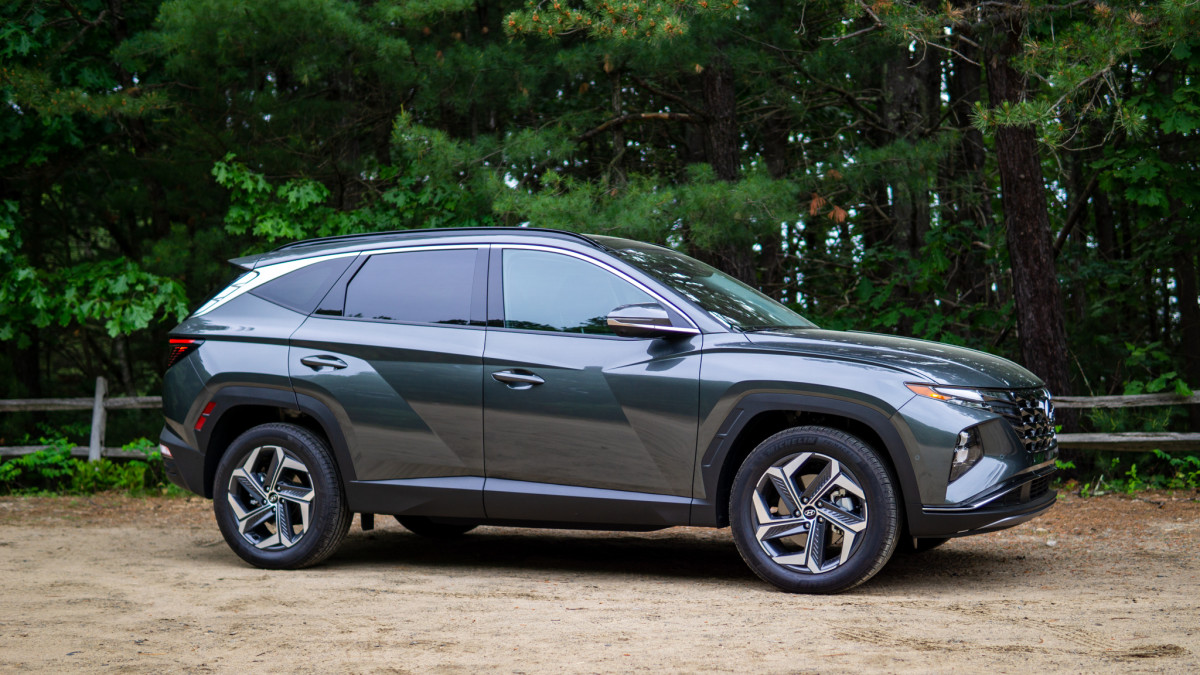
If it wasn’t obvious based on the new sheet metal, Hyundai is taking a big swing with the 2022 Tucson’s styling. A dramatic grille gives the new Tucson a distinctive face that is unlikely to be confused with any other brand on the road. The grille incorporates the headlights in a way that makes them blend in seamlessly with the overall design until they are illuminated, at which point they flank either side of the Tucson’s face with aggressive blades of light. From a design perspective, the plug-in hybrid (PHEV) Tucson is indistinguishable from the gas- and hybrid-powered models, save for its charging port’s door on the passenger side.
On the Tucson’s rear end, you’ll find toothy taillights with a stardust effect in each element. This is a fantastic design cue and belies the Tucson’s mass-market status. Down either side of the car, sharp creases break up the body panels. Barely 10 years ago, the complex stamping patterns necessary to create these body panels wouldn’t have been cost-effective for a vehicle priced in the mid-$40,000 range. Advances in manufacturing have made it cheaper and, thus, possible to add dramatic design language to a mass-market compact crossover. The 2022 Hyundai Tucson PHEV doesn’t take that possibility for granted. Whether or not the dramatic styling will age well is up for debate. Today, at least, the Tucson is a distinctive individual in a sea of conforming crossovers.
We tested a Tucson PHEV in the US equivalent of Canada’s Ultimate trim, which boasts a dark chrome grille and gloss-black pillars. Despite sharing parts with other Hyundai models, the Tucson has an interior design all its own. The flat, button-controlled transmission shifter opens up lots of space between the front seats, and the cabin manages to feel very open and airy despite its relatively compact dimensions. Our vehicle had leather-trimmed upholstery and a leather-wrapped steering wheel, which is standard on the Tucson PHEV in Canada along with heated front seats. The Ultimate also adds heated rear seats.
Interestingly, the Tucson doesn’t have any sort of covering or shade resting over its instrument cluster. We were pleased to see that this doesn’t result in any glare on the screen, but we did notice that dust gathered on the screen pretty easily.

Performance
Hyundai equips the non-hybrid, non-PHEV Tucson with a 2.5-litre naturally aspirated four-cylinder engine. It makes 187 horsepower and 178 pound-feet of torque, and it’s not a quick car, taking nearly 10 seconds to make it from zero to 100 kilometres per hour.
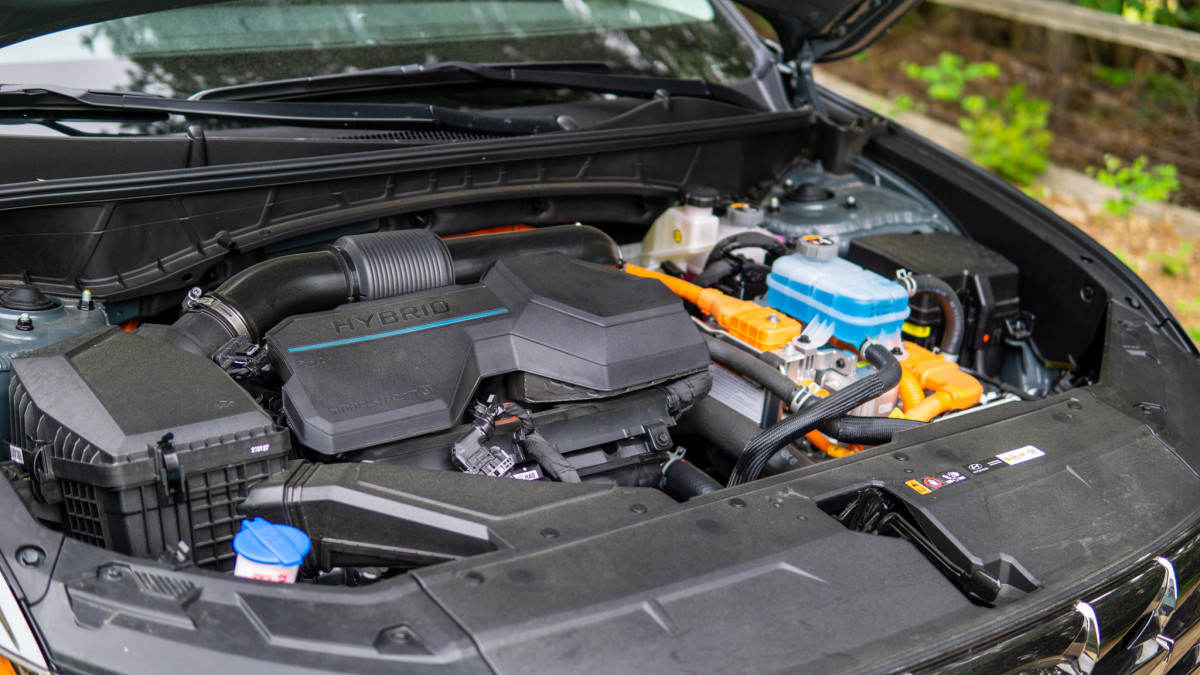
The hybrid Tucson is a fair bit quicker, with 226 horsepower thanks to a powertrain anchored off a more powerful 1.6-litre turbocharged four-cylinder. But the PHEV is the most potent of them all. With impressive specs, including a total of 261 horsepower, the PHEV benefits from the combined efforts of the hybrid’s 1.6-litre turbo engine and a 13.8-kWh battery pack.
The battery powers a single electric motor mounted on the front axle rather than the rear. A mechanical all-wheel-drive (AWD) drivetrain comes standard, and the Tucson PHEV manages its power with a six-speed automatic transmission rather than a continuously variable transmission, which is common in other hybrid and PHEV crossovers. Thanks to the conventional automatic, the Tucson doesn’t suffer from any “rubber-band effect,” when moving through gears. It’s reasonably sporty, with a well-controlled ride and a terrific suspension tune. The Tucson feels smooth and comfortable without feeling overly soft or floaty. Its standard 19-inch alloy wheels (non-PHEV Tucsons put 17-inch wheels on their lower trims) help keep the Tucson controlled in spirited driving.
It's not a performance SUV by any measure, but it’s better to drive than many cars in its class. Hyundai uses regenerative braking to act as a torque-vectoring system in corners, and various drive modes help drivers dial the Tucson to their liking.
53 kilometres of zero-emission EV range becomes available by topping up to a full charge via Level 1 (household plug and an onboard charger) or Level 2 (home charging station). is enough for many commuters—particularly those living in urban areas. After the battery has been depleted, the Tucson should return fuel economy of 6.7 litres per 100 kilometres, per Natural Resources Canada.
However, we noticed in our winter test drive that the Tucson PHEV’s heater doesn’t run without the engine running. There is no auxiliary, electric heater, so even with a fully charged battery, you’ll need to have the engine running if you want to have heat. This was likely a cost-saving measure, but it means that in a winter climate, the Tucson PHEV effectively won’t be able to drive anywhere on electric power alone. To us, this hugely saps a large part of the car’s value proposition.
Form & function
Drivers and passengers alike are going to appreciate the 2022 Hyundai Tucson’s comfortable seats. Although the PHEV, which comes with a standard panoramic sunroof, offers about 5 centimetres less headroom, it still feels spacious and pleasant. In particular, the ergonomics of the seats, armrests, and PHEV-standard heated steering wheel make this a car that is easy to drive over long periods.
In the back, a reclining rear seat lays much further back than we had expected—you can take a pretty good nap in the back of this car. As mentioned earlier, our test vehicle also boasted two-stage heated rear seats.
The trunk is also spacious, albeit a bit less so than the gas- and hybrid-powered Tucsons. 902 litres of cargo space is competitive in the segment, and the total 1,876 litres available with the rear seat folded is more than you’d get in a Toyota RAV4 Prime.
The Tucson PHEV has a smaller gas tank than the Tucson Hybrid. Given that it delivers a touch worse fuel economy than the standard hybrid once its electric range has been expended, this is a bit of an oversight. You simply won’t be able to go as far on a tank of gas in the PHEV as you would in the regular hybrid.

Technology
Hyundai, as is true of its corporate automaker relatives Kia and Genesis, has built a very strong technology offering in recent years. Crisp displays, stylish icons, and impressive feature sets make the Tucson PHEV’s tech look more impressive than the competition's.
A few highlights include the standard 10.25-inch touchscreen display fitted to our Tucson PHEV Ultimate tester. Although it doesn’t support wireless Apple CarPlay or wireless Android Auto connectivity (something the 8-inch display in the Luxury trim level does), the wired version of both is included. A Bose premium audio system is equipped on both trims in Canada. Further, the wider screen real estate can be used to show a second information panel; swipe through navigation, radio, phone projection, or weather updates on the small display while you keep your main information on the larger portion.
There are, however, a few quirks. Notably, the 2022 Tucson uses only touch-sensitive buttons for navigating the infotainment and adjusting the climate control. Paired with piano black plastic housing, these are hard to see in direct sunlight and a pain to use, regardless of the sun. Also, many of the more compelling features, like a power-adjustable front passenger seat and highway driving assist are only available on the much more expensive Ultimate trim.

Safety
Hyundai includes plenty of advanced driver-assistance systems (ADAS) and safety features as standard equipment on the 2022 Tucson PHEV. Included in the list are automatic emergency braking with pedestrian detection, cyclist detection, and junction-turning detection, which identifies cars turning across your path in an intersection, braking the Tucson if necessary. Blind-spot warning and collision avoidance are also standard, as are driver-attention warning, lane-keeping assist, lane-tracing assist, adaptive cruise control, rear cross-traffic alert, and safe exit warning—the latter being a handy system designed to alert you if there’s an upcoming car or cyclist before you open your car’s door. Both PHEV trims come with rain-sensing wipers.
Hyundai’s Highway Driving Assist, a semi-hands-free driving-assistance system, is standard on the Ultimate trim but not available on the Luxury. Likewise, the blind-view monitor is only available if you pay for the higher trim level. We’re particularly fond of the blind-view monitor, which shows the respective blind spot in your gauge cluster when you hit the turn-signal stalk, and we wish it were standard equipment across all trims. The National Highway Traffic Safety Administration (NHTSA) has not rated the PHEV, but the Tucson Hybrid received five out of five stars in overall crash testing. Similarly, the Insurance Institute for Highway Safety (IIHS) awarded the 2022 Tucson a Top Safety Pick+ award.

Cost-effectiveness
Hyundai sells the 2022 Tucson PHEV in two trims in Canada: Luxury and Ultimate. With a new vehicle starting price of $43,699 before the $1,925 destination fee, the Tucson PHEV Luxury looks like a good value—it’s less than the opening MSRP of $44,990 (not including $1,890 for destination) that you’ll find attached to a lesser-equipped base 2022 Toyota RAV4 Prime. However, the Luxury trim lacks many of the features that made our Tucson PHEV so compelling. And, at $46,399 (not including destination), the Tucson PHEV Ultimate looks like less of a bargain.
Note: Images and video show a US model.

What owners say
Yes good value. Can get more vertical space in cargo by lowering the floor. Like drive/terrain modes and proximity lift gate. Wonder about the glossy black dash though: dust, fingerprints, scratches, glare.
May 31, 2022We didnt do a ton of research, to be fair, but we really liked the car. A little less space-snippy than the fully electric Ionia 5, but still very modern, sleek and yet comfortable. And there arent a ton of plug-in hybrids to be had!
November 10, 2023Trims & specs
Base MSRP N/A | Seating N/A |
Engine N/A | Cargo Capacity N/A |
Combined MPG N/A | Drivetrain N/A |
Base MSRP N/A | Seating N/A |
Engine N/A | Cargo Capacity N/A |
Combined MPG N/A | Drivetrain N/A |
Base MSRP N/A | Seating 5 |
Engine 1.6L 268 hp I4 Hybrid | Cargo Capacity 903 L |
Combined MPG 77 | Drivetrain AWD |
Base MSRP N/A | Seating 5 |
Engine 1.6L 261 hp I4 Hybrid | Cargo Capacity 903 L |
Combined MPG 35 | Drivetrain AWD |
Base MSRP N/A | Seating N/A |
Engine N/A | Cargo Capacity N/A |
Combined MPG N/A | Drivetrain N/A |


Pricing trends
Current avg. market price
$30,309
Trending up by 4.7% this month
May 2026 - November 2026

