2022 Mercedes-Benz EQS Reviews, Pricing & Specs


The CarGurus verdict
The 2022 Mercedes EQS reimagines the luxury car for the coming electric era.
After a couple of false starts, Mercedes-Benz is finally getting serious about electric cars for the North American market. And it’s starting from the top.
The 2022 Mercedes-EQ EQS sedan is billed by the German automaker as the electric equivalent of its flagship S-Class sedan. The new EQS will itself become the flagship for a line of EQ-badged electric vehicles, which will include an EQS SUV, an EQE sedan and SUV, and a smaller EQB model. For now, the EQS sets the tone for the Mercedes EV lineup.
With sleek, aerodynamic styling and an elaborate infotainment system, the Mercedes EQS certainly makes a strong first impression. It also feels more luxurious than other similarly priced electric sedans such as the Audi e-Tron GT, Porsche Taycan, and Tesla Model S. The Lucid Air is shaping up to be a potential rival as well, but it’s only just starting production.
In Canada, the 2022 EQS will be available exclusively in the flagship grade, the dual-motor EQS 580 4MATIC with a starting MSRP of $144,200. (Mercedes-Benz Canada does not disclose destination charges as they vary by region and dealership.) Premium ($7,000), Sport ($4,500), Night ($5,000), and Executive Rear Seating ($7,000) packages are available.
out of 10 expert review
Look & feel
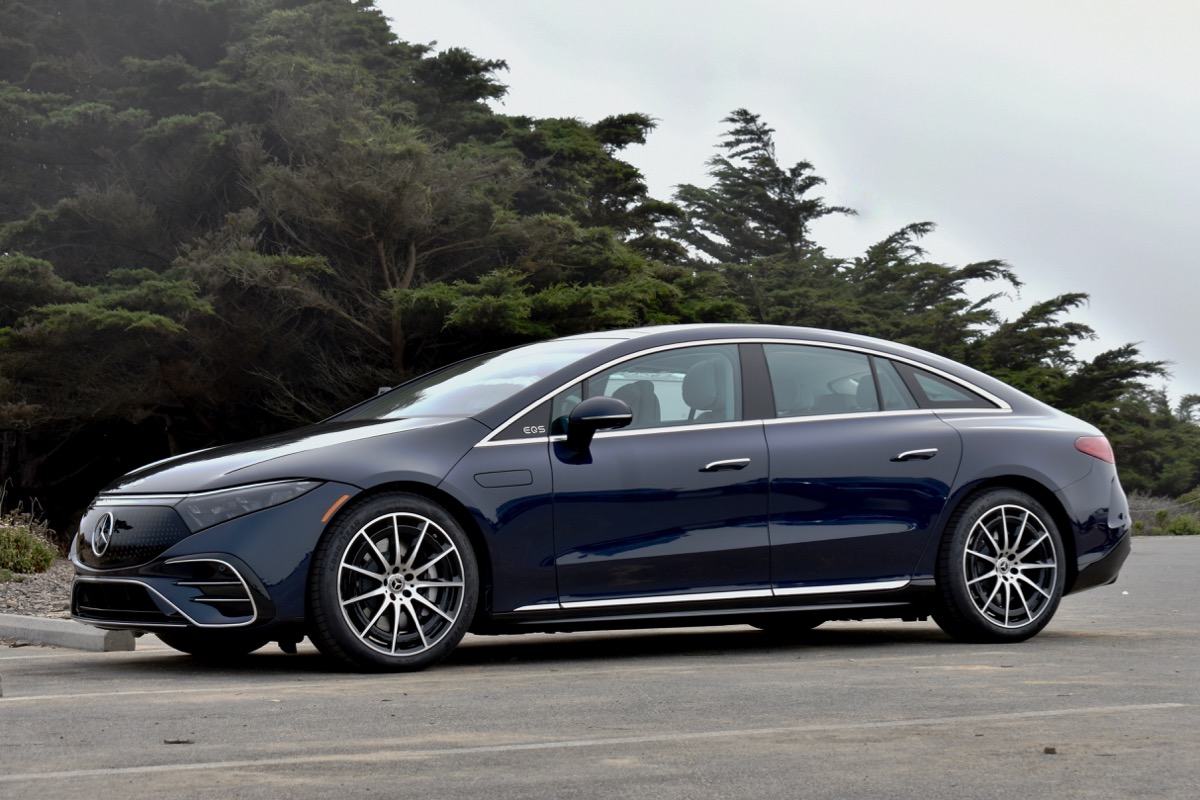
The EQS brings to mind the “jellybean” sedans of the 1990s, but it’s not making a retro fashion statement. Mercedes emphasized aerodynamics, sweeping back the windshield, closing off the grille, and giving the EQS a flat underbody. That resulted in a very low drag coefficient of 0.20. Less aerodynamic drag means less energy is needed to push the car through the air. When it comes to maximizing range, every little bit counts.
That devotion to the wind tunnel also means that the EQS looks sleeker and more futuristic than the more traditionally styled S-Class. However, it’s still a large, imposing car that’s actually quite tall (likely to accommodate the battery pack). The massive Mercedes star on the grille also makes it unlikely that bystanders will mistake this car for anything else. For anyone who doesn't get the hint, closer inspection reveals a cluster of tiny stars surrounding it.
You can also get aerodynamic wheel covers (necessary to achieve the lowest drag coefficient) with a similar star pattern. Mercedes offers 20-inch, 21-inch, and 22-inch wheels, which sit flush to the tires for maximum aerodynamic efficiency (and maximum potential for curb rash).
While it looks radically different, the EQS is fairly close to the S-Class in size. The EV is 1.5 centimetres wider and stands roughly 75 millimetres taller than its gasoline counterpart. The S-Class is 0.75 mm longer than the EQS, which translates to an extra 2.5 cm of wheelbase length.
The interior of the EQS has the same luxurious appearance as the S-Class cabin does, with leather upholstery, stately wood trim, panoramic glass sunroof, and a 64-colour ambient lighting system. You can even get (very comfy!) headrest pillows. However, Mercedes went for a more elaborate design, shaping a curved dashboard around the massive, dashboard-scanning MBUX Hyperscreen display and fitting it with large round air vents that look like they could propel a small aircraft.

Performance
The EQS 580 has two electric motors, one for each axle, giving it all-wheel drive (AWD) and combined power specs of 516 horsepower and 631 lb-ft of torque. Mercedes says the EQS 580 will make the sprint from 0 to 60 mph in 4.1 seconds with a 210 km/h top speed. (0 to 100 km/h times have not been published.)
Those acceleration times won’t set the luxury EV world on fire, but the EQS felt plenty quick in the real world. As with all electric cars, instant torque delivered a visceral feel that the numbers don’t adequately explain. Plus, Mercedes produced an artificial soundtrack that makes merging onto a highway feel like you’ve just engaged warp drive.
Because it’s the electric S-Class, the EQS was designed more for comfort than outright performance. Even with its fairly large wheels and low-profile tires, the EQS delivered great ride quality. Mercedes also kept wind and road noise to a minimum, which isn’t easy when you don’t have an internal-combustion engine to mask those sounds. The seat massagers and HVAC fans did punctuate the silence, however.
The EQS also gets some of the chassis hardware from the latest S-Class, including standard air suspension and rear-wheel steering that can turn the back wheels up to 10 degrees. Together, the suspension and the rear-axle steering produced both a comfortable ride and impressive handling. While the car we drove did feel a bit floaty on the highway, switching to Sport mode cured that. The EQS boasts excellent body control, and it felt like a much smaller car in the corners.
With its regenerative braking setup, Mercedes sought to strike a balance between efficiency and familiarity for drivers transitioning from internal-combustion cars. The standard level of regenerative braking doesn’t allow for one-pedal driving. The default settings also allow the car to creep forward when you lift your foot off the brake pedal, just like a gasoline vehicle. Turn off the creep function and flick the paddle shifters to enable more regen, and you can manage one-pedal driving in certain situations.
Mercedes also included an “intelligent” regenerative braking setting that increases regen when the car detects another vehicle ahead. It’s a bit like using adaptive cruise control. The system will also allow the car to coast when that is deemed more efficient and the road ahead is unobstructed. That worked a bit too well, in our experience. The EQS is so aerodynamic that it doesn’t noticeably decelerate when you take your foot off the right pedal, which can be a bit disconcerting at first.

Form & function
Mercedes did not provide complete interior measurements for the EQS, but we can at least confirm that it offers the same front legroom as an S-Class, with less headroom. That’s likely due to the aggressively sloped roof.
That roof line likely eats into rear-seat headroom as well. The back seats are also positioned fairly high compared to the front seats, creating a somewhat SUV-like feel. Still, buyers who prefer to be driven rather than drive themselves can opt for the EQS Executive Rear Seating package, which adds power-adjustable heated and ventilated rear seats with memory, a larger rear centre armrest with wireless phone charging, extra rear USB-C ports, and “comfort” rear headrests.
While it is considered a sedan, the EQS actually has a rear hatch instead of a trunk, which opens to reveal a long but narrow cargo area. With approximately 620 litres, the EQS offers more cargo space than the internal-combustion Mercedes S-Class. You can also fold the rear seats to get roughly 1,780 litres of cargo space.
What you don’t get is a front trunk. In fact, the hood doesn’t even open. On the inside, Mercedes raised up the centre console, leaving a handy storage area below. Slide the wood-paneled console open, and you get another small nook that hides a wireless phone charger. However, Mercedes didn’t leave enough room for the buttons that control functions like the drive modes and audio volume. They require an awkward arm twist to reach.
The EQS doesn’t have the majestic prow of more traditional luxury sedans, but we still found it difficult to see over the stubby hood due to the tall cowl height. The narrow rear window limited rearward visibility as well, so it looks like owners will be relying on the EQS’s cameras and parking sensors more than most.

Technology
Besides its electric powertrain, the standout feature of the 2022 EQS is the Mercedes-Benz User Experience (MBUX) Hyperscreen infotainment system. Standard on the EQS 580, it consists of a 12.3-inch digital instrument cluster, 17.7-inch main touchscreen, and 12.3-inch front-passenger touchscreen. That adds up to a 56-inch display, which Mercedes claims is the largest in a production car.
All EQS models also get standard wireless Apple CarPlay and Android Auto, SiriusXM satellite radio (separate subscription required) and a Burmester audio system. An optional head-up display can project arrows when using the navigation system.
Mercedes designed the Hyperscreen layout around what it calls the “Zero Layer” concept, with most information shown on different areas of the screen at once. For example, if you’re using the augmented reality navigation system, the map will take up most of the main screen, with smaller tiles for audio and phone functions overlaid. This means you don’t have to dig through menus to access common functions. Mercedes said the system can also learn user habits and pull up functions automatically.
While it can appear overwhelming on a first drive, the Hyperscreen was pretty straightforward to use. The main benefit over other infotainment systems is really for the passenger, as they can do things, like set the climate control for their side of the cabin or listen to music through Bluetooth-connected headphones, independently. The sheer size of the main touchscreen was also helpful when using the navigation system.
However, it did take some time to find certain pieces of information, or to figure out the function of things like the air-quality readout nestled among several other things along the bottom of the screen. We also found the voice assistant—which responds to the prompt “Hey Mercedes”—to be slow to respond.

Safety
Crash-test ratings from the Insurance Institute for Highway Safety (IIHS) and National Highway Traffic Safety Administration (NHTSA) aren’t available yet. The EQS likely won’t be a priority for these safety organizations because it’s an expensive, low-volume model.
Standard safety features and driver assistance technologies for Canada haven’t been announced, but the U.S. receives adaptive cruise control (with steering assist), blind-spot monitoring, lane-keep assist, a driver-attention monitor, parking assist, and a surround-view camera system. If a crash is imminent, Mercedes’s Pre-Safe predictive occupant protection system is designed to minimize the chance of injuries.

Cost-effectiveness
Official Natural Resources Canada driving range figures are 547 kilometres for the EQS 580, while it’s estimated to consume 2.5 litres-equivalent per 100 kilometres. That’s not enough to give Mercedes bragging rights over the Tesla Model S, which tops 650 kilometres in Long Range form, but it's still impressive for an EV, let alone a big luxury sedan.
The EQS can charge at 9.6 kilowatts on a 240-volt Level 2 AC source, allowing for a 10% to 80% charge in about 11 hours, according to Mercedes. The EQS can also DC fast charge at a Level 3 charging station at up to 200 kW, enabling a 10% to 80% charge in 30 minutes, and it supports Plug & Charge, Mercedes said.
The EQS 580 4MATIC starts at $144,200. (Mercedes-Benz Canada does not disclose destination charges as they vary by region and dealership.) Premium ($7,000), Sport ($4,500), Night ($5,000), and Executive Rear Seating ($7,000) packages are available.
As with most luxury cars, the EQS electric luxury sedan is not a great value proposition. Despite the six-figure base MSRP, Mercedes also requires EQS 580 buyers to upgrade to equip massaging seats, four-zone climate control, and a head-up display.
It’s also worth noting that the Tesla Model S Long Range offers 652 kilometres of range for more than $20,000 less. However, the Model S can’t match the EQS when it comes to luxury. Mercedes charges more money, but it also gives you more car.
Note: Images show a US model.

What owners say
Ive tested every single electric luxury sedan and this is by far the most comfortable. Not only that but its driver assist technology is incredibly good. I find the range to be very good and close to the best. Overall it feels very classic luxury with technology being mixed in well. Im a tall person and out of the electric luxury sedans I tested I can confidently say this is one of the two (Lucid Air touring being the other) that I fit in very easily. Its acceleration is quite fast and I find a used one a great proposition for money. However, a new one is quite expensive and while I still think its good value for the money, in this case used might be the way to go. Saved me about 31k. I find the user interface of the car incredibly good though I wish the AC had hard button controls. Otherwise its all laid out very easily. Also, for a sedan it has an incredible amount of trunk space.
June 26, 2023Wonderful myriad of features. I haven’t discovered anything missing.
August 8, 2023excellent car and high quality, echo friendly
May 29, 2024What owners say
Ive tested every single electric luxury sedan and this is by far the most comfortable. Not only that but its driver assist technology is incredibly good. I find the range to be very good and close to the best. Overall it feels very classic luxury with technology being mixed in well. Im a tall person and out of the electric luxury sedans I tested I can confidently say this is one of the two (Lucid Air touring being the other) that I fit in very easily. Its acceleration is quite fast and I find a used one a great proposition for money. However, a new one is quite expensive and while I still think its good value for the money, in this case used might be the way to go. Saved me about 31k. I find the user interface of the car incredibly good though I wish the AC had hard button controls. Otherwise its all laid out very easily. Also, for a sedan it has an incredible amount of trunk space.
June 26, 2023Wonderful myriad of features. I haven’t discovered anything missing.
August 8, 2023excellent car and high quality, echo friendly
May 29, 2024I love the styling, distance rating, and all the cool gadgets.
May 12, 2023Trims & specs
Base MSRP N/A | Seating N/A |
Engine N/A | Cargo Capacity N/A |
Combined MPG N/A | Drivetrain N/A |
Base MSRP N/A | Seating 5 |
Engine 649 hp Electric | Cargo Capacity 623 L |
Combined MPG 78 | Drivetrain AWD |
Base MSRP N/A | Seating 5 |
Engine N/A | Cargo Capacity 623 L |
Combined MPG N/A | Drivetrain N/A |
Base MSRP N/A | Seating 5 |
Engine N/A | Cargo Capacity 623 L |
Combined MPG N/A | Drivetrain N/A |


Pricing trends
Current avg. market price
$75,270
Trending up by 3.1% this month
May 2026 - October 2026

