2022 Toyota Tundra Reviews, Pricing & Specs
Write a review
Toyota finally has an all-new Tundra full-size half-ton pickup truck ready for the 2022 model year. Is this the truck Tundra fans have been waiting for?
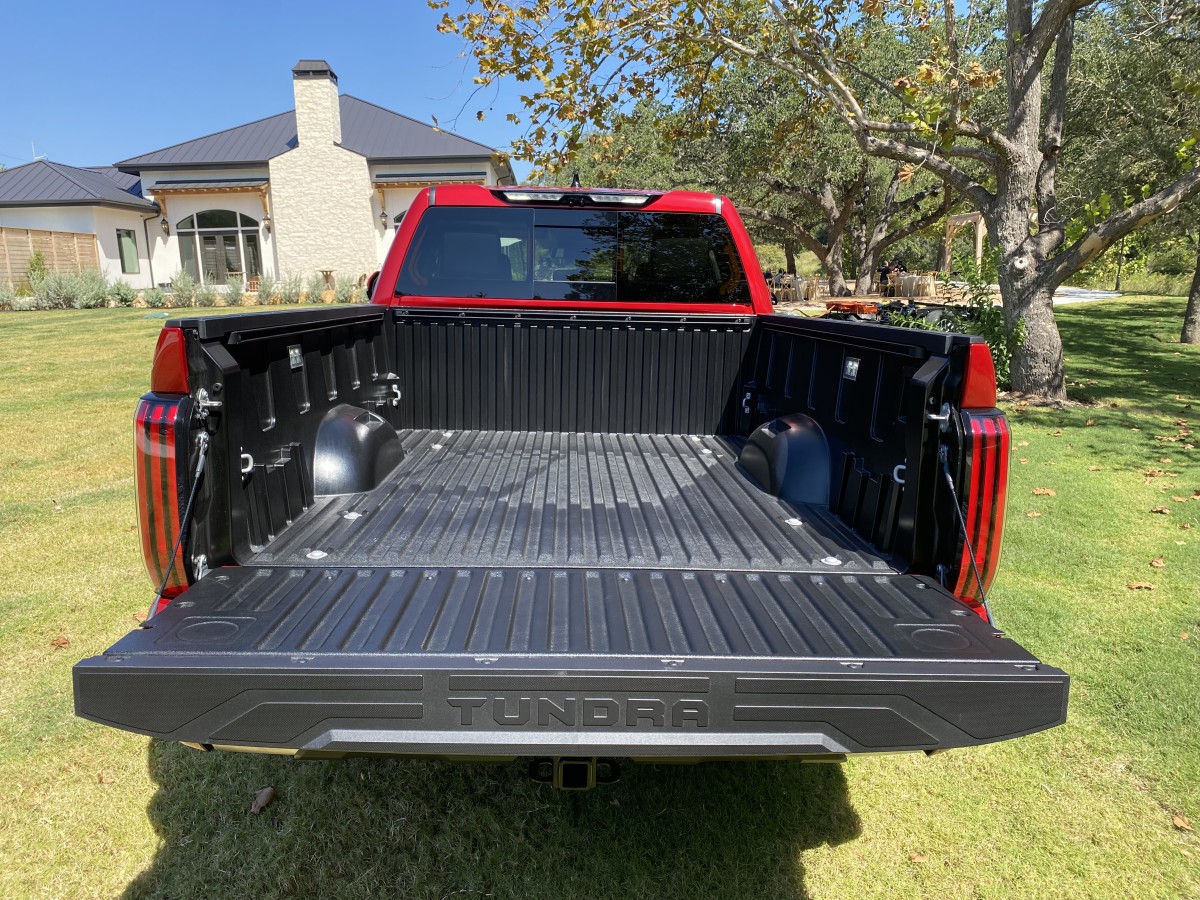
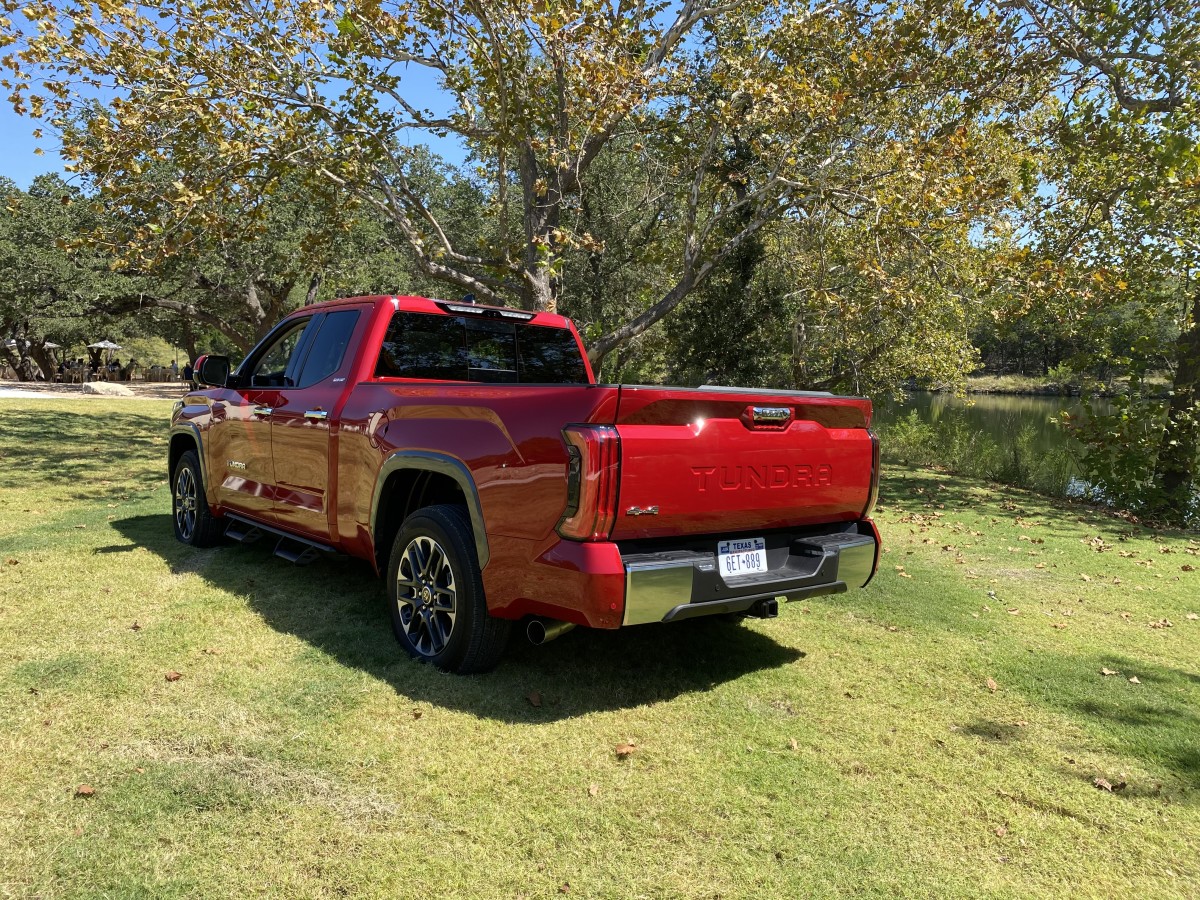
The Tundra debuted as a 2000 model and got its first significant makeover for the 2008 model year. The new 2022 model represents the start of the Tundra’s third generation of production. Toyota says every part on the new truck has been redesigned and engineered anew—right down to the turn signal stalks. The Tundra’s exterior has a more dynamic, expressive look than the outgoing model. It wears a large hexagonal grille, which will be filled with trim-matched patterns and branding. Some will be chrome-finished, some black, some dark chrome, and some gray-painted. All will wear a modest Toyota logo at the centre, except the top-of-the-line TRD Pro trim, which gets “TOYOTA” badging spelled out in retro letters above an LED strip light—very cool. The Tundra TRD Pro also gets trim with a technical camo pattern, a detail you have to study closely to appreciate. The camo pattern continues inside the cabin, where it is integrated into both the front seat and rear seat covers. The body’s side styling looks chiseled and muscular, with a solid foundation and pronounced wheel arches. The rear is neatly tucked in, with LED taillamps bracketing the tailgate, stamped with the vehicle’s name.
Subtle exterior differences distinguish the trim levels. Those with sharp eyes will be able to differentiate a taller stance for models with off-road suspension equipment.
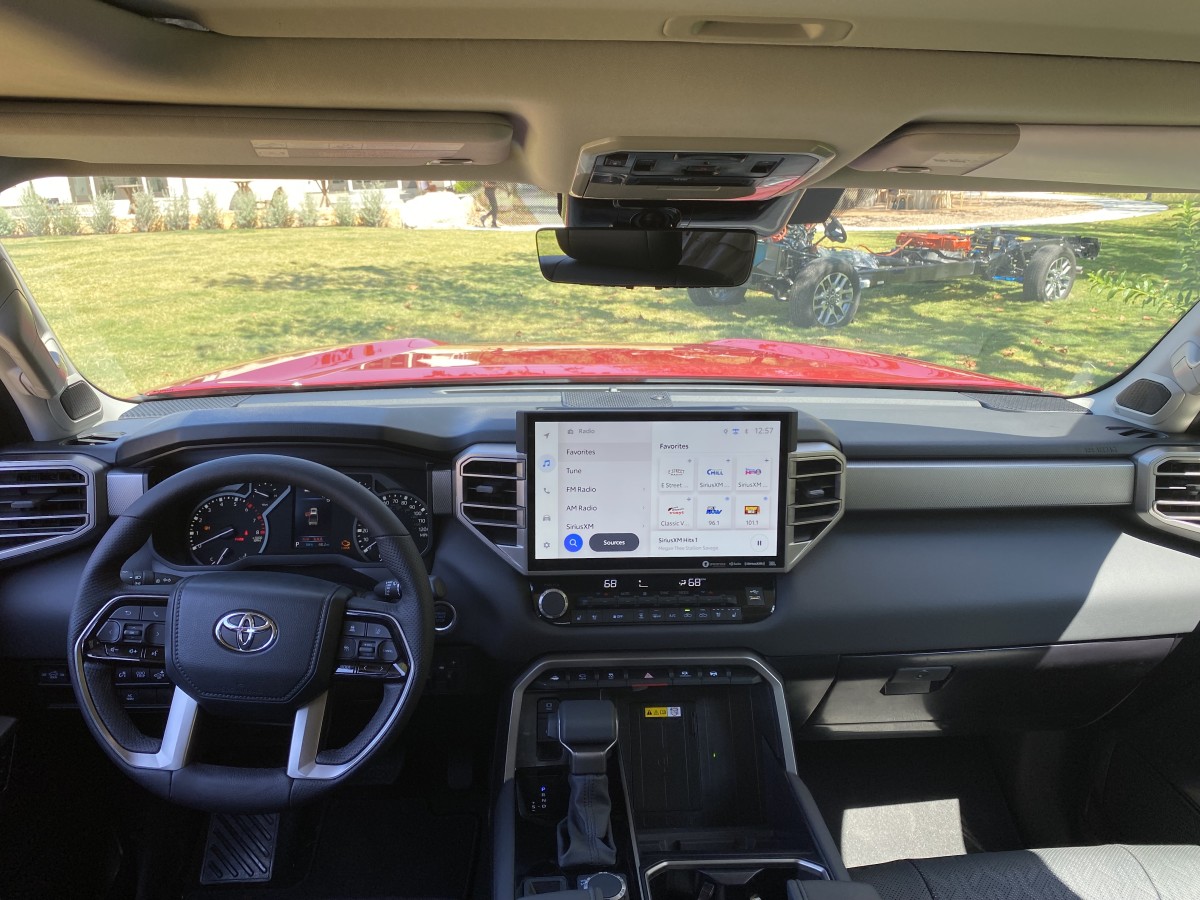
The interior also benefits from updates and upgrades, following a trend toward more premium materials and amenities in trucks. The 14-inch touchscreen display, standard on Limited and Platinum grades, is a bold visual statement of the Tundra’s intent (an 8-inch screen is standard on SR and SR5). The Tundra wants to be in the driver's seat as your family’s everyday adventure vehicle. Shapes from the Tundra’s exterior repeat inside the cabin, linking the complete vehicle design into a cohesive whole—further evidence of a vehicle redesigned from the ground up and not assembled from the company parts bin.
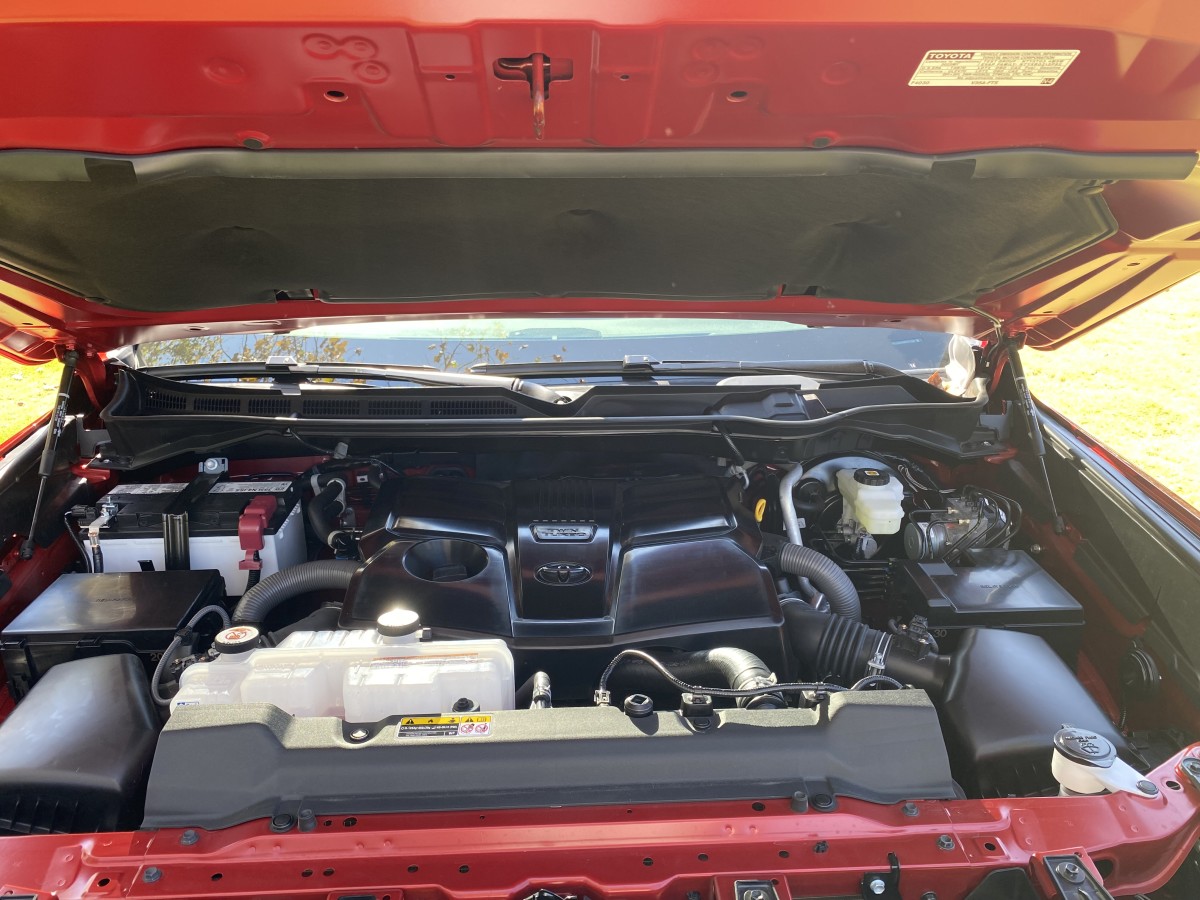
The outgoing Tundra came with a naturally aspirated (non-turbo) 5.7-litre V8 engine—take it or leave it. The new Tundra introduces two new engines, neither of which is a V8.
The base engine, if you can call it that, is the i-Force. It is standard on all trim levels except TRD Pro. A twin-turbocharged 3.5-litre V6 with direct gasoline injection, the i-Force puts out power specs of 389 horsepower and 479 pound-feet of torque (348/405 in SR). Compare that with the outgoing 5.7-litre V8, rated at 381 hp and 401 lb-ft of torque.
The hero powertrain is called “i-Force Max.” It is a hybrid gasoline-electric, adding an electric motor-generator to the twin-turbo V6 with a resultant output of 437 hp and 583 lb-ft of torque. The i-Force Max uses a sealed Nickel-Metal Hydride (Ni-MH) battery with a 288-volt rating and a 1.87-kWh capacity. The battery lives beneath the second row of seats, taking up the under-seat storage compartment in Tundra hybrid models.
Both the gas and hybrid versions use a 10-speed automatic transmission to get power to the wheels. In Canada, RWD is standard on the double-cab SR grade only; 4WD is available on SR and standard on all other trim levels.
Natural Resources Canada rates the RWD Tundra at a fuel consumption of 11.8 litres per 100 kilometres combined (13.1 city, 10.1 highway). With 4WD, the standard V6 engine burns 12.2 L/100 km combined (13.6 city, 10.4 hwy). The hybrid powertrain also consumes 12.2 L/100 km combined (13.5 city, 10.6 hwy).
The new twin-turbo V6 turns out to be an excellent match for the new Tundra, both in gasoline and hybrid forms. Matched with the 10-speed transmission, the engine provides smooth and consistent power delivery without a hint of turbo lag or spikiness. On some models with the JBL sound system, Toyota has provided an enhanced engine sound to the interior, which can fool drivers into believing they’ve got a big, burbling V8 under the hood. They didn’t need to do that—the V6 sounds just fine and performs very well.
Supporting the powertrain, the new chassis and suspension deliver better handling than before. The front independent double-wishbone setup carries over from the previous Tundra but with new components and geometry. The rear suspension has switched from leaf springs to a multi-link with outboard-mounted coil springs, delivering much more compliant ride quality, especially noticeable with an empty bed. Available adaptive variable suspension and load-leveling rear-height control make things even better. Like all full-size pickups, the Tundra will never match a sports car on a curvy road, but this truck is now a pleasure to drive on a meandering path, with minimal body roll and precise steering feel.
A trip through a well-groomed off-road course revealed the Tundra’s capability in the dirt and over the rocks. Adding the TRD Off-Road package to any trim level (except Platinum and TRD Pro) upgrades the Tundra into an adventure vehicle, as Toyota expects many buyers to want. Buyers who wish to maximize on-road performance can add the TRD Sport package and get the Tundra that fits their lifestyle.
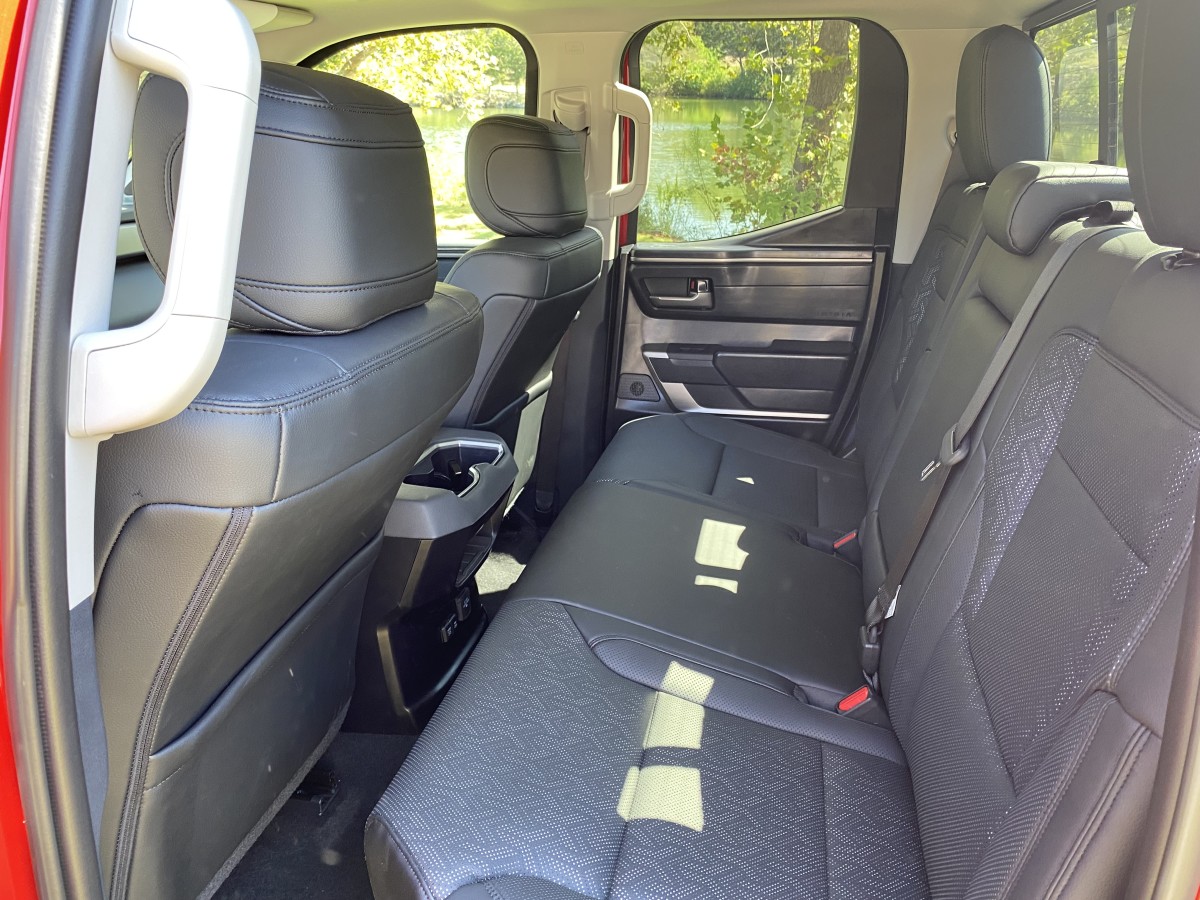
The Tundra comes in Double Cab or CrewMax configurations. Both are four-door crew cabs with a five-passenger seating capacity. The Double Cab has 846 millimetres of rear seat legroom, while the CrewMax offers an SUV-like 1,057 mm of legroom for its second-row passengers. There’s no Regular Cab two-door model—that’s long gone.
Double Cab models come with either a 6.5-foot (1,982 mm) or 8.1-foot (2,469 mm) bed. CrewMax comes with a 5.5-foot (1,677 mm) bed or a 6.5-foot (1,982 mm) bed. For the first time, all Tundra models get an aluminum-reinforced composite bed, a variation on the composite bed used in the Toyota Tacoma. This new bed saves weight over a steel bed, yet maintains payload capacity (up to 880 kilograms or 1,940 pounds, depending on configuration), resists scratches and dents, won’t rust, and doesn’t need painting. Owners can choose to add a spray-on or drop-in bedliner or bed mat if they want to, but Toyota doesn’t think they need to.
Tundra owners use their trucks to tow, according to the automaker’s research. The new truck's towing capacity reaches 5,443 kilograms (12,000 pounds) when properly configured and equipped, and the Tundra comes with standard trailer sway control and TOW/HAUL mode. Trailer brake control is standard on all 4x4 models except SR. A new trailer backup guide system is standard on the Platinum trim. It includes straight path assist, which uses the electric steering system to keep your trailer going straight while reversing, overcoming a significant obstacle for novice (and some experienced) towers.
In the cabin, designers made smart storage a priority. The front centre armrest is a great example. A sliding tray in the middle of the armrest allows access to the storage area in the centre console without having to lift the rear-hinged armrest, which could disrupt the driver’s posture and concentration on the road. The armrest can still open as expected, but now you have a smart, convenient option. Another out-of-the-box solution (literally) is the 12-volt power tap. Instead of being tucked away inside the centre console, it lives in a small tray behind the touchscreen display on top of the dash. In this position, the outlet can now power a dashcam or radar detector (where legal) without leaving an unruly cable dangling down the front of the centre stack. Wherever you look inside the Tundra, Toyota has applied this kind of buyer-focused thinking.
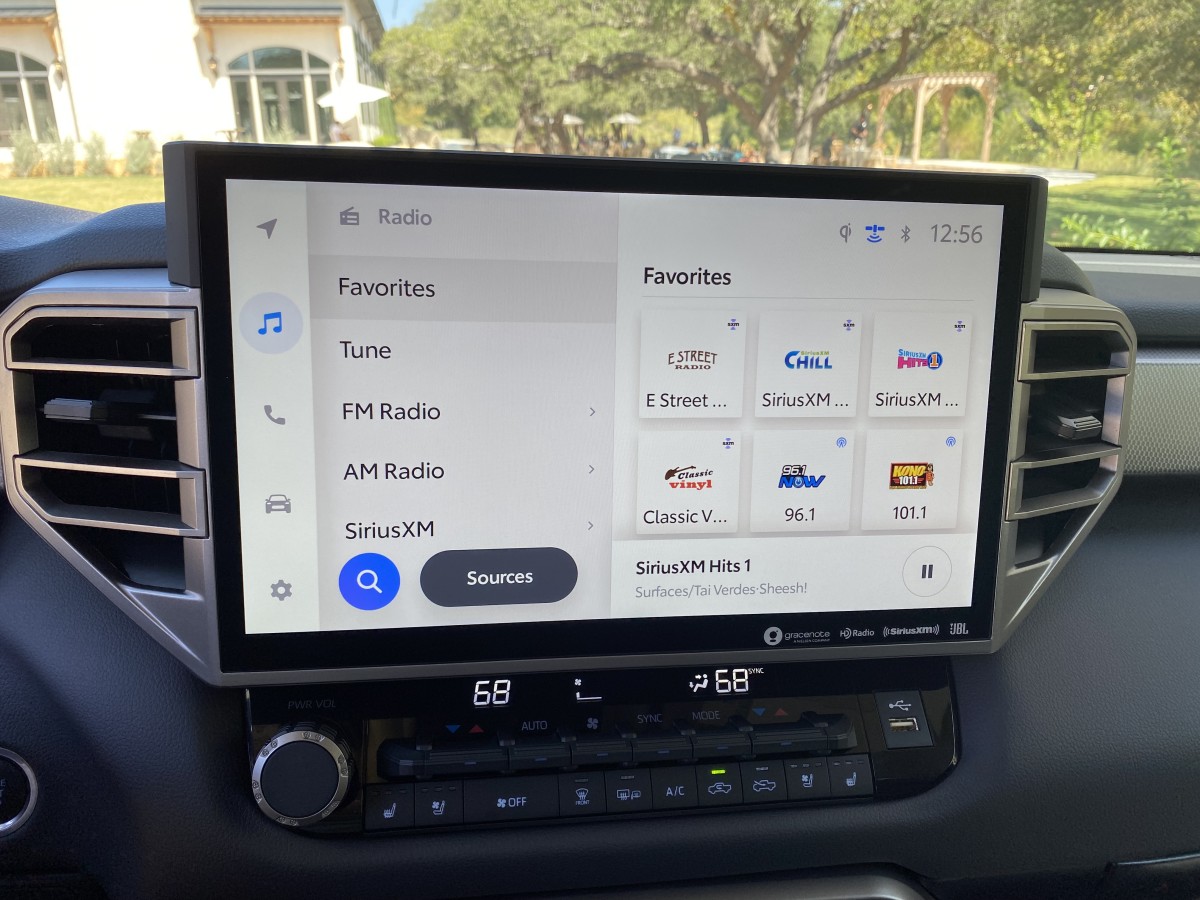
Usually, we measure a vehicle’s tech level against its current competition. With the Tundra, many buyers will be comparing the new truck against their older Tundra pickups. The very loyal Tundra owners hang onto their trucks for hundreds of thousands of kilometres, with documented examples exceeding the million mark. When a truck hasn’t had a major makeover since 2008, out-of-date technology becomes the focus for updates.
In the cabin, the most prominent new technology is the new infotainment system. An 8-inch touchscreen audio system with six speakers (Double Cab) or nine speakers (CrewMax) is standard in SR and SR5 trim levels, and a superstar 14-inch touchscreen is standard in Limited and above. A 12-speaker JBL premium audio system is standard on upper grades. Wireless Apple CarPlay and Android Auto are standard on all models. Toyota Connected services are standard with a trial period, as are Safety Connect, Service Connect, Bluetooth, and SiriusXM. Drive Connect with a 3-year trial period comes with upper grades, as does a Qi-compatible charge pad that doubles as an angled dock for your smartphone (another clever placement by the Tundra’s designers).
SR, SR5, and Limited models come with a combination analog/digital instrument panel with a 4.2-inch colour TFT multi-information display. Upper trims come with a knockout 12.3-inch digital instrument panel, a stunner with outstanding resolution and graphics. About a decade into these all-digital panels, we’re still amazed by them. We’re also still amazed by head-up displays (HUD). You can get a 10.1-inch HUD as part of Platinum models and see critical graphic information projected in your sightlines as you drive.
Off-roaders will appreciate the multi-terrain select system with crawl control and downhill assist control, which makes use of the electronically locking rear differential and is available on 4x4 models (standard on TRD Pro). Special cameras and a unique view make up the multi-terrain monitor system, further enhancing the off-road experience in the Tundra.
Neither the Insurance Institute for Highway Safety (IIHS) nor the National Highway Traffic Safety Administration (NHTSA) have released crash-test safety ratings for the 2022 Toyota Tundra yet.
Toyota has equipped all models of Tundra with standard Toyota Safety Sense 2.5 (TSS 2.5), the latest iteration of its suite of driver assistance and safety features. It includes a pre-collision system with pedestrian detection, full-speed range dynamic radar cruise control, lane-departure warning with steering assist, lane-tracing assist, automatic high beams, and road sign assist. The Star Safety System is also standard, including enhanced vehicle stability control, traction control, anti-lock brakes, electronic brake-force distribution, brake assist, and smart-stop technology. Eight total airbags are distributed within the cabin, and LATCH connectors are installed on outboard second-row seats. Rear door locks have a child-protector function, and the driver has a window-lockout control. Tire-pressure monitor system, hill-start control, drive-start control, and driver and front passenger active headrests are standard.
Blind-spot monitoring with rear cross-traffic alert are available as part of a package on most SR and SR5 models and standard on all other trim levels.
Starting prices on the outgoing Tundra went from $47,010 to $64,250. For 2022, those numbers get a not insignificant bump. The base SR trim with a double cab, 6.5-foot bed, and rear-wheel drive will start at an MSRP of $44,990, and figures rise from there. The luxurious 1794 package on the Platinum trim starts at $74,550. As of this writing, Canadian pricing for the TRD Pro has not been announced. An $1,890 destination charge is extra.
All told, the Tundra comes in five trim levels in 2022: SR, SR5, Limited, Platinum, and TRD Pro. Toyota says SR5 and Limited are their core trims, with more examples produced than other trim levels. TRD Pro is a genuine flagship, with all the bells and whistles Toyota can muster, including FOX shocks and aluminum skid plates, and 1794 is Toyota’s ultimate luxury truck. One of two big options packages, TRD Off-Road or TRD Sport, can be added to just about every trim level (other than TRD Pro) to help personalize each Tundra for its new owner.
Even though Toyota’s counting on the Tundra loyalists to snap up this new truck, buyers will still be aware of the competition. The Ford F-150 (starting at $34,079 for a single cab, $40,259 for a SuperCab), Chevrolet Silverado (starting at $32,648 for a single cab, $37,448 for a double cab), GMC Sierra (starting at $41,148), and Ram 1500 (starting at $47,445) fill out the field. Stiff competition has bred some competent, technologically sophisticated, capable trucks. The Tundra has the disadvantage of not having a heavy-duty variant to attract a wider group of buyers. Still, Toyota’s okay with that, ceding that battle to concentrate on their core.
Bottom line: The 2022 Toyota Tundra improved massively over the outgoing model. If the newly styled and engineered truck can live up to its inherited reputation for durability and all-around capability, Toyota will be able to maintain and maybe even build its niche in the full-size truck market, treating buyers to a new vehicle they can live with happily for a long, long time.
Note: Images show a US model.

User reviews for 2022 Toyota Tundra
Write a review2022 Toyota Tundra Pricing
Trims & specs
Air Conditioning
Automatic climate control front air conditioning · Single front air conditioning zones
Airbags
Dual front airbags · Dual front knee airbags · Passenger airbag deactivation: occupant sensing deactivation · Front side airbags · Front side curtain airbags
Audio System
Antenna Type: diversity · Voice recognition audio system · USB auxiliary audio input · Touch screen display radio · Satellite Radio: SiriusXM · Total Number of Speakers: 6
Brakes
ABS: 4-wheel · Braking assist: hill start assist · Electronic parking brake: auto off · Front brake diameter: 13.9 · Front brakes: ventilated disc · Rear brake diameter: 13.6 · Rear brakes: ventilated disc
Comfort Features
Floor Material: carpet · Shift knob trim: urethane · Steering wheel trim: urethane
Convenience Features
Adaptive stop and go cruise control: semi-automatic · Assist handle: rear · Autonomous lane guidance: lane centering · Center console: front console with armrest and storage · Cruise control: adaptive · Cupholders: rear · Dimming rearview mirror: auto-dimming · Multi-function remote: proximity entry system · One-touch windows: 4 · Power outlet(s): 12V front · Power steering: electric · Power windows: lockout button · Reading lights: rear · Steering wheel: tilt and telescopic · Steering wheel mounted controls: voice recognition controls · Storage: sunglasses holder
Driver Seat
Manual adjustments: 4
Drivetrain
Axle ratio: 3.31
Engine
Battery: maintenance-free
Exterior Features
Door handle color: black · Front bumper color: body-color · Grille color: black · Mirror color: black · Pickup bed light: LED · Rear bumper color: black · Rocker panel color: body-color · Tailgate: power locking · Window trim: black
Headrests
Adjustable rear headrests: foldable · Front headrests: adjustable · Number of front headrests: 2 · Number of rear headrests: 3
In Car Entertainment
Connected in-car apps: Amazon Alexa · Infotainment screen size: 8 in. · Smartphone integration: wireless Apple CarPlay
Instrumentation
Fuel economy display: MPG · Instrument cluster screen size: 4.2 in. · Warnings and reminders: low oil pressure
Lights
Exterior entry lights: security approach lamps · Headlights: LED · Tail and brake lights: LED
Mirrors
Exterior mirrors: heated
Passenger Seat
Manual Adjustments: 4
Rear Seats
Type: 60-40 split bench
Safety
Active head restraints: driver · Automatic emergency braking: front · Camera system: rearview · Child seat anchors: LATCH system · Impact sensor: fuel cut-off · Pre-Collision Warning System: audible warning · Pre-collision warning system: pedestrian detection · Rearview monitor: in dash
Seatbelts
Emergency locking retractors: front and rear · Front seatbelts: 3-point · Seatbelt force limiters: front · Seatbelt pretensioners: front and rear · Seatbelt warning sensor: driver and passenger · Second row seatbelts: 3-point
Seats
Driver seat manual adjustments: reclining · Front seat type: bucket · Passenger seat manual adjustments: reclining · Rear headrests: adjustable · Rear seat folding: folds up · Upholstery: cloth
Security
Power door locks: anti-lockout
Spare Tire
Mount Location: underbody · Size: full-size
Spare Wheel
Rim Type: steel
Stability and Traction
Traction control: with trailer stability control
Steering
Turns lock-to-lock: 3.40
Suspension
Front Shock Type: twin-tube gas shock absorbers · Front Spring Type: coil springs · Front Suspension Classification: independent · Front Suspension Type: double wishbones · Rear Shock Type: twin-tube gas shock absorbers · Rear Spring Type: coil springs · Rear Suspension Classification: solid live axle · Rear Suspension Type: multi-link · Stabilizer bar(s): front
Telematics
Driver assistance app: roadside assistance · Electronic messaging assistance: with voice recognition · Phone: voice activated · Phone wireless data link: Bluetooth · Smart device app compatibility: Toyota Connected Services · Smart device app function: lock operation · Wifi: hotspot
Tires
Type: all season
Tires and Rims
Wheels: steel
Truck Features
Pickup truck sliding rear window: power horizontal
Windows
Front wipers: variable intermittent · Power windows: with safety reverse
Air Conditioning
Automatic climate control front air conditioning · Single front air conditioning zones
Airbags
Dual front airbags · Dual front knee airbags · Passenger airbag deactivation: occupant sensing deactivation · Front side airbags · Rear side curtain airbags
Audio System
Antenna Type: diversity · Voice recognition audio system · USB auxiliary audio input · Touch screen display radio · Satellite Radio: SiriusXM · Total Number of Speakers: 6
Brakes
ABS: 4-wheel · Braking assist: hill start assist · Electronic parking brake: auto off · Front brake diameter: 13.9 · Front brakes: ventilated disc · Rear brake diameter: 13.6 · Rear brakes: ventilated disc
Comfort Features
Floor Material: carpet · Shift knob trim: urethane · Steering wheel trim: urethane
Convenience Features
Adaptive stop and go cruise control: semi-automatic · Assist handle: front · Autonomous lane guidance: lane centering · Center console: front console with armrest and storage · Cruise control: adaptive · Cupholders: rear · Dimming rearview mirror: auto-dimming · Multi-function remote: keyless entry with panic alarm · One-touch windows: 4 · Power outlet(s): USB rear · Power steering: speed-proportional · Power windows: lockout button · Reading lights: front · Steering wheel: tilt and telescopic · Steering wheel mounted controls: phone · Storage: under rear seats
Driver Seat
Manual adjustments: 4
Drivetrain
Axle ratio: 3.31
Engine
Battery: maintenance-free
Exterior Features
Door handle color: black · Front bumper color: body-color · Grille color: black · Mirror color: black · Pickup bed light: LED · Rear bumper color: black · Rocker panel color: body-color · Tailgate: EZ-Lift · Window trim: black
Headrests
Adjustable rear headrests: foldable · Front headrests: adjustable · Number of front headrests: 2 · Number of rear headrests: 3
In Car Entertainment
Connected in-car apps: Google search · Infotainment screen size: 8 in. · Smartphone integration: wireless Android Auto
Instrumentation
Fuel economy display: MPG · Instrument cluster screen size: 4.2 in. · Warnings and reminders: low oil pressure
Lights
Exterior entry lights: security approach lamps · Headlights: Auto on/off · Tail and brake lights: LED
Mirrors
Exterior mirrors: manual folding
Passenger Seat
Manual Adjustments: 4
Rear Seats
Type: 60-40 split bench
Safety
Active head restraints: driver · Automatic emergency braking: intersection/junction turn · Camera system: rearview · Child seat anchors: LATCH system · Cross Traffic Alert: rear · Impact sensor: fuel cut-off · Parking sensors: front · Pre-Collision Warning System: audible warning · Pre-collision warning system: intersection/junction turn · Rearview monitor: in dash
Seatbelts
Emergency locking retractors: front and rear · Front seatbelts: 3-point · Seatbelt force limiters: front · Seatbelt pretensioners: front and rear · Seatbelt warning sensor: driver and passenger · Second row seatbelts: 3-point
Seats
Driver seat manual adjustments: reclining · Front seat type: bucket · Passenger seat manual adjustments: reclining · Rear headrests: adjustable · Rear seat folding: folds up · Upholstery: cloth
Security
Power door locks: anti-lockout
Spare Tire
Mount Location: underbody · Size: full-size
Spare Wheel
Rim Type: steel
Stability and Traction
Traction control: with trailer stability control
Steering
Turns lock-to-lock: 3.40
Suspension
Front Shock Type: twin-tube gas shock absorbers · Front Spring Type: coil springs · Front Suspension Classification: independent · Front Suspension Type: strut · Rear Shock Type: twin-tube gas shock absorbers · Rear Spring Type: coil springs · Rear Suspension Classification: solid live axle · Rear Suspension Type: multi-link · Stabilizer bar(s): front
Telematics
Driver assistance app: roadside assistance · Electronic messaging assistance: with voice recognition · Phone: voice activated · Phone wireless data link: Bluetooth · Smart device app compatibility: Toyota Connected Services · Smart device app function: maintenance status · Wifi: hotspot
Tires
Type: all season
Tires and Rims
Wheels: steel
Truck Features
Pickup truck sliding rear window: power horizontal
Windows
Front wipers: variable intermittent · Power windows: with safety reverse
Air Conditioning
Automatic climate control front air conditioning · Single front air conditioning zones
Airbags
Dual front airbags · Dual front knee airbags · Passenger airbag deactivation: occupant sensing deactivation · Front side airbags · Front side curtain airbags
Audio System
Antenna Type: diversity · Voice recognition audio system · USB auxiliary audio input · AM/FM radio · Satellite Radio: SiriusXM · Total Number of Speakers: 9
Brakes
ABS: 4-wheel · Braking assist: hill start assist · Electronic parking brake: auto off · Front brake diameter: 13.9 · Front brakes: ventilated disc · Rear brake diameter: 13.6 · Rear brakes: ventilated disc
Comfort Features
Floor Material: carpet · Shift knob trim: urethane · Steering wheel trim: urethane
Convenience Features
Adaptive stop and go cruise control: semi-automatic · Assist handle: front · Autonomous lane guidance: lane centering · Center console: front console with armrest and storage · Cruise control: adaptive · Cupholders: front · Dimming rearview mirror: auto-dimming · Multi-function remote: keyless entry with panic alarm · One-touch windows: 4 · Power outlet(s): 12V front · Power steering: speed-proportional · Power windows: lockout button · Reading lights: front · Steering wheel: tilt and telescopic · Steering wheel mounted controls: cruise controls · Storage: sunglasses holder
Driver Seat
Manual adjustments: 4
Drivetrain
Axle ratio: 3.31
Engine
Battery: maintenance-free
Exterior Features
Door handle color: black · Front bumper color: body-color · Grille color: black · Mirror color: black · Pickup bed light: LED · Rear bumper color: black · Rocker panel color: body-color · Tailgate: EZ-Lift · Window trim: black
Headrests
Adjustable rear headrests: foldable · Front headrests: adjustable · Number of front headrests: 2 · Number of rear headrests: 3
In Car Entertainment
Connected in-car apps: Amazon Alexa · Infotainment screen size: 8 in. · Smartphone integration: wireless Android Auto
Instrumentation
Fuel economy display: MPG · Instrument cluster screen size: 4.2 in. · Warnings and reminders: coolant temperature warning
Lights
Exterior entry lights: security approach lamps · Headlights: auto delay off · Tail and brake lights: LED
Mirrors
Exterior mirrors: manual folding
Passenger Seat
Manual Adjustments: 4
Rear Seats
Type: 60-40 split bench
Safety
Active head restraints: driver · Automatic emergency braking: intersection/junction turn · Camera system: rearview · Child seat anchors: LATCH system · Impact sensor: fuel cut-off · Pre-Collision Warning System: visual warning · Pre-collision warning system: intersection/junction turn · Rearview monitor: in dash
Seatbelts
Emergency locking retractors: front and rear · Front seatbelts: 3-point · Seatbelt force limiters: front · Seatbelt pretensioners: front and rear · Seatbelt warning sensor: driver and passenger · Second row seatbelts: 3-point
Seats
Driver seat manual adjustments: reclining · Front seat type: bucket · Passenger seat manual adjustments: reclining · Rear headrests: adjustable · Rear seat folding: folds up · Upholstery: cloth
Security
Power door locks: anti-lockout
Spare Tire
Mount Location: underbody · Size: full-size
Spare Wheel
Rim Type: steel
Stability and Traction
Traction control: with trailer stability control
Steering
Turns lock-to-lock: 3.40
Suspension
Front Shock Type: twin-tube gas shock absorbers · Front Spring Type: coil springs · Front Suspension Classification: independent · Front Suspension Type: strut · Rear Shock Type: twin-tube gas shock absorbers · Rear Spring Type: coil springs · Rear Suspension Classification: solid live axle · Rear Suspension Type: multi-link · Stabilizer bar(s): front
Telematics
Driver assistance app: roadside assistance · Electronic messaging assistance: with voice recognition · Phone: voice activated · Phone wireless data link: Bluetooth · Smart device app compatibility: Toyota Connected Services · Smart device app function: maintenance status · Wifi: hotspot
Tires
Type: all season
Tires and Rims
Wheels: steel
Truck Features
Pickup truck sliding rear window: power vertical
Windows
Front wipers: variable intermittent · Power windows: with safety reverse
Air Conditioning
Automatic climate control front air conditioning · Single front air conditioning zones
Airbags
Dual front airbags · Dual front knee airbags · Passenger airbag deactivation: occupant sensing deactivation · Front side airbags · Front side curtain airbags
Audio System
Antenna Type: diversity · Voice recognition audio system · Bluetooth auxiliary audio input · Touch screen display radio · Satellite Radio: SiriusXM · Total Number of Speakers: 6
Brakes
ABS: 4-wheel · Braking assist: hill start assist · Electronic parking brake: auto off · Front brake diameter: 13.9 · Front brakes: ventilated disc · Rear brake diameter: 13.6 · Rear brakes: ventilated disc
Comfort Features
Floor Material: carpet · Shift knob trim: urethane · Steering wheel trim: urethane
Convenience Features
Adaptive stop and go cruise control: semi-automatic · Assist handle: rear · Autonomous lane guidance: lane centering · Center console: front console with armrest and storage · Cruise control: adaptive · Cupholders: rear · Dimming rearview mirror: auto-dimming · Multi-function remote: proximity entry system · One-touch windows: 4 · Power outlet(s): USB front · Power steering: electric · Power windows: lockout button · Reading lights: front · Steering wheel: tilt and telescopic · Steering wheel mounted controls: voice recognition controls · Storage: front seatback
Driver Seat
Manual adjustments: 4
Drivetrain
4WD Type: part time · Axle ratio: 3.31 · Transfer Case: electronic hi-lo gear selection
Engine
Battery: maintenance-free
Exterior Features
Door handle color: black · Front bumper color: body-color · Grille color: black · Mirror color: black · Pickup bed light: LED · Rear bumper color: black · Rocker panel color: body-color · Tailgate: power locking · Window trim: black
Headrests
Adjustable rear headrests: foldable · Front headrests: adjustable · Number of front headrests: 2 · Number of rear headrests: 3
In Car Entertainment
Connected in-car apps: Amazon Alexa · Infotainment screen size: 8 in. · Smartphone integration: wireless Android Auto
Instrumentation
Fuel economy display: range · Instrument cluster screen size: 4.2 in. · Warnings and reminders: low oil pressure
Lights
Exterior entry lights: security approach lamps · Headlights: automatic high beam dimmer · Tail and brake lights: LED
Mirrors
Exterior mirrors: manual folding
Passenger Seat
Manual Adjustments: 4
Rear Seats
Type: 60-40 split bench
Safety
Active head restraints: driver · Automatic emergency braking: front · Camera system: rearview · Child seat anchors: LATCH system · Impact sensor: fuel cut-off · Pre-Collision Warning System: audible warning · Pre-collision warning system: pedestrian detection · Rearview monitor: in dash
Seatbelts
Emergency locking retractors: front and rear · Front seatbelts: 3-point · Seatbelt force limiters: front · Seatbelt pretensioners: front · Seatbelt warning sensor: driver and passenger · Second row seatbelts: 3-point
Seats
Driver seat manual adjustments: reclining · Front seat type: bucket · Passenger seat manual adjustments: reclining · Rear headrests: adjustable · Rear seat folding: folds up · Upholstery: cloth
Security
Power door locks: anti-lockout
Spare Tire
Mount Location: underbody · Size: full-size
Spare Wheel
Rim Type: steel
Stability and Traction
Traction control: with trailer stability control
Steering
Turns lock-to-lock: 3.40
Suspension
Front Shock Type: twin-tube gas shock absorbers · Front Spring Type: coil springs · Front Suspension Classification: independent · Front Suspension Type: double wishbones · Rear Shock Type: twin-tube gas shock absorbers · Rear Spring Type: coil springs · Rear Suspension Classification: solid live axle · Rear Suspension Type: multi-link · Stabilizer bar(s): front
Telematics
Driver assistance app: roadside assistance · Electronic messaging assistance: with read function · Phone: voice activated · Phone wireless data link: Bluetooth · Smart device app compatibility: Toyota Connected Services · Smart device app function: lock operation · Wifi: hotspot
Tires
Type: all season
Tires and Rims
Wheels: steel
Truck Features
Pickup truck sliding rear window: power horizontal
Windows
Front wipers: variable intermittent · Power windows: with safety reverse
Air Conditioning
Automatic climate control front air conditioning · Single front air conditioning zones
Airbags
Dual front airbags · Dual front knee airbags · Passenger airbag deactivation: occupant sensing deactivation · Front side airbags · Rear side curtain airbags
Audio System
Antenna Type: mast · Voice recognition audio system · USB auxiliary audio input · AM/FM radio · Satellite Radio: SiriusXM · Total Number of Speakers: 6
Brakes
ABS: 4-wheel · Braking assist: hill start assist · Electronic parking brake: auto off · Front brake diameter: 13.9 · Front brakes: ventilated disc · Rear brake diameter: 13.6 · Rear brakes: ventilated disc
Comfort Features
Floor Material: carpet · Shift knob trim: urethane · Steering wheel trim: urethane
Convenience Features
Adaptive stop and go cruise control: semi-automatic · Assist handle: front · Autonomous lane guidance: lane centering · Center console: front console with armrest and storage · Cruise control: adaptive · Cupholders: rear · Dimming rearview mirror: auto-dimming · Multi-function remote: proximity entry system · One-touch windows: 4 · Power outlet(s): 12V front · Power steering: speed-proportional · Power windows: lockout button · Reading lights: rear · Steering wheel: tilt and telescopic · Steering wheel mounted controls: voice recognition controls · Storage: front seatback
Driver Seat
Manual adjustments: 4
Drivetrain
4WD Type: part time · Axle ratio: 3.31 · Transfer Case: electronic hi-lo gear selection
Engine
Battery: maintenance-free
Exterior Features
Door handle color: black · Front bumper color: body-color · Grille color: black · Mirror color: black · Pickup bed light: LED · Rear bumper color: black · Rocker panel color: body-color · Tailgate: removable · Window trim: black
Headrests
Adjustable rear headrests: foldable · Front headrests: adjustable · Number of front headrests: 2 · Number of rear headrests: 3
In Car Entertainment
Connected in-car apps: Google POIs · Infotainment screen size: 8 in. · Smartphone integration: wireless Android Auto
Instrumentation
Fuel economy display: MPG · Instrument cluster screen size: 4.2 in. · Warnings and reminders: low fuel level
Lights
Exterior entry lights: security approach lamps · Headlights: Auto on/off · Tail and brake lights: LED
Mirrors
Exterior mirrors: power
Passenger Seat
Manual Adjustments: 4
Rear Seats
Type: 60-40 split bench
Safety
Active head restraints: driver · Automatic emergency braking: intersection/junction turn · Camera system: rearview · Child seat anchors: LATCH system · Cross Traffic Alert: rear · Impact sensor: fuel cut-off · Parking sensors: rear · Pre-Collision Warning System: audible warning · Pre-collision warning system: intersection/junction turn · Rearview monitor: in dash
Seatbelts
Emergency locking retractors: front and rear · Front seatbelts: 3-point · Seatbelt force limiters: front · Seatbelt pretensioners: front · Seatbelt warning sensor: driver and passenger · Second row seatbelts: 3-point
Seats
Driver seat manual adjustments: reclining · Front seat type: bucket · Passenger seat manual adjustments: reclining · Rear headrests: adjustable · Rear seat folding: folds up · Upholstery: cloth
Security
Power door locks: anti-lockout
Spare Tire
Mount Location: underbody · Size: full-size
Spare Wheel
Rim Type: steel
Stability and Traction
Traction control: with trailer stability control
Steering
Turns lock-to-lock: 3.40
Suspension
Front Shock Type: twin-tube gas shock absorbers · Front Spring Type: coil springs · Front Suspension Classification: independent · Front Suspension Type: strut · Rear Shock Type: twin-tube gas shock absorbers · Rear Spring Type: coil springs · Rear Suspension Classification: solid live axle · Rear Suspension Type: multi-link · Stabilizer bar(s): front
Telematics
Driver assistance app: roadside assistance · Electronic messaging assistance: with voice recognition · Phone: voice activated · Phone wireless data link: Bluetooth · Smart device app compatibility: Toyota Connected Services · Smart device app function: vehicle location · Wifi: hotspot
Tires
Type: all season
Tires and Rims
Wheels: steel
Truck Features
Pickup truck sliding rear window: power horizontal
Windows
Front wipers: variable intermittent · Power windows: with safety reverse
Air Conditioning
Automatic climate control front air conditioning · Single front air conditioning zones
Airbags
Dual front airbags · Dual front knee airbags · Passenger airbag deactivation: occupant sensing deactivation · Front side airbags · Rear side curtain airbags
Audio System
Antenna Type: diversity · Voice recognition audio system · Bluetooth auxiliary audio input · AM/FM radio · Satellite Radio: SiriusXM · Total Number of Speakers: 9
Brakes
ABS: 4-wheel · Braking assist: hill start assist · Electronic parking brake: auto off · Front brake diameter: 13.9 · Front brakes: ventilated disc · Rear brake diameter: 13.6 · Rear brakes: ventilated disc
Comfort Features
Floor Material: carpet · Shift knob trim: urethane · Steering wheel trim: urethane
Convenience Features
Adaptive stop and go cruise control: semi-automatic · Assist handle: front · Autonomous lane guidance: lane centering · Center console: front console with armrest and storage · Cruise control: adaptive · Cupholders: rear · Dimming rearview mirror: auto-dimming · Multi-function remote: proximity entry system · One-touch windows: 4 · Power outlet(s): USB rear · Power steering: speed-proportional · Power windows: lockout button · Reading lights: rear · Steering wheel: tilt and telescopic · Steering wheel mounted controls: multi-function screen controls · Storage: front seatback
Driver Seat
Manual adjustments: 4
Drivetrain
4WD Type: part time · Axle ratio: 3.31 · Transfer Case: electronic hi-lo gear selection
Engine
Battery: maintenance-free
Exterior Features
Door handle color: black · Front bumper color: body-color · Grille color: black · Mirror color: black · Pickup bed light: LED · Rear bumper color: black · Rocker panel color: body-color · Tailgate: power locking · Window trim: black
Headrests
Adjustable rear headrests: foldable · Front headrests: adjustable · Number of front headrests: 2 · Number of rear headrests: 3
In Car Entertainment
Connected in-car apps: Google POIs · Infotainment screen size: 8 in. · Smartphone integration: wireless Apple CarPlay
Instrumentation
Fuel economy display: range · Instrument cluster screen size: 4.2 in. · Warnings and reminders: coolant temperature warning
Lights
Exterior entry lights: security approach lamps · Headlights: Auto on/off · Tail and brake lights: LED
Mirrors
Exterior mirrors: heated
Passenger Seat
Manual Adjustments: 4
Rear Seats
Type: 60-40 split bench
Safety
Active head restraints: driver · Automatic emergency braking: front · Camera system: rearview · Child seat anchors: LATCH system · Impact sensor: fuel cut-off · Pre-Collision Warning System: audible warning · Pre-collision warning system: pedestrian detection · Rearview monitor: in dash
Seatbelts
Emergency locking retractors: front and rear · Front seatbelts: 3-point · Seatbelt force limiters: front · Seatbelt pretensioners: front and rear · Seatbelt warning sensor: driver and passenger · Second row seatbelts: 3-point
Seats
Driver seat manual adjustments: reclining · Front seat type: bucket · Passenger seat manual adjustments: reclining · Rear headrests: adjustable · Rear seat folding: folds up · Upholstery: cloth
Security
Power door locks: anti-lockout
Spare Tire
Mount Location: underbody · Size: full-size
Spare Wheel
Rim Type: steel
Stability and Traction
Traction control: with trailer stability control
Steering
Turns lock-to-lock: 3.40
Suspension
Front Shock Type: twin-tube gas shock absorbers · Front Spring Type: coil springs · Front Suspension Classification: independent · Front Suspension Type: double wishbones · Rear Shock Type: twin-tube gas shock absorbers · Rear Spring Type: coil springs · Rear Suspension Classification: solid live axle · Rear Suspension Type: multi-link · Stabilizer bar(s): front
Telematics
Driver assistance app: roadside assistance · Electronic messaging assistance: with read function · Phone: voice activated · Phone wireless data link: Bluetooth · Smart device app compatibility: Toyota Connected Services · Smart device app function: lock operation · Wifi: hotspot
Tires
Type: all season
Tires and Rims
Wheels: steel
Truck Features
Pickup truck sliding rear window: power vertical
Windows
Front wipers: variable intermittent · Power windows: with safety reverse
Air Conditioning
Automatic climate control front air conditioning · Single front air conditioning zones
Airbags
Dual front airbags · Dual front knee airbags · Passenger airbag deactivation: occupant sensing deactivation · Front side airbags · Rear side curtain airbags
Audio System
Antenna Type: mast · Voice recognition audio system · USB auxiliary audio input · Touch screen display radio · Satellite Radio: SiriusXM · Total Number of Speakers: 6
Brakes
ABS: 4-wheel · Braking assist: hill start assist · Electronic parking brake: auto off · Front brake diameter: 13.9 · Front brakes: ventilated disc · Rear brake diameter: 13.6 · Rear brakes: ventilated disc
Comfort Features
Armrests: rear center with cupholders · Center console trim: simulated alloy · Dash trim: simulated alloy · Door trim: simulated alloy · Floor Material: carpet · Shift knob trim: urethane · Steering wheel trim: urethane
Convenience Features
Adaptive stop and go cruise control: semi-automatic · Assist handle: front · Autonomous lane guidance: lane centering · Center console: front console with armrest and storage · Cruise control: adaptive · Cupholders: rear · Dimming rearview mirror: auto-dimming · Multi-function remote: proximity entry system · One-touch windows: 4 · Power outlet(s): USB rear · Power steering: speed-proportional · Power windows: lockout button · Reading lights: front · Steering wheel: tilt and telescopic · Steering wheel mounted controls: multi-function screen controls · Storage: front seatback · Vanity mirrors: dual
Driver Seat
Manual adjustments: 4
Drivetrain
Axle ratio: 3.31
Engine
Battery: maintenance-free
Exterior Features
Door handle color: black · Fender lip moldings: black · Front bumper color: body-color · Grille color: body-color surround · Mirror color: black · Pickup bed light: LED · Rear bumper color: black · Rocker panel color: body-color · Tailgate: removable · Window trim: black
Headrests
Adjustable rear headrests: foldable · Front headrests: adjustable · Number of front headrests: 2 · Number of rear headrests: 3
In Car Entertainment
Connected in-car apps: Google search · Infotainment screen size: 8 in. · Smartphone integration: wireless Apple CarPlay
Instrumentation
Fuel economy display: range · Instrument cluster screen size: 4.2 in. · Warnings and reminders: coolant temperature warning
Lights
Exterior entry lights: security approach lamps · Front fog lights: LED · Headlights: wiper activated · Tail and brake lights: LED
Mirrors
Exterior mirrors: power
Passenger Seat
Manual Adjustments: 4
Rear Seats
Type: 60-40 split bench
Safety
Active head restraints: driver · Automatic emergency braking: intersection/junction turn · Camera system: rearview · Child seat anchors: LATCH system · Impact sensor: fuel cut-off · Pre-Collision Warning System: visual warning · Pre-collision warning system: pedestrian detection · Rearview monitor: in dash
Seatbelts
Emergency locking retractors: front and rear · Front seatbelts: 3-point · Seatbelt force limiters: front · Seatbelt pretensioners: front and rear · Seatbelt warning sensor: driver and passenger · Second row seatbelts: 3-point
Seats
Driver seat manual adjustments: reclining · Front seat type: bucket · Passenger seat manual adjustments: reclining · Rear headrests: adjustable · Rear seat folding: folds up · Upholstery: cloth
Security
Power door locks: anti-lockout
Spare Tire
Mount Location: underbody · Size: full-size
Spare Wheel
Rim Type: steel
Stability and Traction
Traction control: with trailer stability control
Steering
Turns lock-to-lock: 3.40
Suspension
Front Shock Type: twin-tube gas shock absorbers · Front Spring Type: coil springs · Front Suspension Classification: independent · Front Suspension Type: strut · Rear Shock Type: twin-tube gas shock absorbers · Rear Spring Type: coil springs · Rear Suspension Classification: solid live axle · Rear Suspension Type: multi-link · Stabilizer bar(s): front
Telematics
Driver assistance app: roadside assistance · Electronic messaging assistance: with read function · Phone: voice activated · Phone wireless data link: Bluetooth · Smart device app compatibility: Toyota Connected Services · Smart device app function: vehicle location · Wifi: hotspot
Tires
Type: all season
Tires and Rims
Wheels: painted aluminum
Towing and Hauling
Trailer hitch: receiver hitch · Trailer wiring: 7-pin
Truck Features
Pickup truck sliding rear window: power horizontal
Windows
Front wipers: variable intermittent · Power windows: with safety reverse
Air Conditioning
Automatic climate control front air conditioning · Single front air conditioning zones
Airbags
Dual front airbags · Dual front knee airbags · Passenger airbag deactivation: occupant sensing deactivation · Front side airbags · Rear side curtain airbags
Audio System
Antenna Type: mast · Voice recognition audio system · USB auxiliary audio input · AM/FM radio · Satellite Radio: SiriusXM · Total Number of Speakers: 6
Brakes
ABS: 4-wheel · Braking assist: hill start assist · Electronic parking brake: auto off · Front brake diameter: 13.9 · Front brakes: ventilated disc · Rear brake diameter: 13.6 · Rear brakes: ventilated disc
Comfort Features
Armrests: rear center with cupholders · Center console trim: simulated alloy · Dash trim: simulated alloy · Door trim: simulated alloy · Floor Material: carpet · Shift knob trim: urethane · Steering wheel trim: urethane
Convenience Features
Adaptive stop and go cruise control: semi-automatic · Assist handle: front · Autonomous lane guidance: lane centering · Center console: front console with armrest and storage · Cruise control: adaptive · Cupholders: front · Dimming rearview mirror: auto-dimming · Multi-function remote: proximity entry system · One-touch windows: 4 · Power outlet(s): 12V front · Power steering: electric · Power windows: lockout button · Reading lights: front · Steering wheel: tilt and telescopic · Steering wheel mounted controls: phone · Storage: accessory hook · Vanity mirrors: dual
Driver Seat
Manual adjustments: 4
Drivetrain
Axle ratio: 3.31
Engine
Battery: maintenance-free
Exterior Features
Door handle color: black · Fender lip moldings: black · Front bumper color: body-color · Grille color: black · Mirror color: black · Pickup bed light: LED · Rear bumper color: black · Rocker panel color: body-color · Tailgate: EZ-Lift · Window trim: black
Headrests
Adjustable rear headrests: foldable · Front headrests: adjustable · Number of front headrests: 2 · Number of rear headrests: 3
In Car Entertainment
Connected in-car apps: Google POIs · Infotainment screen size: 8 in. · Smartphone integration: wireless Apple CarPlay
Instrumentation
Fuel economy display: MPG · Instrument cluster screen size: 4.2 in. · Warnings and reminders: low battery
Lights
Exterior entry lights: security approach lamps · Front fog lights: LED · Headlights: Auto on/off · Tail and brake lights: LED
Mirrors
Exterior mirrors: manual folding
Passenger Seat
Manual Adjustments: 4
Rear Seats
Type: 60-40 split bench
Safety
Active head restraints: driver · Automatic emergency braking: intersection/junction turn · Camera system: rearview · Child seat anchors: LATCH system · Cross Traffic Alert: rear · Impact sensor: fuel cut-off · Parking sensors: rear · Pre-Collision Warning System: visual warning · Pre-collision warning system: intersection/junction turn · Rearview monitor: in dash
Seatbelts
Emergency locking retractors: front · Front seatbelts: 3-point · Seatbelt force limiters: front · Seatbelt pretensioners: front and rear · Seatbelt warning sensor: driver and passenger · Second row seatbelts: 3-point
Seats
Driver seat manual adjustments: reclining · Front seat type: bucket · Passenger seat manual adjustments: reclining · Rear headrests: adjustable · Rear seat folding: folds up · Upholstery: cloth
Security
Power door locks: anti-lockout
Spare Tire
Mount Location: underbody · Size: full-size
Spare Wheel
Rim Type: steel
Stability and Traction
Traction control: with trailer stability control
Steering
Turns lock-to-lock: 3.40
Suspension
Front Shock Type: twin-tube gas shock absorbers · Front Spring Type: coil springs · Front Suspension Classification: independent · Front Suspension Type: strut · Rear Shock Type: twin-tube gas shock absorbers · Rear Spring Type: coil springs · Rear Suspension Classification: solid live axle · Rear Suspension Type: multi-link · Stabilizer bar(s): front
Telematics
Driver assistance app: roadside assistance · Electronic messaging assistance: with read function · Phone: voice activated · Phone wireless data link: Bluetooth · Smart device app compatibility: Toyota Connected Services · Smart device app function: vehicle location · Wifi: hotspot
Tires
Type: all season
Tires and Rims
Wheels: painted aluminum
Towing and Hauling
Trailer hitch: receiver hitch · Trailer wiring: 7-pin
Truck Features
Pickup truck sliding rear window: power horizontal
Windows
Front wipers: variable intermittent · Power windows: with safety reverse
Air Conditioning
Automatic climate control front air conditioning · Single front air conditioning zones
Airbags
Dual front airbags · Dual front knee airbags · Passenger airbag deactivation: occupant sensing deactivation · Front side airbags · Front side curtain airbags
Audio System
Antenna Type: mast · Voice recognition audio system · Bluetooth auxiliary audio input · Touch screen display radio · Satellite Radio: SiriusXM · Total Number of Speakers: 9
Brakes
ABS: 4-wheel · Braking assist: hill start assist · Electronic parking brake: auto off · Front brake diameter: 13.9 · Front brakes: ventilated disc · Rear brake diameter: 13.6 · Rear brakes: ventilated disc
Comfort Features
Armrests: rear center with cupholders · Center console trim: simulated alloy · Dash trim: simulated alloy · Door trim: simulated alloy · Floor Material: carpet · Shift knob trim: urethane · Steering wheel trim: urethane
Convenience Features
Adaptive stop and go cruise control: semi-automatic · Assist handle: front · Autonomous lane guidance: lane centering · Center console: front console with armrest and storage · Cruise control: adaptive · Cupholders: front · Dimming rearview mirror: auto-dimming · Multi-function remote: proximity entry system · One-touch windows: 4 · Power outlet(s): USB-C rear · Power steering: speed-proportional · Power windows: lockout button · Reading lights: rear · Steering wheel: tilt and telescopic · Steering wheel mounted controls: phone · Storage: sunglasses holder · Vanity mirrors: dual
Driver Seat
Manual adjustments: 4
Drivetrain
Axle ratio: 3.31
Engine
Battery: maintenance-free
Exterior Features
Door handle color: black · Fender lip moldings: black · Front bumper color: body-color · Grille color: black · Mirror color: black · Pickup bed light: LED · Rear bumper color: black · Rocker panel color: body-color · Tailgate: EZ-Lift · Window trim: black
Headrests
Adjustable rear headrests: foldable · Front headrests: adjustable · Number of front headrests: 2 · Number of rear headrests: 3
In Car Entertainment
Connected in-car apps: Amazon Alexa · Infotainment screen size: 8 in. · Smartphone integration: wireless Android Auto
Instrumentation
Fuel economy display: MPG · Instrument cluster screen size: 4.2 in. · Warnings and reminders: low fuel level
Lights
Exterior entry lights: security approach lamps · Front fog lights: LED · Headlights: manual leveling · Tail and brake lights: LED
Mirrors
Exterior mirrors: manual folding
Passenger Seat
Manual Adjustments: 4
Rear Seats
Type: 60-40 split bench
Safety
Active head restraints: driver · Automatic emergency braking: front pedestrian · Camera system: rearview · Child seat anchors: LATCH system · Impact sensor: fuel cut-off · Pre-Collision Warning System: audible warning · Pre-collision warning system: pedestrian detection · Rearview monitor: in dash
Seatbelts
Emergency locking retractors: front · Front seatbelts: 3-point · Seatbelt force limiters: front · Seatbelt pretensioners: front and rear · Seatbelt warning sensor: driver and passenger · Second row seatbelts: 3-point
Seats
Driver seat manual adjustments: reclining · Front seat type: bucket · Passenger seat manual adjustments: reclining · Rear headrests: adjustable · Rear seat folding: folds up · Upholstery: cloth
Security
Power door locks: anti-lockout
Spare Tire
Mount Location: underbody · Size: full-size
Spare Wheel
Rim Type: steel
Stability and Traction
Traction control: with trailer stability control
Steering
Turns lock-to-lock: 3.40
Suspension
Front Shock Type: twin-tube gas shock absorbers · Front Spring Type: coil springs · Front Suspension Classification: independent · Front Suspension Type: strut · Rear Shock Type: twin-tube gas shock absorbers · Rear Spring Type: coil springs · Rear Suspension Classification: solid live axle · Rear Suspension Type: multi-link · Stabilizer bar(s): front
Telematics
Driver assistance app: roadside assistance · Electronic messaging assistance: with voice recognition · Phone: voice activated · Phone wireless data link: Bluetooth · Smart device app compatibility: Toyota Connected Services · Smart device app function: vehicle location · Wifi: hotspot
Tires
Type: all season
Tires and Rims
Wheels: painted aluminum
Towing and Hauling
Trailer hitch: receiver hitch · Trailer wiring: 4-pin
Truck Features
Pickup truck sliding rear window: power vertical
Windows
Front wipers: variable intermittent · Power windows: with safety reverse
Air Conditioning
Automatic climate control front air conditioning · Single front air conditioning zones
Airbags
Dual front airbags · Dual front knee airbags · Passenger airbag deactivation: occupant sensing deactivation · Front side airbags · Rear side curtain airbags
Audio System
Antenna Type: diversity · Voice recognition audio system · Bluetooth auxiliary audio input · Touch screen display radio · Satellite Radio: SiriusXM · Total Number of Speakers: 6
Brakes
ABS: 4-wheel · Braking assist: hill start assist · Electronic parking brake: auto off · Front brake diameter: 13.9 · Front brakes: ventilated disc · Rear brake diameter: 13.6 · Rear brakes: ventilated disc
Comfort Features
Armrests: rear center with cupholders · Center console trim: simulated alloy · Dash trim: simulated alloy · Door trim: simulated alloy · Floor Material: carpet · Shift knob trim: urethane · Steering wheel trim: urethane
Convenience Features
Adaptive stop and go cruise control: semi-automatic · Assist handle: front · Autonomous lane guidance: lane centering · Center console: front console with armrest and storage · Cruise control: adaptive · Cupholders: rear · Dimming rearview mirror: auto-dimming · Multi-function remote: proximity entry system · One-touch windows: 4 · Power outlet(s): USB rear · Power steering: speed-proportional · Power windows: lockout button · Reading lights: front · Steering wheel: tilt and telescopic · Steering wheel mounted controls: phone · Storage: door pockets · Vanity mirrors: dual
Driver Seat
Manual adjustments: 4
Drivetrain
4WD Type: part time · Axle ratio: 3.31 · Transfer Case: electronic hi-lo gear selection
Engine
Battery: maintenance-free
Exterior Features
Door handle color: black · Fender lip moldings: black · Front bumper color: body-color · Grille color: body-color surround · Mirror color: black · Pickup bed light: LED · Rear bumper color: black · Rocker panel color: body-color · Tailgate: EZ-Lift · Window trim: black
Headrests
Adjustable rear headrests: foldable · Front headrests: adjustable · Number of front headrests: 2 · Number of rear headrests: 3
In Car Entertainment
Connected in-car apps: Google search · Infotainment screen size: 8 in. · Smartphone integration: wireless Apple CarPlay
Instrumentation
Fuel economy display: MPG · Instrument cluster screen size: 4.2 in. · Warnings and reminders: low battery
Lights
Exterior entry lights: security approach lamps · Front fog lights: LED · Headlights: Auto on/off · Tail and brake lights: LED
Mirrors
Exterior mirrors: power
Passenger Seat
Manual Adjustments: 4
Rear Seats
Type: 60-40 split bench
Safety
Active head restraints: driver · Automatic emergency braking: front pedestrian · Camera system: rearview · Child seat anchors: LATCH system · Impact sensor: fuel cut-off · Pre-Collision Warning System: audible warning · Pre-collision warning system: pedestrian detection · Rearview monitor: in dash
Seatbelts
Emergency locking retractors: front and rear · Front seatbelts: 3-point · Seatbelt force limiters: front · Seatbelt pretensioners: front · Seatbelt warning sensor: driver and passenger · Second row seatbelts: 3-point
Seats
Driver seat manual adjustments: reclining · Front seat type: bucket · Passenger seat manual adjustments: reclining · Rear headrests: adjustable · Rear seat folding: folds up · Upholstery: cloth
Security
Power door locks: anti-lockout
Spare Tire
Mount Location: underbody · Size: full-size
Spare Wheel
Rim Type: steel
Stability and Traction
Traction control: with trailer stability control
Steering
Turns lock-to-lock: 3.40
Suspension
Front Shock Type: twin-tube gas shock absorbers · Front Spring Type: coil springs · Front Suspension Classification: independent · Front Suspension Type: strut · Rear Shock Type: twin-tube gas shock absorbers · Rear Spring Type: coil springs · Rear Suspension Classification: solid live axle · Rear Suspension Type: multi-link · Stabilizer bar(s): front
Telematics
Driver assistance app: roadside assistance · Electronic messaging assistance: with voice recognition · Phone: voice activated · Phone wireless data link: Bluetooth · Smart device app compatibility: Toyota Connected Services · Smart device app function: maintenance status · Wifi: hotspot
Tires
Type: all season
Tires and Rims
Wheels: painted aluminum
Towing and Hauling
Trailer hitch: receiver hitch · Trailer wiring: 7-pin
Truck Features
Pickup truck sliding rear window: power horizontal
Windows
Front wipers: variable intermittent · Power windows: with safety reverse
Air Conditioning
Automatic climate control front air conditioning · Single front air conditioning zones
Airbags
Dual front airbags · Dual front knee airbags · Passenger airbag deactivation: occupant sensing deactivation · Front side airbags · Front side curtain airbags
Audio System
Antenna Type: mast · Voice recognition audio system · Bluetooth auxiliary audio input · Touch screen display radio · Satellite Radio: SiriusXM · Total Number of Speakers: 9
Brakes
ABS: 4-wheel · Braking assist: hill start assist · Electronic parking brake: auto off · Front brake diameter: 13.9 · Front brakes: ventilated disc · Rear brake diameter: 13.6 · Rear brakes: ventilated disc
Comfort Features
Armrests: rear center with cupholders · Center console trim: simulated alloy · Dash trim: simulated alloy · Door trim: simulated alloy · Floor Material: carpet · Shift knob trim: urethane · Steering wheel trim: urethane
Convenience Features
Adaptive stop and go cruise control: semi-automatic · Assist handle: front · Autonomous lane guidance: lane centering · Center console: front console with armrest and storage · Cruise control: adaptive · Cupholders: rear · Dimming rearview mirror: auto-dimming · Multi-function remote: proximity entry system · One-touch windows: 4 · Power outlet(s): 12V front · Power steering: speed-proportional · Power windows: lockout button · Reading lights: rear · Steering wheel: tilt and telescopic · Steering wheel mounted controls: phone · Storage: sunglasses holder · Vanity mirrors: dual
Driver Seat
Manual adjustments: 4
Drivetrain
Axle ratio: 3.31
Engine
Battery: maintenance-free
Exterior Features
Door handle color: black · Fender lip moldings: black · Front bumper color: body-color · Grille color: black · Mirror color: black · Pickup bed light: LED · Rear bumper color: black · Rocker panel color: body-color · Tailgate: EZ-Lift · Window trim: black
Headrests
Adjustable rear headrests: foldable · Front headrests: adjustable · Number of front headrests: 2 · Number of rear headrests: 3
In Car Entertainment
Connected in-car apps: Google POIs · Infotainment screen size: 8 in. · Smartphone integration: wireless Apple CarPlay
Instrumentation
Fuel economy display: range · Instrument cluster screen size: 4.2 in. · Warnings and reminders: low oil pressure
Lights
Exterior entry lights: security approach lamps · Front fog lights: LED · Headlights: Auto on/off · Tail and brake lights: LED
Mirrors
Exterior mirrors: manual folding
Passenger Seat
Manual Adjustments: 4
Rear Seats
Type: 60-40 split bench
Safety
Active head restraints: driver · Automatic emergency braking: rear · Camera system: rearview · Child seat anchors: LATCH system · Cross Traffic Alert: rear · Impact sensor: fuel cut-off · Parking sensors: front · Pre-Collision Warning System: audible warning · Pre-collision warning system: pedestrian detection · Rearview monitor: in dash
Seatbelts
Emergency locking retractors: front and rear · Front seatbelts: 3-point · Seatbelt force limiters: front · Seatbelt pretensioners: front and rear · Seatbelt warning sensor: driver and passenger · Second row seatbelts: 3-point
Seats
Driver seat manual adjustments: reclining · Front seat type: bucket · Passenger seat manual adjustments: reclining · Rear headrests: adjustable · Rear seat folding: folds up · Upholstery: cloth
Security
Power door locks: anti-lockout
Spare Tire
Mount Location: underbody · Size: full-size
Spare Wheel
Rim Type: steel
Stability and Traction
Traction control: with trailer stability control
Steering
Turns lock-to-lock: 3.40
Suspension
Front Shock Type: twin-tube gas shock absorbers · Front Spring Type: coil springs · Front Suspension Classification: independent · Front Suspension Type: double wishbones · Rear Shock Type: twin-tube gas shock absorbers · Rear Spring Type: coil springs · Rear Suspension Classification: solid live axle · Rear Suspension Type: multi-link · Stabilizer bar(s): front
Telematics
Driver assistance app: roadside assistance · Electronic messaging assistance: with read function · Phone: voice activated · Phone wireless data link: Bluetooth · Smart device app compatibility: Toyota Connected Services · Smart device app function: lock operation · Wifi: hotspot
Tires
Type: all season
Tires and Rims
Wheels: painted aluminum
Towing and Hauling
Trailer hitch: receiver hitch · Trailer wiring: 4-pin
Truck Features
Pickup truck sliding rear window: power vertical
Windows
Front wipers: variable intermittent · Power windows: with safety reverse
Air Conditioning
Automatic climate control front air conditioning · Single front air conditioning zones
Airbags
Dual front airbags · Dual front knee airbags · Passenger airbag deactivation: occupant sensing deactivation · Front side airbags · Rear side curtain airbags
Audio System
Antenna Type: mast · Voice recognition audio system · Bluetooth auxiliary audio input · AM/FM radio · Satellite Radio: SiriusXM · Total Number of Speakers: 6
Brakes
ABS: 4-wheel · Braking assist: hill start assist · Electronic parking brake: auto off · Front brake diameter: 13.9 · Front brakes: ventilated disc · Rear brake diameter: 13.6 · Rear brakes: ventilated disc
Comfort Features
Armrests: rear center with cupholders · Center console trim: simulated alloy · Dash trim: simulated alloy · Door trim: simulated alloy · Floor Material: carpet · Shift knob trim: urethane · Steering wheel trim: urethane
Convenience Features
Adaptive stop and go cruise control: semi-automatic · Assist handle: front · Autonomous lane guidance: lane centering · Center console: front console with armrest and storage · Cruise control: adaptive · Cupholders: rear · Dimming rearview mirror: auto-dimming · Multi-function remote: proximity entry system · One-touch windows: 4 · Power outlet(s): USB-C front · Power steering: speed-proportional · Power windows: lockout button · Reading lights: front · Steering wheel: tilt and telescopic · Steering wheel mounted controls: multi-function screen controls · Storage: accessory hook · Vanity mirrors: dual
Driver Seat
Manual adjustments: 4
Drivetrain
4WD Type: part time · Axle ratio: 3.31 · Transfer Case: electronic hi-lo gear selection
Engine
Battery: maintenance-free
Exterior Features
Door handle color: black · Fender lip moldings: black · Front bumper color: body-color · Grille color: body-color surround · Mirror color: black · Pickup bed light: LED · Rear bumper color: black · Rocker panel color: body-color · Tailgate: EZ-Lift · Window trim: black
Headrests
Adjustable rear headrests: foldable · Front headrests: adjustable · Number of front headrests: 2 · Number of rear headrests: 3
In Car Entertainment
Connected in-car apps: Google search · Infotainment screen size: 8 in. · Smartphone integration: wireless Apple CarPlay
Instrumentation
Fuel economy display: range · Instrument cluster screen size: 4.2 in. · Warnings and reminders: low battery
Lights
Exterior entry lights: security approach lamps · Front fog lights: LED · Headlights: Auto on/off · Tail and brake lights: LED
Mirrors
Exterior mirrors: power
Passenger Seat
Manual Adjustments: 4
Rear Seats
Type: 60-40 split bench
Safety
Active head restraints: driver · Automatic emergency braking: intersection/junction turn · Camera system: rearview · Child seat anchors: LATCH system · Cross Traffic Alert: rear · Impact sensor: fuel cut-off · Parking sensors: rear · Pre-Collision Warning System: audible warning · Pre-collision warning system: intersection/junction turn · Rearview monitor: in dash
Seatbelts
Emergency locking retractors: front · Front seatbelts: 3-point · Seatbelt force limiters: front · Seatbelt pretensioners: front and rear · Seatbelt warning sensor: driver and passenger · Second row seatbelts: 3-point
Seats
Driver seat manual adjustments: reclining · Front seat type: bucket · Passenger seat manual adjustments: reclining · Rear headrests: adjustable · Rear seat folding: folds up · Upholstery: cloth
Security
Power door locks: anti-lockout
Spare Tire
Mount Location: underbody · Size: full-size
Spare Wheel
Rim Type: steel
Stability and Traction
Traction control: with trailer stability control
Steering
Turns lock-to-lock: 3.40
Suspension
Front Shock Type: twin-tube gas shock absorbers · Front Spring Type: coil springs · Front Suspension Classification: independent · Front Suspension Type: strut · Rear Shock Type: twin-tube gas shock absorbers · Rear Spring Type: coil springs · Rear Suspension Classification: solid live axle · Rear Suspension Type: multi-link · Stabilizer bar(s): front
Telematics
Driver assistance app: roadside assistance · Electronic messaging assistance: with read function · Phone: voice activated · Phone wireless data link: Bluetooth · Smart device app compatibility: Toyota Connected Services · Smart device app function: maintenance status · Wifi: hotspot
Tires
Type: all season
Tires and Rims
Wheels: painted aluminum
Towing and Hauling
Trailer hitch: receiver hitch · Trailer wiring: 7-pin
Truck Features
Pickup truck sliding rear window: power horizontal
Windows
Front wipers: variable intermittent · Power windows: with safety reverse
Air Conditioning
Automatic climate control front air conditioning · Single front air conditioning zones
Airbags
Dual front airbags · Dual front knee airbags · Passenger airbag deactivation: occupant sensing deactivation · Front side airbags · Rear side curtain airbags
Audio System
Antenna Type: diversity · Voice recognition audio system · USB auxiliary audio input · Touch screen display radio · Satellite Radio: SiriusXM · Total Number of Speakers: 9
Brakes
ABS: 4-wheel · Braking assist: hill start assist · Electronic parking brake: auto off · Front brake diameter: 13.9 · Front brakes: ventilated disc · Rear brake diameter: 13.6 · Rear brakes: ventilated disc
Comfort Features
Armrests: rear center with cupholders · Center console trim: simulated alloy · Dash trim: simulated alloy · Door trim: simulated alloy · Floor Material: carpet · Shift knob trim: urethane · Steering wheel trim: urethane
Convenience Features
Adaptive stop and go cruise control: semi-automatic · Assist handle: front · Autonomous lane guidance: lane centering · Center console: front console with armrest and storage · Cruise control: adaptive · Cupholders: front · Dimming rearview mirror: auto-dimming · Multi-function remote: keyless entry with panic alarm · One-touch windows: 4 · Power outlet(s): 12V front · Power steering: speed-proportional · Power windows: lockout button · Reading lights: front · Steering wheel: tilt and telescopic · Steering wheel mounted controls: voice recognition controls · Storage: door pockets · Vanity mirrors: dual
Driver Seat
Manual adjustments: 4
Drivetrain
4WD Type: part time · Axle ratio: 3.31 · Transfer Case: electronic hi-lo gear selection
Engine
Battery: maintenance-free
Exterior Features
Door handle color: black · Fender lip moldings: black · Front bumper color: body-color · Grille color: black · Mirror color: black · Pickup bed light: LED · Rear bumper color: black · Rocker panel color: body-color · Tailgate: power locking · Window trim: black
Headrests
Adjustable rear headrests: foldable · Front headrests: adjustable · Number of front headrests: 2 · Number of rear headrests: 3
In Car Entertainment
Connected in-car apps: Google search · Infotainment screen size: 8 in. · Smartphone integration: wireless Apple CarPlay
Instrumentation
Fuel economy display: range · Instrument cluster screen size: 4.2 in. · Warnings and reminders: coolant temperature warning
Lights
Exterior entry lights: security approach lamps · Front fog lights: LED · Headlights: manual leveling · Tail and brake lights: LED
Mirrors
Exterior mirrors: heated
Passenger Seat
Manual Adjustments: 4
Rear Seats
Type: 60-40 split bench
Safety
Active head restraints: driver · Automatic emergency braking: front · Camera system: rearview · Child seat anchors: LATCH system · Impact sensor: fuel cut-off · Pre-Collision Warning System: visual warning · Pre-collision warning system: pedestrian detection · Rearview monitor: in dash
Seatbelts
Emergency locking retractors: front · Front seatbelts: 3-point · Seatbelt force limiters: front · Seatbelt pretensioners: front and rear · Seatbelt warning sensor: driver and passenger · Second row seatbelts: 3-point
Seats
Driver seat manual adjustments: reclining · Front seat type: bucket · Passenger seat manual adjustments: reclining · Rear headrests: adjustable · Rear seat folding: folds up · Upholstery: cloth
Security
Power door locks: anti-lockout
Spare Tire
Mount Location: underbody · Size: full-size
Spare Wheel
Rim Type: steel
Stability and Traction
Traction control: with trailer stability control
Steering
Turns lock-to-lock: 3.40
Suspension
Front Shock Type: twin-tube gas shock absorbers · Front Spring Type: coil springs · Front Suspension Classification: independent · Front Suspension Type: strut · Rear Shock Type: twin-tube gas shock absorbers · Rear Spring Type: coil springs · Rear Suspension Classification: solid live axle · Rear Suspension Type: multi-link · Stabilizer bar(s): front
Telematics
Driver assistance app: roadside assistance · Electronic messaging assistance: with voice recognition · Phone: voice activated · Phone wireless data link: Bluetooth · Smart device app compatibility: Toyota Connected Services · Smart device app function: maintenance status · Wifi: hotspot
Tires
Type: all season
Tires and Rims
Wheels: painted aluminum
Towing and Hauling
Trailer hitch: receiver hitch · Trailer wiring: 4-pin
Truck Features
Pickup truck sliding rear window: power vertical
Windows
Front wipers: variable intermittent · Power windows: with safety reverse
Air Conditioning
Automatic climate control front air conditioning · Dual front air conditioning zones
Airbags
Dual front airbags · Dual front knee airbags · Passenger airbag deactivation: occupant sensing deactivation · Front side airbags · Rear side curtain airbags
Audio System
Antenna Type: mast · Voice recognition audio system · Bluetooth auxiliary audio input · AM/FM radio · Satellite Radio: SiriusXM · Total Number of Speakers: 6
Brakes
ABS: 4-wheel · Braking assist: hill start assist · Electronic parking brake: auto off · Front brake diameter: 13.9 · Front brakes: ventilated disc · Rear brake diameter: 13.6 · Rear brakes: ventilated disc
Comfort Features
Armrests: rear center with cupholders · Center console trim: simulated alloy · Dash trim: simulated alloy · Door trim: simulated alloy · Floor Material: carpet · Shift knob trim: leather · Steering wheel trim: leather
Convenience Features
Adaptive stop and go cruise control: semi-automatic · Assist handle: rear · Autonomous lane guidance: lane centering · Center console: front console with armrest and storage · Cruise control: adaptive · Cupholders: rear · Dimming rearview mirror: auto-dimming · Easy entry: power driver seat · Memorized settings: driver seat · Multi-function remote: keyless entry with panic alarm · One-touch windows: 4 · Power outlet(s): USB-C rear · Power steering: speed-proportional · Power windows: lockout button · Reading lights: front · Steering wheel: tilt and telescopic · Steering wheel mounted controls: cruise controls · Storage: accessory hook · Universal garage door opener: Homelink · Vanity mirrors: dual illuminating
Driver Seat
Adjustable lumbar support: power · Power adjustments: 8
Drivetrain
Axle ratio: 3.31
Engine
Battery: maintenance-free
Exterior Features
Door handle color: chrome · Fender lip moldings: black · Front bumper color: body-color · Grille color: chrome surround · Mirror color: body-color · Pickup bed light: LED · Rear bumper color: chrome · Rocker panel color: body-color · Tailgate: removable · Window trim: black
Headrests
Adjustable rear headrests: foldable · Front headrests: adjustable · Number of front headrests: 2 · Number of rear headrests: 3
In Car Entertainment
Connected in-car apps: Google search · Infotainment screen size: 14 in. · Smartphone integration: wireless Android Auto
Instrumentation
Fuel economy display: MPG · Instrument cluster screen size: 4.2 in. · Warnings and reminders: maintenance reminder
Lights
Exterior entry lights: security approach lamps · Front fog lights: LED · Headlights: auto delay off · Tail and brake lights: LED
Mirrors
Exterior mirrors: power
Passenger Seat
Adjustable lumbar support: power · Power adjustments: 8
Rear Seats
Type: 60-40 split bench
Safety
Active head restraints: driver · Automatic emergency braking: rear · Camera system: rearview · Child seat anchors: LATCH system · Cross Traffic Alert: rear · Impact sensor: fuel cut-off · Parking sensors: rear · Pre-Collision Warning System: visual warning · Pre-collision warning system: intersection/junction turn · Rearview monitor: in dash
Seatbelts
Emergency locking retractors: front and rear · Front seatbelts: 3-point · Seatbelt force limiters: front · Seatbelt pretensioners: front · Seatbelt warning sensor: driver and passenger · Second row seatbelts: 3-point
Seats
Driver seat power adjustments: height · Front seat type: bucket · Passenger seat power adjustments: height · Rear headrests: adjustable · Rear seat folding: folds up · Upholstery: leatherette
Security
Power door locks: anti-lockout
Spare Tire
Mount Location: underbody · Size: full-size
Spare Wheel
Rim Type: steel
Stability and Traction
Traction control: with trailer stability control
Steering
Turns lock-to-lock: 3.40
Suspension
Front Shock Type: twin-tube gas shock absorbers · Front Spring Type: coil springs · Front Suspension Classification: independent · Front Suspension Type: strut · Rear Shock Type: twin-tube gas shock absorbers · Rear Spring Type: coil springs · Rear Suspension Classification: solid live axle · Rear Suspension Type: multi-link · Stabilizer bar(s): front
Telematics
Driver assistance app: roadside assistance · Electronic messaging assistance: with read function · Navigation system: touch screen display · Phone: voice activated · Phone wireless data link: Bluetooth · Smart device app compatibility: Toyota Connected Services · Smart device app function: security event/collision alert · Wifi: hotspot
Tires
Type: all season
Tires and Rims
Wheels: aluminum with painted accents
Towing and Hauling
Trailer hitch: receiver hitch · Trailer wiring: 4-pin
Truck Features
Pickup truck sliding rear window: power horizontal
Windows
Front wipers: variable intermittent · Laminated glass: acoustic · Power windows: with safety reverse
Air Conditioning
Automatic climate control front air conditioning · Single front air conditioning zones
Airbags
Dual front airbags · Dual front knee airbags · Passenger airbag deactivation: occupant sensing deactivation · Front side airbags · Rear side curtain airbags
Audio System
Antenna Type: diversity · Voice recognition audio system · USB auxiliary audio input · AM/FM radio · Satellite Radio: SiriusXM · Total Number of Speakers: 9
Brakes
ABS: 4-wheel · Braking assist: hill start assist · Electronic parking brake: auto off · Front brake diameter: 13.9 · Front brakes: ventilated disc · Rear brake diameter: 13.6 · Rear brakes: ventilated disc
Comfort Features
Armrests: rear center with cupholders · Center console trim: simulated alloy · Dash trim: simulated alloy · Door trim: simulated alloy · Floor Material: carpet · Shift knob trim: urethane · Steering wheel trim: urethane
Convenience Features
Adaptive stop and go cruise control: semi-automatic · Assist handle: rear · Autonomous lane guidance: lane centering · Center console: front console with armrest and storage · Cruise control: adaptive · Cupholders: rear · Dimming rearview mirror: auto-dimming · Multi-function remote: proximity entry system · One-touch windows: 4 · Power outlet(s): USB-C rear · Power steering: speed-proportional · Power windows: lockout button · Reading lights: rear · Steering wheel: tilt and telescopic · Steering wheel mounted controls: audio · Storage: door pockets · Vanity mirrors: dual
Driver Seat
Manual adjustments: 4
Drivetrain
4WD Type: part time · Axle ratio: 3.31 · Transfer Case: electronic hi-lo gear selection
Engine
Battery: maintenance-free
Exterior Features
Door handle color: black · Fender lip moldings: black · Front bumper color: body-color · Grille color: body-color surround · Mirror color: black · Pickup bed light: LED · Rear bumper color: black · Rocker panel color: body-color · Tailgate: EZ-Lift · Window trim: black
Headrests
Adjustable rear headrests: foldable · Front headrests: adjustable · Number of front headrests: 2 · Number of rear headrests: 3
In Car Entertainment
Connected in-car apps: Google search · Infotainment screen size: 8 in. · Smartphone integration: wireless Apple CarPlay
Instrumentation
Fuel economy display: range · Instrument cluster screen size: 4.2 in. · Warnings and reminders: maintenance reminder
Lights
Exterior entry lights: security approach lamps · Front fog lights: LED · Headlights: LED · Tail and brake lights: LED
Mirrors
Exterior mirrors: power
Passenger Seat
Manual Adjustments: 4
Rear Seats
Type: 60-40 split bench
Safety
Active head restraints: driver · Automatic emergency braking: intersection/junction turn · Camera system: rearview · Child seat anchors: LATCH system · Cross Traffic Alert: rear · Impact sensor: fuel cut-off · Parking sensors: front · Pre-Collision Warning System: audible warning · Pre-collision warning system: intersection/junction turn · Rearview monitor: in dash
Seatbelts
Emergency locking retractors: front and rear · Front seatbelts: 3-point · Seatbelt force limiters: front · Seatbelt pretensioners: front · Seatbelt warning sensor: driver and passenger · Second row seatbelts: 3-point
Seats
Driver seat manual adjustments: reclining · Front seat type: bucket · Passenger seat manual adjustments: reclining · Rear headrests: adjustable · Rear seat folding: folds up · Upholstery: cloth
Security
Power door locks: anti-lockout
Spare Tire
Mount Location: underbody · Size: full-size
Spare Wheel
Rim Type: steel
Stability and Traction
Traction control: with trailer stability control
Steering
Turns lock-to-lock: 3.40
Suspension
Front Shock Type: twin-tube gas shock absorbers · Front Spring Type: coil springs · Front Suspension Classification: independent · Front Suspension Type: double wishbones · Rear Shock Type: twin-tube gas shock absorbers · Rear Spring Type: coil springs · Rear Suspension Classification: solid live axle · Rear Suspension Type: multi-link · Stabilizer bar(s): front
Telematics
Driver assistance app: roadside assistance · Electronic messaging assistance: with read function · Phone: voice activated · Phone wireless data link: Bluetooth · Smart device app compatibility: Toyota Connected Services · Smart device app function: lock operation · Wifi: hotspot
Tires
Type: all season
Tires and Rims
Wheels: painted aluminum
Towing and Hauling
Trailer hitch: receiver hitch · Trailer wiring: 7-pin
Truck Features
Pickup truck sliding rear window: power vertical
Windows
Front wipers: variable intermittent · Power windows: with safety reverse
Air Conditioning
Automatic climate control front air conditioning · Dual front air conditioning zones
Airbags
Dual front airbags · Dual front knee airbags · Passenger airbag deactivation: occupant sensing deactivation · Front side airbags · Front side curtain airbags
Audio System
Antenna Type: mast · Voice recognition audio system · USB auxiliary audio input · Touch screen display radio · Satellite Radio: SiriusXM · Total Number of Speakers: 9
Brakes
ABS: 4-wheel · Braking assist: hill start assist · Electronic parking brake: auto off · Front brake diameter: 13.9 · Front brakes: ventilated disc · Rear brake diameter: 13.6 · Rear brakes: ventilated disc
Comfort Features
Armrests: rear center with cupholders · Center console trim: simulated alloy · Dash trim: simulated alloy · Door trim: simulated alloy · Floor Material: carpet · Shift knob trim: leather · Steering wheel trim: leather
Convenience Features
Adaptive stop and go cruise control: semi-automatic · Assist handle: rear · Autonomous lane guidance: lane centering · Center console: front console with armrest and storage · Cruise control: adaptive · Cupholders: front · Dimming rearview mirror: auto-dimming · Easy entry: power driver seat · Memorized settings: driver seat · Multi-function remote: vehicle and key memory · One-touch windows: 4 · Power outlet(s): 12V front · Power steering: electric · Power windows: lockout button · Reading lights: rear · Steering wheel: tilt and telescopic · Steering wheel mounted controls: voice recognition controls · Storage: door pockets · Universal garage door opener: Homelink · Vanity mirrors: dual illuminating
Driver Seat
Adjustable lumbar support: power · Power adjustments: 8
Drivetrain
Axle ratio: 3.31
Engine
Battery: maintenance-free
Exterior Features
Door handle color: chrome · Fender lip moldings: black · Front bumper color: body-color · Grille color: black · Mirror color: body-color · Pickup bed light: LED · Rear bumper color: chrome · Rocker panel color: body-color · Tailgate: removable · Window trim: chrome
Headrests
Adjustable rear headrests: foldable · Front headrests: adjustable · Number of front headrests: 2 · Number of rear headrests: 3
In Car Entertainment
Connected in-car apps: Amazon Alexa · Infotainment screen size: 14 in. · Smartphone integration: wireless Apple CarPlay
Instrumentation
Fuel economy display: MPG · Instrument cluster screen size: 4.2 in. · Warnings and reminders: maintenance reminder
Lights
Exterior entry lights: security approach lamps · Front fog lights: LED · Headlights: manual leveling · Tail and brake lights: LED
Mirrors
Exterior mirrors: power folding
Passenger Seat
Adjustable lumbar support: power · Power adjustments: 8
Rear Seats
Type: 60-40 split bench
Safety
Active head restraints: driver · Automatic emergency braking: front · Camera system: rearview · Child seat anchors: LATCH system · Cross Traffic Alert: rear · Impact sensor: fuel cut-off · Parking sensors: rear · Pre-Collision Warning System: audible warning · Pre-collision warning system: intersection/junction turn · Rearview monitor: in dash
Seatbelts
Emergency locking retractors: front · Front seatbelts: 3-point · Seatbelt force limiters: front · Seatbelt pretensioners: front · Seatbelt warning sensor: driver and passenger · Second row seatbelts: 3-point
Seats
Driver seat power adjustments: height · Front seat type: bucket · Passenger seat power adjustments: height · Rear headrests: adjustable · Rear seat folding: folds up · Upholstery: leatherette
Security
Power door locks: anti-lockout
Spare Tire
Mount Location: underbody · Size: full-size
Spare Wheel
Rim Type: steel
Stability and Traction
Traction control: with trailer stability control
Steering
Turns lock-to-lock: 3.40
Suspension
Front Shock Type: twin-tube gas shock absorbers · Front Spring Type: coil springs · Front Suspension Classification: independent · Front Suspension Type: double wishbones · Rear Shock Type: twin-tube gas shock absorbers · Rear Spring Type: coil springs · Rear Suspension Classification: solid live axle · Rear Suspension Type: multi-link · Stabilizer bar(s): front
Telematics
Driver assistance app: roadside assistance · Electronic messaging assistance: with read function · Navigation system: touch screen display · Phone: voice activated · Phone wireless data link: Bluetooth · Smart device app compatibility: Toyota Connected Services · Smart device app function: maintenance status · Wifi: hotspot
Tires
Type: all season
Tires and Rims
Wheels: aluminum with painted accents
Towing and Hauling
Trailer hitch: receiver hitch · Trailer wiring: 4-pin
Truck Features
Pickup truck sliding rear window: power vertical
Windows
Front wipers: variable intermittent · Laminated glass: acoustic · Power windows: with safety reverse
Air Conditioning
Automatic climate control front air conditioning · Dual front air conditioning zones
Airbags
Dual front airbags · Dual front knee airbags · Passenger airbag deactivation: occupant sensing deactivation · Front side airbags · Front side curtain airbags
Audio System
Antenna Type: diversity · Voice recognition audio system · Bluetooth auxiliary audio input · Touch screen display radio · Satellite Radio: SiriusXM · Total Number of Speakers: 9
Brakes
ABS: 4-wheel · Braking assist: hill start assist · Electronic parking brake: auto off · Front brake diameter: 13.9 · Front brakes: ventilated disc · Rear brake diameter: 13.6 · Rear brakes: ventilated disc
Comfort Features
Armrests: rear center with cupholders · Center console trim: simulated alloy · Dash trim: simulated alloy · Door trim: simulated alloy · Floor Material: carpet · Shift knob trim: leather · Steering wheel trim: leather
Convenience Features
Adaptive stop and go cruise control: semi-automatic · Assist handle: rear · Autonomous lane guidance: lane centering · Center console: with lighting · Cruise control: adaptive · Cupholders: rear · Dimming rearview mirror: auto-dimming · Easy entry: power driver seat · Memorized settings: side mirrors · Multi-function remote: proximity entry system · One-touch windows: 4 · Power outlet(s): USB rear · Power steering: speed-proportional · Power windows: lockout button · Reading lights: rear · Steering wheel: tilt and telescopic · Steering wheel mounted controls: voice recognition controls · Storage: sunglasses holder · Universal garage door opener: Homelink · Vanity mirrors: dual illuminating
Driver Seat
Adjustable lumbar support: power · Power adjustments: 8
Drivetrain
Axle ratio: 3.31
Engine
Battery: maintenance-free
Exterior Features
Door handle color: chrome · Fender lip moldings: black · Front bumper color: body-color · Grille color: black · Mirror color: body-color · Pickup bed light: LED · Rear bumper color: chrome · Rocker panel color: body-color · Tailgate: EZ-Lift · Window trim: chrome
Headrests
Adjustable rear headrests: foldable · Front headrests: adjustable · Number of front headrests: 2 · Number of rear headrests: 3
In Car Entertainment
Connected in-car apps: Amazon Alexa · Infotainment screen size: 14 in. · Smartphone integration: wireless Android Auto
Instrumentation
Fuel economy display: MPG · Instrument cluster screen size: 4.2 in. · Warnings and reminders: low oil pressure
Lights
Exterior entry lights: security approach lamps · Front fog lights: LED · Headlights: auto delay off · Tail and brake lights: LED
Mirrors
Exterior mirrors: auto-dimming
Passenger Seat
Adjustable lumbar support: power · Power adjustments: 8
Rear Seats
Type: 60-40 split bench
Safety
Active head restraints: driver · Automatic emergency braking: front · Camera system: rearview · Child seat anchors: LATCH system · Cross Traffic Alert: rear · Impact sensor: fuel cut-off · Parking sensors: rear · Pre-Collision Warning System: audible warning · Pre-collision warning system: pedestrian detection · Rearview monitor: in dash
Seatbelts
Emergency locking retractors: front · Front seatbelts: 3-point · Seatbelt force limiters: front · Seatbelt pretensioners: front · Seatbelt warning sensor: driver and passenger · Second row seatbelts: 3-point
Seats
Driver seat power adjustments: height · Front seat type: bucket · Passenger seat power adjustments: height · Rear headrests: adjustable · Rear seat folding: folds up · Upholstery: leatherette
Security
Power door locks: anti-lockout
Spare Tire
Mount Location: underbody · Size: full-size
Spare Wheel
Rim Type: steel
Stability and Traction
Traction control: with trailer stability control
Steering
Turns lock-to-lock: 3.40
Suspension
Front Shock Type: twin-tube gas shock absorbers · Front Spring Type: coil springs · Front Suspension Classification: independent · Front Suspension Type: double wishbones · Rear Shock Type: twin-tube gas shock absorbers · Rear Spring Type: coil springs · Rear Suspension Classification: solid live axle · Rear Suspension Type: multi-link · Stabilizer bar(s): front
Telematics
Driver assistance app: roadside assistance · Electronic messaging assistance: with voice recognition · Navigation system: with voice recognition · Phone: voice activated · Phone wireless data link: Bluetooth · Smart device app compatibility: Toyota Connected Services · Smart device app function: vehicle location · Wifi: hotspot
Tires
Type: all season
Tires and Rims
Wheels: aluminum with painted accents
Towing and Hauling
Trailer hitch: receiver hitch · Trailer wiring: 7-pin
Truck Features
Pickup truck sliding rear window: power vertical
Windows
Front wipers: variable intermittent · Laminated glass: acoustic · Power windows: with safety reverse
Air Conditioning
Automatic climate control front air conditioning · Dual front air conditioning zones
Airbags
Dual front airbags · Dual front knee airbags · Passenger airbag deactivation: occupant sensing deactivation · Front side airbags · Rear side curtain airbags
Audio System
Antenna Type: mast · Voice recognition audio system · Bluetooth auxiliary audio input · Touch screen display radio · Satellite Radio: SiriusXM · Total Number of Speakers: 6
Brakes
ABS: 4-wheel · Braking assist: hill start assist · Electronic parking brake: auto off · Front brake diameter: 13.9 · Front brakes: ventilated disc · Rear brake diameter: 13.6 · Rear brakes: ventilated disc
Comfort Features
Armrests: rear center with cupholders · Center console trim: simulated alloy · Dash trim: simulated alloy · Door trim: simulated alloy · Floor Material: carpet · Shift knob trim: leather · Steering wheel trim: leather
Convenience Features
Adaptive stop and go cruise control: semi-automatic · Assist handle: front · Autonomous lane guidance: lane centering · Center console: with lighting · Cruise control: adaptive · Cupholders: rear · Dimming rearview mirror: auto-dimming · Easy entry: power driver seat · Memorized settings: side mirrors · Multi-function remote: vehicle and key memory · One-touch windows: 4 · Power outlet(s): USB rear · Power steering: speed-proportional · Power windows: lockout button · Reading lights: rear · Steering wheel: tilt and telescopic · Steering wheel mounted controls: phone · Storage: door pockets · Universal garage door opener: Homelink · Vanity mirrors: dual illuminating
Driver Seat
Adjustable lumbar support: power · Power adjustments: 8
Drivetrain
4WD Type: part time · Axle ratio: 3.31 · Transfer Case: electronic hi-lo gear selection
Engine
Battery: maintenance-free
Exterior Features
Door handle color: chrome · Fender lip moldings: black · Front bumper color: body-color · Grille color: chrome surround · Mirror color: body-color · Pickup bed light: LED · Rear bumper color: chrome · Rocker panel color: body-color · Tailgate: EZ-Lift · Window trim: black
Headrests
Adjustable rear headrests: foldable · Front headrests: adjustable · Number of front headrests: 2 · Number of rear headrests: 3
In Car Entertainment
Connected in-car apps: Google search · Infotainment screen size: 14 in. · Smartphone integration: wireless Apple CarPlay
Instrumentation
Fuel economy display: range · Instrument cluster screen size: 4.2 in. · Warnings and reminders: maintenance reminder
Lights
Exterior entry lights: security approach lamps · Front fog lights: LED · Headlights: wiper activated · Tail and brake lights: LED
Mirrors
Exterior mirrors: integrated turn signals
Passenger Seat
Adjustable lumbar support: power · Power adjustments: 8
Rear Seats
Type: 60-40 split bench
Safety
Active head restraints: driver · Automatic emergency braking: intersection/junction turn · Camera system: rearview · Child seat anchors: LATCH system · Cross Traffic Alert: rear · Impact sensor: fuel cut-off · Parking sensors: front · Pre-Collision Warning System: audible warning · Pre-collision warning system: intersection/junction turn · Rearview monitor: in dash
Seatbelts
Emergency locking retractors: front and rear · Front seatbelts: 3-point · Seatbelt force limiters: front · Seatbelt pretensioners: front and rear · Seatbelt warning sensor: driver and passenger · Second row seatbelts: 3-point
Seats
Driver seat power adjustments: reclining · Front seat type: bucket · Passenger seat power adjustments: reclining · Rear headrests: adjustable · Rear seat folding: folds up · Upholstery: leatherette
Security
Power door locks: anti-lockout
Spare Tire
Mount Location: underbody · Size: full-size
Spare Wheel
Rim Type: steel
Stability and Traction
Traction control: with trailer stability control
Steering
Turns lock-to-lock: 3.40
Suspension
Front Shock Type: twin-tube gas shock absorbers · Front Spring Type: coil springs · Front Suspension Classification: independent · Front Suspension Type: strut · Rear Shock Type: twin-tube gas shock absorbers · Rear Spring Type: coil springs · Rear Suspension Classification: solid live axle · Rear Suspension Type: multi-link · Stabilizer bar(s): front
Telematics
Driver assistance app: roadside assistance · Electronic messaging assistance: with read function · Navigation system: with voice recognition · Phone: voice activated · Phone wireless data link: Bluetooth · Smart device app compatibility: Toyota Connected Services · Smart device app function: maintenance status · Wifi: hotspot
Tires
Type: all season
Tires and Rims
Wheels: aluminum with painted accents
Towing and Hauling
Trailer hitch: receiver hitch · Trailer wiring: 7-pin
Truck Features
Pickup truck sliding rear window: power horizontal
Windows
Front wipers: variable intermittent · Laminated glass: acoustic · Power windows: with safety reverse
Air Conditioning
Automatic climate control front air conditioning · Dual front air conditioning zones
Airbags
Dual front airbags · Dual front knee airbags · Passenger airbag deactivation: occupant sensing deactivation · Front side airbags · Rear side curtain airbags
Audio System
Antenna Type: diversity · Voice recognition audio system · USB auxiliary audio input · AM/FM radio · Satellite Radio: SiriusXM · Total Number of Speakers: 9
Brakes
ABS: 4-wheel · Braking assist: hill start assist · Electronic parking brake: auto off · Front brake diameter: 13.9 · Front brakes: ventilated disc · Rear brake diameter: 13.6 · Rear brakes: ventilated disc
Comfort Features
Armrests: rear center with cupholders · Center console trim: simulated alloy · Dash trim: simulated alloy · Door trim: simulated alloy · Floor Material: carpet · Shift knob trim: leather · Steering wheel trim: leather
Convenience Features
Adaptive stop and go cruise control: semi-automatic · Assist handle: front · Autonomous lane guidance: lane centering · Center console: with lighting · Cruise control: adaptive · Cupholders: front · Dimming rearview mirror: auto-dimming · Easy entry: power driver seat · Memorized settings: side mirrors · Multi-function remote: keyless entry with panic alarm · One-touch windows: 4 · Power outlet(s): 12V front · Power steering: electric · Power windows: lockout button · Reading lights: rear · Steering wheel: tilt and telescopic · Steering wheel mounted controls: multi-function screen controls · Storage: under rear seats · Universal garage door opener: Homelink · Vanity mirrors: dual illuminating
Driver Seat
Adjustable lumbar support: power · Power adjustments: 8
Drivetrain
4WD Type: part time · Axle ratio: 3.31 · Transfer Case: electronic hi-lo gear selection
Engine
Battery: maintenance-free
Exterior Features
Door handle color: chrome · Fender lip moldings: black · Front bumper color: body-color · Grille color: black · Mirror color: body-color · Pickup bed light: LED · Rear bumper color: chrome · Rocker panel color: body-color · Tailgate: EZ-Lift · Window trim: chrome
Headrests
Adjustable rear headrests: foldable · Front headrests: adjustable · Number of front headrests: 2 · Number of rear headrests: 3
In Car Entertainment
Connected in-car apps: Google search · Infotainment screen size: 14 in. · Smartphone integration: wireless Apple CarPlay
Instrumentation
Fuel economy display: MPG · Instrument cluster screen size: 4.2 in. · Warnings and reminders: maintenance reminder
Lights
Exterior entry lights: security approach lamps · Front fog lights: LED · Headlights: LED · Tail and brake lights: LED
Mirrors
Exterior mirrors: power folding
Passenger Seat
Adjustable lumbar support: power · Power adjustments: 8
Rear Seats
Type: 60-40 split bench
Safety
Active head restraints: driver · Automatic emergency braking: rear pedestrian · Camera system: rearview · Child seat anchors: LATCH system · Cross Traffic Alert: rear · Impact sensor: fuel cut-off · Parking sensors: front · Pre-Collision Warning System: audible warning · Pre-collision warning system: intersection/junction turn · Rearview monitor: in dash
Seatbelts
Emergency locking retractors: front and rear · Front seatbelts: 3-point · Seatbelt force limiters: front · Seatbelt pretensioners: front · Seatbelt warning sensor: driver and passenger · Second row seatbelts: 3-point
Seats
Driver seat power adjustments: reclining · Front seat type: bucket · Passenger seat power adjustments: reclining · Rear headrests: adjustable · Rear seat folding: folds up · Upholstery: leatherette
Security
Power door locks: anti-lockout
Spare Tire
Mount Location: underbody · Size: full-size
Spare Wheel
Rim Type: steel
Stability and Traction
Traction control: with trailer stability control
Steering
Turns lock-to-lock: 3.40
Suspension
Front Shock Type: twin-tube gas shock absorbers · Front Spring Type: coil springs · Front Suspension Classification: independent · Front Suspension Type: double wishbones · Rear Shock Type: twin-tube gas shock absorbers · Rear Spring Type: coil springs · Rear Suspension Classification: solid live axle · Rear Suspension Type: multi-link · Stabilizer bar(s): front
Telematics
Driver assistance app: roadside assistance · Electronic messaging assistance: with voice recognition · Navigation system: touch screen display · Phone: voice activated · Phone wireless data link: Bluetooth · Smart device app compatibility: Toyota Connected Services · Smart device app function: lock operation · Wifi: hotspot
Tires
Type: all season
Tires and Rims
Wheels: aluminum with painted accents
Towing and Hauling
Trailer hitch: receiver hitch · Trailer wiring: 4-pin
Truck Features
Pickup truck sliding rear window: power vertical
Windows
Front wipers: variable intermittent · Laminated glass: acoustic · Power windows: with safety reverse
Air Conditioning
Automatic climate control front air conditioning · Dual front air conditioning zones
Airbags
Dual front airbags · Dual front knee airbags · Passenger airbag deactivation: occupant sensing deactivation · Front side airbags · Front side curtain airbags
Audio System
Antenna Type: mast · Voice recognition audio system · USB auxiliary audio input · Touch screen display radio · Satellite Radio: SiriusXM · Total Number of Speakers: 9
Brakes
ABS: 4-wheel · Braking assist: hill start assist · Electronic parking brake: auto off · Front brake diameter: 13.9 · Front brakes: ventilated disc · Rear brake diameter: 13.6 · Rear brakes: ventilated disc
Comfort Features
Armrests: rear center with cupholders · Center console trim: simulated alloy · Dash trim: simulated alloy · Door trim: simulated alloy · Floor Material: carpet · Shift knob trim: simulated alloy · Steering wheel trim: leather
Convenience Features
Adaptive stop and go cruise control: semi-automatic · Assist handle: rear · Autonomous lane guidance: lane centering · Center console: with lighting · Cruise control: adaptive · Cupholders: rear · Dimming rearview mirror: auto-dimming · Easy entry: power driver seat · Memorized settings: side mirrors · Multi-function remote: keyless entry with panic alarm · One-touch windows: 4 · Power outlet(s): 12V front · Power steering: electric · Power windows: lockout button · Reading lights: rear · Steering wheel: tilt and telescopic · Steering wheel mounted controls: voice recognition controls · Storage: accessory hook · Universal garage door opener: Homelink · Vanity mirrors: dual illuminating
Driver Seat
Adjustable lumbar support: power · Power adjustments: 8
Drivetrain
4WD Type: part time · Axle ratio: 3.31 · Transfer Case: electronic hi-lo gear selection
Engine
Battery: maintenance-free
Exterior Features
Door handle color: chrome · Fender lip moldings: black · Front bumper color: body-color · Grille color: black · Mirror color: body-color · Pickup bed light: LED · Rear bumper color: chrome · Rocker panel color: body-color · Tailgate: removable · Window trim: chrome
Headrests
Adjustable rear headrests: foldable · Front headrests: adjustable · Number of front headrests: 2 · Number of rear headrests: 3
In Car Entertainment
Connected in-car apps: Amazon Alexa · Infotainment screen size: 14 in. · Smartphone integration: wireless Apple CarPlay
Instrumentation
Fuel economy display: range · Instrument cluster screen size: 4.2 in. · Warnings and reminders: low battery
Lights
Exterior entry lights: security approach lamps · Front fog lights: LED · Headlights: auto delay off · Tail and brake lights: LED
Mirrors
Exterior mirrors: heated
Passenger Seat
Adjustable lumbar support: power · Power adjustments: 8
Rear Seats
Type: 60-40 split bench
Safety
Active head restraints: driver · Automatic emergency braking: front · Camera system: rearview · Child seat anchors: LATCH system · Cross Traffic Alert: rear · Impact sensor: fuel cut-off · Parking sensors: rear · Pre-Collision Warning System: audible warning · Pre-collision warning system: pedestrian detection · Rearview monitor: in dash
Seatbelts
Emergency locking retractors: front · Front seatbelts: 3-point · Seatbelt force limiters: front · Seatbelt pretensioners: front · Seatbelt warning sensor: driver and passenger · Second row seatbelts: 3-point
Seats
Driver seat power adjustments: height · Front seat type: bucket · Passenger seat power adjustments: height · Rear headrests: adjustable · Rear seat folding: folds up · Upholstery: leatherette
Security
Power door locks: anti-lockout
Spare Tire
Mount Location: underbody · Size: full-size
Spare Wheel
Rim Type: steel
Stability and Traction
Traction control: with trailer stability control
Steering
Turns lock-to-lock: 3.40
Suspension
Front Shock Type: twin-tube gas shock absorbers · Front Spring Type: coil springs · Front Suspension Classification: independent · Front Suspension Type: double wishbones · Rear Shock Type: twin-tube gas shock absorbers · Rear Spring Type: coil springs · Rear Suspension Classification: solid live axle · Rear Suspension Type: multi-link · Stabilizer bar(s): front
Telematics
Driver assistance app: roadside assistance · Electronic messaging assistance: with voice recognition · Navigation system: touch screen display · Phone: voice activated · Phone wireless data link: Bluetooth · Smart device app compatibility: Toyota Connected Services · Smart device app function: lock operation · Wifi: hotspot
Tires
Type: all season
Tires and Rims
Wheels: aluminum with painted accents
Towing and Hauling
Trailer hitch: receiver hitch · Trailer wiring: 4-pin
Truck Features
Pickup truck sliding rear window: power vertical
Windows
Front wipers: variable intermittent · Laminated glass: acoustic · Power windows: with safety reverse
Air Conditioning
Automatic climate control front air conditioning · Dual front air conditioning zones
Airbags
Dual front airbags · Dual front knee airbags · Passenger airbag deactivation: occupant sensing deactivation · Front side airbags · Rear side curtain airbags
Audio System
Antenna Type: diversity · Voice recognition audio system · Bluetooth auxiliary audio input · Premium Brand: JBL · Touch screen display radio · Satellite Radio: SiriusXM · 1 subwoofer · Total Number of Speakers: 11
Brakes
ABS: 4-wheel · Braking assist: hill start assist · Electronic parking brake: auto off · Front brake diameter: 13.9 · Front brakes: ventilated disc · Rear brake diameter: 13.6 · Rear brakes: ventilated disc
Comfort Features
Armrests: rear center with cupholders · Center console trim: simulated alloy · Dash trim: simulated alloy · Door trim: simulated alloy · Floor Material: carpet · Shift knob trim: simulated alloy · Steering wheel trim: leather
Convenience Features
Adaptive stop and go cruise control: semi-automatic · Assist handle: front · Autonomous lane guidance: lane centering · Cargo area power outlet: 115V · Center console: front console with armrest and storage · Cruise control: adaptive · Cupholders: rear · Easy entry: power driver seat · Memorized settings: driver seat · Multi-function remote: proximity entry system · One-touch windows: 4 · Power outlet(s): USB front · Power steering: speed-proportional · Power windows: lockout button · Reading lights: front · Rear power outlet: 115V · Rearview mirror: camera-based · Steering wheel: power tilt and telescopic · Steering wheel mounted controls: voice recognition controls · Storage: accessory hook · Sunshade: side window · Universal garage door opener: Homelink · Vanity mirrors: dual illuminating
Driver Seat
Adjustable lumbar support: 4-way power · Power adjustments: 10
Drivetrain
Axle ratio: 3.31
Engine
Battery: maintenance-free
Exterior Features
Body side moldings: black · Door handle color: body-color · Fender lip moldings: black · Front bumper color: body-color · Grille color: smoked chrome · Mirror color: body-color · Pickup bed light: LED · Rear bumper color: body-color · Rocker panel color: body-color · Tailgate: removable · Window trim: black
Headrests
Adjustable rear headrests: foldable · Front headrests: adjustable · Number of front headrests: 2 · Number of rear headrests: 3
In Car Entertainment
Connected in-car apps: Google search · Infotainment screen size: 14 in. · Smartphone integration: wireless Apple CarPlay
Instrumentation
Fuel economy display: range · Instrument cluster screen size: 12.3 in. · Warnings and reminders: low battery
Lights
Daytime running lights: LED · Exterior entry lights: security approach lamps · Front fog lights: LED · Headlights: Auto on/off · Tail and brake lights: LED
Mirrors
Exterior mirrors: auto-dimming
Passenger Seat
Power adjustments: 10
Rear Seats
Type: 60-40 split bench
Roof
Moonroof: power panoramic · Moonroof / Sunroof: power sunshade
Safety
Active head restraints: driver · Automatic emergency braking: intersection/junction turn · Camera system: surround view · Child seat anchors: LATCH system · Cross Traffic Alert: rear · Impact sensor: fuel cut-off · Parking sensors: front · Pre-Collision Warning System: visual warning · Pre-collision warning system: intersection/junction turn · Rearview monitor: in dash
Seatbelts
Emergency locking retractors: front and rear · Front seatbelts: 3-point · Seatbelt force limiters: front · Seatbelt pretensioners: front · Seatbelt warning sensor: driver and passenger · Second row seatbelts: 3-point
Seats
Driver seat power adjustments: height · Front seat type: bucket · Passenger seat power adjustments: height · Rear headrests: adjustable · Rear seat: ventilated · Rear seat folding: folds up · Upholstery: contrast stitching
Security
Power door locks: anti-lockout
Spare Tire
Mount Location: underbody · Size: full-size
Spare Wheel
Rim Type: steel
Stability and Traction
Traction control: with trailer stability control
Steering
Turns lock-to-lock: 3.40
Suspension
Front Shock Type: twin-tube gas shock absorbers · Front Spring Type: coil springs · Front Suspension Classification: independent · Front Suspension Type: strut · Rear Shock Type: twin-tube gas shock absorbers · Rear Spring Type: coil springs · Rear Suspension Classification: solid live axle · Rear Suspension Type: multi-link · Stabilizer bar(s): front
Telematics
Driver assistance app: roadside assistance · Electronic messaging assistance: with read function · Navigation system: with voice recognition · Phone: voice activated · Phone wireless data link: Bluetooth · Smart device app compatibility: Toyota Connected Services · Smart device app function: vehicle location · Wifi: hotspot
Tires
Type: all season
Tires and Rims
Wheels: painted aluminum
Towing and Hauling
Automated trailer backup steering: straight line · Trailer hitch: receiver hitch · Trailer wiring: 7-pin
Truck Features
Pickup truck sliding rear window: power vertical
Windows
Front wipers: rain sensing · Laminated glass: acoustic · Power windows: with safety reverse
Air Conditioning
Automatic climate control front air conditioning · Dual front air conditioning zones
Airbags
Dual front airbags · Dual front knee airbags · Passenger airbag deactivation: occupant sensing deactivation · Front side airbags · Front side curtain airbags
Audio System
Antenna Type: mast · Voice recognition audio system · Bluetooth auxiliary audio input · Premium Brand: JBL · Touch screen display radio · Satellite Radio: SiriusXM · 1 subwoofer · Total Number of Speakers: 11
Brakes
ABS: 4-wheel · Braking assist: hill start assist · Electronic parking brake: auto off · Front brake diameter: 13.9 · Front brakes: ventilated disc · Rear brake diameter: 13.6 · Rear brakes: ventilated disc
Comfort Features
Armrests: rear center with cupholders · Center console trim: simulated alloy · Dash trim: simulated alloy · Door trim: simulated alloy · Floor Material: carpet · Shift knob trim: leather · Steering wheel trim: leather
Convenience Features
Adaptive stop and go cruise control: semi-automatic · Assist handle: rear · Autonomous lane guidance: lane centering · Cargo area power outlet: 115V · Center console: front console with armrest and storage · Cruise control: adaptive · Cupholders: front · Easy entry: power driver seat · Memorized settings: steering wheel · Multi-function remote: vehicle and key memory · One-touch windows: 4 · Power outlet(s): USB-C rear · Power steering: electric · Power windows: lockout button · Reading lights: rear · Rear power outlet: 115V · Rearview mirror: camera-based · Steering wheel: power tilt and telescopic · Steering wheel mounted controls: voice recognition controls · Storage: accessory hook · Sunshade: side window · Universal garage door opener: Homelink · Vanity mirrors: dual illuminating
Driver Seat
Adjustable lumbar support: 4-way power · Power adjustments: 10
Drivetrain
Axle ratio: 3.31
Engine
Battery: maintenance-free
Exterior Features
Body side moldings: black · Door handle color: body-color · Fender lip moldings: black · Front bumper color: body-color · Grille color: smoked chrome · Mirror color: body-color · Pickup bed light: LED · Rear bumper color: body-color · Rocker panel color: body-color · Tailgate: removable · Window trim: black
Headrests
Adjustable rear headrests: foldable · Front headrests: adjustable · Number of front headrests: 2 · Number of rear headrests: 3
In Car Entertainment
Connected in-car apps: Amazon Alexa · Infotainment screen size: 14 in. · Smartphone integration: wireless Apple CarPlay
Instrumentation
Fuel economy display: range · Instrument cluster screen size: 12.3 in. · Warnings and reminders: low battery
Lights
Daytime running lights: LED · Exterior entry lights: security approach lamps · Front fog lights: LED · Headlights: auto delay off · Tail and brake lights: LED
Mirrors
Exterior mirrors: heated
Passenger Seat
Power adjustments: 10
Rear Seats
Type: 60-40 split bench
Roof
Moonroof: tilt/slide · Moonroof / Sunroof: power sunshade
Safety
Active head restraints: driver · Automatic emergency braking: rear · Camera system: surround view · Child seat anchors: LATCH system · Cross Traffic Alert: rear · Impact sensor: fuel cut-off · Parking sensors: rear · Pre-Collision Warning System: visual warning · Pre-collision warning system: pedestrian detection · Rearview monitor: in dash
Seatbelts
Emergency locking retractors: front · Front seatbelts: 3-point · Seatbelt force limiters: front · Seatbelt pretensioners: front and rear · Seatbelt warning sensor: driver and passenger · Second row seatbelts: 3-point
Seats
Driver seat power adjustments: reclining · Front seat type: bucket · Passenger seat power adjustments: reclining · Rear headrests: adjustable · Rear seat: ventilated · Rear seat folding: folds up · Upholstery: leather-trimmed
Security
Power door locks: anti-lockout
Spare Tire
Mount Location: underbody · Size: full-size
Spare Wheel
Rim Type: steel
Stability and Traction
Traction control: with trailer stability control
Steering
Turns lock-to-lock: 3.40
Suspension
Front Shock Type: twin-tube gas shock absorbers · Front Spring Type: coil springs · Front Suspension Classification: independent · Front Suspension Type: double wishbones · Rear Shock Type: twin-tube gas shock absorbers · Rear Spring Type: coil springs · Rear Suspension Classification: solid live axle · Rear Suspension Type: multi-link · Stabilizer bar(s): front
Telematics
Driver assistance app: roadside assistance · Electronic messaging assistance: with read function · Navigation system: with voice recognition · Phone: voice activated · Phone wireless data link: Bluetooth · Smart device app compatibility: Toyota Connected Services · Smart device app function: lock operation · Wifi: hotspot
Tires
Type: all season
Tires and Rims
Wheels: painted aluminum
Towing and Hauling
Automated trailer backup steering: straight line · Trailer hitch: receiver hitch · Trailer wiring: 7-pin
Truck Features
Pickup truck sliding rear window: power vertical
Windows
Front wipers: variable intermittent · Laminated glass: acoustic · Power windows: with safety reverse
Air Conditioning
Automatic climate control front air conditioning · Dual front air conditioning zones
Airbags
Dual front airbags · Dual front knee airbags · Passenger airbag deactivation: occupant sensing deactivation · Front side airbags · Rear side curtain airbags
Audio System
Antenna Type: mast · Voice recognition audio system · Bluetooth auxiliary audio input · Premium Brand: JBL · AM/FM radio · Satellite Radio: SiriusXM · 1 subwoofer · Total Number of Speakers: 11
Brakes
ABS: 4-wheel · Braking assist: hill start assist · Electronic parking brake: auto off · Front brake diameter: 13.9 · Front brakes: ventilated disc · Rear brake diameter: 13.6 · Rear brakes: ventilated disc
Comfort Features
Armrests: rear center with cupholders · Center console trim: wood · Dash trim: simulated alloy · Door trim: simulated alloy · Floor Mat Material: vinyl/rubber · Floor Material: carpet · Floor Mats: front · Interior accents: wood · Shift knob trim: simulated alloy · Steering wheel trim: leather
Convenience Features
Adaptive stop and go cruise control: semi-automatic · Assist handle: front · Autonomous lane guidance: lane centering · Cargo area power outlet: 115V · Center console: with lighting · Cruise control: adaptive · Cupholders: front · Easy entry: power steering wheel · Memorized settings: steering wheel · Multi-function remote: proximity entry system · One-touch windows: 4 · Power outlet(s): USB rear · Power steering: speed-proportional · Power windows: lockout button · Reading lights: front · Rear power outlet: 115V · Rearview mirror: camera-based · Steering wheel: power tilt and telescopic · Steering wheel mounted controls: multi-function screen controls · Storage: accessory hook · Sunshade: side window · Universal garage door opener: Homelink · Vanity mirrors: dual illuminating
Driver Seat
Adjustable lumbar support: 4-way power · Power adjustments: 10
Drivetrain
Axle ratio: 3.31
Engine
Battery: maintenance-free
Exterior Features
Body side moldings: chrome · Door handle color: chrome · Fender lip moldings: black · Front bumper color: body-color · Grille color: chrome · Mirror color: chrome · Pickup bed light: LED · Rear bumper color: chrome · Rocker panel color: body-color · Tailgate: bedside/taillight release button · Window trim: chrome
Headrests
Adjustable rear headrests: foldable · Front headrests: adjustable · Number of front headrests: 2 · Number of rear headrests: 3
In Car Entertainment
Connected in-car apps: Google search · Infotainment screen size: 14 in. · Smartphone integration: wireless Apple CarPlay
Instrumentation
Fuel economy display: range · Instrument cluster screen size: 12.3 in. · Warnings and reminders: low battery
Lights
Daytime running lights: LED · Exterior entry lights: security approach lamps · Front fog lights: LED · Headlights: wiper activated · Tail and brake lights: LED
Mirrors
Exterior mirrors: auto-dimming
Passenger Seat
Power adjustments: 10
Rear Seats
Type: 60-40 split bench
Roof
Moonroof: power panoramic · Moonroof / Sunroof: power sunshade
Safety
Active head restraints: driver · Automatic emergency braking: rear pedestrian · Camera system: surround view · Child seat anchors: LATCH system · Cross Traffic Alert: rear · Impact sensor: fuel cut-off · Parking sensors: rear · Pre-Collision Warning System: visual warning · Pre-collision warning system: pedestrian detection · Rearview monitor: in dash
Seatbelts
Emergency locking retractors: front · Front seatbelts: 3-point · Seatbelt force limiters: front · Seatbelt pretensioners: front · Seatbelt warning sensor: driver and passenger · Second row seatbelts: 3-point
Seats
Driver seat power adjustments: height · Front seat type: bucket · Passenger seat power adjustments: 4-way power lumbar · Rear headrests: adjustable · Rear seat: ventilated · Rear seat folding: folds up · Upholstery: contrast stitching
Security
Power door locks: anti-lockout
Spare Tire
Mount Location: underbody · Size: full-size
Spare Wheel
Rim Type: steel
Stability and Traction
Traction control: with trailer stability control
Steering
Turns lock-to-lock: 3.40
Suspension
Front Shock Type: twin-tube gas shock absorbers · Front Spring Type: coil springs · Front Suspension Classification: independent · Front Suspension Type: strut · Rear Shock Type: twin-tube gas shock absorbers · Rear Spring Type: coil springs · Rear Suspension Classification: solid live axle · Rear Suspension Type: multi-link · Stabilizer bar(s): front
Telematics
Driver assistance app: roadside assistance · Electronic messaging assistance: with read function · Navigation system: with voice recognition · Phone: voice activated · Phone wireless data link: Bluetooth · Smart device app compatibility: Toyota Connected Services · Smart device app function: vehicle location · Wifi: hotspot
Tires
Type: all season
Tires and Rims
Wheels: aluminum with painted accents
Towing and Hauling
Automated trailer backup steering: straight line · Trailer hitch: receiver hitch · Trailer wiring: 7-pin
Truck Features
Pickup truck sliding rear window: power vertical
Windows
Front wipers: rain sensing · Laminated glass: acoustic · Power windows: with safety reverse
Air Conditioning
Automatic climate control front air conditioning · Dual front air conditioning zones
Airbags
Dual front airbags · Dual front knee airbags · Passenger airbag deactivation: occupant sensing deactivation · Front side airbags · Rear side curtain airbags
Audio System
Antenna Type: mast · Voice recognition audio system · USB auxiliary audio input · Premium Brand: JBL · AM/FM radio · Satellite Radio: SiriusXM · 1 subwoofer · Total Number of Speakers: 11
Brakes
ABS: 4-wheel · Braking assist: hill start assist · Electronic parking brake: auto off · Front brake diameter: 13.9 · Front brakes: ventilated disc · Rear brake diameter: 13.6 · Rear brakes: ventilated disc
Comfort Features
Armrests: rear center with cupholders · Center console trim: wood · Dash trim: simulated alloy · Door trim: simulated alloy · Floor Mat Material: vinyl/rubber · Floor Material: carpet · Floor Mats: front · Interior accents: wood · Shift knob trim: leather · Steering wheel trim: leather
Convenience Features
Adaptive stop and go cruise control: semi-automatic · Assist handle: rear · Autonomous lane guidance: lane centering · Cargo area power outlet: 115V · Center console: front console with armrest and storage · Cruise control: adaptive · Cupholders: front · Easy entry: power steering wheel · Memorized settings: driver seat · Multi-function remote: keyless entry with panic alarm · One-touch windows: 4 · Power outlet(s): USB-C front · Power steering: electric · Power windows: lockout button · Reading lights: front · Rear power outlet: 115V · Rearview mirror: camera-based · Steering wheel: power tilt and telescopic · Steering wheel mounted controls: cruise controls · Storage: accessory hook · Sunshade: side window · Universal garage door opener: Homelink · Vanity mirrors: dual illuminating
Driver Seat
Adjustable lumbar support: 4-way power · Power adjustments: 10
Drivetrain
Axle ratio: 3.31
Engine
Battery: maintenance-free
Exterior Features
Body side moldings: chrome · Door handle color: chrome · Fender lip moldings: black · Front bumper color: body-color · Grille color: chrome · Mirror color: chrome · Pickup bed light: LED · Rear bumper color: chrome · Rocker panel color: body-color · Tailgate: bedside/taillight release button · Window trim: chrome
Headrests
Adjustable rear headrests: foldable · Front headrests: adjustable · Number of front headrests: 2 · Number of rear headrests: 3
In Car Entertainment
Connected in-car apps: Google search · Infotainment screen size: 14 in. · Smartphone integration: wireless Android Auto
Instrumentation
Fuel economy display: MPG · Instrument cluster screen size: 12.3 in. · Warnings and reminders: low battery
Lights
Daytime running lights: LED · Exterior entry lights: security approach lamps · Front fog lights: LED · Headlights: automatic high beam dimmer · Tail and brake lights: LED
Mirrors
Exterior mirrors: power
Passenger Seat
Power adjustments: 10
Rear Seats
Type: 60-40 split bench
Roof
Moonroof: tilt/slide · Moonroof / Sunroof: power sunshade
Safety
Active head restraints: driver · Automatic emergency braking: intersection/junction turn · Camera system: surround view · Child seat anchors: LATCH system · Cross Traffic Alert: rear · Impact sensor: fuel cut-off · Parking sensors: rear · Pre-Collision Warning System: audible warning · Pre-collision warning system: intersection/junction turn · Rearview monitor: in dash
Seatbelts
Emergency locking retractors: front · Front seatbelts: 3-point · Seatbelt force limiters: front · Seatbelt pretensioners: front · Seatbelt warning sensor: driver and passenger · Second row seatbelts: 3-point
Seats
Driver seat power adjustments: height · Front seat type: bucket · Passenger seat power adjustments: 4-way power lumbar · Rear headrests: adjustable · Rear seat: ventilated · Rear seat folding: folds up · Upholstery: leather-trimmed
Security
Power door locks: anti-lockout
Spare Tire
Mount Location: underbody · Size: full-size
Spare Wheel
Rim Type: steel
Stability and Traction
Traction control: with trailer stability control
Steering
Turns lock-to-lock: 3.40
Suspension
Front Shock Type: twin-tube gas shock absorbers · Front Spring Type: coil springs · Front Suspension Classification: independent · Front Suspension Type: strut · Rear Shock Type: twin-tube gas shock absorbers · Rear Spring Type: coil springs · Rear Suspension Classification: solid live axle · Rear Suspension Type: multi-link · Stabilizer bar(s): front
Telematics
Driver assistance app: roadside assistance · Electronic messaging assistance: with voice recognition · Navigation system: touch screen display · Phone: voice activated · Phone wireless data link: Bluetooth · Smart device app compatibility: Toyota Connected Services · Smart device app function: phone as a key · Wifi: hotspot
Tires
Type: all season
Tires and Rims
Wheels: aluminum with painted accents
Towing and Hauling
Automated trailer backup steering: straight line · Trailer hitch: receiver hitch · Trailer wiring: 7-pin
Truck Features
Pickup truck sliding rear window: power vertical
Windows
Front wipers: variable intermittent · Laminated glass: acoustic · Power windows: with safety reverse
Air Conditioning
Automatic climate control front air conditioning · Dual front air conditioning zones
Airbags
Dual front airbags · Dual front knee airbags · Passenger airbag deactivation: occupant sensing deactivation · Front side airbags · Rear side curtain airbags
Audio System
Antenna Type: diversity · Voice recognition audio system · Bluetooth auxiliary audio input · Premium Brand: JBL · AM/FM radio · Satellite Radio: SiriusXM · 1 subwoofer · Total Number of Speakers: 11
Brakes
ABS: 4-wheel · Braking assist: hill start assist · Electronic parking brake: auto off · Front brake diameter: 13.9 · Front brakes: ventilated disc · Rear brake diameter: 13.6 · Rear brakes: ventilated disc
Comfort Features
Armrests: rear center with cupholders · Center console trim: simulated alloy · Dash trim: simulated alloy · Door trim: simulated alloy · Floor Material: carpet · Shift knob trim: simulated alloy · Steering wheel trim: leather
Convenience Features
Adaptive stop and go cruise control: semi-automatic · Assist handle: front · Autonomous lane guidance: lane centering · Cargo area power outlet: 115V · Center console: front console with armrest and storage · Cruise control: adaptive · Cupholders: front · Easy entry: power steering wheel · Memorized settings: 2 driver · Multi-function remote: proximity entry system · One-touch windows: 4 · Power outlet(s): USB-C rear · Power steering: electric · Power windows: lockout button · Reading lights: rear · Rear power outlet: 115V · Rearview mirror: camera-based · Steering wheel: power tilt and telescopic · Steering wheel mounted controls: voice recognition controls · Storage: accessory hook · Sunshade: side window · Universal garage door opener: Homelink · Vanity mirrors: dual illuminating
Driver Seat
Adjustable lumbar support: 4-way power · Power adjustments: 10
Drivetrain
4WD Type: part time · Axle ratio: 3.31 · Transfer Case: electronic hi-lo gear selection
Engine
Battery: maintenance-free
Exterior Features
Body side moldings: black · Door handle color: body-color · Fender lip moldings: black · Front bumper color: body-color · Grille color: smoked chrome · Mirror color: body-color · Pickup bed light: LED · Rear bumper color: body-color · Rocker panel color: body-color · Tailgate: removable · Window trim: black
Headrests
Adjustable rear headrests: foldable · Front headrests: adjustable · Number of front headrests: 2 · Number of rear headrests: 3
In Car Entertainment
Connected in-car apps: Google search · Infotainment screen size: 14 in. · Smartphone integration: wireless Apple CarPlay
Instrumentation
Fuel economy display: range · Instrument cluster screen size: 12.3 in. · Warnings and reminders: low fuel level
Lights
Daytime running lights: LED · Exterior entry lights: security approach lamps · Front fog lights: LED · Headlights: Auto on/off · Tail and brake lights: LED
Mirrors
Exterior mirrors: auto-dimming
Passenger Seat
Power adjustments: 10
Rear Seats
Type: 60-40 split bench
Roof
Moonroof: tilt/slide · Moonroof / Sunroof: power sunshade
Safety
Active head restraints: driver · Automatic emergency braking: intersection/junction turn · Camera system: surround view · Child seat anchors: LATCH system · Cross Traffic Alert: rear · Impact sensor: fuel cut-off · Parking sensors: rear · Pre-Collision Warning System: audible warning · Pre-collision warning system: intersection/junction turn · Rearview monitor: in dash
Seatbelts
Emergency locking retractors: front · Front seatbelts: 3-point · Seatbelt force limiters: front · Seatbelt pretensioners: front and rear · Seatbelt warning sensor: driver and passenger · Second row seatbelts: 3-point
Seats
Driver seat power adjustments: height · Front seat type: bucket · Passenger seat power adjustments: 4-way power lumbar · Rear headrests: adjustable · Rear seat: ventilated · Rear seat folding: folds up · Upholstery: contrast stitching
Security
Power door locks: anti-lockout
Spare Tire
Mount Location: underbody · Size: full-size
Spare Wheel
Rim Type: steel
Stability and Traction
Traction control: with trailer stability control
Steering
Turns lock-to-lock: 3.40
Suspension
Front Shock Type: twin-tube gas shock absorbers · Front Spring Type: coil springs · Front Suspension Classification: independent · Front Suspension Type: strut · Rear Shock Type: twin-tube gas shock absorbers · Rear Spring Type: coil springs · Rear Suspension Classification: solid live axle · Rear Suspension Type: multi-link · Stabilizer bar(s): front
Telematics
Driver assistance app: roadside assistance · Electronic messaging assistance: with voice recognition · Navigation system: with voice recognition · Phone: voice activated · Phone wireless data link: Bluetooth · Smart device app compatibility: Toyota Connected Services · Smart device app function: security event/collision alert · Wifi: hotspot
Tires
Type: all season
Tires and Rims
Wheels: painted aluminum
Towing and Hauling
Automated trailer backup steering: straight line · Trailer hitch: receiver hitch · Trailer wiring: 7-pin
Truck Features
Pickup truck sliding rear window: power vertical
Windows
Front wipers: rain sensing · Laminated glass: acoustic · Power windows: with safety reverse
Air Conditioning
Automatic climate control front air conditioning · Dual front air conditioning zones
Airbags
Dual front airbags · Dual front knee airbags · Passenger airbag deactivation: occupant sensing deactivation · Front side airbags · Front side curtain airbags
Audio System
Antenna Type: diversity · Voice recognition audio system · Bluetooth auxiliary audio input · Premium Brand: JBL · HD radio · Satellite Radio: SiriusXM · 1 subwoofer · Total Number of Speakers: 11
Brakes
ABS: 4-wheel · Braking assist: hill start assist · Electronic parking brake: auto off · Front brake diameter: 13.9 · Front brakes: ventilated disc · Rear brake diameter: 13.6 · Rear brakes: ventilated disc
Comfort Features
Armrests: rear center with cupholders · Center console trim: simulated alloy · Dash trim: simulated alloy · Door trim: simulated alloy · Floor Material: carpet · Shift knob trim: simulated alloy · Steering wheel trim: leather
Convenience Features
Adaptive stop and go cruise control: semi-automatic · Assist handle: rear · Autonomous lane guidance: lane centering · Cargo area power outlet: 115V · Center console: front console with armrest and storage · Cruise control: adaptive · Cupholders: rear · Easy entry: power steering wheel · Memorized settings: 2 driver · Multi-function remote: vehicle and key memory · One-touch windows: 4 · Power outlet(s): USB-C rear · Power steering: speed-proportional · Power windows: lockout button · Reading lights: front · Rear power outlet: 115V · Rearview mirror: camera-based · Steering wheel: power tilt and telescopic · Steering wheel mounted controls: voice recognition controls · Storage: sunglasses holder · Sunshade: side window · Universal garage door opener: Homelink · Vanity mirrors: dual illuminating
Driver Seat
Adjustable lumbar support: 4-way power · Power adjustments: 10
Drivetrain
4WD Type: part time · Axle ratio: 3.31 · Transfer Case: electronic hi-lo gear selection
Engine
Battery: maintenance-free
Exterior Features
Body side moldings: black · Door handle color: body-color · Fender lip moldings: black · Front bumper color: body-color · Grille color: smoked chrome · Mirror color: body-color · Pickup bed light: LED · Rear bumper color: body-color · Rocker panel color: body-color · Tailgate: power locking · Window trim: black
Headrests
Adjustable rear headrests: foldable · Front headrests: adjustable · Number of front headrests: 2 · Number of rear headrests: 3
In Car Entertainment
Connected in-car apps: Amazon Alexa · Infotainment screen size: 14 in. · Smartphone integration: wireless Android Auto
Instrumentation
Fuel economy display: MPG · Instrument cluster screen size: 12.3 in. · Warnings and reminders: coolant temperature warning
Lights
Daytime running lights: LED · Exterior entry lights: security approach lamps · Front fog lights: LED · Headlights: self-leveling · Tail and brake lights: LED
Mirrors
Exterior mirrors: power folding
Passenger Seat
Power adjustments: 10
Rear Seats
Type: 60-40 split bench
Roof
Moonroof: anti-trapping feature · Moonroof / Sunroof: power sunshade
Safety
Active head restraints: driver · Automatic emergency braking: front pedestrian · Camera system: surround view · Child seat anchors: LATCH system · Cross Traffic Alert: rear · Impact sensor: fuel cut-off · Parking sensors: front · Pre-Collision Warning System: audible warning · Pre-collision warning system: pedestrian detection · Rearview monitor: in dash
Seatbelts
Emergency locking retractors: front · Front seatbelts: 3-point · Seatbelt force limiters: front · Seatbelt pretensioners: front and rear · Seatbelt warning sensor: driver and passenger · Second row seatbelts: 3-point
Seats
Driver seat power adjustments: reclining · Front seat type: bucket · Passenger seat power adjustments: reclining · Rear headrests: adjustable · Rear seat: ventilated · Rear seat folding: folds up · Upholstery: contrast stitching
Security
Power door locks: anti-lockout
Spare Tire
Mount Location: underbody · Size: full-size
Spare Wheel
Rim Type: steel
Stability and Traction
Traction control: with trailer stability control
Steering
Turns lock-to-lock: 3.40
Suspension
Front Shock Type: twin-tube gas shock absorbers · Front Spring Type: coil springs · Front Suspension Classification: independent · Front Suspension Type: double wishbones · Rear Shock Type: twin-tube gas shock absorbers · Rear Spring Type: coil springs · Rear Suspension Classification: solid live axle · Rear Suspension Type: multi-link · Stabilizer bar(s): front
Telematics
Driver assistance app: roadside assistance · Electronic messaging assistance: with read function · Navigation system: with voice recognition · Phone: voice activated · Phone wireless data link: Bluetooth · Smart device app compatibility: Toyota Connected Services · Smart device app function: lock operation · Wifi: hotspot
Tires
Type: all season
Tires and Rims
Wheels: painted aluminum
Towing and Hauling
Automated trailer backup steering: straight line · Trailer hitch: receiver hitch · Trailer wiring: 4-pin
Truck Features
Pickup truck sliding rear window: power vertical
Windows
Front wipers: variable intermittent · Laminated glass: acoustic · Power windows: with safety reverse
Air Conditioning
Automatic climate control front air conditioning · Dual front air conditioning zones
Airbags
Dual front airbags · Dual front knee airbags · Passenger airbag deactivation: occupant sensing deactivation · Front side airbags · Front side curtain airbags
Audio System
Antenna Type: mast · Voice recognition audio system · Bluetooth auxiliary audio input · Premium Brand: JBL · Touch screen display radio · Satellite Radio: SiriusXM · 1 subwoofer · Total Number of Speakers: 11
Brakes
ABS: 4-wheel · Braking assist: hill start assist · Electronic parking brake: auto off · Front brake diameter: 13.9 · Front brakes: ventilated disc · Rear brake diameter: 13.6 · Rear brakes: ventilated disc
Comfort Features
Armrests: rear center with cupholders · Center console trim: wood · Dash trim: simulated alloy · Door trim: wood · Floor Mat Material: vinyl/rubber · Floor Material: carpet · Floor Mats: front · Interior accents: wood · Shift knob trim: leather · Steering wheel trim: leather
Convenience Features
Adaptive stop and go cruise control: semi-automatic · Assist handle: rear · Autonomous lane guidance: lane centering · Cargo area power outlet: 115V · Center console: front console with armrest and storage · Cruise control: adaptive · Cupholders: rear · Easy entry: power steering wheel · Memorized settings: driver seat · Multi-function remote: proximity entry system · One-touch windows: 4 · Power outlet(s): USB-C front · Power steering: electric · Power windows: lockout button · Reading lights: rear · Rear power outlet: 115V · Rearview mirror: camera-based · Steering wheel: power tilt and telescopic · Steering wheel mounted controls: voice recognition controls · Storage: accessory hook · Sunshade: side window · Universal garage door opener: Homelink · Vanity mirrors: dual illuminating
Driver Seat
Adjustable lumbar support: 4-way power · Power adjustments: 10
Drivetrain
4WD Type: part time · Axle ratio: 3.31 · Transfer Case: electronic hi-lo gear selection
Engine
Battery: maintenance-free
Exterior Features
Body side moldings: chrome · Door handle color: chrome · Fender lip moldings: black · Front bumper color: body-color · Grille color: chrome · Mirror color: chrome · Pickup bed light: LED · Rear bumper color: chrome · Rocker panel color: body-color · Tailgate: removable · Window trim: chrome
Headrests
Adjustable rear headrests: foldable · Front headrests: adjustable · Number of front headrests: 2 · Number of rear headrests: 3
In Car Entertainment
Connected in-car apps: Amazon Alexa · Infotainment screen size: 14 in. · Smartphone integration: wireless Apple CarPlay
Instrumentation
Fuel economy display: MPG · Instrument cluster screen size: 12.3 in. · Warnings and reminders: low battery
Lights
Daytime running lights: LED · Exterior entry lights: security approach lamps · Front fog lights: LED · Headlights: automatic high beam dimmer · Tail and brake lights: LED
Mirrors
Exterior mirrors: heated
Passenger Seat
Power adjustments: 10
Rear Seats
Type: 60-40 split bench
Roof
Moonroof: tilt/slide · Moonroof / Sunroof: power sunshade
Safety
Active head restraints: driver · Automatic emergency braking: rear · Camera system: surround view · Child seat anchors: LATCH system · Cross Traffic Alert: rear · Impact sensor: fuel cut-off · Parking sensors: rear · Pre-Collision Warning System: visual warning · Pre-collision warning system: pedestrian detection · Rearview monitor: in dash
Seatbelts
Emergency locking retractors: front and rear · Front seatbelts: 3-point · Seatbelt force limiters: front · Seatbelt pretensioners: front and rear · Seatbelt warning sensor: driver and passenger · Second row seatbelts: 3-point
Seats
Driver seat power adjustments: reclining · Front seat type: bucket · Passenger seat power adjustments: 4-way power lumbar · Rear headrests: adjustable · Rear seat: ventilated · Rear seat folding: folds up · Upholstery: contrast stitching
Security
Power door locks: anti-lockout
Spare Tire
Mount Location: underbody · Size: full-size
Spare Wheel
Rim Type: steel
Stability and Traction
Traction control: with trailer stability control
Steering
Turns lock-to-lock: 3.40
Suspension
Front Shock Type: twin-tube gas shock absorbers · Front Spring Type: coil springs · Front Suspension Classification: independent · Front Suspension Type: strut · Rear Shock Type: twin-tube gas shock absorbers · Rear Spring Type: coil springs · Rear Suspension Classification: solid live axle · Rear Suspension Type: multi-link · Stabilizer bar(s): front
Telematics
Driver assistance app: roadside assistance · Electronic messaging assistance: with read function · Navigation system: with voice recognition · Phone: voice activated · Phone wireless data link: Bluetooth · Smart device app compatibility: Toyota Connected Services · Smart device app function: maintenance scheduling · Wifi: hotspot
Tires
Type: all season
Tires and Rims
Wheels: aluminum with painted accents
Towing and Hauling
Automated trailer backup steering: straight line · Trailer hitch: receiver hitch · Trailer wiring: 7-pin
Truck Features
Pickup truck sliding rear window: power vertical
Windows
Front wipers: rain sensing · Laminated glass: acoustic · Power windows: with safety reverse
Air Conditioning
Automatic climate control front air conditioning · Dual front air conditioning zones
Airbags
Dual front airbags · Dual front knee airbags · Passenger airbag deactivation: occupant sensing deactivation · Front side airbags · Rear side curtain airbags
Audio System
Antenna Type: diversity · Voice recognition audio system · USB auxiliary audio input · Premium Brand: JBL · AM/FM radio · Satellite Radio: SiriusXM · 1 subwoofer · Total Number of Speakers: 11
Brakes
ABS: 4-wheel · Braking assist: hill start assist · Electronic parking brake: auto off · Front brake diameter: 13.9 · Front brakes: ventilated disc · Rear brake diameter: 13.6 · Rear brakes: ventilated disc
Comfort Features
Armrests: rear center with cupholders · Center console trim: wood · Dash trim: simulated alloy · Door trim: simulated alloy · Floor Mat Material: vinyl/rubber · Floor Material: carpet · Floor Mats: front · Interior accents: wood · Shift knob trim: leather · Steering wheel trim: leather
Convenience Features
Adaptive stop and go cruise control: semi-automatic · Assist handle: front · Autonomous lane guidance: lane centering · Cargo area power outlet: 115V · Center console: with lighting · Cruise control: adaptive · Cupholders: rear · Easy entry: power steering wheel · Memorized settings: driver seat · Multi-function remote: proximity entry system · One-touch windows: 4 · Power outlet(s): USB-C front · Power steering: speed-proportional · Power windows: lockout button · Reading lights: rear · Rear power outlet: 115V · Rearview mirror: camera-based · Steering wheel: power tilt and telescopic · Steering wheel mounted controls: phone · Storage: door pockets · Sunshade: side window · Universal garage door opener: Homelink · Vanity mirrors: dual illuminating
Driver Seat
Adjustable lumbar support: 4-way power · Power adjustments: 10
Drivetrain
4WD Type: part time · Axle ratio: 3.31 · Transfer Case: electronic hi-lo gear selection
Engine
Battery: maintenance-free
Exterior Features
Body side moldings: chrome · Door handle color: chrome · Fender lip moldings: black · Front bumper color: body-color · Grille color: chrome · Mirror color: chrome · Pickup bed light: LED · Rear bumper color: chrome · Rocker panel color: body-color · Tailgate: power locking · Window trim: chrome
Headrests
Adjustable rear headrests: foldable · Front headrests: adjustable · Number of front headrests: 2 · Number of rear headrests: 3
In Car Entertainment
Connected in-car apps: Google search · Infotainment screen size: 14 in. · Smartphone integration: wireless Android Auto
Instrumentation
Fuel economy display: range · Instrument cluster screen size: 12.3 in. · Warnings and reminders: maintenance reminder
Lights
Daytime running lights: LED · Exterior entry lights: security approach lamps · Front fog lights: LED · Headlights: wiper activated · Tail and brake lights: LED
Mirrors
Exterior mirrors: integrated turn signals
Passenger Seat
Power adjustments: 10
Rear Seats
Type: 60-40 split bench
Roof
Moonroof: power panoramic · Moonroof / Sunroof: power sunshade
Safety
Active head restraints: driver · Automatic emergency braking: intersection/junction turn · Camera system: surround view · Child seat anchors: LATCH system · Cross Traffic Alert: rear · Impact sensor: fuel cut-off · Parking sensors: rear · Pre-Collision Warning System: visual warning · Pre-collision warning system: intersection/junction turn · Rearview monitor: in dash
Seatbelts
Emergency locking retractors: front · Front seatbelts: 3-point · Seatbelt force limiters: front · Seatbelt pretensioners: front · Seatbelt warning sensor: driver and passenger · Second row seatbelts: 3-point
Seats
Driver seat power adjustments: reclining · Front seat type: bucket · Passenger seat power adjustments: 4-way power lumbar · Rear headrests: adjustable · Rear seat: ventilated · Rear seat folding: folds up · Upholstery: contrast stitching
Security
Power door locks: anti-lockout
Spare Tire
Mount Location: underbody · Size: full-size
Spare Wheel
Rim Type: steel
Stability and Traction
Traction control: with trailer stability control
Steering
Turns lock-to-lock: 3.40
Suspension
Front Shock Type: twin-tube gas shock absorbers · Front Spring Type: coil springs · Front Suspension Classification: independent · Front Suspension Type: strut · Rear Shock Type: twin-tube gas shock absorbers · Rear Spring Type: coil springs · Rear Suspension Classification: solid live axle · Rear Suspension Type: multi-link · Stabilizer bar(s): front
Telematics
Driver assistance app: roadside assistance · Electronic messaging assistance: with read function · Navigation system: touch screen display · Phone: voice activated · Phone wireless data link: Bluetooth · Smart device app compatibility: Toyota Connected Services · Smart device app function: maintenance status · Wifi: hotspot
Tires
Type: all season
Tires and Rims
Wheels: aluminum with painted accents
Towing and Hauling
Automated trailer backup steering: straight line · Trailer hitch: receiver hitch · Trailer wiring: 7-pin
Truck Features
Pickup truck sliding rear window: power vertical
Windows
Front wipers: rain sensing · Laminated glass: acoustic · Power windows: with safety reverse
