2023 BMW i7 Reviews, Pricing & Specs
Write a review$119,300 to $119,300
Original MSRP
7
of 10
expert review
avg user rating
(0 reviews)
Pros
Great handling
Comfortable
Impressive technology
Cons
Potentially polarizing design
Not much cargo space
Advanced safety features are not standard
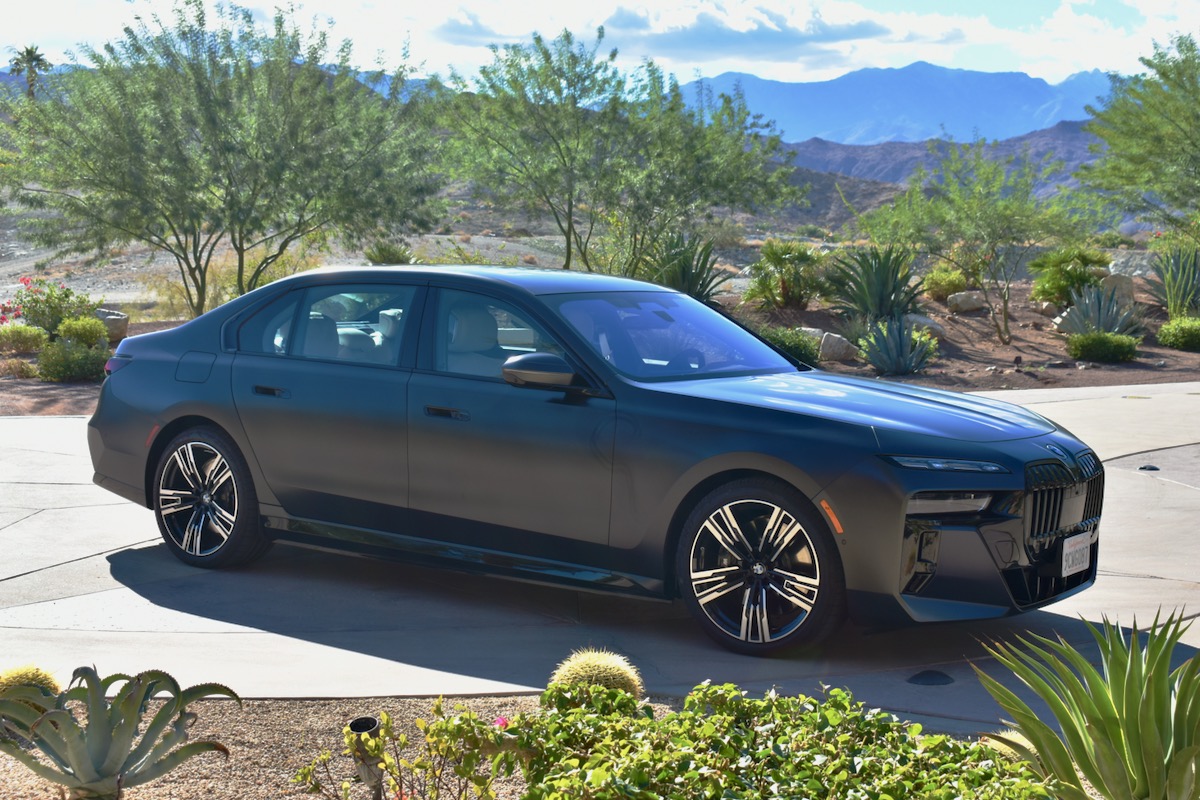
BMW’s flagship 7 Series sedan goes electric in the all-new for 2023 i7.
BMW is applying the electric car experience to its flagship sedan. As part of a redesign, the new 7 Series gets an all-electric variant for the first time. And in keeping with the naming convention established by the i3 and i4, that new model is the 2023 BMW i7.
While the i7 is a different take on BMW’s traditional flagship, it’s also a different approach to luxury EVs. Most other high-end electric sedans—such as the Lucid Air, Mercedes-Benz EQS, and Tesla Model S—were designed from the ground up as EVs. But the i7 is an electric version of a gasoline car.
In its launch i7 xDrive60 guise, the electric model is positioned roughly at the same level as the gasoline 7 Series in performance and price. That will change as the 7 Series lineup grows to include, among other things, a cheaper gasoline model and a more powerful M Performance version of the i7. But for now, BMW is essentially offering the same car with gasoline or electric powertrains.

The i7 electric vehicle shares all of its sheet metal with the gasoline-powered 7 Series, making for quite a contrast with other electric luxury cars. Instead of a streamlined shape to minimize aerodynamic drag, the i7 features the massive profile and statuesque proportions of a traditional flagship luxury sedan. Given negative reactions to the Mercedes-Benz EQS sedan, which has radically different styling from the Mercedes traditional S-Class flagship, this approach makes sense. But that doesn’t mean the i7 will fly under the radar.
BMW made some unusual styling choices with the latest 7 Series, and those carry over to the i7. The kidney grille looks oversized even on a car this big, and the split headlights (a look shared with the BMW X7 SUV) will take some getting used to as well. Styling is subjective, but this is a dramatic departure from the signature BMW look. It will be interesting to see if this new design has the same staying power.
Like the exterior, BMW threw convention out the window when it came to interior design. Speaker grilles flow along the doors like metallic ivy, while ambient lighting elements embedded in the dashboard look like props from the original “Star Trek” series. The i7 can also be equipped with the glass controls previously seen on the iX electric SUV, carbon-fibre trim for the front headrests, and a cashmere wool/Merino leather combination that makes for an intriguing alternative to traditional all-leather upholstery. Instead of leaning into tired luxury tropes, BMW tried something different here—and with great success.
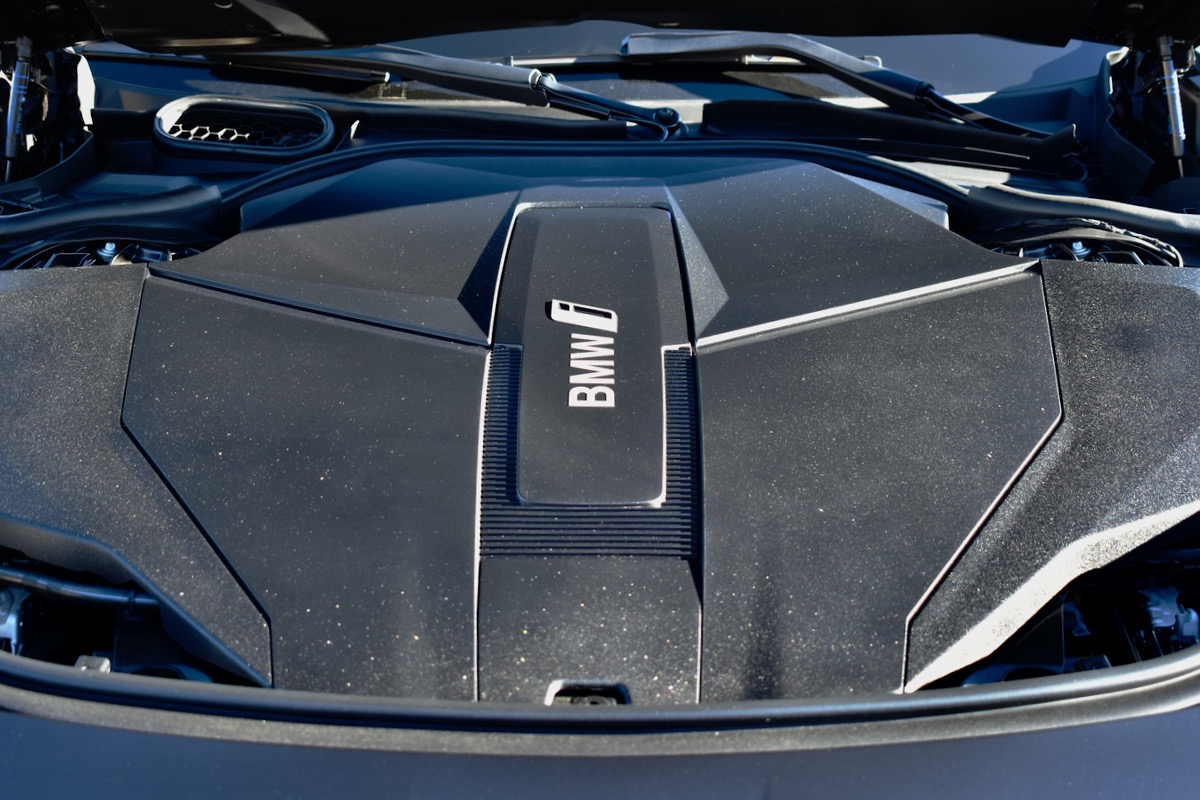
The i7’s standard dual-motor all-wheel drive (AWD) powertrain is rated at power specs of 536 horsepower and 549 lb-ft of torque. BMW quotes a zero to 100 km/h time of roughly 5 seconds, and the top speed is electronically limited to 240 km/h. For comparison, the gasoline BMW 760i xDrive gets identical horsepower from a 4.4-litre twin-turbocharged V8, with 553 pound-feet of torque and a zero to 100 km/h in a factory-quoted 4.2 seconds.
Straight-line acceleration is one thing, but getting a car this big to go around corners without displacing its owners’ Bluetooth earpieces is another matter. So, BMW threw an arsenal of gadgetry at the i7 to benefit handling. Shared with the gasoline 7 Series, the list includes rear-wheel steering, adaptive air suspension, an active roll-stabilization system to neutralize body roll, and a road preview function that uses data from the navigation system and onboard cameras to automatically adjust the suspension for changing road conditions.
These features give the i7 remarkable poise. Even when being hustled on a twisty road—not exactly a full-size luxury sedan’s comfort zone—the i7 remained flat and stable. That feeling of stability remained even as the tires started to lose grip, avoiding the wallowing and dramatic body roll one might expect in a big car designed primarily for ride comfort. And the i7 definitely delivered there, offering a smooth ride to match any of its rivals.
Like other recent BMW EVs, the i7 uses an adaptive regenerative braking system that adjusts the level of regen depending on circumstances, including adding more when following other cars. We found it as unpredictable here as in those other BMW EVs, but with the adaptive system disabled and the regen in its highest setting, the i7 came fairly close to one-pedal driving.
Despite the addition of a battery pack (which sits under the floor), passenger space is nearly identical to the gasoline 7 Series. Headroom in both rows is identical regardless of which powertrain you pick, as is front-row legroom. The i7 loses just over a centimetre of rear-seat legroom compared to gasoline 7 Series models, but still offers a generous 1,087 millimetres.
One would think the i7’s traditional sedan styling would create a decisive advantage in passenger space over more aerodynamically optimized EVs like the Mercedes-Benz EQS sedan and Lucid Air, but the numbers don’t quite line up with that.
The i7 does offer slightly more rear-seat legroom than the EQS sedan, and it beats the Lucid Air by a wider margin in that measurement. That’s likely thanks to a wheelbase that’s about the same length as the Mercedes and about 25 centimetres longer than the Lucid’s. However, the BMW doesn’t offer a true advantage in front-seat legroom, or headroom for either row. That’s a testament to the packaging efficiency of the purpose-built EVs.
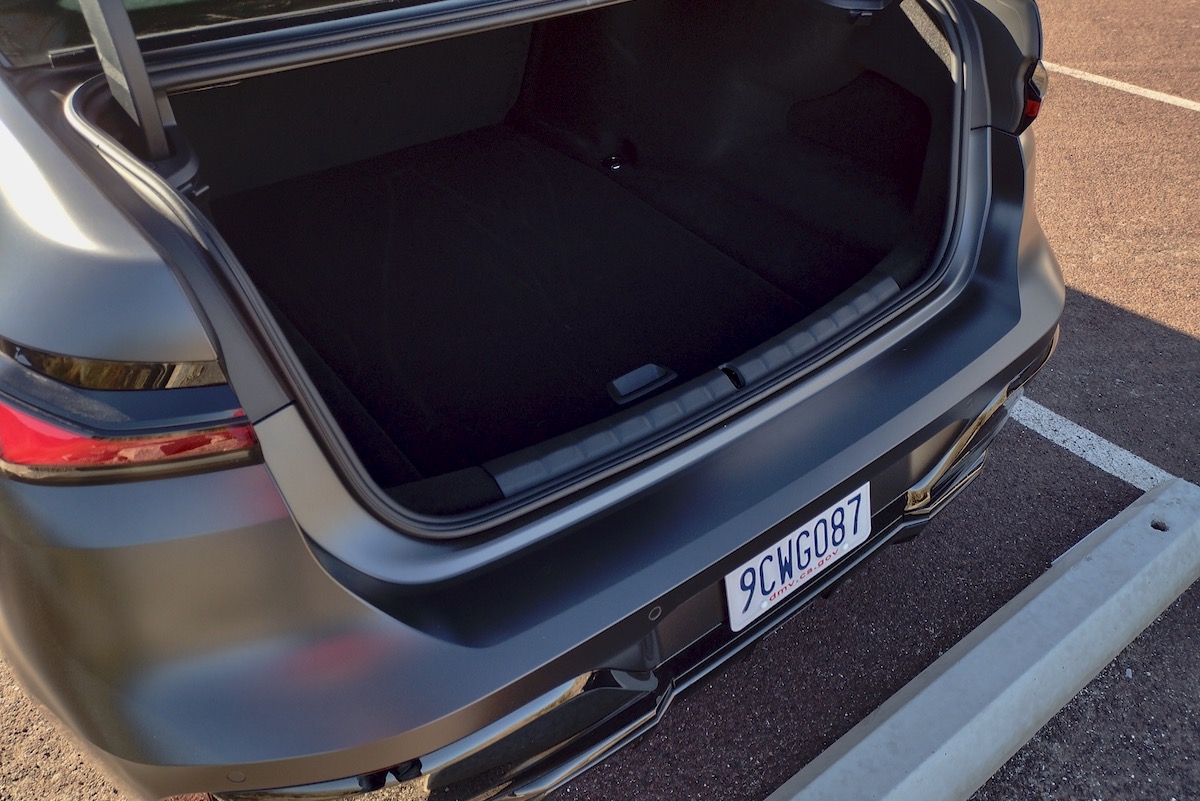
EV shoppers have come to expect a frunk, but the i7 doesn’t have one. The Mercedes EQS sedan doesn’t have one either, but it does at least have more trunk space, at 580 litres to the BMW’s 500 litres. Mercedes also says the rear seats in the EQS can fold to create 1,784 litres of cargo space, but BMW didn’t allow for that. The i7 also has less trunk space than the gasoline 7 Series.
BMW does at least ladle on the luxury. The standard comfort front seats include heating and ventilation, as well as a massage function with nine programs, and a heated steering wheel is standard in Canada. Thankfully, the seats felt decently supportive as well as cushioned.
Rear passengers get similar accommodations, but instead of physical controls, 5.5-inch touchscreens on the rear door panels handle seat adjustments. An available Executive Lounge seating setup adds a reclining right rear seat with leg rest that deploys behind the front passenger seat for the full limousine experience. Adding to that are available automatic doors that can be opened or closed via smartphone.
The driver and all passengers can also stay comfortable with standard four-zone automatic climate control, and they'll appreciate the Panoramic Sky Lounge. A carryover feature from the outgoing 7 Series, it uses embedded LEDs to create different lighting effects. It’s a bit like the Starlight Headliner from BMW-owned Rolls-Royce, but with more of a rave vibe.
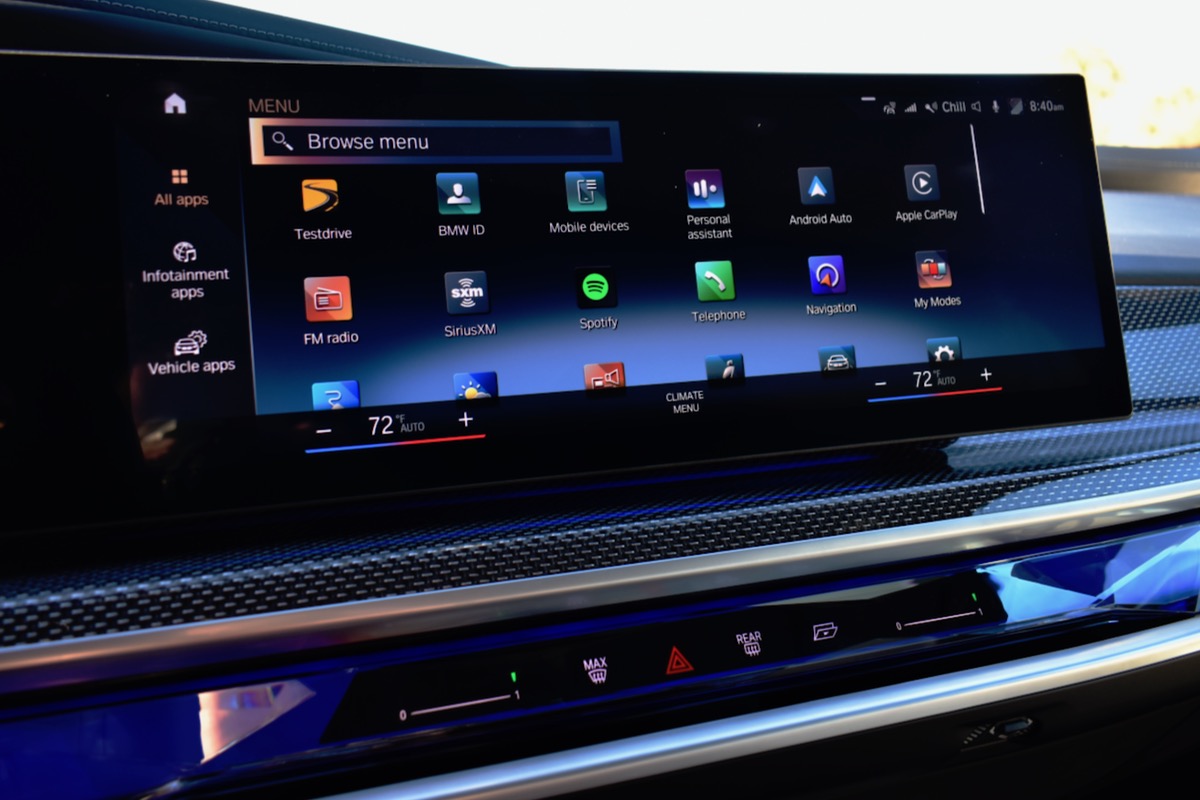
Befitting a flagship luxury sedan, the i7 gets a long list of tech features. Starting up front, we have the BMW Curved Display, which combines a 12.3-inch instrument cluster and 14.9-inch touchscreen in the same housing for one continuous screen. A head-up display is standard equipment. The BMW iDrive 8 infotainment system retains its trademark rotary controller, but there’s now a touchpad Interaction Bar for functions like climate control.
Connectivity includes the expected wireless Apple CarPlay and Android Auto, plus 5G with a car-specific eSIM, and over-the-air (OTA) software update capability. Apple users can also take advantage of Digital Key, which allows an iPhone to be used in place of a key fob.
Rear-seat passengers get their own 5.5-inch touchscreen, and like the gasoline 7 Series, the i7 can be equipped with BMW’s Theatre Screen, a 31.3-inch 8K monitor that folds down from the headliner. Movies and shows can be streamed from sources such as Netflix and Amazon Fire TV. Drivers probably won’t appreciate how the screen cuts into rear visibility, but back seat passengers will likely enjoy watching movies and television shows on the go—with audio provided by the i7’s Bowers & Wilkins Diamond surround sound system.
The front-seat infotainment experience was similar to other recent BMW models, meaning you get impressive graphics and a helpful voice assistant that can accomplish most tasks without forcing a trip through the touchscreen’s menus. Our experience with the theatre screen was brief, but having a screen this big definitely beats watching movies on your phone. Which is exactly what you’ll be reminded of when using the rear-door touchscreens. Swiping and tapping to raise and lower the rear sunshades wasn’t a very satisfying experience, but these screens seem to have mostly been designed with the Theatre Screen and its functions in mind.
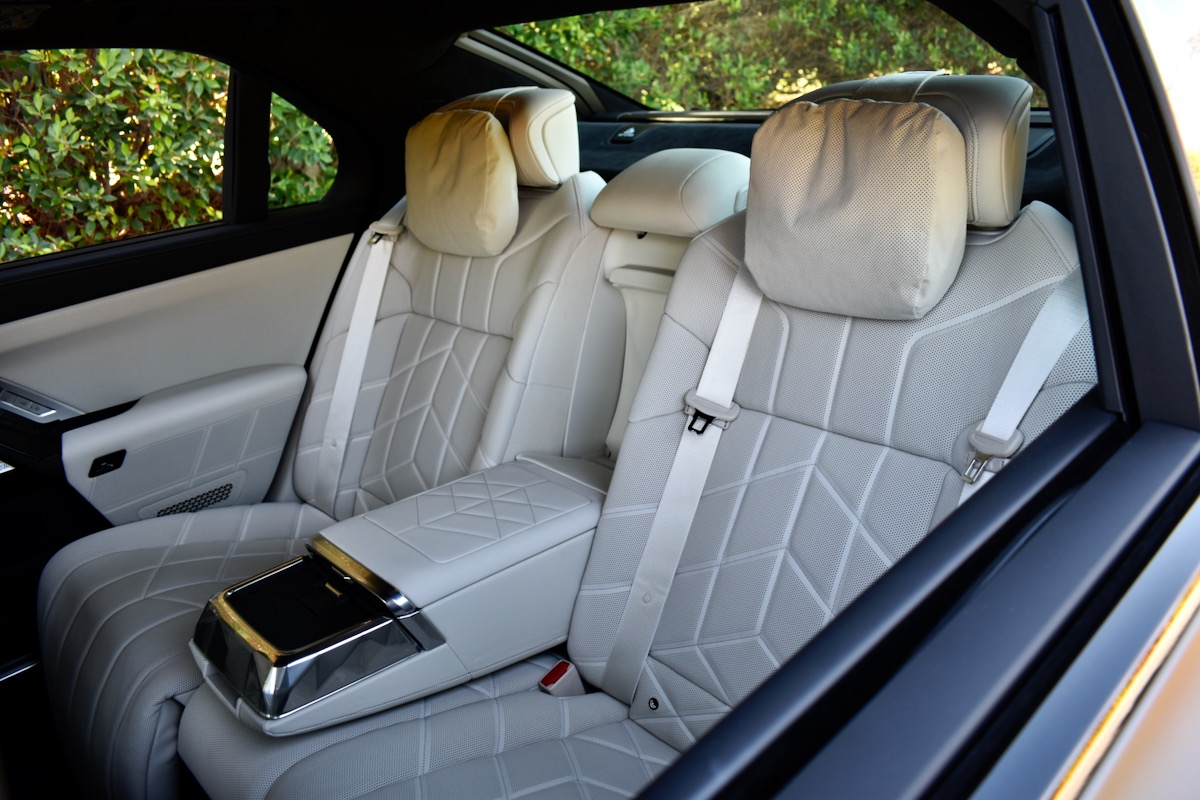
The i7 comes standard with basic driver-assist tech like forward collision warning and automatic emergency braking, but the standout features are extra-cost options.
The $2,000 Advanced Driver Assistance Package adds Highway Assistant, which BMW says enables hands-free driving on divided highways at speeds up to 130 km/h. Drivers must pay attention at all times, though, and BMW includes a driver-facing camera to monitor for that. But BMW doesn’t limit this system to specific stretches of pre-mapped highway like Super Cruise from General Motors.
The i7’s size and tall hood can make parking difficult, but the Parking Assistant Professional system can do it for you. It can even be controlled remotely from outside the car, and includes the Reversing Assistant feature BMW rolled out in 2018. This remembers the path out of parking spaces, retracing steps if a driver pulls into a space they don’t feel confident they can get out of. In Canada, this feature is standard equipment.
The Insurance Institute for Highway Safety (IIHS) and National Highway Traffic Safety Administration (NHTSA) hadn’t released crash-test ratings for the i7 at the time of publication.
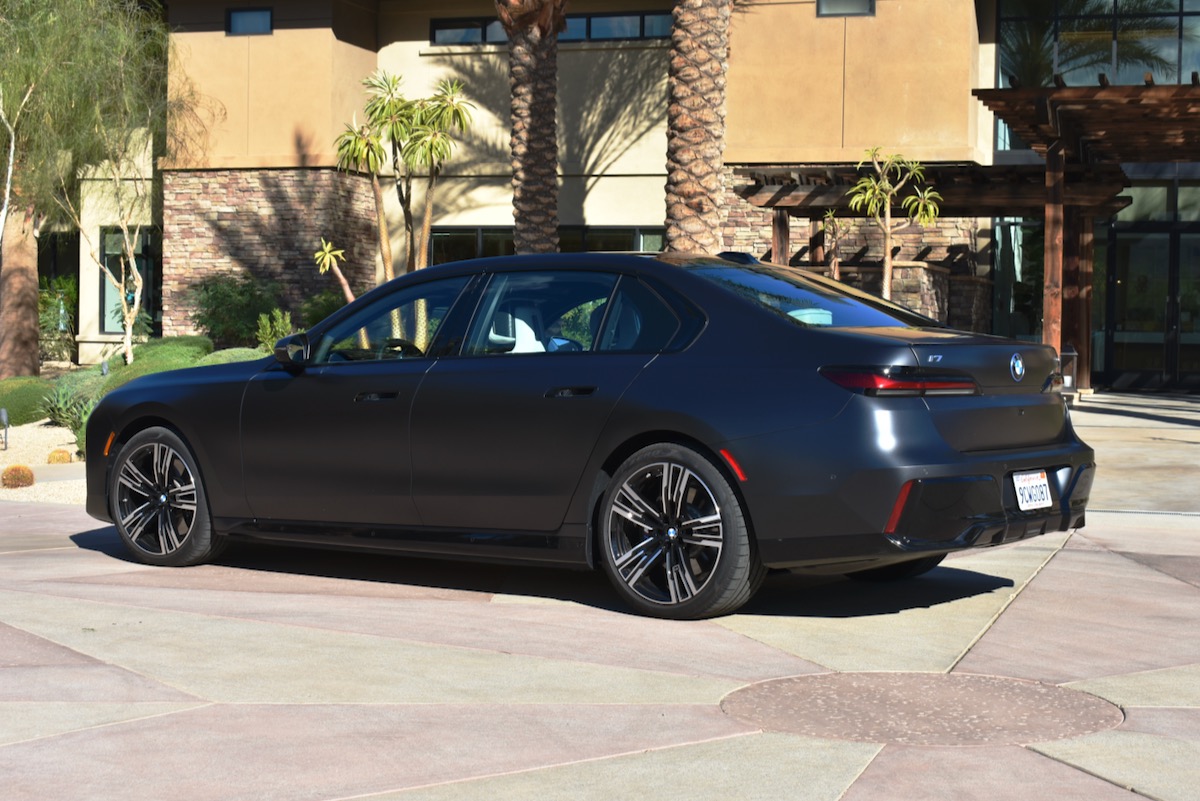
The new BMW i7 maxes out at 512 kilometres of estimated range with Natural Resources Canada efficiency ratings of 2.6 litres-equivalent or 23.5 kWh per 100 kilometres combined (2.7 Le/100 km city, 2.6 highway) with 19-inch wheels. That drops to 2.7 Le/100 km or 24.1 kWh per 100 kilometres combined (2.8 city, 2.6 highway) with 21-inch wheels, and 2.8 Le/100 km or 25.2 kWh/100 km combined (2.9 city, 2.8 highway) with 20-inch wheels.
BMW includes an 11-kilowatt AC onboard charger that the automaker says will recharge the battery pack at a charging rate of 10.5 hours using a 240-volt Level 2 source. The i7 can also take a DC fast charging rate of up to 195 kW, allowing for a 10% to 80% charge in an estimated 34 minutes, or add 130 kilometres of range in 10 minutes of charging.
The i7 gets the same four-year, 80,000-kilometre, new vehicle warranty and eight-year, 160,000-kilometre battery warranty as other BMW EVs.
Pricing starts at $160,306 (with destination) for the sole xDrive60 trim level. BMW Canada offers the i7 at the exact same starting price as the gas-powered 7 Series, which takes some of the sting away from the fact that the electic version doesn’t qualify for any federal or provincial rebate programs. The i7 does start about $11,500 below the Mercedes-Benz EQS 580 4Matic with dual electric motors, but costs more than a Tesla Model S Long Range (Tesla has a habit of abruptly raising prices, however).
The i7 feels more like a traditional luxury sedan than any of those cars, which was the point all along. Its Theatre Screen even surpasses the dedicated EV crowd in tech extravagance, and the BMW’s road manners and bevy of convenience features can make even sitting in traffic relaxing. Almost.
These attributes apply to gas-powered versions of the 7 Series as well, though. Whether new car buyers choose the i7 over a gasoline 7 Series will largely come down to the same factors affecting all EV purchases, including charging convenience and range anxiety. So, it’s possible buyers not already interested in an EV will go for the more convenient-to-own gasoline model.
While the electric 7 Series is impressive on its own, and a more traditional-feeling alternative to other luxury EVs, it’s too similar to the standard 7 Series to make a strong case for going electric.
Note: Images show a US model.

User reviews for 2023 BMW i7
Write a review2023 BMW i7 Pricing
Trims & specs
Air Conditioning
Active charcoal air filtration · Automatic climate control front air conditioning · Dual front air conditioning zones · Automatic climate control rear air conditioning · Dual rear air conditioning zones
Airbags
Dual front airbags · Dual front knee airbags · Passenger airbag deactivation: occupant sensing deactivation · Front side airbags · Front side curtain airbags
Audio System
Antenna Type: mast · Voice recognition audio system · Bluetooth auxiliary audio input · Internet radio app: Spotify · Bower Wilkins premium brand · Touch screen display radio · Satellite Radio: SiriusXM · 1 subwoofer · Total Number of Speakers: 16 · Watts: 655
Brakes
ABS: 4-wheel · Braking assist: hill start assist · Electronic parking brake: auto off · Front brakes: ventilated disc · Rear brakes: ventilated disc
Comfort Features
Armrests: rear center with cupholders · Center console trim: leather · Dash trim: wood · Door sill trim: illuminated scuff plate · Door trim: wood · Floor Mat Material: carpet · Floor Material: carpet · Floor Mats: front · Interior accents: wood · Shift knob trim: alloy · Steering wheel trim: leather
Convenience Features
Active parking system: driver controlled brake, gas and gear selection · Ambient lighting: color-adjustable · Assist handle: rear · Cargo area power outlet: 12V · Center console: front console with armrest and storage · Cupholders: rear · Dimming rearview mirror: auto-dimming · Easy entry: power steering wheel · Footwell lights: color-adjustable · Memorized settings: passenger seat · Multi-function remote: proximity entry system · One-touch windows: 4 · Power outlet(s): USB-C rear · Power steering: electric · Power windows: lockout button · Reading lights: front · Rear power outlet: 12V · Steering wheel: power tilt and telescopic · Steering wheel mounted controls: phone · Storage: cargo tie-down anchors and hooks · Sunshade: side window · Universal garage door opener: Homelink · Vanity mirrors: dual illuminated rear seat
Driver Seat
Adjustable lumbar support: 4-way power · Power adjustments: 20
Drivetrain
4WD Type: full time · Axle ratio: 9.37
Engine
EV battery capacity: 105.6 kWh · EV on-board charger rating: 11 kW · Electric Motor Battery Type: lithium ion · Electric Motor HP: 536 · Electric Motor Power Output (Kilowatts): 400 · Electric Motor Torque: 549 · Electric charge cord: autoswitching 110V/240V · Electric motor charger: DC fast charging · Electric motor charger connector: SAE J1772 · Electric motor charging time: 12 hours · Electric motor miles per charge: 296
Exterior Features
Body side moldings: chrome · Door handle color: chrome · Front bumper color: body-color · Grille color: chrome · Headlamp bezel color: black · Mirror color: body-color with chrome accents · Rear bumper color: body-color · Rear trunk/liftgate: power operated · Rocker panel color: body-color · Side door type: soft close · Window trim: chrome
Headrests
Front headrests: power adjustable · Number of front headrests: 2 · Number of rear headrests: 3
In Car Entertainment
Connected in-car apps: Google POIs · Infotainment screen size: 14.9 in. · Smartphone integration: wireless Android Auto
Instrumentation
Fuel economy display: range · Instrument cluster screen size: 12.3 in. · Warnings and reminders: low battery
Lights
Daytime running lights: LED · Exterior entry lights: puddle lamps · Headlights: self-leveling · Tail and brake lights: LED · Taillights: adaptive
Mirrors
Exterior mirrors: heated
Passenger Seat
Power adjustments: 20
Rear Seats
Type: bench
Roof
Moonroof / Sunroof: power sunshade · Sunroof: panoramic
Safety
Active head restraints: driver · Automatic emergency braking: front pedestrian · Camera system: rearview · Child seat anchors: LATCH system · Cross Traffic Alert: rear · Crumple zones: front · Impact sensor: post-collision safety system · Parking sensors: front · Pre-Collision Warning System: vibrating steering wheel · Pre-collision warning system: pedestrian detection · Rearview monitor: in dash
Seatbelts
Emergency locking retractors: front · Front seatbelts: 3-point · Seatbelt force limiters: front and rear · Seatbelt pretensioners: front · Seatbelt warning sensor: driver and passenger · Second row seatbelts: 3-point
Seats
Driver seat power adjustments: height · Front seat type: bucket · Passenger seat power adjustments: height · Rear headrests: adjustable · Upholstery: premium leather
Spare Tire
Kit: inflator kit
Steering
Steering ratio: 15.6
Suspension
Driver Adjustable Suspension: height · Front Shock Type: twin-tube gas shock absorbers · Front Spring Type: pneumatic springs · Front Suspension Classification: independent · Front Suspension Type: double wishbones · Leveling: self leveling suspension · Rear Shock Type: twin-tube gas shock absorbers · Rear Spring Type: pneumatic springs · Rear Suspension Classification: independent · Rear Suspension Type: multi-link · Stabilizer bar(s): front · Suspension control: electronic
Telematics
Driver assistance app: roadside assistance · Electronic messaging assistance: with voice recognition · Navigation system: with voice recognition · Phone: voice activated · Phone wireless data link: Bluetooth · Satellite communications: BMW Assist · Smart device app compatibility: Amazon Alexa · Smart device app function: horn/light operation · Wifi: hotspot
Tires
Type: all season
Tires and Rims
Wheel type: aluminum alloy
Windows
Front wipers: variable intermittent · Power windows: with safety reverse
