2023 Hyundai Elantra Reviews, Pricing & Specs
Write a reviewPros
Multiple powertrain options
Easy-to-use technology
Excellent value for money
Cons
Potentially polarizing design
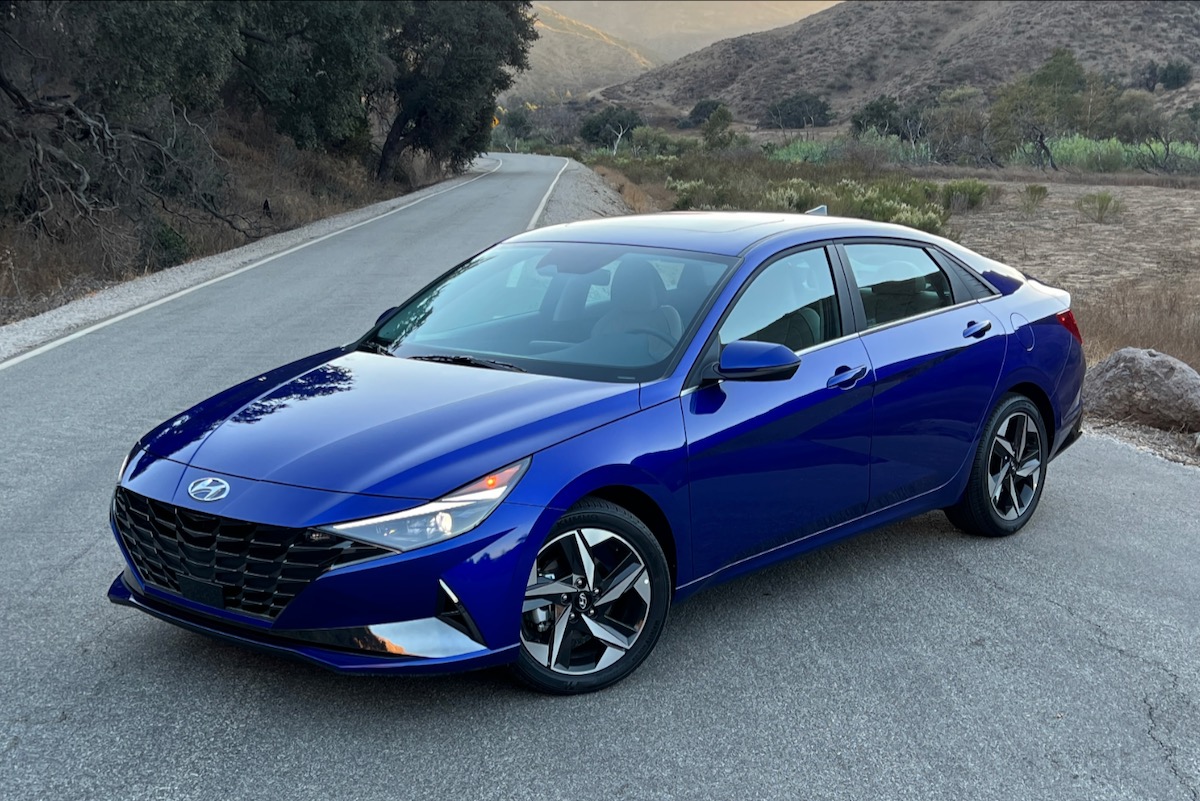
From basic transportation to performance thrills, the 2023 Hyundai Elantra lineup offers something for almost everyone.

With the 2023 Elantra compact sedan, Hyundai offers something for almost everyone. The base Elantra Essential costs roughly half the average for a new car in Canada, and if you have more room in your budget you can upgrade to the Preferred or Luxury trim levels, the latter looking and feeling more upscale than its price tag suggests.
The Elantra Hybrid is a $2,500 option on the Luxury trim and consumes 4.7 litres per 100 kilometres in combined driving. And it looks exactly the same as a standard Elantra except for a discreet “Hybrid” badge.
If you like to drive, the sporty turbo Elantra N Line Ultimate might be right for you. Or you can upgrade to the performance-tuned, 276-horsepower Elantra N, the “N” standing for Germany’s fabled Nürburgring racing track, where Hyundai performed much of the car’s development work, as well as Namyang, South Korea, home of Hyundai’s global R&D centre. It is legit.
Across the lineup, from the Elantra Essential to the Elantra N, prices range from $20,449 to $39,299, not including a $1,775 destination charge. Our test vehicle is the U.S. equivalent of the Elantra Luxury.
For the 2023 model year, changes are few and far between. The Luxury and N Line models get a 10.25-inch digital instrumentation panel paired with a 10.25-inch touchscreen infotainment system. The N Line is no longer available with a six-speed manual transmission, making the Elantra N your only choice if you want to row your own gears.
Now, as far as the Elantra’s look and feel are concerned, the exterior styling is somewhat controversial. We like it, but recognize that the design isn’t appealing to everyone. These days, that seems to be the way at Hyundai.
The same is not true of our test car’s interior. Decked out in light grey leather, the seats and interior panels offered sharp contrast against the otherwise black cabin. Add the test car’s undeniably original style, classy nighttime illumination and ambient lighting, and high-tech displays, and a 2023 Elantra Luxury’s cabin is anything but entry-level. Well, except for the unfortunate hard plastic coating the upper door panels, which is the only disappointment in an otherwise sensational cabin for the price.

Review the Hyundai Elantra Luxury’s spec chart, and you’ll come away unimpressed. Nobody gets excited about a 2.0-litre four-cylinder engine making 147 horsepower at 6,200 rpm and 132 lb-ft of torque at 4,500 rpm. Add the standard continuously variable transmission (CVT), which Hyundai calls an Intelligent Variable Transmission (IVT), front-wheel drive (FWD), and the torsion-beam rear axle suspension, and people who know cars will fall asleep before they finish reading this sentence.
Surprisingly, the Elantra Luxury’s driving dynamics defy expectations. Obviously, this Hyundai is not fast. Or even quick. But it is peppy, and the CVT/IVT is the best one in the compact car class. Plus, despite exploring its handling qualities on our mountainous testing loop, the Elantra Luxury averaged 7.1 L/100 km during the evaluation drive, coming close enough to the official NRCan fuel economy rating of 6.7 L/100 km to call it good.
If you want a dual-clutch transmission (DCT) and an independent multi-link rear suspension instead of the test car’s torsion-beam rear axle setup, pick the N Line Ultimate, the Elantra Hybrid, or the Elantra N. However, before you spend the extra money, we’ll say that most people won’t care about the cost-effective standard underpinnings. Based on our evaluation, it doesn’t compromise the ride and handling to a noticeable degree.
In city and suburban driving, the Elantra Luxury offers a communicative yet compliant ride, a properly calibrated brake pedal, and suitable steering effort levels. On the highway, the car is remarkably quiet for the segment.
On our enthusiastic test drive through the mountains, the Elantra Luxury displayed remarkable composure. The car isn’t outright fun to drive like the Elantra N Line Ultimate or, especially, the fantastic Hyundai Elantra N. But it delivers consistent and repeatable handling qualities that engender trust in its driver.
Undoubtedly, the 17-inch alloy wheels and 225/45 tires assist in this endeavour, but the suspension also attenuates excess motion almost immediately without feeling too firm or stiff. The car demonstrates a flat cornering attitude, the rubber rarely squeals, the stability control doesn’t freak out, and over rumpled sections of road the Elantra remains stable and predictable.
If there’s anything holding the Elantra Luxury back, aside from outright power, it’s steering that doesn’t feel particularly quick or sharp on twisty pavement and doesn’t produce much feel for the road. Also, the test car’s brakes did heat up and start to shudder a little bit, but they didn’t fade.
Overall, we find that the Elantra Luxury’s driving dynamics amount to more than the sum of its specs chart, making for an unexpected but pleasant surprise.

Though the 2023 Elantra exudes style, it doesn’t come at the expense of practicality and utility. This is a roomy compact car that can easily serve a family of four.
Our test vehicle had proximity-sensing keyless entry, which means you don’t need to take the fob out and press a button to unlock the doors. Instead, the car recognizes the key fob is present, and allows the driver to enter the vehicle.
Get behind the steering wheel, which has two lower bars that serve as perfect hand rests for long trips, and you’ll find the Luxury model’s leather-wrapped driver’s seat to be quite comfortable. (In Canada, the Luxury model comes with manual adjustments rather than the power adjustments seen in our test car. Power adjustments are exclusive to the N Line Ultimate trim.) In addition, the test car had dual-zone automatic climate control and heated front seats. In Canada, ventilated front seats are not available.
Our test vehicle includes a manual seat-height adjuster for the front passenger, but rear-seat occupants may not find the Elantra as satisfying a place to spend time. The backrest is too reclined, forcing a slouched seating position. Also, the Elantra lacks rear air conditioning vents and USB charging ports. Taller people won’t like the hard plastic panels on the front seatbacks, either.
A hands-free trunk release feature is standard on some Elantra models, or you can use the deftly integrated trunk release button on the lid. The trunk offers 402 litres of cargo space, and you can stow full-size suitcases on their sides, helping creative packers to make the most of the space. In addition, the Luxury model’s 60/40-split folding back seat expands utility when necessary.

This year, Hyundai broadens availability of the Elantra’s 10.25-inch digital instrumentation and infotainment displays. Now you can get them in the Luxury, Hybrid, and N Line Ultimate trims and as part of a package on the Preferred trim.
These screens are terrific. You don’t expect this kind of technology in a compact car from a mainstream brand, so it elevates the Hyundai the moment you press the engine start button and they come to life.
With this setup, standard infotainment features include Apple CarPlay, Android Auto, satellite radio, activation of connected services, dynamic voice recognition, a navigation system, and a wireless charging pad (the latter is not part of the Preferred package, but a power sunroof is). Unfortunately, only the Bluetooth supports a wireless connection. To use Apple CarPlay or Android Auto, you’ll need to connect to a USB port.
We find this system easy to set up and use, and the voice recognition feature passed most of our tests. But when telling the system we wanted to listen to reggae music, it was unable to comply. Directing it to tune to the Bob Marley channel on SiriusXM produced success.
You’re also supposed to be able to control the climate system using voice commands, but in this case, the tech failed. After asking the digital assistant to change the temperature to 22 degrees, the car instead cranked the heat to the highest level and turned the seat heaters on to their highest setting. That’s not what we wanted.
Hyundai equips the Elantra Luxury with a Bose premium audio system, but it doesn’t sound as good as it should. Bose components in some of the Elantra’s rivals, such as the Honda Civic and the Mazda Mazda3, produce appealing sound quality. That’s not the case here.
Our test vehicle also had Digital Key technology that transforms a compatible smartphone into the vehicle’s key.

If it sounds like the 2023 Hyundai Elantra is hard to fault, you’re not going to find any reason for it when it comes to safety. The generous package of standard safety features includes automatic high-beam headlights, forward-collision warning with pedestrian detection, automatic emergency braking, lane-departure warning, lane-keeping assist, lane-centring assist, a full complement of airbags, and antilock brakes (ABS) with electronic brake force distribution. Other standard features include a driver monitoring system and a rear-seat reminder system.
Our Elantra Luxury test car built on this foundation with a safe exit warning system, cyclist detection, an intersection turning assist system, blind-spot monitoring, rear parking sensors, adaptive cruise control with stop-and-go capability, and Highway Driving Assist, which marries the adaptive cruise control with the lane-centring assist for highway driving.
We tested the Elantra’s driving assist systems on a two-lane highway and a busy urban highway, and it worked beautifully. All systems were go except for when the car encountered some mud-obscured road markings on a rural two-lane road.
The difference here is how smooth and subtle the driving aids are. For example, you can feel the lane-centring assist adding small steering inputs, but they’re barely evident rather than sudden or abrupt. It’s hard to trust technology that doesn’t seem sure of what it’s doing, but the Elantra’s Highway Driving Assist system is nothing but calm, cool, and collected. Better, you rarely feel like you need to override the tech’s inputs, and when you do, it’s easy rather than a struggle.
The 2023 Elantra earned a Top Safety Pick rating from the Insurance Institute for Highway Safety (IIHS). The National Highway Traffic Safety Administration (NHTSA) gives the 2023 Elantra a five-star overall rating, as well as five stars in all crash-test categories except frontal crash protection, where it received four stars.

Affordable by modern standards, the 2023 Hyundai Elantra is a cost-effective choice in a compact car.
Every new Hyundai gets the automaker’s 5-year, 100,000-kilometre bumper-to-bumper warranty work at your local dealerships, along with roadside assistance. Blue Link connected services are also available on most models.
In short, no matter if you’re buying the entry-level model, the fuel-efficient Elantra Hybrid, or the downright thrilling Elantra N, this Hyundai is one of the best deals on wheels.
Note: Images show a US model.

User reviews for 2023 Hyundai Elantra
Write a review2023 Hyundai Elantra Pricing
Trims & specs
Air Conditioning
Single front air conditioning zones
Airbags
Dual front airbags · Passenger airbag deactivation: occupant sensing deactivation · Front side airbags · Front side curtain airbags
Audio System
Antenna Type: element · Bluetooth auxiliary audio input · HD radio · Total Number of Speakers: 4
Brakes
ABS: 4-wheel · Braking assist: hill start assist · Front brake diameter: 11.0 · Front brakes: ventilated disc · Rear brake diameter: 10.3 · Rear brakes: disc
Comfort Features
Door sill trim: scuff plate · Floor Material: carpet · Shift knob trim: urethane · Steering wheel trim: urethane
Convenience Features
Assist handle: front · Autonomous lane guidance: lane centering · Center console: front console with armrest and storage · Cupholders: front · Multi-function remote: keyless entry with panic alarm · One-touch windows: 1 · Power outlet(s): USB front · Power steering: speed-proportional · Power windows: lockout button · Reading lights: front · Steering wheel: tilt and telescopic · Steering wheel mounted controls: phone · Storage: door pockets · Vanity mirrors: dual
Driver Seat
Manual adjustments: 6
Drivetrain
Axle ratio: 4.89
Engine
Alternator: 120 amps · Battery: maintenance-free
Exterior Features
Door handle color: body-color · Exhaust tip color: stainless-steel · Front bumper color: body-color · Grille color: chrome · Mirror color: body-color · Rear bumper color: body-color · Rocker panel color: body-color · Window trim: black
Headrests
Front headrests: adjustable · Number of front headrests: 2 · Number of rear headrests: 3
In Car Entertainment
Connected in-car apps: Google POIs · Infotainment screen size: 8 in. · Smartphone integration: wireless Android Auto
Instrumentation
Fuel economy display: range · Instrument cluster screen size: 4.2 in. · Warnings and reminders: low fuel level
Lights
Daytime running lights: LED · Headlights: automatic high beam dimmer
Mirrors
Exterior mirrors: manual folding · Inside rearview mirror: manual day/night
Passenger Seat
Manual Adjustments: 4
Rear Seats
Type: bench
Safety
Automatic emergency braking: rear · Camera system: rearview · Child seat anchors: LATCH system · Cross Traffic Alert: rear · Crumple zones: front · Pre-Collision Warning System: visual warning · Pre-collision warning system: pedestrian detection · Rearview monitor: in dash
Seatbelts
Emergency locking retractors: front · Front seatbelts: 3-point · Seatbelt force limiters: front · Seatbelt pretensioners: front · Seatbelt warning sensor: driver and passenger · Second row seatbelts: 3-point
Seats
Driver seat manual adjustments: height · Front seat type: bucket · Passenger seat manual adjustments: reclining · Rear seat folding: one-piece · Upholstery: premium cloth
Spare Tire
Mount Location: inside · Size: temporary
Spare Wheel
Rim Type: steel
Steering
Steering ratio: 12.9 · Turns lock-to-lock: 2.5
Suspension
Front Arm Type: lower control arms · Front Shock Type: twin-tube gas shock absorbers · Front Spring Type: coil springs · Front Stabilizer Bar: diameter 22 mm · Front Suspension Classification: independent · Front Suspension Type: MacPherson struts · Rear Spring Type: coil springs · Rear Suspension Classification: semi-independent · Rear Suspension Type: torsion bar · Rear shock type: monotube
Telematics
Electronic messaging assistance: with voice recognition · Phone: voice activated · Phone wireless data link: Bluetooth
Tires
Type: all season
Tires and Rims
Wheel type: aluminum alloy
Windows
Front wipers: variable intermittent · Power windows: with safety reverse
Air Conditioning
Automatic climate control front air conditioning · Dual front air conditioning zones
Airbags
Dual front airbags · Passenger airbag deactivation: occupant sensing deactivation · Front side airbags · Front side curtain airbags
Audio System
Antenna Type: diversity · USB auxiliary audio input · HD radio · Satellite Radio: SiriusXM · Total Number of Speakers: 6
Brakes
ABS: 4-wheel · Braking assist: hill start assist · Front brake diameter: 11.0 · Front brakes: ventilated disc · Rear brake diameter: 10.3 · Rear brakes: disc
Comfort Features
Door sill trim: scuff plate · Floor Material: carpet · Shift knob trim: urethane · Steering wheel trim: urethane
Convenience Features
Assist handle: rear · Autonomous lane guidance: lane centering · Center console: front console with armrest and storage · Cupholders: front · Multi-function remote: keyless entry with panic alarm · One-touch windows: 1 · Power outlet(s): two 12V front · Power steering: speed-proportional · Power windows: lockout button · Reading lights: front · Steering wheel: tilt and telescopic · Steering wheel mounted controls: phone · Storage: door pockets · Vanity mirrors: dual illuminating
Driver Seat
Manual adjustments: 6
Drivetrain
Axle ratio: 4.89
Engine
Alternator: 120 amps · Battery: maintenance-free
Exterior Features
Door handle color: body-color · Exhaust tip color: stainless-steel · Front bumper color: body-color · Grille color: chrome · Mirror color: body-color · Rear bumper color: body-color · Rear trunk/liftgate: sensor-activated · Rocker panel color: body-color · Window trim: black
Headrests
Front headrests: adjustable · Number of front headrests: 2 · Number of rear headrests: 3
In Car Entertainment
Connected in-car apps: Google search · Infotainment: Blue Link · Infotainment screen size: 8 in. · Smartphone integration: wireless Android Auto
Instrumentation
Fuel economy display: range · Instrument cluster screen size: 4.2 in. · Warnings and reminders: low fuel level
Lights
Daytime running lights: LED · Headlights: automatic high beam dimmer
Mirrors
Exterior mirrors: power · Inside rearview mirror: manual day/night
Passenger Seat
Manual Adjustments: 4
Rear Seats
Type: bench
Safety
Automatic emergency braking: front pedestrian · Camera system: rearview · Child seat anchors: LATCH system · Cross Traffic Alert: rear · Crumple zones: front · Pre-Collision Warning System: audible warning · Pre-collision warning system: pedestrian detection · Rearview monitor: in dash
Seatbelts
Emergency locking retractors: front · Front seatbelts: 3-point · Seatbelt force limiters: front · Seatbelt pretensioners: front · Seatbelt warning sensor: driver and passenger · Second row seatbelts: 3-point
Seats
Driver seat manual adjustments: height · Front seat type: bucket · Passenger seat manual adjustments: reclining · Rear seat folding: one-piece · Upholstery: premium cloth
Security
Power door locks: anti-lockout
Spare Tire
Mount Location: inside · Size: temporary
Spare Wheel
Rim Type: steel
Steering
Steering ratio: 12.9 · Turns lock-to-lock: 2.5
Suspension
Front Arm Type: lower control arms · Front Shock Type: twin-tube gas shock absorbers · Front Spring Type: coil springs · Front Stabilizer Bar: diameter 22 mm · Front Suspension Classification: independent · Front Suspension Type: MacPherson struts · Rear Spring Type: coil springs · Rear Suspension Classification: semi-independent · Rear Suspension Type: torsion bar · Rear shock type: monotube
Telematics
Driver assistance app: roadside assistance · Electronic messaging assistance: with read function · Phone: voice activated · Phone wireless data link: Bluetooth · Smart device app compatibility: MyHyundai with Blue Link · Smart device app function: maintenance scheduling
Tires
Type: all season
Tires and Rims
Wheel type: aluminum alloy
Windows
Front wipers: variable intermittent · Power windows: with safety reverse
Air Conditioning
Automatic climate control front air conditioning · Dual front air conditioning zones
Airbags
Dual front airbags · Passenger airbag deactivation: occupant sensing deactivation · Front side airbags · Front side curtain airbags
Audio System
Antenna Type: element · Voice recognition audio system · USB auxiliary audio input · Premium Brand: Bose · AM/FM radio · Satellite Radio: SiriusXM · 1 subwoofer · Total Number of Speakers: 7
Brakes
ABS: 4-wheel · Braking assist: hill start assist · Electronic parking brake: auto off · Front brake diameter: 11.0 · Front brakes: ventilated disc · Rear brake diameter: 10.3 · Rear brakes: disc
Comfort Features
Armrests: rear center with cupholders · Center console trim: leatherette · Door sill trim: scuff plate · Door trim: leatherette · Floor Material: carpet · Shift knob trim: leather · Steering wheel trim: leather
Convenience Features
Adaptive stop and go cruise control: semi-automatic · Ambient lighting: color-adjustable · Assist handle: rear · Autonomous lane guidance: lane centering · Center console: front console with armrest and storage · Cruise control: adaptive · Cupholders: front · Dimming rearview mirror: auto-dimming · Multi-function remote: keyless entry with panic alarm · One-touch windows: 1 · Power outlet(s): two 12V front · Power steering: electric · Power windows: lockout button · Reading lights: front · Steering wheel: tilt and telescopic · Steering wheel mounted controls: cruise controls · Storage: accessory hook · Vanity mirrors: dual illuminating
Driver Seat
Adjustable lumbar support: power · Power adjustments: 6
Drivetrain
Axle ratio: 4.89
Engine
Alternator: 120 amps · Battery: maintenance-free
Exterior Features
Door handle color: body-color · Exhaust tip color: stainless-steel · Front bumper color: body-color · Grille color: black chrome · Mirror color: body-color · Rear bumper color: body-color · Rear trunk/liftgate: sensor-activated · Rocker panel color: body-color · Window trim: chrome
Headrests
Front headrests: adjustable · Number of front headrests: 2 · Number of rear headrests: 3
In Car Entertainment
Connected in-car apps: app marketplace integration · Infotainment: Android Auto ready · Infotainment screen size: 10.25 in.
Instrumentation
Fuel economy display: MPG · Instrument cluster screen size: 10.25 in. · Warnings and reminders: lamp failure
Lights
Daytime running lights: LED · Headlights: LED · Tail and brake lights: LED
Mirrors
Exterior mirrors: manual folding
Passenger Seat
Manual Adjustments: 4
Rear Seats
Type: 60-40 split bench
Roof
Moonroof: sliding sunshade
Safety
Automatic emergency braking: front · Camera system: rearview · Child seat anchors: LATCH system · Cross Traffic Alert: rear · Crumple zones: rear · Parking sensors: rear · Pre-Collision Warning System: audible warning · Pre-collision warning system: pedestrian detection · Programmable safety key: MyKey · Rearview monitor: in dash · Traffic sign recognition: adaptive speed limiting
Seatbelts
Emergency locking retractors: front · Front seatbelts: 3-point · Seatbelt force limiters: front · Seatbelt pretensioners: front · Seatbelt warning sensor: driver and passenger · Second row seatbelts: 3-point
Seats
Driver seat power adjustments: height · Front seat type: bucket · Passenger seat manual adjustments: height · Rear headrests: adjustable · Rear seat folding: split · Upholstery: leather-trimmed
Security
Power door locks: anti-lockout
Spare Tire
Mount Location: inside · Size: temporary
Spare Wheel
Rim Type: steel
Steering
Steering ratio: 12.9 · Turns lock-to-lock: 2.5
Suspension
Front Arm Type: lower control arms · Front Shock Type: twin-tube gas shock absorbers · Front Spring Type: coil springs · Front Stabilizer Bar: diameter 22 mm · Front Suspension Classification: independent · Front Suspension Type: MacPherson struts · Rear Spring Type: coil springs · Rear Suspension Classification: semi-independent · Rear Suspension Type: torsion bar · Rear shock type: monotube
Telematics
Driver assistance app: roadside assistance · Electronic messaging assistance: with voice recognition · Navigation system: touch screen display · Phone: voice activated · Phone wireless data link: Bluetooth · Smart device app compatibility: MyHyundai with Blue Link · Smart device app function: lock operation
Tires
Type: all season
Tires and Rims
Wheel type: aluminum alloy
Windows
Front wipers: variable intermittent · Power windows: with safety reverse
Air Conditioning
Automatic climate control front air conditioning · Dual front air conditioning zones
Airbags
Dual front airbags · Passenger airbag deactivation: occupant sensing deactivation · Front side airbags · Front side curtain airbags
Audio System
Antenna Type: element · Bluetooth auxiliary audio input · AM/FM radio · Satellite Radio: SiriusXM · Total Number of Speakers: 6
Brakes
ABS: 4-wheel · Braking assist: hill start assist · Front brake diameter: 12.0 · Front brakes: ventilated disc · Rear brake diameter: 10.3 · Rear brakes: disc
Comfort Features
Armrests: rear center with cupholders · Door sill trim: scuff plate · Floor Material: carpet · Foot pedal trim: alloy · Shift knob trim: leather · Steering wheel trim: leather
Convenience Features
Assist handle: rear · Autonomous lane guidance: lane centering · Center console: front console with armrest and storage · Cupholders: rear · Multi-function remote: proximity entry system · One-touch windows: 1 · Power outlet(s): USB front · Power steering: speed-proportional · Power windows: lockout button · Reading lights: front · Steering wheel: tilt and telescopic · Steering wheel mounted controls: voice recognition controls · Storage: sunglasses holder · Vanity mirrors: dual illuminating
Driver Seat
Adjustable lumbar support: power · Power adjustments: 6
Drivetrain
Axle ratio: 4.64
Engine
Alternator: 130 amps · Battery: maintenance-free
Exterior Features
Door handle color: body-color · Exhaust: dual exhaust tips · Exhaust tip color: chrome · Front bumper color: body-color · Grille color: black · Mirror color: black · Rear bumper color: body-color · Rear spoiler: lip · Rear spoiler color: body-color · Rear trunk/liftgate: power operated · Rocker panel color: black · Window trim: black
Headrests
Front headrests: adjustable · Number of front headrests: 2 · Number of rear headrests: 3
In Car Entertainment
Connected in-car apps: Google POIs · Infotainment: Blue Link · Infotainment screen size: 8 in. · Smartphone integration: wireless Apple CarPlay
Instrumentation
Fuel economy display: MPG · Instrument cluster screen size: 4.2 in. · Warnings and reminders: maintenance reminder
Lights
Daytime running lights: LED · Headlights: Halogen · Tail and brake lights: LED
Mirrors
Exterior mirrors: heated · Inside rearview mirror: manual day/night
Passenger Seat
Manual Adjustments: 4
Rear Seats
Type: 60-40 split bench
Roof
Moonroof: sliding sunshade
Safety
Automatic emergency braking: rear · Camera system: rearview · Child seat anchors: LATCH system · Cross Traffic Alert: rear · Crumple zones: rear · Pre-Collision Warning System: visual warning · Pre-collision warning system: pedestrian detection · Rearview monitor: in dash
Seatbelts
Emergency locking retractors: front and rear · Front seatbelts: 3-point · Seatbelt force limiters: front · Seatbelt pretensioners: front · Seatbelt warning sensor: driver and passenger · Second row seatbelts: 3-point
Seats
Driver seat power adjustments: height · Front seat type: sport bucket · Passenger seat manual adjustments: reclining · Rear headrests: adjustable · Rear seat folding: split · Upholstery: premium cloth · Upholstery accents: leather-trimmed
Security
Power door locks: anti-lockout
Spare Tire
Mount Location: inside · Size: temporary
Spare Wheel
Rim Type: steel
Suspension
Front Arm Type: lower control arms · Front Shock Type: twin-tube gas shock absorbers · Front Spring Type: coil springs · Front Stabilizer Bar: diameter 23 mm · Front Suspension Classification: independent · Front Suspension Type: MacPherson struts · Rear Spring Type: coil springs · Rear Stabilizer Bar: diameter 17 mm · Rear Suspension Classification: independent · Rear Suspension Type: multi-link · Rear shock type: monotube
Telematics
Driver assistance app: roadside assistance · Electronic messaging assistance: with voice recognition · Phone: voice activated · Phone wireless data link: Bluetooth · Smart device app compatibility: MyHyundai with Blue Link · Smart device app function: phone as a key
Tires
Type: all season
Tires and Rims
Wheel type: aluminum alloy
Windows
Front wipers: variable intermittent · Power windows: with safety reverse
