2023 Kia Sportage Hybrid Reviews, Pricing & Specs
Write a reviewPros
Fuel-efficient
Impressive technology
Great ride quality
Cons
Potentially polarizing design
Advanced safety features are not standard
Interior materials feel cheap
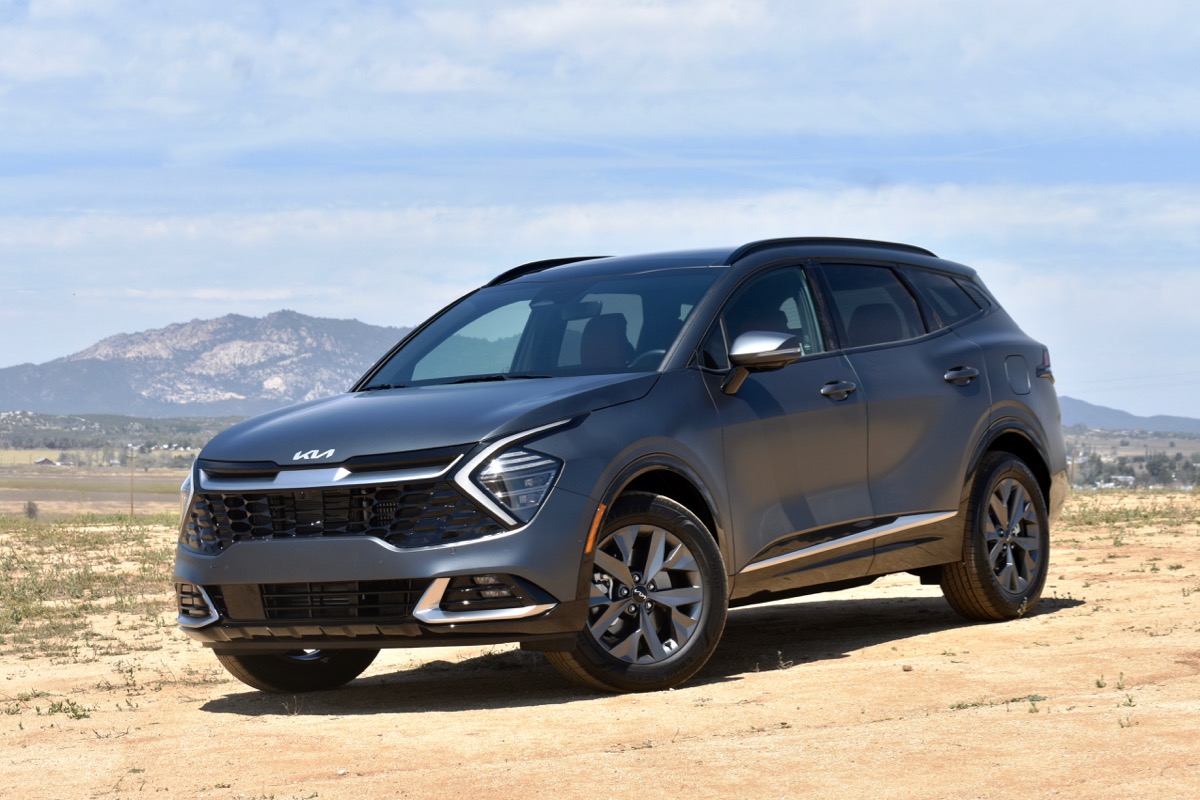
Kia’s longest-running nameplate, the Sportage, gets a first-ever hybrid model for 2023.
The Kia Sportage is the automaker’s longest-running nameplate in North America. It started out as a no-frills off-roader, but today the Sportage competes in the red-hot small crossover SUV segment against big names like the Ford Escape, Honda CR-V, and Toyota RAV4, as well as the Hyundai Tucson from Kia’s parent brand. All of those nameplates have added hybrid variants recently, so Kia followed suit as part of a 2023-model-year redesign. This segment slots in size-wise below mid-size SUVs such as the Kia Sorento (also offered as the Sorento Hybrid and PHEV) and Kia Telluride.
The 2023 Kia Sportage Hybrid will be offered alongside non-hybrid and plug-in hybrid versions of the new Sportage, which represents the nameplate’s fifth generation. The hybrid model is part of an effort to create more space between the Sportage and the smaller Kia Seltos, which also brought increased interior space, more tech, and radical exterior styling.
The Sportage Hybrid is offered in Canada in EX and SX trim levels. We drove the U.S. equivalent of the SX trim for this review. Note that this isn’t the same lineup as the non-hybrid Sportage, which is offered in Canada in five different trims (LX, X-Line, EX, EX Premium, and X-Line Limited).

All 2023 Sportage models ride on the N3 platform used by the larger Kia Sorento, which brings a size increase over the 2022 Sportage. The new model is 18 centimetres longer with a 8.6-centimetre longer wheelbase that primarily benefits rear-seat legroom. The new Sportage is also about 2.5 cm taller, and about a centimetre wider, than its predecessor.
The previous-generation Sportage took some styling risks, but the new versions goes even further. Both hybrid and non-hybrid models share a radically styled front end with angular LED headlights and what Kia calls “boomerang” LED daytime running lights. This gives the Sportage a face unlike any other car and, while we’re not sure how shoppers will react, it’s better to be different than boring.
The Sportage Hybrid EX gets standard 17-inch alloy wheels, while the SX gets 18-inch wheels. Hybrid models get unique wheel designs and subtle exterior badging, but no other distinguishing styling features.
The interior is largely designed around the Sportage’s large infotainment display, which is standard on the Sportage Hybrid in Canada, with large air vents flanking the touchscreen and instrument cluster like brackets. The shape of those vents is echoed in the interior door handles—a nice touch. The rest of the interior has a pleasingly clean, minimalist look that’s more elegant than the Hyundai Tucson Hybrid cabin, and a sharp contrast from the Toyota RAV4 Hybrid’s faux ruggedness.
Typically for this price range, base models get cloth seats. But instead of offering real leather upholstery, Kia offers SynTex artificial leather on both trims, which the automaker now promotes as an “animal free” alternative to real leather. Regardless of the potential benefit of eliminating animal products, this material felt a bit cheap. And the steering wheel is still wrapped in real leather, anyway.
In addition to quilted SynTex upholstery, our SX test car was dressed up with gloss black plastic trim, and additional plastic with a silver metallic finish. This looked nice at first, but the gloss black trim quickly accumulated fingerprint smudges, and both materials produced a lot of glare.

The Sportage Hybrid uses a 1.6-litre turbocharged four-cylinder engine and 6-speed automatic transmission, assisted by a single electric motor that draws power from a 1.49-kilowatt-hour battery pack. This hybrid powertrain combination produces power specs of 227 horsepower and 258 pound-feet of torque. Front-wheel drive (FWD) is not offered in Canada; both trims are equipped with standard all-wheel drive (AWD).
This is the same powertrain used in the Hyundai Tucson Hybrid, but for some reason the Hyundai is rated at 226 hp. Both Korean crossovers offer more horsepower than the Honda CR-V, Toyota RAV4, and Ford Escape hybrids. The Sportage Hybrid is also more powerful than the non-hybrid version, which uses a naturally aspirated 2.5-litre inline-four producing 187 hp and 178 lb-ft of torque, with an eight-speed automatic transmission.
The Sportage Hybrid was very pleasant to drive—and not just because of its extra power. In addition to providing robust acceleration, the powertrain delivered thrust smoothly and predictably. The handoff between electric and gasoline power was impossible to detect, as was the introduction of turbo boost at higher rpm. The Sportage Hybrid drove like a conventional car with a larger-displacement engine.
The powertrain was aided by a well-tuned transmission, which provided smooth shifts and quick responses. Other pluses included a quiet cabin and comfortable ride. Our test car had the larger 18-inch wheels, but thick tire sidewalls ensured they didn’t diminish the ride quality.
The Sportage Hybrid wasn’t meant to be a driver’s car, but the Honda CR-V Hybrid does feel a bit more composed and stable in corners than the Kia. That’s partially down to the Sportage Hybrid’s steering, which weighted up in a nonlinear way, and got artificially heavy in the Sport driving mode.
The Sportage Hybrid has a maximum towing capacity of 907 kilograms (2,000 pounds)—225 kg (500 pounds) less than the non-hybrid version.

The Sportage Hybrid has slightly less headroom and cargo space than the non-hybrid Sportage, but it’s still competitive with other vehicles in its market segment.
Kia offers a bit more front-seat headroom in the Sportage than you get in the Honda CR-V and Toyota RAV4 hybrids, but less headroom for second-row passengers. Rear-seat legroom is tied with the related Hyundai Tucson Hybrid for best-in-class, but the CR-V and Ford Escape Hybrids offer a bit more front legroom.
Kia included a dual-level cargo floor for added flexibility. With the floor at its lower level, the Sportage Hybrid has 1,118 litres of cargo space with the rear seats in place and 2,087 litres with the rear seats folded. That means, with the seats up and the floor lowered, the Sportage Hybrid has more cargo space than its hybrid crossover rivals. The Tucson Hybrid has more space with the rear seats folded, but the Sportage still beats the Escape, CR-V, and RAV4 hybrids.
Kia also made good use of the available space between the front seats. Sportage Hybrids get a rotary shift knob instead of the more traditional lever on gasoline models, which doesn’t get in the way when reaching for a phone or drink.
Speaking of those items, phones sit in large bin ahead of the shifter with neatly packaged USB ports and standard wireless charging. The cupholders, meanwhile, have clever rings that move inward to grasp undersized cups or bottles, and open to accommodate larger items. The centre console storage bin had a decent amount of space as well.

The standard infotainment system includes a 12.3-inch touchscreen, while the SX adds a panoramic display combining the 12.3-inch screen with a 12.3-inch digital instrument cluster in one housing. Note that Kia models with the larger touchscreen have wired Apple CarPlay and Android Auto, not the wireless versions.
The panoramic display is visually impressive, as even the related Hyundai Tucson doesn’t get it. It’s also pretty nice to use, with pleasing graphics and a responsive touchscreen. The instrument cluster was placed so the steering wheel didn’t block it (in our driving position, at least). Android Auto doesn’t display across the entire touchscreen, however, with a good chunk of the space remaining unused.
Kia also added touch controls on a thin bar below the screen. Like the panoramic display, this is a tech feature that also functions as a design feature, giving the dashboard a cleaner look. The individual controls can also switch between audio and climate controls depending what the driver wants to play with. That also goes for the analog knobs Kia included, which can adjust audio volume or temperature.
Hybrid models get four standard USB-C ports, with an additional two rear USB-C ports and an upgraded Harman Kardon audio system are available on the SX trim.

Because of the recent redesign, crash-test ratings from the Insurance Institute for Highway Safety (IIHS) and National Highway Traffic Safety Administration (NHTSA) weren’t available at the time of our test drive.
The base EX trim level gets standard safety features and driver assistance technologies that include forward collision avoidance, lane keep assist, lane departure warning, automatic high beams, adaptive cruise control with stop and go, blind-spot monitoring and rear cross-traffic alert, and safe-exit warning. But you really need the SX trim level to get the most driver-assist tech.
The top Sportage Hybrid trim level gets a blind-spot view monitor that displays the camera view in the instrument cluster, a 360-degree camera system, Remote Smart Parking Assist automated parking, and Highway Driving Assist, which combines adaptive cruise control with automated lane centring.
Competitors (other than parent brand Hyundai) don’t have anything to match Remote Smart Parking Assist and the clever blind-spot view camera.

Because of the recent redesign, crash-test ratings from the Insurance Institute for Highway Safety (IIHS) and National Highway Traffic Safety Administration (NHTSA) weren’t available at the time of our test drive.
The base EX trim level gets standard safety features and driver assistance technologies that include forward collision avoidance, lane keep assist, lane departure warning, automatic high beams, adaptive cruise control with stop and go, blind-spot monitoring and rear cross-traffic alert, and safe-exit warning. But you really need the SX trim level to get the most driver-assist tech.
The top Sportage Hybrid trim level gets a blind-spot view monitor that displays the camera view in the instrument cluster, a 360-degree camera system, Remote Smart Parking Assist automated parking, and Highway Driving Assist, which combines adaptive cruise control with automated lane centring.
Competitors (other than parent brand Hyundai) don’t have anything to match Remote Smart Parking Assist and the clever blind-spot view camera.
Note: Images show a US model.

User reviews for 2023 Kia Sportage Hybrid
Write a review2023 Kia Sportage Hybrid Pricing
Trims & specs
Air Conditioning
Automatic climate control front air conditioning · Dual front air conditioning zones
Airbags
Dual front airbags · Passenger airbag deactivation: occupant sensing deactivation · Front side airbags · Rear side curtain airbags
Audio System
Antenna Type: mast · USB auxiliary audio input · Touch screen display radio · Total Number of Speakers: 6 · 160 watts
Brakes
ABS: 4-wheel · Braking assist: hill start assist · Electronic parking brake: auto off · Front brakes: ventilated disc · Rear brakes: disc
Comfort Features
Armrests: rear center with cupholders · Center console trim: metallic · Door sill trim: scuff plate · Door trim: leatherette · Floor Material: carpet · Shift knob trim: chrome · Steering wheel trim: urethane
Convenience Features
Assist handle: front · Autonomous lane guidance: lane centering · Cargo area power outlet: 12V · Center console: front console with armrest and storage · Cupholders: rear · Multi-function remote: keyless entry with panic alarm · One-touch windows: 1 · Power outlet(s): 12V front · Power steering: speed-proportional · Power windows: lockout button · Reading lights: front · Steering wheel: tilt and telescopic · Steering wheel mounted controls: paddle shifter · Storage: dual level cargo area · Vanity mirrors: dual
Driver Seat
Manual adjustments: 6
Drivetrain
Axle ratio: 3.32
Engine
Alternator: 150 amps · EV battery capacity: 1.5 kWh · Electric Motor Battery Type: lithium polymer · Electric Motor HP: 59 · Electric Motor Power Output (Kilowatts): 44 · Electric Motor Torque: 195 · Hybrid Gas Engine HP: 177 · Hybrid Gas Engine HP@RPM: 5500 · Hybrid Gas Engine Torque: 195 · Hybrid gas Engine Torque@RPM: 1500
Exterior Features
Door handle color: body-color · Fender lip moldings: black · Front bumper color: body-color · Grille color: grey surround · Mirror color: body-color · Rear bumper color: black · Rear spoiler: roofline spoiler · Rear spoiler color: body-color · Rear trunk/liftgate: liftgate · Rocker panel color: black · Skid plate(s): front · Window trim: silver
Headrests
Front headrests: adjustable · Number of front headrests: 2 · Number of rear headrests: 3
Hybrid
Starter Type: motor/generator
In Car Entertainment
Connected in-car apps: Google search · Infotainment screen size: 8 in. · Smartphone integration: wireless Android Auto
Instrumentation
Fuel economy display: MPG · Instrument cluster screen size: 12.2 in. · Warnings and reminders: low oil pressure
Lights
Daytime running lights: LED · Headlights: wiper activated · Tail and brake lights: LED
Mirrors
Exterior mirrors: manual folding · Inside rearview mirror: manual day/night
Passenger Seat
Manual Adjustments: 4
Rear Seats
Type: 60-40 split bench
Safety
Automatic emergency braking: front · Camera system: rearview · Child seat anchors: LATCH system · Crumple zones: rear · Impact sensor: door unlock · Parking sensors: rear · Pre-Collision Warning System: visual warning · Pre-collision warning system: pedestrian detection · Rearview monitor: in dash
Seatbelts
Emergency locking retractors: front · Front seatbelts: 3-point · Seatbelt force limiters: front · Seatbelt pretensioners: front · Seatbelt warning sensor: driver and passenger · Second row seatbelts: 3-point
Seats
Driver seat manual adjustments: reclining · Front seat type: bucket · Passenger seat manual adjustments: reclining · Rear headrests: adjustable · Rear seat folding: split · Rear seat manual adjustments: reclining · Upholstery: cloth
Security
Power door locks: anti-lockout
Spare Tire
Kit: inflator kit
Stability and Traction
Traction control: with trailer stability control
Steering
Steering ratio: 13.6 · Turns lock-to-lock: 2.4
Suspension
Front Arm Type: lower control arms · Front Shock Type: gas shock absorbers · Front Spring Type: coil springs · Front Suspension Classification: independent · Front Suspension Type: MacPherson struts · Rear Shock Type: gas shock absorbers · Rear Spring Type: coil springs · Rear Suspension Classification: independent · Rear Suspension Type: multi-link · Stabilizer bar(s): front
Telematics
Electronic messaging assistance: with read function · Phone: voice activated · Phone wireless data link: Bluetooth
Tires
Type: all season
Tires and Rims
Wheel type: aluminum alloy
Windows
Front wipers: variable intermittent · Laminated glass: acoustic · Liftgate window: fixed · Power windows: with safety reverse · Rear wiper: with washer
Air Conditioning
Automatic climate control front air conditioning · Dual front air conditioning zones
Airbags
Dual front airbags · Passenger airbag deactivation: occupant sensing deactivation · Front side airbags · Rear side curtain airbags
Audio System
Antenna Type: mast · Bluetooth auxiliary audio input · AM/FM radio · Total Number of Speakers: 6 · 160 watts
Brakes
ABS: 4-wheel · Braking assist: hill start assist · Electronic parking brake: auto off · Front brakes: ventilated disc · Rear brakes: disc
Comfort Features
Armrests: rear center with cupholders · Center console trim: metallic · Door sill trim: scuff plate · Door trim: leatherette · Floor Material: carpet · Shift knob trim: chrome · Steering wheel trim: urethane
Convenience Features
Assist handle: front · Autonomous lane guidance: lane centering · Cargo area power outlet: 12V · Center console: front console with armrest and storage · Cupholders: front · Multi-function remote: keyless entry with panic alarm · One-touch windows: 1 · Power outlet(s): USB-C front · Power steering: speed-proportional · Power windows: lockout button · Reading lights: front · Steering wheel: tilt and telescopic · Steering wheel mounted controls: paddle shifter · Storage: accessory hook · Vanity mirrors: dual
Driver Seat
Manual adjustments: 6
Drivetrain
4WD Type: full time · Axle ratio: 3.32 · Locking differential: center
Engine
Alternator: 150 amps · EV battery capacity: 1.5 kWh · Electric Motor Battery Type: lithium polymer · Electric Motor HP: 59 · Electric Motor Power Output (Kilowatts): 44 · Electric Motor Torque: 195 · Hybrid Gas Engine HP: 177 · Hybrid Gas Engine HP@RPM: 5500 · Hybrid Gas Engine Torque: 195 · Hybrid gas Engine Torque@RPM: 1500
Exterior Features
Door handle color: body-color · Fender lip moldings: black · Front bumper color: body-color · Grille color: grey surround · Mirror color: body-color · Rear bumper color: black · Rear spoiler: roofline spoiler · Rear spoiler color: body-color · Rear trunk/liftgate: liftgate · Rocker panel color: black · Skid plate(s): front and rear · Window trim: silver
Headrests
Front headrests: adjustable · Number of front headrests: 2 · Number of rear headrests: 3
Hybrid
Starter Type: motor/generator
In Car Entertainment
Connected in-car apps: Google search · Infotainment screen size: 8 in. · Smartphone integration: wireless Android Auto
Instrumentation
Fuel economy display: MPG · Instrument cluster screen size: 12.2 in. · Warnings and reminders: maintenance reminder
Lights
Daytime running lights: LED · Headlights: wiper activated · Tail and brake lights: LED
Mirrors
Exterior mirrors: power · Inside rearview mirror: manual day/night
Passenger Seat
Manual Adjustments: 4
Rear Seats
Type: 60-40 split bench
Safety
Automatic emergency braking: front pedestrian · Camera system: rearview · Child seat anchors: LATCH system · Crumple zones: front · Impact sensor: door unlock · Parking sensors: rear · Pre-Collision Warning System: audible warning · Pre-collision warning system: pedestrian detection · Rearview monitor: in dash
Seatbelts
Emergency locking retractors: front · Front seatbelts: 3-point · Seatbelt force limiters: front · Seatbelt pretensioners: front · Seatbelt warning sensor: driver and passenger · Second row seatbelts: 3-point
Seats
Driver seat manual adjustments: reclining · Front seat type: bucket · Passenger seat manual adjustments: reclining · Rear headrests: adjustable · Rear seat folding: flat · Rear seat manual adjustments: reclining · Upholstery: cloth
Security
Power door locks: anti-lockout
Spare Tire
Mount Location: inside · Size: temporary
Spare Wheel
Rim Type: steel
Stability and Traction
Traction control: with trailer stability control
Steering
Steering ratio: 13.6 · Turns lock-to-lock: 2.4
Suspension
Front Arm Type: lower control arms · Front Shock Type: gas shock absorbers · Front Spring Type: coil springs · Front Suspension Classification: independent · Front Suspension Type: MacPherson struts · Rear Shock Type: gas shock absorbers · Rear Spring Type: coil springs · Rear Suspension Classification: independent · Rear Suspension Type: multi-link · Stabilizer bar(s): rear
Telematics
Electronic messaging assistance: with voice recognition · Phone: voice activated · Phone wireless data link: Bluetooth
Tires
Type: all season
Tires and Rims
Wheel type: aluminum alloy
Windows
Front wipers: variable intermittent · Laminated glass: acoustic · Liftgate window: fixed · Power windows: with safety reverse · Rear wiper: intermittent
Air Conditioning
Automatic climate control front air conditioning · Dual front air conditioning zones
Airbags
Dual front airbags · Passenger airbag deactivation: occupant sensing deactivation · Front side airbags · Rear side curtain airbags
Audio System
Antenna Type: mast · Voice recognition audio system · USB auxiliary audio input · HD radio · Satellite Radio: SiriusXM · Total Number of Speakers: 6 · 160 watts
Brakes
ABS: 4-wheel · Braking assist: hill start assist · Electronic parking brake: auto off · Front brakes: ventilated disc · Rear brakes: disc
Comfort Features
Armrests: rear center with cupholders · Center console trim: metallic · Door sill trim: scuff plate · Door trim: leatherette · Floor Material: carpet · Shift knob trim: chrome · Steering wheel trim: leather
Convenience Features
Assist handle: front · Autonomous lane guidance: lane centering · Cargo area power outlet: 12V · Center console: front console with armrest and storage · Cupholders: rear · Multi-function remote: proximity entry system · One-touch windows: 2 · Power outlet(s): USB-C rear · Power steering: speed-proportional · Power windows: lockout button · Reading lights: front · Steering wheel: tilt and telescopic · Steering wheel mounted controls: multi-function screen controls · Storage: dual level cargo area · Vanity mirrors: dual
Driver Seat
Adjustable lumbar support: power · Power adjustments: 10
Drivetrain
4WD Type: full time · Axle ratio: 3.32 · Locking differential: center
Engine
Alternator: 150 amps · EV battery capacity: 1.5 kWh · Electric Motor Battery Type: lithium polymer · Electric Motor HP: 59 · Electric Motor Power Output (Kilowatts): 44 · Electric Motor Torque: 195 · Hybrid Gas Engine HP: 177 · Hybrid Gas Engine HP@RPM: 5500 · Hybrid Gas Engine Torque: 195 · Hybrid gas Engine Torque@RPM: 1500
Exterior Features
Door handle color: body-color · Fender lip moldings: black · Front bumper color: body-color · Grille color: grey surround · Mirror color: body-color · Rear bumper color: black · Rear spoiler: roofline spoiler · Rear spoiler color: body-color · Rear trunk/liftgate: liftgate · Rocker panel color: black · Skid plate(s): front · Window trim: silver
Headrests
Front headrests: adjustable · Number of front headrests: 2 · Number of rear headrests: 3
Hybrid
Starter Type: motor/generator
In Car Entertainment
Connected in-car apps: Google search · Infotainment: Apply CarPlay ready · Infotainment screen size: 12.3 in.
Instrumentation
Fuel economy display: MPG · Instrument cluster screen size: 12.2 in. · Warnings and reminders: low oil level
Lights
Daytime running lights: LED · Exterior entry lights: security approach lamps · Headlights: auto delay off · Tail and brake lights: LED
Mirrors
Exterior mirrors: integrated turn signals · Inside rearview mirror: manual day/night
Passenger Seat
Manual Adjustments: 4
Rear Seats
Type: 60-40 split bench
Roof
Roof rails: silver
Safety
Automatic emergency braking: front pedestrian · Camera system: rearview · Child seat anchors: LATCH system · Cross Traffic Alert: rear · Crumple zones: front · Impact sensor: door unlock · Parking sensors: rear · Pre-Collision Warning System: audible warning · Pre-collision warning system: pedestrian detection · Rearview monitor: in dash
Seatbelts
Emergency locking retractors: front and rear · Front seatbelts: 3-point · Seatbelt force limiters: front · Seatbelt pretensioners: front · Seatbelt warning sensor: driver and passenger · Second row seatbelts: 3-point
Seats
Driver seat power adjustments: reclining · Front seat type: bucket · Passenger seat manual adjustments: reclining · Rear headrests: adjustable · Rear seat folding: split · Rear seat manual adjustments: reclining · Upholstery: perforated
Security
Power door locks: anti-lockout
Spare Tire
Mount Location: inside · Size: temporary
Spare Wheel
Rim Type: steel
Stability and Traction
Traction control: with trailer stability control
Steering
Steering ratio: 13.6 · Turns lock-to-lock: 2.4
Suspension
Front Arm Type: lower control arms · Front Shock Type: gas shock absorbers · Front Spring Type: coil springs · Front Suspension Classification: independent · Front Suspension Type: MacPherson struts · Rear Shock Type: gas shock absorbers · Rear Spring Type: coil springs · Rear Suspension Classification: independent · Rear Suspension Type: multi-link · Stabilizer bar(s): rear
Telematics
Driver assistance app: roadside assistance · Electronic messaging assistance: with voice recognition · Navigation system: with voice recognition · Phone: voice activated · Phone wireless data link: Bluetooth · Smart device app compatibility: Kia Access · Smart device app function: vehicle location
Tires
Type: all season
Tires and Rims
Wheel type: aluminum alloy
Windows
Front wipers: variable intermittent · Laminated glass: acoustic · Liftgate window: fixed · Power windows: with safety reverse · Rear wiper: with washer
Air Conditioning
Automatic climate control front air conditioning · Dual front air conditioning zones
Airbags
Dual front airbags · Passenger airbag deactivation: occupant sensing deactivation · Front side airbags · Front side curtain airbags
Audio System
Antenna Type: diversity · Voice recognition audio system · USB auxiliary audio input · Premium Brand: Harman-Kardon · HD radio · Satellite Radio: SiriusXM · 1 subwoofer · Surround audio: 5.1 · Total Number of Speakers: 7 · 400 watts
Brakes
ABS: 4-wheel · Braking assist: hill start assist · Electronic parking brake: auto off · Front brakes: ventilated disc · Rear brakes: disc
Comfort Features
Armrests: rear center with cupholders · Center console trim: metallic · Door sill trim: scuff plate · Door trim: leatherette · Floor Material: carpet · Shift knob trim: chrome · Steering wheel trim: leather
Convenience Features
Adaptive stop and go cruise control: semi-automatic · Ambient lighting: color-adjustable · Assist handle: rear · Autonomous lane guidance: lane centering · Cargo area power outlet: 12V · Center console: front console with armrest and storage · Cruise control: adaptive · Cupholders: front · Footwell lights: color-adjustable · Memorized settings: side mirrors · Multi-function remote: keyless entry with panic alarm · One-touch windows: 2 · Power outlet(s): 12V front · Power steering: electric · Power windows: lockout button · Reading lights: rear · Remote parking assist: key fob operated · Steering wheel: tilt and telescopic · Steering wheel mounted controls: cruise controls · Storage: cargo tie-down anchors and hooks · Vanity mirrors: dual illuminating
Driver Seat
Adjustable lumbar support: power · Power adjustments: 10
Drivetrain
4WD Type: full time · Axle ratio: 3.32 · Locking differential: center
Engine
Alternator: 150 amps · EV battery capacity: 1.5 kWh · Electric Motor Battery Type: lithium polymer · Electric Motor HP: 59 · Electric Motor Power Output (Kilowatts): 44 · Electric Motor Torque: 195 · Hybrid Gas Engine HP: 177 · Hybrid Gas Engine HP@RPM: 5500 · Hybrid Gas Engine Torque: 195 · Hybrid gas Engine Torque@RPM: 1500
Exterior Features
Door handle color: body-color · Fender lip moldings: black · Front bumper color: body-color · Grille color: black · Mirror color: body-color · Rear bumper color: black · Rear spoiler: roofline spoiler · Rear spoiler color: body-color · Rear trunk/liftgate: sensor-activated · Rocker panel color: black · Skid plate(s): front · Window trim: chrome
Headrests
Front headrests: adjustable · Number of front headrests: 2 · Number of rear headrests: 3
Hybrid
Starter Type: motor/generator
In Car Entertainment
Connected in-car apps: Google POIs · Infotainment: Apply CarPlay ready · Infotainment screen size: 12.3 in.
Instrumentation
Fuel economy display: range · Instrument cluster screen size: 12.3 in. · Warnings and reminders: low oil pressure
Lights
Daytime running lights: LED · Exterior entry lights: security approach lamps · Front fog lights: LED · Headlights: wiper activated · Tail and brake lights: LED
Mirrors
Exterior mirrors: manual folding · Inside rearview mirror: manual day/night
Passenger Seat
Power adjustments: 8
Rear Seats
Type: 60-40 split bench
Roof
Moonroof: anti-trapping feature · Moonroof / Sunroof: power sunshade · Roof rails: black
Safety
Automatic emergency braking: front · Blind spot safety: passenger side camera · Camera system: surround view · Child seat anchors: LATCH system · Cross Traffic Alert: rear · Crumple zones: front · Impact sensor: door unlock · Parking sensors: rear · Pre-Collision Warning System: audible warning · Pre-collision warning system: intersection/junction turn · Rear pre-collision warning system: pedestrian detection · Rearview monitor: in dash
Seatbelts
Emergency locking retractors: front · Front seatbelts: 3-point · Seatbelt force limiters: front · Seatbelt pretensioners: front · Seatbelt warning sensor: driver and passenger · Second row seatbelts: 3-point
Seats
Driver seat power adjustments: height · Front seat type: bucket · Passenger seat power adjustments: height · Rear headrests: adjustable · Rear seat folding: split · Rear seat manual adjustments: reclining · Upholstery: leatherette
Security
Power door locks: anti-lockout
Spare Tire
Mount Location: inside · Size: temporary
Spare Wheel
Rim Type: steel
Stability and Traction
Traction control: with trailer stability control
Steering
Steering ratio: 13.6 · Turns lock-to-lock: 2.4
Suspension
Front Arm Type: lower control arms · Front Shock Type: gas shock absorbers · Front Spring Type: coil springs · Front Suspension Classification: independent · Front Suspension Type: MacPherson struts · Rear Shock Type: gas shock absorbers · Rear Spring Type: coil springs · Rear Suspension Classification: independent · Rear Suspension Type: multi-link · Stabilizer bar(s): rear
Telematics
Driver assistance app: roadside assistance · Electronic messaging assistance: with read function · Navigation system: touch screen display · Phone: voice activated · Phone wireless data link: Bluetooth · Smart device app compatibility: Kia Access · Smart device app function: horn/light operation
Tires
Type: all season
Tires and Rims
Wheels: painted aluminum
Windows
Front wipers: variable intermittent · Laminated glass: acoustic · Liftgate window: fixed · Power windows: with safety reverse · Rear wiper: intermittent
