2023 Lexus GX Reviews, Pricing & Specs
Write a reviewPros
Commanding driving position
Off-road capability
Cons
Poor fuel economy
Cramped third row
Outdated technology
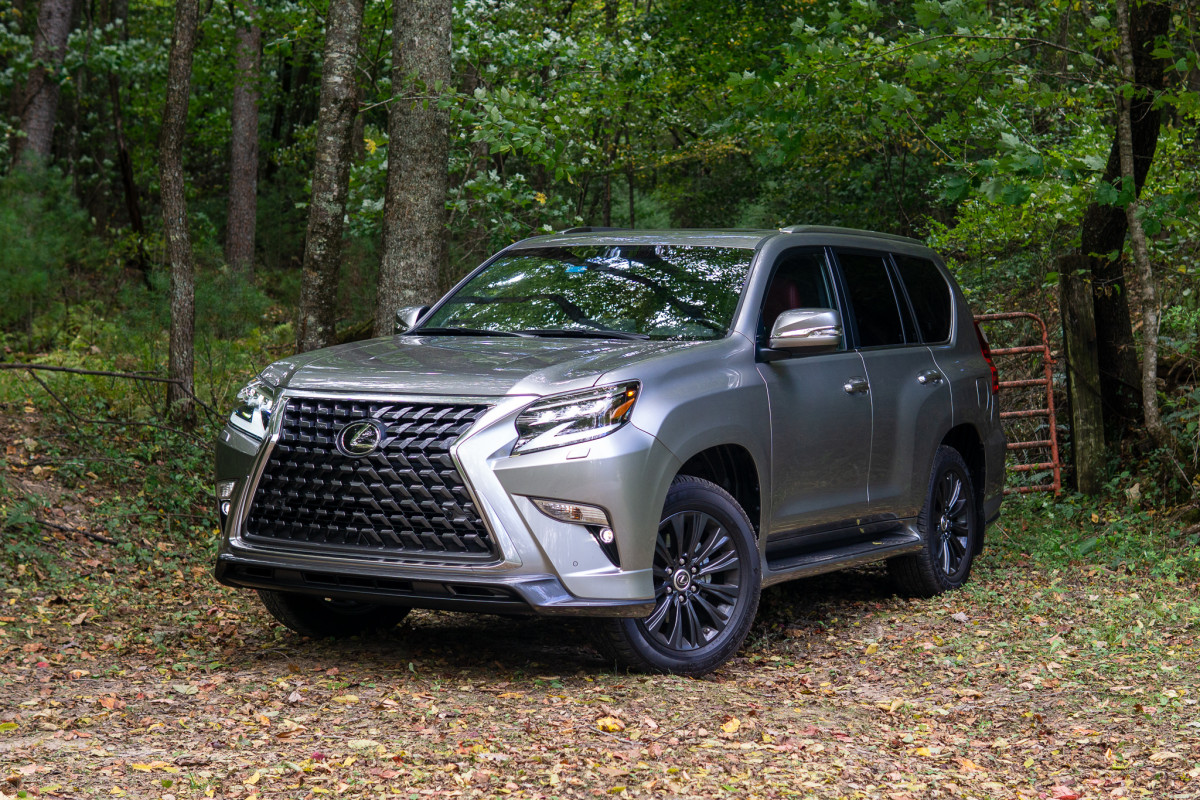
With only mild updates for 2023, the Lexus GX retains its old-school charm. But this SUV remains dated when compared with the competition.
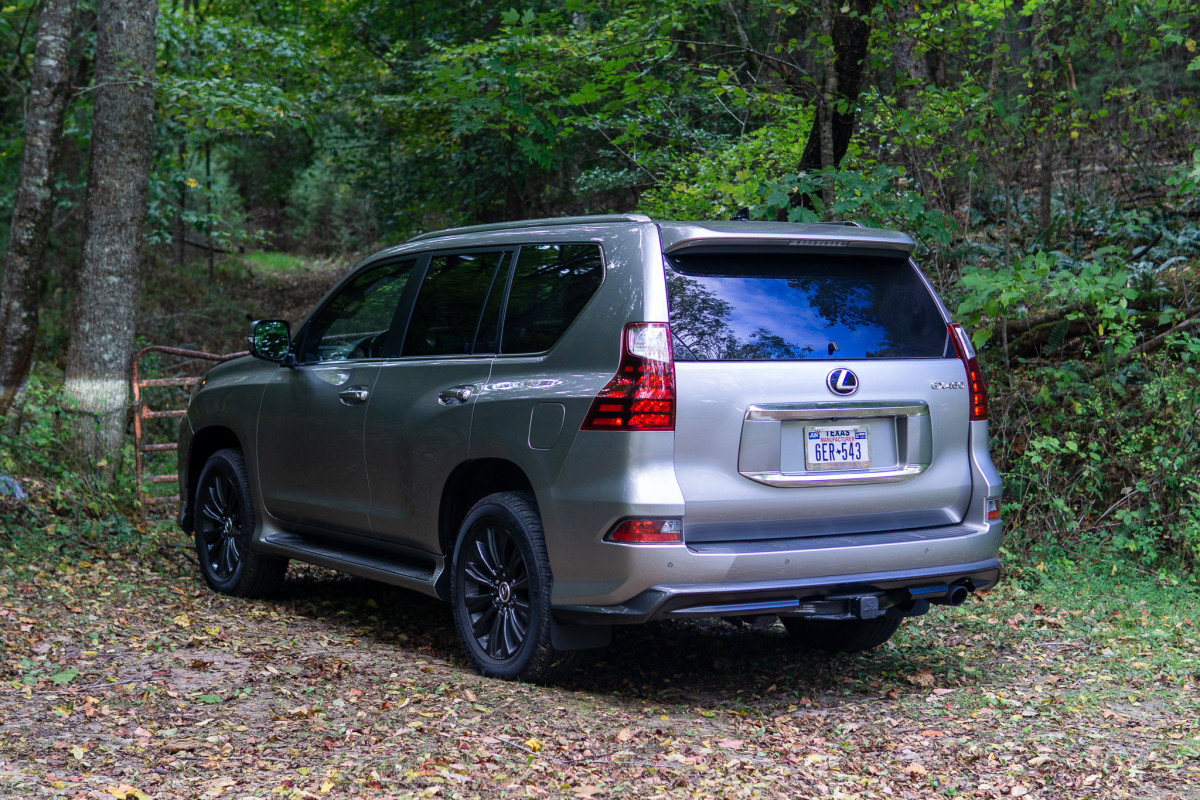
Combine its huge spindle grille with 206 millimetres of ground clearance and a total overall height of 1,885 millimetres, the 2023 GX certainly has visual presence. The front end looks ready to swallow up the road ahead, and the massive headlights do a nice job framing the GX’s distinctive face.
After debuting in 2022, the GX Black Line Special Edition returns for the 2023 model year. Only 3,000 units will be sold, and it will come in three paint colours: Obsidian, Eminent White Pearl (new for 2023), and an exclusive Nori Green Pearl.
Walk down the side, however, and the GX’s dimensions seem to shrink. At 2,789 mm, the wheelbase is positively short (a two-door Jeep Wrangler, for comparison, stretches 3,007 mm between the wheels). Even more striking, there’s not much to the overhangs at the front or rear bumpers. The GX, despite its luxury badge, genuinely looks engineered for going up, over, and down impediments in its path.
Big, flared fenders add to its chunky motif, but compared with the blocky designs taking over Toyota’s current design language, the GX’s overall aesthetic leans sleeker. From the driver’s vantage point, the hood falls away from sight much sooner than it does on a Toyota 4Runner or Tundra. This makes the GX easier to place in technical driving, particularly when climbing up an incline.
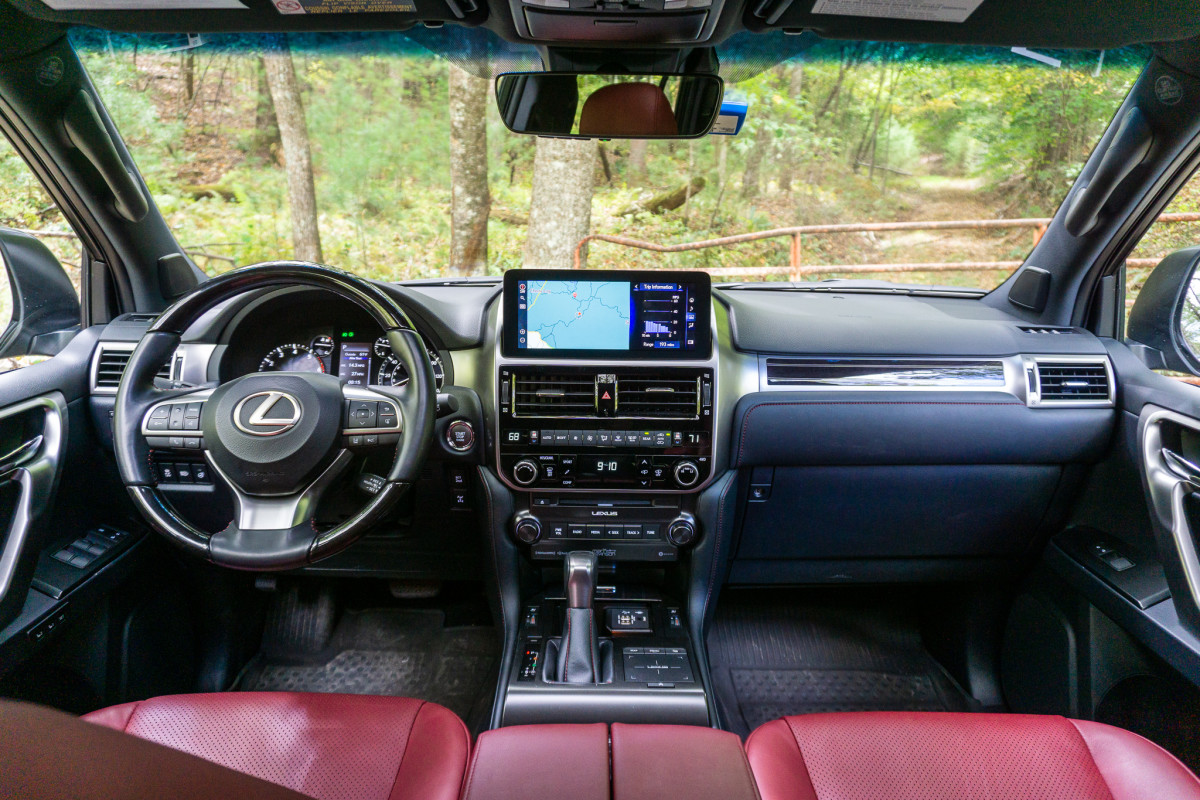
The interior hosts a disappointing amount of plastic material, which belies the SUV’s luxury badge (and price tag). Truth be told, the Lexus GX is a low-selling model, and for a company—even one as flush as Lexus—to keep a car afloat at the GX’s purchase rate, it needs to reap benefits from easy manufacturing. The research and design budget on the GX is long past spent. Today, Lexus needs only to churn these SUVs out from the factory and enjoy a luxury price premium on the few it sells.
Despite the plastic, there are still plenty of luxury touches. Our test vehicle had heated and cooled front seats, a power-retracting steering wheel, and very impressive leather upholstery.
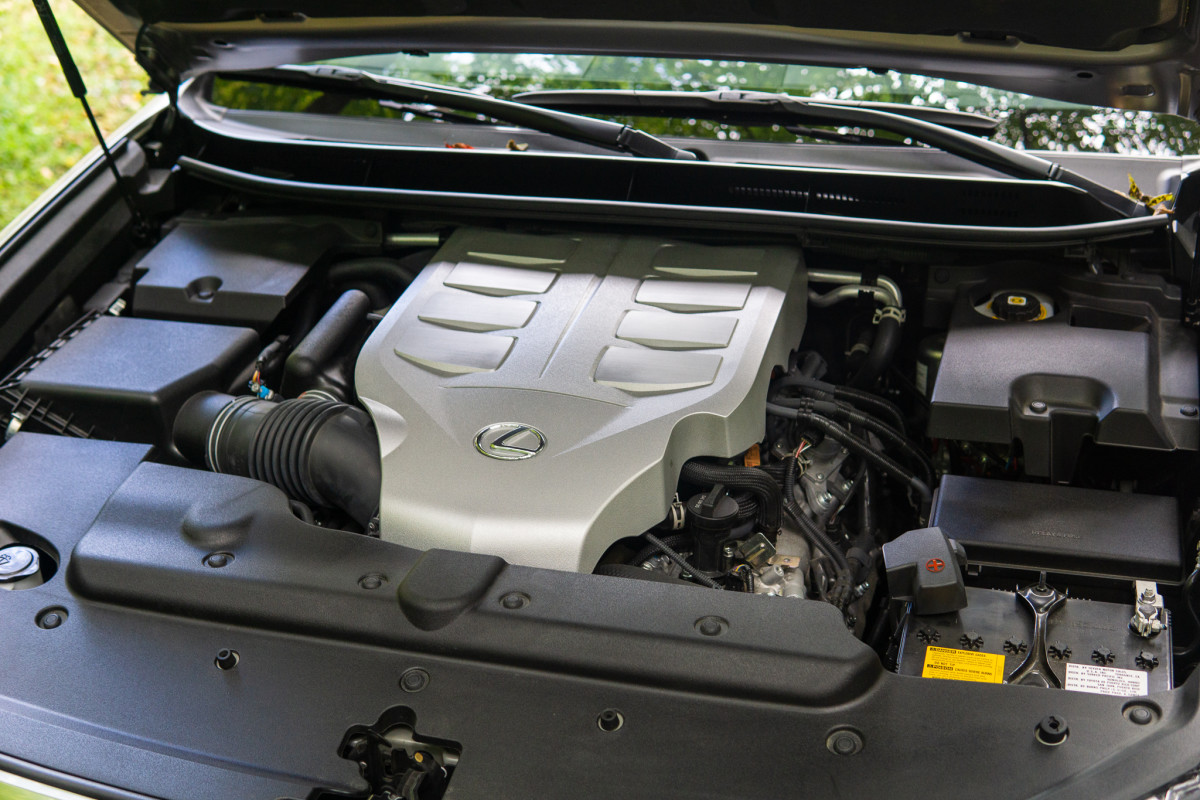
The Lexus GX’s defining powertrain characteristic is its V8 engine. Unlike the steady roar coming from a 4Runner’s V6, the Lexus GX 460’s V8 swells. The noise—and the power—rise linearly as you depress the accelerator. There’s plenty of gusto down low in the rev range, and the engine doesn’t feel like it’s exerting itself until you bury the throttle.
With 301 horsepower and 329 lb-ft of torque sent through a 6-speed automatic transmission, the naturally aspirated 4.6-litre V8 doesn’t win many battles on paper. Toyota’s new 3.5-litre twin-turbo V6 hybrid under the hood of the Sequoia and some Tundras, for instance, makes an incredible 427 horsepower and 583 pound-feet, all while delivering better fuel economy. But as potent as that more technologically advanced engine may be, it doesn’t have the sound or the satisfaction of the GX’s V8. Well, at least not to some people.
If a V8 doesn’t do anything special for you, the GX loses more than a few performance points. A 2,948-kilogram (6,500-pound) towing capacity makes the GX more capable than most three-row crossovers, but it falls behind other SUVs (even those without V8 engines). The V8 also carries V8-levels of fuel economy, and that’s not a good thing. Natural Resources Canada estimates 16.2 litres per 100 kilometres in city driving, 12.3 on the highway, and 14.5 combined. Those specs are not very appealing next to most other modern SUVs.
And there’s no getting around the Lexus GX’s weight. It rolls through corners. Luckily, unlike some top-heavy competitors, the GX’s roll feels predictable and controllable. Yes, it might feel a bit like powder skiing if you put a GX on a set of big all-terrain tires, but with its stock equipment, it’s a manageable affair.
The GX hasn’t had a generational update in 14 model years, but Lexus continues to improve upon its driving dynamics. Road feel is surprisingly communicative, although the steering is a big vague off-centre. That is to be expected in this class of vehicle. The brakes are strong, solid, and predictable. It takes a lot of force to stop a GX from 100 kilometres per hour (particularly when headed downhill) and you do feel the effort. The brakes are up to the job, thankfully.
A Torsen torque-sensing limited-slip differential distributes the standard four-wheel drive (4WD) system into a 40:60 front:rear split in most conditions. It can, however, adjust based on wheel slip. This makes the GX more user-friendly when driving in snow, or mud, or anywhere the tarmac ends.
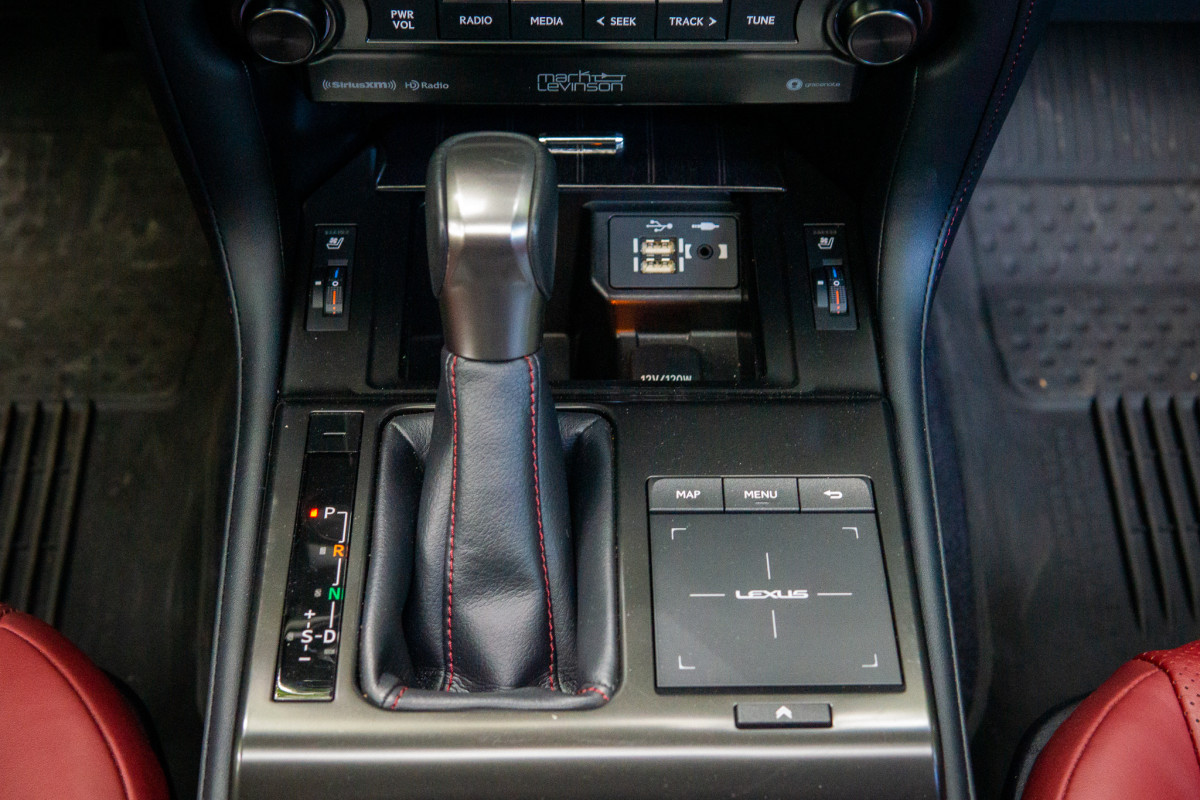
Lexus has done a good job retaining plenty of cubby space for small items in the GX. The centre console bin is deep and spacious, and there’s a handy space ahead of the shifter for a phone. Lexus also has the cupholders conveniently placed side-by-side between the front seats. Two USB ports live in the forward cubby, but they’re old USB-A ports; the GX does not have USB-C ports. The door pockets are also a bit small for larger water bottles.
With regards to physical controls, Lexus’s decision to stick with hard buttons rather than transitioning toward the increasingly popular haptic-touch interfaces is a blessing, particularly for folks put off by touchscreens. Granted, there are a lot of hard buttons in the GX, so it will take owners a while to get comfortable with all the controls, but at least they won’t need to worry about digging through menus to find what they’re looking for.
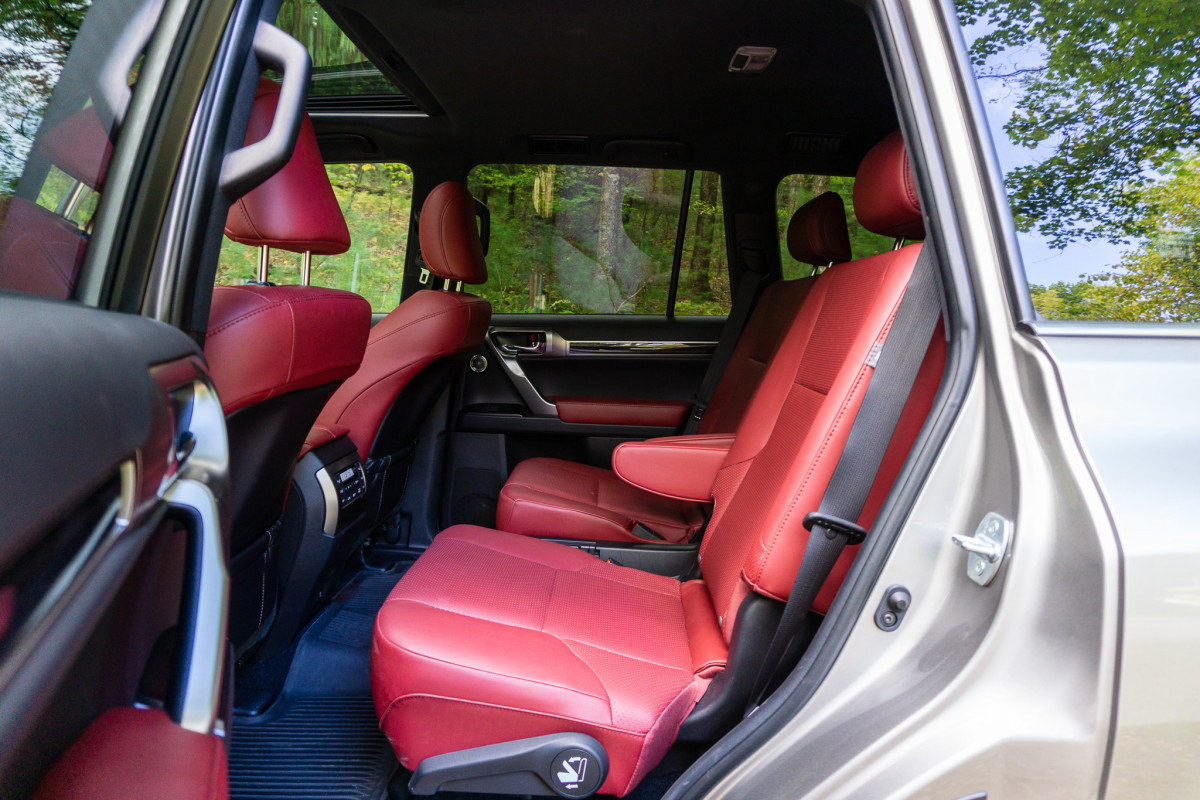
The centre console lid is equipped with handy adjustable sliding mechanisms, so the centre arm rest can be adjusted to fit a driver and front passenger who happen to be different sizes—a novel idea, for sure. The second row is also comfortable. Our test vehicle had second-row captain’s chairs with fold-out cupholders built into the sides of each. A three-across bench seat is standard, with the cupholders housed in a fold-down centre armrest (where the middle seat would be). Legroom is good enough for all but the longest-legged passengers, and headroom is excellent.
The third row seats, unfortunately, are just too tight for regular use—even for children. Yes, it’s handy to have in a pinch, but most shoppers should view the GX as a two-row SUV with a couple extra seats for emergencies.
Opening the trunk is problematic in its own right: It’s a side-hinged door, and it’s not power-operated. Opening it requires some muscle and a clear path behind the vehicle. Things don’t get better when it’s opened, either: the GX offers a very narrow 328 litres of cargo space behind its rear seats. Fold that row down, as many owners will, and the GX offers 1,322 litres. With both the second and third row folded, you’ll manage to fit 1,832 litres of stuff in your GX. For reference, that’s less than a Toyota RAV4’s 1,976 litres.
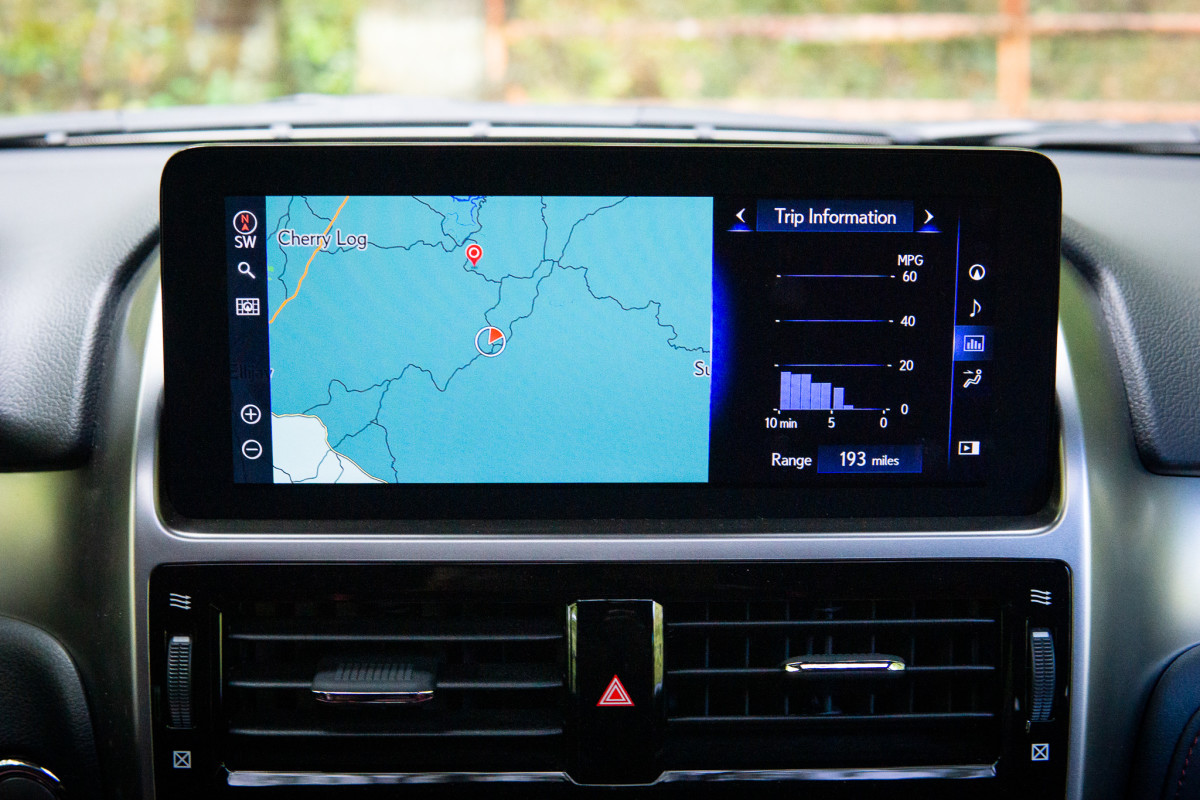
Lexus revamped the GX’s infotainment technology for the 2022 model year but one year later, it already looks dated—even when compared with other Lexus models.
First, the good: The 10.3-inch touchscreen infotainment system is a massive improvement over the old system. It sits high on the dash, is easy to read, and includes some helpful integrations as standard features like SiriusXM satellite radio, Bluetooth, and Apple CarPlay and Android Auto compatibility. The Lexus Remote Touch Interface (RTI) is still present between the seats, but it’s rendered unnecessary by the improved touchscreen.
Three years of Lexus Enform Remote—essentially a remote-start feature operable from your smartphone—comes included with the GX. Our test car also had a 17-speaker Mark Levinson premium audio system and a CD player.
And the not so good? Well, the inclusion of a CD player feels appropriate when the rest of the GX’s tech offerings are taken into consideration. Although the touchscreen was new to the GX last year, it’s no longer new to Lexus—not even close. The GX pales in comparison with the new tech showcased in the Lexus NX, Lexus RX, and Lexus LX. The touchscreen lags and the graphics are not nearly as crisp as what can be found in competing models.
No, infotainment technology is not the GX’s strong suit. Instead, shoppers should look toward its off-road capability if they want to feel impressed. First, the GX is equipped with a real 4WD system, complete with a two-speed transfer case, low range, and a locking centre differential. Further driving-focused technology includes downhill assist, hill-start assist, traction control, and stability control.
Lexus also equips the GX with its Kinetic Dynamic Suspension System (KDSS). This air suspension levels the vehicle in on-road and off-road driving via compressing suspension components when and where necessary. Finally, our test vehicle had the optional multi-terrain monitor, transmission cooler, fuel-tank protection, crawl control, and a multi-terrain select system designed to handle rocks, mud and sand, and moguls.
Neither the National Highway Traffic Safety Administration (NHTSA) nor the Insurance Institute for Highway Safety (IIHS) have crash tested the 2023 Lexus GX. It can’t be ignored, however, that this SUV was originally engineered for the 2010 model year. There have been improvements in structural safety since 2010.
That said, Toyota and Lexus do an admirable job of including advanced driver assistance systems (ADAS) into all of their vehicles. Although the GX is missing a few top-end features like lane-tracing assist and road-sign recognition, it does come equipped with the Lexus Safety System+ and other safety features, including automatic emergency braking with pedestrian detection, lane-departure alert, adaptive cruise control (Lexus calls this Dynamic Radar Cruise Control), parking assist, blind spot monitoring, rear cross-traffic alert, rain-sensing wipers, and automatic high beams. Although it may have the body of a 14-year-old car, its brains are significantly newer.
The 2023 Lexus GX is offered in a single trim in Canada that starts at a new vehicle price of $79,933 including a destination fee of $2,205. Three packages are offered: Black Line Special Edition ($4,400 extra), Premium (adds $7,950), and Executive ($11,650 more).
Limited to 3,000 units, the Black Line darkens the skid plate, fog lamps, and grille. The taillamps are swapped out for clear units with black inserts. The Black Line is also available in three colours: Obsidian, Eminent White Pearl, and a Black-Line-exclusive Nori Green Pearl.
There aren’t many natural new-car competitors to the Lexus GX. The Wagoneer sits above it in terms of size and price, while the Jeep Grand Cherokee cedes the luxury badge to Lexus (although top-trim Jeeps are essentially luxury vehicles in their own right). Acura doesn’t have a competitor for the GX, and few shoppers are going to confuse a Mercedes-Benz G-Class with the Lexus. The closest competition is likely the Infiniti QX80 and the Land Rover Defender.
The Defender is a newer and more advanced vehicle all around, but unless you’re willing to spend north of six figures, you can’t have one with the V8. The Infiniti QX80 is a larger, more spacious vehicle than the Lexus GX, but only marginally more refined.
That puts the GX in a pricing no-man’s land. It’s cheaper than the more impressive Defender but more expensive than the non-luxury Jeep Grand Cherokee. If you’re in the market for a true SUV capable of towing and driving off road, the 2023 Lexus GX remains a viable option—an appealing one if you’re a sucker for a V8—and that’s been true for over a decade.
Note: Images show a US model.

User reviews for 2023 Lexus GX
Write a review2023 Lexus GX Pricing
Trims & specs
Air Conditioning
Automatic climate control front air conditioning · Dual front air conditioning zones
Airbags
Dual front airbags · Dual front knee airbags · Passenger airbag deactivation: occupant sensing deactivation · Front side airbags · Rear side curtain airbags
Audio System
Antenna Type: diversity · Voice recognition audio system · USB auxiliary audio input · Single disc in-Dash CD · IHeartRadio internet radio · MP3 player: CD MP3 Playback · HD radio · Satellite Radio: SiriusXM · Total Number of Speakers: 9
Brakes
ABS: 4-wheel · Braking assist: hill start assist · Front brake diameter: 13.3 · Front brakes: ventilated disc · Rear brake diameter: 12.3 · Rear brakes: ventilated disc
Comfort Features
Armrests: rear center with cupholders · Center console trim: wood · Dash Trim: Leatherette · Dash trim: wood · Door trim: leatherette · Floor Mat Material: carpet · Floor Material: carpet · Floor Mats: front · Interior accents: wood · Steering wheel trim: leatherette
Convenience Features
Adaptive stop and go cruise control: semi-automatic · Assist handle: front · Cargo area power outlet: 115V · Center console: front console with armrest and storage · Cruise control: adaptive · Cupholders: front · Dimming rearview mirror: auto-dimming · Easy entry: power driver seat · Memorized settings: side mirrors · Multi-function remote: keyless entry with panic alarm · One-touch windows: 4 · Power outlet(s): 12V front · Power steering: hydraulic variable assist · Power windows: lockout button · Reading lights: third row · Steering wheel: power tilt and telescopic · Steering wheel mounted controls: voice recognition controls · Storage: front seatback · Universal garage door opener: Homelink · Vanity mirrors: dual illuminating
Driver Seat
Adjustable lumbar support: power · Power adjustments: 10
Drivetrain
4WD Type: full time · Axle ratio: 3.91 · Limited slip differential: center · Locking differential: center
Engine
Alternator: 130 amps · Battery: maintenance-free
Exterior Features
Body side moldings: body-color · Door handle color: chrome · Exhaust tip color: black · Front bumper color: body-color · Grille color: chrome surround · Mirror color: body-color · Mudguards: front · Rear bumper color: body-color · Rear spoiler: roofline spoiler · Rear spoiler color: body-color · Rear trunk/liftgate: side-hinged · Running boards: illuminated · Window trim: chrome
Headrests
Front headrests: adjustable · Number of front headrests: 2 · Number of rear headrests: 3 · Number of third row headrests: 2
In Car Entertainment
Connected in-car apps: Google POIs · Infotainment: Android Auto ready · Infotainment screen size: 10.3 in.
Instrumentation
Fuel economy display: range · Instrument cluster screen size: 4.2 in. · Warnings and reminders: coolant temperature warning
Lights
Daytime running lights: LED · Exterior entry lights: security approach lamps · Headlights: automatic high beam dimmer · Tail and brake lights: LED
Mirrors
Exterior mirrors: integrated turn signals
Passenger Seat
Adjustable lumbar support: power · Power adjustments: 10
Rear Seats
Type: 40-20-40 split bench
Roof
Moonroof: one-touch open/close · Roof rails: silver
Safety
Active head restraints: driver · Automatic emergency braking: front · Camera system: rearview · Child seat anchors: LATCH system · Cross Traffic Alert: rear · Crumple zones: front · Impact sensor: fuel cut-off · Parking sensors: rear · Pre-Collision Warning System: audible warning · Pre-collision warning system: pedestrian detection · Rearview monitor: in dash
Seatbelts
Emergency locking retractors: front, rear, third, and fourth row · Front seatbelts: 3-point · Seatbelt force limiters: front · Seatbelt pretensioners: front and rear · Seatbelt warning sensor: driver and passenger · Second row seatbelts: 3-point · Third row seatbelts: 3-point
Seats
Driver seat power adjustments: reclining · Front seat type: bucket · Passenger seat power adjustments: reclining · Rear headrests: adjustable · Rear seat manual adjustments: reclining · Third row headrests: adjustable · Third row seat folding: split · Upholstery: leatherette
Security
Power door locks: anti-lockout
Spare Tire
Mount Location: underbody · Size: full-size
Spare Wheel
Rim type: aluminum alloy
Stability and Traction
Traction control: with trailer stability control
Steering
Steering ratio: 18.4 · Turns lock-to-lock: 3.0
Suspension
Front Shock Type: gas shock absorbers · Front Spring Type: coil springs · Front Suspension Classification: independent · Front Suspension Type: strut · Front stabilizer bar: active hydraulic mount · Rear Shock Type: gas shock absorbers · Rear Spring Type: coil springs · Rear Suspension Classification: solid live axle · Rear Suspension Type: multi-link · Rear stabilizer bar: active hydraulic mount
Telematics
Driver assistance app: roadside assistance · Electronic messaging assistance: with read function · Navigation system: hard drive navigation system · Phone: voice activated · Phone wireless data link: Bluetooth · Smart device app compatibility: Amazon Alexa · Smart device app function: maintenance scheduling · Wifi: hotspot
Third Row Seat
Type: 50-50 split bench
Tires
Type: all season
Tires and Rims
Wheel type: aluminum alloy
Wheels
Wheel spokes: 6
Windows
Front wipers: variable intermittent · Laminated glass: acoustic · Liftgate window: manual flip-up · Power windows: with safety reverse · Rear wiper: with washer · Solar-tinted glass: front
Air Conditioning
Automatic climate control front air conditioning · Dual front air conditioning zones
Airbags
Dual front airbags · Dual front knee airbags · Passenger airbag deactivation: occupant sensing deactivation · Front side airbags · Front side curtain airbags
Audio System
Antenna Type: diversity · Voice recognition audio system · Bluetooth auxiliary audio input · Single disc in-Dash CD · IHeartRadio internet radio · MP3 player: CD MP3 Playback · Touch screen display radio · Satellite Radio: SiriusXM · Total Number of Speakers: 9
Brakes
ABS: 4-wheel · Braking assist: hill start assist · Front brake diameter: 13.3 · Front brakes: ventilated disc · Rear brake diameter: 12.3 · Rear brakes: ventilated disc
Comfort Features
Armrests: rear center with cupholders · Center console trim: wood · Dash Trim: Leatherette · Dash trim: wood · Door trim: leatherette · Floor Mat Material: carpet · Floor Material: carpet · Floor Mats: front · Interior accents: wood · Steering wheel trim: leatherette
Convenience Features
Adaptive stop and go cruise control: semi-automatic · Assist handle: front · Cargo area power outlet: 115V · Center console: with lighting · Cruise control: adaptive · Cupholders: rear · Dimming rearview mirror: auto-dimming · Easy entry: manual rear seat · Memorized settings: side mirrors · Multi-function remote: vehicle and key memory · One-touch windows: 4 · Power outlet(s): USB front · Power steering: speed-proportional · Power windows: lockout button · Reading lights: rear · Steering wheel: power tilt and telescopic · Steering wheel mounted controls: voice recognition controls · Storage: door pockets · Universal garage door opener: Homelink · Vanity mirrors: dual illuminating
Driver Seat
Adjustable lumbar support: power · Power adjustments: 10
Drivetrain
4WD Type: full time · Axle ratio: 3.91 · Limited slip differential: center · Locking differential: center
Engine
Alternator: 130 amps · Battery: maintenance-free
Exterior Features
Body side moldings: body-color · Door handle color: chrome · Exhaust tip color: black · Front bumper color: body-color · Grille color: chrome surround · Mirror color: body-color · Mudguards: rear · Rear bumper color: body-color · Rear spoiler: roofline spoiler · Rear spoiler color: body-color · Rear trunk/liftgate: side-hinged · Running boards: body color · Window trim: chrome
Headrests
Front headrests: adjustable · Number of front headrests: 2 · Number of rear headrests: 3 · Number of third row headrests: 2
In Car Entertainment
Connected in-car apps: Amazon Alexa · Infotainment: Apply CarPlay ready · Infotainment screen size: 10.3 in.
Instrumentation
Fuel economy display: MPG · Instrument cluster screen size: 4.2 in. · Warnings and reminders: maintenance reminder
Lights
Daytime running lights: LED · Exterior entry lights: security approach lamps · Headlights: auto delay off · Tail and brake lights: LED
Mirrors
Exterior mirrors: integrated turn signals
Passenger Seat
Adjustable lumbar support: power · Power adjustments: 10
Rear Seats
Type: 40-20-40 split bench
Roof
Moonroof: tilt/slide · Roof rails: silver
Safety
Active head restraints: driver · Automatic emergency braking: front · Camera system: rearview · Child seat anchors: LATCH system · Cross Traffic Alert: rear · Crumple zones: rear · Impact sensor: fuel cut-off · Parking sensors: rear · Pre-Collision Warning System: visual warning · Pre-collision warning system: pedestrian detection · Rearview monitor: in dash
Seatbelts
Emergency locking retractors: front and rear · Front seatbelts: 3-point · Seatbelt force limiters: front · Seatbelt pretensioners: front · Seatbelt warning sensor: driver and passenger · Second row seatbelts: 3-point · Third row seatbelts: 3-point
Seats
Driver seat power adjustments: height · Front seat type: bucket · Passenger seat power adjustments: height · Rear headrests: adjustable · Rear seat manual adjustments: reclining · Third row headrests: adjustable · Third row seat folding: flat · Upholstery: leatherette
Security
Power door locks: anti-lockout
Spare Tire
Mount Location: underbody · Size: full-size
Spare Wheel
Rim type: aluminum alloy
Stability and Traction
Traction control: with trailer stability control
Steering
Steering ratio: 18.4 · Turns lock-to-lock: 3.0
Suspension
Front Shock Type: gas shock absorbers · Front Spring Type: coil springs · Front Suspension Classification: independent · Front Suspension Type: strut · Front stabilizer bar: active hydraulic mount · Rear Shock Type: gas shock absorbers · Rear Spring Type: coil springs · Rear Suspension Classification: solid live axle · Rear Suspension Type: multi-link · Rear stabilizer bar: active hydraulic mount
Telematics
Driver assistance app: roadside assistance · Electronic messaging assistance: with read function · Navigation system: touch screen display · Phone: voice activated · Phone wireless data link: Bluetooth · Smart device app compatibility: Enform Remote Connect · Smart device app function: vehicle location · Wifi: hotspot
Third Row Seat
Type: 50-50 split bench
Tires
Type: all season
Tires and Rims
Wheel type: aluminum alloy
Wheels
Wheel spokes: 6
Windows
Front wipers: variable intermittent · Laminated glass: acoustic · Liftgate window: manual flip-up · Power windows: with safety reverse · Rear wiper: intermittent · Solar-tinted glass: front
Air Conditioning
Automatic climate control front air conditioning · Dual front air conditioning zones · Rear air conditioning: with independent controls · Single rear air conditioning zones
Airbags
Dual front airbags · Dual front knee airbags · Passenger airbag deactivation: occupant sensing deactivation · Front side airbags · Rear side curtain airbags
Audio System
Antenna Type: mast · Voice recognition audio system · USB auxiliary audio input · Single disc in-Dash CD · IHeartRadio internet radio · MP3 player: CD MP3 Playback · Premium Brand: Mark Levinson · AM/FM radio · Satellite Radio: SiriusXM · 1 subwoofer · Surround audio: 7.1 · Total Number of Speakers: 16 · Watts: 330
Brakes
ABS: 4-wheel · Braking assist: hill start assist · Front brake diameter: 13.3 · Front brakes: ventilated disc · Rear brake diameter: 12.3 · Rear brakes: ventilated disc
Comfort Features
Armrests: rear center with cupholders · Center console trim: leather · Dash trim: leather · Door sill trim: illuminated scuff plate · Door trim: leather · Floor Mat Material: carpet · Floor Material: carpet · Floor Mats: front · Interior accents: wood · Shift knob trim: leather · Steering wheel trim: wood
Convenience Features
Adaptive stop and go cruise control: semi-automatic · Assist handle: front · Cargo area power outlet: 115V · Cargo cover: retractable · Center console: with lighting · Cruise control: adaptive · Cupholders: front · Dimming rearview mirror: auto-dimming · Easy entry: manual rear seat · Memorized settings: steering wheel · Multi-function remote: keyless entry with panic alarm · One-touch windows: 4 · Power outlet(s): 12V front · Power steering: hydraulic variable assist · Power windows: lockout button · Reading lights: front · Steering wheel: power tilt and telescopic · Steering wheel mounted controls: multi-function screen controls · Storage: front seatback · Universal garage door opener: Homelink · Vanity mirrors: dual illuminating
Driver Seat
Adjustable lumbar support: power · Power adjustments: 10
Drivetrain
4WD Type: full time · Axle ratio: 3.91 · Limited slip differential: center · Locking differential: center
Engine
Alternator: 130 amps · Battery: maintenance-free
Exterior Features
Body side moldings: body-color · Door handle color: chrome · Exhaust tip color: black · Front bumper color: body-color · Grille color: chrome surround · Mirror color: body-color · Mudguards: front · Rear bumper color: body-color · Rear spoiler: roofline spoiler · Rear spoiler color: body-color · Rear trunk/liftgate: side-hinged · Running boards: illuminated · Window trim: chrome
Headrests
Front headrests: adjustable · Number of front headrests: 2 · Number of rear headrests: 3 · Number of third row headrests: 2
In Car Entertainment
Connected in-car apps: Google search · Infotainment: Enform · Infotainment screen size: 10.3 in.
Instrumentation
Fuel economy display: MPG · Instrument cluster screen size: 4.2 in. · Warnings and reminders: low fuel level
Lights
Daytime running lights: LED · Exterior entry lights: security approach lamps · Front fog lights: LED · Headlights: self-leveling · Tail and brake lights: LED
Mirrors
Exterior mirrors: power
Passenger Seat
Adjustable lumbar support: power · Power adjustments: 10
Rear Seats
Type: 40-20-40 split bench
Roof
Moonroof: tilt/slide · Roof rails: silver
Safety
Active head restraints: driver · Automatic emergency braking: front pedestrian · Camera system: rearview · Child seat anchors: LATCH system · Cross Traffic Alert: rear · Crumple zones: front · Impact sensor: door unlock · Parking sensors: rear · Pre-Collision Warning System: audible warning · Pre-collision warning system: pedestrian detection · Rearview monitor: in dash
Seatbelts
Emergency locking retractors: front, rear, third, and fourth row · Front seatbelts: 3-point · Seatbelt force limiters: front · Seatbelt pretensioners: front · Seatbelt warning sensor: driver and passenger · Second row seatbelts: 3-point · Third row seatbelts: 3-point
Seats
Driver seat power adjustments: height · Front seat type: bucket · Passenger seat power adjustments: height · Rear headrests: adjustable · Rear seat manual adjustments: reclining · Third row headrests: adjustable · Third row seat folding: power · Upholstery: semi-aniline leather
Security
Power door locks: anti-lockout
Spare Tire
Mount Location: underbody · Size: full-size
Spare Wheel
Rim type: aluminum alloy
Stability and Traction
Traction control: with trailer stability control
Steering
Steering ratio: 18.4 · Turns lock-to-lock: 3.0
Suspension
Air Suspension: rear · Driver Adjustable Suspension: ride control · Front Shock Type: gas shock absorbers · Front Spring Type: coil springs · Front Suspension Classification: independent · Front Suspension Type: strut · Front stabilizer bar: active hydraulic mount · Leveling: self leveling suspension · Rear Shock Type: gas shock absorbers · Rear Spring Type: pneumatic springs · Rear Suspension Classification: solid live axle · Rear Suspension Type: multi-link · Rear stabilizer bar: active hydraulic mount · Suspension control: electronic
Telematics
Driver assistance app: roadside assistance · Electronic messaging assistance: with read function · Navigation system: hard drive navigation system · Phone: voice activated · Phone wireless data link: Bluetooth · Smart device app compatibility: Enform Remote Connect · Smart device app function: maintenance scheduling · Wifi: hotspot
Third Row Seat
Type: 50-50 split bench
Tires
Type: all season
Tires and Rims
Wheel type: aluminum alloy
Wheels
Wheel spokes: 6
Windows
Front wipers: rain sensing · Laminated glass: acoustic · Liftgate window: manual flip-up · Power windows: with safety reverse · Rear wiper: intermittent · Solar-tinted glass: front
