2023 Subaru Forester Reviews, Pricing & Specs
Write a reviewPros
Standard all-wheel drive
Spacious interior
Exceptionally practical
Cons
Underwhelming engine
Poor voice recognition
Uncomfortable back seat
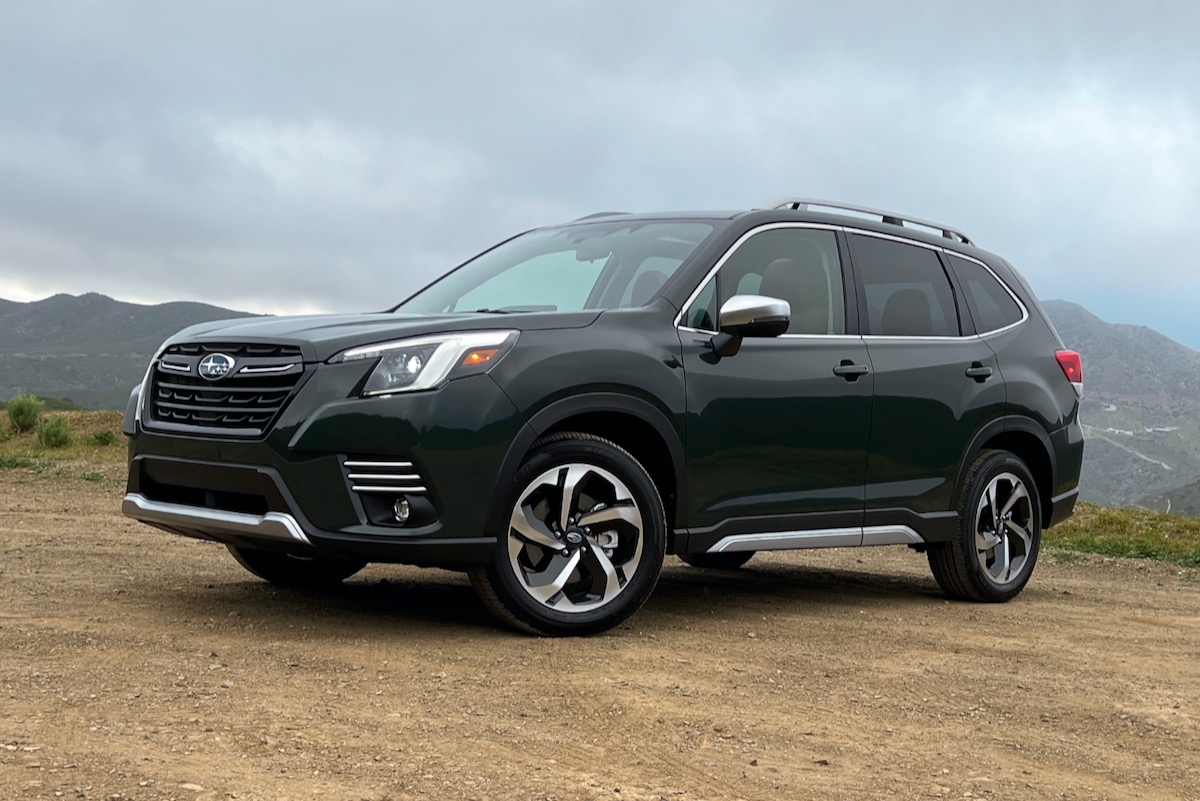
The 2023 Subaru Forester is a rational–instead of emotional–choice in a new compact SUV.
Sheer practicality defines the 2023 Subaru Forester, a compact crossover SUV where form follows function without fail. In turn, the 2023 Forester possesses the power to make your life easier in nearly every respect. From its standard all-wheel drive (AWD) and generous ground clearance to its roomy interior and sizable cargo hold, it effortlessly tackles most daily tasks with a shrug.
This year, Subaru continues to refine the Forester, adding next-generation EyeSight safety features and an improved standard infotainment system. Unfortunately, though, the Forester still lacks a turbocharged engine option or an electrified drivetrain.

Beauty is usually more than skin deep, and so it is with the homely 2023 Subaru Forester, which at a glance resembles every other Forester built during the past two decades. That’s especially true when the Forester is wearing Cascade Green Silica paint, like our test vehicle. Sometimes it seems like every Forester ever made is green.
This year, the 2023 Forester comes in Base, Touring, Sport, Wilderness, Limited, and Premier trim levels in Canada, ranging in price from $30,995 to $41,595, not including the $1,975 destination charge. Our test vehicle arrived in Premier trim equipped with no options, bringing its manufacturer’s suggested retail price to $44,087, including destination.
Like most other SUVs roaming the planet, the Forester resembles two boxes on wheels. It looks a bit like a shrunken Subaru Ascent, with its flared fenders, narrow waist, upswept belt line into the rear roof pillars, and pincer-shaped front and rear lighting. But neither is pretty.
Within the 2023 Forester lineup, the Premier is the best-looking of the bunch, thanks to its appealing 18-inch alloy wheel design and upscale satin chrome exterior trim. Like nearly all Foresters, it also comes with robust roof rails ready to accept accessories for carrying all manner of sporting equipment. You can even pitch a tent atop the Forester, thanks to the roof rails’ 317-kilogram (700-pound) static-weight rating (362 kg (800 pounds) for the Forester Wilderness trim). Just remember that the dynamic-load rating is 80 kg (176 pounds).
Inside, the Forester Premier offers exclusive brown leather and trim, exposed stitching, and metallic accents. Those elements decorate an interior reflecting traditional Subaru design with analog gauges separated by a small driver information display, an 8-inch touchscreen, and an information display at the top of the dashboard. Hard plastic is abundant, but makes the cabin easy to clean up.
Overall, the Forester’s appearance is busy, inside and out. Partly, that is due to the mix of grey and silver lower body and bumper cladding on the outside. But also, the interior control layout heavily relies on traditional buttons and knobs, which is a preferable approach because it makes things easy to locate and use. Still, there is no denying the back-to-basics nature of the 2023 Subaru Forester, and that’s just fine by us.

Every Subaru Forester has a 2.5-litre four-cylinder engine generating power specs of 182 horsepower and 176 lb-ft of torque. It powers all four wheels through a continuously variable transmission (CVT). The CVT has eight programmed ratios to make it sound and feel more like a traditional automatic, and a Subaru Intelligent Drive SI-Drive system offers a Sport driving mode to quicken the Forester’s responses.
In addition to SI-Drive, all Foresters have an X-Mode off-road traction control system, with a hill descent control system. Starting with the Sport trim, the system adds Deep Snow and Mud settings.
For even more off-roading capability, you can choose the Forester Wilderness which receives all-terrain tires and numerous modifications that make it remarkably capable when the going gets tough. See our review of the 2022 Subaru Forester Wilderness for more information.
We evaluated the tamer Forester Premier this time and, as luck would have it, the weather gods bestowed upon us the perfect storm for testing a Subaru. A series of “atmospheric rivers” struck that week, dumping torrential rain and burying the local mountains in multiple metres of snow.
We couldn’t venture to higher elevations due to road closures, but we did traverse flooded roadways, rain-blasted highways, and a muddy trail without effort or concern. Well, except when the Forester began to slide laterally in the muck on an uneven part of the soupy terrain. That caused an increase in heart rate. Regardless, this gave us a rare chance to experience the weather for which Subarus are seemingly made, and the Forester inspired confidence that it would get to where we needed to go with ease.
During a dry day, we ran our usual evaluation route across the mountains and up the coast to rural farm roads. Having recently driven a Subaru Outback with the same powertrain as the Forester, we expected disappointment with the engine and transmission. However, the Forester Premier weighs 85 kilograms (187 pounds) less than the Outback Premier, and it seems a little livelier.
Don’t get too excited, though. The 2.5-litre four remains merely adequate, just less overcome by its task in comparison to the Outback. Plus, under acceleration, the boxer-type engine is louder in the Forester than in the Outback, which might bother some people (but not us).
It is possible the Forester’s excellent driving dynamics coloured our perceptions of the powertrain. Subaru has expertly tuned this SUV to provide a comfortable yet communicative ride blended with entertaining and trustworthy handling. The light and accurate steering, responsive and effective brakes, and excellent suspension tuning don’t encourage enthusiastic driving, but they will support it.
Better yet, when you’re hustling the Forester on an undulating mountain road, you don’t get the lateral rocking and fore-aft motions that you frequently experience in other crossover SUVs. There is nothing sloppy about the Forester’s demeanour, and the ride isn’t soft and anesthetized like it is in the Outback. The Forester drives with the slightly firm communicativeness of Subarus of old, which in our book is a good thing.
Still, we’d like a turbocharged engine. They perform better at elevation, and we’re certain many Forester owners are heading for the hills at the first sign of fresh powder. Not only that, but adventure awaits in the mountains, and the Forester seems custom-built for such excursions.
Besides, the Forester returned 9.1 litres per 100 kilometres on the testing route, falling well short of the official Natural Resources Canada fuel economy rating of 8.2 L/100 km in combined driving (9.0 L/100 km for the Wilderness model). If the Forester isn’t going to hit that mark, Subaru might as well offer a forced-induction alternative.
We’d also like to see a Forester hybrid or plug-in hybrid, which could improve efficiency while providing some extra off-the-line thrust thanks to an electric motor.

As you might expect from looking at it, the Subaru Forester is all about function over form. Style takes a back seat to simplicity and substance, making this SUV a tool you use instead of a suit in which you show off. And for this reason, we love it.
You need not upgrade beyond the Touring trim in order to get a panoramic glass sunroof, a 10-way power-adjustable driver’s seat, heated front seats (standard), heated side mirrors (standard), heated steering wheel, and a windshield wiper de-icer system. The Forester Touring’s cloth upholstery is great for cold weather, too.
But, if you want something fancier, you can enjoy StarTex artificial leather in the Forester Wilderness or perforated genuine leather in the Forester Limited and Premier. Those models also feature a dual-zone automatic climate control system, while the Forester Limited and Premier have an eight-way power-adjustable front passenger’s seat and heated outboard rear seats.
One of the great things about driving a Subaru Forester is the outward visibility. You sit up high in this SUV, and the tall glass, thin windshield pillars, and large side mirrors provide outstanding spatial awareness. In turn, this makes the Forester easy to drive and park. Furthermore, front and rear seat entry and exit are effortless.
Unfortunately, Subaru doesn’t tint the panoramic sunroof enough. So, unless it’s the dead of winter north of the 45th parallel, the amount of solar heating that cooks the upper portion of the cabin demands that you close the shade. And since the Forester Premier doesn’t come with ventilated front seats, you may swelter a bit. Also, while the Premier trim’s power-adjustable front seats are comfortable and supportive during longer trips, the back seats are not as satisfying. There is plenty of legroom, headroom, and foot room. However, the bottom seat cushion should offer more leg support and the backrest angle is reclined too much, forcing taller adults to splay and slouch.
You might want to note that the Forester’s doors are exceptionally well sealed. One afternoon after school pick-up, our youngest child did not slam her door hard enough to latch it. That evening, the wind picked up, blowing the door partly open, and then a driving rain fell, drenching the left rear part of the interior. But, upon discovery of this situation, everything cleaned up in a matter of minutes.
Interior storage is as plentiful as it can be, though some locations are smaller than preferable. In the back, passengers will be delighted with front seatbacks containing three different pockets each. Subaru hasn’t passed up any opportunities to create space for stashing your stuff.
Most Foresters offer a standard power liftgate. When it rises, it reveals a usefully shaped cargo area with hooks for grocery bags and tie-downs for cargo. Under the load floor, hidden storage is available. And if you remove the available retractable cargo cover, you can slide four full-size suitcases into the Forester, storing them on their sides.
Behind the back seat, the Forester offers 762 litres of cargo space (818 litres with the base trim, which doesn’t have a panoramic sunroof). Fold the back seat down, and the Forester swallows 1,957 litres of cargo (2,101 litres with the Base model). These cargo-capacity numbers are average for the compact SUV segment.

At a glance, it might appear that the Forester’s technology is outdated. However, looks are deceiving, and you might prefer what Subaru installs in the 2023 Forester to what you’ll find in the company’s other models.
For the 2023 model year, the Base trim level adds a 6.5-inch touchscreen infotainment system with a high-resolution display. It includes Bluetooth, Apple CarPlay and Android Auto connectivity, SiriusXM satellite radio, HD Radio, and Starlink connected services with access to features such as remote engine starting. Old-schoolers will be happy to discover a CD player in all Foresters.
An 8-inch touchscreen display is available, paving the way to upgrades such as a navigation system and an excellent Harman Kardon premium audio system. Our Forester Premier had all of these features. However, a wireless smartphone charger is notably absent.
As far as the user interface goes, the Forester’s older Subaru Starlink infotainment systems might be preferable to the new ones featuring a larger screen but fewer physical controls. For example, in the Forester, the climate controls are completely separate from the touchscreen, the volume and tuning knobs are easy to locate and use, and a collection of main menu buttons quickly take you to the screen you want. We’re not crazy about the reflections on the display and its surrounding trim, but otherwise, the Forester’s setup is simple and appealing.
Unfortunately, the voice-recognition system is nearly useless. It found a Starbucks, responding to our command with the urgency of a sloth. After that, things went downhill, and fast. For example, in response to a request for directions to the closest Chipotle, the system thought we’d asked for a “road rescue.” When we told it we needed directions to the nearest hospital, it listed two veterinary offices and an assisted-living centre before providing the name of any hospitals.
So, you’re going to want to use Apple CarPlay or Android Auto, and skip asking the Forester’s digital assistant for anything—except maybe for directions to Starbucks, assuming you're not in a hurry.

The most significant change to the 2023 Forester is its next-generation EyeSight collection of collision avoidance and driver assist technologies. It has updated software and cameras providing a wider field of view, and Subaru says that means it should perform better than before. Adaptive cruise control is standard.
In addition, Forester models equipped with a blind-spot monitoring system add a new feature called Automatic Emergency Steering. Subaru says it works at speeds under 80 km/h and assists with avoiding in-lane obstacles by checking clearance in adjacent lanes via the blind-spot monitor, and then helping to steer around whatever is in the way. Blind-spot monitoring and rear cross-traffic alert are unavailable with the Base trim but standard on all other trim levels.
When you upgrade past the base trim, you get a Rear Automatic Braking (RAB) system. When reversing into a driveway with a family of four aboard, the RAB mistook the angled driveway pavers for an obstacle and unnecessarily slammed hard on the brakes, surprising and panicking everyone aboard. Not pleasant.
Unfortunately, while Subaru offers physical switchgear to manually turn off features including the blind-spot monitoring, forward-collision warning, and lane-departure warning and lane-keep assist systems, the RAB Off button is located on the infotainment screen and the system defaults to “on” each time you restart the engine.
The Limited and Premier trims have an exclusive DriverFocus Distraction Mitigation System, which monitors the driver for inattention and issues warnings. It also provides gesture control for the climate system’s temperature settings. But why bother with that nonsense when you can just reach out and twist a knob? This feature seems like a case of Subaru trying to fix something that isn’t broken.
For whatever reason, the Forester’s new EyeSight systems worked much better than what we recently observed in the 2023 Outback, which also gets the new tech. Overall, it performed in a smoother and more confident fashion and engaged in less nannying about driver behaviour. But remember that we did not evaluate the systems under identical conditions, so perhaps conditions were less challenging for the Forester’s tech.
Subaru is known for its dedication to safety, but it appears the Forester’s age is catching up to it. In new tests performed by the Insurance Institute for Highway Safety (IIHS), the 2023 Forester earns a Top Safety Pick rating, a notch down from last year’s Top Safety Pick+ award. According to the IIHS, the Forester earns an Acceptable rather than Good rating in a new side-impact protection test. Worse, it gets a Marginal rating in a new small-overlap, frontal-impact assessment.
Meanwhile, over at the National Highway Traffic Safety Administration (NHTSA), which hasn’t made meaningful updates to its crash-test program in well over a decade, the Forester receives the highest five-star crash-test ratings across the board, plus a four-star rollover resistance rating, a common score for crossover SUVs.

Except for its awful voice-recognition system, lack of a turbocharged engine option, unimpressive real-world fuel economy, uncomfortable back seat, and emerging crashworthiness concerns, the 2023 Subaru Forester is a terrific all-around vehicle that’s ready for just about anything.
Not only that, but with standard AWD, more off-road capability than most rivals, and its unwavering focus on sheer practicality, you cannot help but love this Subaru. But the Forester isn’t a looker, especially in Wilderness specification, which makes it resemble a raccoon on wheels.
As for the Subaru Forester’s cost-effectiveness, prices are lower than some rivals in the class, J.D. Power claims it will hold its value better than other compact SUVs, which include the Honda CR-V, Hyundai Tucson, Mazda CX-5 and CX-50, and Toyota RAV4. We also expect the Forester to deliver good reliability over time. But if you’re looking for a longer warranty or generous trial subscriptions to connected services, you’ll need to shop elsewhere.
Note: Images show a US model.

User reviews for 2023 Subaru Forester
Write a review2023 Subaru Forester Pricing
Trims & specs
Air Conditioning
Automatic climate control front air conditioning · Single front air conditioning zones
Airbags
Dual front airbags · Driver knee airbags · Passenger airbag deactivation: occupant sensing deactivation · Front side airbags · Front side curtain airbags
Audio System
Antenna Type: mast · Voice recognition audio system · Bluetooth auxiliary audio input · Single disc in-Dash CD · Aha internet radio · Stitcher internet radio · MP3 player: CD MP3 Playback · Touch screen display radio · Satellite Radio: SiriusXM · Total Number of Speakers: 4
Brakes
ABS: 4-wheel · Braking assist: hill start assist · Electronic parking brake: auto off · Front brake diameter: 11.6 · Front brakes: ventilated disc · Rear brake diameter: 11.2 · Rear brakes: ventilated disc
Comfort Features
Center console trim: leatherette · Dash trim: metallic · Door trim: leatherette · Floor Mat Material: carpet · Floor Material: carpet · Floor Mats: front · Shift knob trim: urethane · Steering wheel trim: urethane
Convenience Features
Adaptive stop and go cruise control: semi-automatic · Assist handle: rear · Autonomous lane guidance: lane centering · Cargo area power outlet: 12V · Center console: front console with armrest and storage · Console Insert: organizer tray · Cruise control: adaptive · Cupholders: front · Multi-function remote: keyless entry with panic alarm · One-touch windows: 1 · Power outlet(s): 12V front · Power steering: electric · Power windows: lockout button · Reading lights: rear · Rear power outlet: 12V · Steering wheel: tilt and telescopic · Steering wheel mounted controls: cruise controls · Storage: cargo tie-down anchors and hooks · Vanity mirrors: dual
Driver Seat
Manual adjustments: 6
Drivetrain
4WD Type: full time · Axle ratio: 3.70
Engine
Alternator: 150 amps · Battery: maintenance-free
Exterior Features
Bumper detail: rear underguard · Door handle color: body-color · Fender lip moldings: black · Front bumper color: black · Grille color: black · Headlamp bezel color: black · Mirror color: black · Rear bumper color: black · Rear trunk/liftgate: liftgate · Rocker panel color: black · Window trim: black
Headrests
Front headrests: adjustable · Number of front headrests: 2 · Number of rear headrests: 3
In Car Entertainment
Connected in-car apps: Google POIs · Infotainment: Apply CarPlay ready · Infotainment screen size: 6.5 in.
Instrumentation
Fuel economy display: range · Instrument cluster screen size: 4.2 in. · Warnings and reminders: coolant temperature warning
Lights
Exterior entry lights: security approach lamps · Headlights: automatic high beam dimmer
Mirrors
Exterior mirrors: manual folding · Inside rearview mirror: manual day/night
Passenger Seat
Manual Adjustments: 4
Rear Seats
Type: 60-40 split bench
Safety
Automatic emergency braking: front · Camera system: rearview · Camera system washer: rear · Child seat anchors: LATCH system · Crumple zones: rear · Impact absorbing seats: dual front · Impact sensor: fuel cut-off · Pre-Collision Warning System: audible warning · Pre-collision warning system: pedestrian detection · Rearview monitor: in dash
Seatbelts
Emergency locking retractors: front · Front seatbelts: 3-point · Seatbelt force limiters: front · Seatbelt pretensioners: front · Seatbelt warning sensor: driver and passenger · Second row seatbelts: 3-point
Seats
Driver seat manual adjustments: height · Front seat type: bucket · Passenger seat manual adjustments: reclining · Rear headrests: adjustable · Rear seat folding: split · Upholstery: cloth
Security
Power door locks: anti-lockout
Spare Tire
Mount Location: inside · Size: temporary
Spare Wheel
Rim Type: steel
Stability and Traction
Traction control: with trailer stability control
Steering
Steering ratio: 13.5 · Turns lock-to-lock: 2.6
Suspension
Front Arm Type: lower control arms · Front Shock Type: gas shock absorbers · Front Spring Type: coil springs · Front Suspension Classification: independent · Front Suspension Type: MacPherson struts · Rear Shock Type: gas shock absorbers · Rear Spring Type: coil springs · Rear Suspension Classification: independent · Rear Suspension Type: double wishbone · Stabilizer bar(s): front
Telematics
Electronic messaging assistance: with read function · Phone: voice activated · Phone wireless data link: Bluetooth · Satellite communications: Turn-by-Turn Navigation
Tires
Type: all season
Tires and Rims
Wheels: steel
Wheels
Wheel covers: full
Windows
Front wipers: variable intermittent · Laminated glass: acoustic · Liftgate window: fixed · Power windows: with safety reverse · Rear wiper: auto-on in reverse
Air Conditioning
Automatic climate control front air conditioning · Single front air conditioning zones
Airbags
Dual front airbags · Driver knee airbags · Passenger airbag deactivation: occupant sensing deactivation · Front side airbags · Front side curtain airbags
Audio System
Antenna Type: mast · Voice recognition audio system · Bluetooth auxiliary audio input · Single disc in-Dash CD · Aha internet radio · Pandora internet radio · MP3 player: CD MP3 Playback · Touch screen display radio · Satellite Radio: SiriusXM · Total Number of Speakers: 6
Brakes
ABS: 4-wheel · Braking assist: hill start assist · Electronic parking brake: auto off · Front brake diameter: 12.4 · Front brakes: ventilated disc · Rear brake diameter: 11.2 · Rear brakes: ventilated disc
Comfort Features
Armrests: rear center with cupholders · Center console trim: leatherette · Dash trim: metallic · Door trim: leatherette · Floor Mat Material: carpet · Floor Material: carpet · Floor Mats: front · Shift knob trim: urethane · Steering wheel trim: leather
Convenience Features
Adaptive stop and go cruise control: semi-automatic · Assist handle: rear · Autonomous lane guidance: lane centering · Cargo area power outlet: 12V · Cargo cover: retractable · Center console: front console with armrest and storage · Console Insert: organizer tray · Cruise control: adaptive · Cupholders: front · Multi-function remote: keyless entry with panic alarm · One-touch windows: 2 · Power outlet(s): USB front · Power steering: electric · Power windows: lockout button · Reading lights: rear · Rear power outlet: 12V · Steering wheel: tilt and telescopic · Steering wheel mounted controls: phone · Storage: sunglasses holder · Vanity mirrors: dual illuminating
Driver Seat
Adjustable lumbar support: power · Power adjustments: 10
Drivetrain
4WD Type: full time · Axle ratio: 3.70
Engine
Alternator: 150 amps · Battery: maintenance-free
Exterior Features
Bumper detail: front underguard · Door handle color: body-color · Fender lip moldings: black · Front bumper color: black · Grille color: black · Headlamp bezel color: black · Mirror color: body-color · Rear bumper color: black · Rear spoiler: roofline spoiler · Rear spoiler color: body-color · Rear trunk/liftgate: liftgate · Rocker panel color: black · Window trim: black
Headrests
Front headrests: adjustable · Number of front headrests: 2 · Number of rear headrests: 3
In Car Entertainment
Connected in-car apps: Yelp · Infotainment: Apply CarPlay ready · Infotainment screen size: 6.5 in.
Instrumentation
Fuel economy display: range · Instrument cluster screen size: 4.2 in. · Warnings and reminders: lamp failure
Lights
Exterior entry lights: security approach lamps · Headlights: self-leveling
Mirrors
Exterior mirrors: heated · Inside rearview mirror: manual day/night
Passenger Seat
Manual Adjustments: 4
Rear Seats
Type: 60-40 split bench
Roof
Moonroof: anti-trapping feature · Roof rails: black
Safety
Automatic emergency braking: front · Camera system: rearview · Camera system washer: rear · Child seat anchors: LATCH system · Crumple zones: rear · Impact absorbing seats: dual front · Impact sensor: door unlock · Pre-Collision Warning System: visual warning · Pre-collision warning system: pedestrian detection · Rearview monitor: in dash
Seatbelts
Emergency locking retractors: front · Front seatbelts: 3-point · Seatbelt force limiters: front · Seatbelt pretensioners: front · Seatbelt warning sensor: driver and passenger · Second row seatbelts: 3-point
Seats
Driver seat power adjustments: height · Front seat type: bucket · Passenger seat manual adjustments: reclining · Rear headrests: adjustable · Rear seat folding: split · Rear seat manual adjustments: reclining · Upholstery: cloth
Security
Power door locks: anti-lockout
Spare Tire
Mount Location: inside · Size: temporary
Spare Wheel
Rim Type: steel
Stability and Traction
Traction control: with trailer stability control
Steering
Steering ratio: 13.5 · Turns lock-to-lock: 2.6
Suspension
Front Arm Type: lower control arms · Front Shock Type: gas shock absorbers · Front Spring Type: coil springs · Front Suspension Classification: independent · Front Suspension Type: MacPherson struts · Rear Shock Type: gas shock absorbers · Rear Spring Type: coil springs · Rear Suspension Classification: independent · Rear Suspension Type: double wishbone · Stabilizer bar(s): front
Telematics
Driver assistance app: roadside assistance · Electronic messaging assistance: with voice recognition · Phone: voice activated · Phone wireless data link: Bluetooth · Satellite communications: Turn-by-Turn Navigation · Smart device app compatibility: MySubaru · Smart device app function: lock operation · Wifi: hotspot compatible
Tires
Type: all season
Tires and Rims
Wheels: painted aluminum
Windows
Front wipers: variable intermittent · Laminated glass: acoustic · Liftgate window: fixed · Power windows: with safety reverse · Rear wiper: auto-on in reverse
Air Conditioning
Automatic climate control front air conditioning · Single front air conditioning zones
Airbags
Dual front airbags · Driver knee airbags · Passenger airbag deactivation: occupant sensing deactivation · Front side airbags · Rear side curtain airbags
Audio System
Antenna Type: mast · Voice recognition audio system · Bluetooth auxiliary audio input · Single disc in-Dash CD · Aha internet radio · Pandora internet radio · MP3 player: CD MP3 Playback · AM/FM radio · Satellite Radio: SiriusXM · Total Number of Speakers: 6
Brakes
ABS: 4-wheel · Braking assist: hill start assist · Electronic parking brake: auto off · Front brake diameter: 12.4 · Front brakes: ventilated disc · Rear brake diameter: 11.2 · Rear brakes: ventilated disc
Comfort Features
Armrests: rear center with cupholders · Cargo area floor mat: rubber/vinyl · Center console trim: leatherette · Dash trim: metallic · Door trim: leatherette · Floor Mat Material: carpet · Floor Material: carpet · Floor Mats: front · Shift knob trim: leather · Steering wheel trim: leather
Convenience Features
Adaptive stop and go cruise control: semi-automatic · Assist handle: front · Autonomous lane guidance: lane centering · Cargo area power outlet: 12V · Cargo cover: retractable · Center console: front console with armrest and storage · Console Insert: organizer tray · Cruise control: adaptive · Cupholders: rear · Multi-function remote: proximity entry system · One-touch windows: 2 · Power outlet(s): 12V front · Power steering: speed-proportional · Power windows: lockout button · Reading lights: rear · Rear power outlet: 12V · Steering wheel: tilt and telescopic · Steering wheel mounted controls: paddle shifter · Storage: grocery bag holder · Vanity mirrors: dual illuminating
Driver Seat
Adjustable lumbar support: power · Power adjustments: 10
Drivetrain
4WD Type: full time · Axle ratio: 3.70
Engine
Alternator: 150 amps · Battery: maintenance-free
Exterior Features
Bumper detail: rear underguard · Door handle color: body-color · Exhaust tip color: stainless-steel · Fender lip moldings: black · Front bumper color: accent color · Grille color: black · Headlamp bezel color: black · Mirror color: body-color · Rear bumper color: accent · Rear spoiler: roofline spoiler · Rear spoiler color: body-color · Rear trunk/liftgate: liftgate · Rocker panel color: black · Window trim: black
Headrests
Front headrests: adjustable · Number of front headrests: 2 · Number of rear headrests: 3
In Car Entertainment
Connected in-car apps: Google search · Infotainment: STARLINK · Infotainment screen size: 6.5 in.
Instrumentation
Fuel economy display: range · Instrument cluster screen size: 6.3 in. · Warnings and reminders: coolant temperature warning
Lights
Exterior entry lights: security approach lamps · Front fog lights: LED · Headlights: cornering
Mirrors
Exterior mirrors: integrated turn signals · Inside rearview mirror: manual day/night
Passenger Seat
Manual Adjustments: 4
Rear Seats
Type: 60-40 split bench
Roof
Moonroof: power panoramic · Roof rails: black
Safety
Automatic emergency braking: front · Camera system: rearview · Camera system washer: rear · Child seat anchors: LATCH system · Cross Traffic Alert: rear · Crumple zones: front · Impact absorbing seats: dual front · Impact sensor: door unlock · Pre-Collision Warning System: visual warning · Pre-collision warning system: pedestrian detection · Rearview monitor: in dash
Seatbelts
Emergency locking retractors: front and rear · Front seatbelts: 3-point · Seatbelt force limiters: front · Seatbelt pretensioners: front · Seatbelt warning sensor: driver and passenger · Second row seatbelts: 3-point
Seats
Driver seat power adjustments: reclining · Front seat type: bucket · Passenger seat manual adjustments: reclining · Rear headrests: adjustable · Rear seat folding: split · Rear seat manual adjustments: reclining · Upholstery: contrast stitching
Security
Power door locks: anti-lockout
Spare Tire
Mount Location: inside · Size: temporary
Spare Wheel
Rim Type: steel
Stability and Traction
Traction control: with trailer stability control
Steering
Steering ratio: 13.5 · Turns lock-to-lock: 2.6
Suspension
Front Arm Type: lower control arms · Front Shock Type: gas shock absorbers · Front Spring Type: coil springs · Front Suspension Classification: independent · Front Suspension Type: MacPherson struts · Rear Shock Type: gas shock absorbers · Rear Spring Type: coil springs · Rear Suspension Classification: independent · Rear Suspension Type: double wishbone · Stabilizer bar(s): rear
Telematics
Driver assistance app: roadside assistance · Electronic messaging assistance: with read function · Phone: voice activated · Phone wireless data link: Bluetooth · Satellite communications: Turn-by-Turn Navigation · Smart device app compatibility: MySubaru · Smart device app function: vehicle location · Wifi: hotspot compatible
Tires
Type: all season
Tires and Rims
Wheels: painted aluminum
Windows
Front wipers: variable intermittent · Laminated glass: acoustic · Liftgate window: fixed · Power windows: with safety reverse · Rear wiper: with washer
Air Conditioning
Automatic climate control front air conditioning · Dual front air conditioning zones
Airbags
Dual front airbags · Driver knee airbags · Passenger airbag deactivation: occupant sensing deactivation · Front side airbags · Rear side curtain airbags
Audio System
Antenna Type: mast · Voice recognition audio system · USB auxiliary audio input · Single disc in-Dash CD · Aha internet radio · Pandora internet radio · MP3 player: CD MP3 Playback · HD radio · Satellite Radio: SiriusXM · Total Number of Speakers: 6
Brakes
ABS: 4-wheel · Braking assist: hill start assist · Electronic parking brake: auto off · Front brake diameter: 12.4 · Front brakes: ventilated disc · Rear brake diameter: 11.2 · Rear brakes: ventilated disc
Comfort Features
Armrests: rear center with cupholders · Cargo area floor mat: rubber/vinyl · Center console trim: leatherette · Dash trim: metallic · Door trim: leatherette · Floor Mat Material: carpet · Floor Material: carpet · Floor Mats: front · Shift knob trim: leather · Steering wheel trim: leather
Convenience Features
Adaptive stop and go cruise control: semi-automatic · Assist handle: front · Autonomous lane guidance: lane centering · Cargo area power outlet: 12V · Cargo cover: retractable · Center console: with lighting · Console Insert: organizer tray · Cruise control: adaptive · Cupholders: rear · Memorized settings: liftgate · Multi-function remote: keyless entry with panic alarm · One-touch windows: 2 · Power outlet(s): 12V front · Power steering: electric · Power windows: lockout button · Reading lights: front · Rear power outlet: 12V · Steering wheel: tilt and telescopic · Steering wheel mounted controls: phone · Storage: door pockets · Vanity mirrors: dual illuminating
Driver Seat
Adjustable lumbar support: power · Power adjustments: 10
Drivetrain
4WD Type: full time · Axle ratio: 3.70
Engine
Alternator: 150 amps · Battery: maintenance-free
Exterior Features
Bumper detail: front underguard · Door handle color: body-color · Exhaust tip color: stainless-steel · Fender lip moldings: black · Front bumper color: black · Grille color: black · Headlamp bezel color: black · Mirror color: body-color · Rear bumper color: black · Rear spoiler: roofline spoiler · Rear spoiler color: body-color · Rear trunk/liftgate: liftgate · Rocker panel color: black · Window trim: chrome
Headrests
Front headrests: adjustable · Number of front headrests: 2 · Number of rear headrests: 3
In Car Entertainment
Connected in-car apps: Google POIs · Infotainment: STARLINK · Infotainment screen size: 8 in.
Instrumentation
Fuel economy display: range · Instrument cluster screen size: 6.3 in. · Warnings and reminders: maintenance reminder
Lights
Exterior entry lights: security approach lamps · Front fog lights: LED · Headlights: LED
Mirrors
Exterior mirrors: manual folding · Inside rearview mirror: manual day/night
Passenger Seat
Manual Adjustments: 4
Rear Seats
Type: 60-40 split bench
Roof
Moonroof: one-touch open/close · Roof rails: black
Safety
Automatic emergency braking: front pedestrian · Camera system: rearview · Camera system washer: rear · Child seat anchors: LATCH system · Cross Traffic Alert: rear · Crumple zones: front · Impact absorbing seats: dual front · Impact sensor: door unlock · Pre-Collision Warning System: visual warning · Pre-collision warning system: pedestrian detection · Rearview monitor: in dash
Seatbelts
Emergency locking retractors: front · Front seatbelts: 3-point · Seatbelt force limiters: front · Seatbelt pretensioners: front · Seatbelt warning sensor: driver and passenger · Second row seatbelts: 3-point
Seats
Driver seat power adjustments: reclining · Front seat type: bucket · Passenger seat manual adjustments: reclining · Rear headrests: adjustable · Rear seat folding: one-touch fold flat · Rear seat manual adjustments: reclining · Upholstery: leather-trimmed
Security
Power door locks: anti-lockout
Spare Tire
Mount Location: inside · Size: temporary
Spare Wheel
Rim Type: steel
Stability and Traction
Traction control: with trailer stability control
Steering
Steering ratio: 13.5 · Turns lock-to-lock: 2.6
Suspension
Front Arm Type: lower control arms · Front Shock Type: gas shock absorbers · Front Spring Type: coil springs · Front Suspension Classification: independent · Front Suspension Type: MacPherson struts · Rear Shock Type: gas shock absorbers · Rear Spring Type: coil springs · Rear Suspension Classification: independent · Rear Suspension Type: double wishbone · Stabilizer bar(s): front
Telematics
Driver assistance app: roadside assistance · Electronic messaging assistance: with voice recognition · Phone: voice activated · Phone wireless data link: Bluetooth · Satellite communications: Turn-by-Turn Navigation · Smart device app compatibility: MySubaru · Smart device app function: lock operation · Wifi: hotspot compatible
Tires
Type: all season
Tires and Rims
Wheels: painted aluminum
Windows
Front wipers: variable intermittent · Laminated glass: acoustic · Liftgate window: fixed · Power windows: with safety reverse · Rear wiper: intermittent
Air Conditioning
Automatic climate control front air conditioning · Single front air conditioning zones
Airbags
Dual front airbags · Driver knee airbags · Passenger airbag deactivation: occupant sensing deactivation · Front side airbags · Front side curtain airbags
Audio System
Antenna Type: mast · Voice recognition audio system · USB auxiliary audio input · Single disc in-Dash CD · Aha internet radio · Pandora internet radio · MP3 player: CD MP3 Playback · HD radio · Satellite Radio: SiriusXM · Total Number of Speakers: 6
Brakes
ABS: 4-wheel · Braking assist: hill start assist · Electronic parking brake: auto off · Front brake diameter: 12.4 · Front brakes: ventilated disc · Rear brake diameter: 11.2 · Rear brakes: ventilated disc
Comfort Features
Armrests: rear center with cupholders · Cargo area floor mat: rubber/vinyl · Center console trim: leatherette · Dash trim: metallic · Door trim: leatherette · Floor Mat Material: vinyl/rubber · Floor Material: carpet · Floor Mats: front · Foot pedal trim: alloy · Shift knob trim: urethane · Steering wheel trim: leather
Convenience Features
Adaptive stop and go cruise control: semi-automatic · Assist handle: front · Autonomous lane guidance: lane centering · Cargo area power outlet: 12V · Cargo cover: retractable · Center console: with lighting · Console Insert: organizer tray · Cruise control: adaptive · Cupholders: front · Multi-function remote: keyless entry with panic alarm · One-touch windows: 2 · Power outlet(s): 12V front · Power steering: speed-proportional · Power windows: lockout button · Reading lights: rear · Rear power outlet: 12V · Steering wheel: tilt and telescopic · Steering wheel mounted controls: cruise controls · Storage: sunglasses holder · Vanity mirrors: dual illuminating
Driver Seat
Adjustable lumbar support: power · Power adjustments: 10
Drivetrain
4WD Type: full time · Axle ratio: 4.11
Engine
Alternator: 150 amps · Battery: maintenance-free · Oil cooler: auxiliary
Exterior Features
Bumper detail: rear underguard · Door handle color: body-color · Exhaust tip color: stainless-steel · Fender lip moldings: black · Front bumper color: gray · Grille color: black · Headlamp bezel color: black · Mirror color: black with chrome accents · Rear bumper color: black · Rear spoiler: roofline spoiler · Rear spoiler color: body-color · Rear trunk/liftgate: liftgate · Rocker panel color: black · Skid plate(s): engine · Window trim: black
Headrests
Front headrests: adjustable · Number of front headrests: 2 · Number of rear headrests: 3
In Car Entertainment
Connected in-car apps: SiriusXM Travel Link · Infotainment: Android Auto ready · Infotainment screen size: 8 in.
Instrumentation
Fuel economy display: range · Instrument cluster screen size: 6.3 in. · Warnings and reminders: maintenance reminder
Lights
Exterior entry lights: security approach lamps · Front fog lights: LED · Headlights: auto delay off
Mirrors
Exterior mirrors: manual folding · Inside rearview mirror: manual day/night
Passenger Seat
Manual Adjustments: 4
Rear Seats
Type: 60-40 split bench
Roof
Moonroof: anti-trapping feature · Roof rails: black
Safety
Automatic emergency braking: front · Camera system: rearview · Camera system washer: rear · Child seat anchors: LATCH system · Cross Traffic Alert: rear · Crumple zones: rear · Impact absorbing seats: dual front · Impact sensor: fuel cut-off · Parking sensors: rear · Pre-Collision Warning System: audible warning · Pre-collision warning system: pedestrian detection · Rear pre-collision warning system: pedestrian detection · Rearview monitor: in dash
Seatbelts
Emergency locking retractors: front and rear · Front seatbelts: 3-point · Seatbelt force limiters: front · Seatbelt pretensioners: front · Seatbelt warning sensor: driver and passenger · Second row seatbelts: 3-point
Seats
Driver seat power adjustments: height · Front seat type: bucket · Passenger seat manual adjustments: reclining · Rear headrests: adjustable · Rear seat folding: one-touch fold flat · Rear seat manual adjustments: reclining · Upholstery: contrast stitching
Security
Power door locks: anti-lockout
Spare Tire
Mount Location: inside · Size: full-size
Spare Wheel
Rim type: aluminum alloy
Stability and Traction
Traction control: with trailer stability control
Steering
Steering ratio: 13.5 · Turns lock-to-lock: 2.6
Suspension
Front Arm Type: lower control arms · Front Shock Type: gas shock absorbers · Front Spring Type: coil springs · Front Suspension Classification: independent · Front Suspension Type: MacPherson struts · Rear Shock Type: gas shock absorbers · Rear Spring Type: coil springs · Rear Suspension Classification: independent · Rear Suspension Type: double wishbone · Stabilizer bar(s): rear
Telematics
Driver assistance app: roadside assistance · Electronic messaging assistance: with read function · Phone: voice activated · Phone wireless data link: Bluetooth · Satellite communications: Turn-by-Turn Navigation · Smart device app compatibility: MySubaru · Smart device app function: maintenance scheduling · Wifi: hotspot compatible
Tires
Type: all terrain
Tires and Rims
Wheels: painted aluminum
Windows
Front wipers: variable intermittent · Laminated glass: acoustic · Liftgate window: fixed · Power windows: with safety reverse · Rear wiper: auto-on in reverse
Air Conditioning
Automatic climate control front air conditioning · Dual front air conditioning zones
Airbags
Dual front airbags · Driver knee airbags · Passenger airbag deactivation: occupant sensing deactivation · Front side airbags · Rear side curtain airbags
Audio System
Antenna Type: diversity · Voice recognition audio system · Auxiliary audio input: jack · Single disc in-Dash CD · Aha internet radio · Stitcher internet radio · MP3 player: CD MP3 Playback · Premium Brand: Harman-Kardon · HD radio · Satellite Radio: SiriusXM · 1 subwoofer · Total Number of Speakers: 8 · 576 watts
Brakes
ABS: 4-wheel · Braking assist: hill start assist · Electronic parking brake: auto off · Front brake diameter: 12.4 · Front brakes: ventilated disc · Rear brake diameter: 11.2 · Rear brakes: ventilated disc
Comfort Features
Armrests: rear center with cupholders · Cargo area floor mat: rubber/vinyl · Center console trim: leatherette · Dash trim: metallic · Door trim: leatherette · Floor Mat Material: carpet · Floor Material: carpet · Floor Mats: front · Shift knob trim: leather · Steering wheel trim: leather
Convenience Features
Adaptive stop and go cruise control: semi-automatic · Assist handle: front · Autonomous lane guidance: lane centering · Cargo area power outlet: 12V · Cargo cover: retractable · Center console: with lighting · Console Insert: organizer tray · Cruise control: adaptive · Cupholders: rear · Memorized settings: driver seat · Multi-function remote: proximity entry system · One-touch windows: 2 · Power outlet(s): USB front · Power steering: speed-proportional · Power windows: lockout button · Reading lights: front · Rear power outlet: 12V · Steering wheel: tilt and telescopic · Steering wheel mounted controls: multi-function screen controls · Storage: grocery bag holder · Vanity mirrors: dual illuminating
Driver Seat
Adjustable lumbar support: power · Power adjustments: 10
Drivetrain
4WD Type: full time · Axle ratio: 3.70
Engine
Alternator: 150 amps · Battery: maintenance-free
Exterior Features
Bumper detail: front underguard · Door handle color: body-color · Exhaust tip color: stainless-steel · Fender lip moldings: black · Front bumper color: black · Grille color: black · Headlamp bezel color: black · Mirror color: chrome · Rear bumper color: black · Rear spoiler: roofline spoiler · Rear spoiler color: body-color · Rear trunk/liftgate: liftgate · Rocker panel color: chrome accents · Window trim: chrome
Headrests
Front headrests: adjustable · Number of front headrests: 2 · Number of rear headrests: 3
In Car Entertainment
Connected in-car apps: Google search · Infotainment: Apply CarPlay ready · Infotainment screen size: 8 in.
Instrumentation
Fuel economy display: MPG · Instrument cluster screen size: 6.3 in. · Warnings and reminders: low fuel level
Lights
Exterior entry lights: security approach lamps · Front fog lights: LED · Headlights: Auto on/off
Mirrors
Exterior mirrors: heated · Inside rearview mirror: manual day/night
Passenger Seat
Power adjustments: 8
Rear Seats
Type: 60-40 split bench
Roof
Moonroof: power panoramic · Roof rails: silver
Safety
Automatic emergency braking: front · Camera system: rearview · Camera system washer: rear · Child seat anchors: LATCH system · Cross Traffic Alert: rear · Crumple zones: rear · Impact absorbing seats: dual front · Impact sensor: fuel cut-off · Parking sensors: rear · Pre-Collision Warning System: visual warning · Pre-collision warning system: pedestrian detection · Rear pre-collision warning system: pedestrian detection · Rearview monitor: in dash
Seatbelts
Emergency locking retractors: front · Front seatbelts: 3-point · Seatbelt force limiters: front · Seatbelt pretensioners: front · Seatbelt warning sensor: driver and passenger · Second row seatbelts: 3-point
Seats
Driver seat power adjustments: reclining · Front seat type: bucket · Passenger seat power adjustments: reclining · Rear headrests: adjustable · Rear seat folding: one-touch fold flat · Rear seat manual adjustments: reclining · Upholstery: perforated
Security
Power door locks: anti-lockout
Spare Tire
Mount Location: inside · Size: temporary
Spare Wheel
Rim Type: steel
Stability and Traction
Traction control: with trailer stability control
Steering
Steering ratio: 13.5 · Turns lock-to-lock: 2.6
Suspension
Front Arm Type: lower control arms · Front Shock Type: gas shock absorbers · Front Spring Type: coil springs · Front Suspension Classification: independent · Front Suspension Type: MacPherson struts · Rear Shock Type: gas shock absorbers · Rear Spring Type: coil springs · Rear Suspension Classification: independent · Rear Suspension Type: double wishbone · Stabilizer bar(s): rear
Telematics
Driver assistance app: roadside assistance · Electronic messaging assistance: with voice recognition · Navigation app: TomTom · Navigation system: with voice recognition · Phone: voice activated · Phone wireless data link: Bluetooth · Satellite communications: Turn-by-Turn Navigation · Smart device app compatibility: MySubaru · Smart device app function: maintenance status · Wifi: hotspot compatible
Tires
Type: all season
Tires and Rims
Wheels: painted aluminum
Windows
Front wipers: variable intermittent · Laminated glass: acoustic · Liftgate window: fixed · Power windows: with safety reverse · Rear wiper: auto-on in reverse
