2023 Toyota Corolla Hatchback Reviews, Pricing & Specs
Write a reviewPros
Stylish design
Impressive technology
Great safety ratings
Cons
Uninspired performance
Not much cargo space
Irritating driving aids
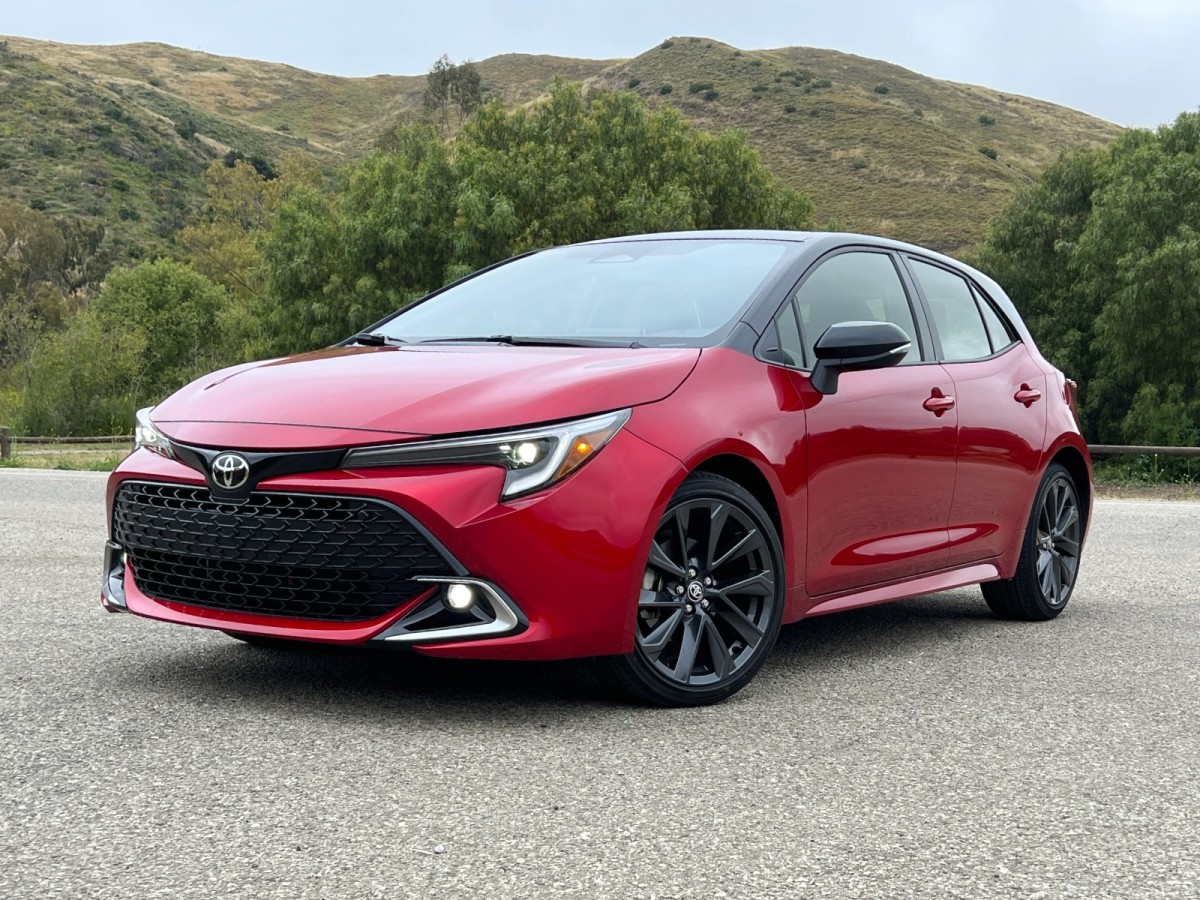
Why buy a 2023 Toyota Corolla Hatchback? For added utility and a sense of style.

Look closely, and you might spot a handful of minor styling changes to the 2023 Corolla Hatchback. Toyota says it has updated the grille and LED headlights, added new taillights (shared with the GR Corolla model), revised the rear bumper, and bolted on new wheel designs. In addition, Blue Crush and Inferno are new paint colours for 2023.
Hatchbacks often look out of balance due to their stubby butts, and that’s true of the Corolla. Still, the relatively fast rear window and expressive yet restrained styling works, even if the design concentrates too much of its visual weight over the front wheels. The Corolla Sedan offers more natural proportions.
Interiors are unchanged for 2023, aside from the new Toyota Audio Multimedia infotainment system and its graphics. And that’s fine because the Corolla’s cabin is a model of simplicity, and the automaker executes it with quality materials. However, the new infotainment system doesn’t include a radio tuning knob, which is a user interface misstep.
In Canada, the 2023 Corolla Hatchback models are the SE and XSE trim, and new vehicle prices start at $23,490 for the Toyota Corolla Hatchback SE, not including a destination charge of $1,760 plus other fees. Our test car arrived in XSE trim with optional two-tone paint and has a fees-in Canadian manufacturer’s suggested retail price (MSRP) of $33,795.
In addition, there is a performance-tuned version of the Corolla Hatchback. Toyota calls it the GR Corolla, and we’ve reviewed that model separately.

Toyota equips the Corolla Hatchback with a 2.0-litre four-cylinder engine making 169 horsepower at 6,600 rpm and 151 pound-feet of torque at 4,400 rpm. It uses a continuously variable transmission (CVT) equipped with a physical launch gear and stepped ratio changes that sound and feel like gear shifts. Toyota also optionally equips the Corolla hatch with paddle shifters, but c’mon now, we don't think those will be used frequently. Front-wheel drive (FWD) is the default when you’re looking south of the performance-oriented GR Corolla.
Drivers can choose from Eco, Normal, and Sport driving modes. We used Normal mode during testing, and while the engine supplies decent power, if speedy acceleration is important to you, other choices in the segment are more satisfying. In addition, the CVT tweaks help to make the car feel more responsive when accelerating from a stop and sound less in agony when gathering speed. Still, the car’s soundtrack is often grating to the ear, and the Corolla‘s powertrain spends lots of time revving.
Toyota builds the Corolla on a platform engineered to provide rewarding driving dynamics, and the car uses a strut-front and multilink-rear suspension design. With the XSE’s 18-inch alloy wheels and 225/40 all-season tires, the Corolla is fun to toss down a twisty mountain road. However, though the brakes feel good underfoot, the admittedly precise steering lacks feel and feedback.
The Corolla is an agreeable city car, in part because Toyota dials in enough suspension compliance to ensure a good ride quality. Visibility to the front and sides is excellent, but since you can’t see the hood, the low-hanging front end is hard to judge. It is relatively quiet, too, but once you get up to speed on a highway, the cabin suffers plenty of noise.
With XSE trim, the Corolla hatchback earns a Natural Resources Canada fuel economy rating of 6.8 litres per 100 kilometres in combined driving. The test vehicle averaged a still fuel-efficient 7.9 L/100 km on our mountainous evaluation loop, and we switched to Sport mode for the fun parts of the route.

When you select the XSE trim level, you’ll upgrade from single to dual-zone automatic climate control, enjoy SofTex artificial leather upholstery with fabric inserts and contrast stitching, and receive heated front seats with eight-way power adjustment for the driver’s seat. Heated front seats are not standard in Canada but are included with every trim and package above the base model.
The added comfort alone might be worth the ask for XSE trim. We were surprised by how supportive the Corolla was after hours behind the steering wheel. Only the centre armrest’s thin padding caused any irritation. It would be nice, though, if the front passenger’s seat offered a height adjuster.
Getting into and out of the back seat is somewhat challenging because the back doors do not open very wide, and the door openings are narrow. Once you’re in, you’ll find a comfortable seat with good thigh support and a proper backrest angle. The legroom is tight, but the front seatbacks are soft, so that isn’t an issue. However, Toyota doesn’t offer rear air conditioning vents in this car, and that’s a problem in hot weather.
Interior storage space could be better. For example, the centre console sacrifices practicality for style. But, the test car did have a wireless charger located forward of the transmission shifter.
Open the Corolla’s lightweight hatch, and you’ll find 660 litres of cargo space. That’s more luggage room than a Corolla Sedan offers, but not as much as other compact hatchbacks. When you fold the rear seats flat, the resulting maximum load floor is uneven. Toyota does not publish a maximum cargo space number for the Corolla Hatchback.

In addition to an available 7-inch digital gauge cluster, the 2023 Corolla Hatchback boasts a new Toyota Multimedia infotainment system. Toyota keeps the tech current through over-the-air software updates.
An 8-inch touchscreen is standard, as well as dual-smartphone Bluetooth pairing, wireless Apple CarPlay and Android Auto, HD Radio, SiriusXM satellite radio, and access to Apple Music and Amazon Music. In addition, five connected service plans are available, each with a complimentary subscription that ranges up to 10 years.
One of the plans is Safety Connect, which provides automatic collision notification and SOS emergency calling. Drive Connect is new for 2023, and it powers the infotainment system’s cloud-based navigation system, Google points-of-interest database, human assistance through Destination Assist, and a natural voice recognition system called Intelligent Assistant.
With an active Drive Connect subscription, you rouse the Intelligent Assistant by pressing the voice button on the steering wheel or simply by saying: “Hey, Toyota.” The technology is excellent, and its ease of use and quick, accurate response to commands and queries rivals much more expensive vehicles. It even works for adjusting the climate system.
In addition to wireless charging, the XSE trim level now includes a standard eight-speaker JBL premium audio system with stylish gloss black tweeter speaker surrounds. It produces decent sound quality for this class of vehicle.

This year, the 2023 Corolla Hatchback adds next-generation Toyota Safety Sense 3.0 (TSS 3.0) technology. It is standard and installs what the automaker claims are enhanced versions of the core TSS advanced driving-assistance systems (ADAS).
They include adaptive cruise control, a pre-collision system with forward collision warning with pedestrian detection and automatic emergency braking, lane-departure warning, lane-keeping assist, lane-centring assist, road-sign assist, and automatic high-beam headlight control.
In addition to TSS 3.0, the Corolla Hatchback XSE includes blind-spot monitoring and rear cross-traffic alert, two important safety features that really ought to be standard with SE trim, too. Instead, they are optional on that version of the car. It would also be nice if Toyota offered parking sensors or a surround-view camera system as an upgrade from the required backup camera, but those are unavailable.
Toyota claims TSS 3.0 is improved, but during testing, it struck us as a greater source of aggravation than before. We found it necessary to correct the lane-centring assist more often in bends, and when using the adaptive cruise control, the car slowed too much in curves. While driving up a mountainous four-lane highway, we had to turn the adaptive cruise control and lane-centring assist systems off because the Corolla’s exaggerated slowing and lane-wandering behavior was clearly angering our fellow motorists.
In addition, the tech emits a beep to signal when the lane-centring assist turns off, presumably due to conditions that don’t meet system operation requirements. However, when the beep gets your attention, and you look down at the 7-inch digital instrument panel, there isn’t a message explaining what the beep is signaling. A confirmation would be helpful.
Lastly, we’ve noticed in newer Toyotas that the automaker is cramming numerous ADAS status lights into a small amount of real estate on the instrumentation display. That makes it hard to reference them at a glance.
The 2023 Toyota Corolla Hatchback performs well in crash tests. The Insurance Institute for Highway Safety (IIHS) calls the car a Top Safety Pick, and in National Highway Traffic Safety Administration (NHTSA) testing, it gets five-star ratings across the board, plus a commendable four-star rollover resistance rating.

If you want a compact five-door hatch, few of them are available. Your choices include this Toyota and the Honda Civic, Mazda3 Sport, and Subaru Impreza. Or, you can get spendy and choose a Volkswagen Golf GTI.
Among these rivals, the Impreza is the most affordable and includes standard all-wheel drive (AWD). But, the Corolla is almost as inexpensive.
Nevertheless, we think the pricier Honda Civic Hatchback and Mazda’s Mazda3 Sport hatchback are better to drive, and they come across as more refined and sophisticated than the Corolla Hatchback. In addition, the Mazda offers available AWD and, similar to the significantly more expensive Volkswagen Golf GTI, the Mazda3 hatchback offers a six-speed manual transmission.
Still, if your heart is set on a Corolla Hatchback, we won’t dissuade you from that decision. In this compact Toyota, you’ll get a car that is refreshingly simple and easy to drive, technologically advanced, safe in a collision, and likely to keep running strong for years (perhaps decades) as long as you take good care of it.
Note: Images show a US model.

User reviews for 2023 Toyota Corolla Hatchback
Write a review2023 Toyota Corolla Hatchback Pricing
Trims & specs
Air Conditioning
Automatic climate control front air conditioning · Single front air conditioning zones
Airbags
Dual front airbags · Driver knee airbags · Passenger airbag deactivation: occupant sensing deactivation · Rear side airbags · Rear side curtain airbags
Audio System
Antenna Type: diversity · Voice recognition audio system · Bluetooth auxiliary audio input · Gracenote internet radio · Touch screen display radio · Satellite Radio: SiriusXM · Total Number of Speakers: 6
Brakes
ABS: 4-wheel · Braking assist: hill start assist · Electronic parking brake: auto off · Front brake diameter: 11.5 · Front brakes: ventilated disc · Rear brake diameter: 10.5 · Rear brakes: disc
Comfort Features
Armrests: rear center with cupholders · Dash Trim: Leatherette · Floor Material: carpet · Shift knob trim: leather · Steering wheel trim: leather
Convenience Features
Adaptive stop and go cruise control: semi-automatic · Assist handle: front · Autonomous lane guidance: lane centering · Center console: front console with armrest and storage · Cruise control: adaptive · Cupholders: rear · Multi-function remote: proximity entry system · One-touch windows: 4 · Power outlet(s): USB-C front · Power steering: electric · Power windows: lockout button · Reading lights: front · Steering wheel: tilt and telescopic · Steering wheel mounted controls: voice recognition controls · Storage: grocery bag holder · Vanity mirrors: dual illuminating
Driver Seat
Manual adjustments: 6
Drivetrain
Axle ratio: 3.79
Engine
Battery: maintenance-free
Exterior Features
Door handle color: body-color · Front bumper color: body-color · Grille color: body-color surround · Mirror color: body-color · Rear bumper color: body-color · Rear spoiler: roofline spoiler · Rear spoiler color: body-color · Rear trunk/liftgate: liftgate · Rocker panel color: body-color · Window trim: black
Headrests
Adjustable rear headrests: foldable · Front headrests: adjustable · Number of front headrests: 2 · Number of rear headrests: 3
In Car Entertainment
Connected in-car apps: Google search · Infotainment: Toyota Audio Multimedia · Infotainment screen size: 8 in. · Smartphone integration: wireless Android Auto
Instrumentation
Fuel economy display: MPG · Instrument cluster screen size: 4.2 in. · Warnings and reminders: lamp failure
Lights
Daytime running lights: LED · Headlights: wiper activated · Tail and brake lights: LED
Mirrors
Exterior mirrors: heated · Inside rearview mirror: manual day/night
Passenger Seat
Manual Adjustments: 4
Rear Seats
Type: 60-40 split bench
Safety
Automatic emergency braking: front · Camera system: rearview · Child seat anchors: LATCH system · Crumple zones: rear · Impact absorbing seats: dual front · Impact sensor: post-collision safety system · Pre-Collision Warning System: audible warning · Pre-collision warning system: pedestrian detection · Rearview monitor: in dash
Seatbelts
Emergency locking retractors: front · Front seatbelts: 3-point · Seatbelt force limiters: front and rear · Seatbelt pretensioners: front · Seatbelt warning sensor: driver and passenger · Second row seatbelts: 3-point
Seats
Driver seat manual adjustments: reclining · Front seat type: sport bucket · Passenger seat manual adjustments: reclining · Rear headrests: adjustable · Rear seat folding: split · Upholstery: cloth
Security
Power door locks: anti-lockout
Spare Tire
Mount Location: inside · Size: temporary
Spare Wheel
Rim Type: steel
Steering
Steering ratio: 13.5 · Turns lock-to-lock: 2.8
Suspension
Front Arm Type: lower control arms · Front Shock Type: gas shock absorbers · Front Spring Type: coil springs · Front Stabilizer Bar: diameter 25 mm · Front Suspension Classification: independent · Front Suspension Type: MacPherson struts · Rear Shock Type: gas shock absorbers · Rear Spring Type: coil springs · Rear Stabilizer Bar: diameter 24 mm · Rear Suspension Classification: independent · Rear Suspension Type: multi-link
Telematics
Driver assistance app: roadside assistance · Electronic messaging assistance: with voice recognition · Phone: voice activated · Phone wireless data link: Bluetooth · Smart device app compatibility: Toyota Connected Services · Smart device app function: maintenance status · Wifi: hotspot
Tires
Type: all season
Tires and Rims
Wheel type: aluminum alloy
Windows
Front wipers: variable intermittent · Liftgate window: fixed · Power windows: with safety reverse · Rear wiper: variable intermittent
Air Conditioning
Automatic climate control front air conditioning · Dual front air conditioning zones
Airbags
Dual front airbags · Driver knee airbags · Passenger airbag deactivation: occupant sensing deactivation · Rear side airbags · Rear side curtain airbags
Audio System
Antenna Type: diversity · Voice recognition audio system · USB auxiliary audio input · Gracenote internet radio · Premium Brand: JBL · HD radio · Satellite Radio: SiriusXM · Total Number of Speakers: 8 · Watts: 800
Brakes
ABS: 4-wheel · Braking assist: hill start assist · Electronic parking brake: auto off · Front brake diameter: 11.5 · Front brakes: ventilated disc · Rear brake diameter: 10.5 · Rear brakes: disc
Comfort Features
Armrests: rear center with cupholders · Dash Trim: Leatherette · Floor Material: carpet · Shift knob trim: leather · Steering wheel trim: leather
Convenience Features
Adaptive stop and go cruise control: semi-automatic · Assist handle: front · Autonomous lane guidance: lane centering · Center console: front console with armrest and storage · Cruise control: adaptive · Cupholders: rear · Multi-function remote: proximity entry system · One-touch windows: 4 · Power outlet(s): USB-C rear · Power steering: electric · Power windows: lockout button · Reading lights: rear · Steering wheel: tilt and telescopic · Steering wheel mounted controls: paddle shifter · Storage: grocery bag holder · Vanity mirrors: dual illuminating
Driver Seat
Adjustable lumbar support: power · Power adjustments: 8
Drivetrain
Axle ratio: 3.79
Engine
Battery: maintenance-free
Exterior Features
Door handle color: body-color · Front bumper color: body-color · Grille color: chrome accents · Mirror color: body-color · Rear bumper color: chrome accents · Rear spoiler: roofline spoiler · Rear spoiler color: body-color · Rear trunk/liftgate: liftgate · Rocker panel color: body-color · Window trim: black
Headrests
Adjustable rear headrests: foldable · Front headrests: adjustable · Number of front headrests: 2 · Number of rear headrests: 3
In Car Entertainment
Connected in-car apps: Google POIs · Infotainment: Toyota Audio Multimedia · Infotainment screen size: 8 in. · Smartphone integration: wireless Apple CarPlay
Instrumentation
Fuel economy display: MPG · Instrument cluster screen size: 7 in. · Warnings and reminders: low fuel level
Lights
Daytime running lights: LED · Front fog lights: LED · Headlights: Auto on/off · Tail and brake lights: LED
Mirrors
Exterior mirrors: integrated turn signals · Inside rearview mirror: manual day/night
Passenger Seat
Manual Adjustments: 4
Rear Seats
Type: 60-40 split bench
Safety
Automatic emergency braking: intersection/junction turn · Camera system: rearview · Child seat anchors: LATCH system · Cross Traffic Alert: rear · Crumple zones: front · Impact absorbing seats: dual front · Impact sensor: alert system · Pre-Collision Warning System: audible warning · Pre-collision warning system: intersection/junction turn · Rearview monitor: in dash
Seatbelts
Emergency locking retractors: front and rear · Front seatbelts: 3-point · Seatbelt force limiters: front and rear · Seatbelt pretensioners: front · Seatbelt warning sensor: driver and passenger · Second row seatbelts: 3-point
Seats
Driver seat power adjustments: reclining · Front seat type: sport bucket · Passenger seat manual adjustments: reclining · Rear headrests: adjustable · Rear seat folding: split · Upholstery: leatherette · Upholstery accents: cloth
Security
Power door locks: anti-lockout
Spare Tire
Mount Location: inside · Size: temporary
Spare Wheel
Rim Type: steel
Steering
Steering ratio: 13.6 · Turns lock-to-lock: 2.7
Suspension
Front Arm Type: lower control arms · Front Shock Type: gas shock absorbers · Front Spring Type: coil springs · Front Stabilizer Bar: diameter 27 mm · Front Suspension Classification: independent · Front Suspension Type: MacPherson struts · Rear Shock Type: gas shock absorbers · Rear Spring Type: coil springs · Rear Stabilizer Bar: diameter 24 mm · Rear Suspension Classification: independent · Rear Suspension Type: multi-link
Telematics
Driver assistance app: roadside assistance · Electronic messaging assistance: with read function · Phone: voice activated · Phone wireless data link: Bluetooth · Smart device app compatibility: Toyota Connected Services · Smart device app function: maintenance status · Wifi: hotspot
Tires
Type: all season
Tires and Rims
Wheels: painted aluminum
Windows
Front wipers: variable intermittent · Liftgate window: fixed · Power windows: with safety reverse · Rear wiper: with washer
