2023 Toyota RAV4 Hybrid Reviews, Pricing & Specs
Write a reviewPros
Fuel-efficient
Standard all-wheel drive
Easy-to-use technology
Cons
Interior isn't as refined as some rivals
Smaller-than-average cargo capacity
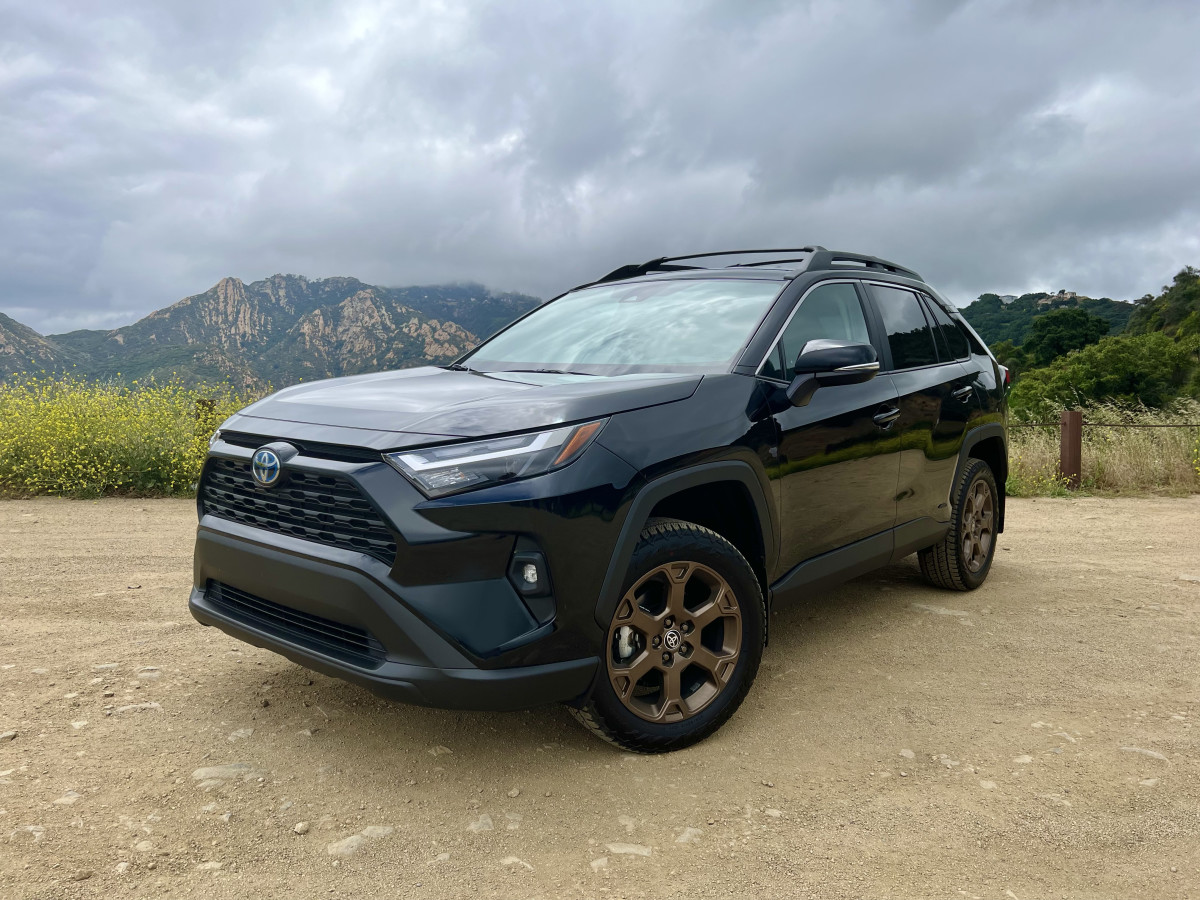
The 2023 Toyota RAV4 Hybrid is smartly designed and very fuel efficient.
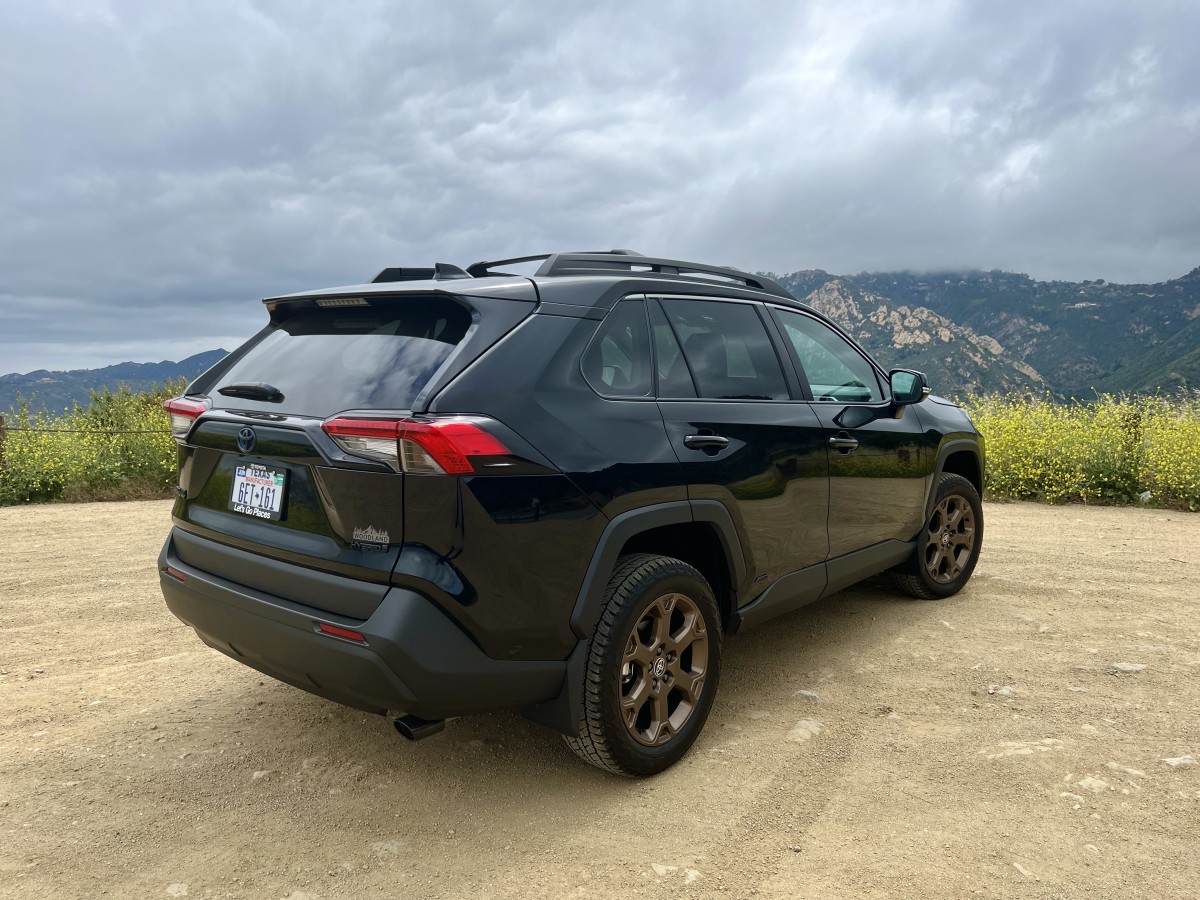
When the RAV4 was redesigned in 2019, it shed its softer and more typical crossover styling in favour of a more substantial and blocky appearance. The trapezoidal grille was adapted from Toyota's truck line to add some heft, with beveled and angled bodywork surrounding it to frame the headlights. It was a bigger deal immediately after the restyling, but in the years since, other carmakers have taken a similar approach as can be seen in the Honda CR-V and Mazda CX-50. 17-inch steel wheels are standard on the LE trim, while 18-inch alloy wheels are fitted on XLE with a package and are standard on higher grades.
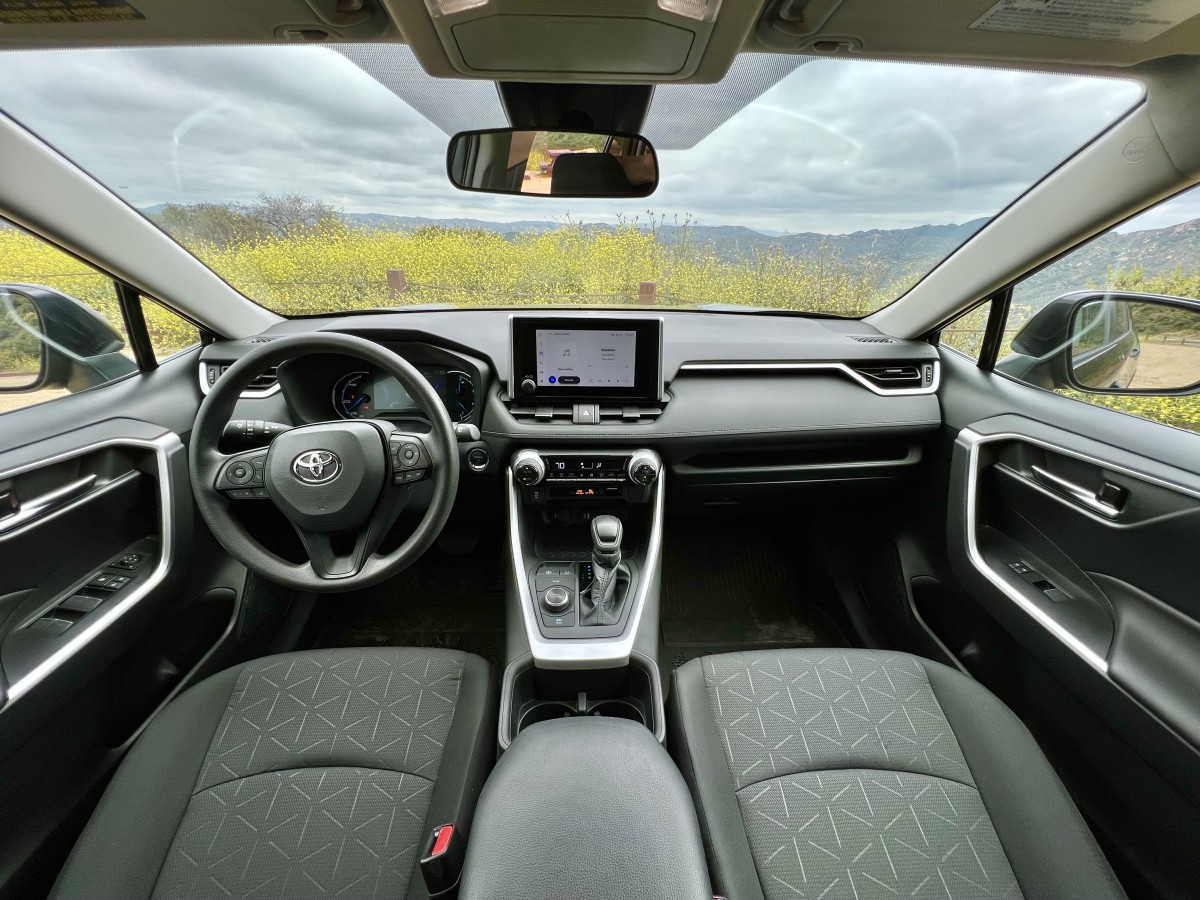
The angular theme carries over to the interior, with a multi-tiered dashboard with beveled cutouts to add some visual interest to an otherwise plain surface. The basic layout is common for vehicles at the time, with an infotainment touchscreen mounted atop the dash and a good amount of physical buttons and knobs for primary feature control.
Materials quality is about average for the class and price. There are plenty of hard plastics, but most surfaces you're prone to come into contact with are lightly padded. The base model curiously leaves out the leather-wrapped steering wheel and opts for a very downmarket urethane wheel and centre armrest. It feels rubbery and cheap in your hands, which is a problem since that's what the driver is always touching. Thankfully, most other trim levels come with a leather covering. Build quality is strong, with no detectable creaks or squeaks when driving over rough pavement.
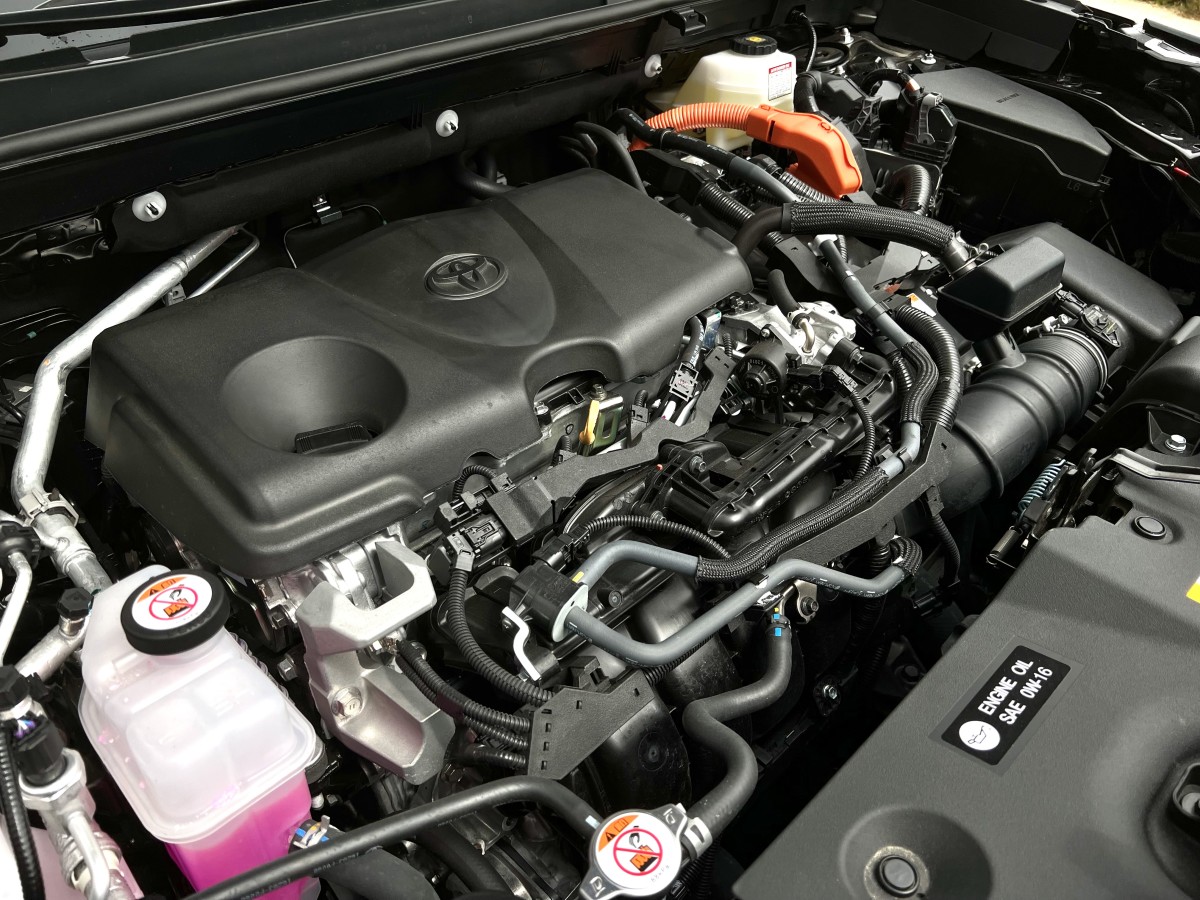
The RAV4 Hybrid is powered by a 2.5-litre four-cylinder engine paired with an electric motor/generator. They're mated to a continuously variable transmission (CVT) that drives the front wheels. A second electric motor between the rear axle provides all-wheel drive (AWD). Combined, they produce power specs of 219 horsepower and accelerate the RAV4 to 100 kilometres per hour in a respectable 7.5 seconds (approximately). Most drivers will never need to floor the pedal unless they're trying to merge with highway traffic on a steep uphill ramp.
Compared to other RAV4 models, the Hybrid powertrain is about half a second quicker than the standard RAV4, while the plug-in hybrid RAV4 Prime reaches 100 km/h in roughly 5.5 seconds. Within the compact hybrid SUV class, the Kia Sportage hybrid is a fraction of a second quicker while the Honda CR-V Hybrid should reach 100 km/h in about 8 seconds, placing them on an even playing field when it comes to acceleration.
The brakes operate much like any other vehicle, hybrid or otherwise. The initial pedal stroke typically engages regenerative braking which uses the RAV4's braking momentum to charge the hybrid battery. Under more aggressive stops, or when coming to a full stop, the physical brakes are actuated, but you won't feel the transition.
The suspension ably smooths the ride quality over moderate bumps and potholes while also delivering confident cornering. It's not sporty, nor does it need to be. Instead, it does the fundamentals well and should appeal to most drivers. The RAV4 Hybrid's driving dynamics don't elicit any complaints from us, but it also doesn't impress. Then again, its rivals are somewhat similar in this manner. They're all fairly calm and effortless to drive.
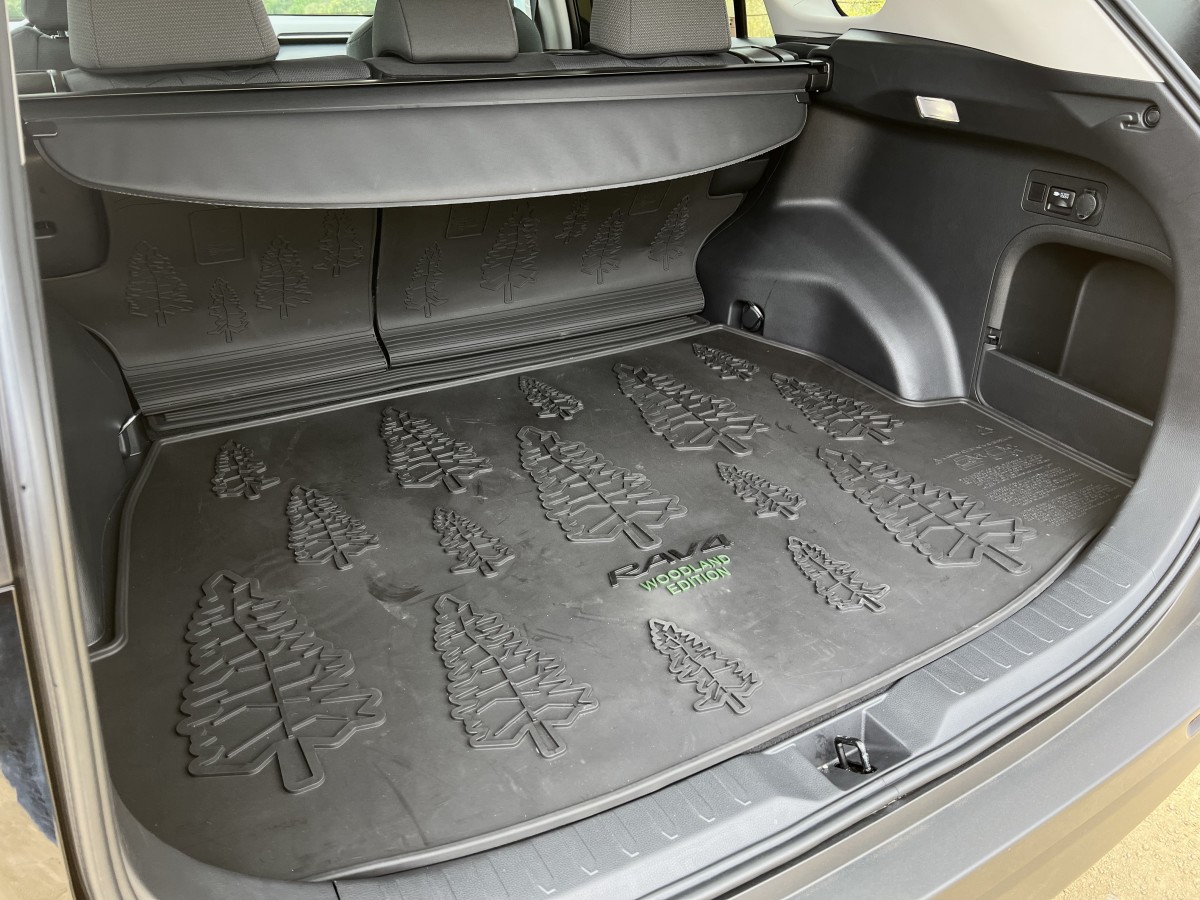
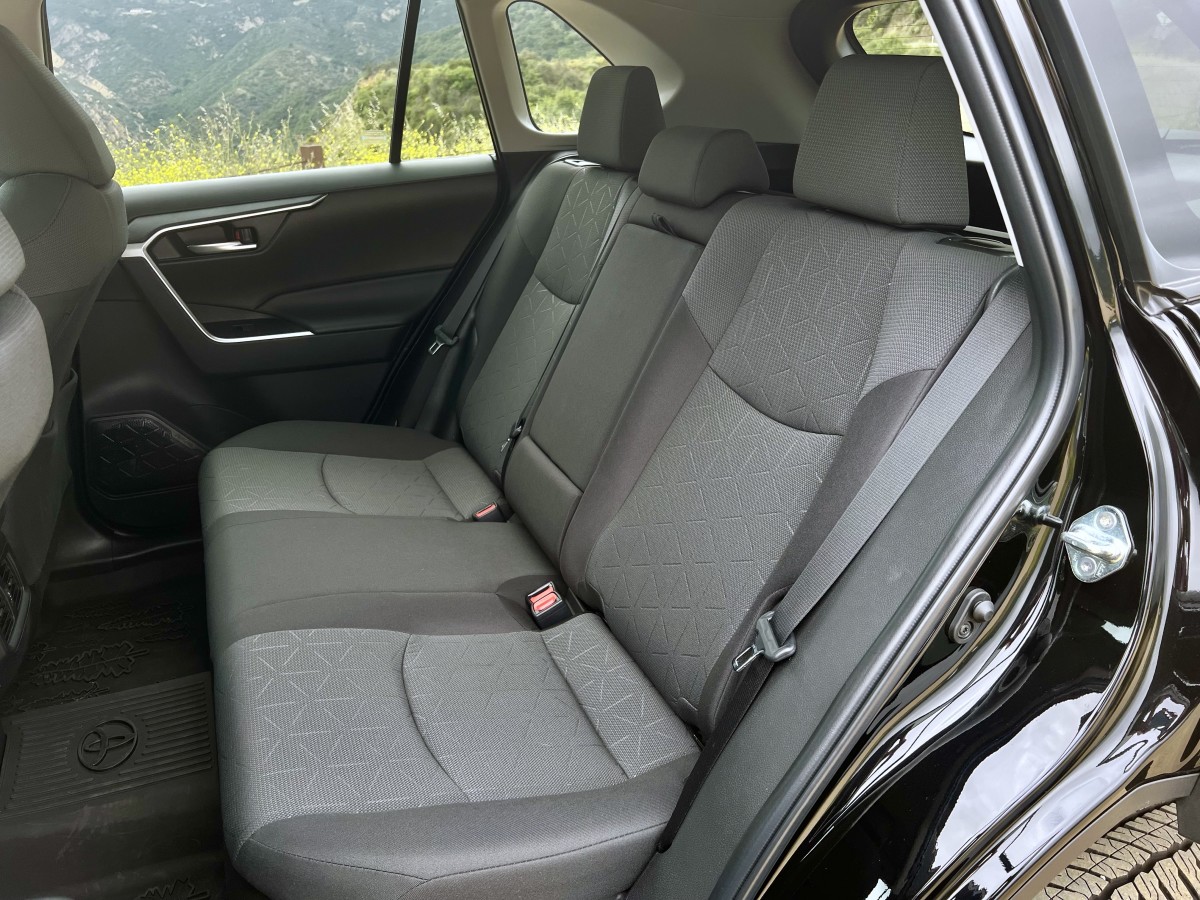
The front seats have plenty of space for larger passengers while the rear seats will easily accommodate average-sized adults. On paper, you get slightly more rear headroom than the Honda CR-V or Kia Sportage, but a bit less legroom. In practice, the differences are insignificant, though if you have a rear-facing infant seat, you may have to scoot the front seat up to make room for it. The rear seat cushions are also set a bit low, which may leave taller passengers wishing for more thigh support on long road trips.
Behind those seats, you can fit as much as 1,059 litres of cargo. That's only three litres smaller than the non-hybrid RAV4. Cargo space is sometimes sacrificed for the battery pack, but that's not the case here. By comparison, the Honda CR-V Hybrid can hold 1,028 litres and the Kia Sportage measures 1,121 litres, so there's no significant advantage for any of these hybrids. The rear seatbacks fold flat with the cargo floor, but shorter owners will have a rather long reach to get to them.
One area where the RAV4 excels is in interior storage for your personal items. The front passenger has a wide shelf in the dashboard and there's a phone tray for the available wireless charging pad in front of the centre console. You also get very large cupholders that can hold those massive Super Big Gulp cups as well as a large centre armrest bin. Door pockets are about average in size. Dual-zone climate control is standard on all trims but the base Hybrid LE.
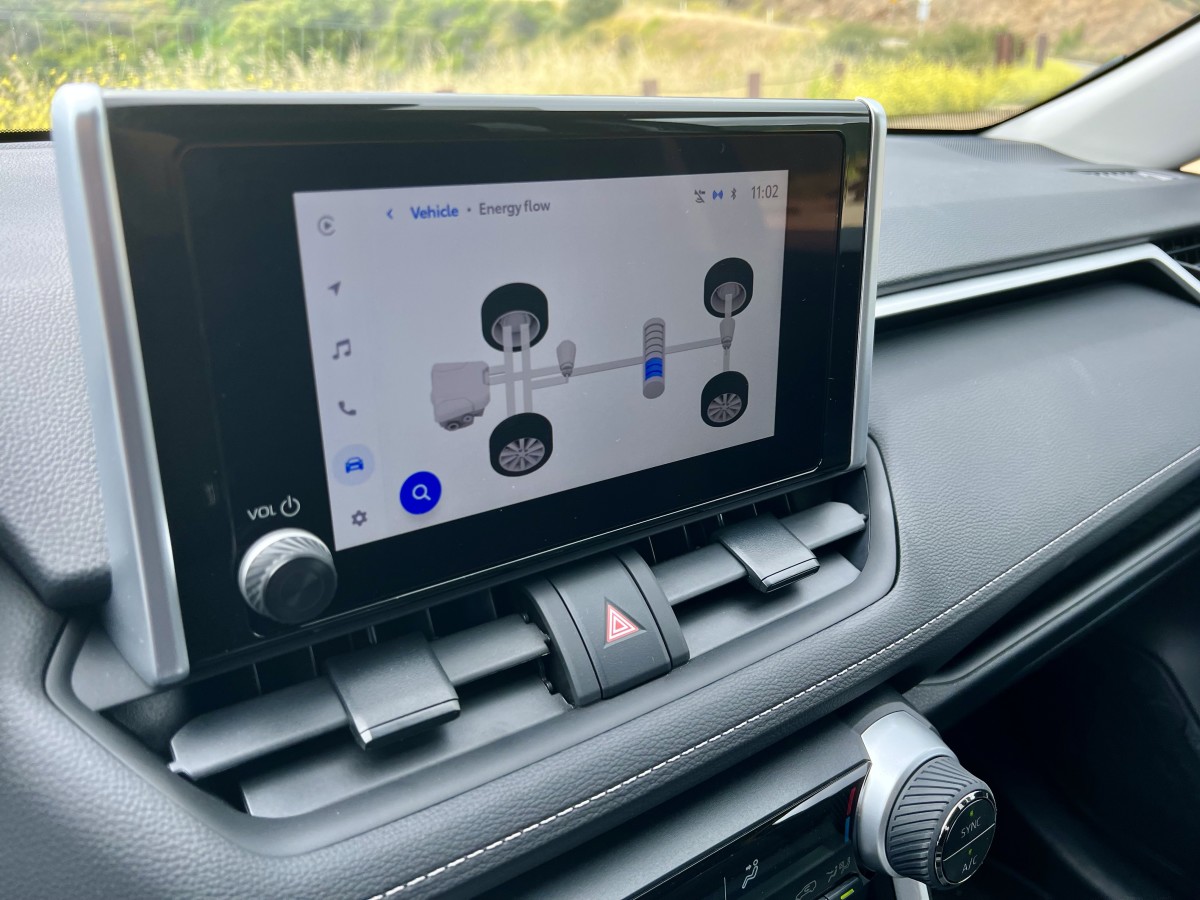
For 2023, the RAV4 receives a new multimedia infotainment system that represents a huge improvement over previous attempts. The touchscreen graphics are much more modern and sharp, plus the menus are arranged logically. The screen placement on top of the dashboard helps to reduce distraction when driving. Most trim levels come with a rather small 8.0-inch display while the higher trimmed models upgrade to a 10.5-inch touchscreen. The base display's on-screen buttons are rather small and require more effort to press them accurately.
Wireless Apple CarPlay and Android Auto are standard on all RAV4 models, but a wireless charging pad is an option. That means you'll still be stuck with a cable if you want to stay charged up unless you can add the charger. The infotainment system is capable of over-the-air software updates to keep features current and connectivity includes a Wi-Fi hotspot along with remote monitoring and control over the vehicle. The top RAV4 Hybrid trim also upgrades to a fully digital instrument panel. Six-speaker audio is standard on most RAV4 models and delivers decent clarity and power for a base system. The top XSE and Limited trims come with a more powerful 11-speaker JBL audio system.
The National Highway Traffic Safety Administration (NHTSA) awarded the RAV4 Hybrid five out of five stars for overall and side crash protection, and four stars in frontal and rollover crash tests. The Insurance Institute for Highway Safety (IIHS) gave the RAV4 its highest score of "Good" in all tests except for its new moderate overlap frontal and side-impact tests where it scored a second-best "Acceptable" safety rating. It also named the RAV4 a Top Safety Pick, the Institute's second-highest honour.
All 2023 RAV4 Hybrid models come standard with the Toyota Safety Sense 2.5 suite of safety features. That includes forward collision warning with pedestrian detection and automatic emergency braking, adaptive cruise control, lane-keep assist, lane departure warning with steering assist, automatic high beams, and a traffic sign reader. In Canada, blind spot monitoring and rear cross-traffic alert are also standard. The top Limited trim adds front and rear parking proximity sensors with automatic braking when backing up and a surround-view camera system, while these features are availble on the XSE. A digital rearview mirror is equipped on both trims. The latter will allow you to see what's behind you, even if the cargo area is loaded to the roof.
In our time with the RAV4, we never received any false alarms from these systems and they all functioned as they should. The adaptive cruise control is notable for its smooth throttle and brake inputs, as well as its gentle stops.
New car prices for the 2023 RAV4 Hybrid start at a manufacturer's suggested retail price (MSRP) of $38,135 (including $1,930 in destination charges and other fees) for the base Hybrid LE AWD trim. From there, trims continue to Hybrid XLE AWD, Hybrid SE AWD, Hybrid XSE AWD, and Hybrid Limited AWD, with a variety of packages offered in between. As far as the base model goes, its price is roughly $2,500 more than the standard non-hybrid RAV4. Natural Resources Canada estimates RAV4 Hybrids will return 5.8 L/100 km city, 6.3 on the highway, and 6.0 in combined driving. The non-hybrid RAV4 fuel economy is estimated between 7.9 and 8.5 L/100 km.
With these figures and taking into account 20,000 kilometres driven per year with gas costing $1.50 per litre, it would take less than two years to recoup that $2,500 premium over the standard RAV4. Given the lower price gap and higher fuel cost in Canada than the U.S., that makes the RAV4 Hybrid a better value proposition for us than for our friends south of the border.
The Kia Sportage Hybrid is all-new for 2023. It starts at a slightly higher new vehicle price of $39,483 fees in, but it also comes with a more robust set of standard features. It’s estimated to consume 6.2 L/100 km in combined city/highway kilometres with its standard AWD. But if you’re looking strictly at base trims, it will take longer to break even versus the gas model.
The Honda CR-V is also redesigned for 2023, though the only hybrid trim available in Canada is the Touring. A slightly more affordable EX-L Hybrid trim is coming for 2024, but this still launches pricing into the high $40,000 range. A similar strategy for the Hyundai Tucson Hybrid gives it a higher entry price in the same ballpark.
The 2023 Toyota RAV4 Hybrid remains a solid choice among these newer rivals, but it trends more expensive than some rivals as more equipment is added. As a result, we suggest checking out the Sportage and CR-V before committing to the RAV4 Hybrid.
Note: Images show a US model.

User reviews for 2023 Toyota RAV4 Hybrid
Write a review2023 Toyota RAV4 Hybrid Pricing
Trims & specs
Air Conditioning
Automatic climate control front air conditioning · Dual front air conditioning zones
Airbags
Dual front airbags · Driver knee airbags · Passenger airbag deactivation: occupant sensing deactivation · Front side airbags · Front side curtain airbags
Audio System
Antenna Type: mast · Voice recognition audio system · Bluetooth auxiliary audio input · Gracenote internet radio · AM/FM radio · Satellite Radio: SiriusXM · Total Number of Speakers: 6
Brakes
ABS: 4-wheel · Braking assist: hill start assist · Electronic parking brake: auto off · Front brake diameter: 12.0 · Front brakes: ventilated disc · Rear brake diameter: 11.1 · Rear brakes: disc
Comfort Features
Armrests: rear center with cupholders · Center console trim: simulated alloy · Dash trim: simulated alloy · Door trim: simulated alloy · Floor Material: carpet · Shift knob trim: urethane · Steering wheel trim: urethane
Convenience Features
Adaptive stop and go cruise control: semi-automatic · Assist handle: rear · Autonomous lane guidance: lane centering · Center console: front console with armrest and storage · Cruise control: adaptive · Cupholders: front · Multi-function remote: keyless entry with panic alarm · One-touch windows: 4 · Power outlet(s): 12V front · Power steering: speed-proportional · Power windows: lockout button · Reading lights: front · Rear power outlet: 12V · Steering wheel: tilt and telescopic · Steering wheel mounted controls: multi-function screen controls · Storage: cargo tie-down anchors and hooks · Vanity mirrors: dual illuminating
Driver Seat
Manual adjustments: 6
Drivetrain
4WD Type: on demand · Axle ratio: 3.61
Engine
EV battery capacity: 1.6 kWh · Electric Motor Battery Type: nickel-metal hydride · Electric Motor HP: 118 · Electric Motor Power Output (Kilowatts): 88 · Electric Motor Torque: 149 · Hybrid Gas Engine HP: 176 · Hybrid Gas Engine HP@RPM: 5700 · Hybrid Gas Engine Torque: 163 · Hybrid gas Engine Torque@RPM: 3600 · Oil cooler: auxiliary
Exterior Features
Door handle color: body-color · Exhaust: dual exhaust tips · Exhaust tip color: chrome · Fender lip moldings: black · Front bumper color: body-color · Grille color: black · Headlamp bezel color: black · Mirror color: black · Rear bumper color: black · Rear spoiler: roofline spoiler · Rear spoiler color: body-color · Rear trunk/liftgate: liftgate · Rocker panel color: black · Window trim: chrome
Headrests
Front headrests: adjustable · Number of front headrests: 2 · Number of rear headrests: 3
Hybrid
Starter Type: motor/generator
In Car Entertainment
Connected in-car apps: Google search · Infotainment: Toyota Audio Multimedia · Infotainment screen size: 8 in. · Smartphone integration: wireless Android Auto
Instrumentation
Fuel economy display: MPG · Instrument cluster screen size: 7 in. · Warnings and reminders: coolant temperature warning
Lights
Daytime running lights: LED · Exterior entry lights: security approach lamps · Headlights: auto delay off · Tail and brake lights: LED
Mirrors
Exterior mirrors: manual folding · Inside rearview mirror: manual day/night
Passenger Seat
Manual Adjustments: 4
Rear Seats
Type: 60-40 split bench
Roof
Roof rails: black
Safety
Automatic emergency braking: front pedestrian · Camera system: rearview · Child seat anchors: LATCH system · Crumple zones: front · Impact absorbing seats: dual front · Impact sensor: fuel cut-off · Pre-Collision Warning System: audible warning · Pre-collision warning system: pedestrian detection · Rearview monitor: in dash
Seatbelts
Emergency locking retractors: front and rear · Front seatbelts: 3-point · Seatbelt force limiters: front · Seatbelt pretensioners: front and rear · Seatbelt warning sensor: driver and passenger · Second row seatbelts: 3-point
Seats
Driver seat manual adjustments: reclining · Front seat type: bucket · Passenger seat manual adjustments: reclining · Rear headrests: adjustable · Rear seat folding: split · Rear seat manual adjustments: reclining · Upholstery: cloth
Spare Tire
Mount Location: inside · Size: temporary
Spare Wheel
Rim Type: steel
Stability and Traction
Traction control: with trailer stability control
Steering
Steering ratio: 14.3 · Turns lock-to-lock: 2.8
Suspension
Front Arm Type: lower control arms · Front Shock Type: gas shock absorbers · Front Spring Type: coil springs · Front Stabilizer Bar: diameter 26 mm · Front Suspension Classification: independent · Front Suspension Type: MacPherson struts · Rear Shock Type: gas shock absorbers · Rear Spring Type: coil springs · Rear Stabilizer Bar: diameter 24 mm · Rear Suspension Classification: independent · Rear Suspension Type: multi-link
Telematics
Driver assistance app: roadside assistance · Electronic messaging assistance: with voice recognition · Phone: voice activated · Phone wireless data link: Bluetooth · Smart device app compatibility: Toyota Connected Services · Smart device app function: vehicle location · Wifi: hotspot
Tires
Type: all season
Tires and Rims
Wheels: painted aluminum
Wheels
Wheel spokes: 5
Windows
Front wipers: intermittent · Liftgate window: fixed · Power windows: with safety reverse · Rear wiper: auto-on in reverse
Air Conditioning
Automatic climate control front air conditioning · Dual front air conditioning zones
Airbags
Dual front airbags · Driver knee airbags · Passenger airbag deactivation: occupant sensing deactivation · Front side airbags · Rear side curtain airbags
Audio System
Antenna Type: diversity · Voice recognition audio system · Bluetooth auxiliary audio input · Gracenote internet radio · Touch screen display radio · Satellite Radio: SiriusXM · Total Number of Speakers: 6
Brakes
ABS: 4-wheel · Braking assist: hill start assist · Electronic parking brake: auto off · Front brake diameter: 12.0 · Front brakes: ventilated disc · Rear brake diameter: 11.1 · Rear brakes: disc
Comfort Features
Armrests: rear center with cupholders · Center console trim: simulated alloy · Dash trim: simulated alloy · Door trim: simulated alloy · Floor Material: carpet · Shift knob trim: urethane · Steering wheel trim: urethane
Convenience Features
Adaptive stop and go cruise control: semi-automatic · Assist handle: rear · Autonomous lane guidance: lane centering · Cargo area power outlet: 12V · Cargo cover: retractable · Center console: front console with armrest and storage · Cruise control: adaptive · Cupholders: front · Multi-function remote: keyless entry with panic alarm · One-touch windows: 4 · Power outlet(s): 12V front · Power steering: electric · Power windows: lockout button · Reading lights: rear · Steering wheel: tilt and telescopic · Steering wheel mounted controls: voice recognition controls · Storage: accessory hook · Vanity mirrors: dual illuminating
Driver Seat
Adjustable lumbar support: power · Power adjustments: 8
Drivetrain
4WD Type: on demand · Axle ratio: 3.61
Engine
EV battery capacity: 1.6 kWh · Electric Motor Battery Type: nickel-metal hydride · Electric Motor HP: 118 · Electric Motor Power Output (Kilowatts): 88 · Electric Motor Torque: 149 · Hybrid Gas Engine HP: 176 · Hybrid Gas Engine HP@RPM: 5700 · Hybrid Gas Engine Torque: 163 · Hybrid gas Engine Torque@RPM: 3600 · Oil cooler: auxiliary
Exterior Features
Door handle color: body-color · Exhaust: dual exhaust tips · Exhaust tip color: chrome · Fender lip moldings: black · Front bumper color: body-color · Grille color: black · Headlamp bezel color: chrome · Mirror color: body-color · Rear bumper color: black · Rear spoiler: roofline spoiler · Rear spoiler color: body-color · Rear trunk/liftgate: liftgate · Rocker panel color: black · Window trim: chrome
Headrests
Front headrests: adjustable · Number of front headrests: 2 · Number of rear headrests: 3
Hybrid
Starter Type: motor/generator
In Car Entertainment
Connected in-car apps: Google POIs · Infotainment: Toyota Audio Multimedia · Infotainment screen size: 8 in. · Smartphone integration: wireless Apple CarPlay
Instrumentation
Fuel economy display: range · Instrument cluster screen size: 7 in. · Warnings and reminders: coolant temperature warning
Lights
Daytime running lights: LED · Exterior entry lights: security approach lamps · Headlights: wiper activated · Tail and brake lights: LED
Mirrors
Exterior mirrors: heated · Inside rearview mirror: manual day/night
Passenger Seat
Manual Adjustments: 4
Rear Seats
Type: 60-40 split bench
Roof
Roof rails: black
Safety
Automatic emergency braking: front · Camera system: rearview · Child seat anchors: LATCH system · Cross Traffic Alert: rear · Crumple zones: front · Impact absorbing seats: dual front · Impact sensor: fuel cut-off · Pre-Collision Warning System: visual warning · Pre-collision warning system: intersection/junction turn · Rearview monitor: in dash
Seatbelts
Emergency locking retractors: front · Front seatbelts: 3-point · Seatbelt force limiters: front and rear · Seatbelt pretensioners: front · Seatbelt warning sensor: driver and passenger · Second row seatbelts: 3-point
Seats
Driver seat power adjustments: reclining · Front seat type: bucket · Passenger seat manual adjustments: reclining · Rear headrests: adjustable · Rear seat folding: flat · Rear seat manual adjustments: reclining · Upholstery: cloth
Security
Power door locks: anti-lockout
Spare Tire
Mount Location: inside · Size: temporary
Spare Wheel
Rim Type: steel
Stability and Traction
Traction control: with trailer stability control
Steering
Steering ratio: 14.3 · Turns lock-to-lock: 2.8
Suspension
Front Arm Type: lower control arms · Front Shock Type: gas shock absorbers · Front Spring Type: coil springs · Front Stabilizer Bar: diameter 26 mm · Front Suspension Classification: independent · Front Suspension Type: MacPherson struts · Rear Shock Type: gas shock absorbers · Rear Spring Type: coil springs · Rear Stabilizer Bar: diameter 24 mm · Rear Suspension Classification: independent · Rear Suspension Type: multi-link
Telematics
Driver assistance app: roadside assistance · Electronic messaging assistance: with read function · Phone: voice activated · Phone wireless data link: Bluetooth · Smart device app compatibility: Toyota Connected Services · Smart device app function: maintenance status · Wifi: hotspot
Tires
Type: all season
Tires and Rims
Wheels: painted aluminum
Wheels
Wheel spokes: 5
Windows
Front wipers: variable intermittent · Liftgate window: fixed · Power windows: with safety reverse · Rear wiper: auto-on in reverse
Air Conditioning
Automatic climate control front air conditioning · Dual front air conditioning zones
Airbags
Dual front airbags · Driver knee airbags · Passenger airbag deactivation: occupant sensing deactivation · Front side airbags · Front side curtain airbags
Audio System
Antenna Type: mast · Voice recognition audio system · Bluetooth auxiliary audio input · Gracenote internet radio · Touch screen display radio · Satellite Radio: SiriusXM · Total Number of Speakers: 6
Brakes
ABS: 4-wheel · Braking assist: hill start assist · Electronic parking brake: auto off · Front brake diameter: 12.0 · Front brakes: ventilated disc · Rear brake diameter: 11.1 · Rear brakes: disc
Comfort Features
Armrests: rear center with cupholders · Center console trim: simulated alloy · Dash trim: simulated alloy · Door trim: simulated alloy · Floor Material: carpet · Shift knob trim: leather · Steering wheel trim: leather
Convenience Features
Adaptive stop and go cruise control: semi-automatic · Assist handle: rear · Autonomous lane guidance: lane centering · Cargo area power outlet: 12V · Cargo cover: retractable · Center console: front console with armrest and storage · Cruise control: adaptive · Cupholders: rear · Multi-function remote: proximity entry system · One-touch windows: 4 · Power outlet(s): USB-C rear · Power steering: speed-proportional · Power windows: lockout button · Reading lights: rear · Steering wheel: tilt and telescopic · Steering wheel mounted controls: voice recognition controls · Storage: in dash · Vanity mirrors: dual illuminating
Driver Seat
Adjustable lumbar support: power · Power adjustments: 8
Drivetrain
4WD Type: on demand · Axle ratio: 3.61
Engine
EV battery capacity: 0.93 kWh · Electric Motor Battery Type: lithium ion · Electric Motor HP: 118 · Electric Motor Power Output (Kilowatts): 88 · Electric Motor Torque: 149 · Hybrid Gas Engine HP: 176 · Hybrid Gas Engine HP@RPM: 5700 · Hybrid Gas Engine Torque: 163 · Hybrid gas Engine Torque@RPM: 3600 · Oil cooler: auxiliary
Exterior Features
Door handle color: body-color · Exhaust: dual exhaust tips · Exhaust tip color: chrome · Fender lip moldings: black · Front bumper color: body-color · Grille color: body-color surround · Headlamp bezel color: chrome · Mirror color: body-color · Rear bumper color: black · Rear spoiler: roofline spoiler · Rear spoiler color: body-color · Rear trunk/liftgate: liftgate · Rocker panel color: black · Window trim: chrome
Headrests
Front headrests: adjustable · Number of front headrests: 2 · Number of rear headrests: 3
Hybrid
Starter Type: motor/generator
In Car Entertainment
Connected in-car apps: Google search · Infotainment: Toyota Audio Multimedia · Infotainment screen size: 8 in. · Smartphone integration: wireless Apple CarPlay
Instrumentation
Fuel economy display: MPG · Instrument cluster screen size: 7 in. · Warnings and reminders: low fuel level
Lights
Daytime running lights: LED · Exterior entry lights: security approach lamps · Headlights: Auto on/off · Tail and brake lights: LED
Mirrors
Exterior mirrors: heated · Inside rearview mirror: manual day/night
Passenger Seat
Manual Adjustments: 4
Rear Seats
Type: 60-40 split bench
Roof
Roof rails: black
Safety
Automatic emergency braking: front · Camera system: rearview · Child seat anchors: LATCH system · Cross Traffic Alert: rear · Crumple zones: front · Impact absorbing seats: dual front · Impact sensor: post-collision safety system · Pre-Collision Warning System: visual warning · Pre-collision warning system: intersection/junction turn · Rearview monitor: in dash
Seatbelts
Emergency locking retractors: front · Front seatbelts: 3-point · Seatbelt force limiters: front and rear · Seatbelt pretensioners: front · Seatbelt warning sensor: driver and passenger · Second row seatbelts: 3-point
Seats
Driver seat power adjustments: reclining · Front seat type: bucket · Passenger seat manual adjustments: reclining · Rear headrests: adjustable · Rear seat folding: split · Rear seat manual adjustments: reclining · Upholstery: cloth
Security
Power door locks: anti-lockout
Spare Tire
Mount Location: inside · Size: temporary
Spare Wheel
Rim Type: steel
Stability and Traction
Traction control: with trailer stability control
Steering
Steering ratio: 14.3 · Turns lock-to-lock: 2.8
Suspension
Front Arm Type: lower control arms · Front Shock Type: gas shock absorbers · Front Spring Type: coil springs · Front Stabilizer Bar: diameter 26 mm · Front Suspension Classification: independent · Front Suspension Type: MacPherson struts · Rear Shock Type: gas shock absorbers · Rear Spring Type: coil springs · Rear Stabilizer Bar: diameter 24 mm · Rear Suspension Classification: independent · Rear Suspension Type: multi-link
Telematics
Driver assistance app: roadside assistance · Electronic messaging assistance: with read function · Phone: voice activated · Phone wireless data link: Bluetooth · Smart device app compatibility: Toyota Connected Services · Smart device app function: vehicle location · Wifi: hotspot
Tires
Type: all season
Tires and Rims
Wheels: painted aluminum
Wheels
Wheel spokes: multi-spoke
Windows
Front wipers: variable intermittent · Liftgate window: fixed · Power windows: with safety reverse · Rear wiper: auto-on in reverse
Air Conditioning
Automatic climate control front air conditioning · Dual front air conditioning zones
Airbags
Dual front airbags · Driver knee airbags · Passenger airbag deactivation: occupant sensing deactivation · Front side airbags · Front side curtain airbags
Audio System
Antenna Type: mast · Voice recognition audio system · USB auxiliary audio input · Gracenote internet radio · Touch screen display radio · Satellite Radio: SiriusXM · Total Number of Speakers: 6
Brakes
ABS: 4-wheel · Braking assist: hill start assist · Electronic parking brake: auto off · Front brake diameter: 12.0 · Front brakes: ventilated disc · Rear brake diameter: 11.1 · Rear brakes: disc
Comfort Features
Armrests: rear center with cupholders · Cargo area floor mat: rubber/vinyl · Center console trim: simulated alloy · Dash trim: simulated alloy · Door trim: simulated alloy · Floor Mat Material: vinyl/rubber · Floor Material: carpet · Floor Mats: front · Shift knob trim: urethane · Steering wheel trim: urethane
Convenience Features
Adaptive stop and go cruise control: semi-automatic · Assist handle: rear · Autonomous lane guidance: lane centering · Cargo area power outlet: 12V · Cargo cover: retractable · Center console: front console with armrest and storage · Cruise control: adaptive · Cupholders: rear · Multi-function remote: proximity entry system · One-touch windows: 4 · Power outlet(s): USB-C rear · Power steering: speed-proportional · Power windows: lockout button · Reading lights: front · Steering wheel: tilt and telescopic · Steering wheel mounted controls: voice recognition controls · Storage: in dash · Vanity mirrors: dual illuminating
Driver Seat
Adjustable lumbar support: power · Power adjustments: 8
Drivetrain
4WD Type: on demand · Axle ratio: 3.61
Engine
EV battery capacity: 1.6 kWh · Electric Motor Battery Type: nickel-metal hydride · Electric Motor HP: 118 · Electric Motor Power Output (Kilowatts): 88 · Electric Motor Torque: 149 · Hybrid Gas Engine HP: 176 · Hybrid Gas Engine HP@RPM: 5700 · Hybrid Gas Engine Torque: 163 · Hybrid gas Engine Torque@RPM: 3600 · Oil cooler: auxiliary
Exterior Features
Door handle color: black · Exhaust: dual exhaust tips · Exhaust tip color: black · Fender lip moldings: black · Front bumper color: body-color · Grille color: body-color surround · Headlamp bezel color: chrome · Mirror color: black · Mudguards: rear · Rear bumper color: black · Rear spoiler: roofline spoiler · Rear spoiler color: body-color · Rear trunk/liftgate: liftgate · Rocker panel color: black · Window trim: chrome
Headrests
Front headrests: adjustable · Number of front headrests: 2 · Number of rear headrests: 3
Hybrid
Starter Type: motor/generator
In Car Entertainment
Connected in-car apps: Google POIs · Infotainment: Toyota Audio Multimedia · Infotainment screen size: 8 in. · Smartphone integration: wireless Android Auto
Instrumentation
Fuel economy display: MPG · Instrument cluster screen size: 7 in. · Warnings and reminders: lamp failure
Lights
Daytime running lights: LED · Exterior entry lights: security approach lamps · Front fog lights: LED · Headlights: LED · Tail and brake lights: LED
Mirrors
Exterior mirrors: heated · Inside rearview mirror: manual day/night
Passenger Seat
Manual Adjustments: 4
Rear Seats
Type: 60-40 split bench
Roof
Roof rack color: black · Roof rails: black
Safety
Automatic emergency braking: front pedestrian · Camera system: rearview · Child seat anchors: LATCH system · Cross Traffic Alert: rear · Crumple zones: front · Impact absorbing seats: dual front · Impact sensor: battery disconnect · Pre-Collision Warning System: visual warning · Pre-collision warning system: pedestrian detection · Rearview monitor: in dash
Seatbelts
Emergency locking retractors: front and rear · Front seatbelts: 3-point · Seatbelt force limiters: front and rear · Seatbelt pretensioners: front and rear · Seatbelt warning sensor: driver and passenger · Second row seatbelts: 3-point
Seats
Driver seat power adjustments: reclining · Front seat type: bucket · Passenger seat manual adjustments: reclining · Rear headrests: adjustable · Rear seat folding: flat · Rear seat manual adjustments: reclining · Upholstery: cloth
Security
Power door locks: anti-lockout
Spare Tire
Mount Location: inside · Size: temporary
Spare Wheel
Rim Type: steel
Stability and Traction
Traction control: with trailer stability control
Steering
Steering ratio: 14.3 · Turns lock-to-lock: 2.8
Suspension
Front Arm Type: lower control arms · Front Shock Type: gas shock absorbers · Front Spring Type: coil springs · Front Stabilizer Bar: diameter 26 mm · Front Suspension Classification: independent · Front Suspension Type: MacPherson struts · Rear Shock Type: gas shock absorbers · Rear Spring Type: coil springs · Rear Stabilizer Bar: diameter 24 mm · Rear Suspension Classification: independent · Rear Suspension Type: multi-link
Telematics
Driver assistance app: roadside assistance · Electronic messaging assistance: with voice recognition · Phone: voice activated · Phone wireless data link: Bluetooth · Smart device app compatibility: Toyota Connected Services · Smart device app function: lock operation · Wifi: hotspot
Tires
Type: all terrain
Tires and Rims
Wheels: painted aluminum
Wheels
Wheel spokes: 6
Windows
Front wipers: variable intermittent · Liftgate window: fixed · Power windows: with safety reverse · Rear wiper: auto-on in reverse
Air Conditioning
Automatic climate control front air conditioning · Dual front air conditioning zones
Airbags
Dual front airbags · Driver knee airbags · Passenger airbag deactivation: occupant sensing deactivation · Front side airbags · Rear side curtain airbags
Audio System
Antenna Type: mast · Voice recognition audio system · USB auxiliary audio input · Gracenote internet radio · HD radio · Satellite Radio: SiriusXM · Total Number of Speakers: 6
Brakes
ABS: 4-wheel · Braking assist: hill start assist · Electronic parking brake: auto off · Front brake diameter: 12.0 · Front brakes: ventilated disc · Rear brake diameter: 11.1 · Rear brakes: disc
Comfort Features
Armrests: rear center with cupholders · Center console trim: simulated alloy · Dash trim: simulated alloy · Door trim: simulated alloy · Floor Material: carpet · Shift knob trim: leather · Steering wheel trim: leather
Convenience Features
Adaptive stop and go cruise control: semi-automatic · Assist handle: front · Autonomous lane guidance: lane centering · Cargo area power outlet: 12V · Cargo cover: retractable · Center console: front console with armrest and storage · Cruise control: adaptive · Cupholders: front · Memorized settings: liftgate · Multi-function remote: keyless entry with panic alarm · One-touch windows: 4 · Power outlet(s): 12V front · Power steering: speed-proportional · Power windows: lockout button · Reading lights: front · Steering wheel: tilt and telescopic · Steering wheel mounted controls: audio · Storage: front seatback · Vanity mirrors: dual illuminating
Driver Seat
Adjustable lumbar support: power · Power adjustments: 8
Drivetrain
4WD Type: on demand · Axle ratio: 3.61
Engine
EV battery capacity: 0.93 kWh · Electric Motor Battery Type: lithium ion · Electric Motor HP: 118 · Electric Motor Power Output (Kilowatts): 88 · Electric Motor Torque: 149 · Hybrid Gas Engine HP: 176 · Hybrid Gas Engine HP@RPM: 5700 · Hybrid Gas Engine Torque: 163 · Hybrid gas Engine Torque@RPM: 3600 · Oil cooler: auxiliary
Exterior Features
Door handle color: body-color · Exhaust: dual exhaust tips · Exhaust tip color: chrome · Fender lip moldings: black · Front bumper color: body-color · Grille color: body-color surround · Headlamp bezel color: chrome · Mirror color: body-color · Rear bumper color: black · Rear spoiler: roofline spoiler · Rear spoiler color: body-color · Rear trunk/liftgate: liftgate · Rocker panel color: black · Window trim: chrome
Headrests
Front headrests: adjustable · Number of front headrests: 2 · Number of rear headrests: 3
Hybrid
Starter Type: motor/generator
In Car Entertainment
Connected in-car apps: Google search · Infotainment: Toyota Audio Multimedia · Infotainment screen size: 8 in. · Smartphone integration: wireless Android Auto
Instrumentation
Fuel economy display: MPG · Instrument cluster screen size: 7 in. · Warnings and reminders: maintenance reminder
Lights
Daytime running lights: LED · Exterior entry lights: security approach lamps · Front fog lights: LED · Headlights: automatic high beam dimmer · Tail and brake lights: LED
Mirrors
Exterior mirrors: power · Inside rearview mirror: manual day/night
Passenger Seat
Manual Adjustments: 4
Rear Seats
Type: 60-40 split bench
Roof
Moonroof: power glass · Roof rails: black
Safety
Automatic emergency braking: front pedestrian · Camera system: rearview · Child seat anchors: LATCH system · Cross Traffic Alert: rear · Crumple zones: front · Impact absorbing seats: dual front · Impact sensor: battery disconnect · Pre-Collision Warning System: audible warning · Pre-collision warning system: intersection/junction turn · Rearview monitor: in dash
Seatbelts
Emergency locking retractors: front and rear · Front seatbelts: 3-point · Seatbelt force limiters: front and rear · Seatbelt pretensioners: front and rear · Seatbelt warning sensor: driver and passenger · Second row seatbelts: 3-point
Seats
Driver seat power adjustments: height · Front seat type: bucket · Passenger seat manual adjustments: reclining · Rear headrests: adjustable · Rear seat folding: split · Rear seat manual adjustments: reclining · Upholstery: leatherette
Security
Power door locks: anti-lockout
Spare Tire
Mount Location: inside · Size: temporary
Spare Wheel
Rim Type: steel
Stability and Traction
Traction control: with trailer stability control
Steering
Steering ratio: 14.3 · Turns lock-to-lock: 2.8
Suspension
Front Arm Type: lower control arms · Front Shock Type: gas shock absorbers · Front Spring Type: coil springs · Front Stabilizer Bar: diameter 26 mm · Front Suspension Classification: independent · Front Suspension Type: MacPherson struts · Rear Shock Type: gas shock absorbers · Rear Spring Type: coil springs · Rear Stabilizer Bar: diameter 24 mm · Rear Suspension Classification: independent · Rear Suspension Type: multi-link
Telematics
Driver assistance app: roadside assistance · Electronic messaging assistance: with voice recognition · Phone: voice activated · Phone wireless data link: Bluetooth · Smart device app compatibility: Toyota Connected Services · Smart device app function: engine start · Wifi: hotspot
Tires
Type: all season
Tires and Rims
Wheel type: aluminum alloy
Wheels
Wheel spokes: multi-spoke
Windows
Front wipers: variable intermittent · Liftgate window: fixed · Power windows: with safety reverse · Rear wiper: intermittent
Air Conditioning
Automatic climate control front air conditioning · Dual front air conditioning zones
Airbags
Dual front airbags · Driver knee airbags · Passenger airbag deactivation: occupant sensing deactivation · Front side airbags · Rear side curtain airbags
Audio System
Antenna Type: mast · Voice recognition audio system · Bluetooth auxiliary audio input · Gracenote internet radio · Touch screen display radio · Satellite Radio: SiriusXM · Total Number of Speakers: 6
Brakes
ABS: 4-wheel · Braking assist: hill start assist · Electronic parking brake: auto off · Front brake diameter: 12.0 · Front brakes: ventilated disc · Rear brake diameter: 11.1 · Rear brakes: disc
Comfort Features
Armrests: rear center with cupholders · Center console trim: simulated alloy · Dash trim: simulated alloy · Door trim: simulated alloy · Floor Material: carpet · Shift knob trim: leather · Steering wheel trim: leather
Convenience Features
Adaptive stop and go cruise control: semi-automatic · Ambient lighting: color · Assist handle: front · Autonomous lane guidance: lane centering · Cargo area power outlet: 12V · Cargo cover: retractable · Center console: front console with armrest and storage · Cruise control: adaptive · Cupholders: rear · Dimming rearview mirror: auto-dimming · Memorized settings: liftgate · Multi-function remote: proximity entry system · One-touch windows: 4 · Power outlet(s): USB-C rear · Power steering: speed-proportional · Power windows: lockout button · Reading lights: rear · Steering wheel: tilt and telescopic · Steering wheel mounted controls: audio · Storage: in dash · Universal garage door opener: Homelink · Vanity mirrors: dual illuminating
Driver Seat
Adjustable lumbar support: power · Power adjustments: 8
Drivetrain
4WD Type: on demand · Axle ratio: 3.61
Engine
EV battery capacity: 0.93 kWh · Electric Motor Battery Type: lithium ion · Electric Motor HP: 118 · Electric Motor Power Output (Kilowatts): 88 · Electric Motor Torque: 149 · Hybrid Gas Engine HP: 176 · Hybrid Gas Engine HP@RPM: 5700 · Hybrid Gas Engine Torque: 163 · Hybrid gas Engine Torque@RPM: 3600 · Oil cooler: auxiliary
Exterior Features
Door handle color: body-color · Exhaust: dual exhaust tips · Exhaust tip color: chrome · Fender lip moldings: black · Front bumper color: body-color · Grille color: black · Headlamp bezel color: chrome · Mirror color: black · Paint: contrast roof · Rear bumper color: black · Rear spoiler: roofline spoiler · Rear spoiler color: black · Rear trunk/liftgate: liftgate · Rocker panel color: black · Window trim: chrome
Headrests
Front headrests: adjustable · Number of front headrests: 2 · Number of rear headrests: 3
Hybrid
Starter Type: motor/generator
In Car Entertainment
Connected in-car apps: Google search · Infotainment: Toyota Audio Multimedia · Infotainment screen size: 10.5 in. · Smartphone integration: wireless Android Auto
Instrumentation
Fuel economy display: range · Instrument cluster screen size: 7 in. · Warnings and reminders: lamp failure
Lights
Daytime running lights: LED · Exterior entry lights: security approach lamps · Headlights: wiper activated · Tail and brake lights: LED
Mirrors
Exterior mirrors: integrated turn signals
Passenger Seat
Manual Adjustments: 4
Rear Seats
Type: 60-40 split bench
Roof
Moonroof: sliding sunshade · Roof rails: black
Safety
Automatic emergency braking: intersection/junction turn · Camera system: rearview · Child seat anchors: LATCH system · Cross Traffic Alert: rear · Crumple zones: front · Impact absorbing seats: dual front · Impact sensor: post-collision safety system · Pre-Collision Warning System: visual warning · Pre-collision warning system: intersection/junction turn · Rearview monitor: in dash
Seatbelts
Emergency locking retractors: front and rear · Front seatbelts: 3-point · Seatbelt force limiters: front and rear · Seatbelt pretensioners: front · Seatbelt warning sensor: driver and passenger · Second row seatbelts: 3-point
Seats
Driver seat power adjustments: height · Front seat type: bucket · Passenger seat manual adjustments: reclining · Rear headrests: adjustable · Rear seat folding: flat · Rear seat manual adjustments: reclining · Upholstery: contrast stitching · Upholstery accents: cloth
Security
Power door locks: anti-lockout
Spare Tire
Mount Location: inside · Size: temporary
Spare Wheel
Rim Type: steel
Stability and Traction
Traction control: with trailer stability control
Steering
Steering ratio: 14.3 · Turns lock-to-lock: 2.8
Suspension
Front Arm Type: lower control arms · Front Shock Type: gas shock absorbers · Front Spring Type: coil springs · Front Stabilizer Bar: diameter 26 mm · Front Suspension Classification: independent · Front Suspension Type: MacPherson struts · Rear Shock Type: gas shock absorbers · Rear Spring Type: coil springs · Rear Stabilizer Bar: diameter 24 mm · Rear Suspension Classification: independent · Rear Suspension Type: multi-link
Telematics
Driver assistance app: roadside assistance · Electronic messaging assistance: with read function · Navigation system: with voice recognition · Phone: voice activated · Phone wireless data link: Bluetooth · Smart device app compatibility: Toyota Connected Services · Smart device app function: maintenance status · Wifi: hotspot
Tires
Type: all season
Tires and Rims
Wheels: painted aluminum
Wheels
Wheel spokes: multi-spoke
Windows
Front wipers: variable intermittent · Liftgate window: fixed · Power windows: with safety reverse · Rear wiper: with washer
Air Conditioning
Automatic climate control front air conditioning · Dual front air conditioning zones
Airbags
Dual front airbags · Driver knee airbags · Passenger airbag deactivation: occupant sensing deactivation · Front side airbags · Rear side curtain airbags
Audio System
Antenna Type: mast · Voice recognition audio system · USB auxiliary audio input · Gracenote internet radio · Premium Brand: JBL · HD radio · Satellite Radio: SiriusXM · 1 subwoofer · Total Number of Speakers: 10 · Watts: 800
Brakes
ABS: 4-wheel · Braking assist: hill start assist · Electronic parking brake: auto off · Front brake diameter: 12.0 · Front brakes: ventilated disc · Rear brake diameter: 11.1 · Rear brakes: disc
Comfort Features
Armrests: rear center with cupholders · Center console trim: simulated alloy · Dash trim: simulated alloy · Door trim: simulated alloy · Floor Material: carpet · Shift knob trim: leather · Steering wheel trim: leather
Convenience Features
Adaptive stop and go cruise control: semi-automatic · Ambient lighting: color · Assist handle: front · Autonomous lane guidance: lane centering · Cargo area power outlet: 12V · Cargo cover: retractable · Center console: front console with armrest and storage · Cruise control: adaptive · Cupholders: rear · Dimming rearview mirror: auto-dimming · Memorized settings: liftgate · Multi-function remote: proximity entry system · One-touch windows: 4 · Power outlet(s): 12V front · Power steering: speed-proportional · Power windows: lockout button · Reading lights: front · Steering wheel: tilt and telescopic · Steering wheel mounted controls: audio · Storage: cargo net · Universal garage door opener: Homelink · Vanity mirrors: dual illuminating
Driver Seat
Adjustable lumbar support: power · Power adjustments: 8
Drivetrain
4WD Type: on demand · Axle ratio: 3.61
Engine
EV battery capacity: 0.93 kWh · Electric Motor Battery Type: lithium ion · Electric Motor HP: 118 · Electric Motor Power Output (Kilowatts): 88 · Electric Motor Torque: 149 · Hybrid Gas Engine HP: 176 · Hybrid Gas Engine HP@RPM: 5700 · Hybrid Gas Engine Torque: 163 · Hybrid gas Engine Torque@RPM: 3600 · Oil cooler: auxiliary
Exterior Features
Door handle color: body-color with chrome accents · Exhaust: dual exhaust tips · Exhaust tip color: chrome · Fender lip moldings: black · Front bumper color: body-color · Grille color: metallic · Headlamp bezel color: chrome · Mirror color: body-color · Rear bumper color: black · Rear spoiler: roofline spoiler · Rear spoiler color: body-color · Rear trunk/liftgate: liftgate · Rocker panel color: black · Window trim: chrome
Headrests
Front headrests: adjustable · Number of front headrests: 2 · Number of rear headrests: 3
Hybrid
Starter Type: motor/generator
In Car Entertainment
Connected in-car apps: Google POIs · Infotainment: Toyota Audio Multimedia · Infotainment screen size: 10.5 in. · Smartphone integration: wireless Apple CarPlay
Instrumentation
Fuel economy display: range · Instrument cluster screen size: 12.3 in. · Warnings and reminders: lamp failure
Lights
Daytime running lights: LED · Exterior entry lights: security approach lamps · Front fog lights: LED · Headlights: auto delay off · Tail and brake lights: LED
Mirrors
Exterior mirrors: integrated turn signals
Passenger Seat
Power adjustments: 4
Rear Seats
Type: 60-40 split bench
Roof
Moonroof: power glass · Roof rails: black
Safety
Automatic emergency braking: intersection/junction turn · Camera system: rearview · Child seat anchors: LATCH system · Cross Traffic Alert: rear · Crumple zones: front · Impact absorbing seats: dual front · Impact sensor: post-collision safety system · Parking sensors: rear · Pre-Collision Warning System: audible warning · Pre-collision warning system: intersection/junction turn · Rearview monitor: in dash
Seatbelts
Emergency locking retractors: front · Front seatbelts: 3-point · Seatbelt force limiters: front · Seatbelt pretensioners: front · Seatbelt warning sensor: driver and passenger · Second row seatbelts: 3-point
Seats
Driver seat power adjustments: height · Front seat type: bucket · Passenger seat power adjustments: reclining · Rear headrests: adjustable · Rear seat folding: split · Rear seat manual adjustments: reclining · Upholstery: contrast stitching
Security
Power door locks: anti-lockout
Spare Tire
Mount Location: inside · Size: temporary
Spare Wheel
Rim Type: steel
Stability and Traction
Traction control: with trailer stability control
Steering
Steering ratio: 14.3 · Turns lock-to-lock: 2.8
Suspension
Front Arm Type: lower control arms · Front Shock Type: gas shock absorbers · Front Spring Type: coil springs · Front Stabilizer Bar: diameter 26 mm · Front Suspension Classification: independent · Front Suspension Type: MacPherson struts · Rear Shock Type: gas shock absorbers · Rear Spring Type: coil springs · Rear Stabilizer Bar: diameter 24 mm · Rear Suspension Classification: independent · Rear Suspension Type: multi-link
Telematics
Driver assistance app: roadside assistance · Electronic messaging assistance: with voice recognition · Navigation system: with voice recognition · Phone: voice activated · Phone wireless data link: Bluetooth · Smart device app compatibility: Toyota Connected Services · Smart device app function: vehicle location · Wifi: hotspot
Tires
Type: all season
Tires and Rims
Wheel type: aluminum alloy
Wheels
Wheel spokes: multi-spoke
Windows
Front wipers: variable intermittent · Liftgate window: fixed · Power windows: with safety reverse · Rear wiper: with washer
