2023 Toyota Sequoia Reviews, Pricing & Specs
Write a reviewPros
Powerful engine
Easy-to-use technology
Standard advanced safety features
Cons
Poor ride quality
Cramped third row
Not much cargo space
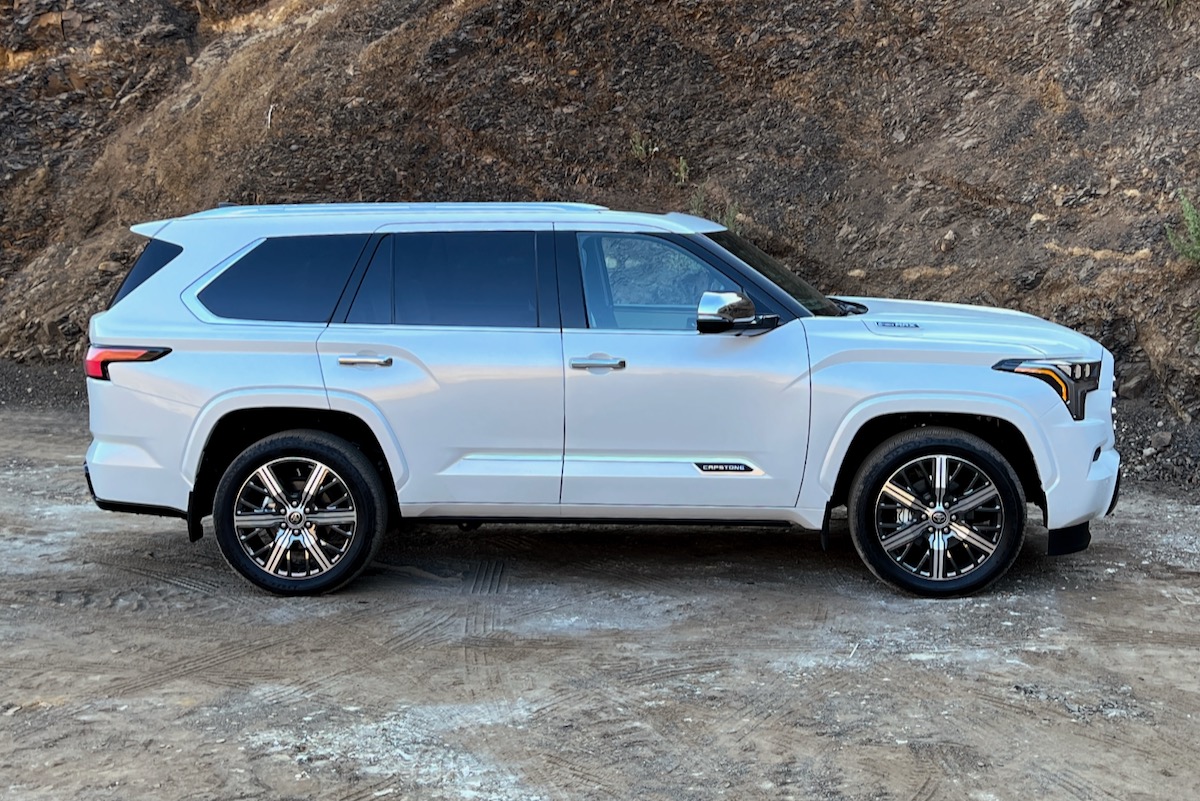
A redesign transforms the 2023 Toyota Sequoia into a technologically advanced full-size SUV with the interior space of a midsize SUV.

It’s impossible to ignore the 2023 Toyota Sequoia three-row SUV. With styling that marries the bold look of the Toyota Tundra pickup truck with a newly creased and kinked SUV body, the distinctively redesigned 2023 Sequoia has substantially more presence than the previous-generation model. Whether or not it appeals to you is a matter of personal preference, but we’ll point out that, compared to the new Tundra, the Sequoia’s traditional grille and front bumper rid the body-on-frame SUV of the pickup truck’s “manta ray on wheels” appearance.
Inside, there’s plenty of overlap with the Tundra. The underlying theme is industrial in nature, with an appealing architectural layer of leather, wood, and metallic finishes in the upscale Toyota Sequoia Capstone trim level. A huge 14-inch Toyota Audio Multimedia infotainment system dominates the Sequoia Capstone’s dashboard, and the Capstone’s interior comes only in a decadent cream white-over-black two-tone colour scheme. However, while the Sequoia Capstone looks luxurious, some of the interior materials will endlessly remind you that this SUV springs from a full-size pickup truck.
The Capstone, umm, caps a lineup that also includes the TRD Off-road, Limited, Platinum, and TRD Pro. At the start of the 2023 model year, prices ranged from $79,335 for a base TRD Off-road with standard four-wheel drive (4WD; rear-wheel drive (RWD) is not offered in Canada) to $95,335 for a Capstone. Those values include a destination charge of $1,930 plus other fees. Our Sequoia Capstone test vehicle had extra-cost Wind Chill Pearl paint, bumping the cost by $255.
If you’re planning to take your new Sequoia off-roading, you’ll want to strongly consider the TRD Pro for its added capability. Still, even with this trim level, the Sequoia’s ground clearance and angles of approach, breakover, and departure suggest less capability when the going gets rough than the previous-generation model.
If you’d rather not spend the money required to park the Sequoia TRD Pro in your driveway, you can choose the Sequoia TRD Off-Road. For a reasonable price, it has 18-inch TRD alloy wheels, all-terrain tires, off-road suspension, and an electronically controlled locking rear differential. This package also installs Multi-Terrain Select off-road driving modes, Downhill Assist Control, and an off-roading cruise control system called Crawl Control.

Equipped with a twin-turbocharged 3.5-litre V6 engine, a 10-speed automatic transmission, a 36-kilowatt electric motor/generator, and a 1.87 kilowatt-hour nickel-metal hydride battery pack, the 2023 Sequoia is not short on power. This hybrid powertrain supplies power specs of 437 horsepower at 5,200 rpm and 583 pound-feet of torque at a low 2,400 rpm.
While it might not emit as satisfying a rumble as the outgoing model’s 5.7-litre V8, the new i-Force Max twin-turbo V6 can tow substantially more weight. While payload capacity is similar to the previous version at 640 kilograms (1,411 pounds), the previous Sequoia could tow 3,356 kilograms (7,400 pounds), while the 2023 Toyota Sequoia’s maximum tow rating in Canada is 4,137 kilograms (9,120 pounds).
The new Toyota Sequoia is also more fuel-efficient than before. According to official Natural Resources Canada fuel economy ratings, the old SUV mustered no better than 16.4 litres per 100 kilometres in combined driving with 4WD. The new one is rated to return 11.7 L/100 km with 4WD.
We averaged 13.2 L/100 km in the Capstone during our test drive on our mountainous evaluation loop in RWD mode while switching between Normal and Sport driving modes. The previous-generation Sequoia TRD Pro returned 16.4 L/100 km on the same route.
Considering this newfound fuel efficiency and the 2023 Sequoia’s robust power (+56 hp) and torque (+182 lb-ft of torque), few people should mourn the old V8. The automaker even gives the twin-turbo V6 an appealing engine and exhaust note, though it’s artificially supplied via the stereo speakers. Also, despite the electric motor/generator and battery pack, the new Sequoia weighs about the same as the old Sequoia, and that translates into improved straight-line hustle.
In the Sequoia Capstone, you can choose between Eco, Comfort, Normal, Sport, and Sport+ driving modes. The 4WD system does not have an automatic engagement setting. Instead, you select from 2WD, 4WD Hi, and 4WD Lo. Our test vehicle came with 22-inch wheels wearing 265/50 all-season tires; the heavier rims and lower profile rubber undoubtedly contributed to a degradation in the ride quality.
Unless you run the Sequoia in Eco or Comfort mode, the suspension isn’t shy about communicating impact shock from the road surface. We expected this in Sport and Sport+ mode, but in Normal mode, the Sequoia’s urban and suburban ride quality is busy and occasionally jittery.
This SUV is happier on smooth, clean surfaces. However, in the softer settings, the suspension can allow too much lateral body rocking over uneven sections. Sport and Sport+ help to better control these excessive ride motions, but then you’re also dealing with a more responsive powertrain that could contribute to lower fuel economy.
Fortunately, there is a Custom mode that allows a Sequoia’s driver to configure dynamic settings to personal preferences. This is likely your best bet to create a favourable combination of powertrain, ride, and handling characteristics.
We likely would have enjoyed driving the Sequoia more had we configured the Custom mode. Instead, we used Normal mode and switched to Sport and Sport+ for the mountain driving portion of the evaluation. Overall, Sport mode was our favourite.
No matter which driving mode you choose, the Sequoia’s steering is slow, so you’re going to work the wheel when making U-turns, navigating parking garages, and slipping the Sequoia into and out of parking spaces.
In addition, the regenerative braking system that helps to keep the hybrid powertrain’s battery charged can feel unresponsive, heavy, and numb underfoot. This is not surprising because this is how most regenerative braking systems behave. However, especially in traffic and urban driving situations, the result is inconsistent braking behaviour.

The Toyota Sequoia is at its best on open roads at highway speeds. In addition to suffering only minor wind and road noise on the highway, our range-topping test vehicle’s cabin featured comfortable front seats with soft leather upholstery, a decent JBL premium audio system with 14 speakers, and a triple-zone automatic climate control system with heated and ventilated front and rear seats. Those heated front seats are standard, as is a heated steering wheel and power-folding mirrors. But what impressed us the most was the wide, flat, padded upper door panel shelf, which makes a perfect place to rest your left arm on a long road trip.
Power-deploying running boards can help shorter people get into and out of the Sequoia. Taller people may find them a nuisance, though. Starting with the Sequoia Limited trim level, Toyota includes a panoramic glass moonroof that chews into second-row headroom, but passengers also get comfortable captain’s chairs separated by a floor-mounted storage tray. These seating locations also receive separate rear climate controls, several air-conditioning vents, and robust grab handles to help with getting in and out.
The second-row captain’s chairs do not slide forward and back, so you can’t make extra room for people who are riding in the third-row seat. They could certainly use it. This seat is mounted above the Sequoia’s battery pack, so the floor is high, the roof is low, and the thigh support is non-existent. Legroom is adequate, but there’s nowhere to stash your feet. It is not as comfortable as what you’ll find in the Sequoia’s primary rivals but is roomier than the third-row seat in a midsize Toyota Highlander.
Around the back, the Sequoia loses the power liftgate window that owners of previous models loved. Instead, you get a flip-up glass window. Open the liftgate, and you’ll discover the most disappointing compromise the new Sequoia makes to accommodate its new hybrid powertrain.
With the third-row seat in its rearmost position, this full-size SUV holds just 325 litres of cargo. You can slide the third-row seat forward to expand that to 631 litres. Toyota also equips every Sequoia with an adjustable cargo shelf that helps you to maximize the use of the space, but it doesn’t have any kind of a lip on the end, so items stored upon it could fall out when you open the liftgate unless you first unload them through the flip-up rear window.
The Sequoia’s third-row seats fold in half to expand cargo capacity to 1,387 litres, which is roughly 500 litres less than the old Sequoia. To create a flat load floor, you’ll need to adjust the shelf to its middle setting. That action results in a lower compartment under the shelf where you can stash more luggage in the form of duffel bags or backpacks while loading as many as six full-size suitcases on the upper deck. However, that upper deck is quite a distance from the ground, so whatever you place there had better be light or you’d better have muscles.
Fold the second-row seats down, and the Sequoia is ready to accommodate 2,460 litres of cargo. That’s 940 litres less than the previous-generation model, and it makes the 2023 Sequoia substantially smaller inside than its segment rivals. Not only that, a new Sequoia can carry only 75 litres more maximum cargo than a Toyota Highlander Hybrid.
While we applaud Toyota’s move to a hybrid powertrain for its additional towing and hauling capacity and improved fuel economy, the switch takes a heavy toll on the new Sequoia’s overall utility.

While every 2023 Sequoia gets a new Toyota Audio Multimedia infotainment system, the base TRD Off-road trim gets only a small 8-inch touchscreen. All other versions boast the oversized 14-inch touchscreen found in our Capstone test vehicle.
This new infotainment system is relatively intuitive if you’re familiar with modern smartphones and tablets, and it includes wireless Apple CarPlay and Android Auto so that when the complimentary connected service plans expire, you won’t necessarily feel like you need to pay for a subscription. However, there’s no escaping the amount of glare on the display, especially in the Capstone with its white leather on the upper front-passenger seat back.
With the connected services active, you can set up user accounts for different drivers and switch to a guest account to protect your information when, for example, a valet is driving the SUV. The available Drive Connect plan includes an Intelligent Assistant that responds to a “Hey Toyota” wake word and proceeds to assist with directions. During testing, the Intelligent Assistant proved reasonably quick to respond and accurate in interpreting our commands. However, when we told the Sequoia that we needed to go to a hospital, the resulting list of nearby medical facilities was not fully filtered to show only hospitals.
The Toyota Audio Multimedia system allows simultaneous Bluetooth pairing for two devices. With a phone paired and using Apple CarPlay, we attempted to place a call to a contact. In response, the Intelligent Assistant told us we would need to first pair a phone to make a call. Umm, OK. The workaround was to access the contact list via Apple CarPlay and manually choose the contact. Our test vehicle was a pre-production model, so perhaps there was a bug in the system.
The Capstone trim also includes a 10-inch head-up display that shows a wealth of data on the windshield ahead of the driver, but we couldn’t see it when wearing polarized sunglasses.
The Toyota Sequoia Platinum and Capstone trims include a surround-view camera system with multiple viewing angles, and a camera-based, digital rearview mirror is standard on those same trims. Objects captured by the surround-view camera tech may be closer than they appear on the centre display, though.
While reversing from a parking space with a couple of pedestrians on the opposite side of the parking lot aisle, the Sequoia’s parking sensors and automatic rear braking system suddenly brought the SUV to a halt. Sure enough, while we looked away from the display to judge the front corners, both people had started to cross and were closer than when we began reversing. Thus, the Toyota’s tech successfully thwarted Darwin’s law.

Every driver-assistance feature available for the 2023 Toyota Sequoia is standard equipment. The list is long, and the tech is mainly bundled into a package called Toyota Safety Sense 2.5 (TSS 2.5). In TSS 2.5, you’ll find forward-collision warning, pedestrian detection, automatic emergency braking, lane-departure warning, lane-keeping assist, lane-centring assist, adaptive cruise control, automatic high-beam headlights, and a road sign recognition system.
Additionally, the Sequoia includes blind-spot monitoring, rear cross-traffic alert, and Safety Connect services including emergency assistance and automatic collision notification. Front and rear parking sensors with automatic braking are also standard.
As installed in the 2023 Sequoia, TSS 2.5 is impressive. The adaptive cruise control and lane-centring assist systems help to make highway driving easier, and aside from the irritating beeping from the lane-departure warning system, none of the SUV’s driving aids proved aggravating enough to discontinue use.
As this review was written, neither the National Highway Traffic Safety Administration (NHTSA) nor the Insurance Institute for Highway Safety (IIHS) had performed crash tests on the new Sequoia. However, the Tundra on which it is based earned the highest possible rating from the IIHS, which bodes well for the Sequoia.

With a base price of just over $75,000 and a significant shortfall in third-row comfort and overall cargo space compared to most of its rivals, the new 2023 Toyota Sequoia does not appear to be a cost-effective choice in a new full-size SUV.
However, it is worth remembering that a base Sequoia TRD Off-road is anything but basic. Plus, the only reasons to choose a vehicle like this are if you need its towing capacity and off-road capability. That’s true of any full-size SUV. If you just require comfortable seating for six or more people or lots of cargo space, a minivan is likely to serve you better and at a big discount.
With that in mind, the Sequoia’s maximum tow rating is stout, and the TRD Off-Road option package and Toyota Sequoia TRD Pro trim level allow it to go where few vehicles dare travel. Plus, the hybrid powertrain promises impressive fuel economy even if it came up short of expectations during our testing.
Still, a Jeep Wagoneer tows more weight than this Toyota, and a Ford Expedition comes close. Furthermore, on the same evaluation loop, a 2022 Expedition fell only slightly behind the Toyota in fuel economy. The Chevy Tahoe and GMC Yukon full-size SUVs are less capable at towing trailers, but they offer optional turbodiesel engines that effortlessly eclipse the Toyota’s real-world fuel economy numbers. And all four of these alternatives have a more comfortable third-row seat and superior amounts of cargo room than the new Sequoia.
Note: Images show a US model.

User reviews for 2023 Toyota Sequoia
Write a review2023 Toyota Sequoia Pricing
Trims & specs
Air Conditioning
Automatic climate control front air conditioning · Dual front air conditioning zones · Automatic climate control rear air conditioning · Single rear air conditioning zones · Second and third row rear heat vents
Airbags
Dual front airbags · Dual front knee airbags · Passenger airbag deactivation: occupant sensing deactivation · Front side airbags · Third row side curtain airbags
Audio System
Antenna Type: diversity · Voice recognition audio system · Bluetooth auxiliary audio input · HD radio · Satellite Radio: SiriusXM · Total Number of Speakers: 8
Brakes
ABS: 4-wheel · Braking assist: hill start assist · Electronic parking brake: auto off · Front brake diameter: 13.9 · Front brakes: ventilated disc · Rear brake diameter: 13.6 · Rear brakes: ventilated disc
Comfort Features
Armrests: rear center with cupholders · Center console trim: simulated alloy · Dash trim: simulated alloy · Door trim: simulated alloy · Floor Material: carpet · Shift knob trim: leather · Steering wheel trim: leather
Convenience Features
Adaptive stop and go cruise control: semi-automatic · Assist handle: front · Autonomous lane guidance: lane centering · Cargo cover: hard · Center console: front console with armrest and storage · Cruise control: adaptive · Cupholders: front, rear and third row · Dimming rearview mirror: auto-dimming · Easy entry: manual rear seat · Multi-function remote: trunk release · One-touch windows: 4 · Power outlet(s): USB rear · Power steering: speed-proportional · Power windows: lockout button · Reading lights: rear · Steering wheel: tilt and telescopic · Steering wheel mounted controls: phone · Storage: dual level cargo area · Universal garage door opener: Homelink · Vanity mirrors: dual illuminating
Driver Seat
Adjustable lumbar support: power · Power adjustments: 8
Drivetrain
Axle ratio: 3.31
Engine
Battery: maintenance-free · EV battery capacity: 1.9 kWh · Electric Motor Battery Type: nickel-metal hydride · Electric Motor HP: 48 · Electric Motor Power Output (Kilowatts): 36 · Electric Motor Torque: 184 · Hybrid Gas Engine HP: 389 · Hybrid Gas Engine HP@RPM: 5200 · Hybrid Gas Engine Torque: 479 · Hybrid gas Engine Torque@RPM: 2400
Exterior Features
Door handle color: body-color · Exhaust tip color: black · Fender lip moldings: black · Front bumper color: body-color · Grille color: chrome surround · Mirror color: body-color · Mudguards: front · Rear bumper color: body-color · Rear spoiler: roofline spoiler · Rear spoiler color: body-color · Rear trunk/liftgate: liftgate · Rocker panel color: body-color · Running boards: black · Window trim: chrome
Headrests
Front headrests: adjustable · Number of front headrests: 2 · Number of rear headrests: 3 · Number of third row headrests: 3
Hybrid
Starter Type: starter/belt alternator
In Car Entertainment
Connected in-car apps: Google search · Infotainment: Toyota Audio Multimedia · Infotainment screen size: 8 in. · Smartphone integration: wireless Apple CarPlay
Instrumentation
Fuel economy display: range · Instrument cluster screen size: 12.3 in. · Warnings and reminders: maintenance reminder
Lights
Daytime running lights: LED · Front fog lights: LED · Headlights: wiper activated · Tail and brake lights: LED
Mirrors
Exterior mirrors: integrated turn signals
Passenger Seat
Adjustable lumbar support: power · Power adjustments: 8
Rear Seats
Type: 60-40 split bench
Roof
Moonroof: power glass · Roof rails: black
Safety
Active head restraints: driver · Automatic emergency braking: intersection/junction turn · Camera system: surround view · Child seat anchors: LATCH system · Cross Traffic Alert: rear · Impact sensor: post-collision safety system · Parking sensors: front · Pre-Collision Warning System: visual warning · Pre-collision warning system: intersection/junction turn · Rearview monitor: in dash
Seatbelts
Emergency locking retractors: front and rear · Front seatbelts: 3-point · Seatbelt force limiters: front · Seatbelt pretensioners: front · Seatbelt warning sensor: driver and passenger · Second row seatbelts: 3-point · Third row seatbelts: 3-point
Seats
Driver seat power adjustments: reclining · Front seat type: bucket · Passenger seat power adjustments: reclining · Rear headrests: adjustable · Rear seat folding: split · Rear seat manual adjustments: reclining · Third row headrests: adjustable · Third row seat folding: split · Upholstery: cloth
Security
Power door locks: anti-lockout
Spare Tire
Mount Location: underbody · Size: full-size
Spare Wheel
Rim Type: steel
Stability and Traction
Traction control: with trailer stability control
Steering
Turns lock-to-lock: 3.40
Suspension
Front Shock Type: twin-tube gas shock absorbers · Front Spring Type: coil springs · Front Suspension Classification: independent · Front Suspension Type: strut · Rear Shock Type: twin-tube gas shock absorbers · Rear Spring Type: coil springs · Rear Suspension Classification: solid live axle · Rear Suspension Type: multi-link · Stabilizer bar(s): front
Telematics
Driver assistance app: roadside assistance · Electronic messaging assistance: with voice recognition · Phone: voice activated · Phone wireless data link: Bluetooth · Smart device app compatibility: Toyota Connected Services · Smart device app function: maintenance status · Wifi: hotspot
Third Row Seat
Type: 40-60 split bench
Tires
Type: all season
Tires and Rims
Wheel type: aluminum alloy
Towing and Hauling
Trailer hitch: Class IV · Trailer wiring: 4-pin
Windows
Front wipers: variable intermittent · Laminated glass: acoustic · Liftgate window: manual flip-up · Power windows: with safety reverse · Rear wiper: intermittent
Air Conditioning
Automatic climate control front air conditioning · Dual front air conditioning zones · Rear air conditioning: with independent controls · Single rear air conditioning zones · Second and third row rear heat vents
Airbags
Dual front airbags · Dual front knee airbags · Passenger airbag deactivation: occupant sensing deactivation · Front side airbags · Front side curtain airbags
Audio System
Antenna Type: mast · Voice recognition audio system · Bluetooth auxiliary audio input · AM/FM radio · Satellite Radio: SiriusXM · Total Number of Speakers: 8
Brakes
ABS: 4-wheel · Braking assist: hill start assist · Electronic parking brake: auto off · Front brake diameter: 13.9 · Front brakes: ventilated disc · Rear brake diameter: 13.6 · Rear brakes: ventilated disc
Comfort Features
Armrests: rear center with cupholders · Center console trim: simulated alloy · Dash trim: simulated alloy · Door trim: simulated alloy · Floor Material: carpet · Shift knob trim: leather · Steering wheel trim: leather
Convenience Features
Adaptive stop and go cruise control: semi-automatic · Assist handle: front · Autonomous lane guidance: lane centering · Cargo cover: hard · Center console: front console with armrest and storage · Cruise control: adaptive · Cupholders: rear · Dimming rearview mirror: auto-dimming · Easy entry: manual rear seat · Multi-function remote: proximity entry system · One-touch windows: 4 · Power outlet(s): USB-C front · Power steering: electric · Power windows: lockout button · Reading lights: rear · Steering wheel: tilt and telescopic · Steering wheel mounted controls: audio · Storage: dual level cargo area · Universal garage door opener: Homelink · Vanity mirrors: dual illuminating
Driver Seat
Adjustable lumbar support: power · Power adjustments: 8
Drivetrain
4WD Type: part time · Axle ratio: 3.31 · Transfer Case: electronic hi-lo gear selection
Engine
Battery: maintenance-free · EV battery capacity: 1.9 kWh · Electric Motor Battery Type: nickel-metal hydride · Electric Motor HP: 48 · Electric Motor Power Output (Kilowatts): 36 · Electric Motor Torque: 184 · Hybrid Gas Engine HP: 389 · Hybrid Gas Engine HP@RPM: 5200 · Hybrid Gas Engine Torque: 479 · Hybrid gas Engine Torque@RPM: 2400
Exterior Features
Door handle color: body-color · Exhaust tip color: black · Fender lip moldings: black · Front bumper color: body-color · Grille color: black · Mirror color: body-color · Mudguards: front · Rear bumper color: body-color · Rear spoiler: roofline spoiler · Rear spoiler color: body-color · Rear trunk/liftgate: liftgate · Rocker panel color: body-color · Running boards: black · Window trim: chrome
Headrests
Front headrests: adjustable · Number of front headrests: 2 · Number of rear headrests: 3 · Number of third row headrests: 3
Hybrid
Starter Type: starter/belt alternator
In Car Entertainment
Connected in-car apps: Google search · Infotainment: Toyota Audio Multimedia · Infotainment screen size: 8 in. · Smartphone integration: wireless Android Auto
Instrumentation
Fuel economy display: MPG · Instrument cluster screen size: 12.3 in. · Warnings and reminders: low battery
Lights
Daytime running lights: LED · Front fog lights: LED · Headlights: automatic high beam dimmer · Tail and brake lights: LED
Mirrors
Exterior mirrors: integrated turn signals
Passenger Seat
Adjustable lumbar support: power · Power adjustments: 8
Rear Seats
Type: 60-40 split bench
Roof
Moonroof: sliding sunshade · Roof rails: black
Safety
Active head restraints: driver · Automatic emergency braking: rear · Camera system: surround view · Child seat anchors: LATCH system · Cross Traffic Alert: rear · Impact sensor: post-collision safety system · Parking sensors: front · Pre-Collision Warning System: audible warning · Pre-collision warning system: pedestrian detection · Rearview monitor: in dash
Seatbelts
Emergency locking retractors: front and rear · Front seatbelts: 3-point · Seatbelt force limiters: front · Seatbelt pretensioners: front and rear · Seatbelt warning sensor: driver and passenger · Second row seatbelts: 3-point · Third row seatbelts: 3-point
Seats
Driver seat power adjustments: height · Front seat type: bucket · Passenger seat power adjustments: height · Rear headrests: adjustable · Rear seat folding: flat · Rear seat manual adjustments: reclining · Third row headrests: adjustable · Third row seat folding: split · Upholstery: cloth
Security
Power door locks: anti-lockout
Spare Tire
Mount Location: underbody · Size: full-size
Spare Wheel
Rim Type: steel
Stability and Traction
Traction control: with trailer stability control
Steering
Turns lock-to-lock: 3.40
Suspension
Front Shock Type: twin-tube gas shock absorbers · Front Spring Type: coil springs · Front Suspension Classification: independent · Front Suspension Type: strut · Rear Shock Type: twin-tube gas shock absorbers · Rear Spring Type: coil springs · Rear Suspension Classification: solid live axle · Rear Suspension Type: multi-link · Stabilizer bar(s): front
Telematics
Driver assistance app: roadside assistance · Electronic messaging assistance: with read function · Phone: voice activated · Phone wireless data link: Bluetooth · Smart device app compatibility: Toyota Connected Services · Smart device app function: vehicle location · Wifi: hotspot
Third Row Seat
Type: 40-60 split bench
Tires
Type: all season
Tires and Rims
Wheel type: aluminum alloy
Towing and Hauling
Trailer hitch: Class IV · Trailer wiring: 7-pin
Windows
Front wipers: variable intermittent · Laminated glass: acoustic · Liftgate window: manual flip-up · Power windows: with safety reverse · Rear wiper: with washer
Air Conditioning
Automatic climate control front air conditioning · Dual front air conditioning zones · Automatic climate control rear air conditioning · Single rear air conditioning zones · Second and third row rear heat vents
Airbags
Dual front airbags · Dual front knee airbags · Passenger airbag deactivation: occupant sensing deactivation · Front side airbags · Front side curtain airbags
Audio System
Antenna Type: diversity · Voice recognition audio system · Bluetooth auxiliary audio input · AM/FM radio · Satellite Radio: SiriusXM · Total Number of Speakers: 8
Brakes
ABS: 4-wheel · Braking assist: hill start assist · Electronic parking brake: auto off · Front brake diameter: 13.9 · Front brakes: ventilated disc · Rear brake diameter: 13.6 · Rear brakes: ventilated disc
Comfort Features
Armrests: rear center with cupholders · Center console trim: simulated alloy · Dash trim: simulated alloy · Door trim: simulated alloy · Floor Material: carpet · Shift knob trim: leather · Steering wheel trim: leather
Convenience Features
Adaptive stop and go cruise control: semi-automatic · Assist handle: front · Autonomous lane guidance: lane centering · Cargo area power outlet: 115V · Cargo cover: hard · Center console: with lighting · Cruise control: adaptive · Cupholders: front, rear and third row · Dimming rearview mirror: auto-dimming · Easy entry: manual rear seat · Memorized settings: driver seat · Multi-function remote: proximity entry system · One-touch windows: 4 · Power outlet(s): USB front · Power steering: speed-proportional · Power windows: lockout button · Reading lights: rear · Rear power outlet: 115V · Steering wheel: tilt and telescopic · Steering wheel mounted controls: voice recognition controls · Storage: sunglasses holder · Sunshade: side window · Universal garage door opener: Homelink · Vanity mirrors: dual illuminating
Driver Seat
Adjustable lumbar support: power · Power adjustments: 8
Drivetrain
Axle ratio: 3.31
Engine
Battery: maintenance-free · EV battery capacity: 1.9 kWh · Electric Motor Battery Type: nickel-metal hydride · Electric Motor HP: 48 · Electric Motor Power Output (Kilowatts): 36 · Electric Motor Torque: 184 · Hybrid Gas Engine HP: 389 · Hybrid Gas Engine HP@RPM: 5200 · Hybrid Gas Engine Torque: 479 · Hybrid gas Engine Torque@RPM: 2400
Exterior Features
Door handle color: chrome · Exhaust tip color: black · Fender lip moldings: black · Front bumper color: body-color · Grille color: black · Mirror color: body-color · Mudguards: rear · Rear bumper color: body-color · Rear spoiler: roofline spoiler · Rear spoiler color: body-color · Rear trunk/liftgate: sensor-activated · Rocker panel color: body-color · Running boards: black · Window trim: chrome
Headrests
Front headrests: adjustable · Number of front headrests: 2 · Number of rear headrests: 3 · Number of third row headrests: 3
Hybrid
Starter Type: starter/belt alternator
In Car Entertainment
Connected in-car apps: Google POIs · Infotainment: Toyota Audio Multimedia · Infotainment screen size: 14 in. · Smartphone integration: wireless Android Auto
Instrumentation
Fuel economy display: MPG · Instrument cluster screen size: 12.3 in. · Warnings and reminders: low oil pressure
Lights
Daytime running lights: LED · Front fog lights: LED · Headlights: automatic high beam dimmer · Tail and brake lights: LED
Mirrors
Exterior mirrors: power folding
Passenger Seat
Adjustable lumbar support: power · Power adjustments: 8
Rear Seats
Type: 60-40 split bench
Roof
Moonroof: anti-trapping feature · Roof rails: chrome
Safety
Active head restraints: driver · Automatic emergency braking: rear · Camera system: surround view · Child seat anchors: LATCH system · Cross Traffic Alert: rear · Impact sensor: post-collision safety system · Parking sensors: front · Pre-Collision Warning System: visual warning · Pre-collision warning system: pedestrian detection · Rearview monitor: in dash
Seatbelts
Emergency locking retractors: front, rear, third, and fourth row · Front seatbelts: 3-point · Seatbelt force limiters: front · Seatbelt pretensioners: front · Seatbelt warning sensor: driver and passenger · Second row seatbelts: 3-point · Third row seatbelts: 3-point
Seats
Driver seat power adjustments: height · Front seat type: bucket · Passenger seat power adjustments: height · Rear headrests: adjustable · Rear seat folding: flat · Rear seat manual adjustments: reclining · Third row headrests: adjustable · Third row seat folding: split · Upholstery: leatherette
Security
Power door locks: anti-lockout
Spare Tire
Mount Location: underbody · Size: full-size
Spare Wheel
Rim Type: steel
Stability and Traction
Traction control: with trailer stability control
Steering
Turns lock-to-lock: 3.40
Suspension
Front Shock Type: twin-tube gas shock absorbers · Front Spring Type: coil springs · Front Suspension Classification: independent · Front Suspension Type: double wishbones · Rear Shock Type: twin-tube gas shock absorbers · Rear Spring Type: coil springs · Rear Suspension Classification: solid live axle · Rear Suspension Type: multi-link · Stabilizer bar(s): front
Telematics
Driver assistance app: roadside assistance · Electronic messaging assistance: with read function · Navigation system: with voice recognition · Phone: voice activated · Phone wireless data link: Bluetooth · Smart device app compatibility: Amazon Alexa · Smart device app function: lock operation · Wifi: hotspot
Third Row Seat
Type: 40-60 split bench
Tires
Type: all season
Tires and Rims
Wheels: aluminum with painted accents
Towing and Hauling
Trailer hitch: Class IV · Trailer wiring: 7-pin
Windows
Front wipers: variable intermittent · Laminated glass: acoustic · Liftgate window: manual flip-up · Power windows: with safety reverse · Rear wiper: auto-on in reverse
Air Conditioning
Automatic climate control front air conditioning · Dual front air conditioning zones · Rear air conditioning: with independent controls · Single rear air conditioning zones · Second and third row rear heat vents
Airbags
Dual front airbags · Dual front knee airbags · Passenger airbag deactivation: occupant sensing deactivation · Front side airbags · Front side curtain airbags
Audio System
Antenna Type: diversity · Voice recognition audio system · Bluetooth auxiliary audio input · Touch screen display radio · Satellite Radio: SiriusXM · Total Number of Speakers: 8
Brakes
ABS: 4-wheel · Braking assist: hill start assist · Electronic parking brake: auto off · Front brake diameter: 13.9 · Front brakes: ventilated disc · Rear brake diameter: 13.6 · Rear brakes: ventilated disc
Comfort Features
Armrests: rear center with cupholders · Center console trim: simulated alloy · Dash trim: simulated alloy · Door trim: simulated alloy · Floor Material: carpet · Shift knob trim: leather · Steering wheel trim: leather
Convenience Features
Adaptive stop and go cruise control: semi-automatic · Assist handle: front · Autonomous lane guidance: lane centering · Cargo area power outlet: 115V · Cargo cover: hard · Center console: with lighting · Cruise control: adaptive · Cupholders: rear · Dimming rearview mirror: auto-dimming · Easy entry: manual rear seat · Memorized settings: side mirrors · Multi-function remote: vehicle and key memory · One-touch windows: 4 · Power outlet(s): USB rear · Power steering: speed-proportional · Power windows: lockout button · Reading lights: rear · Rear power outlet: 115V · Steering wheel: tilt and telescopic · Steering wheel mounted controls: cruise controls · Storage: front seatback · Sunshade: side window · Universal garage door opener: Homelink · Vanity mirrors: dual illuminating
Driver Seat
Adjustable lumbar support: power · Power adjustments: 8
Drivetrain
4WD Type: part time · Axle ratio: 3.31 · Transfer Case: electronic hi-lo gear selection
Engine
Battery: maintenance-free · EV battery capacity: 1.9 kWh · Electric Motor Battery Type: nickel-metal hydride · Electric Motor HP: 48 · Electric Motor Power Output (Kilowatts): 36 · Electric Motor Torque: 184 · Hybrid Gas Engine HP: 389 · Hybrid Gas Engine HP@RPM: 5200 · Hybrid Gas Engine Torque: 479 · Hybrid gas Engine Torque@RPM: 2400
Exterior Features
Door handle color: chrome · Exhaust tip color: black · Fender lip moldings: black · Front bumper color: body-color · Grille color: black · Mirror color: body-color · Mudguards: front · Rear bumper color: body-color · Rear spoiler: roofline spoiler · Rear spoiler color: body-color · Rear trunk/liftgate: sensor-activated · Rocker panel color: body-color · Running boards: black · Window trim: chrome
Headrests
Front headrests: adjustable · Number of front headrests: 2 · Number of rear headrests: 3 · Number of third row headrests: 3
Hybrid
Starter Type: starter/belt alternator
In Car Entertainment
Connected in-car apps: Google search · Infotainment: Toyota Audio Multimedia · Infotainment screen size: 14 in. · Smartphone integration: wireless Android Auto
Instrumentation
Fuel economy display: range · Instrument cluster screen size: 12.3 in. · Warnings and reminders: coolant temperature warning
Lights
Daytime running lights: LED · Front fog lights: LED · Headlights: automatic high beam dimmer · Tail and brake lights: LED
Mirrors
Exterior mirrors: heated
Passenger Seat
Adjustable lumbar support: power · Power adjustments: 8
Rear Seats
Type: 60-40 split bench
Roof
Moonroof: sliding sunshade · Roof rails: chrome
Safety
Active head restraints: driver · Automatic emergency braking: front · Camera system: surround view · Child seat anchors: LATCH system · Cross Traffic Alert: rear · Impact sensor: post-collision safety system · Parking sensors: front · Pre-Collision Warning System: audible warning · Pre-collision warning system: intersection/junction turn · Rearview monitor: in dash
Seatbelts
Emergency locking retractors: front and rear · Front seatbelts: 3-point · Seatbelt force limiters: front · Seatbelt pretensioners: front · Seatbelt warning sensor: driver and passenger · Second row seatbelts: 3-point · Third row seatbelts: 3-point
Seats
Driver seat power adjustments: height · Front seat type: bucket · Passenger seat power adjustments: height · Rear headrests: adjustable · Rear seat folding: flat · Rear seat manual adjustments: reclining · Third row headrests: adjustable · Third row seat folding: flat · Upholstery: leatherette
Security
Power door locks: anti-lockout
Spare Tire
Mount Location: underbody · Size: full-size
Spare Wheel
Rim Type: steel
Stability and Traction
Traction control: with trailer stability control
Steering
Turns lock-to-lock: 3.40
Suspension
Front Shock Type: twin-tube gas shock absorbers · Front Spring Type: coil springs · Front Suspension Classification: independent · Front Suspension Type: double wishbones · Rear Shock Type: twin-tube gas shock absorbers · Rear Spring Type: coil springs · Rear Suspension Classification: solid live axle · Rear Suspension Type: multi-link · Stabilizer bar(s): front
Telematics
Driver assistance app: roadside assistance · Electronic messaging assistance: with read function · Navigation system: with voice recognition · Phone: voice activated · Phone wireless data link: Bluetooth · Smart device app compatibility: Toyota Connected Services · Smart device app function: send destination to vehicle · Wifi: hotspot
Third Row Seat
Type: 40-60 split bench
Tires
Type: all season
Tires and Rims
Wheels: aluminum with painted accents
Towing and Hauling
Trailer hitch: Class IV · Trailer wiring: 7-pin
Windows
Front wipers: variable intermittent · Laminated glass: acoustic · Liftgate window: manual flip-up · Power windows: with safety reverse · Rear wiper: auto-on in reverse
Air Conditioning
Automatic climate control front air conditioning · Dual front air conditioning zones · Rear air conditioning: with independent controls · Single rear air conditioning zones · Second and third row rear heat vents
Airbags
Dual front airbags · Dual front knee airbags · Passenger airbag deactivation: occupant sensing deactivation · Front side airbags · Third row side curtain airbags
Audio System
Antenna Type: mast · Voice recognition audio system · USB auxiliary audio input · Premium Brand: JBL · Touch screen display radio · Satellite Radio: SiriusXM · 1 subwoofer · Total Number of Speakers: 13 · Watts: 800
Brakes
ABS: 4-wheel · Braking assist: hill start assist · Electronic parking brake: auto off · Front brake diameter: 13.9 · Front brakes: ventilated disc · Rear brake diameter: 13.6 · Rear brakes: ventilated disc
Comfort Features
Armrests: rear outboard seats · Center console trim: simulated alloy · Dash trim: simulated alloy · Door trim: simulated alloy · Floor Material: carpet · Shift knob trim: leather · Steering wheel trim: leather
Convenience Features
Adaptive stop and go cruise control: semi-automatic · Assist handle: rear · Autonomous lane guidance: lane centering · Cargo area power outlet: 115V · Cargo cover: hard · Center console: front console with armrest and storage · Cruise control: adaptive · Cupholders: front · Easy entry: power steering wheel · Memorized settings: driver seat · Multi-function remote: proximity entry system · One-touch windows: 4 · Power outlet(s): 12V front · Power steering: electric · Power windows: lockout button · Reading lights: front · Rear power outlet: 115V · Rearview mirror: camera-based · Steering wheel: power tilt and telescopic · Steering wheel mounted controls: audio · Storage: dual level cargo area · Sunshade: side window · Universal garage door opener: Homelink · Vanity mirrors: dual illuminating
Driver Seat
Adjustable lumbar support: 4-way power · Power adjustments: 10
Drivetrain
Axle ratio: 3.31
Engine
Battery: maintenance-free · EV battery capacity: 1.9 kWh · Electric Motor Battery Type: nickel-metal hydride · Electric Motor HP: 48 · Electric Motor Power Output (Kilowatts): 36 · Electric Motor Torque: 184 · Hybrid Gas Engine HP: 389 · Hybrid Gas Engine HP@RPM: 5200 · Hybrid Gas Engine Torque: 479 · Hybrid gas Engine Torque@RPM: 2400
Exterior Features
Body side moldings: black · Door handle color: body-color · Exhaust tip color: black · Fender lip moldings: black · Front bumper color: body-color · Grille color: chrome surround · Mirror color: body-color · Mudguards: front · Rear bumper color: body-color · Rear spoiler: roofline spoiler · Rear spoiler color: body-color · Rear trunk/liftgate: liftgate · Rocker panel color: body-color · Running boards: black · Window trim: black
Headrests
Front headrests: adjustable · Number of front headrests: 2 · Number of rear headrests: 2 · Number of third row headrests: 3
Hybrid
Starter Type: starter/belt alternator
In Car Entertainment
Connected in-car apps: Google POIs · Infotainment: Toyota Audio Multimedia · Infotainment screen size: 14 in. · Smartphone integration: wireless Apple CarPlay
Instrumentation
Fuel economy display: MPG · Instrument cluster screen size: 12.3 in. · Warnings and reminders: low fuel level
Lights
Daytime running lights: LED · Front fog lights: LED · Headlights: wiper activated · Tail and brake lights: LED
Mirrors
Exterior mirrors: auto-dimming
Passenger Seat
Power adjustments: 10
Rear Seats
Type: captains chairs
Roof
Moonroof: tilt/slide · Moonroof / Sunroof: power sunshade · Roof rails: black
Safety
Active head restraints: driver · Automatic emergency braking: front · Camera system: surround view · Child seat anchors: LATCH system · Cross Traffic Alert: rear · Impact sensor: post-collision safety system · Parking sensors: rear · Pre-Collision Warning System: audible warning · Pre-collision warning system: intersection/junction turn · Rearview monitor: in dash
Seatbelts
Emergency locking retractors: front and rear · Front seatbelts: 3-point · Seatbelt force limiters: front · Seatbelt pretensioners: front and rear · Seatbelt warning sensor: driver and passenger · Second row seatbelts: 3-point · Third row seatbelts: 3-point
Seats
Driver seat power adjustments: height · Front seat type: bucket · Passenger seat power adjustments: 4-way power lumbar · Rear headrests: adjustable · Rear seat: ventilated · Rear seat folding: flat · Rear seat manual adjustments: reclining · Third row headrests: adjustable · Third row seat folding: flat · Upholstery: leather-trimmed
Security
Power door locks: anti-lockout
Spare Tire
Mount Location: underbody · Size: full-size
Spare Wheel
Rim Type: steel
Stability and Traction
Traction control: with trailer stability control
Steering
Turns lock-to-lock: 3.40
Suspension
Front Shock Type: twin-tube gas shock absorbers · Front Spring Type: coil springs · Front Suspension Classification: independent · Front Suspension Type: double wishbones · Rear Shock Type: twin-tube gas shock absorbers · Rear Spring Type: coil springs · Rear Suspension Classification: solid live axle · Rear Suspension Type: multi-link · Stabilizer bar(s): front
Telematics
Driver assistance app: roadside assistance · Electronic messaging assistance: with read function · Navigation system: with voice recognition · Phone: voice activated · Phone wireless data link: Bluetooth · Smart device app compatibility: Amazon Alexa · Smart device app function: maintenance status · Wifi: hotspot
Third Row Seat
Type: 40-60 split bench
Tires
Type: all season
Tires and Rims
Wheels: painted aluminum
Towing and Hauling
Automated trailer backup steering: straight line · Trailer hitch: Class IV · Trailer wiring: 4-pin
Windows
Front wipers: rain sensing · Laminated glass: acoustic · Liftgate window: manual flip-up · Power windows: with safety reverse · Rear wiper: with washer
Air Conditioning
Automatic climate control front air conditioning · Dual front air conditioning zones · Rear air conditioning: with independent controls · Single rear air conditioning zones · Second and third row rear heat vents
Airbags
Dual front airbags · Dual front knee airbags · Passenger airbag deactivation: occupant sensing deactivation · Front side airbags · Front side curtain airbags
Audio System
Antenna Type: mast · Voice recognition audio system · USB auxiliary audio input · Premium Brand: JBL · Touch screen display radio · Satellite Radio: SiriusXM · 1 subwoofer · Total Number of Speakers: 13 · Watts: 800
Brakes
ABS: 4-wheel · Braking assist: hill start assist · Electronic parking brake: auto off · Front brake diameter: 13.9 · Front brakes: ventilated disc · Rear brake diameter: 13.6 · Rear brakes: ventilated disc
Comfort Features
Armrests: rear outboard seats · Center console trim: simulated alloy · Dash trim: simulated alloy · Door trim: simulated alloy · Floor Material: carpet · Shift knob trim: leather · Steering wheel trim: leather
Convenience Features
Adaptive stop and go cruise control: semi-automatic · Assist handle: rear · Autonomous lane guidance: lane centering · Cargo area power outlet: 115V · Cargo cover: hard · Center console: with lighting · Cruise control: adaptive · Cupholders: front, rear and third row · Easy entry: manual rear seat · Memorized settings: side mirrors · Multi-function remote: keyless entry with panic alarm · One-touch windows: 4 · Power outlet(s): 12V front · Power steering: electric · Power windows: lockout button · Reading lights: rear · Rear power outlet: 115V · Rearview mirror: camera-based · Steering wheel: power tilt and telescopic · Steering wheel mounted controls: voice recognition controls · Storage: cargo tie-down anchors and hooks · Sunshade: side window · Universal garage door opener: Homelink · Vanity mirrors: dual illuminating
Driver Seat
Adjustable lumbar support: 4-way power · Power adjustments: 10
Drivetrain
4WD Type: part time · Axle ratio: 3.31 · Transfer Case: electronic hi-lo gear selection
Engine
Battery: maintenance-free · EV battery capacity: 1.9 kWh · Electric Motor Battery Type: nickel-metal hydride · Electric Motor HP: 48 · Electric Motor Power Output (Kilowatts): 36 · Electric Motor Torque: 184 · Hybrid Gas Engine HP: 389 · Hybrid Gas Engine HP@RPM: 5200 · Hybrid Gas Engine Torque: 479 · Hybrid gas Engine Torque@RPM: 2400
Exterior Features
Body side moldings: black · Door handle color: body-color · Exhaust tip color: black · Fender lip moldings: black · Front bumper color: body-color · Grille color: black · Mirror color: body-color · Mudguards: front · Rear bumper color: body-color · Rear spoiler: roofline spoiler · Rear spoiler color: body-color · Rear trunk/liftgate: sensor-activated · Rocker panel color: body-color · Running boards: black · Window trim: black
Headrests
Front headrests: adjustable · Number of front headrests: 2 · Number of rear headrests: 2 · Number of third row headrests: 3
Hybrid
Starter Type: starter/belt alternator
In Car Entertainment
Connected in-car apps: Google search · Infotainment: Toyota Audio Multimedia · Infotainment screen size: 14 in. · Smartphone integration: wireless Apple CarPlay
Instrumentation
Fuel economy display: range · Instrument cluster screen size: 12.3 in. · Warnings and reminders: maintenance reminder
Lights
Daytime running lights: LED · Front fog lights: LED · Headlights: self-leveling · Tail and brake lights: LED
Mirrors
Exterior mirrors: heated
Passenger Seat
Power adjustments: 10
Rear Seats
Type: captains chairs
Roof
Moonroof: one-touch open/close · Moonroof / Sunroof: power sunshade · Roof rails: black
Safety
Active head restraints: driver · Automatic emergency braking: front · Camera system: surround view · Child seat anchors: LATCH system · Cross Traffic Alert: rear · Impact sensor: post-collision safety system · Parking sensors: rear · Pre-Collision Warning System: audible warning · Pre-collision warning system: intersection/junction turn · Rearview monitor: in dash
Seatbelts
Emergency locking retractors: front, rear, third, and fourth row · Front seatbelts: 3-point · Seatbelt force limiters: front · Seatbelt pretensioners: front and rear · Seatbelt warning sensor: driver and passenger · Second row seatbelts: 3-point · Third row seatbelts: 3-point
Seats
Driver seat power adjustments: height · Front seat type: bucket · Passenger seat power adjustments: height · Rear headrests: adjustable · Rear seat: ventilated · Rear seat folding: flat · Rear seat manual adjustments: reclining · Third row headrests: adjustable · Third row seat folding: flat · Upholstery: leather-trimmed
Security
Power door locks: anti-lockout
Spare Tire
Mount Location: underbody · Size: full-size
Spare Wheel
Rim Type: steel
Stability and Traction
Traction control: with trailer stability control
Steering
Turns lock-to-lock: 3.40
Suspension
Front Shock Type: twin-tube gas shock absorbers · Front Spring Type: coil springs · Front Suspension Classification: independent · Front Suspension Type: double wishbones · Rear Shock Type: twin-tube gas shock absorbers · Rear Spring Type: coil springs · Rear Suspension Classification: solid live axle · Rear Suspension Type: multi-link · Stabilizer bar(s): front
Telematics
Driver assistance app: roadside assistance · Electronic messaging assistance: with read function · Navigation system: touch screen display · Phone: voice activated · Phone wireless data link: Bluetooth · Smart device app compatibility: Amazon Alexa · Smart device app function: lock operation · Wifi: hotspot
Third Row Seat
Type: 40-60 split bench
Tires
Type: all season
Tires and Rims
Wheels: painted aluminum
Towing and Hauling
Automated trailer backup steering: straight line · Trailer hitch: Class IV · Trailer wiring: 4-pin
Windows
Front wipers: variable intermittent · Laminated glass: acoustic · Liftgate window: manual flip-up · Power windows: with safety reverse · Rear wiper: auto-on in reverse
Air Conditioning
Automatic climate control front air conditioning · Dual front air conditioning zones · Automatic climate control rear air conditioning · Single rear air conditioning zones · Second and third row rear heat vents
Airbags
Dual front airbags · Dual front knee airbags · Passenger airbag deactivation: occupant sensing deactivation · Front side airbags · Front side curtain airbags
Audio System
Antenna Type: mast · Voice recognition audio system · Bluetooth auxiliary audio input · Premium Brand: JBL · Touch screen display radio · Satellite Radio: SiriusXM · 1 subwoofer · Total Number of Speakers: 13 · Watts: 800
Brakes
ABS: 4-wheel · Braking assist: hill start assist · Electronic parking brake: auto off · Front brake diameter: 13.9 · Front brakes: ventilated disc · Rear brake diameter: 13.6 · Rear brakes: ventilated disc
Comfort Features
Armrests: rear outboard seats · Center console trim: simulated wood · Dash trim: simulated wood · Door trim: simulated wood · Floor Mat Material: carpet · Floor Material: carpet · Floor Mats: front · Shift knob trim: leather · Steering wheel trim: leather
Convenience Features
Adaptive stop and go cruise control: semi-automatic · Assist handle: rear · Autonomous lane guidance: lane centering · Cargo area power outlet: 115V · Cargo cover: hard · Center console: front console with armrest and storage · Cruise control: adaptive · Cupholders: front, rear and third row · Easy entry: power steering wheel · Memorized settings: side mirrors · Multi-function remote: vehicle and key memory · One-touch windows: 4 · Power outlet(s): USB-C rear · Power steering: speed-proportional · Power windows: lockout button · Reading lights: front · Rear power outlet: 115V · Rearview mirror: camera-based · Steering wheel: power tilt and telescopic · Steering wheel mounted controls: phone · Storage: cargo tie-down anchors and hooks · Sunshade: side window · Universal garage door opener: Homelink · Vanity mirrors: dual illuminating
Driver Seat
Adjustable lumbar support: 4-way power · Power adjustments: 10
Drivetrain
Axle ratio: 3.31
Engine
Battery: maintenance-free · EV battery capacity: 1.9 kWh · Electric Motor Battery Type: nickel-metal hydride · Electric Motor HP: 48 · Electric Motor Power Output (Kilowatts): 36 · Electric Motor Torque: 184 · Hybrid Gas Engine HP: 389 · Hybrid Gas Engine HP@RPM: 5200 · Hybrid Gas Engine Torque: 479 · Hybrid gas Engine Torque@RPM: 2400
Exterior Features
Body side moldings: chrome · Door handle color: chrome · Exhaust tip color: black · Fender lip moldings: body-color · Front bumper color: body-color · Grille color: chrome surround · Lower body step rails: power-retractable · Mirror color: chrome · Mudguards: rear · Rear bumper color: body-color · Rear spoiler: roofline spoiler · Rear spoiler color: body-color · Rear trunk/liftgate: liftgate · Rocker panel color: body-color · Running boards: black · Window trim: chrome
Headrests
Front headrests: adjustable · Number of front headrests: 2 · Number of rear headrests: 2 · Number of third row headrests: 3
Hybrid
Starter Type: starter/belt alternator
In Car Entertainment
Connected in-car apps: Google POIs · Infotainment: Toyota Audio Multimedia · Infotainment screen size: 14 in. · Smartphone integration: wireless Apple CarPlay
Instrumentation
Fuel economy display: MPG · Instrument cluster screen size: 12.3 in. · Warnings and reminders: low fuel level
Lights
Daytime running lights: LED · Front fog lights: LED · Headlights: wiper activated · Tail and brake lights: LED
Mirrors
Exterior mirrors: reverse gear tilt
Passenger Seat
Power adjustments: 10
Rear Seats
Type: captains chairs
Roof
Moonroof: power panoramic · Moonroof / Sunroof: power sunshade · Roof rails: chrome
Safety
Active head restraints: driver · Automatic emergency braking: rear · Camera system: surround view · Child seat anchors: LATCH system · Cross Traffic Alert: rear · Impact sensor: post-collision safety system · Parking sensors: front · Pre-Collision Warning System: audible warning · Pre-collision warning system: pedestrian detection · Rearview monitor: in dash
Seatbelts
Emergency locking retractors: front and rear · Front seatbelts: 3-point · Seatbelt force limiters: front · Seatbelt pretensioners: front · Seatbelt warning sensor: driver and passenger · Second row seatbelts: 3-point · Third row seatbelts: 3-point
Seats
Driver seat power adjustments: height · Front seat type: bucket · Passenger seat power adjustments: height · Rear headrests: adjustable · Rear seat: ventilated · Rear seat folding: flat · Rear seat manual adjustments: reclining · Third row headrests: adjustable · Third row seat folding: split · Upholstery: contrast stitching
Security
Power door locks: anti-lockout
Spare Tire
Mount Location: underbody · Size: full-size
Spare Wheel
Rim Type: steel
Stability and Traction
Traction control: with trailer stability control
Steering
Turns lock-to-lock: 3.40
Suspension
Front Shock Type: twin-tube gas shock absorbers · Front Spring Type: coil springs · Front Suspension Classification: independent · Front Suspension Type: double wishbones · Rear Shock Type: twin-tube gas shock absorbers · Rear Spring Type: coil springs · Rear Suspension Classification: solid live axle · Rear Suspension Type: multi-link · Stabilizer bar(s): front
Telematics
Driver assistance app: roadside assistance · Electronic messaging assistance: with voice recognition · Navigation system: with voice recognition · Phone: voice activated · Phone wireless data link: Bluetooth · Smart device app compatibility: Amazon Alexa · Smart device app function: maintenance status · Wifi: hotspot
Third Row Seat
Type: 40-60 split bench
Tires
Type: all season
Tires and Rims
Wheels: aluminum with painted accents
Towing and Hauling
Automated trailer backup steering: straight line · Trailer hitch: Class IV · Trailer wiring: 7-pin
Windows
Front wipers: rain sensing · Laminated glass: acoustic · Liftgate window: manual flip-up · Power windows: with safety reverse · Rear wiper: with washer
Air Conditioning
Automatic climate control front air conditioning · Dual front air conditioning zones · Rear air conditioning: with independent controls · Single rear air conditioning zones · Second and third row rear heat vents
Airbags
Dual front airbags · Dual front knee airbags · Passenger airbag deactivation: occupant sensing deactivation · Front side airbags · Rear side curtain airbags
Audio System
Antenna Type: diversity · Voice recognition audio system · Bluetooth auxiliary audio input · Premium Brand: JBL · HD radio · Satellite Radio: SiriusXM · 1 subwoofer · Total Number of Speakers: 13 · Watts: 800
Brakes
ABS: 4-wheel · Braking assist: hill start assist · Electronic parking brake: auto off · Front brake diameter: 13.9 · Front brakes: ventilated disc · Rear brake diameter: 13.6 · Rear brakes: ventilated disc
Comfort Features
Armrests: rear outboard seats · Floor Mat Material: vinyl/rubber · Floor Material: carpet · Floor Mats: front · Foot pedal trim: aluminum · Shift knob trim: leather · Steering wheel trim: leather
Convenience Features
Adaptive stop and go cruise control: semi-automatic · Assist handle: rear · Autonomous lane guidance: lane centering · Cargo area power outlet: 115V · Cargo cover: hard · Center console: front console with armrest and storage · Cruise control: adaptive · Cupholders: rear · Easy entry: manual rear seat · Memorized settings: side mirrors · Multi-function remote: proximity entry system · One-touch windows: 4 · Power outlet(s): USB-C front · Power steering: electric · Power windows: lockout button · Reading lights: third row · Rear power outlet: 115V · Rearview mirror: camera-based · Steering wheel: tilt and telescopic · Steering wheel mounted controls: multi-function screen controls · Storage: accessory hook · Sunshade: side window · Universal garage door opener: Homelink · Vanity mirrors: dual illuminating
Driver Seat
Adjustable lumbar support: power · Power adjustments: 8
Drivetrain
4WD Type: part time · Axle ratio: 3.31 · Locking differential: rear · Transfer Case: electronic hi-lo gear selection
Engine
Battery: maintenance-free · EV battery capacity: 1.9 kWh · Electric Motor Battery Type: nickel-metal hydride · Electric Motor HP: 48 · Electric Motor Power Output (Kilowatts): 36 · Electric Motor Torque: 184 · Hybrid Gas Engine HP: 389 · Hybrid Gas Engine HP@RPM: 5200 · Hybrid Gas Engine Torque: 479 · Hybrid gas Engine Torque@RPM: 2400
Exterior Features
Door handle color: body-color · Exhaust: dual exhaust tips · Exhaust tip color: black · Fender lip moldings: black · Front bumper color: body-color · Grille color: black surround · Mirror color: black · Mudguards: rear · Rear bumper color: body-color · Rear spoiler: roofline spoiler · Rear spoiler color: body-color · Rear trunk/liftgate: power operated · Rocker panel color: body-color · Running boards: black · Skid plate(s): front · Window trim: black
Headrests
Front headrests: adjustable · Number of front headrests: 2 · Number of rear headrests: 2 · Number of third row headrests: 3
Hybrid
Starter Type: starter/belt alternator
In Car Entertainment
Connected in-car apps: Google search · Infotainment: Toyota Audio Multimedia · Infotainment screen size: 14 in. · Smartphone integration: wireless Apple CarPlay
Instrumentation
Fuel economy display: MPG · Instrument cluster screen size: 12.3 in. · Warnings and reminders: low battery
Lights
Daytime running lights: LED · Front fog lights: LED · Headlights: wiper activated · Tail and brake lights: LED
Mirrors
Exterior mirrors: integrated turn signals
Passenger Seat
Adjustable lumbar support: power · Power adjustments: 8
Rear Seats
Type: captains chairs
Roof
Moonroof: tilt/slide · Roof rails: black
Safety
Active head restraints: driver · Automatic emergency braking: intersection/junction turn · Camera system: surround view · Child seat anchors: LATCH system · Cross Traffic Alert: rear · Impact sensor: fuel cut-off · Parking sensors: front · Pre-Collision Warning System: audible warning · Pre-collision warning system: intersection/junction turn · Rearview monitor: in dash
Seatbelts
Emergency locking retractors: front · Front seatbelts: 3-point · Seatbelt force limiters: front · Seatbelt pretensioners: front and rear · Seatbelt warning sensor: driver and passenger · Second row seatbelts: 3-point · Third row seatbelts: 3-point
Seats
Driver seat power adjustments: height · Front seat type: bucket · Passenger seat power adjustments: height · Rear headrests: adjustable · Rear seat folding: flat · Rear seat manual adjustments: reclining · Third row headrests: adjustable · Third row seat folding: power · Upholstery: contrast stitching
Security
Power door locks: anti-lockout
Spare Tire
Mount Location: underbody · Size: full-size
Spare Wheel
Rim Type: steel
Stability and Traction
Traction control: with trailer stability control
Steering
Turns lock-to-lock: 3.2
Suspension
Front Shock Type: gas shock absorbers · Front Spring Type: coil springs · Front Suspension Classification: independent · Front Suspension Type: strut · Rear Shock Type: gas shock absorbers · Rear Spring Type: coil springs · Rear Suspension Classification: solid live axle · Rear Suspension Type: multi-link · Stabilizer bar(s): front
Telematics
Driver assistance app: roadside assistance · Electronic messaging assistance: with read function · Navigation system: with voice recognition · Phone: voice activated · Phone wireless data link: Bluetooth · Smart device app compatibility: Toyota Connected Services · Smart device app function: maintenance status · Wifi: hotspot
Third Row Seat
Type: 40-60 split bench
Tires
Type: all terrain
Tires and Rims
Wheels: painted aluminum
Towing and Hauling
Automated trailer backup steering: straight line · Trailer hitch: Class IV · Trailer wiring: 7-pin
Windows
Front wipers: variable intermittent · Laminated glass: acoustic · Liftgate window: manual flip-up · Power windows: with safety reverse · Rear wiper: with washer
Air Conditioning
Automatic climate control front air conditioning · Dual front air conditioning zones · Automatic climate control rear air conditioning · Single rear air conditioning zones · Second and third row rear heat vents
Airbags
Dual front airbags · Dual front knee airbags · Passenger airbag deactivation: occupant sensing deactivation · Front side airbags · Third row side curtain airbags
Audio System
Antenna Type: diversity · Voice recognition audio system · USB auxiliary audio input · Premium Brand: JBL · Touch screen display radio · Satellite Radio: SiriusXM · 1 subwoofer · Total Number of Speakers: 13 · Watts: 800
Brakes
ABS: 4-wheel · Braking assist: hill start assist · Electronic parking brake: auto off · Front brake diameter: 13.9 · Front brakes: ventilated disc · Rear brake diameter: 13.6 · Rear brakes: ventilated disc
Comfort Features
Armrests: rear outboard seats · Center console trim: simulated wood · Dash trim: simulated wood · Door trim: simulated wood · Floor Mat Material: carpet · Floor Material: carpet · Floor Mats: front · Shift knob trim: leather · Steering wheel trim: leather
Convenience Features
Adaptive stop and go cruise control: semi-automatic · Assist handle: front · Autonomous lane guidance: lane centering · Cargo area power outlet: 115V · Cargo cover: hard · Center console: front console with armrest and storage · Cruise control: adaptive · Cupholders: rear · Easy entry: power steering wheel · Memorized settings: 2 driver · Multi-function remote: proximity entry system · One-touch windows: 4 · Power outlet(s): USB front · Power steering: speed-proportional · Power windows: lockout button · Reading lights: front · Rear power outlet: 115V · Rearview mirror: camera-based · Steering wheel: power tilt and telescopic · Steering wheel mounted controls: audio · Storage: dual level cargo area · Sunshade: side window · Universal garage door opener: Homelink · Vanity mirrors: dual illuminating
Driver Seat
Adjustable lumbar support: 4-way power · Power adjustments: 10
Drivetrain
4WD Type: part time · Axle ratio: 3.31 · Transfer Case: electronic hi-lo gear selection
Engine
Battery: maintenance-free · EV battery capacity: 1.9 kWh · Electric Motor Battery Type: nickel-metal hydride · Electric Motor HP: 48 · Electric Motor Power Output (Kilowatts): 36 · Electric Motor Torque: 184 · Hybrid Gas Engine HP: 389 · Hybrid Gas Engine HP@RPM: 5200 · Hybrid Gas Engine Torque: 479 · Hybrid gas Engine Torque@RPM: 2400
Exterior Features
Body side moldings: chrome · Door handle color: chrome · Exhaust tip color: black · Fender lip moldings: body-color · Front bumper color: body-color · Grille color: chrome · Lower body step rails: power-retractable · Mirror color: chrome · Mudguards: front · Rear bumper color: body-color · Rear spoiler: roofline spoiler · Rear spoiler color: body-color · Rear trunk/liftgate: sensor-activated · Rocker panel color: body-color · Running boards: black · Window trim: chrome
Headrests
Front headrests: adjustable · Number of front headrests: 2 · Number of rear headrests: 2 · Number of third row headrests: 3
Hybrid
Starter Type: starter/belt alternator
In Car Entertainment
Connected in-car apps: Google POIs · Infotainment: Toyota Audio Multimedia · Infotainment screen size: 14 in. · Smartphone integration: wireless Android Auto
Instrumentation
Fuel economy display: MPG · Instrument cluster screen size: 12.3 in. · Warnings and reminders: low fuel level
Lights
Daytime running lights: LED · Front fog lights: LED · Headlights: Auto on/off · Tail and brake lights: LED
Mirrors
Exterior mirrors: integrated turn signals
Passenger Seat
Power adjustments: 10
Rear Seats
Type: captains chairs
Roof
Moonroof: power panoramic · Moonroof / Sunroof: power sunshade · Roof rails: chrome
Safety
Active head restraints: driver · Automatic emergency braking: rear · Camera system: surround view · Child seat anchors: LATCH system · Cross Traffic Alert: rear · Impact sensor: post-collision safety system · Parking sensors: rear · Pre-Collision Warning System: audible warning · Pre-collision warning system: intersection/junction turn · Rearview monitor: in dash
Seatbelts
Emergency locking retractors: front and rear · Front seatbelts: 3-point · Seatbelt force limiters: front · Seatbelt pretensioners: front · Seatbelt warning sensor: driver and passenger · Second row seatbelts: 3-point · Third row seatbelts: 3-point
Seats
Driver seat power adjustments: reclining · Front seat type: bucket · Passenger seat power adjustments: 4-way power lumbar · Rear headrests: adjustable · Rear seat: ventilated · Rear seat folding: flat · Rear seat manual adjustments: reclining · Third row headrests: adjustable · Third row seat folding: split · Upholstery: semi-aniline leather
Security
Power door locks: anti-lockout
Spare Tire
Mount Location: underbody · Size: full-size
Spare Wheel
Rim Type: steel
Stability and Traction
Traction control: with trailer stability control
Steering
Turns lock-to-lock: 3.40
Suspension
Front Shock Type: twin-tube gas shock absorbers · Front Spring Type: coil springs · Front Suspension Classification: independent · Front Suspension Type: strut · Rear Shock Type: twin-tube gas shock absorbers · Rear Spring Type: coil springs · Rear Suspension Classification: solid live axle · Rear Suspension Type: multi-link · Stabilizer bar(s): front
Telematics
Driver assistance app: roadside assistance · Electronic messaging assistance: with read function · Navigation system: with voice recognition · Phone: voice activated · Phone wireless data link: Bluetooth · Smart device app compatibility: Toyota Connected Services · Smart device app function: maintenance status · Wifi: hotspot
Third Row Seat
Type: 40-60 split bench
Tires
Type: all season
Tires and Rims
Wheels: aluminum with painted accents
Towing and Hauling
Automated trailer backup steering: straight line · Trailer hitch: Class IV · Trailer wiring: 7-pin
Windows
Front wipers: rain sensing · Laminated glass: acoustic · Liftgate window: manual flip-up · Power windows: with safety reverse · Rear wiper: with washer
