2023 Volkswagen ID.4 Reviews, Pricing & Specs
Write a reviewPros
Comfortable
Standard advanced safety features
Wireless Apple CarPlay/Android Auto
Cons
Potentially polarizing design
Unintuitive technology
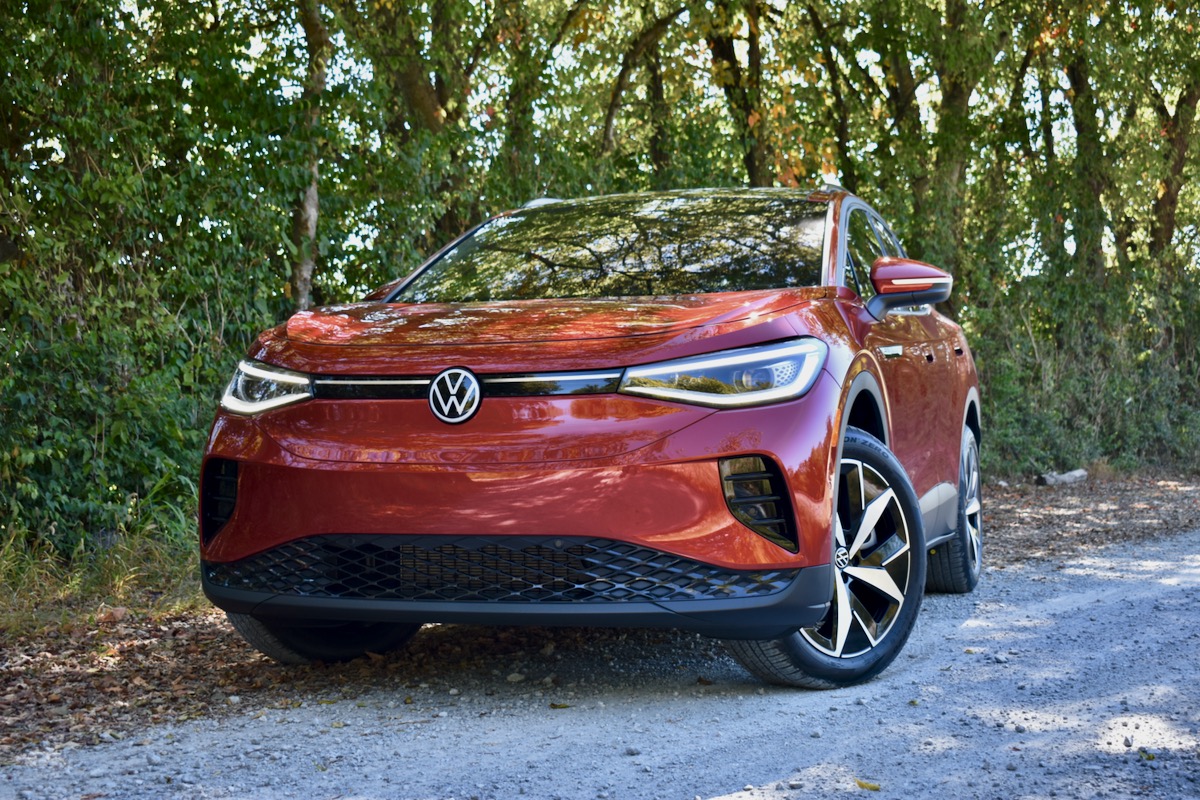
A new entry-level variant brings the ID.4 closer to VW’s goal of mass-market affordability.
The Volkswagen ID.4 electric car is still relatively new to the marketplace (it debuted for the 2021 model year) but VW is already making some important updates to keep it competitive and fulfil goals set when this compact electric SUV first launched.
The 2023 Volkswagen ID.4 adds a new base model and a smaller 62-kilowatt-hour battery pack alongside the carryover 82-kWh to increase affordability. VW will also begin sourcing cars for its North American dealerships from the same Chattanooga, Tennessee, factory that builds the gasoline-powered Atlas and Atlas Cross Sport. The automaker has been discussing this since the ID.4 was unveiled, but at first cars for our market came from Zwickau, Germany.
The 2023 ID.4 retains single-motor rear-wheel drive (RWD) and dual-motor all-wheel drive (AWD) powertrain options, but gets revised exterior and interior styling, some software changes, and a few more standard tech features and driver aids.
The new-for-2023 base model is dubbed simply ID.4, slotting below the ID.4 Pro and ID.4 Pro AWD. We recently spent a day on a test drive with the U.S. equivalent of the ID.4 Pro AWD model, along with a shorter drive in a base ID.4 model.
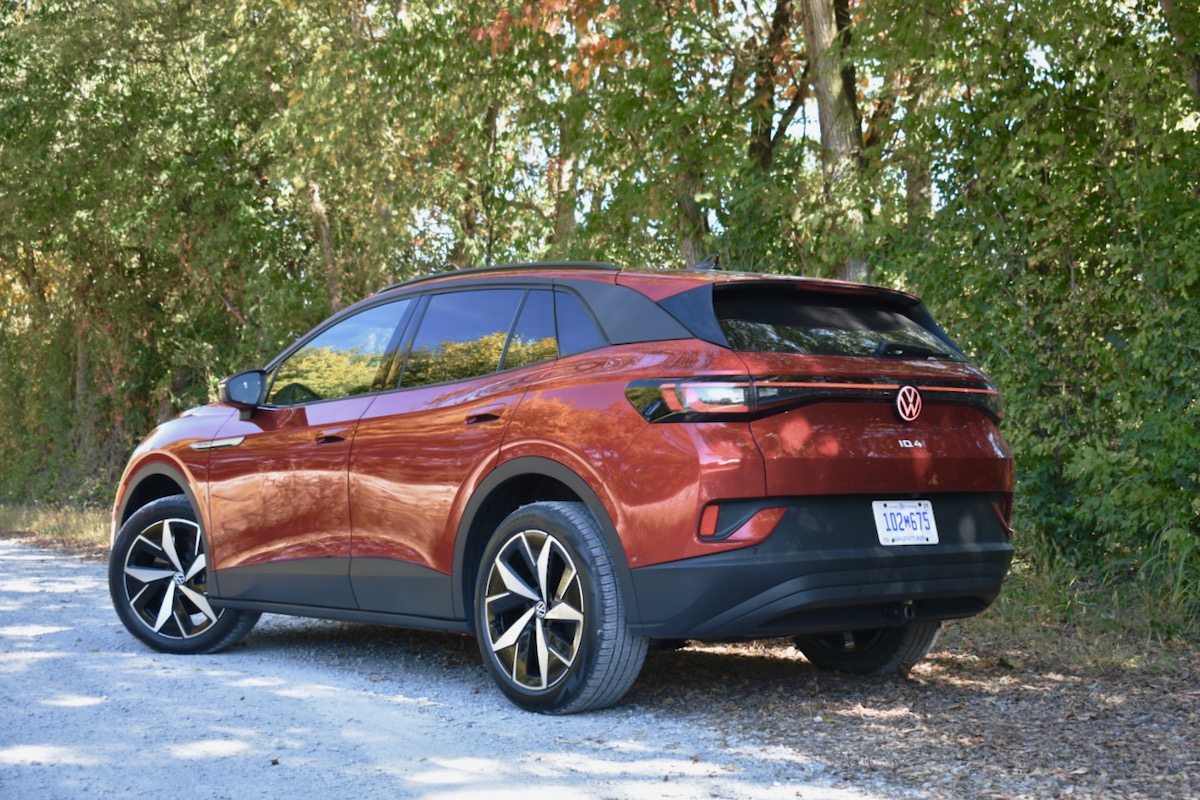
VW made some very subtle styling changes for the 2023 model year. The front bumper now has some gloss black trim, while the rear bumper has a more squared-off design that improves aerodynamics, VW claims. All wheel designs and colours are also new for 2023, and the rear VW logo now lights up.
While it’s easily distinguished as an EV when compared to VW’s gasoline models, the VW ID.4 doesn’t look particularly SUV-like. It lacks the upright profile and added ground clearance of more traditional SUVs, which might be a problem for VW, as those styling features are a big part of the attractiveness of SUVs to new car buyers. But the same could be said about many other current electric vehicles. The Chevrolet Bolt EUV, for example, is marketed as an SUV but is very hard to distinguish from its Bolt EV hatchback sibling.
The ID.4 is based on VW’s MEB platform, which was designed specifically for EVs with built-in modularity to support a wide variety of models. It’s essentially the EV equivalent to the MQB platform that currently underpins everything from the seven-seat Atlas to the VW Jetta compact sedan. The next MEB-based model slated for North America is the Microbus-inspired ID.Buzz electric van, due to arrive here in 2024.
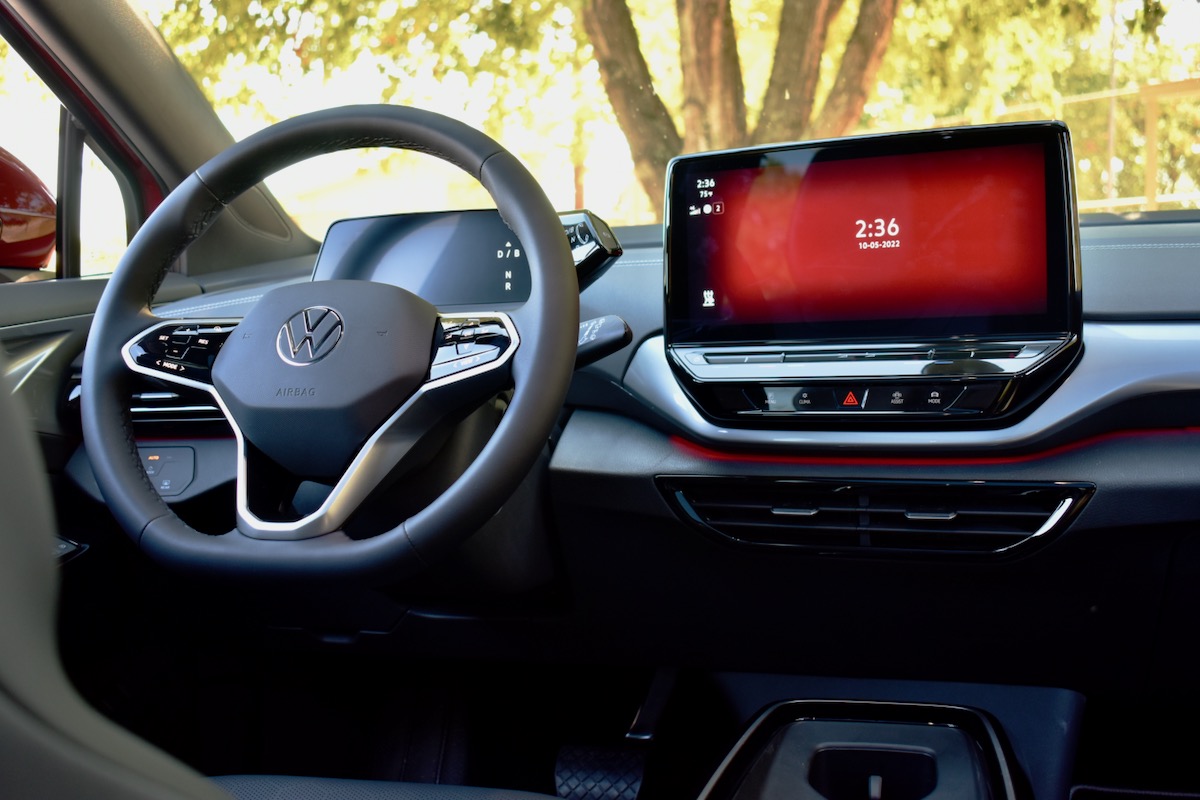
The interior carries over the best qualities from recent VW gasoline-car interiors, including a minimalist design and an overall feeling of quality. That trickles down to the base ID.4 model which, aside from a manual driver’s seat, didn’t seem like much of a downgrade from the higher-level ID.4 Pro AWD we spent most of our driving time in. Leatherette upholstery with seat and door-panel inserts made partly from recycled fibres are standard for 2023.
The new-for-2023 62-kWh battery pack is available on the base model, and only with RWD. The Pro gets the carryover 82-kWh pack and is available with RWD or AWD.
Powertrains and most specs carry over. Regardless of battery pack, single electric motor RWD models are rated at 201 horsepower and 229 pound-feet of torque. The dual-motor AWD powertrain ups output to 295 hp and 339 lb-ft of torque, allowing for zero to 60 mph in 5.7 seconds, according to VW. (0 to 100 km/h times are not published.)
Volkswagen estimates that the smaller battery pack reduces curb weight by 109 kilograms (240 pounds), which should improve acceleration and handling. The 62-kWh ID.4 definitely felt quite spritely during a short drive, but we’d need more seat time for a proper comparison with the larger-battery RWD version. Regardless, it didn’t feel like a downgrade in terms of driving dynamics.
With AWD, the ID.4 has the acceleration to rival hot hatchbacks like VW’s Golf GTI and Golf R, but not the handling. While comfortable and refined, the ID.4 allows too much body roll to be truly entertaining on twisty roads. It was a great way to rack up roughly 320 kilometres of driving, but we couldn’t really take advantage of the nicest driving roads when we found them.
All EVs uses regenerative braking to recover energy while decelerating, but each automaker seems to have a different philosophy. Some automakers pursue one-pedal driving, allowing drivers to avoid using the brake pedal most of the time. VW doesn’t go that far, allowing the ID.4 to coast in its default regen setting, and still stopping short (pun not intended) of one-pedal driving in the more aggressive “B” setting. A lack of one-pedal driving might disappoint some EV fans, but it provides a more familiar experience for EV first-timers.
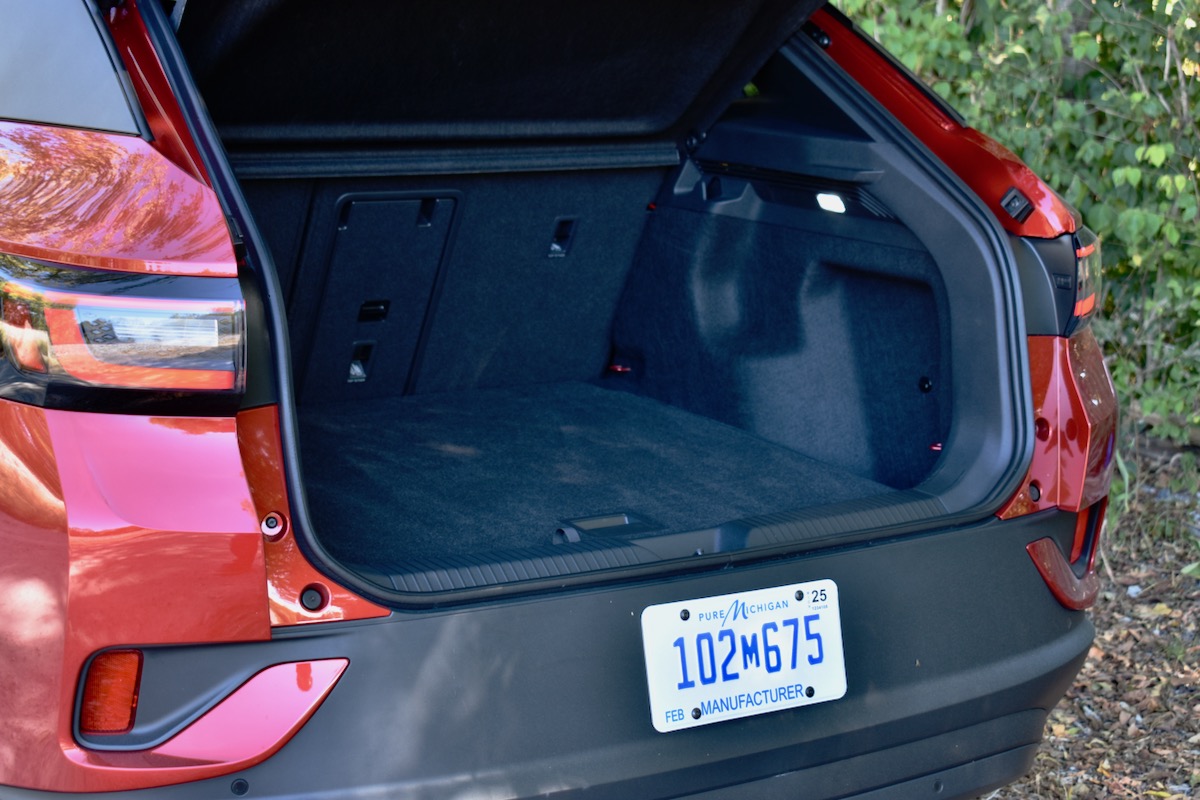
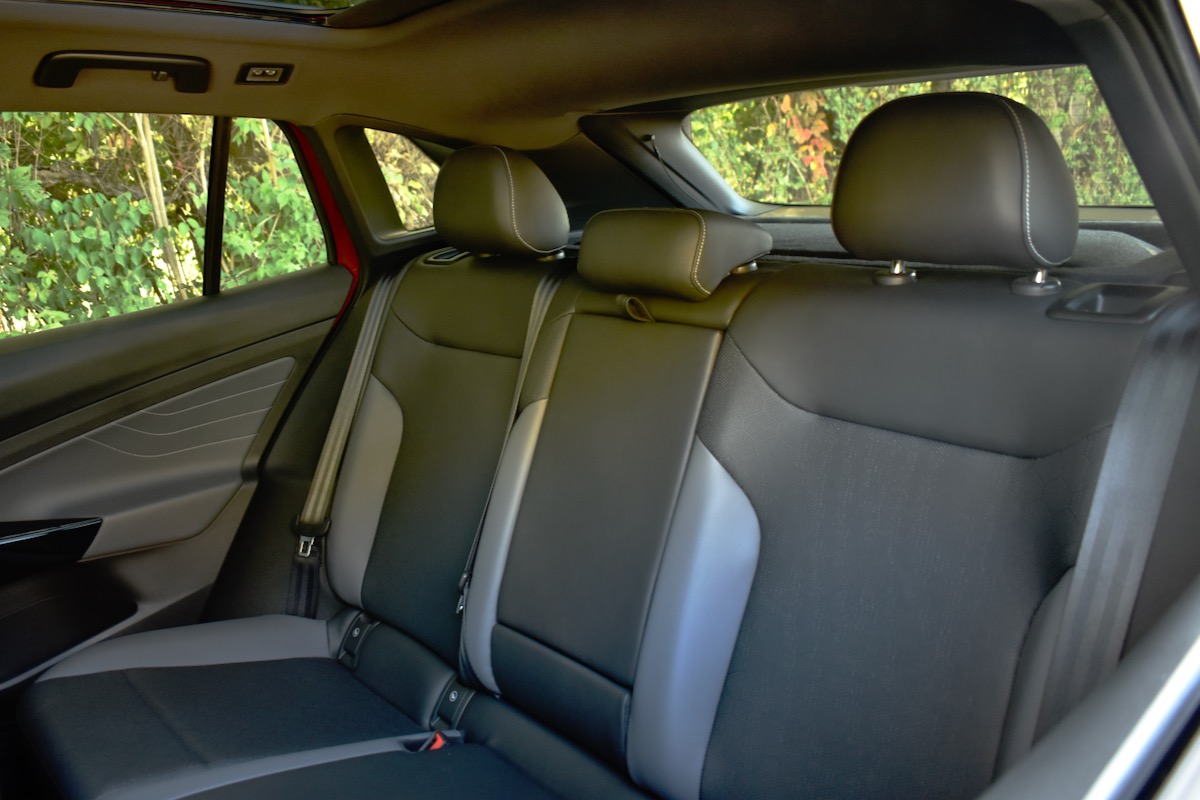
The ID.4 lives up to its SUV billing with more interior space than other affordable EVs. It has more front-seat and rear-seat legroom than a Chevrolet Bolt EV or Nissan Leaf, and more headroom than the freshly redesigned 2023 Kia Niro EV.
At 858 litres of cargo space with the rear seats up, and 1,818 litres with the rear seats folded, the ID.4 also has substantially more cargo space than most other entry-level EVs. It’s worth noting that VW also benchmarks the ID.4 against gasoline crossovers like the Honda CR-V and Toyota RAV4. While it falls short of those vehicles on interior space, it’s definitely the SUV of affordable EVs when it comes to practicality.
SUV buyers may also expect some towing capability, and the ID.4 does deliver on that front. But, again, the figures are only notable when compared to other entry-level EVs. VW’s quoted towing capacity of 1,000 kilograms (2,200 pounds) for RWD models and 1,225 kg (2,700 pounds) for AWD models provides some usable capability, but you won’t be towing a large boat with this car.
VW made some small changes to the interior for 2023 that improve functionality. The centre console now has a conventional lid in place of the previous sliding cover, as well as a better spot for a phone, located between the cupholders and storage bin. Three-zone climate control is now available as well, with rear-seat controls and heated outboard rear seats.
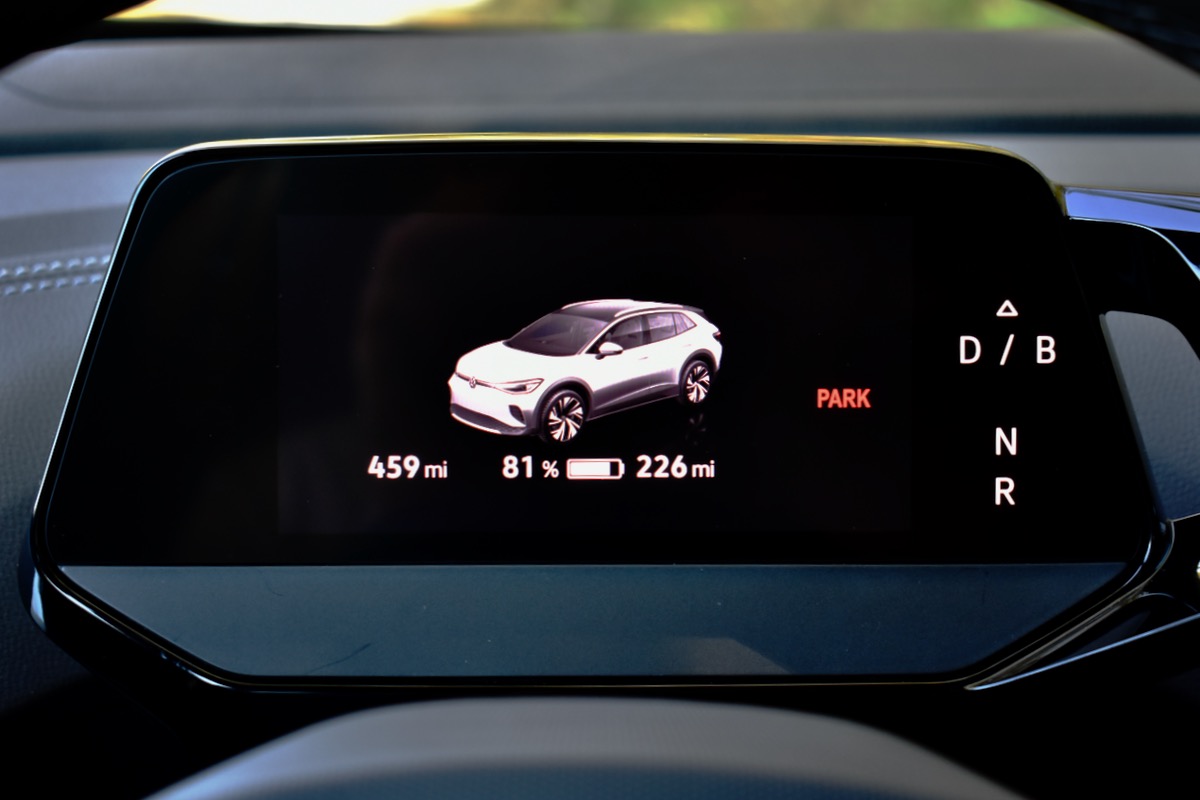
For 2023, the formerly optional 12.0-inch touchscreen is now standard on all models, replacing the 10.0-inch screen on lower trim levels. The infotainment system itself gets some software updates to improve responsiveness, while wireless Apple CarPlay and Android Auto remain standard and the ID.Cockpit digital instrument cluster remain standard.
Despite the software updates, not much has changed about the infotainment system’s user experience. That means you still get sharp graphics and a choice of smartphone-like icons or a more traditional automotive split-screen view for the touchscreen, as well as natural-language voice recognition that can intuit most simple command phrases.
The downside to the ID.4’s user interface remains the haptic touchpads on the dashboard and steering wheel that replace conventional buttons. Unlike buttons, they don’t provide physical feedback, so it’s hard to tell if you’ve actually pressed one. The setup is worryingly distracting although, in our experience, the above-mentioned voice recognition made it redundant in most situations. It was much easier to ask the car to turn down the audio volume or adjust the temperature than to use the dashboard controls.
Another carryover tech feature is ID.Light, which is part ambient lighting system, part AI assistant. Lights around the perimeter of the dashboard change colour depending on the drive mode (in sync with the touchscreen), but will also flash to indicate which direction you should turn when using the navigation system. It’s a clever feature, but one that’s easily overlooked in normal driving, blending in with the array of visual and audio warnings and alerts from the various driver aids.
The National Highway Traffic Safety Administration (NHTSA) gave the 2023 ID.4 a five-star overall safety rating, with five stars in frontal and side crash tests, and four stars in rollover crash tests.
Insurance Institute for Highway Safety (IIHS) crash-test ratings for the 2023 ID.4 haven’t been published, but the similar 2022 model received the IIHS’s highest “Top Safety Pick+” rating. That included top “Good” scores in all crash tests, the top “Superior” rating for vehicle-to-vehicle front crash prevention, and an “Advanced” rating for vehicle-to-pedestrian collision prevention in daylight. The only blemish was an “Average” score for the standard headlights; the headlights on the U.S. Pro S model received a “Good” score, but those are not the headlights we receive here in Canada.
The ID.4 also gets a fairly good complement of standard driver-assist features, including forward collision warning, automatic emergency braking with pedestrian and (new for 2023) cyclist detection, blind-spot monitoring, rear park distance control, automatic high beams, traffic-sign recognition, and VW’s Travel Assist 2.0, which includes adaptive cruise control and automated lane centring. Also standard is Emergency Assist 3.0, which will automatically pull the vehicle over if the driver is incapacitated.
For 2023, the ID.4 also adds standard Park Assist Plus automated parking, an automated lane-change feature for Travel Assist, and a 360-degree camera system.
In the base ID.4 with the smaller battery, Natural Resources Canada estimates the ID.4’s range at 336 kilometres. Move to the larger battery in the Pro and you’ll get a driving range of 443 km with RWD and 410 km with AWD. For reference, the Chevy Bolt EV and Bolt EUV are rated at 417 and 397 kilometres respectively, with a 65-kWh pack.
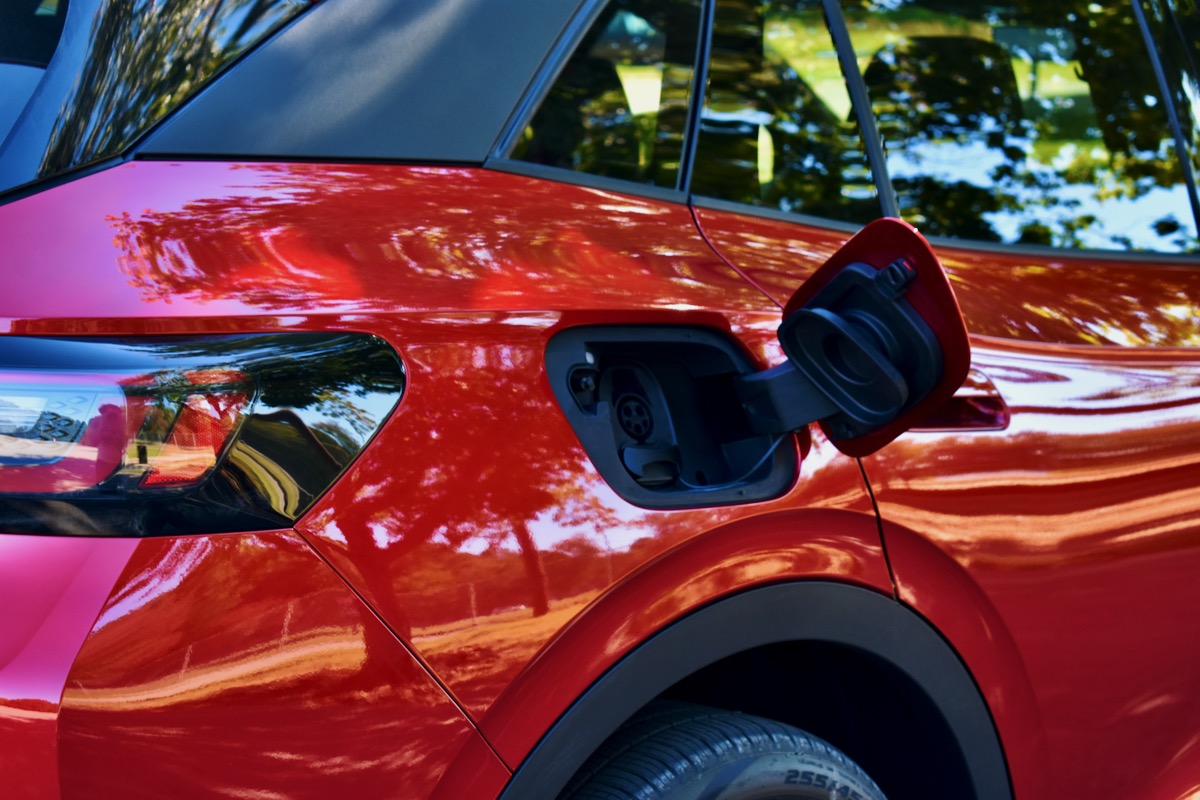
The ID.4 gets a couple of important charging updates for 2023. The DC fast-charging rate for 82-kWh models increases from 135 kilowatts to 170 kW, allowing for a 10% to 80% charge in 30 minutes (62-kWh models charge at 140 kW). The 2023 ID.4 also gets Plug and Charge connectivity, letting drivers start a charging session simply by plugging in at compatible charging stations. For Level 2 AC charging, the onboard 11 kW charger can replenish the 62-kWh battery in six hours and 15 minutes, and the 82-kWh battery in seven hours and 30 minutes.
The ID.4’s standard warranty coverage is unchanged for 2023. VW includes a four-year, 80,000-kilometre, limited warranty for the vehicle itself, and an eight-year, 160,000-km, warranty on battery pack and associated EV drive components.
The base 62-kWh ID.4 starts at a new vehicle price of $49,175 with a $2,050 destination charge, which means it qualifies for the federal iZEV rebate program as well as provincial incentive programs where they exist. The top ID.4 AWD Pro starts at $58,175. Packages are available, most notably the Statement package, priced at $4,700 and available with all trims.
While the ID.4 is one of the more affordable EVs on sale today, it’s by no means the cheapest. The 2023 Chevrolet Bolt EV starts at $41,574 with destination, while its Bolt EUV sibling has a base price of $43,179.
The ID.4 strikes a good balance, however. It’s less bare-bones than other entry-level EVs, with more standard tech and convenience features, as well as a decent amount of interior space. And lower-tier models undercut the Hyundai Ioniq 5, Mach-E, and EV6 in price—as well as the more value-oriented Toyota bZ4X. That’s not a bad place to be.
Note: Images show a US model.

User reviews for 2023 Volkswagen ID.4
Write a review2023 Volkswagen ID.4 Pricing
Trims & specs
Air Conditioning
Automatic climate control front air conditioning · Dual front air conditioning zones
Airbags
Dual front airbags · Passenger airbag deactivation: occupant sensing deactivation · Front side airbags · Rear side curtain airbags
Audio System
Antenna Type: diversity · Voice recognition audio system · Bluetooth auxiliary audio input · AM/FM radio · Satellite Radio: SiriusXM · Total Number of Speakers: 7
Brakes
ABS: 4-wheel · Braking assist: hill start assist · Electronic parking brake: auto off · Front brake diameter: 13.4 · Front brake width: 1.1 · Front brakes: ventilated disc · Rear brake diameter: 11.0 · Rear brake width: 2.00 · Rear brakes: drum
Comfort Features
Door trim: cloth · Floor Mat Material: carpet · Floor Material: cargo area carpet · Floor Mats: front
Convenience Features
Active parking system: fully automated · Adaptive stop and go cruise control: semi-automatic · Ambient lighting: color-adjustable · Assist handle: rear · Autonomous lane guidance: lane changing · Cargo area power outlet: 12V · Center console: front console with armrest and storage · Cruise control: adaptive · Cupholders: front · Dimming rearview mirror: auto-dimming · Multi-function remote: keyless entry with panic alarm · One-touch windows: 4 · Power outlet(s): USB-C front · Power steering: electric · Power windows: lockout button · Reading lights: rear · Steering wheel: tilt and telescopic · Steering wheel mounted controls: audio · Storage: cargo tie-down anchors and hooks · Vanity mirrors: dual illuminating
Driver Seat
Manual adjustments: 6
Drivetrain
Axle ratio: 4.39
Engine
EV battery capacity: 62 kWh · EV on-board charger rating: 11 kW · Electric Charge Cord: 120 volt · Electric Motor Battery Type: lithium ion · Electric Motor HP: 201 · Electric Motor Power Output (Kilowatts): 150 · Electric Motor Torque: 229 · Electric motor charger: DC fast charging · Electric motor charger connector: SAE Combo CCS · Electric motor miles per charge: 209
Exterior Features
Door handle color: body-color · Fender lip moldings: black · Front bumper color: body-color · Grille color: black · Mirror color: body-color · Rear bumper color: body-color · Rear spoiler: roofline spoiler · Rear spoiler color: body-color · Rear trunk/liftgate: liftgate · Rocker panel color: black · Window trim: black
Headrests
Front headrests: adjustable · Number of front headrests: 2 · Number of rear headrests: 3
In Car Entertainment
Connected in-car apps: app marketplace integration · Infotainment: Apply CarPlay ready · Infotainment screen size: 12 in.
Instrumentation
Fuel economy display: range · Warnings and reminders: low battery
Lights
Daytime running lights: LED · Exterior entry lights: security approach lamps · Headlights: LED · Tail and brake lights: LED
Mirrors
Exterior mirrors: manual folding
Passenger Seat
Manual Adjustments: 6
Rear Seats
Type: 60-40 split bench
Roof
Roof rails: black
Safety
Automatic emergency braking: rear · Camera system: rearview · Child seat anchors: LATCH system · Cross Traffic Alert: rear · Crumple zones: front · Impact sensor: door unlock · Parking sensors: rear · Pre-Collision Warning System: visual warning · Pre-collision warning system: pedestrian detection · Rearview monitor: in dash
Seatbelts
Emergency locking retractors: front · Front seatbelts: 3-point · Seatbelt force limiters: front · Seatbelt pretensioners: front · Seatbelt warning sensor: driver and passenger · Second row seatbelts: 3-point
Seats
Driver seat manual adjustments: reclining · Front seat type: bucket · Passenger seat manual adjustments: reclining · Rear headrests: adjustable · Rear seat folding: flat · Upholstery: contrast stitching · Upholstery accents: leatherette
Security
Power door locks: anti-lockout
Spare Tire
Kit: tire sealant
Steering
Steering ratio: 15.9 · Turns lock-to-lock: 3.5
Suspension
Front Arm Type: lower control arms · Front Shock Type: gas shock absorbers · Front Spring Type: coil springs · Front Suspension Classification: independent · Front Suspension Type: MacPherson struts · Rear Shock Type: gas shock absorbers · Rear Spring Type: coil springs · Rear Suspension Classification: independent · Rear Suspension Type: multi-link · Stabilizer bar(s): front
Telematics
Driver assistance app: roadside assistance · Electronic messaging assistance: with voice recognition · Navigation system: touch screen display · Phone: voice activated · Phone wireless data link: Bluetooth · Smart device app compatibility: Car-Net · Smart device app function: engine start · Wifi: hotspot
Tires
Type: all season
Tires and Rims
Wheels: painted aluminum
Wheels
Wheel locks: front and rear
Windows
Front wipers: speed sensitive · Liftgate window: fixed · Power windows: with safety reverse · Rear wiper: intermittent
Air Conditioning
Automatic climate control front air conditioning · Dual front air conditioning zones
Airbags
Dual front airbags · Passenger airbag deactivation: occupant sensing deactivation · Front side airbags · Rear side curtain airbags
Audio System
Antenna Type: mast · Voice recognition audio system · Bluetooth auxiliary audio input · Touch screen display radio · Satellite Radio: SiriusXM · Total Number of Speakers: 7
Brakes
ABS: 4-wheel · Braking assist: hill start assist · Electronic parking brake: auto off · Front brake diameter: 13.4 · Front brake width: 1.1 · Front brakes: ventilated disc · Rear brake diameter: 11.0 · Rear brake width: 2.00 · Rear brakes: drum
Comfort Features
Door trim: cloth · Floor Mat Material: carpet · Floor Material: carpet · Floor Mats: front
Convenience Features
Active parking system: fully automated · Adaptive stop and go cruise control: semi-automatic · Ambient lighting: color-adjustable · Assist handle: front · Autonomous lane guidance: lane changing · Cargo area power outlet: 12V · Center console: front console with armrest and storage · Cruise control: adaptive · Cupholders: rear · Dimming rearview mirror: auto-dimming · Multi-function remote: proximity entry system · One-touch windows: 4 · Power outlet(s): USB-C front · Power steering: speed-proportional · Power windows: lockout button · Reading lights: front · Steering wheel: tilt and telescopic · Steering wheel mounted controls: phone · Storage: in-floor · Vanity mirrors: dual illuminating
Driver Seat
Manual adjustments: 6
Drivetrain
Axle ratio: 4.39
Engine
EV on-board charger rating: 11 kW · Electric Charge Cord: 120 volt · Electric Motor Battery Type: lithium ion · Electric Motor HP: 201 · Electric Motor Power Output (Kilowatts): 150 · Electric Motor Torque: 229 · Electric motor charger: DC fast charging · Electric motor charger connector: SAE Combo CCS · Electric motor miles per charge: 275
Exterior Features
Door handle color: body-color · Fender lip moldings: black · Front bumper color: body-color · Grille color: black · Mirror color: body-color · Rear bumper color: body-color · Rear spoiler: roofline spoiler · Rear spoiler color: body-color · Rear trunk/liftgate: liftgate · Rocker panel color: black · Window trim: black
Headrests
Front headrests: adjustable · Number of front headrests: 2 · Number of rear headrests: 3
Hybrid
EV battery capacity: 82 kWh
In Car Entertainment
Connected in-car apps: Google POIs · Infotainment: Android Auto ready · Infotainment screen size: 12 in.
Instrumentation
Fuel economy display: range · Warnings and reminders: maintenance reminder
Lights
Daytime running lights: LED · Exterior entry lights: security approach lamps · Headlights: Auto on/off · Tail and brake lights: LED
Mirrors
Exterior mirrors: integrated turn signals
Passenger Seat
Manual Adjustments: 6
Rear Seats
Type: 60-40 split bench
Roof
Roof rails: black
Safety
Automatic emergency braking: front · Camera system: rearview · Child seat anchors: LATCH system · Cross Traffic Alert: rear · Crumple zones: rear · Impact sensor: post-collision safety system · Parking sensors: front · Pre-Collision Warning System: audible warning · Pre-collision warning system: pedestrian detection · Rearview monitor: in dash
Seatbelts
Emergency locking retractors: front and rear · Front seatbelts: 3-point · Seatbelt force limiters: front · Seatbelt pretensioners: front · Seatbelt warning sensor: driver and passenger · Second row seatbelts: 3-point
Seats
Driver seat manual adjustments: height · Front seat type: bucket · Passenger seat manual adjustments: height · Rear headrests: adjustable · Rear seat folding: flat · Upholstery: cloth · Upholstery accents: leatherette
Security
Power door locks: anti-lockout
Spare Tire
Kit: inflator kit
Steering
Steering ratio: 15.9 · Turns lock-to-lock: 3.5
Suspension
Front Arm Type: lower control arms · Front Shock Type: gas shock absorbers · Front Spring Type: coil springs · Front Suspension Classification: independent · Front Suspension Type: MacPherson struts · Rear Shock Type: gas shock absorbers · Rear Spring Type: coil springs · Rear Suspension Classification: independent · Rear Suspension Type: multi-link · Stabilizer bar(s): rear
Telematics
Driver assistance app: roadside assistance · Electronic messaging assistance: with voice recognition · Navigation system: with voice recognition · Phone: voice activated · Phone wireless data link: Bluetooth · Smart device app compatibility: Car-Net · Smart device app function: vehicle location · Wifi: hotspot
Tires
Type: all season
Tires and Rims
Wheels: painted aluminum
Wheels
Wheel locks: front and rear
Windows
Front wipers: rain sensing · Liftgate window: fixed · Power windows: with safety reverse · Rear wiper: with washer
Air Conditioning
Automatic climate control front air conditioning · Dual front air conditioning zones
Airbags
Dual front airbags · Passenger airbag deactivation: occupant sensing deactivation · Front side airbags · Rear side curtain airbags
Audio System
Antenna Type: diversity · Voice recognition audio system · Bluetooth auxiliary audio input · AM/FM radio · Satellite Radio: SiriusXM · Total Number of Speakers: 7
Brakes
ABS: 4-wheel · Braking assist: hill start assist · Electronic parking brake: auto off · Front brake diameter: 13.4 · Front brake width: 1.1 · Front brakes: ventilated disc · Rear brake diameter: 11.0 · Rear brake width: 2.00 · Rear brakes: drum
Comfort Features
Armrests: rear center folding with pass-thru · Dash Trim: Leatherette · Door trim: leatherette · Floor Mat Material: carpet · Floor Material: cargo area carpet · Floor Mats: front
Convenience Features
Active parking system: fully automated · Adaptive stop and go cruise control: semi-automatic · Ambient lighting: color-adjustable · Assist handle: rear · Autonomous lane guidance: lane changing · Cargo area power outlet: 12V · Center console: front console with armrest and storage · Cruise control: adaptive · Cupholders: rear · Dimming rearview mirror: auto-dimming · Memorized settings: 2 driver · Multi-function remote: proximity entry system · One-touch windows: 4 · Power outlet(s): USB-C rear · Power steering: speed-proportional · Power windows: lockout button · Reading lights: rear · Steering wheel: tilt and telescopic · Steering wheel mounted controls: audio · Storage: accessory hook · Vanity mirrors: dual illuminating
Driver Seat
Adjustable lumbar support: 4-way power · Power adjustments: 12
Drivetrain
Axle ratio: 4.39
Engine
EV battery capacity: 62 kWh · EV on-board charger rating: 11 kW · Electric Charge Cord: 120 volt · Electric Motor Battery Type: lithium ion · Electric Motor HP: 201 · Electric Motor Power Output (Kilowatts): 150 · Electric Motor Torque: 229 · Electric motor charger: DC fast charging · Electric motor charger connector: SAE Combo CCS · Electric motor miles per charge: 209
Exterior Features
Door handle color: body-color · Fender lip moldings: black · Front bumper color: body-color · Grille color: black · Illuminated accent: front emblem · Mirror color: body-color · Rear bumper color: body-color · Rear spoiler: roofline spoiler · Rear spoiler color: body-color · Rear trunk/liftgate: power operated · Rocker panel color: black · Window trim: black
Headrests
Front headrests: adjustable · Number of front headrests: 2 · Number of rear headrests: 3
In Car Entertainment
Connected in-car apps: Google search · Infotainment: Android Auto ready · Infotainment screen size: 12 in.
Instrumentation
Fuel economy display: range · Warnings and reminders: low battery
Lights
Daytime running lights: LED · Exterior entry lights: security approach lamps · Headlights: Auto on/off · Tail and brake lights: LED
Mirrors
Exterior mirrors: integrated turn signals
Passenger Seat
Adjustable lumbar support: power · Power adjustments: 12
Rear Seats
Type: 60-40 split bench
Roof
Moonroof / Sunroof: power sunshade · Roof rails: black · Sunroof: panoramic
Safety
Automatic emergency braking: front pedestrian · Camera system: rearview · Child seat anchors: LATCH system · Cross Traffic Alert: rear · Crumple zones: rear · Impact sensor: post-collision safety system · Parking sensors: front · Pre-Collision Warning System: visual warning · Pre-collision warning system: pedestrian detection · Rearview monitor: in dash
Seatbelts
Emergency locking retractors: front and rear · Front seatbelts: 3-point · Seatbelt force limiters: front · Seatbelt pretensioners: front · Seatbelt warning sensor: driver and passenger · Second row seatbelts: 3-point
Seats
Driver seat power adjustments: reclining · Front seat type: bucket · Passenger seat power adjustments: 4-way power lumbar · Rear headrests: adjustable · Rear seat folding: flat · Upholstery: perforated
Security
Power door locks: anti-lockout
Spare Tire
Kit: inflator kit
Steering
Steering ratio: 15.9 · Turns lock-to-lock: 3.5
Suspension
Front Arm Type: lower control arms · Front Shock Type: gas shock absorbers · Front Spring Type: coil springs · Front Suspension Classification: independent · Front Suspension Type: MacPherson struts · Rear Shock Type: gas shock absorbers · Rear Spring Type: coil springs · Rear Suspension Classification: independent · Rear Suspension Type: multi-link · Stabilizer bar(s): rear
Telematics
Driver assistance app: roadside assistance · Electronic messaging assistance: with read function · Navigation system: touch screen display · Phone: voice activated · Phone wireless data link: Bluetooth · Smart device app compatibility: Car-Net · Smart device app function: maintenance status · Wifi: hotspot
Tires
Type: all season
Tires and Rims
Wheels: painted aluminum
Wheels
Wheel locks: front and rear · Wheel spokes: 5
Windows
Front wipers: rain sensing · Liftgate window: fixed · Power windows: with safety reverse · Rear wiper: with washer
Air Conditioning
Automatic climate control front air conditioning · Dual front air conditioning zones
Airbags
Dual front airbags · Passenger airbag deactivation: occupant sensing deactivation · Front side airbags · Rear side curtain airbags
Audio System
Antenna Type: diversity · Voice recognition audio system · USB auxiliary audio input · HD radio · Satellite Radio: SiriusXM · Total Number of Speakers: 7
Brakes
ABS: 4-wheel · Braking assist: hill start assist · Electronic parking brake: auto off · Front brake diameter: 14.1 · Front brake width: 1.2 · Front brakes: ventilated disc · Rear brake diameter: 11.0 · Rear brake width: 2.00 · Rear brakes: drum
Comfort Features
Door trim: cloth · Floor Mat Material: carpet · Floor Material: carpet · Floor Mats: front
Convenience Features
Active parking system: fully automated · Adaptive stop and go cruise control: semi-automatic · Ambient lighting: color-adjustable · Assist handle: front · Autonomous lane guidance: lane changing · Cargo area power outlet: 12V · Center console: front console with armrest and storage · Cruise control: adaptive · Cupholders: rear · Dimming rearview mirror: auto-dimming · Multi-function remote: trunk release · One-touch windows: 4 · Power outlet(s): USB-C front · Power steering: speed-proportional · Power windows: lockout button · Reading lights: rear · Steering wheel: tilt and telescopic · Steering wheel mounted controls: audio · Storage: in-floor · Vanity mirrors: dual illuminating
Driver Seat
Manual adjustments: 6
Drivetrain
4WD Type: full time · Axle ratio: 3.90
Engine
EV on-board charger rating: 11 kW · Electric Charge Cord: 120 volt · Electric Motor Battery Type: lithium ion · Electric Motor HP: 295 · Electric Motor Power Output (Kilowatts): 220 · Electric Motor Torque: 339 · Electric motor charger: DC fast charging · Electric motor charger connector: SAE Combo CCS · Electric motor miles per charge: 255
Exterior Features
Bumper detail: front underguard · Door handle color: body-color · Fender lip moldings: black · Front bumper color: body-color · Grille color: black · Mirror color: body-color · Rear bumper color: body-color · Rear spoiler: roofline spoiler · Rear spoiler color: body-color · Rear trunk/liftgate: liftgate · Rocker panel color: black · Window trim: black
Headrests
Front headrests: adjustable · Number of front headrests: 2 · Number of rear headrests: 3
Hybrid
EV battery capacity: 82 kWh
In Car Entertainment
Connected in-car apps: Google search · Infotainment: Apply CarPlay ready · Infotainment screen size: 12 in.
Instrumentation
Fuel economy display: range · Warnings and reminders: maintenance reminder
Lights
Daytime running lights: LED · Exterior entry lights: security approach lamps · Headlights: automatic high beam dimmer · Tail and brake lights: LED
Mirrors
Exterior mirrors: power
Passenger Seat
Manual Adjustments: 6
Rear Seats
Type: 60-40 split bench
Roof
Roof rails: black
Safety
Automatic emergency braking: front · Camera system: rearview · Child seat anchors: LATCH system · Cross Traffic Alert: rear · Crumple zones: front · Impact sensor: post-collision safety system · Parking sensors: rear · Pre-Collision Warning System: visual warning · Pre-collision warning system: pedestrian detection · Rearview monitor: in dash
Seatbelts
Emergency locking retractors: front and rear · Front seatbelts: 3-point · Seatbelt force limiters: front · Seatbelt pretensioners: front · Seatbelt warning sensor: driver and passenger · Second row seatbelts: 3-point
Seats
Driver seat manual adjustments: height · Front seat type: bucket · Passenger seat manual adjustments: reclining · Rear headrests: adjustable · Rear seat folding: split · Upholstery: contrast stitching · Upholstery accents: leatherette
Security
Power door locks: anti-lockout
Spare Tire
Kit: inflator kit
Steering
Steering ratio: 15.9 · Turns lock-to-lock: 3.0
Suspension
Front Arm Type: lower control arms · Front Shock Type: gas shock absorbers · Front Spring Type: coil springs · Front Suspension Classification: independent · Front Suspension Type: MacPherson struts · Rear Shock Type: gas shock absorbers · Rear Spring Type: coil springs · Rear Suspension Classification: independent · Rear Suspension Type: multi-link · Stabilizer bar(s): rear
Telematics
Driver assistance app: roadside assistance · Electronic messaging assistance: with voice recognition · Navigation system: touch screen display · Phone: voice activated · Phone wireless data link: Bluetooth · Smart device app compatibility: Car-Net · Smart device app function: maintenance scheduling · Wifi: hotspot
Tires
Type: all season
Tires and Rims
Wheels: painted aluminum
Wheels
Wheel locks: front and rear
Windows
Front wipers: variable intermittent · Liftgate window: fixed · Power windows: with safety reverse · Rear wiper: intermittent
Air Conditioning
Automatic climate control front air conditioning · Dual front air conditioning zones
Airbags
Dual front airbags · Passenger airbag deactivation: occupant sensing deactivation · Front side airbags · Front side curtain airbags
Audio System
Antenna Type: mast · Voice recognition audio system · USB auxiliary audio input · HD radio · Satellite Radio: SiriusXM · Total Number of Speakers: 7
Brakes
ABS: 4-wheel · Braking assist: hill start assist · Electronic parking brake: auto off · Front brake diameter: 13.4 · Front brake width: 1.1 · Front brakes: ventilated disc · Rear brake diameter: 11.0 · Rear brake width: 2.00 · Rear brakes: drum
Comfort Features
Armrests: rear center with cupholders · Dash Trim: Leatherette · Door trim: leatherette · Floor Mat Material: carpet · Floor Material: carpet · Floor Mats: front
Convenience Features
Active parking system: fully automated · Adaptive stop and go cruise control: semi-automatic · Ambient lighting: color-adjustable · Assist handle: rear · Autonomous lane guidance: lane changing · Cargo area power outlet: 12V · Center console: front console with armrest and storage · Cruise control: adaptive · Cupholders: rear · Dimming rearview mirror: auto-dimming · Memorized settings: driver seat · Multi-function remote: keyless entry with panic alarm · One-touch windows: 4 · Power outlet(s): USB-C rear · Power steering: speed-proportional · Power windows: lockout button · Reading lights: rear · Steering wheel: tilt and telescopic · Steering wheel mounted controls: audio · Storage: in-floor · Vanity mirrors: dual illuminating
Driver Seat
Adjustable lumbar support: 4-way power · Power adjustments: 12
Drivetrain
Axle ratio: 4.39
Engine
EV on-board charger rating: 11 kW · Electric Charge Cord: 120 volt · Electric Motor Battery Type: lithium ion · Electric Motor HP: 201 · Electric Motor Power Output (Kilowatts): 150 · Electric Motor Torque: 229 · Electric motor charger: DC fast charging · Electric motor charger connector: SAE Combo CCS · Electric motor miles per charge: 275
Exterior Features
Door handle color: body-color · Fender lip moldings: black · Front bumper color: body-color · Grille color: black · Illuminated accent: front emblem · Mirror color: body-color · Rear bumper color: body-color · Rear spoiler: roofline spoiler · Rear spoiler color: body-color · Rear trunk/liftgate: liftgate · Rocker panel color: black · Window trim: black
Headrests
Front headrests: adjustable · Number of front headrests: 2 · Number of rear headrests: 3
Hybrid
EV battery capacity: 82 kWh
In Car Entertainment
Connected in-car apps: Google POIs · Infotainment: Android Auto ready · Infotainment screen size: 12 in.
Instrumentation
Fuel economy display: range · Warnings and reminders: maintenance reminder
Lights
Daytime running lights: LED · Exterior entry lights: security approach lamps · Headlights: automatic high beam dimmer · Tail and brake lights: LED
Mirrors
Exterior mirrors: integrated turn signals
Passenger Seat
Adjustable lumbar support: power · Power adjustments: 12
Rear Seats
Type: 60-40 split bench
Roof
Moonroof / Sunroof: power sunshade · Roof rails: black · Sunroof: panoramic
Safety
Automatic emergency braking: rear · Camera system: rearview · Child seat anchors: LATCH system · Cross Traffic Alert: rear · Crumple zones: front · Impact sensor: door unlock · Parking sensors: rear · Pre-Collision Warning System: visual warning · Pre-collision warning system: pedestrian detection · Rearview monitor: in dash
Seatbelts
Emergency locking retractors: front and rear · Front seatbelts: 3-point · Seatbelt force limiters: front · Seatbelt pretensioners: front · Seatbelt warning sensor: driver and passenger · Second row seatbelts: 3-point
Seats
Driver seat power adjustments: reclining · Front seat type: bucket · Passenger seat power adjustments: 4-way power lumbar · Rear headrests: adjustable · Rear seat folding: flat · Upholstery: leatherette
Security
Power door locks: anti-lockout
Spare Tire
Kit: tire sealant
Steering
Steering ratio: 15.9 · Turns lock-to-lock: 3.5
Suspension
Front Arm Type: lower control arms · Front Shock Type: gas shock absorbers · Front Spring Type: coil springs · Front Suspension Classification: independent · Front Suspension Type: MacPherson struts · Rear Shock Type: gas shock absorbers · Rear Spring Type: coil springs · Rear Suspension Classification: independent · Rear Suspension Type: multi-link · Stabilizer bar(s): front
Telematics
Driver assistance app: roadside assistance · Electronic messaging assistance: with read function · Navigation system: touch screen display · Phone: voice activated · Phone wireless data link: Bluetooth · Smart device app compatibility: Amazon Alexa · Smart device app function: engine start · Wifi: hotspot
Tires
Type: all season
Tires and Rims
Wheels: painted aluminum
Wheels
Wheel locks: front and rear · Wheel spokes: 5
Windows
Front wipers: speed sensitive · Liftgate window: fixed · Power windows: with safety reverse · Rear wiper: intermittent
Air Conditioning
Automatic climate control front air conditioning · Dual front air conditioning zones · Rear air conditioning: with independent controls · Single rear air conditioning zones
Airbags
Dual front airbags · Passenger airbag deactivation: occupant sensing deactivation · Front side airbags · Rear side curtain airbags
Audio System
Antenna Type: mast · Voice recognition audio system · Bluetooth auxiliary audio input · HD radio · Satellite Radio: SiriusXM · Total Number of Speakers: 7
Brakes
ABS: 4-wheel · Braking assist: hill start assist · Electronic parking brake: auto off · Front brake diameter: 13.4 · Front brake width: 1.1 · Front brakes: ventilated disc · Rear brake diameter: 11.0 · Rear brake width: 2.00 · Rear brakes: drum
Comfort Features
Armrests: rear center folding with pass-thru · Dash Trim: Leatherette · Door trim: leatherette · Floor Mat Material: carpet · Floor Material: cargo area carpet · Floor Mats: front
Convenience Features
Active parking system: fully automated · Adaptive stop and go cruise control: semi-automatic · Ambient lighting: color-adjustable · Assist handle: front · Autonomous lane guidance: lane changing · Cargo area power outlet: 12V · Center console: front console with armrest and storage · Cruise control: adaptive · Cupholders: rear · Dimming rearview mirror: auto-dimming · Memorized settings: side mirrors · Multi-function remote: proximity entry system · One-touch windows: 4 · Power outlet(s): USB-C rear · Power steering: speed-proportional · Power windows: lockout button · Reading lights: front · Steering wheel: tilt and telescopic · Steering wheel mounted controls: phone · Storage: in-floor · Vanity mirrors: dual illuminating
Driver Seat
Adjustable lumbar support: 4-way power · Power adjustments: 12
Drivetrain
Axle ratio: 4.39
Engine
EV on-board charger rating: 11 kW · Electric Charge Cord: 120 volt · Electric Motor Battery Type: lithium ion · Electric Motor HP: 201 · Electric Motor Power Output (Kilowatts): 150 · Electric Motor Torque: 229 · Electric motor charger: DC fast charging · Electric motor charger connector: SAE Combo CCS · Electric motor miles per charge: 275
Exterior Features
Door handle color: body-color · Fender lip moldings: black · Front bumper color: body-color · Grille color: black · Illuminated accent: front emblem · Mirror color: body-color · Rear bumper color: body-color · Rear spoiler: roofline spoiler · Rear spoiler color: body-color · Rear trunk/liftgate: sensor-activated · Rocker panel color: black · Window trim: black
Headrests
Front headrests: adjustable · Number of front headrests: 2 · Number of rear headrests: 3
Hybrid
EV battery capacity: 82 kWh
In Car Entertainment
Connected in-car apps: Google search · Infotainment: Apply CarPlay ready · Infotainment screen size: 12 in.
Instrumentation
Fuel economy display: range · Warnings and reminders: maintenance reminder
Lights
Daytime running lights: LED · Exterior entry lights: puddle lamps · Headlights: Auto on/off · Tail and brake lights: LED
Mirrors
Exterior mirrors: integrated turn signals
Passenger Seat
Adjustable lumbar support: power · Power adjustments: 12
Rear Seats
Type: 60-40 split bench
Roof
Moonroof / Sunroof: power sunshade · Roof rails: silver · Sunroof: panoramic
Safety
Automatic emergency braking: rear · Camera system: surround view · Child seat anchors: LATCH system · Cross Traffic Alert: rear · Crumple zones: front · Impact sensor: post-collision safety system · Parking sensors: rear · Pre-Collision Warning System: audible warning · Pre-collision warning system: pedestrian detection · Rearview monitor: in dash
Seatbelts
Emergency locking retractors: front and rear · Front seatbelts: 3-point · Seatbelt force limiters: front · Seatbelt pretensioners: front · Seatbelt warning sensor: driver and passenger · Second row seatbelts: 3-point
Seats
Driver seat power adjustments: reclining · Front seat type: bucket · Passenger seat power adjustments: 4-way power lumbar · Rear headrests: adjustable · Rear seat folding: split · Upholstery: perforated
Security
Power door locks: anti-lockout
Spare Tire
Kit: inflator kit
Steering
Steering ratio: 15.9 · Turns lock-to-lock: 3.5
Suspension
Front Arm Type: lower control arms · Front Shock Type: gas shock absorbers · Front Spring Type: coil springs · Front Suspension Classification: independent · Front Suspension Type: MacPherson struts · Rear Shock Type: gas shock absorbers · Rear Spring Type: coil springs · Rear Suspension Classification: independent · Rear Suspension Type: multi-link · Stabilizer bar(s): rear
Telematics
Driver assistance app: roadside assistance · Electronic messaging assistance: with read function · Navigation system: with voice recognition · Phone: voice activated · Phone wireless data link: Bluetooth · Smart device app compatibility: Car-Net · Smart device app function: maintenance status · Wifi: hotspot
Tires
Type: all season
Tires and Rims
Wheels: painted aluminum
Wheels
Wheel locks: front and rear
Windows
Front wipers: rain sensing · Liftgate window: fixed · Power windows: with safety reverse · Rear wiper: with washer
Air Conditioning
Automatic climate control front air conditioning · Dual front air conditioning zones · Rear air conditioning: with independent controls · Single rear air conditioning zones
Airbags
Dual front airbags · Passenger airbag deactivation: occupant sensing deactivation · Front side airbags · Rear side curtain airbags
Audio System
Antenna Type: mast · Voice recognition audio system · Bluetooth auxiliary audio input · Touch screen display radio · Satellite Radio: SiriusXM · 1 subwoofer
Brakes
ABS: 4-wheel · Braking assist: hill start assist · Electronic parking brake: auto off · Front brake diameter: 13.4 · Front brake width: 1.1 · Front brakes: ventilated disc · Rear brake diameter: 11.0 · Rear brake width: 2.00 · Rear brakes: drum
Comfort Features
Armrests: rear center folding with pass-thru · Dash Trim: Leatherette · Door trim: leatherette · Floor Mat Material: carpet · Floor Material: cargo area carpet · Floor Mats: front
Convenience Features
Active parking system: fully automated · Adaptive stop and go cruise control: semi-automatic · Ambient lighting: color-adjustable · Assist handle: rear · Autonomous lane guidance: lane changing · Cargo area power outlet: 12V · Center console: front console with armrest and storage · Cruise control: adaptive · Cupholders: rear · Dimming rearview mirror: auto-dimming · Memorized settings: side mirrors · Multi-function remote: keyless entry with panic alarm · One-touch windows: 4 · Power outlet(s): USB-C rear · Power steering: electric · Power windows: lockout button · Reading lights: rear · Steering wheel: tilt and telescopic · Steering wheel mounted controls: voice recognition controls · Storage: in-floor · Vanity mirrors: dual illuminating
Driver Seat
Adjustable lumbar support: 4-way power · Power adjustments: 12
Drivetrain
Axle ratio: 4.39
Engine
EV on-board charger rating: 11 kW · Electric Charge Cord: 120 volt · Electric Motor Battery Type: lithium ion · Electric Motor HP: 201 · Electric Motor Power Output (Kilowatts): 150 · Electric Motor Torque: 229 · Electric motor charger: DC fast charging · Electric motor charger connector: SAE Combo CCS · Electric motor miles per charge: 275
Exterior Features
Door handle color: body-color · Fender lip moldings: black · Front bumper color: body-color · Grille color: black · Illuminated accent: front emblem · Mirror color: body-color · Rear bumper color: body-color · Rear spoiler: roofline spoiler · Rear spoiler color: body-color · Rear trunk/liftgate: sensor-activated · Rocker panel color: black · Window trim: black
Headrests
Front headrests: adjustable · Number of front headrests: 2 · Number of rear headrests: 3
Hybrid
EV battery capacity: 82 kWh
In Car Entertainment
Connected in-car apps: app marketplace integration · Infotainment: Android Auto ready · Infotainment screen size: 12 in.
Instrumentation
Fuel economy display: range · Warnings and reminders: lamp failure
Lights
Daytime running lights: LED · Exterior entry lights: security approach lamps · Headlights: automatic high beam dimmer · Tail and brake lights: LED
Mirrors
Exterior mirrors: power folding
Passenger Seat
Adjustable lumbar support: power · Power adjustments: 12
Rear Seats
Type: 60-40 split bench
Roof
Moonroof / Sunroof: power sunshade · Roof rails: silver · Sunroof: panoramic
Safety
Automatic emergency braking: front · Camera system: surround view · Child seat anchors: LATCH system · Cross Traffic Alert: rear · Crumple zones: front · Impact sensor: alert system · Parking sensors: front · Pre-Collision Warning System: visual warning · Pre-collision warning system: pedestrian detection · Rearview monitor: in dash
Seatbelts
Emergency locking retractors: front and rear · Front seatbelts: 3-point · Seatbelt force limiters: front · Seatbelt pretensioners: front · Seatbelt warning sensor: driver and passenger · Second row seatbelts: 3-point
Seats
Driver seat power adjustments: reclining · Front seat type: bucket · Passenger seat power adjustments: reclining · Rear headrests: adjustable · Rear seat folding: split · Upholstery: leatherette
Security
Power door locks: anti-lockout
Spare Tire
Kit: tire sealant
Steering
Steering ratio: 15.9 · Turns lock-to-lock: 3.5
Suspension
Front Arm Type: lower control arms · Front Shock Type: gas shock absorbers · Front Spring Type: coil springs · Front Suspension Classification: independent · Front Suspension Type: MacPherson struts · Rear Shock Type: gas shock absorbers · Rear Spring Type: coil springs · Rear Suspension Classification: independent · Rear Suspension Type: multi-link · Stabilizer bar(s): front
Telematics
Driver assistance app: roadside assistance · Electronic messaging assistance: with voice recognition · Navigation system: touch screen display · Phone: voice activated · Phone wireless data link: Bluetooth · Smart device app compatibility: Amazon Alexa · Smart device app function: vehicle location · Wifi: hotspot
Tires
Type: all season
Tires and Rims
Wheels: painted aluminum
Wheels
Wheel locks: front and rear
Windows
Front wipers: variable intermittent · Liftgate window: fixed · Power windows: with safety reverse · Rear wiper: with washer
Air Conditioning
Automatic climate control front air conditioning · Dual front air conditioning zones
Airbags
Dual front airbags · Passenger airbag deactivation: occupant sensing deactivation · Front side airbags · Rear side curtain airbags
Audio System
Antenna Type: mast · Voice recognition audio system · USB auxiliary audio input · AM/FM radio · Satellite Radio: SiriusXM · Total Number of Speakers: 7
Brakes
ABS: 4-wheel · Braking assist: hill start assist · Electronic parking brake: auto off · Front brake diameter: 14.1 · Front brake width: 1.2 · Front brakes: ventilated disc · Rear brake diameter: 11.0 · Rear brake width: 2.00 · Rear brakes: drum
Comfort Features
Armrests: rear center with cupholders · Dash Trim: Leatherette · Door trim: leatherette · Floor Mat Material: carpet · Floor Material: cargo area carpet · Floor Mats: front
Convenience Features
Active parking system: fully automated · Adaptive stop and go cruise control: semi-automatic · Ambient lighting: color-adjustable · Assist handle: rear · Autonomous lane guidance: lane changing · Cargo area power outlet: 12V · Center console: front console with armrest and storage · Cruise control: adaptive · Cupholders: front · Dimming rearview mirror: auto-dimming · Memorized settings: driver seat · Multi-function remote: trunk release · One-touch windows: 4 · Power outlet(s): USB-C rear · Power steering: speed-proportional · Power windows: lockout button · Reading lights: front · Steering wheel: tilt and telescopic · Steering wheel mounted controls: phone · Storage: in-floor · Vanity mirrors: dual illuminating
Driver Seat
Adjustable lumbar support: 4-way power · Power adjustments: 12
Drivetrain
4WD Type: full time · Axle ratio: 3.90
Engine
EV on-board charger rating: 11 kW · Electric Charge Cord: 120 volt · Electric Motor Battery Type: lithium ion · Electric Motor HP: 295 · Electric Motor Power Output (Kilowatts): 220 · Electric Motor Torque: 339 · Electric motor charger: DC fast charging · Electric motor charger connector: SAE Combo CCS · Electric motor miles per charge: 255
Exterior Features
Bumper detail: front underguard · Door handle color: body-color · Fender lip moldings: black · Front bumper color: body-color · Grille color: black · Illuminated accent: front emblem · Mirror color: body-color · Rear bumper color: body-color · Rear spoiler: roofline spoiler · Rear spoiler color: body-color · Rear trunk/liftgate: power operated · Rocker panel color: black · Window trim: black
Headrests
Front headrests: adjustable · Number of front headrests: 2 · Number of rear headrests: 3
Hybrid
EV battery capacity: 82 kWh
In Car Entertainment
Connected in-car apps: Google search · Infotainment: Android Auto ready · Infotainment screen size: 12 in.
Instrumentation
Fuel economy display: range · Warnings and reminders: lamp failure
Lights
Daytime running lights: LED · Exterior entry lights: security approach lamps · Headlights: automatic high beam dimmer · Tail and brake lights: LED
Mirrors
Exterior mirrors: power
Passenger Seat
Adjustable lumbar support: power · Power adjustments: 12
Rear Seats
Type: 60-40 split bench
Roof
Moonroof / Sunroof: power sunshade · Roof rails: black · Sunroof: panoramic
Safety
Automatic emergency braking: front pedestrian · Camera system: rearview · Child seat anchors: LATCH system · Cross Traffic Alert: rear · Crumple zones: front · Impact sensor: door unlock · Parking sensors: front · Pre-Collision Warning System: audible warning · Pre-collision warning system: pedestrian detection · Rearview monitor: in dash
Seatbelts
Emergency locking retractors: front and rear · Front seatbelts: 3-point · Seatbelt force limiters: front · Seatbelt pretensioners: front · Seatbelt warning sensor: driver and passenger · Second row seatbelts: 3-point
Seats
Driver seat power adjustments: reclining · Front seat type: bucket · Passenger seat power adjustments: reclining · Rear headrests: adjustable · Rear seat folding: split · Upholstery: leatherette
Security
Power door locks: anti-lockout
Spare Tire
Kit: tire sealant
Steering
Steering ratio: 15.9 · Turns lock-to-lock: 3.0
Suspension
Front Arm Type: lower control arms · Front Shock Type: gas shock absorbers · Front Spring Type: coil springs · Front Suspension Classification: independent · Front Suspension Type: MacPherson struts · Rear Shock Type: gas shock absorbers · Rear Spring Type: coil springs · Rear Suspension Classification: independent · Rear Suspension Type: multi-link · Stabilizer bar(s): front
Telematics
Driver assistance app: roadside assistance · Electronic messaging assistance: with voice recognition · Navigation system: touch screen display · Phone: voice activated · Phone wireless data link: Bluetooth · Smart device app compatibility: Amazon Alexa · Smart device app function: engine start · Wifi: hotspot
Tires
Type: all season
Tires and Rims
Wheels: painted aluminum
Wheels
Wheel locks: front and rear · Wheel spokes: 5
Windows
Front wipers: speed sensitive · Liftgate window: fixed · Power windows: with safety reverse · Rear wiper: with washer
Air Conditioning
Automatic climate control front air conditioning · Dual front air conditioning zones · Automatic climate control rear air conditioning · Single rear air conditioning zones
Airbags
Dual front airbags · Passenger airbag deactivation: occupant sensing deactivation · Front side airbags · Front side curtain airbags
Audio System
Antenna Type: diversity · Voice recognition audio system · USB auxiliary audio input · Touch screen display radio · Satellite Radio: SiriusXM · Total Number of Speakers: 7
Brakes
ABS: 4-wheel · Braking assist: hill start assist · Electronic parking brake: auto off · Front brake diameter: 14.1 · Front brake width: 1.2 · Front brakes: ventilated disc · Rear brake diameter: 11.0 · Rear brake width: 2.00 · Rear brakes: drum
Comfort Features
Armrests: rear center folding with pass-thru · Dash Trim: Leatherette · Door trim: leatherette · Floor Mat Material: carpet · Floor Material: carpet · Floor Mats: front
Convenience Features
Active parking system: fully automated · Adaptive stop and go cruise control: semi-automatic · Ambient lighting: color-adjustable · Assist handle: rear · Autonomous lane guidance: lane changing · Cargo area power outlet: 12V · Center console: front console with armrest and storage · Cruise control: adaptive · Cupholders: rear · Dimming rearview mirror: auto-dimming · Memorized settings: driver seat · Multi-function remote: proximity entry system · One-touch windows: 4 · Power outlet(s): USB-C rear · Power steering: speed-proportional · Power windows: lockout button · Reading lights: front · Steering wheel: tilt and telescopic · Steering wheel mounted controls: multi-function screen controls · Storage: accessory hook · Vanity mirrors: dual illuminating
Driver Seat
Adjustable lumbar support: 4-way power · Power adjustments: 12
Drivetrain
4WD Type: full time · Axle ratio: 3.90
Engine
EV on-board charger rating: 11 kW · Electric Charge Cord: 120 volt · Electric Motor Battery Type: lithium ion · Electric Motor HP: 295 · Electric Motor Power Output (Kilowatts): 220 · Electric Motor Torque: 339 · Electric motor charger: DC fast charging · Electric motor charger connector: SAE Combo CCS · Electric motor miles per charge: 255
Exterior Features
Bumper detail: front underguard · Door handle color: body-color · Fender lip moldings: black · Front bumper color: body-color · Grille color: black · Illuminated accent: front emblem · Mirror color: body-color · Rear bumper color: body-color · Rear spoiler: roofline spoiler · Rear spoiler color: body-color · Rear trunk/liftgate: power operated · Rocker panel color: black · Window trim: black
Headrests
Front headrests: adjustable · Number of front headrests: 2 · Number of rear headrests: 3
Hybrid
EV battery capacity: 82 kWh
In Car Entertainment
Connected in-car apps: Google POIs · Infotainment: Apply CarPlay ready · Infotainment screen size: 12 in.
Instrumentation
Fuel economy display: range · Warnings and reminders: maintenance reminder
Lights
Daytime running lights: LED · Exterior entry lights: puddle lamps · Headlights: Auto on/off · Tail and brake lights: LED
Mirrors
Exterior mirrors: heated
Passenger Seat
Adjustable lumbar support: power · Power adjustments: 12
Rear Seats
Type: 60-40 split bench
Roof
Moonroof / Sunroof: power sunshade · Roof rails: silver · Sunroof: panoramic
Safety
Automatic emergency braking: front · Camera system: surround view · Child seat anchors: LATCH system · Cross Traffic Alert: rear · Crumple zones: rear · Impact sensor: post-collision safety system · Parking sensors: front · Pre-Collision Warning System: audible warning · Pre-collision warning system: pedestrian detection · Rearview monitor: in dash
Seatbelts
Emergency locking retractors: front · Front seatbelts: 3-point · Seatbelt force limiters: front · Seatbelt pretensioners: front · Seatbelt warning sensor: driver and passenger · Second row seatbelts: 3-point
Seats
Driver seat power adjustments: height · Front seat type: bucket · Passenger seat power adjustments: height · Rear headrests: adjustable · Rear seat folding: flat · Upholstery: perforated
Security
Power door locks: anti-lockout
Spare Tire
Kit: inflator kit
Steering
Steering ratio: 15.9 · Turns lock-to-lock: 3.0
Suspension
Front Arm Type: lower control arms · Front Shock Type: gas shock absorbers · Front Spring Type: coil springs · Front Suspension Classification: independent · Front Suspension Type: MacPherson struts · Rear Shock Type: gas shock absorbers · Rear Spring Type: coil springs · Rear Suspension Classification: independent · Rear Suspension Type: multi-link · Stabilizer bar(s): front
Telematics
Driver assistance app: roadside assistance · Electronic messaging assistance: with read function · Navigation system: with voice recognition · Phone: voice activated · Phone wireless data link: Bluetooth · Smart device app compatibility: Car-Net · Smart device app function: engine start · Wifi: hotspot
Tires
Type: all season
Tires and Rims
Wheels: painted aluminum
Wheels
Wheel locks: front and rear
Windows
Front wipers: rain sensing · Liftgate window: fixed · Power windows: with safety reverse · Rear wiper: intermittent
Air Conditioning
Automatic climate control front air conditioning · Dual front air conditioning zones · Rear air conditioning: with independent controls · Single rear air conditioning zones
Airbags
Dual front airbags · Passenger airbag deactivation: occupant sensing deactivation · Front side airbags · Front side curtain airbags
Audio System
Antenna Type: mast · Voice recognition audio system · Bluetooth auxiliary audio input · HD radio · Satellite Radio: SiriusXM · 1 subwoofer
Brakes
ABS: 4-wheel · Braking assist: hill start assist · Electronic parking brake: auto off · Front brake diameter: 14.1 · Front brake width: 1.2 · Front brakes: ventilated disc · Rear brake diameter: 11.0 · Rear brake width: 2.00 · Rear brakes: drum
Comfort Features
Armrests: rear center folding with pass-thru · Dash Trim: Leatherette · Door trim: leatherette · Floor Mat Material: carpet · Floor Material: carpet · Floor Mats: front
Convenience Features
Active parking system: fully automated · Adaptive stop and go cruise control: semi-automatic · Ambient lighting: color-adjustable · Assist handle: front · Autonomous lane guidance: lane changing · Cargo area power outlet: 12V · Center console: front console with armrest and storage · Cruise control: adaptive · Cupholders: rear · Dimming rearview mirror: auto-dimming · Memorized settings: side mirrors · Multi-function remote: proximity entry system · One-touch windows: 4 · Power outlet(s): USB-C front · Power steering: speed-proportional · Power windows: lockout button · Reading lights: rear · Steering wheel: tilt and telescopic · Steering wheel mounted controls: cruise controls · Storage: cargo tie-down anchors and hooks · Vanity mirrors: dual illuminating
Driver Seat
Adjustable lumbar support: 4-way power · Power adjustments: 12
Drivetrain
4WD Type: full time · Axle ratio: 3.90
Engine
EV on-board charger rating: 11 kW · Electric Charge Cord: 120 volt · Electric Motor Battery Type: lithium ion · Electric Motor HP: 295 · Electric Motor Power Output (Kilowatts): 220 · Electric Motor Torque: 339 · Electric motor charger: DC fast charging · Electric motor charger connector: SAE Combo CCS · Electric motor miles per charge: 255
Exterior Features
Bumper detail: front underguard · Door handle color: body-color · Fender lip moldings: black · Front bumper color: body-color · Grille color: black · Illuminated accent: front emblem · Mirror color: body-color · Rear bumper color: body-color · Rear spoiler: roofline spoiler · Rear spoiler color: body-color · Rear trunk/liftgate: sensor-activated · Rocker panel color: black · Window trim: black
Headrests
Front headrests: adjustable · Number of front headrests: 2 · Number of rear headrests: 3
Hybrid
EV battery capacity: 82 kWh
In Car Entertainment
Connected in-car apps: app marketplace integration · Infotainment: Android Auto ready · Infotainment screen size: 12 in.
Instrumentation
Fuel economy display: range · Warnings and reminders: lamp failure
Lights
Daytime running lights: LED · Exterior entry lights: security approach lamps · Headlights: auto delay off · Tail and brake lights: LED
Mirrors
Exterior mirrors: heated
Passenger Seat
Adjustable lumbar support: power · Power adjustments: 12
Rear Seats
Type: 60-40 split bench
Roof
Moonroof / Sunroof: power sunshade · Roof rails: silver · Sunroof: panoramic
Safety
Automatic emergency braking: rear · Camera system: surround view · Child seat anchors: LATCH system · Cross Traffic Alert: rear · Crumple zones: rear · Impact sensor: alert system · Parking sensors: front · Pre-Collision Warning System: audible warning · Pre-collision warning system: pedestrian detection · Rearview monitor: in dash
Seatbelts
Emergency locking retractors: front · Front seatbelts: 3-point · Seatbelt force limiters: front · Seatbelt pretensioners: front · Seatbelt warning sensor: driver and passenger · Second row seatbelts: 3-point
Seats
Driver seat power adjustments: height · Front seat type: bucket · Passenger seat power adjustments: height · Rear headrests: adjustable · Rear seat folding: flat · Upholstery: contrast stitching
Security
Power door locks: anti-lockout
Spare Tire
Kit: inflator kit
Steering
Steering ratio: 15.9 · Turns lock-to-lock: 3.0
Suspension
Front Arm Type: lower control arms · Front Shock Type: gas shock absorbers · Front Spring Type: coil springs · Front Suspension Classification: independent · Front Suspension Type: MacPherson struts · Rear Shock Type: gas shock absorbers · Rear Spring Type: coil springs · Rear Suspension Classification: independent · Rear Suspension Type: multi-link · Stabilizer bar(s): rear
Telematics
Driver assistance app: roadside assistance · Electronic messaging assistance: with read function · Navigation system: with voice recognition · Phone: voice activated · Phone wireless data link: Bluetooth · Smart device app compatibility: Car-Net · Smart device app function: vehicle location · Wifi: hotspot
Tires
Type: all season
Tires and Rims
Wheels: painted aluminum
Wheels
Wheel locks: front and rear
Windows
Front wipers: speed sensitive · Liftgate window: fixed · Power windows: with safety reverse · Rear wiper: with washer
