2024 Kia Carnival Reviews, Pricing & Specs


Pros & cons
What we like
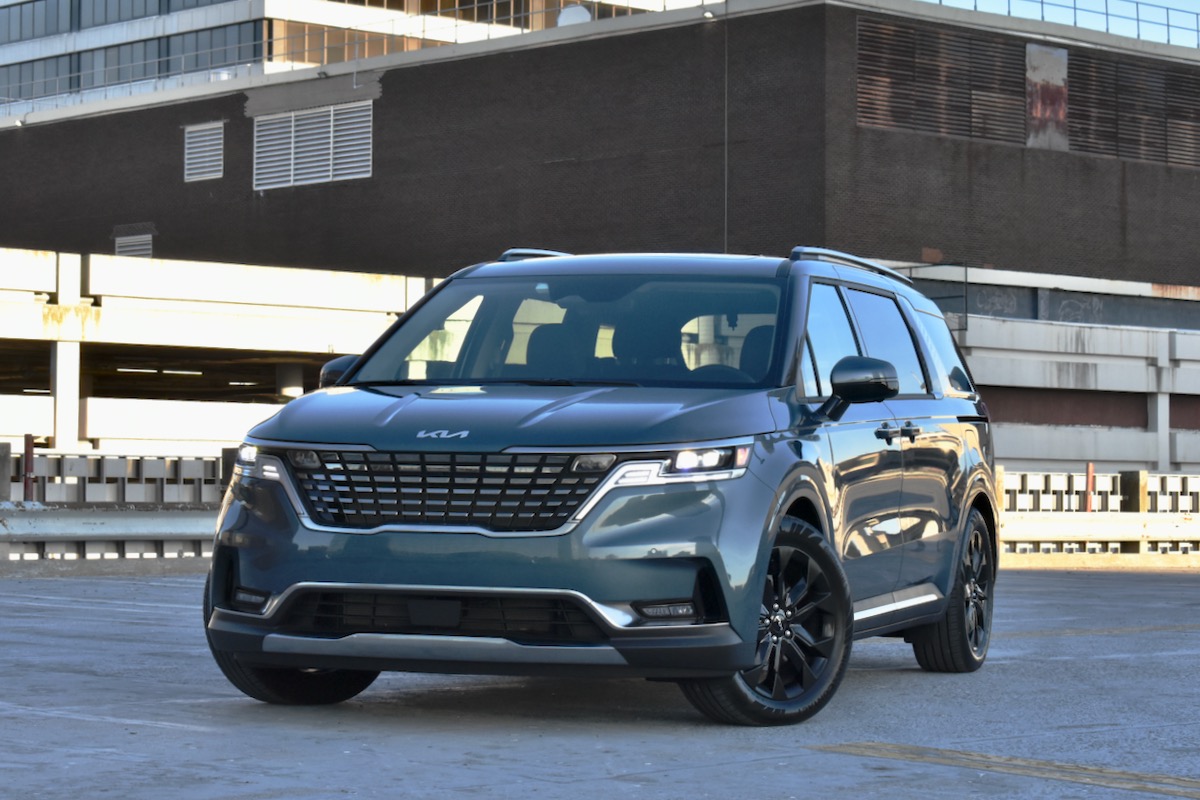
Stylish design
Powerful engine
Excellent value for money
What to consider
Mixed safety ratings
No hybrid or all-wheel drive options
Kia doesn’t make folding the seats easy
The CarGurus verdict
It may have a silly name, but the 2024 Kia Carnival is a seriously good people mover.
Ahead of a 2025-model-year refresh, the 2024 Kia Carnival carries over unchanged as Kia’s entry into a small, but competitive, minivan segment that also includes the Chrysler Pacifica, Honda Odyssey, and Toyota Sienna.
The Carnival offers a great driving experience and affordable starting price, but these upsides are tainted by a lack of all-wheel drive and mixed safety ratings.
out of 10 expert review
Look & feel
Every minivan currently on sale makes some kind of design statement—they have to in order to attract the attention of car shoppers more focused on SUVs. Kia’s strategy seems to have been of the “if you can’t beat ‘em, join ‘em,” variety. The Carnival’s prominent grille, slab sides, and pronounced hood are decidedly SUV-like, although the sliding doors and lack of ground clearance still give it away as a minivan.
There are some interesting styling details when you look closer as well. The grille has a slightly concave shape and disco-ball-like trim, while the taillights have cool filament-like lighting elements. Our test car is the U.S. equivalent of Canada’s top SX trim, and its 19-inch wheels were also perfectly sized, filling out the wheel wells without making the Carnival look like it’s trying too hard. This all gives the Carnival a somewhat more distinctive look than the more restrained, but also handsome, Chrysler Pacifica, without the gawky detailing of its two Japanese rivals.
The SUV-like theme continues inside with chunky switchgear and a big shifter that seems calculated to make image-conscious dads feel better about their new vehicle purchase. They also won’t mistake it for the infotainment controller, as one might with the Pacifica’s rotary shifter. The large buttons and knobs are easy to use as well, in addition to looking rugged.
Our test car felt solidly put together, with materials that acknowledge the abuse a family hauler like this is likely to take over its life span. Base Carnival LX and LX+ models get cloth seats, EX and EX+ models get leatherette upholstery, while SX trims get real leather upholstery. Heated and ventilated first-row and second-row seats, as well as dual sunroofs, are available as well, but Kia didn’t extend the luxury treatment to the rest of the interior, which is mostly plastic even in the SX. Note the base Carnival LX doesn’t come with standard heated seats or a heated steering wheel. If you’re looking for those, you’ll need to pony up for the LX+ grade.
For what it’s worth, few vehicles can match the Carnival’s sheer variety of plastic trim pieces, including piano black, metallic, bits with a fish-scale-like pattern, and textured gray that looks straight out of the 1990s. And we’d rather have these materials than harder-to-clean wood or leather.

Performance
Kia keeps things simple in the powertrain department. The Carnival is only offered with a 3.5-litre V6 engine connected to an eight-speed automatic transmission and front-wheel drive (FWD).
No all-wheel drive (AWD) option is available, nor is there a hybrid powertrain to match the standard offering in the Toyota Sienna, or the Chrysler Pacifica’s available plug-in hybrid powertrain. (A hybrid powertrain has been announced as part of the refresh coming to the Kia Carnival for 2025.) Kia’s current powertrain strategy does match what Honda does with the Odyssey, though. At 290 horsepower and 262 pound-feet of torque, the Carnival’s V6 has 10 hp more than the Odyssey’s similar-sized engine, with the same amount of torque.
The Carnival is also pleasant to drive. Key to this is the steering, which has the perfect amount of feel and effort for a vehicle like this. It’s light enough to make the Carnival’s size a nonissue while maneuvering in parking lots, but still precise enough that you don’t have to make big inputs for small changes in direction. At higher speeds, it’s easy to smoothly position the Carnival for lane changes or corner entries, without upsetting the softly sprung chassis.
Speaking of the chassis, the Carnival also provides a comfortable ride that should make for fatigue-free road trips. Interior noise levels were low, and there’s also an internal speaker system that lets first-row occupants talk to people in the back seats without shouting.
The drivetrain is impressively refined as well. The transmissions shifts so smoothly and quickly that gearchanges are barely noticeable. The V6 does its work without complaint, even emitting a nice growl at full throttle. A naturally aspirated V6 and conventional geared automatic transmission may not be the most efficient combination, but the Carnival is a reminder of why it was so popular before heightened concern over emissions standards spurred the proliferation of turbocharging, continuously variable transmissions (CVTs), and electrification.

Form & function
In Canada, most Carnival grades come standard in an eight-passenger configuration with a second-row removable bench seat. SX models instead receive VIP Lounge seats for the second row with a one-touch sliding and recline function that gives La-Z-Boy a run for its money. Power-sliding rear doors, a power liftgate, and tri-zone automatic climate control are standard on all grades except the base model.
Headroom across all three rows is roughly the same as rival minivans, as is first-row and second-row legroom. The Carnival has the least third-row legroom of any minivan currently on sale, although the difference between the Kia and the next-worst Chrysler Pacifica is fairly small.
With all three rows of seats in place, the Carnival offers substantially more cargo space than other minivans, at 1,138 litres. That’s partly due to a deep cargo well that should help keep grocery bags from sliding around but also makes unloading a bit more awkward. Kia doesn’t list a cargo-space figure with only the third-row seats folded, but the automaker claims 4,110 litres with both the third and second rows folded. That’s just ahead of the Honda Odyssey, but far ahead of the Pacifica and the Toyota Sienna.
A minivan really comes into its own in passenger space. The Carnival is close to the Kia Telluride in headroom and legroom, but its sliding doors and low step-in height make loading and unloading rear-seat passengers much easier. However, the Carnival doesn’t have any special features like the Pacifica’s fold-flat Stow ‘n Go seating to make rearranging the interior easier.
Kia organized the space up front a bit better than Chrysler, though. In contrast to the Pacifica’s form-over-function design, the Carnival’s chunky controls are easy to find at a quick glance. Despite the inclusion of a large shift lever and handy toggle switches for the optional heated seats and steering wheel, Kia still found plenty of room for the obligatory cupholders and phone charger as well. The raised centre console also means most drivers won’t be reaching down, but front-seat occupants also don’t get a storage nook in the space below like they do in the Toyota Sienna.
The Carnival can also tow up to 1,587 kilograms (3,500 pounds)—the same as the Honda Odyssey and Toyota Sienna, and roughly 50 kg (100 pounds) below gasoline versions of the Chrysler Pacifica.

Technology
The LX, LX+, and EX trim levels get an 8-inch touchscreen with wireless Apple CarPlay and Android Auto connectivity. Other trim levels upgrade to a 12.3-inch touchscreen as well as a 12.3-inch digital instrument cluster—but with wired versions of Apple CarPlay and Android Auto. A 12-speaker Bose premium audio system is added on the SX grade. Bluetooth voice recognition is standard on all trim levels, with rear-seat voice recognition on higher grades.
The Carnival has a competent infotainment system. The graphics on the dual-screen setup in our SX test car looked great, and the default dark background made text easier to read at a wider variety of light levels. It also didn’t take too much fiddling to figure out how to perform basic functions, some of which didn’t even require the touchscreen. We appreciated a dedicated button for surround-view camera system, for example.
Cameras don’t just look outside the vehicle. The Carnival can also be equipped with a cabin camera system that displays video feed of the second and third rows on the central touchscreen. And if the kids are misbehaving, you can yell at them through an intercom that plays feed from a first-row microphone through the rear speakers. An available Quiet Mode also disconnects the rear speakers.

Safety
The 2024 Kia Carnival received mixed scores from the Insurance Institute for Highway Safety (IIHS). It received the top “Good” rating in the driver and passenger-side small-overlap front crash tests, and the same high score in the original versions of the moderate-overlap front and side tests. However, it received a “Marginal” rating in the updated moderate-overlap front test and a “Poor” rating in the updated side test.
And while the IIHS gave the headlights on Canadian EX+ and SX trims a “Good” rating, the headlights for all other trim levels were rated “Poor.” Front-crash prevention systems received high ratings in daytime, but not nighttime, testing. The IIHS also rated the Carnival only “Acceptable” for child-seat anchor ease of use.
The National Highway Traffic Safety Administration (NHTSA) hadn’t released any safety ratings for the Carnival at the time of publication.
Unfortunately, only some safety features are standard in Canada. Lane keep assist, lane follow assist, forward collision avoidance assist, a driver attention monitor, high beam assist, and rear parking sensors are equipped on all trims. To get blind-spot monitoring, rear cross-traffic alert, adaptive cruise control, junction turning collision avoidance assist, front parking sensors, and safe exit assist, you’ll need to upgrade to the EX trim. A surround-view camera system and a blind-spot camera system that shows a camera view in the instrument cluster when a turn signal is activated are equipped on EX+ models. For reserve parking collision avoidance assist, you’ll need to go all the way to the SX grade.

Cost-effectiveness
The Carnival is rated by Natural Resources Canada 12.1 litres per 100 kilometres in city driving, 9.0 on the highway, and 10.7 combined. We got an indicated 11.4 L/100 km average, although cold weather may have contributed to an increase. The fuel-economy ratings are about the same as those of the Honda Odyssey, but the Toyota Sienna’s standard hybrid powertrain delivers greater efficiency, as does the Chrysler Pacifica’s optional plug-in hybrid powertrain.
Like other Kia models, the Carnival has a 5-year, 100,000-kilometre limited comprehensive warranty, including the powertrain.
Pricing for the 2024 Kia Carnival starts at $40,283 for the base LX grade (including a mandatory $2,649 destination charge and other fees). That’s nearly $14,000 less than a base Odyssey, $16,000 than a base Pacifica (and $12,000 less than the feature-reduced Chrysler Grand Caravan), and roughly $8,000 less than the entry-level Sienna.
All minivans get pricier with options, though. In the case of the Carnival, the LX+ starts at $43,783, the EX at $47,783, and the EX+ at $51,083. The top Carnival SX trim level starts at $53,783, but it comes well equipped at that price. Kia Canada’s pricing includes all features except for a paint charge of $250. Even at that price, though, the Carnival is still cheaper than fully loaded versions of the Pacifica, Odyssey, and Sienna.
Note: Images show a US model.

What owners say
Quiet smooth ride, lots of power, lots of comfort even in the base model
October 22, 2023Its a great vehicle, for a great price.
June 18, 2023Great tech and safety features. Beautiful color and smooth ride.
March 5, 2024What owners say
Quiet smooth ride, lots of power, lots of comfort even in the base model
October 22, 2023Its a great vehicle, for a great price.
June 18, 2023Great tech and safety features. Beautiful color and smooth ride.
March 5, 2024I love the handling of this van, I do wish it had an automatic lift gate though, really that is my only complaint. So far, ( I’ve only put about 400 miles on it) it has been an excellent purchase.
June 24, 2024Trims & specs
Base MSRP N/A | Seating 8 |
Engine 3.5L 290 hp V6 | Cargo Capacity 1138 L |
Combined MPG 22 | Drivetrain FWD |
Base MSRP N/A | Seating 8 |
Engine 3.5L 290 hp V6 | Cargo Capacity 1138 L |
Combined MPG 22 | Drivetrain FWD |
Base MSRP N/A | Seating 8 |
Engine 3.5L 290 hp V6 | Cargo Capacity 1138 L |
Combined MPG 22 | Drivetrain FWD |
Base MSRP N/A | Seating N/A |
Engine N/A | Cargo Capacity N/A |
Combined MPG N/A | Drivetrain N/A |
Base MSRP N/A | Seating 7 |
Engine 3.5L 290 hp V6 | Cargo Capacity 1138 L |
Combined MPG 22 | Drivetrain FWD |
Base MSRP N/A | Seating 8 |
Engine 3.5L 290 hp V6 | Cargo Capacity 1138 L |
Combined MPG 22 | Drivetrain FWD |
Base MSRP N/A | Seating N/A |
Engine N/A | Cargo Capacity N/A |
Combined MPG N/A | Drivetrain N/A |


Pricing trends
Current avg. market price
$37,800
Trending up by 1.7% this month
May 2026 - November 2026


