2024 Mazda CX-90 Reviews, Pricing & Specs
Write a reviewPros
Excellent handling
Terrific powertrains
Stylish design
Cons
PHEV electric range could be better
Frustrating technology
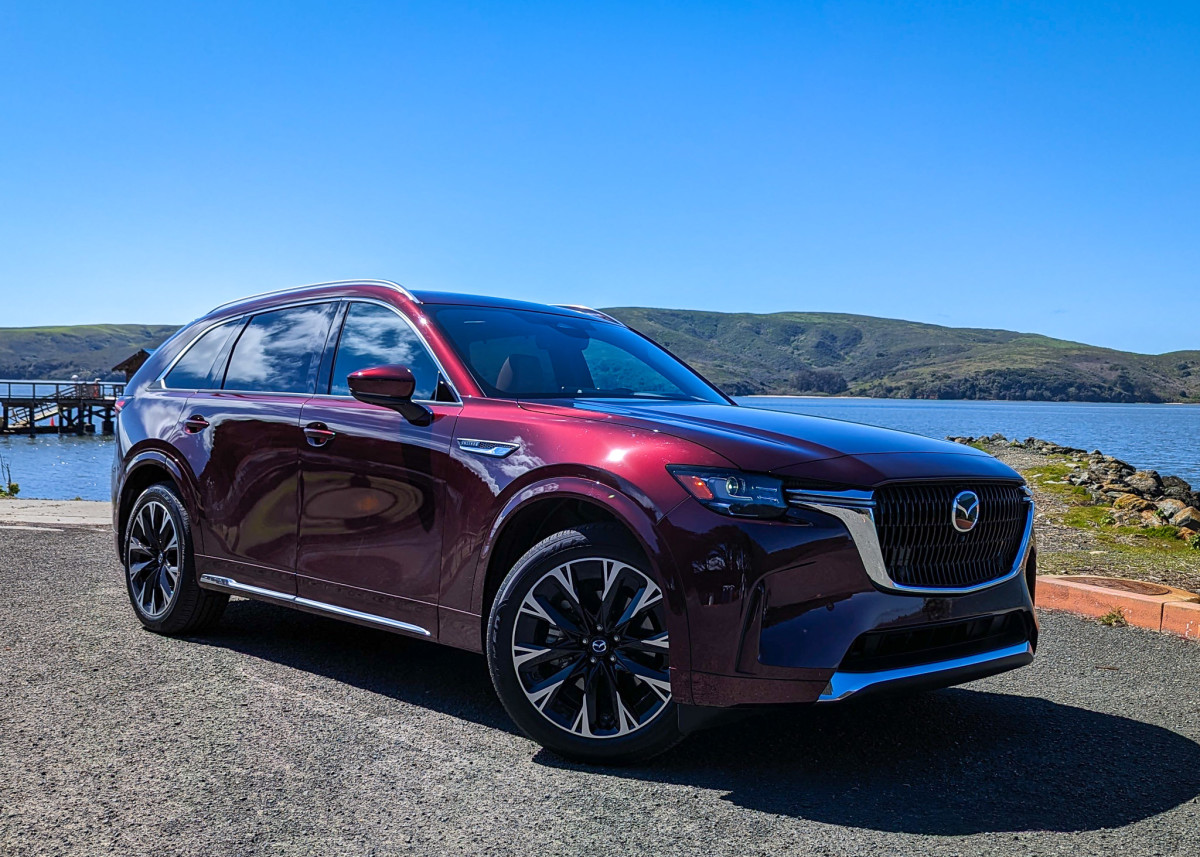
The Mazda CX-90 is a three-row crossover with the heart of a sports car.

If you want a luxury image, buy a BMW or a Mercedes-Benz. Those manufacturers are well-known for top-tier luxury and performance, and their high price tags convey status and wealth.
But if you want a luxury car, you can also now consider a Mazda. The Japanese automaker has soared past Honda, Nissan, and Toyota in terms of design and material quality, coming closer to the luxury arms of those competitors–Acura, Infiniti, and Lexus.
From the outside, the all-new Mazda CX-90 takes the elegant design language of the smaller Mazda CX-30 and CX-5 and supersizes it. Stretching over 5 metres, the CX-90 is an imposing SUV. Its big grille, wide-set front end, and large wheels (ranging from 18 to 21 inches) all demand attention. Add in some tasteful chrome trim, and this is an SUV that manages to look elegant despite its mass.
Things are even more impressive once you open the door. Mazda sells the CX-90 in many different trims, which we’ll get to shortly, but top-shelf models sport an interior that could match some of the best names in luxury. If you’re willing to pay for it, brown suede upholstery covers the dash, wood inlays fill the centre console, and any black plastic bits are pleasantly matte, rather than gaudy and glossy. There’s nothing tacky about a Mazda interior–next to a flagship CX-90, a BMW X5 will look similarly lovely, but massively overpriced.
Given that Mazda sells the CX-90 in a range of trims, not all of them will look quite so striking. However, all will benefit from the stylish, delicate design language and the comfortable layout. All told, there are 8 different trim levels in Canada for the CX-90, spread across three powertrains. You’ll find the CX-90 Turbo sold in GS, GS-L, GT, GT-P, and Signature trims, with the latter two being equipped with the more powerful mild-hybrid engine. There’s a plug-in hybrid (PHEV) CX-90, too, sold in GS, GS-L, and GT trims.
For this review, we took U.S. versions of the PHEV along with the top-tier Signature for a test drive.

Mazda’s big news for 2024 is the introduction of two new powertrains. The CX-90 is the first Mazda SUV to offer a plug-in hybrid option, and it aims to deliver better fuel economy and performance than the outgoing CX-9. Along with the PHEV, shoppers can choose between two iterations of an all-new turbocharged inline six-cylinder engine with a mild-hybrid system. The turbo I6 delivers 280 horsepower and 332 pound-feet of torque in base spec, but we didn’t have a chance to drive that de-tuned model. Instead, we were delighted by the upgraded I6 found in CX-90 GT-P and Signature trims.
The new powertrains illustrate a startling transformation from the outgoing Mazda CX-9 to the new CX-90. While the turbocharged four-cylinder found in the old car was capable, it has always felt more suited to a smaller SUV, like the CX-5 or the CX-50. The new, powerful inline-six and PHEV powertrains help distinguish the CX-90 as being in a separate class from those smaller crossovers. In particular, the CX-90 Signature carries an incredible exhaust note; this machine sounds unlike any Mazda to have come before.
The upgraded 3.3-litre inline-6 turbo engine increases power from 280 horses to 340–a substantial jump–when using premium fuel. Torque also jumps, climbing to 369 lb-ft. All 2024 Mazda CX-90 models get all-wheel drive (AWD) as standard equipment, and they all employ an eight-speed automatic transmission.
There are three driving modes available in the CX-90 Signature: Normal, Sport, and Off-Road. While we didn’t have an opportunity to test the CX-90’s off-roading chops, there was a noticeable difference in behaviour when driving in Normal and Sport modes. Pushing this engine high into the rev range opens up the CX-90’s lungs and creates an exceptional roar from the engine. In Sport mode, the CX-90 can hold its gears a bit longer, allowing the car to scream along at peak horsepower. However, we did notice that the eight-speed transmission demonstrated inconsistent behaviour, particularly when we drove in Sport mode. Sometimes it held gears deep into the rev range, other times it shifted frenetically, trying to find the right power band.
The more fuel-efficient 2024 Mazda CX-90 PHEV employs a 2.5-litre naturally aspirated four-cylinder engine in conjunction with a 17.8-kWh battery and a 68-kW electric motor. Total output measures 323 horsepower and 369 lb-ft of torque. Shoppers should expect an all-electric driving range of 42 kilometres, notably less than the 2023 Kia Sorento’s 51 kilometres of all-EV range. Note that because the CX-90 PHEV’s electric range falls below 50 km, it qualifies only for partial EV purchase incentive programs from federal and provincial governments. Natural Resources Canada estimates that the CX-90 PHEV will return 4.2 Le/100 km in combined driving, with 747 kilometres of total driving range. The PHEV model simply can’t match the Signature for noise and drama, but it exhibited similar handling performance.
Which is to say, both CX-90 models were brilliant through corners, tackling Northern California’s twisty roads with the composure of a much smaller vehicle.
The 2024 Mazda CX-90 is built on a larger platform than the outgoing CX-9, but a double-wishbone front suspension and transverse engine layout allow the front wheels to turn further while keeping solid contact with the ground. This helps the CX-90 feel lithe and agile in tight corners, which is not something we’re used to writing about three-row crossovers. Add in the thin, almost delicate steering wheel common on Mazda models, and the driver gets the feeling that they’re driving a much smaller car.
Mazda has developed a reputation for building outstanding driver’s cars. After all, this is the company that gave us the MX-5. However, it would be easy to shelve this goal when the product is meant for shuttling families and going grocery shopping, rather than weekend joyride and track days. We’re thrilled to report that, instead, Mazda has succeeded in imbuing the CX-90 with the attitude of an MX-5.

The CX-90 is available in an array of trims and, fittingly, an array of seating configurations, too. The lowest trims can seat eight passengers, with three across in the second and third rows. The mid-level trims get captain’s chairs in place of the second-row bench and seat seven. We expect most shoppers will likely buy a seven-seater CX-90. The Turbo Signature trim gets an exclusive six-seat configuration–two in the front, two in the second-row seats, two in the rear seats.
You get a touch more cargo space in CX-90s fitted with the two-seater third row, but just a touch. Total cargo space measures 2,129 litres in those models, with 451 litres behind the third row and 1,155 litres behind the second. Models with the more common three-across back seat will fit 423 litres behind the available hands-free liftgate, 1,133 litres behind the second row, and 2,101 litres when all rows are folded.
Those numbers are more than what you’d get in a CX-9 (which offered 407 to 2,017 litres of cargo space). One of our regular criticisms of the CX-9 was that it felt a bit small for its segment. The CX-90 is certainly an improvement, but it’s worth noting that the CX-90 still falls short on capacity next to the Honda Pilot, Nissan Pathfinder, and Toyota Highlander, and legroom in the third row is comparatively snug.
Pleasantly, Mazda has stuck plenty of cubbies and clever storage options in the CX-90. The centre console is plenty large, there are spacious door pockets, and the cupholders are nicely sized and placed. The middle-row captain's chairs in our CX-90 Signature test car also had a centre console with its own sizeable bin, side-by-side cupholders, and a storage drawer at its base.
Add in the lovely materials and upholstery, the comfortable seats, and a big panoramic sunroof, and the CX-90 might not be as spacious as some other options, but it’s certainly comfortable.

Mazda has a very clear objective when it comes to technology: eliminate distractions to ensure safety.
In this spirit, the Mazda Connect infotainment system does not employ a touchscreen interface. Instead, it uses a set of hard buttons on the centre console and a rotary control knob.
The logic is sound: touchscreens require drivers to take their eyes off the road, while physical controls do not. The rotary knob is beautifully engineered with a satisfying action, and the buttons are smartly placed.
Unfortunately, we have yet to drive a Mazda vehicle with this technology setup and come away satisfied. Instead, there are just too many frustrating quirks and idiosyncrasies–for instance, orienting the navigation map takes multiple clicks with the rotary dial, rather than a simple press with a finger. While the intention was to reduce distraction, we inevitably end up more distracted just trying to master basic functions than we would be if they were controlled via a typical touchscreen.
Luckily, there are a few saving graces. First, the CX-90 offers personalization software which, once set up, will use facial recognition to automatically adjust the seats, mirrors, and head-up display (HUD) to your preferred driving position. It will also update myriad other settings–like radio station favourites–to your specific profile. In past Mazda models, the solution to annoyances like not being able to scroll through radio stations was to simply set your preferred stations as “favourites” and scroll through those. Naturally, anyone sharing a car with another driver knew that solution was easier said than done. With the CX-90’s personalization feature, it actually works.
Additionally, the CX-90 comes standard with Android Auto and Apple CarPlay (wireless in higher-level trims). Mazda’s rotary controller works with these projection systems, but the company seems willing to admit that touchscreen controls work even better. Thus, thankfully, both Apple CarPlay and Android Auto do employ touchscreen controls. Given the familiarity and prevalence of Apple CarPlay and Android Auto, we suspect most people will default to them when they start their CX-90.

Although Mazda’s infotainment technology is a bit of a swing and a miss, we’re happy to report that its dedicated safety features are an extra-base hit. i-Activsense, the company’s suite of advanced driver assistance systems (ADAS) comes standard on every CX-90 and includes some features that are often extra-cost options on other crossovers, such as blind-spot monitoring and adaptive cruise control.
Other standard ADAS features include automatic emergency braking, smart brake support with front-crossing and turn-across-traffic identification capabilities, rear cross-traffic alert, and a safe-exit warning. The CX-90 also benefits from lane-departure warning and lane-keeping assist.
Our top-spec CX-90 Signature test car had cruising and traffic support, too. This technology set blends lane-centring with adaptive cruise control to provide a hands-on driver support system. We were pleased to see that the CX-90 stayed evenly in its lane, and we experienced only a few minor hiccups while we tested this tech.
Neither the Insurance Institute for Highway Safety (IIHS) nor the National Highway Traffic Safety Administration (NHTSA) has crash-tested the 2024 Mazda CX-90–which is not unusual with brand-new models–but we expect it to perform well. The 2023 CX-9 was named a Top Safety Pick by the IIHS and received five stars in overall rating from the NHTSA, so a step below those accolades would be surprising for this new crossover.

Mazda has increased pricing alongside feature availability and build quality in recent years, meaning it’s a bit disingenuous to compare it directly with brands such as Honda, Nissan, and Toyota. However, it’s also not quite accurate to say Mazda is a direct competitor to established luxury brands; it doesn’t have exactly the same craftsmanship and its lower prices reflect that.
Ultimately, Mazda sits a bit in the middle. Like Jeep, Mazda builds cars that are a little nicer than most, but for lower prices than you’d find in the commonly accepted luxury segment.
The CX-90 follows this strategy. The starting new car MSRP of $45,900, not including the mandatory $2,195 destination charge and other fees, for a Turbo GS trim is more than $5,000 below a Honda Pilot’s starting price, and it’s even lower than the Hyundai Palisade’s starting price just shy of $50,000. The $63,300 MSRP for a Signature is roughly $10,000 less than a top-spec Acura MDX.
Across the trim lineup, you’ll find most CX-90s priced between $50,000 and $60,000, which represents a great value for what you’re getting. Few vehicles on sale today pair interior refinement, striking exterior design, and brilliant powertrain dynamics as seamlessly as the 2024 Mazda CX-90 does, and virtually none live below the luxury tier.
Note: Images show a US model.

User reviews for 2024 Mazda CX-90
Write a review2024 Mazda CX-90 Pricing
Trims & specs
Air Conditioning
Sun sensor climate control front air conditioning · Dual front air conditioning zones · Rear air conditioning: with independent controls · Single rear air conditioning zones · Second and third row rear heat vents
Airbags
Dual front airbags · Dual front knee airbags · Passenger airbag deactivation: occupant sensing deactivation · Rear side airbags · Rear side curtain airbags
Audio System
Antenna Type: element · Voice recognition audio system · USB auxiliary audio input · Pandora internet radio · HD radio · Total Number of Speakers: 8
Brakes
ABS: 4-wheel · Braking assist: hill start assist · Electronic parking brake: auto off · Front brake diameter: 12.9 · Front brakes: ventilated disc · Rear brake diameter: 13.8 · Rear brakes: ventilated disc
Comfort Features
Armrests: rear center folding with storage · Floor Mat Material: carpet · Floor Material: carpet · Floor Mats: front · Shift knob trim: leather · Steering wheel trim: leather
Convenience Features
Adaptive stop and go cruise control: semi-automatic · Assist handle: front · Cargo area power outlet: 12V · Center console: front console with armrest and storage · Cruise control: adaptive · Cupholders: front · Easy entry: manual rear seat · Memorized settings: liftgate · Multi-function remote: keyless entry with panic alarm · One-touch windows: 4 · Power outlet(s): 12V front · Power steering: speed-proportional · Power windows: lockout button · Reading lights: front · Steering wheel: tilt and telescopic · Steering wheel mounted controls: audio · Storage: in-floor · Vanity mirrors: dual illuminating
Driver Seat
Adjustable lumbar support: power · Power adjustments: 8
Drivetrain
4WD Type: on demand · Axle ratio: 3.69
Engine
Battery: maintenance-free · EV battery capacity: 0.33 kWh · Electric Motor Battery Type: lithium ion · Electric Motor HP: 17 · Electric Motor Power Output (Kilowatts): 12 · Electric Motor Torque: 113 · Hybrid Gas Engine HP: 280 · Hybrid Gas Engine HP@RPM: 5000 · Hybrid Gas Engine Torque: 332 · Hybrid gas Engine Torque@RPM: 2000
Exterior Features
Door handle color: body-color · Fender lip moldings: black · Front bumper color: body-color · Grille color: black · Mirror color: body-color · Rear bumper color: body-color · Rear spoiler: roofline spoiler · Rear spoiler color: body-color · Rear trunk/liftgate: power operated · Rocker panel color: black · Window trim: black
Headrests
Front headrests: adjustable · Number of front headrests: 2 · Number of rear headrests: 3 · Number of third row headrests: 3
Hybrid
Starter Type: motor/generator
In Car Entertainment
Connected in-car apps: Google search · Infotainment: Android Auto ready · Infotainment screen size: 10.25 in.
Instrumentation
Fuel economy display: MPG · Instrument cluster screen size: 7 in. · Warnings and reminders: low fuel level
Lights
Daytime running lights: LED · Exterior entry lights: security approach lamps · Headlights: automatic high beam dimmer · Tail and brake lights: LED
Mirrors
Exterior mirrors: power · Inside rearview mirror: manual day/night
Passenger Seat
Manual Adjustments: 4
Rear Seats
Type: 60-40 split bench
Roof
Roof rails: chrome
Safety
Automatic emergency braking: front · Camera system: rearview · Child seat anchors: LATCH system · Cross Traffic Alert: rear · Crumple zones: rear · Impact sensor: post-collision safety system · Pre-Collision Warning System: audible warning · Pre-collision warning system: pedestrian detection · Rearview monitor: in dash
Seatbelts
Emergency locking retractors: front · Front seatbelts: 3-point · Seatbelt force limiters: front and rear · Seatbelt pretensioners: front and rear · Seatbelt warning sensor: driver and passenger · Second row seatbelts: 3-point · Third row seatbelts: 3-point
Seats
Driver seat power adjustments: height · Front seat type: bucket · Passenger seat manual adjustments: reclining · Rear headrests: adjustable · Rear seat folding: flat · Rear seat manual adjustments: reclining · Third row headrests: adjustable · Third row seat folding: flat · Upholstery: leatherette
Security
Power door locks: anti-lockout
Spare Tire
Mount Location: inside · Size: temporary
Spare Wheel
Rim Type: steel
Stability and Traction
Traction control: with trailer stability control
Steering
Steering ratio: 17.1 · Turns lock-to-lock: 3.3
Suspension
Front Shock Type: gas shock absorbers · Front Spring Type: coil springs · Front Suspension Classification: independent · Front Suspension Type: strut · Rear Shock Type: gas shock absorbers · Rear Spring Type: coil springs · Rear Suspension Classification: independent · Rear Suspension Type: multi-link · Stabilizer bar(s): front
Telematics
Driver assistance app: roadside assistance · Electronic messaging assistance: with read function · Phone: voice activated · Phone wireless data link: Bluetooth · Smart device app compatibility: MyMazda · Smart device app function: maintenance scheduling · Wifi: hotspot
Third Row Seat
Type: 40-60 split bench
Tires
Type: all season
Tires and Rims
Wheels: painted aluminum
Windows
Front wipers: rain sensing · Liftgate window: fixed · Power windows: with safety reverse · Rear wiper: with washer
Air Conditioning
Sun sensor climate control front air conditioning · Dual front air conditioning zones · Automatic climate control rear air conditioning · Single rear air conditioning zones · Second and third row rear heat vents
Airbags
Dual front airbags · Dual front knee airbags · Passenger airbag deactivation: occupant sensing deactivation · Rear side airbags · Rear side curtain airbags
Audio System
Antenna Type: element · Voice recognition audio system · Bluetooth auxiliary audio input · Pandora internet radio · HD radio · Total Number of Speakers: 8
Brakes
ABS: 4-wheel · Braking assist: hill start assist · Electronic parking brake: auto off · Front brake diameter: 12.9 · Front brakes: ventilated disc · Rear brake diameter: 13.8 · Rear brakes: ventilated disc
Comfort Features
Armrests: rear center folding with storage · Floor Mat Material: carpet · Floor Material: carpet · Floor Mats: front · Shift knob trim: leather · Steering wheel trim: leather
Convenience Features
Adaptive stop and go cruise control: semi-automatic · Assist handle: front · Cargo area power outlet: 12V · Center console: front console with armrest and storage · Cruise control: adaptive · Cupholders: rear · Easy entry: manual rear seat · Memorized settings: liftgate · Multi-function remote: proximity entry system · One-touch windows: 4 · Power outlet(s): USB-C rear · Power steering: speed-proportional · Power windows: lockout button · Reading lights: rear · Steering wheel: tilt and telescopic · Steering wheel mounted controls: paddle shifter · Storage: grocery bag holder · Sunshade: side window · Vanity mirrors: dual illuminating
Driver Seat
Adjustable lumbar support: power · Power adjustments: 8
Drivetrain
4WD Type: on demand · Axle ratio: 3.69
Engine
Battery: maintenance-free · EV battery capacity: 0.33 kWh · Electric Motor Battery Type: lithium ion · Electric Motor HP: 17 · Electric Motor Power Output (Kilowatts): 12 · Electric Motor Torque: 113 · Hybrid Gas Engine HP: 280 · Hybrid Gas Engine HP@RPM: 5000 · Hybrid Gas Engine Torque: 332 · Hybrid gas Engine Torque@RPM: 2000
Exterior Features
Door handle color: body-color · Fender lip moldings: black · Front bumper color: body-color · Grille color: black · Mirror color: body-color · Rear bumper color: body-color · Rear spoiler: roofline spoiler · Rear spoiler color: body-color · Rear trunk/liftgate: power operated · Rocker panel color: black · Window trim: black
Headrests
Front headrests: adjustable · Number of front headrests: 2 · Number of rear headrests: 3 · Number of third row headrests: 3
Hybrid
Starter Type: motor/generator
In Car Entertainment
Connected in-car apps: Google search · Infotainment: Android Auto ready · Infotainment screen size: 10.25 in.
Instrumentation
Fuel economy display: range · Instrument cluster screen size: 7 in. · Warnings and reminders: lamp failure
Lights
Daytime running lights: LED · Exterior entry lights: security approach lamps · Headlights: Auto on/off · Tail and brake lights: LED
Mirrors
Exterior mirrors: integrated turn signals · Inside rearview mirror: manual day/night
Passenger Seat
Power adjustments: 4
Rear Seats
Type: 60-40 split bench
Roof
Moonroof: sliding sunshade · Roof rails: chrome
Safety
Automatic emergency braking: front · Camera system: rearview · Child seat anchors: LATCH system · Cross Traffic Alert: rear · Crumple zones: rear · Impact sensor: post-collision safety system · Pre-Collision Warning System: visual warning · Pre-collision warning system: pedestrian detection · Rearview monitor: in dash
Seatbelts
Emergency locking retractors: front · Front seatbelts: 3-point · Seatbelt force limiters: front and rear · Seatbelt pretensioners: front · Seatbelt warning sensor: driver and passenger · Second row seatbelts: 3-point · Third row seatbelts: 3-point
Seats
Driver seat power adjustments: height · Front seat type: bucket · Passenger seat power adjustments: reclining · Rear headrests: adjustable · Rear seat folding: split · Rear seat manual adjustments: reclining · Third row headrests: adjustable · Third row seat folding: split · Upholstery: leather
Security
Power door locks: anti-lockout
Spare Tire
Mount Location: inside · Size: temporary
Spare Wheel
Rim Type: steel
Stability and Traction
Traction control: with trailer stability control
Steering
Steering ratio: 17.1 · Turns lock-to-lock: 3.3
Suspension
Front Shock Type: gas shock absorbers · Front Spring Type: coil springs · Front Suspension Classification: independent · Front Suspension Type: strut · Rear Shock Type: gas shock absorbers · Rear Spring Type: coil springs · Rear Suspension Classification: independent · Rear Suspension Type: multi-link · Stabilizer bar(s): front
Telematics
Driver assistance app: roadside assistance · Electronic messaging assistance: with read function · Phone: voice activated · Phone wireless data link: Bluetooth · Smart device app compatibility: MyMazda · Smart device app function: maintenance status · Wifi: hotspot
Third Row Seat
Type: 40-60 split bench
Tires
Type: all season
Tires and Rims
Wheels: painted aluminum
Windows
Front wipers: rain sensing · Liftgate window: fixed · Power windows: with safety reverse · Rear wiper: with washer
Air Conditioning
Automatic climate control front air conditioning · Dual front air conditioning zones · Rear air conditioning: with independent controls · Single rear air conditioning zones · Second and third row rear heat vents
Airbags
Dual front airbags · Dual front knee airbags · Passenger airbag deactivation: occupant sensing deactivation · Front side airbags · Front side curtain airbags
Audio System
Antenna Type: element · Voice recognition audio system · Bluetooth auxiliary audio input · Pandora internet radio · AM/FM radio · Total Number of Speakers: 8
Brakes
ABS: 4-wheel · Braking assist: hill start assist · Electronic parking brake: auto off · Front brake diameter: 12.9 · Front brakes: ventilated disc · Rear brake diameter: 13.8 · Rear brakes: ventilated disc
Comfort Features
Armrests: rear center with cupholders · Floor Mat Material: carpet · Floor Material: carpet · Floor Mats: front · Shift knob trim: leather · Steering wheel trim: leather
Convenience Features
Adaptive stop and go cruise control: semi-automatic · Assist handle: rear · Cargo area power outlet: 12V · Center console: front console with armrest and storage · Cruise control: adaptive · Cupholders: front, rear and third row · Easy entry: manual rear seat · Memorized settings: liftgate · Multi-function remote: keyless entry with panic alarm · One-touch windows: 4 · Power outlet(s): USB-C third row · Power steering: electric · Power windows: lockout button · Reading lights: rear · Steering wheel: tilt and telescopic · Steering wheel mounted controls: cruise controls · Storage: storage organizer · Sunshade: side window · Vanity mirrors: dual illuminating
Driver Seat
Adjustable lumbar support: power · Power adjustments: 8
Drivetrain
4WD Type: on demand · Axle ratio: 3.69
Engine
Battery: lithium ion · EV battery capacity: 0.33 kWh · Electric Motor Battery Type: lithium ion · Electric Motor HP: 17 · Electric Motor Power Output (Kilowatts): 12 · Electric Motor Torque: 113 · Hybrid Gas Engine HP: 280 · Hybrid Gas Engine HP@RPM: 5000 · Hybrid Gas Engine Torque: 332 · Hybrid gas Engine Torque@RPM: 2000
Exterior Features
Door handle color: body-color · Fender lip moldings: black · Front bumper color: body-color · Grille color: black · Mirror color: body-color · Rear bumper color: body-color · Rear spoiler: roofline spoiler · Rear spoiler color: body-color · Rear trunk/liftgate: power operated · Rocker panel color: black · Window trim: black
Headrests
Front headrests: adjustable · Number of front headrests: 2 · Number of rear headrests: 3 · Number of third row headrests: 3
Hybrid
Starter Type: motor/generator
In Car Entertainment
Connected in-car apps: Google POIs · Infotainment: Mazda Connect · Infotainment screen size: 10.25 in. · Smartphone integration: wireless Apple CarPlay
Instrumentation
Fuel economy display: range · Instrument cluster screen size: 7 in. · Warnings and reminders: lamp failure
Lights
Daytime running lights: LED · Exterior entry lights: security approach lamps · Headlights: LED · Tail and brake lights: LED
Mirrors
Exterior mirrors: manual folding · Inside rearview mirror: manual day/night
Passenger Seat
Power adjustments: 4
Rear Seats
Type: 60-40 split bench
Roof
Moonroof: sliding sunshade · Roof rails: chrome
Safety
Automatic emergency braking: front · Camera system: rearview · Child seat anchors: LATCH system · Cross Traffic Alert: rear · Crumple zones: rear · Impact sensor: post-collision safety system · Pre-Collision Warning System: visual warning · Pre-collision warning system: pedestrian detection · Rearview monitor: in dash
Seatbelts
Emergency locking retractors: front, rear, third, and fourth row · Front seatbelts: 3-point · Seatbelt force limiters: front and rear · Seatbelt pretensioners: front · Seatbelt warning sensor: driver and passenger · Second row seatbelts: 3-point · Third row seatbelts: 3-point
Seats
Driver seat power adjustments: height · Front seat type: bucket · Passenger seat power adjustments: reclining · Rear headrests: adjustable · Rear seat folding: flat · Rear seat manual adjustments: reclining · Third row headrests: adjustable · Third row seat folding: flat · Upholstery: leather
Security
Power door locks: anti-lockout
Spare Tire
Mount Location: inside · Size: temporary
Spare Wheel
Rim Type: steel
Stability and Traction
Traction control: with trailer stability control
Steering
Steering ratio: 17.1 · Turns lock-to-lock: 3.3
Suspension
Front Shock Type: gas shock absorbers · Front Spring Type: coil springs · Front Suspension Classification: independent · Front Suspension Type: double wishbones · Rear Shock Type: gas shock absorbers · Rear Spring Type: coil springs · Rear Suspension Classification: independent · Rear Suspension Type: multi-link · Stabilizer bar(s): front
Telematics
Driver assistance app: roadside assistance · Electronic messaging assistance: with read function · Phone: voice activated · Phone wireless data link: Bluetooth · Smart device app compatibility: MyMazda · Smart device app function: lock operation · Wifi: hotspot
Third Row Seat
Type: 40-60 split bench
Tires
Type: all season
Tires and Rims
Wheels: painted aluminum
Windows
Front wipers: speed sensitive · Liftgate window: fixed · Power windows: with safety reverse · Rear wiper: intermittent
Air Conditioning
Automatic climate control front air conditioning · Dual front air conditioning zones · Rear air conditioning: with independent controls · Single rear air conditioning zones · Second and third row rear heat vents
Airbags
Dual front airbags · Dual front knee airbags · Passenger airbag deactivation: occupant sensing deactivation · Front side airbags · Front side curtain airbags
Audio System
Antenna Type: mast · Voice recognition audio system · Bluetooth auxiliary audio input · Pandora internet radio · Premium Brand: Bose · AM/FM radio · Satellite Radio: SiriusXM · 1 subwoofer · Total Number of Speakers: 11
Brakes
ABS: 4-wheel · Braking assist: hill start assist · Electronic parking brake: auto off · Front brake diameter: 13.7 · Front brakes: ventilated disc · Rear brake diameter: 13.8 · Rear brakes: ventilated disc
Comfort Features
Armrests: rear outboard seats · Floor Mat Material: carpet · Floor Material: carpet · Floor Mats: front · Shift knob trim: leather · Steering wheel trim: leather
Convenience Features
Adaptive stop and go cruise control: semi-automatic · Assist handle: rear · Cargo area power outlet: 12V · Center console: front console with armrest and storage · Cruise control: adaptive · Cupholders: front, rear and third row · Dimming rearview mirror: auto-dimming · Easy entry: manual rear seat · Memorized settings: 2 driver · Multi-function remote: proximity entry system · One-touch windows: 4 · Power outlet(s): USB-C rear · Power steering: speed-proportional · Power windows: lockout button · Reading lights: front · Steering wheel: tilt and telescopic · Steering wheel mounted controls: cruise controls · Storage: sunglasses holder · Sunshade: side window · Universal garage door opener: Homelink · Vanity mirrors: dual illuminating
Driver Seat
Adjustable lumbar support: power · Power adjustments: 8
Drivetrain
4WD Type: on demand · Axle ratio: 3.69
Engine
Battery: lithium ion · EV battery capacity: 0.33 kWh · Electric Motor Battery Type: lithium ion · Electric Motor HP: 17 · Electric Motor Power Output (Kilowatts): 12 · Electric Motor Torque: 113 · Hybrid Gas Engine HP: 280 · Hybrid Gas Engine HP@RPM: 5000 · Hybrid Gas Engine Torque: 332 · Hybrid gas Engine Torque@RPM: 2000
Exterior Features
Door handle color: body-color · Fender lip moldings: black · Front bumper color: body-color · Grille color: black · Mirror color: body-color · Rear bumper color: chrome accents · Rear spoiler: roofline spoiler · Rear spoiler color: body-color · Rear trunk/liftgate: power operated · Rocker panel color: chrome accents · Window trim: chrome
Headrests
Front headrests: adjustable · Number of front headrests: 2 · Number of rear headrests: 2 · Number of third row headrests: 3
Hybrid
Starter Type: motor/generator
In Car Entertainment
Connected in-car apps: Google search · Infotainment: Mazda Connect · Infotainment screen size: 10.25 in. · Smartphone integration: wireless Android Auto
Instrumentation
Fuel economy display: MPG · Instrument cluster screen size: 7 in. · Warnings and reminders: maintenance reminder
Lights
Daytime running lights: LED · Exterior entry lights: security approach lamps · Headlights: Auto on/off · Tail and brake lights: LED
Mirrors
Exterior mirrors: manual folding
Passenger Seat
Power adjustments: 4
Rear Seats
Type: captains chairs
Roof
Moonroof: anti-trapping feature · Moonroof / Sunroof: power sunshade · Roof rails: chrome
Safety
Automatic emergency braking: front · Camera system: rearview · Child seat anchors: LATCH system · Cross Traffic Alert: rear · Crumple zones: rear · Evasive steering assist: head-on collision avoidance · Impact sensor: alert system · Parking sensors: rear · Pre-Collision Warning System: visual warning · Pre-collision warning system: pedestrian detection · Rearview monitor: in dash · Traffic sign recognition: adaptive speed limiting
Seatbelts
Emergency locking retractors: front and rear · Front seatbelts: 3-point · Seatbelt force limiters: front · Seatbelt pretensioners: front · Seatbelt warning sensor: driver and passenger · Second row seatbelts: 3-point · Third row seatbelts: 3-point
Seats
Driver seat power adjustments: height · Front seat type: bucket · Passenger seat power adjustments: reclining · Rear headrests: adjustable · Third row headrests: adjustable · Third row seat folding: flat · Upholstery: leather
Security
Power door locks: anti-lockout
Spare Tire
Mount Location: inside · Size: temporary
Spare Wheel
Rim Type: steel
Stability and Traction
Traction control: with trailer stability control
Steering
Steering ratio: 17.1 · Turns lock-to-lock: 3.3
Suspension
Front Shock Type: gas shock absorbers · Front Spring Type: coil springs · Front Suspension Classification: independent · Front Suspension Type: strut · Rear Shock Type: gas shock absorbers · Rear Spring Type: coil springs · Rear Suspension Classification: independent · Rear Suspension Type: multi-link · Stabilizer bar(s): rear
Telematics
Driver assistance app: roadside assistance · Electronic messaging assistance: with voice recognition · Navigation system: with voice recognition · Phone: voice activated · Phone wireless data link: Bluetooth · Smart device app compatibility: MyMazda · Smart device app function: maintenance status · Wifi: hotspot
Third Row Seat
Type: 40-60 split bench
Tires
Type: all season
Tires and Rims
Wheels: painted aluminum
Windows
Front wipers: speed sensitive · Liftgate window: fixed · Power windows: with safety reverse · Rear wiper: with washer
Air Conditioning
Automatic climate control front air conditioning · Dual front air conditioning zones · Rear air conditioning: with independent controls · Single rear air conditioning zones · Second and third row rear heat vents
Airbags
Dual front airbags · Dual front knee airbags · Passenger airbag deactivation: occupant sensing deactivation · Rear side airbags · Third row side curtain airbags
Audio System
Antenna Type: diversity · Voice recognition audio system · Bluetooth auxiliary audio input · Pandora internet radio · Premium Brand: Bose · HD radio · Satellite Radio: SiriusXM · 1 subwoofer · Total Number of Speakers: 11
Brakes
ABS: 4-wheel · Braking assist: hill start assist · Electronic parking brake: auto off · Front brake diameter: 13.7 · Front brakes: ventilated disc · Rear brake diameter: 13.8 · Rear brakes: ventilated disc
Comfort Features
Armrests: rear outboard seats · Floor Mat Material: carpet · Floor Material: carpet · Floor Mats: front · Shift knob trim: leather · Steering wheel trim: leather
Convenience Features
Adaptive stop and go cruise control: semi-automatic · Assist handle: front · Cargo area power outlet: 115V · Center console: front console with armrest and storage · Cruise control: adaptive · Cupholders: illuminated · Dimming rearview mirror: auto-dimming · Easy entry: manual rear seat · Memorized settings: driver seat · Multi-function remote: proximity entry system · One-touch windows: 4 · Power outlet(s): USB-C third row · Power steering: electric · Power windows: lockout button · Reading lights: rear · Steering wheel: tilt and telescopic · Steering wheel mounted controls: audio · Storage: sunglasses holder · Sunshade: side window · Universal garage door opener: Homelink · Vanity mirrors: dual illuminating
Driver Seat
Adjustable lumbar support: power · Power adjustments: 8
Drivetrain
4WD Type: on demand · Axle ratio: 3.69
Engine
Battery: maintenance-free · EV battery capacity: 0.33 kWh · Electric Motor Battery Type: lithium ion · Electric Motor HP: 17 · Electric Motor Power Output (Kilowatts): 12 · Electric Motor Torque: 113 · Hybrid Gas Engine HP: 280 · Hybrid Gas Engine HP@RPM: 5000 · Hybrid Gas Engine Torque: 332 · Hybrid gas Engine Torque@RPM: 2000
Exterior Features
Door handle color: body-color · Fender lip moldings: black · Front bumper color: body-color · Grille color: black · Mirror color: body-color · Rear bumper color: body-color · Rear spoiler: roofline spoiler · Rear spoiler color: body-color · Rear trunk/liftgate: liftgate · Rocker panel color: black · Window trim: chrome
Headrests
Front headrests: adjustable · Number of front headrests: 2 · Number of rear headrests: 2 · Number of third row headrests: 3
Hybrid
Starter Type: motor/generator
In Car Entertainment
Connected in-car apps: Google search · Infotainment: Mazda Connect · Infotainment screen size: 12.3 in. · Smartphone integration: wireless Apple CarPlay
Instrumentation
Fuel economy display: MPG · Instrument cluster screen size: 12.3 in. · Warnings and reminders: maintenance reminder
Lights
Daytime running lights: LED · Exterior entry lights: security approach lamps · Headlights: LED · Tail and brake lights: LED
Mirrors
Exterior mirrors: power folding
Passenger Seat
Power adjustments: 8
Rear Seats
Type: captains chairs
Roof
Moonroof: one-touch open/close · Moonroof / Sunroof: power sunshade · Roof rails: chrome
Safety
Automatic emergency braking: rear · Camera system: surround view · Child seat anchors: LATCH system · Cross Traffic Alert: rear · Crumple zones: rear · Evasive steering assist: head-on collision avoidance · Impact sensor: post-collision safety system · Parking sensors: front · Pre-Collision Warning System: audible warning · Pre-collision warning system: pedestrian detection · Rearview monitor: in dash · Traffic sign recognition: adaptive speed limiting
Seatbelts
Emergency locking retractors: front · Front seatbelts: 3-point · Seatbelt force limiters: front · Seatbelt pretensioners: front and rear · Seatbelt warning sensor: driver and passenger · Second row seatbelts: 3-point · Third row seatbelts: 3-point
Seats
Driver seat power adjustments: reclining · Front seat type: bucket · Passenger seat power adjustments: reclining · Rear headrests: adjustable · Third row headrests: adjustable · Third row seat folding: flat · Upholstery: premium leather
Security
Power door locks: anti-lockout
Spare Tire
Mount Location: inside · Size: temporary
Spare Wheel
Rim Type: steel
Stability and Traction
Traction control: with trailer stability control
Steering
Steering ratio: 17.1 · Turns lock-to-lock: 3.3
Suspension
Front Shock Type: gas shock absorbers · Front Spring Type: coil springs · Front Suspension Classification: independent · Front Suspension Type: double wishbones · Rear Shock Type: gas shock absorbers · Rear Spring Type: coil springs · Rear Suspension Classification: independent · Rear Suspension Type: multi-link · Stabilizer bar(s): front
Telematics
Driver assistance app: roadside assistance · Electronic messaging assistance: with voice recognition · Navigation system: with voice recognition · Phone: voice activated · Phone wireless data link: Bluetooth · Smart device app compatibility: MyMazda · Smart device app function: lock operation · Wifi: hotspot
Third Row Seat
Type: 40-60 split bench
Tires
Type: all season
Tires and Rims
Wheels: painted aluminum
Windows
Front wipers: rain sensing · Liftgate window: fixed · Power windows: with safety reverse · Rear wiper: with washer
Air Conditioning
Sun sensor climate control front air conditioning · Dual front air conditioning zones · Rear air conditioning: with independent controls · Single rear air conditioning zones · Second and third row rear heat vents
Airbags
Dual front airbags · Dual front knee airbags · Passenger airbag deactivation: occupant sensing deactivation · Front side airbags · Third row side curtain airbags
Audio System
Antenna Type: diversity · Voice recognition audio system · USB auxiliary audio input · Pandora internet radio · Premium Brand: Bose · AM/FM radio · Satellite Radio: SiriusXM · 1 subwoofer · Total Number of Speakers: 11
Brakes
ABS: 4-wheel · Braking assist: hill start assist · Electronic parking brake: auto off · Front brake diameter: 13.7 · Front brakes: ventilated disc · Rear brake diameter: 13.8 · Rear brakes: ventilated disc
Comfort Features
Armrests: rear center with cupholders · Floor Mat Material: carpet · Floor Material: carpet · Floor Mats: front · Shift knob trim: leather · Steering wheel trim: leather
Convenience Features
Adaptive stop and go cruise control: semi-automatic · Assist handle: rear · Autonomous lane guidance: lane centering · Cargo area power outlet: 12V · Center console: front console with armrest and storage · Cruise control: adaptive · Cupholders: illuminated · Dimming rearview mirror: auto-dimming · Easy entry: manual rear seat · Memorized settings: 2 driver · Multi-function remote: trunk release · One-touch windows: 4 · Power outlet(s): USB-C third row · Power steering: speed-proportional · Power windows: lockout button · Reading lights: front · Steering wheel: tilt and telescopic · Steering wheel mounted controls: audio · Storage: in-floor · Sunshade: side window · Universal garage door opener: Homelink · Vanity mirrors: dual illuminating
Driver Seat
Adjustable lumbar support: power · Power adjustments: 8
Drivetrain
4WD Type: on demand · Axle ratio: 3.69
Engine
Battery: maintenance-free · EV battery capacity: 0.33 kWh · Electric Motor Battery Type: lithium ion · Electric Motor HP: 17 · Electric Motor Power Output (Kilowatts): 12 · Electric Motor Torque: 113 · Hybrid Gas Engine HP: 340 · Hybrid Gas Engine HP@RPM: 5000 · Hybrid Gas Engine Torque: 369 · Hybrid gas Engine Torque@RPM: 2000
Exterior Features
Door handle color: body-color · Fender lip moldings: body-color · Front bumper color: chrome accents · Grille color: black · Mirror color: body-color · Rear bumper color: chrome accents · Rear spoiler: roofline spoiler · Rear spoiler color: body-color · Rear trunk/liftgate: power operated · Rocker panel color: chrome accents · Window trim: chrome
Headrests
Front headrests: adjustable · Number of front headrests: 2 · Number of rear headrests: 3 · Number of third row headrests: 2
Hybrid
Starter Type: motor/generator
In Car Entertainment
Connected in-car apps: Google POIs · Infotainment: Mazda Connect · Infotainment screen size: 12.3 in. · Smartphone integration: wireless Apple CarPlay
Instrumentation
Fuel economy display: MPG · Instrument cluster screen size: 12.3 in. · Warnings and reminders: lamp failure
Lights
Daytime running lights: LED · Exterior entry lights: security approach lamps · Headlights: LED · Tail and brake lights: LED
Mirrors
Exterior mirrors: power folding
Passenger Seat
Power adjustments: 8
Rear Seats
Type: 60-40 split bench
Roof
Moonroof: anti-trapping feature · Moonroof / Sunroof: power sunshade · Roof rails: chrome
Safety
Automatic emergency braking: front pedestrian · Camera system: rearview · Child seat anchors: LATCH system · Cross Traffic Alert: rear · Crumple zones: front · Evasive steering assist: head-on collision avoidance · Impact sensor: post-collision safety system · Parking sensors: front · Pre-Collision Warning System: visual warning · Pre-collision warning system: pedestrian detection · Rearview monitor: in dash · Traffic sign recognition: adaptive speed limiting
Seatbelts
Emergency locking retractors: front, rear, third, and fourth row · Front seatbelts: 3-point · Seatbelt force limiters: front and rear · Seatbelt pretensioners: front and rear · Seatbelt warning sensor: driver and passenger · Second row seatbelts: 3-point · Third row seatbelts: 3-point
Seats
Driver seat power adjustments: height · Front seat type: bucket · Passenger seat power adjustments: height · Rear headrests: adjustable · Rear seat folding: flat · Rear seat manual adjustments: reclining · Third row headrests: adjustable · Third row seat folding: split · Upholstery: leather
Security
Power door locks: anti-lockout
Spare Tire
Mount Location: inside · Size: temporary
Spare Wheel
Rim Type: steel
Stability and Traction
Traction control: with trailer stability control
Steering
Steering ratio: 17.1 · Turns lock-to-lock: 3.3
Suspension
Front Shock Type: gas shock absorbers · Front Spring Type: coil springs · Front Suspension Classification: independent · Front Suspension Type: double wishbones · Rear Shock Type: gas shock absorbers · Rear Spring Type: coil springs · Rear Suspension Classification: independent · Rear Suspension Type: multi-link · Stabilizer bar(s): front
Telematics
Driver assistance app: roadside assistance · Electronic messaging assistance: with read function · Navigation system: memory card navigation system · Phone: voice activated · Phone wireless data link: Bluetooth · Smart device app compatibility: MyMazda · Smart device app function: horn/light operation · Wifi: hotspot
Third Row Seat
Type: 50-50 split bench
Tires
Type: all season
Tires and Rims
Wheels: painted aluminum
Windows
Front wipers: variable intermittent · Liftgate window: fixed · Power windows: remote operation · Rear wiper: intermittent
Air Conditioning
Automatic climate control front air conditioning · Dual front air conditioning zones · Rear air conditioning: with independent controls · Single rear air conditioning zones · Second and third row rear heat vents
Airbags
Dual front airbags · Dual front knee airbags · Passenger airbag deactivation: occupant sensing deactivation · Rear side airbags · Rear side curtain airbags
Audio System
Antenna Type: element · Voice recognition audio system · Auxiliary audio input: iPod/iPhone integration · Pandora internet radio · HD radio · Total Number of Speakers: 8
Brakes
ABS: 4-wheel · Braking assist: hill start assist · Electronic parking brake: auto off · Front brake diameter: 13.7 · Front brakes: ventilated disc · Rear brake diameter: 13.8 · Rear brakes: ventilated disc
Comfort Features
Armrests: rear center with cupholders · Floor Mat Material: carpet · Floor Material: carpet · Floor Mats: front · Shift knob trim: leather · Steering wheel trim: leather
Convenience Features
Adaptive stop and go cruise control: semi-automatic · Assist handle: front · Cargo area power outlet: 12V · Center console: front console with armrest and storage · Cruise control: adaptive · Cupholders: front · Easy entry: manual rear seat · Memorized settings: liftgate · Multi-function remote: trunk release · One-touch windows: 4 · Power outlet(s): USB-C third row · Power steering: speed-proportional · Power windows: lockout button · Reading lights: rear · Steering wheel: tilt and telescopic · Steering wheel mounted controls: audio · Storage: door pockets · Sunshade: side window · Vanity mirrors: dual illuminating
Driver Seat
Adjustable lumbar support: power · Power adjustments: 8
Drivetrain
4WD Type: on demand · Axle ratio: 4.44
Engine
Battery: maintenance-free · EV battery capacity: 17.8 kWh · EV on-board charger rating: 7.2 kW · Electric Charge Cord: 240 volt · Electric Motor Battery Type: lithium ion · Electric Motor HP: 173 · Electric Motor Power Output (Kilowatts): 129 · Electric Motor Torque: 199 · Electric motor charger connector: SAE J1772 · Electric motor charging time (120V): 11 hours · Electric motor charging time (240V): 2.3 hours · Electric motor miles per charge: 26 · Hybrid Gas Engine HP: 189 · Hybrid Gas Engine HP@RPM: 6000 · Hybrid Gas Engine Torque: 192 · Hybrid gas Engine Torque@RPM: 4000
Exterior Features
Door handle color: body-color · Fender lip moldings: black · Front bumper color: body-color · Grille color: chrome surround · Mirror color: body-color · Rear bumper color: body-color · Rear spoiler: roofline spoiler · Rear spoiler color: body-color · Rear trunk/liftgate: power operated · Rocker panel color: black · Window trim: black
Headrests
Front headrests: adjustable · Number of front headrests: 2 · Number of rear headrests: 3 · Number of third row headrests: 3
Hybrid
Starter Type: motor/generator
In Car Entertainment
Connected in-car apps: Google POIs · Infotainment: Mazda Connect · Infotainment screen size: 10.25 in.
Instrumentation
Fuel economy display: MPG · Instrument cluster screen size: 12.3 in. · Warnings and reminders: low fuel level
Lights
Daytime running lights: LED · Exterior entry lights: security approach lamps · Headlights: self-leveling · Tail and brake lights: LED
Mirrors
Exterior mirrors: power · Inside rearview mirror: manual day/night
Passenger Seat
Power adjustments: 4
Rear Seats
Type: 60-40 split bench
Roof
Moonroof: one-touch open/close · Roof rails: chrome
Safety
Automatic emergency braking: front · Camera system: rearview · Child seat anchors: LATCH system · Cross Traffic Alert: rear · Crumple zones: front · Impact sensor: post-collision safety system · Pre-Collision Warning System: visual warning · Pre-collision warning system: pedestrian detection · Rearview monitor: in dash
Seatbelts
Emergency locking retractors: front, rear, third, and fourth row · Front seatbelts: 3-point · Seatbelt force limiters: front and rear · Seatbelt pretensioners: front · Seatbelt warning sensor: driver and passenger · Second row seatbelts: 3-point · Third row seatbelts: 3-point
Seats
Driver seat power adjustments: reclining · Front seat type: bucket · Passenger seat power adjustments: reclining · Rear headrests: adjustable · Rear seat folding: split · Rear seat manual adjustments: reclining · Third row headrests: adjustable · Third row seat folding: split · Upholstery: leather
Security
Power door locks: anti-lockout
Spare Tire
Mount Location: inside · Size: temporary
Spare Wheel
Rim Type: steel
Stability and Traction
Traction control: with trailer stability control
Steering
Steering ratio: 17.1 · Turns lock-to-lock: 3.3
Suspension
Front Shock Type: gas shock absorbers · Front Spring Type: coil springs · Front Suspension Classification: independent · Front Suspension Type: strut · Rear Shock Type: gas shock absorbers · Rear Spring Type: coil springs · Rear Suspension Classification: independent · Rear Suspension Type: multi-link · Stabilizer bar(s): rear
Telematics
Driver assistance app: roadside assistance · Electronic messaging assistance: with read function · Phone: voice activated · Phone wireless data link: Bluetooth · Smart device app compatibility: MyMazda · Smart device app function: security event/collision alert · Wifi: hotspot
Third Row Seat
Type: 40-60 split bench
Tires
Type: all season
Tires and Rims
Wheels: painted aluminum
Windows
Front wipers: speed sensitive · Liftgate window: fixed · Power windows: remote operation · Rear wiper: intermittent
Air Conditioning
Automatic climate control front air conditioning · Dual front air conditioning zones · Automatic climate control rear air conditioning · Single rear air conditioning zones · Second and third row rear heat vents
Airbags
Dual front airbags · Dual front knee airbags · Passenger airbag deactivation: occupant sensing deactivation · Front side airbags · Front side curtain airbags
Audio System
Antenna Type: mast · Voice recognition audio system · Bluetooth auxiliary audio input · Pandora internet radio · Premium Brand: Bose · Touch screen display radio · Satellite Radio: SiriusXM · 1 subwoofer · Total Number of Speakers: 11
Brakes
ABS: 4-wheel · Braking assist: hill start assist · Electronic parking brake: auto off · Front brake diameter: 13.7 · Front brakes: ventilated disc · Rear brake diameter: 13.8 · Rear brakes: ventilated disc
Comfort Features
Armrests: rear outboard seats · Floor Mat Material: carpet · Floor Material: carpet · Floor Mats: front · Shift knob trim: leather · Steering wheel trim: leather
Convenience Features
Adaptive stop and go cruise control: semi-automatic · Assist handle: front · Autonomous lane guidance: lane centering · Cargo area power outlet: 12V · Center console: front console with armrest and storage · Cruise control: adaptive · Cupholders: rear · Dimming rearview mirror: auto-dimming · Easy entry: manual rear seat · Memorized settings: driver seat · Multi-function remote: proximity entry system · One-touch windows: 4 · Power outlet(s): USB-C front · Power steering: electric · Power windows: lockout button · Reading lights: front · Steering wheel: power tilt and telescopic · Steering wheel mounted controls: cruise controls · Storage: storage organizer · Sunshade: side window · Universal garage door opener: Homelink · Vanity mirrors: dual illuminating
Driver Seat
Adjustable lumbar support: power · Power adjustments: 8
Drivetrain
4WD Type: on demand · Axle ratio: 3.69
Engine
Battery: lithium ion · EV battery capacity: 0.33 kWh · Electric Motor Battery Type: lithium ion · Electric Motor HP: 17 · Electric Motor Power Output (Kilowatts): 12 · Electric Motor Torque: 113 · Hybrid Gas Engine HP: 340 · Hybrid Gas Engine HP@RPM: 5000 · Hybrid Gas Engine Torque: 369 · Hybrid gas Engine Torque@RPM: 2000
Exterior Features
Door handle color: body-color · Fender lip moldings: body-color · Front bumper color: body-color · Grille color: chrome surround · Mirror color: body-color · Rear bumper color: body-color · Rear spoiler: roofline spoiler · Rear spoiler color: body-color · Rear trunk/liftgate: liftgate · Rocker panel color: chrome accents · Window trim: chrome
Headrests
Front headrests: adjustable · Number of front headrests: 2 · Number of rear headrests: 2 · Number of third row headrests: 2
Hybrid
Starter Type: motor/generator
In Car Entertainment
Connected in-car apps: Google POIs · Infotainment: Mazda Connect · Infotainment screen size: 12.3 in. · Smartphone integration: wireless Apple CarPlay
Instrumentation
Fuel economy display: MPG · Instrument cluster screen size: 12.3 in. · Warnings and reminders: low fuel level
Lights
Daytime running lights: LED · Exterior entry lights: security approach lamps · Headlights: auto delay off · Tail and brake lights: LED
Mirrors
Exterior mirrors: reverse gear tilt
Passenger Seat
Power adjustments: 8
Rear Seats
Type: captains chairs
Roof
Moonroof: tilt/slide · Moonroof / Sunroof: power sunshade · Roof rails: chrome
Safety
Automatic emergency braking: front · Camera system: surround view · Child seat anchors: LATCH system · Cross Traffic Alert: rear · Crumple zones: rear · Evasive steering assist: head-on collision avoidance · Impact sensor: post-collision safety system · Parking sensors: front · Pre-Collision Warning System: visual warning · Pre-collision warning system: pedestrian detection · Rear pre-collision warning system: pedestrian detection · Rearview monitor: in dash · Traffic sign recognition: adaptive speed limiting
Seatbelts
Emergency locking retractors: front and rear · Front seatbelts: 3-point · Seatbelt force limiters: front · Seatbelt pretensioners: front · Seatbelt warning sensor: driver and passenger · Second row seatbelts: 3-point · Third row seatbelts: 3-point
Seats
Driver seat power adjustments: height · Front seat type: bucket · Passenger seat power adjustments: height · Rear headrests: adjustable · Third row headrests: adjustable · Third row seat folding: flat · Upholstery: premium leather
Security
Power door locks: anti-lockout
Spare Tire
Mount Location: inside · Size: temporary
Spare Wheel
Rim Type: steel
Stability and Traction
Traction control: with trailer stability control
Steering
Steering ratio: 17.1 · Turns lock-to-lock: 3.3
Suspension
Front Shock Type: gas shock absorbers · Front Spring Type: coil springs · Front Suspension Classification: independent · Front Suspension Type: strut · Rear Shock Type: gas shock absorbers · Rear Spring Type: coil springs · Rear Suspension Classification: independent · Rear Suspension Type: multi-link · Stabilizer bar(s): rear
Telematics
Driver assistance app: roadside assistance · Electronic messaging assistance: with voice recognition · Navigation system: with voice recognition · Phone: voice activated · Phone wireless data link: Bluetooth · Smart device app compatibility: MyMazda · Smart device app function: maintenance status · Wifi: hotspot
Third Row Seat
Type: 50-50 split bench
Tires
Type: all season
Tires and Rims
Wheels: painted aluminum
Windows
Front wipers: speed sensitive · Liftgate window: fixed · Power windows: with safety reverse · Rear wiper: with washer
Air Conditioning
Automatic climate control front air conditioning · Dual front air conditioning zones · Automatic climate control rear air conditioning · Single rear air conditioning zones · Second and third row rear heat vents
Airbags
Dual front airbags · Dual front knee airbags · Passenger airbag deactivation: occupant sensing deactivation · Front side airbags · Third row side curtain airbags
Audio System
Antenna Type: diversity · Voice recognition audio system · USB auxiliary audio input · Pandora internet radio · Premium Brand: Bose · HD radio · Satellite Radio: SiriusXM · 1 subwoofer · Total Number of Speakers: 11
Brakes
ABS: 4-wheel · Braking assist: hill start assist · Electronic parking brake: auto off · Front brake diameter: 13.7 · Front brakes: ventilated disc · Rear brake diameter: 13.8 · Rear brakes: ventilated disc
Comfort Features
Armrests: rear outboard seats · Floor Mat Material: carpet · Floor Material: carpet · Floor Mats: front · Shift knob trim: leather · Steering wheel trim: leather
Convenience Features
Adaptive stop and go cruise control: semi-automatic · Assist handle: rear · Cargo area power outlet: 12V · Center console: front console with armrest and storage · Cruise control: adaptive · Cupholders: illuminated · Dimming rearview mirror: auto-dimming · Easy entry: manual rear seat · Memorized settings: driver seat · Multi-function remote: proximity entry system · One-touch windows: 4 · Power outlet(s): USB-C third row · Power steering: speed-proportional · Power windows: lockout button · Reading lights: rear · Steering wheel: tilt and telescopic · Steering wheel mounted controls: audio · Storage: in-floor · Sunshade: side window · Universal garage door opener: Homelink · Vanity mirrors: dual illuminating
Driver Seat
Adjustable lumbar support: power · Power adjustments: 8
Drivetrain
4WD Type: on demand · Axle ratio: 4.44
Engine
Battery: maintenance-free · EV battery capacity: 17.8 kWh · EV on-board charger rating: 7.2 kW · Electric Charge Cord: 120 volt · Electric Motor Battery Type: lithium ion · Electric Motor HP: 173 · Electric Motor Power Output (Kilowatts): 129 · Electric Motor Torque: 199 · Electric motor charger connector: SAE J1772 · Electric motor charging time (120V): 11 hours · Electric motor charging time (240V): 2.3 hours · Electric motor miles per charge: 26 · Hybrid Gas Engine HP: 189 · Hybrid Gas Engine HP@RPM: 6000 · Hybrid Gas Engine Torque: 192 · Hybrid gas Engine Torque@RPM: 4000
Exterior Features
Door handle color: body-color · Fender lip moldings: black · Front bumper color: chrome accents · Grille color: black · Mirror color: body-color · Rear bumper color: chrome accents · Rear spoiler: roofline spoiler · Rear spoiler color: body-color · Rear trunk/liftgate: sensor-activated · Rocker panel color: chrome accents · Window trim: chrome
Headrests
Front headrests: adjustable · Number of front headrests: 2 · Number of rear headrests: 2 · Number of third row headrests: 3
Hybrid
Starter Type: motor/generator
In Car Entertainment
Connected in-car apps: Google search · Infotainment: Mazda Connect · Infotainment screen size: 10.25 in. · Smartphone integration: wireless Apple CarPlay
Instrumentation
Fuel economy display: range · Instrument cluster screen size: 12.3 in. · Warnings and reminders: lamp failure
Lights
Daytime running lights: LED · Exterior entry lights: security approach lamps · Headlights: automatic high beam dimmer · Tail and brake lights: LED
Mirrors
Exterior mirrors: heated
Passenger Seat
Power adjustments: 4
Rear Seats
Type: captains chairs
Roof
Moonroof: one-touch open/close · Moonroof / Sunroof: power sunshade · Roof rails: chrome
Safety
Automatic emergency braking: front · Camera system: rearview · Child seat anchors: LATCH system · Cross Traffic Alert: rear · Crumple zones: front · Evasive steering assist: head-on collision avoidance · Impact sensor: alert system · Parking sensors: front · Pre-Collision Warning System: audible warning · Pre-collision warning system: pedestrian detection · Rearview monitor: in dash · Traffic sign recognition: adaptive speed limiting
Seatbelts
Emergency locking retractors: front and rear · Front seatbelts: 3-point · Seatbelt force limiters: front · Seatbelt pretensioners: front and rear · Seatbelt warning sensor: driver and passenger · Second row seatbelts: 3-point · Third row seatbelts: 3-point
Seats
Driver seat power adjustments: reclining · Front seat type: bucket · Passenger seat power adjustments: reclining · Rear headrests: adjustable · Third row headrests: adjustable · Third row seat folding: flat · Upholstery: leather
Security
Power door locks: anti-lockout
Spare Tire
Mount Location: inside · Size: temporary
Spare Wheel
Rim Type: steel
Stability and Traction
Traction control: with trailer stability control
Steering
Steering ratio: 17.1 · Turns lock-to-lock: 3.3
Suspension
Front Shock Type: gas shock absorbers · Front Spring Type: coil springs · Front Suspension Classification: independent · Front Suspension Type: double wishbones · Rear Shock Type: gas shock absorbers · Rear Spring Type: coil springs · Rear Suspension Classification: independent · Rear Suspension Type: multi-link · Stabilizer bar(s): front
Telematics
Driver assistance app: roadside assistance · Electronic messaging assistance: with read function · Navigation system: memory card navigation system · Phone: voice activated · Phone wireless data link: Bluetooth · Smart device app compatibility: MyMazda · Smart device app function: lock operation · Wifi: hotspot
Third Row Seat
Type: 40-60 split bench
Tires
Type: all season
Tires and Rims
Wheels: painted aluminum
Windows
Front wipers: variable intermittent · Liftgate window: fixed · Power windows: with safety reverse · Rear wiper: with washer
Air Conditioning
Sun sensor climate control front air conditioning · Dual front air conditioning zones · Rear air conditioning: with independent controls · Single rear air conditioning zones · Second and third row rear heat vents
Airbags
Dual front airbags · Dual front knee airbags · Passenger airbag deactivation: occupant sensing deactivation · Rear side airbags · Rear side curtain airbags
Audio System
Antenna Type: diversity · Voice recognition audio system · Bluetooth auxiliary audio input · Pandora internet radio · Premium Brand: Bose · Touch screen display radio · Satellite Radio: SiriusXM · 1 subwoofer · Total Number of Speakers: 11
Brakes
ABS: 4-wheel · Braking assist: hill start assist · Electronic parking brake: auto off · Front brake diameter: 13.7 · Front brakes: ventilated disc · Rear brake diameter: 13.8 · Rear brakes: ventilated disc
Comfort Features
Floor Mat Material: carpet · Floor Material: carpet · Floor Mats: front · Shift knob trim: leather · Steering wheel trim: leather
Convenience Features
Adaptive stop and go cruise control: semi-automatic · Assist handle: rear · Autonomous lane guidance: lane centering · Cargo area power outlet: 12V · Center console: front console with armrest and storage · Cruise control: adaptive · Cupholders: rear · Dimming rearview mirror: auto-dimming · Easy entry: power driver seat · Memorized settings: steering wheel · Multi-function remote: proximity entry system · One-touch windows: 4 · Power outlet(s): USB-C front · Power steering: speed-proportional · Power windows: lockout button · Reading lights: front · Steering wheel: power tilt and telescopic · Steering wheel mounted controls: multi-function screen controls · Storage: accessory hook · Sunshade: side window · Universal garage door opener: Homelink · Vanity mirrors: dual illuminating
Driver Seat
Adjustable lumbar support: power · Power adjustments: 8
Drivetrain
4WD Type: on demand · Axle ratio: 3.69
Engine
Battery: maintenance-free · EV battery capacity: 0.33 kWh · Electric Motor Battery Type: lithium ion · Electric Motor HP: 17 · Electric Motor Power Output (Kilowatts): 12 · Electric Motor Torque: 113 · Hybrid Gas Engine HP: 340 · Hybrid Gas Engine HP@RPM: 5000 · Hybrid Gas Engine Torque: 369 · Hybrid gas Engine Torque@RPM: 2000
Exterior Features
Door handle color: body-color · Fender lip moldings: body-color · Front bumper color: body-color · Grille color: chrome surround · Mirror color: body-color · Rear bumper color: body-color · Rear spoiler: roofline spoiler · Rear spoiler color: body-color · Rear trunk/liftgate: power operated · Rocker panel color: body-color · Window trim: chrome
Headrests
Front headrests: adjustable · Number of front headrests: 2 · Number of rear headrests: 2 · Number of third row headrests: 2
Hybrid
Starter Type: motor/generator
In Car Entertainment
Connected in-car apps: Google POIs · Infotainment: Mazda Connect · Infotainment screen size: 12.3 in. · Smartphone integration: wireless Apple CarPlay
Instrumentation
Fuel economy display: range · Instrument cluster screen size: 12.3 in. · Warnings and reminders: maintenance reminder
Lights
Daytime running lights: LED · Exterior entry lights: security approach lamps · Headlights: self-leveling · Tail and brake lights: LED
Mirrors
Exterior mirrors: power folding
Passenger Seat
Power adjustments: 8
Rear Seats
Type: captains chairs
Roof
Moonroof: one-touch open/close · Moonroof / Sunroof: power sunshade · Roof rails: chrome
Safety
Automatic emergency braking: front pedestrian · Camera system: surround view · Child seat anchors: LATCH system · Cross Traffic Alert: front · Crumple zones: rear · Evasive steering assist: head-on collision avoidance · Impact sensor: alert system · Parking sensors: rear · Pre-Collision Warning System: visual warning · Pre-collision warning system: pedestrian detection · Rear pre-collision warning system: pedestrian detection · Rearview monitor: in dash · Traffic sign recognition: adaptive speed limiting
Seatbelts
Emergency locking retractors: front and rear · Front seatbelts: 3-point · Seatbelt force limiters: front · Seatbelt pretensioners: front and rear · Seatbelt warning sensor: driver and passenger · Second row seatbelts: 3-point · Third row seatbelts: 3-point
Seats
Driver seat power adjustments: reclining · Front seat type: bucket · Passenger seat power adjustments: reclining · Rear headrests: adjustable · Rear seat: ventilated · Third row headrests: adjustable · Third row seat folding: split · Upholstery: premium leather
Security
Power door locks: anti-lockout
Spare Tire
Mount Location: inside · Size: temporary
Spare Wheel
Rim Type: steel
Stability and Traction
Traction control: with trailer stability control
Steering
Steering ratio: 17.1 · Turns lock-to-lock: 3.3
Suspension
Front Shock Type: gas shock absorbers · Front Spring Type: coil springs · Front Suspension Classification: independent · Front Suspension Type: strut · Rear Shock Type: gas shock absorbers · Rear Spring Type: coil springs · Rear Suspension Classification: independent · Rear Suspension Type: multi-link · Stabilizer bar(s): front
Telematics
Driver assistance app: roadside assistance · Electronic messaging assistance: with voice recognition · Navigation system: with voice recognition · Phone: voice activated · Phone wireless data link: Bluetooth · Smart device app compatibility: MyMazda · Smart device app function: horn/light operation · Wifi: hotspot
Third Row Seat
Type: 50-50 split bench
Tires
Type: all season
Tires and Rims
Wheels: painted aluminum
Windows
Front wipers: rain sensing · Liftgate window: fixed · Power windows: with safety reverse · Rear wiper: with washer
Air Conditioning
Automatic climate control front air conditioning · Dual front air conditioning zones · Rear air conditioning: with independent controls · Single rear air conditioning zones · Second and third row rear heat vents
Airbags
Dual front airbags · Dual front knee airbags · Passenger airbag deactivation: occupant sensing deactivation · Rear side airbags · Front side curtain airbags
Audio System
Antenna Type: diversity · Voice recognition audio system · Auxiliary audio input: iPod/iPhone integration · Pandora internet radio · Premium Brand: Bose · HD radio · Satellite Radio: SiriusXM · 1 subwoofer · Total Number of Speakers: 11
Brakes
ABS: 4-wheel · Braking assist: hill start assist · Electronic parking brake: auto off · Front brake diameter: 13.7 · Front brakes: ventilated disc · Rear brake diameter: 13.8 · Rear brakes: ventilated disc
Comfort Features
Armrests: rear outboard seats · Floor Mat Material: carpet · Floor Material: carpet · Floor Mats: front · Shift knob trim: leather · Steering wheel trim: leather
Convenience Features
Adaptive stop and go cruise control: semi-automatic · Assist handle: front · Cargo area power outlet: 115V · Center console: front console with armrest and storage · Cruise control: adaptive · Cupholders: front · Dimming rearview mirror: auto-dimming · Easy entry: manual rear seat · Memorized settings: 2 driver · Multi-function remote: keyless entry with panic alarm · One-touch windows: 4 · Power outlet(s): USB-C rear · Power steering: speed-proportional · Power windows: lockout button · Reading lights: rear · Steering wheel: tilt and telescopic · Steering wheel mounted controls: voice recognition controls · Storage: storage organizer · Sunshade: side window · Universal garage door opener: Homelink · Vanity mirrors: dual illuminating
Driver Seat
Adjustable lumbar support: power · Power adjustments: 8
Drivetrain
4WD Type: on demand · Axle ratio: 4.44
Engine
Battery: maintenance-free · EV battery capacity: 17.8 kWh · EV on-board charger rating: 7.2 kW · Electric Charge Cord: 240 volt · Electric Motor Battery Type: lithium ion · Electric Motor HP: 173 · Electric Motor Power Output (Kilowatts): 129 · Electric Motor Torque: 199 · Electric motor charger connector: SAE J1772 · Electric motor charging time (120V): 11 hours · Electric motor charging time (240V): 2.3 hours · Electric motor miles per charge: 26 · Hybrid Gas Engine HP: 189 · Hybrid Gas Engine HP@RPM: 6000 · Hybrid Gas Engine Torque: 192 · Hybrid gas Engine Torque@RPM: 4000
Exterior Features
Door handle color: body-color · Fender lip moldings: black · Front bumper color: chrome accents · Grille color: black · Mirror color: body-color · Rear bumper color: body-color · Rear spoiler: roofline spoiler · Rear spoiler color: body-color · Rear trunk/liftgate: sensor-activated · Rocker panel color: black · Window trim: chrome
Headrests
Front headrests: adjustable · Number of front headrests: 2 · Number of rear headrests: 2 · Number of third row headrests: 3
Hybrid
Starter Type: motor/generator
In Car Entertainment
Connected in-car apps: Google POIs · Infotainment: Mazda Connect · Infotainment screen size: 12.3 in. · Smartphone integration: wireless Android Auto
Instrumentation
Fuel economy display: range · Instrument cluster screen size: 12.3 in. · Warnings and reminders: coolant temperature warning
Lights
Daytime running lights: LED · Exterior entry lights: security approach lamps · Headlights: automatic high beam dimmer · Tail and brake lights: LED
Mirrors
Exterior mirrors: power
Passenger Seat
Power adjustments: 8
Rear Seats
Type: captains chairs
Roof
Moonroof: one-touch open/close · Moonroof / Sunroof: power sunshade · Roof rails: chrome
Safety
Automatic emergency braking: front pedestrian · Camera system: surround view · Child seat anchors: LATCH system · Cross Traffic Alert: rear · Crumple zones: front · Evasive steering assist: head-on collision avoidance · Impact sensor: door unlock · Parking sensors: rear · Pre-Collision Warning System: audible warning · Pre-collision warning system: intersection/junction cross · Rearview monitor: in dash · Traffic sign recognition: adaptive speed limiting
Seatbelts
Emergency locking retractors: front, rear, third, and fourth row · Front seatbelts: 3-point · Seatbelt force limiters: front and rear · Seatbelt pretensioners: front and rear · Seatbelt warning sensor: driver and passenger · Second row seatbelts: 3-point · Third row seatbelts: 3-point
Seats
Driver seat power adjustments: height · Front seat type: bucket · Passenger seat power adjustments: height · Rear headrests: adjustable · Third row headrests: adjustable · Third row seat folding: split · Upholstery: premium leather
Security
Power door locks: anti-lockout
Spare Tire
Mount Location: inside · Size: temporary
Spare Wheel
Rim Type: steel
Stability and Traction
Traction control: with trailer stability control
Steering
Steering ratio: 17.1 · Turns lock-to-lock: 3.3
Suspension
Front Shock Type: gas shock absorbers · Front Spring Type: coil springs · Front Suspension Classification: independent · Front Suspension Type: strut · Rear Shock Type: gas shock absorbers · Rear Spring Type: coil springs · Rear Suspension Classification: independent · Rear Suspension Type: multi-link · Stabilizer bar(s): rear
Telematics
Driver assistance app: roadside assistance · Electronic messaging assistance: with voice recognition · Navigation system: with voice recognition · Phone: voice activated · Phone wireless data link: Bluetooth · Smart device app compatibility: MyMazda · Smart device app function: engine start · Wifi: hotspot
Third Row Seat
Type: 40-60 split bench
Tires
Type: all season
Tires and Rims
Wheels: painted aluminum
Windows
Front wipers: speed sensitive · Liftgate window: fixed · Power windows: remote operation · Rear wiper: intermittent
