2025 Audi Q6 e-tron Reviews, Pricing & Specs
Write a review$63,800 to $72,600
Original MSRP
7.2
of 10
expert review
avg user rating
(0 reviews)
Pros
It has the SUV look
Easy-to-use technology
Faster charging than previous Audi electric SUVs
Cons
Poor ride quality
Glitchy voice recognition
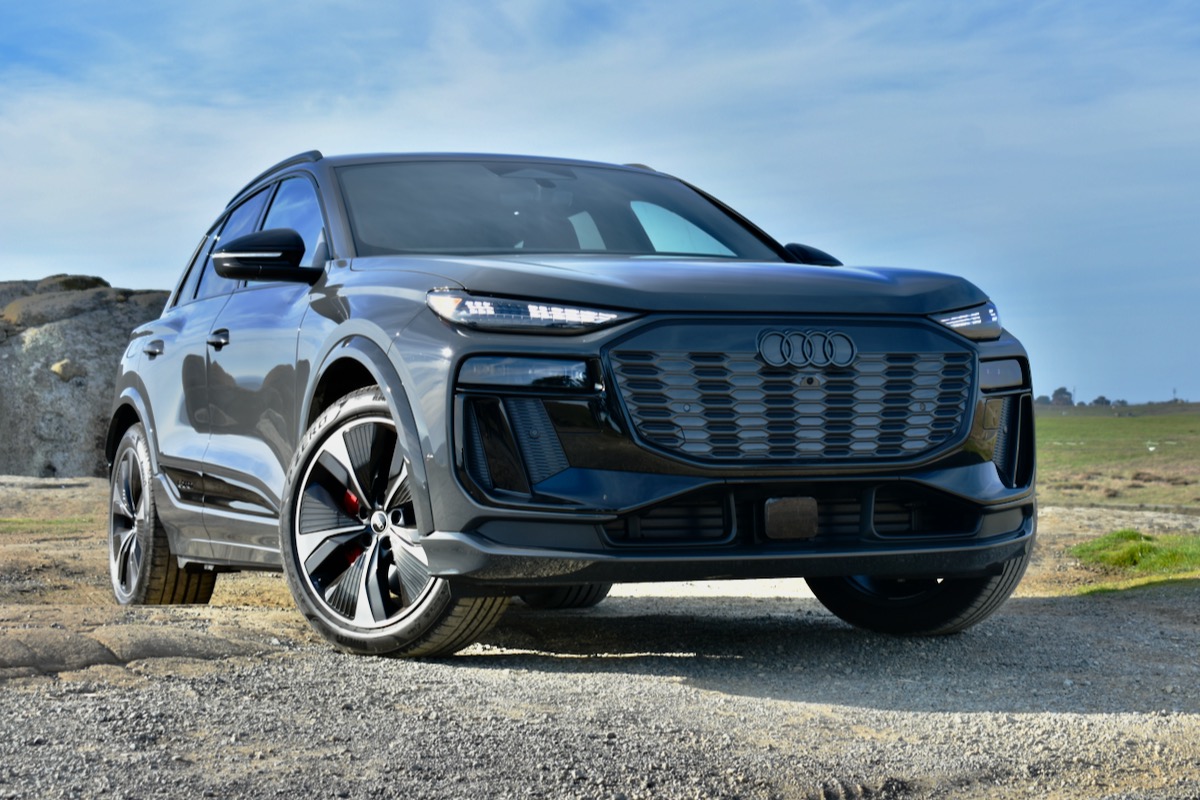
Audi’s newest EV, the Q6 e-tron, shows off the brand’s latest styling and tech features.
The 2025 Audi Q6 e-tron is a new addition to the German luxury brand’s electric vehicle and SUV lineups. It’s a two-row, five-seat midsize model that slots between the Audi Q4 e-tron and Audi Q8 e-tron SUVs, giving Audi a more direct rival to the Acura ZDX, Cadillac Lyriq, and Mercedes-Benz EQE SUV. It also dabbles in Tesla Model Y and Porsche Macan EV territory.
Verdict: Compared to its rivals, the Q6 e-tron is a better choice for buyers who want an EV that still feels like a normal SUV.

The Q6 e-tron represents the new status quo for Audi EVs and the brand in general. It shares the Premium Platform Electric (PPE) architecture with the Audi A6 e-tron sedan and the Porsche Macan Electric, while debuting a new styling theme and interior layout that are also being used on gasoline models like the Q5 and A5.
Many other electric SUVs from luxury brands have sleek exteriors shaped by the wind tunnel that proudly advertise their battery-powered nature. Not this Audi. Engineers didn’t ignore aerodynamics, but Audi also prioritized making the Q6 e-tron look like a real SUV. It stands a bit higher than the Q8 e-tron and features a more upright front end with a large grille and stacked lighting elements. Protruding fenders add more visual bulk in profile view. Many of these features are also seen on the redesigned gasoline Audi Q5, so the Q6 e-tron will do a better job of blending in than most of its rivals.
Audi offers the Q6 e-tron in base, Progressiv, and Technik trim levels in Canada, while the sportier SQ6 e-tron is available in the two higher configurations. These receive a dual-element front lighting setup, with a plain rectangle serving as the headlights and more stylized daytime running lights above. A light signature package is available that allows owners to program up to six animated lighting signatures.
Instead of the emphasis on neat horizontal lines that’s been in vogue recently, the Q6 e-tron’s dashboard bows out to accommodate its curved screen housing. That angularity is reflected in the design of the door panels and the squared-off steering wheel that’s available on some models.
Not all interior materials looked premium, with the grey woodgrain dashboard trim on one test car being a prime example. But Q6 e-trons are appropriately well equipped. Heated and ventilated front seats are available on the Q6, while SQ6 e-tron models are available with massaging front seats and stylish quilted leather upholstery. Crucially, Audi also gave the Q6 e-tron an available opening sunroof with a shade rather than a fixed glass roof that allows the cabin to get too hot.

In Canada, Audi is offering two specs for the Q6 e-tron. The Q6 e-tron comes with dual-motor all-wheel drive (AWD), and the S6 e-tron gets an extra dollop of power. All models have a 100-kilowatt-hour battery pack with 94 kWh of usable capacity and feature launch control. Air suspension is standard on the SQ6 e-tron.
The Q6 e-tron quattro models have a total output of 422 hp (456 hp with launch control), dropping the zero to 100 km/h time to roughly 5 seconds. The S6 e-tron boasts 483 hp (509 hp with launch control), getting it to 100 km/h in 4.3 seconds. This version also has a 230 km/h top speed, compared to 210 km/h for the Q6 e-tron.
We started our testing in the Q6 e-tron quattro and were duly impressed by its quick acceleration and general feeling of solidity. The steering wasn’t very precise or communicative, but its relaxed feel was at least a good fit for a tall, heavy vehicle that can’t change directions that quickly anyway.
Our main complaint is with the air suspension, which produced a choppy ride in the default Balanced and sportier Dynamic drive modes but with poor body control that left the Q6 e-tron flailing about on undulating pavement. Comfort mode added more cushioning but with a floaty ride that further compromised body control.
We found the same chassis issues with the SQ6 e-tron, which only felt sportier than the standard Q6 e-tron on long straightaways, when there was a chance to unleash its extra power. While this isn’t one of Audi’s high performance RS models, we were expecting a bit more differentiation between the SQ6 and Q6, particularly in the handling department. That at least means buyers won’t have to worry about upgrading to an SQ6.
Audi is now implementing one-pedal driving, with a number of different options for drivers. Shifting from “D” into “B” engages one-pedal mode, which did offer suitably strong regenerative braking. It’s also possible to summon short bursts of extra regeneration with steering wheel paddles. There’s also an automatic mode that will adjust regeneration based on factors like road curvature and the speed of the vehicle in front. However, that also means you don’t know how much regeneration you will get in a given situation. And if you end up having to use the brake pedal, the system resets.

Dedicated EV platforms generally give engineers more freedom to configure interiors and maximize space. That’s even more true with the larger footprint of an SUV, but that doesn’t mean all EV interiors are created equal.
The Q6 e-tron offers nearly identical first-row headroom to the Cadillac Lyriq, more headroom than the Acura ZDX, and less than the Mercedes-Benz EQE SUV. Front-seat occupants get the least legroom of the group, though. The Audi also offers appreciably less second-row legroom than its rivals, although back-seat passengers do get more headroom than in the Acura and Cadillac.
At 855 litres, the Q6 e-tron offers more cargo space than rivals with its rear seats in place. The 1,710 litres available with the second row folded isn’t segment-leading, but it’s certainly competitive. Unlike its rivals, the Q6 e-tron also has a small frunk, although it’s really just for storing charging cables.
Inside the cabin, the Q6 e-tron offers decent small item storage, made possible by a compact pull-tab shifter. The shallow-but-long centre console storage bin was able to accommodate two small water bottles laid on their sides. It actually proved to be a good storage spot once the two centre console cupholders were filled, as the door pockets are so big that only jumbo bottles will fit snugly without rattling around.
For those that want to tow with their midsize luxury EV, the Q6 e-tron is the obvious choice. Its 2,000-kilogram (4,400-pound) maximum towing capacity is a meaningful improvement over the 1,587 kilograms (3,500 pounds) of its rivals from Acura, Cadillac, and Mercedes. This, along with the Q6’s practical interior, adds up to true SUV utility. The only thing that’s really missing is off-road capability, but that’s not something offered by rivals either and doesn’t seem to be a priority for Audi’s target customers.

The Q6 e-tron features a tri-screen layout that is set to become the norm for Audi models going forward. An 11.9-inch digital instrument cluster and 14.5-inch touchscreen are placed side-by-side in one curved housing. A third 10.9-inch touchscreen for the front passenger is available. Wireless Apple CarPlay and Android Auto are standard, along with native voice recognition.
While still branded MMI like previous Audi infotainment systems, the Q6 e-tron’s system switches to an Android operating system. However, unlike Android-based infotainment systems from General Motors, Polestar, and Volvo, this system doesn’t rely on Google apps. Audi provides its own navigation and voice recognition instead of using Google Maps and Google Assistant, respectively.
Audi does a good job of placing things so that drivers can keep their eyes on the road and avoid fumbling for touch controls. The touchscreen is angled so that it can be viewed at a quick glance, and it’s easy to reach from the driver’s seat. That also means it’s facing slightly away from the passenger, which makes the dedicated screen for the righthand side of the cockpit more important. That screen can access functions like audio and climate control, but not driver-specific functions like drive modes and vehicle settings. Passengers can also watch YouTube videos while in a motion, with a privacy filter to prevent driver distraction.
Other notable features include an available head-up display that is also perfectly positioned (for drivers of medium height, at least). If you get too close to another car, a proximity warning appears right behind it without obscuring it. Arrows indicating the direction of an upcoming turn float at eye level where they can’t be missed. Speaking of navigation, the optional Bang & Olufsen audio system includes headrest speakers that pipe prompts directly to the driver rather than blasting them through the whole cabin.
The voice recognition system was less impressive. It’s supposed to respond to the prompt “Hey Audi,” but in our experience it woke up unprompted at seemingly random times. Similar systems from rivals BMW and Mercedes-Benz don’t have that issue, in our experience.

The Q6 e-tron receives a Top Safety Pick+ rating from the Insurance Institute for Highway Safety (IIHS), the group’s highest honour. The U.S. National Highway Traffic Safety Administration (NHTSA) gives it a five-star overall safety rating.
Standard driver-assist features include: adaptive cruise control, lane-departure warning, safe exist assist, forward-collision warning, automatic emergency braking, traffic sign recognition, swerve assist, front turn assist, and a driver-attention monitor.
Notable options include a 360-degree camera system and highway driving assist that combines the functions of lane-keep assist and adaptive cruise control to keep the car centred in its lane at a set speed. This system also works in traffic jam conditions, Audi claims, but does not enable hands-free driving like the Super Cruise system available on the Cadillac Lyriq and Acura ZDX (where it’s branded as Hands Free Cruise).

According to Natural Resources Canada, the 2025 Audi Q6 e-tron has a range of 494 kilometres with 19-inch wheels or 475 km with 20-inch wheels. The Q6 e-tron Sportback version has 513 km of range with 19-inch wheels and 491 km of range with 20-inch wheels. The SQ6 e-tron offers 443 km of range in the standard body style or 455 km as the SQ6 e-tron Sportback.
The Q6 e-tron can DC fast charge at up to 270 kilowatts, allowing for a 10%-80% charge in 21 minutes with a suitably powerful charging station. A full charge using a 240-volt Level 2 AC source takes 14 hours, assuming consistent charging at 9.6 kW.
Audi provides an eight-year/160,000-kilometre battery warranty in addition to its four-year/80,000-kilometre comprehensive and powertrain warranties.
In Canada, the base 2025 Audi Q6 e-tron starts at $83,895, including a $2,850 destination charge and other fees. The Progressiv trim starts at $89,995, while the Technik trim starts at $92,945. The Sportback version starts at $93,795 for the Progressiv trim and $96,745 for the Technik trim. The Audi SQ6 e-tron starts at $100,054 for the Progressiv and $103,954 for the Technik, while opting for the Sportback lifts those base prices to $104,014 and $107,914 respectively.
The 2025 Audi Q6 e-tron is priced too high to qualify for any EV incentive programs in Canada as of this writing. Note that models priced above $100,000 will also be subject to the federal government’s luxury tax.
The Q6 e-tron has a much lower base price than a Mercedes-Benz EQE, a slightly lower base price than an Acura ZDX, and is marginally undercut by the Acura’s Cadillac Lyriq cousin. But the real reason to consider this Audi is how normal it looks and feels.
While it isn’t the most remarkable vehicle to drive, the Q6 e-tron also doesn’t try to be anything other like a normal SUV — one that just happens to be electric. And with competitive range and charging capability, it should help ease the transition from gasoline to electric for first-time EV buyers.
Note: Images show a US model.

User reviews for 2025 Audi Q6 e-tron
Write a review2025 Audi Q6 e-tron Pricing
Trims & specs
Air Conditioning
Automatic climate control front air conditioning · Dual front air conditioning zones · Automatic climate control rear air conditioning · Single rear air conditioning zones
Airbags
Dual front airbags · Passenger airbag deactivation: occupant sensing deactivation · Rear side airbags · Rear side curtain airbags
Audio System
Antenna Type: diversity · Voice recognition audio system · Bluetooth auxiliary audio input · IHeartRadio internet radio · Internet radio app: Spotify · HD radio · Satellite Radio: SiriusXM · 1 subwoofer · Total Number of Speakers: 9 · 180 watts
Brakes
ABS: 4-wheel · Braking assist: hill start assist · Electronic parking brake: auto off · Front brake diameter: 13.8 · Front brakes: ventilated disc · Rear brake diameter: 13.8 · Rear brakes: ventilated disc
Comfort Features
Armrests: rear center folding with storage and pass-thru · Center console trim: leatherette · Dash Trim: Leatherette · Dash trim: wood · Door sill trim: illuminated scuff plate · Door trim: leatherette · Floor Mat Material: carpet · Floor Material: carpet · Floor Mats: front · Interior accents: wood · Steering wheel trim: leather
Convenience Features
Active parking system: driver controlled brake, gas and gear selection · Adaptive stop and go cruise control: semi-automatic · Assist handle: rear · Cargo area power outlet: 12V · Cargo cover: retractable · Center console: with lighting · Cruise control: adaptive · Cupholders: rear · Dimming rearview mirror: auto-dimming · Memorized settings: driver seat · Multi-function remote: vehicle and key memory · One-touch windows: 4 · Power outlet(s): USB-C rear · Power steering: electric · Power windows: lockout button · Reading lights: front · Steering wheel: power tilt and telescopic · Steering wheel mounted controls: phone · Storage: cargo tie-down anchors and hooks · Universal garage door opener: Homelink · Vanity mirrors: dual illuminating
Driver Seat
Adjustable lumbar support: 4-way power · Power adjustments: 12
Drivetrain
Axle ratio: 9.24
Engine
EV battery capacity: 100 kWh · EV on-board charger rating: 9.6 kW · Electric Motor Battery Type: lithium ion · Electric Motor HP: 322 · Electric Motor Power Output (Kilowatts): 260 · Electric Motor Torque: 358 · Electric charge cord: autoswitching 110V/240V · Electric motor charger: DC fast charging · Electric motor charger connector: SAE Combo CCS
Exterior Features
Body side moldings: black · Door handle color: body-color · Fender lip moldings: body-color · Front bumper color: body-color · Grille color: body-color · Mirror color: body-color · Rear bumper color: body-color · Rear spoiler: roofline spoiler · Rear spoiler color: body-color · Rear trunk/liftgate: power operated · Window trim: black
Headrests
Front headrests: adjustable · Number of front headrests: 2 · Number of rear headrests: 3
Hybrid
Electric motor charging time (240V): 14 hours · Electric motor miles per charge: 310
In Car Entertainment
Connected in-car apps: app marketplace integration · Infotainment: Audi MMI Connect · Infotainment screen size: 14.5 in. · Smartphone integration: wireless Apple CarPlay
Instrumentation
Fuel economy display: range · Instrument cluster screen size: 11.9 in. · Warnings and reminders: low battery
Lights
Daytime running lights: LED · Exterior entry lights: security approach lamps · Headlights: LED · Tail and brake lights: LED
Mirrors
Exterior mirrors: heated
Passenger Seat
Power adjustments: 12
Rear Seats
Type: 40-20-40 split bench
Roof
Roof rails: black
Safety
Automatic emergency braking: intersection/junction cross · Camera system: rearview · Child seat anchors: LATCH system · Cross Traffic Alert: front · Crumple zones: rear · Impact sensor: door unlock · Parking sensors: front · Pre-Collision Warning System: vibrating steering wheel · Pre-collision warning system: pedestrian detection · Rearview monitor: in dash
Seatbelts
Emergency locking retractors: front · Front seatbelts: 3-point · Seatbelt force limiters: front · Seatbelt pretensioners: front · Seatbelt warning sensor: driver and passenger · Second row seatbelts: 3-point
Seats
Driver seat power adjustments: reclining · Front seat type: bucket · Passenger seat power adjustments: reclining · Rear headrests: adjustable · Rear seat folding: split · Rear seat manual adjustments: reclining · Upholstery: leather
Security
Power door locks: anti-lockout
Steering
Steering ratio: 16.3
Suspension
Front Shock Type: gas shock absorbers · Front Spring Type: coil springs · Front Suspension Classification: independent · Front Suspension Type: strut · Rear Shock Type: gas shock absorbers · Rear Spring Type: coil springs · Rear Suspension Classification: independent · Rear Suspension Type: multi-link · Stabilizer bar(s): rear
Telematics
Driver assistance app: roadside assistance · Electronic messaging assistance: with voice recognition · Navigation app: INRIX Traffic · Navigation system: with voice recognition · Phone: voice activated · Phone wireless data link: Bluetooth · Smart device app compatibility: myAudi with Audi connect · Smart device app function: maintenance status · Wifi: hotspot
Tires
Type: all season
Tires and Rims
Wheel type: aluminum alloy
Towing and Hauling
Trailer hitch: ready
Wheels
Wheel spokes: 5
Windows
Front wipers: rain sensing · Laminated glass: acoustic · Liftgate window: fixed · Power windows: remote operation · Rear wiper: auto-on in reverse
Air Conditioning
Automatic climate control front air conditioning · Dual front air conditioning zones · Automatic climate control rear air conditioning · Single rear air conditioning zones
Airbags
Dual front airbags · Passenger airbag deactivation: occupant sensing deactivation · Front side airbags · Front side curtain airbags
Audio System
Antenna Type: diversity · Voice recognition audio system · USB auxiliary audio input · TuneIn internet radio · Internet radio app: Spotify · Radio: FM · Satellite Radio: SiriusXM · 1 subwoofer · Total Number of Speakers: 9 · 180 watts
Brakes
ABS: 4-wheel · Braking assist: hill start assist · Electronic parking brake: auto off · Front brake diameter: 13.8 · Front brakes: ventilated disc · Rear brake diameter: 13.8 · Rear brakes: ventilated disc
Comfort Features
Armrests: rear center with cupholders · Center console trim: leatherette · Dash Trim: Leatherette · Dash trim: wood · Door sill trim: illuminated scuff plate · Door trim: leatherette · Floor Mat Material: carpet · Floor Material: carpet · Floor Mats: front · Interior accents: wood · Steering wheel trim: leather
Convenience Features
Active parking system: driver controlled brake, gas and gear selection · Adaptive stop and go cruise control: semi-automatic · Assist handle: rear · Cargo area power outlet: 12V · Cargo cover: retractable · Center console: front console with armrest and storage · Cruise control: adaptive · Cupholders: front · Dimming rearview mirror: auto-dimming · Memorized settings: 2 driver · Multi-function remote: trunk release · One-touch windows: 4 · Power outlet(s): 12V front · Power steering: electric · Power windows: lockout button · Reading lights: rear · Steering wheel: power tilt and telescopic · Steering wheel mounted controls: cruise controls · Storage: cargo tie-down anchors and hooks · Universal garage door opener: Homelink · Vanity mirrors: dual illuminating
Driver Seat
Adjustable lumbar support: 4-way power · Power adjustments: 12
Drivetrain
4WD Type: on demand · Axle ratio: 9.24
Engine
EV battery capacity: 100 kWh · EV on-board charger rating: 9.6 kW · Electric Motor Battery Type: lithium ion · Electric Motor HP: 456 · Electric Motor Power Output (Kilowatts): 315 · Electric Motor Torque: 631 · Electric charge cord: autoswitching 110V/240V · Electric motor charger: DC fast charging · Electric motor charger connector: SAE Combo CCS · Electric motor miles per charge: 307
Exterior Features
Body side moldings: black · Door handle color: body-color · Fender lip moldings: body-color · Front bumper color: body-color · Grille color: body-color · Mirror color: body-color · Rear bumper color: body-color · Rear spoiler: roofline spoiler · Rear spoiler color: body-color · Rear trunk/liftgate: sensor-activated · Window trim: black
Headrests
Front headrests: adjustable · Number of front headrests: 2 · Number of rear headrests: 3
Hybrid
Electric motor charging time (240V): 14 hours
In Car Entertainment
Connected in-car apps: app marketplace integration · Infotainment: Android Automotive · Infotainment screen size: 14.5 in. · Smartphone integration: wireless Android Auto
Instrumentation
Fuel economy display: range · Instrument cluster screen size: 11.9 in. · Warnings and reminders: lamp failure
Lights
Daytime running lights: LED · Exterior entry lights: security approach lamps · Headlights: LED · Tail and brake lights: LED
Mirrors
Exterior mirrors: power folding
Passenger Seat
Power adjustments: 12
Rear Seats
Type: 40-20-40 split bench
Roof
Roof rails: black
Safety
Automatic emergency braking: front · Camera system: rearview · Child seat anchors: LATCH system · Cross Traffic Alert: rear · Crumple zones: rear · Impact sensor: door unlock · Parking sensors: front · Pre-Collision Warning System: vibrating steering wheel · Pre-collision warning system: pedestrian detection · Rearview monitor: in dash
Seatbelts
Emergency locking retractors: front · Front seatbelts: 3-point · Seatbelt force limiters: front and rear · Seatbelt pretensioners: front · Seatbelt warning sensor: driver and passenger · Second row seatbelts: 3-point
Seats
Driver seat power adjustments: reclining · Front seat type: bucket · Passenger seat power adjustments: reclining · Rear headrests: adjustable · Rear seat folding: split · Rear seat manual adjustments: reclining · Upholstery: leather
Security
Power door locks: anti-lockout
Steering
Steering ratio: 16.3
Suspension
Front Shock Type: gas shock absorbers · Front Spring Type: coil springs · Front Suspension Classification: independent · Front Suspension Type: multi-link · Rear Shock Type: gas shock absorbers · Rear Spring Type: coil springs · Rear Suspension Classification: independent · Rear Suspension Type: multi-link · Stabilizer bar(s): front
Telematics
Driver assistance app: roadside assistance · Electronic messaging assistance: with voice recognition · Navigation app: INRIX Traffic · Navigation system: over-the-air map updates (OTA) · Phone: voice activated · Phone wireless data link: Bluetooth · Smart device app compatibility: myAudi with Audi connect · Smart device app function: lock operation · Wifi: hotspot
Tires
Type: all season
Tires and Rims
Wheels: aluminum with painted accents
Towing and Hauling
Trailer hitch: ready
Wheels
Wheel spokes: 5
Windows
Front wipers: rain sensing · Laminated glass: acoustic · Liftgate window: fixed · Power windows: with safety reverse · Rear wiper: auto-on in reverse
Air Conditioning
Automatic climate control front air conditioning · Dual front air conditioning zones · Automatic climate control rear air conditioning · Single rear air conditioning zones
Airbags
Dual front airbags · Passenger airbag deactivation: occupant sensing deactivation · Front side airbags · Front side curtain airbags
Audio System
Antenna Type: diversity · Voice recognition audio system · Bluetooth auxiliary audio input · TuneIn internet radio · Internet radio app: Spotify · Premium Brand: Bang & Olufsen · Radio: FM · Satellite Radio: SiriusXM · 1 subwoofer · Surround audio: 5.1 · Total Number of Speakers: 16 · 830 watts
Brakes
ABS: 4-wheel · Braking assist: hill start assist · Electronic parking brake: auto off · Front brake diameter: 13.8 · Front brakes: ventilated disc · Rear brake diameter: 13.8 · Rear brakes: ventilated disc
Comfort Features
Armrests: rear center with cupholders · Center console trim: leatherette · Dash Trim: Leatherette · Dash trim: wood · Door sill trim: illuminated scuff plate · Door trim: leatherette · Floor Mat Material: carpet · Floor Material: carpet · Floor Mats: front · Interior accents: wood · Steering wheel trim: leather
Convenience Features
Active parking system: driver controlled brake, gas and gear selection · Adaptive stop and go cruise control: semi-automatic · Ambient lighting: color-adjustable · Assist handle: rear · Autonomous lane guidance: lane centering · Cargo area power outlet: 12V · Cargo cover: retractable · Center console: front console with armrest and storage · Cruise control: adaptive · Cupholders: rear · Dimming rearview mirror: auto-dimming · Footwell lights: color-adjustable · Memorized settings: driver seat · Multi-function remote: vehicle and key memory · One-touch windows: 4 · Power outlet(s): USB-C rear · Power steering: speed-proportional · Power windows: lockout button · Reading lights: rear · Steering wheel: power tilt and telescopic · Steering wheel mounted controls: cruise controls · Storage: front seatback · Universal garage door opener: Homelink · Vanity mirrors: dual illuminating
Driver Seat
Adjustable lumbar support: 4-way power · Power adjustments: 12
Drivetrain
Axle ratio: 9.24
Engine
EV battery capacity: 100 kWh · EV on-board charger rating: 9.6 kW · Electric Motor Battery Type: lithium ion · Electric Motor HP: 322 · Electric Motor Power Output (Kilowatts): 260 · Electric Motor Torque: 358 · Electric charge cord: autoswitching 110V/240V · Electric motor charger: DC fast charging · Electric motor charger connector: SAE Combo CCS
Exterior Features
Body side moldings: black · Door handle color: body-color · Fender lip moldings: body-color · Front bumper color: body-color · Grille color: body-color · Mirror color: body-color · Rear bumper color: body-color · Rear spoiler: roofline spoiler · Rear spoiler color: body-color · Rear trunk/liftgate: sensor-activated · Window trim: black
Headrests
Front headrests: adjustable · Number of front headrests: 2 · Number of rear headrests: 3
Hybrid
Electric motor charging time (240V): 14 hours · Electric motor miles per charge: 310
In Car Entertainment
Connected in-car apps: app marketplace integration · Infotainment: Android Automotive · Infotainment screen size: 14.5 in. · Smartphone integration: wireless Android Auto
Instrumentation
Fuel economy display: range · Head-up display: augmented reality · Instrument cluster screen size: 11.9 in. · Warnings and reminders: coolant temperature warning
Lights
Daytime running lights: LED · Exterior entry lights: security approach lamps · Headlights: automatic high beam dimmer · Tail and brake lights: LED
Mirrors
Exterior mirrors: heated
Passenger Seat
Power adjustments: 12
Rear Seats
Type: 40-20-40 split bench
Roof
Moonroof: remote operation · Moonroof / Sunroof: power sunshade · Roof rails: black
Safety
Automatic emergency braking: front · Camera system: surround view · Child seat anchors: LATCH system · Cross Traffic Alert: rear · Crumple zones: rear · Impact sensor: door unlock · Parking sensors: front · Pre-Collision Warning System: vibrating steering wheel · Pre-collision warning system: pedestrian detection · Rearview monitor: in dash
Seatbelts
Emergency locking retractors: front and rear · Front seatbelts: 3-point · Seatbelt force limiters: front · Seatbelt pretensioners: front and rear · Seatbelt warning sensor: driver and passenger · Second row seatbelts: 3-point
Seats
Driver seat power adjustments: height · Front seat type: bucket · Passenger seat power adjustments: height · Rear headrests: adjustable · Rear seat folding: split · Rear seat manual adjustments: reclining · Upholstery: leather
Security
Power door locks: anti-lockout
Steering
Steering ratio: 16.3
Suspension
Front Shock Type: gas shock absorbers · Front Spring Type: coil springs · Front Suspension Classification: independent · Front Suspension Type: multi-link · Rear Shock Type: gas shock absorbers · Rear Spring Type: coil springs · Rear Suspension Classification: independent · Rear Suspension Type: multi-link · Stabilizer bar(s): front
Telematics
Driver assistance app: roadside assistance · Electronic messaging assistance: with voice recognition · Navigation app: INRIX Traffic · Navigation system: hard drive navigation system · Phone: voice activated · Phone wireless data link: Bluetooth · Smart device app compatibility: myAudi with Audi connect · Smart device app function: send destination to vehicle · Wifi: hotspot
Tires
Type: all season
Tires and Rims
Wheel type: aluminum alloy
Towing and Hauling
Trailer hitch: ready
Wheels
Wheel spokes: 5
Windows
Front wipers: variable intermittent · Laminated glass: acoustic · Liftgate window: fixed · Power windows: remote operation · Rear wiper: auto-on in reverse
Air Conditioning
Automatic climate control front air conditioning · Dual front air conditioning zones · Rear air conditioning: with independent controls · Single rear air conditioning zones
Airbags
Dual front airbags · Passenger airbag deactivation: occupant sensing deactivation · Front side airbags · Rear side curtain airbags
Audio System
Antenna Type: mast · Voice recognition audio system · USB auxiliary audio input · IHeartRadio internet radio · Internet radio app: Spotify · Premium Brand: Bang & Olufsen · HD radio · Satellite Radio: SiriusXM · 1 subwoofer · Surround audio: 5.1 · Total Number of Speakers: 16 · 830 watts
Brakes
ABS: 4-wheel · Braking assist: hill start assist · Electronic parking brake: auto off · Front brake diameter: 13.8 · Front brakes: ventilated disc · Rear brake diameter: 13.8 · Rear brakes: ventilated disc
Comfort Features
Armrests: rear center with cupholders · Center console trim: leatherette · Dash Trim: Leatherette · Dash trim: wood · Door sill trim: aluminum · Door trim: leatherette · Floor Mat Material: carpet · Floor Material: carpet · Floor Mats: front · Interior accents: wood · Steering wheel trim: leather
Convenience Features
Active parking system: driver controlled brake, gas and gear selection · Adaptive stop and go cruise control: semi-automatic · Ambient lighting: color-adjustable · Assist handle: front · Autonomous lane guidance: lane centering · Cargo area power outlet: 12V · Cargo cover: retractable · Center console: front console with armrest and storage · Cruise control: adaptive · Cupholders: front · Dimming rearview mirror: auto-dimming · Footwell lights: color-adjustable · Memorized settings: 2 driver · Multi-function remote: trunk release · One-touch windows: 4 · Power outlet(s): 12V front · Power steering: electric · Power windows: lockout button · Reading lights: rear · Steering wheel: power tilt and telescopic · Steering wheel mounted controls: cruise controls · Storage: door pockets · Universal garage door opener: Homelink · Vanity mirrors: dual illuminating
Driver Seat
Adjustable lumbar support: 4-way power · Power adjustments: 12
Drivetrain
4WD Type: on demand · Axle ratio: 9.24
Engine
EV battery capacity: 100 kWh · EV on-board charger rating: 9.6 kW · Electric Motor Battery Type: lithium ion · Electric Motor HP: 456 · Electric Motor Power Output (Kilowatts): 315 · Electric Motor Torque: 631 · Electric charge cord: autoswitching 110V/240V · Electric motor charger: DC fast charging · Electric motor charger connector: SAE Combo CCS · Electric motor miles per charge: 307
Exterior Features
Body side moldings: black · Door handle color: body-color · Fender lip moldings: body-color · Front bumper color: body-color · Grille color: body-color · Mirror color: body-color · Rear bumper color: body-color · Rear spoiler: roofline spoiler · Rear spoiler color: body-color · Rear trunk/liftgate: liftgate · Window trim: black
Headrests
Front headrests: adjustable · Number of front headrests: 2 · Number of rear headrests: 3
Hybrid
Electric motor charging time (240V): 14 hours
In Car Entertainment
Connected in-car apps: Apple Music · Infotainment: Audi MMI Connect · Infotainment screen size: 14.5 in. · Smartphone integration: wireless Android Auto
Instrumentation
Fuel economy display: range · Head-up display: augmented reality · Instrument cluster screen size: 11.9 in. · Warnings and reminders: maintenance reminder
Lights
Daytime running lights: LED · Exterior entry lights: security approach lamps · Headlights: LED · Tail and brake lights: LED
Mirrors
Exterior mirrors: power folding
Passenger Seat
Power adjustments: 12
Rear Seats
Type: 40-20-40 split bench
Roof
Moonroof: tilt/slide · Moonroof / Sunroof: power sunshade · Roof rails: black
Safety
Automatic emergency braking: intersection/junction turn · Camera system: surround view · Child seat anchors: LATCH system · Cross Traffic Alert: front · Crumple zones: rear · Impact sensor: post-collision safety system · Parking sensors: rear · Pre-Collision Warning System: audible warning · Pre-collision warning system: intersection/junction turn · Rearview monitor: in dash
Seatbelts
Emergency locking retractors: front and rear · Front seatbelts: 3-point · Seatbelt force limiters: front · Seatbelt pretensioners: front · Seatbelt warning sensor: driver and passenger · Second row seatbelts: 3-point
Seats
Driver seat power adjustments: reclining · Front seat type: bucket · Passenger seat power adjustments: reclining · Rear headrests: adjustable · Rear seat folding: split · Rear seat manual adjustments: reclining · Upholstery: contrast stitching
Security
Power door locks: anti-lockout
Steering
Steering ratio: 16.3
Suspension
Front Shock Type: gas shock absorbers · Front Spring Type: coil springs · Front Suspension Classification: independent · Front Suspension Type: strut · Rear Shock Type: gas shock absorbers · Rear Spring Type: coil springs · Rear Suspension Classification: independent · Rear Suspension Type: multi-link · Stabilizer bar(s): rear
Telematics
Driver assistance app: roadside assistance · Electronic messaging assistance: with voice recognition · Navigation app: INRIX Traffic · Navigation system: touch screen display · Phone: voice activated · Phone wireless data link: Bluetooth · Smart device app compatibility: myAudi with Audi connect · Smart device app function: lock operation · Wifi: hotspot
Tires
Type: all season
Tires and Rims
Wheels: aluminum with painted accents
Towing and Hauling
Trailer hitch: ready
Wheels
Wheel spokes: 5
Windows
Front wipers: rain sensing · Laminated glass: acoustic · Liftgate window: fixed · Power windows: remote operation · Rear wiper: intermittent
Air Conditioning
Automatic climate control front air conditioning · Dual front air conditioning zones · Automatic climate control rear air conditioning · Single rear air conditioning zones
Airbags
Dual front airbags · Passenger airbag deactivation: occupant sensing deactivation · Front side airbags · Rear side curtain airbags
Audio System
Antenna Type: mast · Voice recognition audio system · Bluetooth auxiliary audio input · IHeartRadio internet radio · Internet radio app: Spotify · Premium Brand: Bang & Olufsen · Touch screen display radio · Satellite Radio: SiriusXM · 1 subwoofer · Surround audio: 5.1 · Total Number of Speakers: 16 · 830 watts
Brakes
ABS: 4-wheel · Braking assist: hill start assist · Electronic parking brake: auto off · Front brake diameter: 13.8 · Front brakes: ventilated disc · Rear brake diameter: 13.8 · Rear brakes: ventilated disc
Comfort Features
Armrests: rear center folding with storage and pass-thru · Center console trim: leatherette · Dash Trim: Leatherette · Dash trim: wood · Door sill trim: aluminum · Door trim: leatherette · Floor Mat Material: carpet · Floor Material: carpet · Floor Mats: front · Interior accents: wood · Steering wheel trim: leather
Convenience Features
Active parking system: driver controlled brake, gas and gear selection · Adaptive stop and go cruise control: semi-automatic · Ambient lighting: color-adjustable · Assist handle: rear · Autonomous lane guidance: lane centering · Cargo area power outlet: 12V · Cargo cover: retractable · Center console: front console with armrest and storage · Cruise control: adaptive · Cupholders: front · Dimming rearview mirror: auto-dimming · Footwell lights: color-adjustable · Memorized settings: driver seat · Multi-function remote: vehicle and key memory · One-touch windows: 4 · Power outlet(s): USB-C rear · Power steering: electric · Power windows: lockout button · Reading lights: rear · Steering wheel: power tilt and telescopic · Steering wheel mounted controls: audio · Storage: front seatback · Universal garage door opener: Homelink · Vanity mirrors: dual illuminating
Driver Seat
Adjustable lumbar support: 4-way power · Power adjustments: 12
Drivetrain
Axle ratio: 9.24
Engine
EV battery capacity: 100 kWh · EV on-board charger rating: 9.6 kW · Electric Motor Battery Type: lithium ion · Electric Motor HP: 322 · Electric Motor Power Output (Kilowatts): 260 · Electric Motor Torque: 358 · Electric charge cord: autoswitching 110V/240V · Electric motor charger: DC fast charging · Electric motor charger connector: SAE Combo CCS
Exterior Features
Body side moldings: black · Door handle color: body-color · Fender lip moldings: body-color · Front bumper color: body-color · Grille color: body-color · Mirror color: body-color · Rear bumper color: body-color · Rear spoiler: roofline spoiler · Rear spoiler color: body-color · Rear trunk/liftgate: liftgate · Window trim: black
Headrests
Front headrests: adjustable · Number of front headrests: 2 · Number of rear headrests: 3
Hybrid
Electric motor charging time (240V): 14 hours · Electric motor miles per charge: 310
In Car Entertainment
Connected in-car apps: Yelp · Front passenger screen size: 10.9 in. · Infotainment: Android Automotive · Infotainment screen size: 14.5 in. · Smartphone integration: wireless Apple CarPlay
Instrumentation
Fuel economy display: range · Head-up display: augmented reality · Instrument cluster screen size: 11.9 in. · Warnings and reminders: low battery
Lights
Daytime running lights: LED · Exterior entry lights: security approach lamps · Headlights: auto delay off · Tail and brake lights: LED
Mirrors
Exterior mirrors: heated
Passenger Seat
Power adjustments: 12
Rear Seats
Type: 40-20-40 split bench
Roof
Moonroof: tilt/slide · Moonroof / Sunroof: power sunshade · Roof rails: black
Safety
Automatic emergency braking: rear · Camera system: surround view · Child seat anchors: LATCH system · Cross Traffic Alert: front · Crumple zones: rear · Impact sensor: post-collision safety system · Parking sensors: front · Pre-Collision Warning System: vibrating steering wheel · Pre-collision warning system: intersection/junction cross · Rearview monitor: in dash
Seatbelts
Emergency locking retractors: front · Front seatbelts: 3-point · Seatbelt force limiters: front · Seatbelt pretensioners: front and rear · Seatbelt warning sensor: driver and passenger · Second row seatbelts: 3-point
Seats
Driver seat power adjustments: reclining · Front seat type: bucket · Passenger seat power adjustments: reclining · Rear headrests: adjustable · Rear seat folding: split · Rear seat manual adjustments: reclining · Upholstery: leather
Security
Power door locks: anti-lockout
Steering
Steering ratio: 16.3
Suspension
Driver Adjustable Suspension: ride control · Front Shock Type: gas shock absorbers · Front Spring Type: pneumatic springs · Front Suspension Classification: independent · Front Suspension Type: strut · Leveling: self leveling suspension · Rear Shock Type: gas shock absorbers · Rear Spring Type: pneumatic springs · Rear Suspension Classification: independent · Rear Suspension Type: multi-link · Stabilizer bar(s): front · Suspension control: electronic
Telematics
Driver assistance app: roadside assistance · Electronic messaging assistance: with read function · Navigation app: INRIX Traffic · Navigation system: over-the-air map updates (OTA) · Phone: voice activated · Phone wireless data link: Bluetooth · Smart device app compatibility: myAudi with Audi connect · Smart device app function: lock operation · Wifi: hotspot
Tires
Type: all season
Tires and Rims
Wheel type: aluminum alloy
Towing and Hauling
Trailer hitch: ready
Wheels
Wheel spokes: 5
Windows
Front wipers: variable intermittent · Laminated glass: acoustic · Liftgate window: fixed · Power windows: with safety reverse · Rear wiper: with washer
Air Conditioning
Automatic climate control front air conditioning · Dual front air conditioning zones · Rear air conditioning: with independent controls · Single rear air conditioning zones
Airbags
Dual front airbags · Passenger airbag deactivation: occupant sensing deactivation · Front side airbags · Front side curtain airbags
Audio System
Antenna Type: mast · Voice recognition audio system · USB auxiliary audio input · IHeartRadio internet radio · Internet radio app: Spotify · Premium Brand: Bang & Olufsen · Radio: FM · Satellite Radio: SiriusXM · 1 subwoofer · Surround audio: 5.1 · Total Number of Speakers: 16 · 830 watts
Brakes
ABS: 4-wheel · Braking assist: hill start assist · Electronic parking brake: auto off · Front brake diameter: 13.8 · Front brakes: ventilated disc · Rear brake diameter: 13.8 · Rear brakes: ventilated disc
Comfort Features
Armrests: rear center folding with storage and pass-thru · Center console trim: leatherette · Dash Trim: Leatherette · Dash trim: wood · Door sill trim: illuminated scuff plate · Door trim: leatherette · Floor Mat Material: carpet · Floor Material: carpet · Floor Mats: front · Interior accents: wood · Steering wheel trim: leather
Convenience Features
Active parking system: driver controlled brake, gas and gear selection · Adaptive stop and go cruise control: semi-automatic · Ambient lighting: color-adjustable · Assist handle: rear · Autonomous lane guidance: lane centering · Cargo area power outlet: 12V · Cargo cover: retractable · Center console: front console with armrest and storage · Cruise control: adaptive · Cupholders: rear · Dimming rearview mirror: auto-dimming · Footwell lights: color-adjustable · Memorized settings: side mirrors · Multi-function remote: proximity entry system · One-touch windows: 4 · Power outlet(s): USB-C rear · Power steering: electric · Power windows: lockout button · Reading lights: rear · Steering wheel: power tilt and telescopic · Steering wheel mounted controls: cruise controls · Storage: cargo tie-down anchors and hooks · Universal garage door opener: Homelink · Vanity mirrors: dual illuminating
Driver Seat
Adjustable lumbar support: 4-way power · Power adjustments: 12
Drivetrain
4WD Type: on demand · Axle ratio: 9.24
Engine
EV battery capacity: 100 kWh · EV on-board charger rating: 9.6 kW · Electric Motor Battery Type: lithium ion · Electric Motor HP: 456 · Electric Motor Power Output (Kilowatts): 315 · Electric Motor Torque: 631 · Electric charge cord: autoswitching 110V/240V · Electric motor charger: DC fast charging · Electric motor charger connector: SAE Combo CCS · Electric motor miles per charge: 307
Exterior Features
Body side moldings: black · Door handle color: body-color · Fender lip moldings: body-color · Front bumper color: body-color · Grille color: body-color · Mirror color: body-color · Rear bumper color: body-color · Rear spoiler: roofline spoiler · Rear spoiler color: body-color · Rear trunk/liftgate: sensor-activated · Window trim: black
Headrests
Front headrests: adjustable · Number of front headrests: 2 · Number of rear headrests: 3
Hybrid
Electric motor charging time (240V): 14 hours
In Car Entertainment
Connected in-car apps: app marketplace integration · Front passenger screen size: 10.9 in. · Infotainment: Android Automotive · Infotainment screen size: 14.5 in. · Smartphone integration: wireless Apple CarPlay
Instrumentation
Fuel economy display: range · Head-up display: augmented reality · Instrument cluster screen size: 11.9 in. · Warnings and reminders: lamp failure
Lights
Daytime running lights: LED · Exterior entry lights: security approach lamps · Headlights: Auto on/off · Tail and brake lights: LED
Mirrors
Exterior mirrors: heated
Passenger Seat
Power adjustments: 12
Rear Seats
Type: 40-20-40 split bench
Roof
Moonroof: anti-trapping feature · Moonroof / Sunroof: power sunshade · Roof rails: black
Safety
Automatic emergency braking: front · Camera system: surround view · Child seat anchors: LATCH system · Cross Traffic Alert: rear · Crumple zones: rear · Impact sensor: post-collision safety system · Parking sensors: front · Pre-Collision Warning System: vibrating steering wheel · Pre-collision warning system: pedestrian detection · Rearview monitor: in dash
Seatbelts
Emergency locking retractors: front · Front seatbelts: 3-point · Seatbelt force limiters: front and rear · Seatbelt pretensioners: front and rear · Seatbelt warning sensor: driver and passenger · Second row seatbelts: 3-point
Seats
Driver seat power adjustments: height · Front seat type: bucket · Passenger seat power adjustments: height · Rear headrests: adjustable · Rear seat folding: split · Rear seat manual adjustments: reclining · Upholstery: leather
Security
Power door locks: anti-lockout
Steering
Steering ratio: 16.3
Suspension
Driver Adjustable Suspension: height · Front Shock Type: gas shock absorbers · Front Spring Type: pneumatic springs · Front Suspension Classification: independent · Front Suspension Type: strut · Leveling: self leveling suspension · Rear Shock Type: gas shock absorbers · Rear Spring Type: pneumatic springs · Rear Suspension Classification: independent · Rear Suspension Type: multi-link · Stabilizer bar(s): front · Suspension control: electronic
Telematics
Driver assistance app: roadside assistance · Electronic messaging assistance: with voice recognition · Navigation app: INRIX Traffic · Navigation system: with voice recognition · Phone: voice activated · Phone wireless data link: Bluetooth · Smart device app compatibility: myAudi with Audi connect · Smart device app function: lock operation · Wifi: hotspot
Tires
Type: all season
Tires and Rims
Wheels: aluminum with painted accents
Towing and Hauling
Trailer hitch: ready
Wheels
Wheel spokes: 5
Windows
Front wipers: rain sensing · Laminated glass: acoustic · Liftgate window: fixed · Power windows: with safety reverse · Rear wiper: auto-on in reverse
