2025 Chevrolet Blazer EV Reviews, Pricing & Specs
Write a reviewPros
Multiple powertrain options
Plenty of cargo space
Available Super Cruise
Cons
Apple CarPlay is not offered
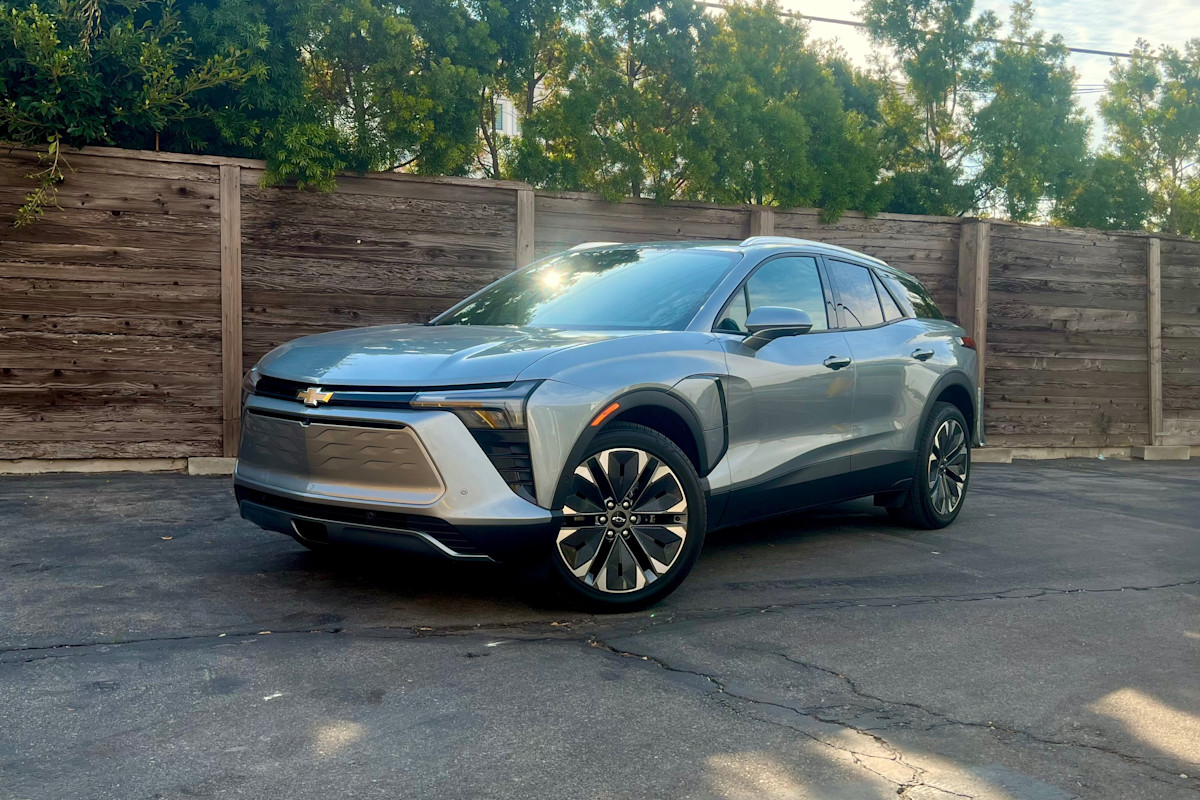
The 2025 Chevrolet Blazer EV brings Chevy SUV style to the electric landscape.
The Chevrolet Blazer EV is a sporty counterpoint to the more affordable Equinox EV. It has more eye-catching style and the performance to back it up, too. This gives new-car shoppers more options at Chevy showrooms.
Verdict: Although the Blazer EV offers sportier styling, it doesn’t offer any clear advantages in range or interior space over its competing stablemate, the Equinox EV.

The 2025 Blazer EV is one of two all-electric crossover SUVs from Chevrolet, joined by the slightly smaller Equinox EV. The Blazer EV distinguishes itself with a sharper and sportier design that has some hints of the now-discontinued Camaro muscle car. A narrow bar of lights separates the faceted hood from the filled-in "grille," while exaggerated flared fenders give it a more athletic and hunkered-down stance.
This sleek profile also helps the Chevy Blazer EV stand out from more conventionally styled electric SUVs, making it look almost more like a longer hatchback than a crossover. If not for the blanked-off grille and EV badging, it would be easy to mistake the Blazer EV for an internal combustion vehicle. Even the charge port is hidden just ahead of the driver's door, though its power operation is painfully slow, and the auxiliary DC charge port cover can get tangled in the mechanism when closing the panel.
The Camaro theme is echoed in the interior of the Blazer EV with sporty round air vents, faceted screens that dominate the dashboard, and contrast stitching for a subtle but racy personality. Those vents and glossy displays make for a good combination of old-school cool with modern tech. First impressions are favourable, but upon closer inspection there are plenty of hard plastic elements. To their credit, these pieces are textured to match the soft-touch materials on the doors and centre armrest.
The steering wheel feels good in your hands, and the controls are well placed, but the stitching and leather seams aren't as carefully assembled as we expected. If you're familiar with current luxury vehicles, it's difficult to unsee the minor flaws. If you're not, you likely won't even notice.

The 2025 Chevy Blazer EV lineup is about as confusing as it can get, with multiple powertrain choices within trim levels.
Up first are the LT and RS, which come standard with two electric motors for all-wheel-drive (AWD). Combined, these motors produce 288 horsepower and 333 pound-feet of torque and are fed by an 85-kWh battery pack in the floor of the vehicle. These AWD models should accelerate to 96 km/h in only 6.0 seconds, according to Chevy. Natural Resources Canada estimates they can return as much as 455 kilometres on a full charge, though real-world results tend to vary.
The LT and RS trims gain a new front-wheel drive (FWD) option for 2025. A single motor up front produces 220 hp and 243 lb-ft of torque. While less powerful, FWD extends estimated range to 502 kilometres.
Additionally, the Blazer EV RS is now available in single-motor rear-wheel drive (RWD) form, making the Blazer EV the only vehicle for sale today that offered with FWD, RWD, and AWD. The RWD Blazer EV RS is actually more powerful than the RS AWD, at 340 hp and 325 lb-ft of torque. It’s also the range leader of the lineup, with a 538-kilometre estimate courtesy of a larger 102-kWh battery.
Finally, there's the new SS trim (we told you it was confusing). This high-performance version combines a dual-motor powertrain with the larger battery pack from the RS, plus some model-specific chassis tuning. Power skyrockets to 615 hp and 650 lb-ft of torque — good enough for zero to 96 km/h in 3.4 seconds, according to Chevy — but range drops to 488 kilometres.
For this test drive, we were entrusted with an LT with AWD that presented a mixed bag of results. Acceleration is quick when compared to a typical gas-powered SUV, but this version of the Blazer EV is not as potent as many other electric rivals. That said, it's far quicker than the vast majority of drivers will desire. On highway onramps, we had to back off the accelerator to match the flow of traffic. The Blazer EV also corners with confidence, thanks to having a lot of its weight low in the vehicle. While we wouldn't consider it sporty, it will also exceed most drivers’ expectations.
We're pleased that the Blazer EV not only offers one-pedal driving but also gives the driver two levels of brake regeneration. In its highest setting, the vehicle decelerates as though you've given the brake pedal a sharp press. With just a little practice, it's easy to bring the Blazer EV to a full and smooth stop without ever having to touch the brake pedal. In tight parking situations, it can be too jumpy and sensitive, though. In those cases, the moderate one-pedal setting is better.
On the road, the suspension is on the firm side. You'll feel small imperfections in the pavement, but there's enough compliance to keep moderate bumps from sending sharp jolts through the cabin. The ride quality is also slightly smoother than most Teslas, Hyundais, and Kias. The steering could use some improvement, as we noticed that the vehicle tends to wander within highway lanes. This lack of an on-centre feel means you'll be constantly making adjustments, and it can get tiresome rather quickly.
On smooth surfaces, the Blazer EV is nearly silent, but road noise can get annoyingly loud in less optimal conditions. We heard the tires rolling most of the time, and on some rain-grooved sections, this constant — and loud — howl was thoroughly off-putting. To its credit, the Blazer EV is still an easy car to drive, and on an extended drive, the range estimates proved accurate.
The Blazer EV has an AC charge rate of 11.5 kW for use with home chargers. It also has DC fast charging capability up to 190 kW, which should replenish up to 125 kilometres of range in 10 minutes, Chevy estimates. That’s quick enough for most drivers on a road trip.
However, EVs from Hyundai and Kia charge significantly quicker, assuming one can find a more powerful fast charger to make use of that capability. Helping matters for the Blazer EV is plentiful map data for locating nearby chargers, and the ability to pre-condition the battery for the quickest recharge rates.

The front seats offer good support and adequate cushioning for longer road trips. We like the massive touchscreen's placement high on the dash and its large on-screen buttons that reduce distraction when driving, but it’s still further away than we prefer. Climate controls get redundant physical knobs and buttons below the infotainment screen and can be adjusted without having to take your eyes off the road. There are numerous small trays and pockets for your personal effects, but some rivals offer more and larger storage options.
The rear seats are firm and flat by comparison, but they offer a wealth of legroom. Headroom is more limited, although an average-sized adult passenger will have enough space without brushing against the headliner. The lack of a transmission hump in the floor also means the centre passenger won't feel as though they're being penalized.
Behind those seats, the Blazer EV can hold up to 722 litres of cargo, which is about average for the class. The space itself is flat without any significant obstructions, which, along with the standard hands-free power liftgate should make loading easier. The sloping rear hatch will make bulky objects harder to fit, though.
For the most part, the Blazer EV is easy to use and live with, leaving us with only minor nitpicks. These include its climate control system, which takes a long time to heat the cabin on a cold day. This is attributed to the use of a heat pump instead of a more conventional unit, but on the plus side, it's more efficient and helps to extend range in cold weather. Those in snowy climates would do well to pre-condition the cabin via the smartphone app ahead of time.
Another annoyance is the placement of the brake regeneration paddle on the backside of the steering wheel. It's too close to the audio controls and neither have any tactile dimples to tell them apart. That resulted in a few inadvertent decelerations when we intended to skip to the next track.

The Blazer comes with plenty of standard tech features. These include the huge 17.7-inch infotainment touchscreen and digital instrument panel, a native navigation system, a Wi-Fi hotspot, and OnStar remote monitoring and control. The infotainment system runs on the Google Built-in platform, making it easier to integrate map and productivity data from the rest of your life (assuming you use Google’s apps outside the car). The system is quick to respond to touch commands, and the displays are crystal clear.
The big problem is what's missing. Apple CarPlay and Android Auto are not offered at all, leaving smartphone users on their own. It may seem trivial at first, but anyone who has regularly used CarPlay might feel as though they have one hand tied behind their back. Searching for your music requires digging deeper into generic folders, and the lack of voice texting through the familiar interface adds to the inconvenience.
Voice commands through your phone help to alleviate some issues, but GM’s decision to discontinue offering smartphone mirroring on its new EVs makes that a moot point. Native voice controls via Google are accurate but take some time to identify what you're asking for. They also don't work with climate controls or other secondary systems the way the systems in many rivals do.
The standard six-speaker audio system lacks punchy bass while some high notes can get distorted at higher volumes. An eight-speaker Bose upgrade is available, but only on the SS trim.

The Blazer EV (RWD) received five out of five stars in all crash tests conducted by the U.S. National Highway Traffic Safety Administration (NHTSA). The AWD model received four stars for rollover protection, and the FWD model has not been fully evaluated. The Insurance Institute for Highway Safety (IIHS) has yet to publish its results.
Standard driver assistance safety features include: forward collision warning with automatic emergency braking, adaptive cruise control, lane-keep assist, blind-spot monitoring with steering intervention, reverse automatic braking, a surround-view camera system, and automatic high beams. Also included is the safety alert seat that vibrates when a warning is activated.
GM's Super Cruise automated hands-free driving system is available as an option and also comes with a semi-automated parking system. That makes the Blazer EV one of the few vehicles that offers such an advanced driving system, although Super Cruise is also available on the Chevy Equinox EV. The Ford Mustang Mach-E is available with an equivalent system, called BlueCruise.
We made liberal use of Super Cruise on local highways and found it very useful but not perfect. When activated, a green light illuminates on the top of the steering wheel and the system flawlessly maintains a consistent gap between you and the vehicle ahead. When traffic slows or stops, the braking is smooth if you don't set the following distance to its shortest setting.
On most of the gentle curves in the highway, the steering tracked as it should, keeping the vehicle central in its lane. On some of the sharper bends, Super Cruise struggled to stay in its lane and required driver intervention to keep from wandering from edge to edge of the lane as if a drunkard was at the wheel. Over many hours, it became easy to determine which curves might cause an issue, allowing us to rely on the system under all other conditions and greatly reducing our long-distance fatigue.

In Canada, the 2025 Chevrolet Blazer EV has a manufacturer's suggested retail price (MSRP) of $57,833 (including the $2,500 destination charge and other fees) for the single motor (FWD) LT trim. For another $3,500, you can upgrade to the dual-motor AWD model. The sportier RS starts at $61,533 with FWD and $65,033 with AWD, while the more lively RS RWD rings in at $68,333. At the top of the lineup, the high-performance SS will set you back $73,333.
That figures out to about $10,000 more than the related and similarly sized Chevy Equinox EV, which begs the question, "what do I get for the added cost?" Neither electric SUV has a clear advantage in terms of interior space or cargo capacity, and range estimates aren't wildly different, either. In the end, it comes down to price or personality. The Equinox EV is an excellent electric vehicle for the money, but if you want a sportier look and more performance from higher trim levels, the Blazer EV is the best pick. Both EVs qualify for the rebate programs that still exist in some provinces.
The Honda Prologue is also built on the same shared platform as the two Chevy EVs. It has a distinctly different style but is similar in most other ways. We'd consider it against the Chevys primarily because it offers Apple CarPlay and Android Auto. Otherwise, the Blazer EV could also be cross-shopped against the Ford Mustang Mach-E, Hyundai Ioniq 5, Kia EV6, Tesla Model Y, and Volkswagen ID.4.
Note: Images show a US model.

User reviews for 2025 Chevrolet Blazer EV
Write a review2025 Chevrolet Blazer EV Pricing
Trims & specs
Air Conditioning
Automatic climate control front air conditioning · Single front air conditioning zones
Airbags
Dual front airbags · Dual front knee airbags · Passenger airbag deactivation: occupant sensing deactivation · Front side airbags · Front side curtain airbags
Audio System
Antenna Type: mast · Voice recognition audio system · Bluetooth auxiliary audio input · Stitcher internet radio · Internet radio app: Spotify · Touch screen display radio · Satellite Radio: SiriusXM · Total Number of Speakers: 6
Brakes
ABS: 4-wheel · Braking assist: hill start assist · Electronic parking brake: auto off · Front brake diameter: 12.6 · Front brakes: ventilated disc · Rear brake diameter: 13.6 · Rear brakes: disc
Comfort Features
Armrests: rear center with cupholders · Center console trim: leatherette · Dash Trim: Leatherette · Floor Mat Material: carpet · Floor Material: carpet · Floor Mats: front · Steering wheel trim: urethane
Convenience Features
Adaptive stop and go cruise control: semi-automatic · Assist handle: passenger side · Center console: front console with armrest and storage · Cruise control: adaptive · Cupholders: 4 · Multi-function remote: keyless entry with panic alarm · One-touch windows: 4 · Power outlet(s): 12V front · Power steering: electric · Power windows: lockout button · Reading lights: front · Steering wheel: tilt and telescopic · Steering wheel mounted controls: multi-function screen controls · Storage: front seatback · Vanity mirrors: dual illuminating
Driver Seat
Manual adjustments: 6
Engine
Battery: maintenance-free · EV battery capacity: 85 kWh · EV on-board charger rating: 11.5 kW · Electric Motor HP: 220 · Electric Motor Power Output (Kilowatts): 164 · Electric Motor Torque: 243 · Electric motor battery type: Ultium lithium ion · Electric motor charger: DC fast charging · Electric motor charger connector: SAE J1772
Exterior Features
Body side moldings: black · Door handle color: body-color · Fender lip moldings: black · Front bumper color: black · Grille color: body-color · Mirror color: body-color · Rear bumper color: black · Rear spoiler: roofline spoiler · Rear spoiler color: body-color · Rear trunk/liftgate: liftgate · Rocker panel color: black · Window trim: black
Headrests
Front headrests: adjustable · Number of front headrests: 2 · Number of rear headrests: 3
In Car Entertainment
Connected in-car apps: Google search · Infotainment: Google Built-In · Infotainment screen size: 17.7 in.
Instrumentation
Fuel economy display: range · Instrument cluster screen size: 11 in. · Warnings and reminders: maintenance reminder
Lights
Daytime running lights: LED · Headlights: auto delay off · Tail and brake lights: LED
Mirrors
Exterior mirrors: manual folding · Inside rearview mirror: manual day/night
Passenger Seat
Manual Adjustments: 6
Rear Seats
Type: 60-40 split bench
Safety
Automatic emergency braking: front pedestrian · Camera system: surround view · Child seat anchors: LATCH system · Cross Traffic Alert: rear · Parking sensors: rear · Pre-Collision Warning System: audible warning · Pre-collision warning system: pedestrian detection · Rearview monitor: in dash
Seatbelts
Emergency locking retractors: front · Front seatbelts: 3-point · Seatbelt force limiters: front · Seatbelt pretensioners: front and rear · Seatbelt warning sensor: driver and passenger · Second row seatbelts: 3-point
Seats
Driver seat manual adjustments: height · Front seat type: bucket · Passenger seat manual adjustments: height · Rear headrests: adjustable · Rear seat folding: flat · Upholstery: premium cloth
Security
Power door locks: anti-lockout
Spare Tire
Kit: inflator kit
Stability and Traction
Traction control: with trailer stability control
Suspension
Front Arm Type: lower control arms · Front Shock Type: gas shock absorbers · Front Spring Type: coil springs · Front Suspension Classification: independent · Front Suspension Type: MacPherson struts · Rear Shock Type: gas shock absorbers · Rear Spring Type: coil springs · Rear Suspension Classification: independent · Rear Suspension Type: multi-link · Stabilizer bar(s): front
Telematics
Driver assistance app: roadside assistance · Electronic messaging assistance: with voice recognition · Navigation system: with voice recognition · Phone: voice activated · Phone wireless data link: Bluetooth · Satellite communications: OnStar · Smart device app compatibility: Amazon Alexa · Smart device app function: maintenance status · Wifi: hotspot
Tires
Type: all season
Tires and Rims
Wheels: polished aluminum with painted accents
Windows
Front wipers: variable intermittent · Laminated glass: acoustic · Liftgate window: fixed · Power windows: with safety reverse · Rear wiper: intermittent
Air Conditioning
Automatic climate control front air conditioning · Single front air conditioning zones
Airbags
Dual front airbags · Dual front knee airbags · Passenger airbag deactivation: occupant sensing deactivation · Front side airbags · Front side curtain airbags
Audio System
Antenna Type: diversity · Voice recognition audio system · Bluetooth auxiliary audio input · Stitcher internet radio · Internet radio app: Spotify · Touch screen display radio · Satellite Radio: SiriusXM · Total Number of Speakers: 6
Brakes
ABS: 4-wheel · Braking assist: hill start assist · Electronic parking brake: auto off · Front brake diameter: 12.6 · Front brakes: ventilated disc · Rear brake diameter: 13.6 · Rear brakes: disc
Comfort Features
Armrests: rear center with cupholders · Center console trim: leatherette · Dash Trim: Leatherette · Floor Mat Material: carpet · Floor Material: carpet · Floor Mats: front · Steering wheel trim: urethane
Convenience Features
Adaptive stop and go cruise control: semi-automatic · Assist handle: passenger side · Center console: front console with armrest and storage · Cruise control: adaptive · Cupholders: 4 · Multi-function remote: proximity entry system · One-touch windows: 4 · Power outlet(s): USB-C front · Power steering: speed-proportional · Power windows: lockout button · Reading lights: front · Steering wheel: tilt and telescopic · Steering wheel mounted controls: multi-function screen controls · Storage: door pockets · Vanity mirrors: dual illuminating
Driver Seat
Manual adjustments: 6
Drivetrain
4WD Type: on demand
Engine
Battery: maintenance-free · EV battery capacity: 85 kWh · EV on-board charger rating: 11.5 kW · Electric Motor HP: 288 · Electric Motor Power Output (Kilowatts): 212 · Electric Motor Torque: 333 · Electric motor battery type: Ultium lithium ion · Electric motor charger: DC fast charging · Electric motor charger connector: SAE J1772 · Electric motor miles per charge: 282
Exterior Features
Body side moldings: black · Door handle color: body-color · Fender lip moldings: black · Front bumper color: black · Grille color: body-color · Mirror color: body-color · Rear bumper color: black · Rear spoiler: roofline spoiler · Rear spoiler color: body-color · Rear trunk/liftgate: liftgate · Rocker panel color: black · Window trim: black
Headrests
Front headrests: adjustable · Number of front headrests: 2 · Number of rear headrests: 3
In Car Entertainment
Connected in-car apps: Google Assistant · Infotainment: Google Built-In · Infotainment screen size: 17.7 in.
Instrumentation
Fuel economy display: range · Instrument cluster screen size: 11 in. · Warnings and reminders: maintenance reminder
Lights
Daytime running lights: LED · Headlights: Auto on/off · Tail and brake lights: LED
Mirrors
Exterior mirrors: manual folding · Inside rearview mirror: manual day/night
Passenger Seat
Manual Adjustments: 6
Rear Seats
Type: 60-40 split bench
Safety
Automatic emergency braking: rear · Camera system: surround view · Child seat anchors: LATCH system · Cross Traffic Alert: rear · Parking sensors: front · Pre-Collision Warning System: vibrating driver seat · Pre-collision warning system: pedestrian detection · Rearview monitor: in dash
Seatbelts
Emergency locking retractors: front · Front seatbelts: 3-point · Seatbelt force limiters: front and rear · Seatbelt pretensioners: front · Seatbelt warning sensor: driver and passenger · Second row seatbelts: 3-point
Seats
Driver seat manual adjustments: height · Front seat type: bucket · Passenger seat manual adjustments: height · Rear headrests: adjustable · Rear seat folding: flat · Upholstery: premium cloth
Security
Power door locks: anti-lockout
Spare Tire
Kit: inflator kit
Stability and Traction
Traction control: with trailer stability control
Suspension
Front Arm Type: lower control arms · Front Shock Type: gas shock absorbers · Front Spring Type: coil springs · Front Suspension Classification: independent · Front Suspension Type: MacPherson struts · Rear Shock Type: gas shock absorbers · Rear Spring Type: coil springs · Rear Suspension Classification: independent · Rear Suspension Type: multi-link · Stabilizer bar(s): front
Telematics
Driver assistance app: roadside assistance · Electronic messaging assistance: with voice recognition · Navigation system: with voice recognition · Phone: voice activated · Phone wireless data link: Bluetooth · Satellite communications: OnStar · Smart device app compatibility: myChevrolet with Connected Access · Smart device app function: send destination to vehicle · Wifi: hotspot
Tires
Type: all season
Tires and Rims
Wheels: polished aluminum with painted accents
Windows
Front wipers: variable intermittent · Laminated glass: acoustic · Liftgate window: fixed · Power windows: with safety reverse · Rear wiper: intermittent
Air Conditioning
Automatic climate control front air conditioning · Dual front air conditioning zones
Airbags
Dual front airbags · Dual front knee airbags · Passenger airbag deactivation: occupant sensing deactivation · Front side airbags · Front side curtain airbags
Audio System
Antenna Type: diversity · Voice recognition audio system · Bluetooth auxiliary audio input · Stitcher internet radio · Internet radio app: Spotify · Touch screen display radio · Satellite Radio: SiriusXM · Total Number of Speakers: 6
Brakes
ABS: 4-wheel · Braking assist: hill start assist · Electronic parking brake: auto off · Front brake diameter: 12.6 · Front brakes: ventilated disc · Rear brake diameter: 13.6 · Rear brakes: disc
Comfort Features
Armrests: rear center with cupholders · Center console trim: leatherette · Dash Trim: Leatherette · Floor Mat Material: carpet · Floor Material: carpet · Floor Mats: front · Steering wheel trim: leatherette
Convenience Features
Adaptive stop and go cruise control: semi-automatic · Ambient lighting: color-adjustable · Assist handle: passenger side · Center console: front console with armrest and storage · Cruise control: adaptive · Cupholders: front · Dimming rearview mirror: auto-dimming · Memorized settings: side mirrors · Multi-function remote: keyless entry with panic alarm · One-touch windows: 4 · Power outlet(s): 12V front · Power steering: electric · Power windows: lockout button · Reading lights: rear · Steering wheel: tilt and telescopic · Steering wheel mounted controls: cruise controls · Storage: cargo tie-down anchors and hooks · Vanity mirrors: dual illuminating
Driver Seat
Adjustable lumbar support: power · Power adjustments: 8
Engine
Battery: maintenance-free · EV battery capacity: 85 kWh · EV on-board charger rating: 11.5 kW · Electric Motor HP: 220 · Electric Motor Power Output (Kilowatts): 164 · Electric Motor Torque: 243 · Electric motor battery type: Ultium lithium ion · Electric motor charger: DC fast charging · Electric motor charger connector: SAE J1772
Exterior Features
Body side moldings: black · Door handle color: body-color · Fender lip moldings: black · Front bumper color: black · Grille color: black · Illuminated accent: grille · Mirror color: black · Rear bumper color: black · Rear spoiler: roofline spoiler · Rear spoiler color: body-color · Rear trunk/liftgate: liftgate · Rocker panel color: black · Window trim: black
Headrests
Front headrests: adjustable · Number of front headrests: 2 · Number of rear headrests: 3
In Car Entertainment
Connected in-car apps: app marketplace integration · Infotainment: Chevrolet Infotainment System · Infotainment screen size: 17.7 in.
Instrumentation
Fuel economy display: range · Instrument cluster screen size: 11 in. · Warnings and reminders: maintenance reminder
Lights
Daytime running lights: LED · Exterior entry lights: security approach lamps · Headlights: auto delay off · Tail and brake lights: LED
Mirrors
Exterior mirrors: driver side auto-dimming
Passenger Seat
Adjustable lumbar support: power · Power adjustments: 6
Rear Seats
Type: 60-40 split bench
Roof
Roof rails: black
Safety
Automatic emergency braking: rear · Camera system: surround view · Child seat anchors: LATCH system · Cross Traffic Alert: rear · Parking sensors: rear · Pre-Collision Warning System: vibrating driver seat · Pre-collision warning system: pedestrian detection · Rearview monitor: in dash
Seatbelts
Emergency locking retractors: front and rear · Front seatbelts: 3-point · Seatbelt force limiters: front · Seatbelt pretensioners: front and rear · Seatbelt warning sensor: driver and passenger · Second row seatbelts: 3-point
Seats
Driver seat power adjustments: height · Front seat type: bucket · Passenger seat power adjustments: height · Rear headrests: adjustable · Rear seat folding: flat · Upholstery: leatherette · Upholstery accents: faux suede
Security
Power door locks: anti-lockout
Stability and Traction
Traction control: with trailer stability control
Suspension
Front Arm Type: lower control arms · Front Shock Type: gas shock absorbers · Front Spring Type: coil springs · Front Suspension Classification: independent · Front Suspension Type: MacPherson struts · Rear Shock Type: gas shock absorbers · Rear Spring Type: coil springs · Rear Suspension Classification: independent · Rear Suspension Type: multi-link · Stabilizer bar(s): front
Telematics
Driver assistance app: roadside assistance · Electronic messaging assistance: with voice recognition · Navigation system: touch screen display · Phone: voice activated · Phone wireless data link: Bluetooth · Satellite communications: Turn-by-Turn Navigation · Smart device app compatibility: Amazon Alexa · Smart device app function: horn/light operation · Wifi: hotspot
Tires
Type: all season
Tires and Rims
Run flat tires: puncture sealing compound with electric compressor · Wheels: polished aluminum with painted accents
Towing and Hauling
Trailer wiring: 4-pin
Windows
Front wipers: variable intermittent · Laminated glass: acoustic · Liftgate window: fixed · Power windows: with safety reverse · Rear wiper: intermittent
Air Conditioning
Automatic climate control front air conditioning · Dual front air conditioning zones
Airbags
Dual front airbags · Dual front knee airbags · Passenger airbag deactivation: occupant sensing deactivation · Front side airbags · Rear side curtain airbags
Audio System
Antenna Type: diversity · Voice recognition audio system · Bluetooth auxiliary audio input · Stitcher internet radio · Internet radio app: Spotify · AM/FM radio · Satellite Radio: SiriusXM · Total Number of Speakers: 6
Brakes
ABS: 4-wheel · Braking assist: hill start assist · Electronic parking brake: auto off · Front brake diameter: 12.6 · Front brakes: ventilated disc · Rear brake diameter: 13.6 · Rear brakes: disc
Comfort Features
Armrests: rear center with cupholders · Center console trim: leatherette · Dash Trim: Leatherette · Floor Mat Material: carpet · Floor Material: carpet · Floor Mats: front · Steering wheel trim: leatherette
Convenience Features
Adaptive stop and go cruise control: semi-automatic · Ambient lighting: color-adjustable · Assist handle: rear · Center console: front console with armrest and storage · Cruise control: adaptive · Cupholders: rear · Dimming rearview mirror: auto-dimming · Memorized settings: liftgate · Multi-function remote: proximity entry system · One-touch windows: 4 · Power outlet(s): USB-C rear · Power steering: speed-proportional · Power windows: lockout button · Reading lights: front · Steering wheel: tilt and telescopic · Steering wheel mounted controls: phone · Storage: accessory hook · Vanity mirrors: dual illuminating
Driver Seat
Adjustable lumbar support: power · Power adjustments: 8
Drivetrain
4WD Type: on demand
Engine
Battery: maintenance-free · EV battery capacity: 85 kWh · EV on-board charger rating: 11.5 kW · Electric Motor HP: 288 · Electric Motor Power Output (Kilowatts): 212 · Electric Motor Torque: 333 · Electric motor battery type: Ultium lithium ion · Electric motor charger: DC fast charging · Electric motor charger connector: SAE J1772 · Electric motor miles per charge: 282
Exterior Features
Body side moldings: black · Door handle color: body-color · Fender lip moldings: black · Front bumper color: black · Grille color: black · Illuminated accent: grille · Mirror color: black · Rear bumper color: black · Rear spoiler: roofline spoiler · Rear spoiler color: body-color · Rear trunk/liftgate: power operated · Rocker panel color: black · Window trim: black
Headrests
Front headrests: adjustable · Number of front headrests: 2 · Number of rear headrests: 3
In Car Entertainment
Connected in-car apps: Google POIs · Infotainment: Google Built-In · Infotainment screen size: 17.7 in.
Instrumentation
Fuel economy display: range · Instrument cluster screen size: 11 in. · Warnings and reminders: maintenance reminder
Lights
Daytime running lights: LED · Exterior entry lights: security approach lamps · Headlights: Auto on/off · Tail and brake lights: LED
Mirrors
Exterior mirrors: integrated turn signals
Passenger Seat
Adjustable lumbar support: power · Power adjustments: 6
Rear Seats
Type: 60-40 split bench
Roof
Roof rails: black
Safety
Automatic emergency braking: intersection/junction turn · Camera system: surround view · Child seat anchors: LATCH system · Cross Traffic Alert: rear · Parking sensors: front · Pre-Collision Warning System: audible warning · Pre-collision warning system: pedestrian detection · Rearview monitor: in dash
Seatbelts
Emergency locking retractors: front and rear · Front seatbelts: 3-point · Seatbelt force limiters: front · Seatbelt pretensioners: front · Seatbelt warning sensor: driver and passenger · Second row seatbelts: 3-point
Seats
Driver seat power adjustments: reclining · Front seat type: bucket · Passenger seat power adjustments: reclining · Rear headrests: adjustable · Rear seat folding: flat · Upholstery: perforated · Upholstery accents: faux suede
Security
Power door locks: anti-lockout
Stability and Traction
Traction control: with trailer stability control
Suspension
Front Arm Type: lower control arms · Front Shock Type: gas shock absorbers · Front Spring Type: coil springs · Front Suspension Classification: independent · Front Suspension Type: MacPherson struts · Rear Shock Type: gas shock absorbers · Rear Spring Type: coil springs · Rear Suspension Classification: independent · Rear Suspension Type: multi-link · Stabilizer bar(s): rear
Telematics
Driver assistance app: roadside assistance · Electronic messaging assistance: with read function · Navigation system: with voice recognition · Phone: voice activated · Phone wireless data link: Bluetooth · Satellite communications: OnStar · Smart device app compatibility: myChevrolet with Connected Access · Smart device app function: vehicle location · Wifi: hotspot
Tires
Type: all season
Tires and Rims
Run flat tires: puncture sealing compound with electric compressor · Wheels: polished aluminum with painted accents
Towing and Hauling
Trailer wiring: 4-pin
Windows
Front wipers: rain sensing · Laminated glass: acoustic · Liftgate window: fixed · Power windows: with safety reverse · Rear wiper: with washer
Air Conditioning
Automatic climate control front air conditioning · Dual front air conditioning zones
Airbags
Dual front airbags · Dual front knee airbags · Passenger airbag deactivation: occupant sensing deactivation · Front side airbags · Front side curtain airbags
Audio System
Antenna Type: mast · Voice recognition audio system · Bluetooth auxiliary audio input · Stitcher internet radio · Internet radio app: Spotify · Premium Brand: Bose · Touch screen display radio · Satellite Radio: SiriusXM · Total Number of Speakers: 8
Brakes
ABS: 4-wheel · Braking assist: hill start assist · Electronic parking brake: auto off · Front brake diameter: 12.6 · Front brakes: ventilated disc · Rear brake diameter: 13.6 · Rear brakes: disc
Comfort Features
Armrests: rear center with cupholders · Center console trim: leatherette · Dash Trim: Leatherette · Floor Mat Material: carpet · Floor Material: carpet · Floor Mats: front · Steering wheel trim: leatherette
Convenience Features
Adaptive stop and go cruise control: semi-automatic · Ambient lighting: color-adjustable · Assist handle: passenger side · Center console: front console with armrest and storage · Cruise control: adaptive · Cupholders: 4 · Dimming rearview mirror: auto-dimming · Memorized settings: liftgate · Multi-function remote: proximity entry system · One-touch windows: 4 · Power outlet(s): USB-C front · Power steering: electric · Power windows: lockout button · Reading lights: front · Rearview mirror: camera-based · Steering wheel: tilt and telescopic · Steering wheel mounted controls: phone · Storage: cargo tie-down anchors and hooks · Vanity mirrors: dual illuminating
Driver Seat
Adjustable lumbar support: power · Power adjustments: 8
Engine
Battery: maintenance-free · EV battery capacity: 102 kWh · EV on-board charger rating: 11.5 kW · Electric Motor HP: 340 · Electric Motor Power Output (Kilowatts): 254 · Electric Motor Torque: 325 · Electric motor battery type: Ultium lithium ion · Electric motor charger: DC fast charging · Electric motor charger connector: SAE J1772 · Electric motor miles per charge: 334
Exterior Features
Body side moldings: black · Door handle color: body-color · Fender lip moldings: black · Front bumper color: black · Grille color: black · Illuminated accent: grille · Mirror color: black · Rear bumper color: black · Rear spoiler: roofline spoiler · Rear spoiler color: body-color · Rear trunk/liftgate: sensor-activated · Rocker panel color: black · Window trim: black
Headrests
Front headrests: adjustable · Number of front headrests: 2 · Number of rear headrests: 3
In Car Entertainment
Connected in-car apps: Google search · Infotainment: Google Built-In · Infotainment screen size: 17.7 in.
Instrumentation
Fuel economy display: range · Instrument cluster screen size: 11 in. · Warnings and reminders: maintenance reminder
Lights
Daytime running lights: LED · Exterior entry lights: security approach lamps · Headlights: Auto on/off · Tail and brake lights: LED
Mirrors
Exterior mirrors: integrated turn signals
Passenger Seat
Adjustable lumbar support: power · Power adjustments: 6
Rear Seats
Type: 60-40 split bench
Roof
Roof rails: black
Safety
Automatic emergency braking: intersection/junction turn · Camera system: surround view · Camera system washer: rear · Child seat anchors: LATCH system · Cross Traffic Alert: rear · Parking sensors: front · Pre-Collision Warning System: vibrating driver seat · Pre-collision warning system: pedestrian detection · Rearview monitor: in dash
Seatbelts
Emergency locking retractors: front and rear · Front seatbelts: 3-point · Seatbelt force limiters: front and rear · Seatbelt pretensioners: front and rear · Seatbelt warning sensor: driver and passenger · Second row seatbelts: 3-point
Seats
Driver seat power adjustments: height · Front seat type: bucket · Passenger seat power adjustments: height · Rear headrests: adjustable · Rear seat folding: split · Upholstery: perforated · Upholstery accents: faux suede
Security
Power door locks: anti-lockout
Stability and Traction
Traction control: with trailer stability control
Suspension
Front Arm Type: lower control arms · Front Shock Type: gas shock absorbers · Front Spring Type: coil springs · Front Suspension Classification: independent · Front Suspension Type: MacPherson struts · Rear Shock Type: gas shock absorbers · Rear Spring Type: coil springs · Rear Suspension Classification: independent · Rear Suspension Type: multi-link · Stabilizer bar(s): front
Telematics
Driver assistance app: roadside assistance · Electronic messaging assistance: with voice recognition · Navigation system: with voice recognition · Phone: voice activated · Phone wireless data link: Bluetooth · Satellite communications: OnStar · Smart device app compatibility: Amazon Alexa · Smart device app function: maintenance status · Wifi: hotspot
Tires
Type: all season
Tires and Rims
Run flat tires: puncture sealing compound with electric compressor · Wheels: polished aluminum with painted accents
Towing and Hauling
Trailer wiring: 4-pin
Windows
Front wipers: rain sensing · Laminated glass: acoustic · Liftgate window: fixed · Power windows: with safety reverse · Rear wiper: with washer
Air Conditioning
Automatic climate control front air conditioning · Dual front air conditioning zones
Airbags
Dual front airbags · Dual front knee airbags · Passenger airbag deactivation: occupant sensing deactivation · Front side airbags · Front side curtain airbags
Audio System
Antenna Type: mast · Voice recognition audio system · USB auxiliary audio input · Stitcher internet radio · Internet radio app: Spotify · AM/FM radio · Satellite Radio: SiriusXM
Brakes
ABS: 4-wheel · Braking assist: hill start assist · Electronic parking brake: auto off · Front brake diameter: 12.6 · Front brakes: ventilated disc · Premium brakes: Brembo · Rear brake diameter: 13.6 · Rear brakes: disc
Comfort Features
Floor Material: rubber · Steering wheel trim: urethane
Convenience Features
Assist handle: rear · Bottle holders: 2 · Cupholders: front · Dimming rearview mirror: auto-dimming · Multi-function remote: proximity entry system · One-touch windows: 4 · Power outlet(s): 12V front · Power steering: electric · Power windows: lockout button · Reading lights: front · Steering wheel: tilt and telescopic · Steering wheel mounted controls: voice recognition controls · Storage: accessory hook · Vanity mirrors: dual illuminating
Driver Seat
Adjustable lumbar support: power · Power adjustments: 8
Drivetrain
4WD Type: on demand
Engine
Battery: maintenance-free · EV battery capacity: 102 kWh · EV on-board charger rating: 19 kW · Electric Motor HP: 498 · Electric Motor Power Output (Kilowatts): 366 · Electric Motor Torque: 531 · Electric motor battery type: Ultium lithium ion · Electric motor charger: DC fast charging · Electric motor charger connector: SAE J1772
Exterior Features
Body side moldings: black · Door handle color: body-color · Fender lip moldings: black · Front bumper color: black · Grille color: black · Mirror color: black · Rear bumper color: black · Rear spoiler: roofline spoiler · Rear spoiler color: body-color · Rear trunk/liftgate: liftgate · Rocker panel color: black · Skid plate(s): front · Window trim: black
Headrests
Front headrests: adjustable · Number of front headrests: 2 · Number of rear headrests: 3
In Car Entertainment
Connected in-car apps: app marketplace integration · Infotainment: Google Built-In · Infotainment screen size: 17.7 in.
Instrumentation
Fuel economy display: range · Instrument cluster screen size: 11 in. · Warnings and reminders: maintenance reminder
Lights
Daytime running lights: LED · Headlights: LED · Tail and brake lights: LED
Mirrors
Exterior mirrors: power folding
Passenger Seat
Adjustable lumbar support: power · Power adjustments: 6
Rear Seats
Type: 60-40 split bench
Safety
Camera system: rearview · Camera system washer: rear · Child seat anchors: LATCH system · Parking sensors: front · Pre-Collision Warning System: audible warning · Programmable safety key: MyKey · Rearview monitor: in dash
Seatbelts
Emergency locking retractors: front and rear · Front seatbelts: 3-point · Seatbelt force limiters: front · Seatbelt pretensioners: front · Seatbelt warning sensor: driver and passenger · Second row seatbelts: 3-point
Seats
Driver seat power adjustments: reclining · Front seat type: bucket · Passenger seat power adjustments: reclining · Rear headrests: adjustable · Rear seat folding: flat · Upholstery: cloth
Security
Power door locks: anti-lockout
Spare Tire
Kit: inflator kit
Suspension
Front Arm Type: lower control arms · Front Shock Type: gas shock absorbers · Front Spring Type: coil springs · Front Suspension Classification: independent · Front Suspension Type: MacPherson struts · Rear Shock Type: gas shock absorbers · Rear Spring Type: coil springs · Rear Suspension Classification: independent · Rear Suspension Type: multi-link · Stabilizer bar(s): front
Telematics
Driver assistance app: roadside assistance · Electronic messaging assistance: with voice recognition · Navigation system: with voice recognition · Phone: voice activated · Phone wireless data link: Bluetooth · Satellite communications: OnStar · Smart device app compatibility: Amazon Alexa · Smart device app function: lock operation · Wifi: hotspot
Tires
Type: all season
Tires and Rims
Run flat tires: puncture sealing compound with electric compressor · Wheels: steel
Windows
Front wipers: variable intermittent · Laminated glass: acoustic · Liftgate window: fixed · Power windows: with safety reverse · Rear wiper: with washer · Solar-tinted glass: rear
Air Conditioning
Automatic climate control front air conditioning · Dual front air conditioning zones
Airbags
Dual front airbags · Dual front knee airbags · Passenger airbag deactivation: occupant sensing deactivation · Front side airbags · Rear side curtain airbags
Audio System
Antenna Type: diversity · Voice recognition audio system · USB auxiliary audio input · Stitcher internet radio · Internet radio app: Spotify · Premium Brand: Bose · Touch screen display radio · Satellite Radio: SiriusXM · Total Number of Speakers: 8
Brakes
ABS: 4-wheel · Braking assist: hill start assist · Electronic parking brake: auto off · Front brake diameter: 12.6 · Front brakes: ventilated disc · Premium brakes: Brembo · Rear brake diameter: 13.6 · Rear brakes: disc
Comfort Features
Armrests: rear center with cupholders · Center console trim: leatherette · Dash Trim: Leatherette · Floor Mat Material: carpet · Floor Material: carpet · Floor Mats: front · Steering wheel trim: leatherette
Convenience Features
Active parking system: fully automated · Adaptive stop and go cruise control: semi-automatic · Ambient lighting: color-adjustable · Assist handle: rear · Center console: front console with armrest and storage · Cruise control: adaptive · Cupholders: front · Dimming rearview mirror: auto-dimming · Memorized settings: driver seat · Multi-function remote: trunk release · One-touch windows: 4 · Power outlet(s): 12V front · Power steering: speed-proportional · Power windows: lockout button · Reading lights: rear · Rearview mirror: camera-based · Steering wheel: tilt and telescopic · Steering wheel mounted controls: audio · Storage: door pockets · Vanity mirrors: dual illuminating
Driver Seat
Adjustable lumbar support: power · Power adjustments: 8
Drivetrain
4WD Type: on demand
Engine
Battery: maintenance-free · EV battery capacity: 102 kWh · EV on-board charger rating: 11.5 kW · Electric Motor HP: 615 · Electric Motor Power Output (Kilowatts): 459 · Electric Motor Torque: 650 · Electric motor battery type: Ultium lithium ion · Electric motor charger: DC fast charging · Electric motor charger connector: SAE J1772
Exterior Features
Body side moldings: black · Door handle color: body-color · Fender lip moldings: black · Front bumper color: black · Grille color: black · Illuminated accent: grille · Mirror color: black · Paint: contrast roof · Rear bumper color: black · Rear spoiler: roofline spoiler · Rear spoiler color: body-color · Rear trunk/liftgate: sensor-activated · Rocker panel color: black · Window trim: black
Headrests
Front headrests: adjustable · Number of front headrests: 2 · Number of rear headrests: 3
In Car Entertainment
Connected in-car apps: Google POIs · Infotainment: Chevrolet Infotainment System · Infotainment screen size: 17.7 in.
Instrumentation
Fuel economy display: range · Instrument cluster screen size: 11 in. · Warnings and reminders: maintenance reminder
Lights
Daytime running lights: LED · Exterior entry lights: security approach lamps · Headlights: Auto on/off · Tail and brake lights: LED
Mirrors
Exterior mirrors: power
Passenger Seat
Adjustable lumbar support: power · Power adjustments: 6
Rear Seats
Type: 60-40 split bench
Roof
Roof rails: black
Safety
Automatic emergency braking: intersection/junction turn · Camera system: surround view · Camera system washer: rear · Child seat anchors: LATCH system · Cross Traffic Alert: rear · Parking sensors: rear · Pre-Collision Warning System: vibrating driver seat · Pre-collision warning system: pedestrian detection · Rearview monitor: in dash
Seatbelts
Emergency locking retractors: front · Front seatbelts: 3-point · Seatbelt force limiters: front · Seatbelt pretensioners: front · Seatbelt warning sensor: driver and passenger · Second row seatbelts: 3-point
Seats
Driver seat power adjustments: reclining · Front seat type: bucket · Passenger seat power adjustments: reclining · Rear headrests: adjustable · Rear seat folding: split · Upholstery: leatherette
Security
Power door locks: anti-lockout
Stability and Traction
Traction control: with trailer stability control
Suspension
Front Arm Type: lower control arms · Front Shock Type: gas shock absorbers · Front Spring Type: coil springs · Front Suspension Classification: independent · Front Suspension Type: MacPherson struts · Rear Shock Type: gas shock absorbers · Rear Spring Type: coil springs · Rear Suspension Classification: independent · Rear Suspension Type: multi-link · Stabilizer bar(s): rear
Telematics
Driver assistance app: roadside assistance · Electronic messaging assistance: with read function · Navigation system: touch screen display · Phone: voice activated · Phone wireless data link: Bluetooth · Satellite communications: Turn-by-Turn Navigation · Smart device app compatibility: Amazon Alexa · Smart device app function: send destination to vehicle · Wifi: hotspot
Tires
Type: all season
Tires and Rims
Run flat tires: puncture sealing compound with electric compressor · Wheels: polished aluminum with painted accents
Windows
Front wipers: variable intermittent · Laminated glass: acoustic · Liftgate window: fixed · Power windows: with safety reverse · Rear wiper: intermittent
