2025 Ford Explorer Reviews, Pricing & Specs
Write a reviewPros
Fun to drive
Comfortable
Easy-to-use technology
Cons
No hybrid or plug-in hybrid option
No off-road trim level
Cramped third-row

The original Ford Explorer sparked North America’s love affair with SUVs. The 2025 Explorer nourishes it.
Thanks to numerous changes for 2025, the Ford Explorer is a more appealing alternative to the seemingly countless choices in the midsize three-row SUV segment. Highlights include sophisticated new infotainment and safety technologies, improved interior quality, bolder styling, and a simplified lineup offering Active, ST-Line, Platinum, and ST trim levels. Also, as the prices of rivals have risen, the 2025 Ford Explorer seems properly priced in comparison.
Verdict: Ford’s updates to the Explorer for the 2025 model year have a positive effect on the SUV’s desirability. It looks tougher, it feels nicer inside, and the family-friendly SUV leaps forward technologically. Turbocharged power and a rear-drive platform add driving enjoyment. All that’s missing is a more comfortable third-row seat, an electrified powertrain option, and an off-road trim level.
The last time Ford redesigned the Explorer, it switched the midsize SUV from a front-wheel-drive (FWD) to a rear-wheel-drive (RWD) platform. The decision gave the Explorer balanced proportions and a swept-back appearance as the “floating” roof and greenhouse tapered into the liftgate, resulting in a sleeker and less boxy design.
That continues with the refreshed 2025 Explorer. Ford restyled the front end, though, and the Explorer is better for it. It looks wider and more ruggedly handsome now, and less like a little kid who got caught stealing goodies from the candy jar. In back, new LED taillights bleed into the liftgate, connected by a strip of trim with the SUV’s name on it. A mixed bag of new wheel designs debut, too.
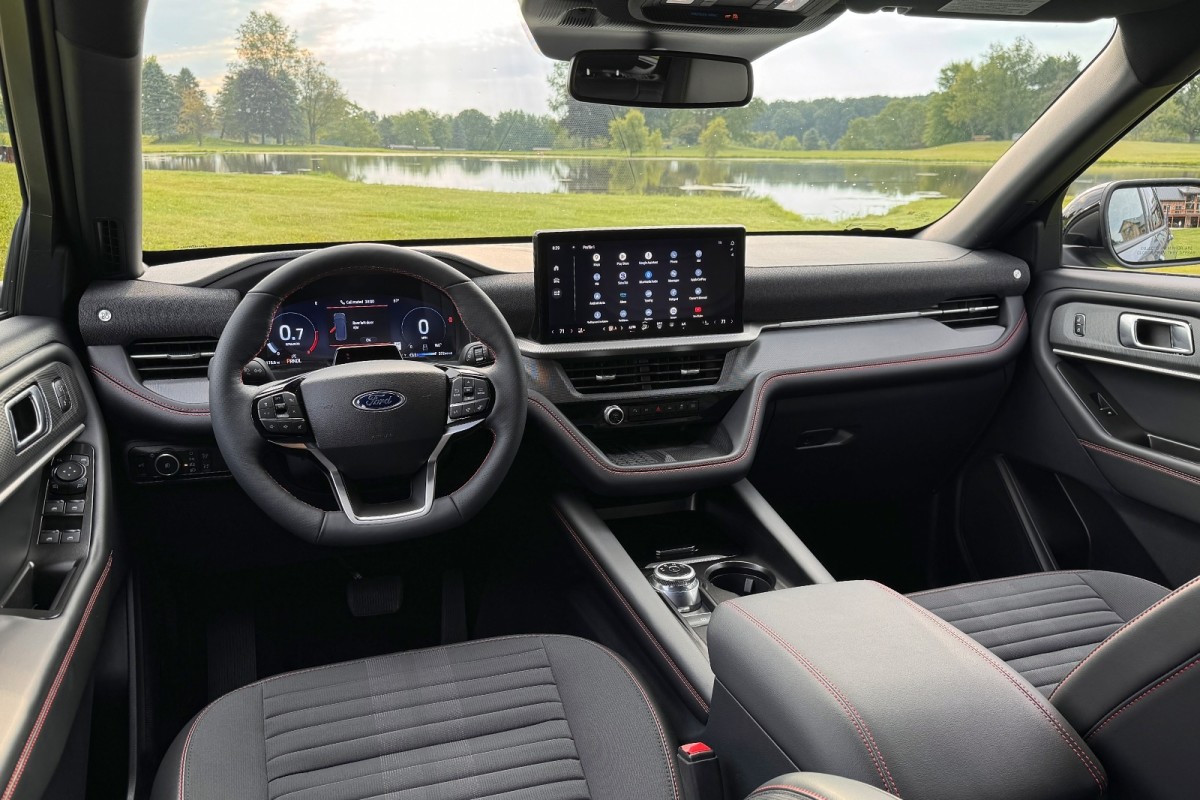
Interior updates dramatically improve the mood in the 2025 Explorer. From the base trim up, Ford’s family-size SUV looks and feels much nicer inside than before. The colours, materials, design, and displays are absolutely competitive in the segment now, eliminating a reason to pass on the Explorer for a different model.
Ford chops the available trim levels in Canada from six down to four. Those that remain include the new base trim called Active, plus the sporty ST-Line, the luxurious Platinum, and the performance-tuned ST. Prices range from $52,830 to $71,430, including the destination charge of $2,295.
During a Ford-sponsored driving event, we got a chance to sample all four versions of the 2025 Explorer. The one we spent the most time with on this first drive was an ST-Line with extra-cost blue paint, a Premium Package, and an ST-Line Street Pack. It carries a Canadian manufacturer’s suggested retail price (MSRP) of $64,280, including the destination charge.
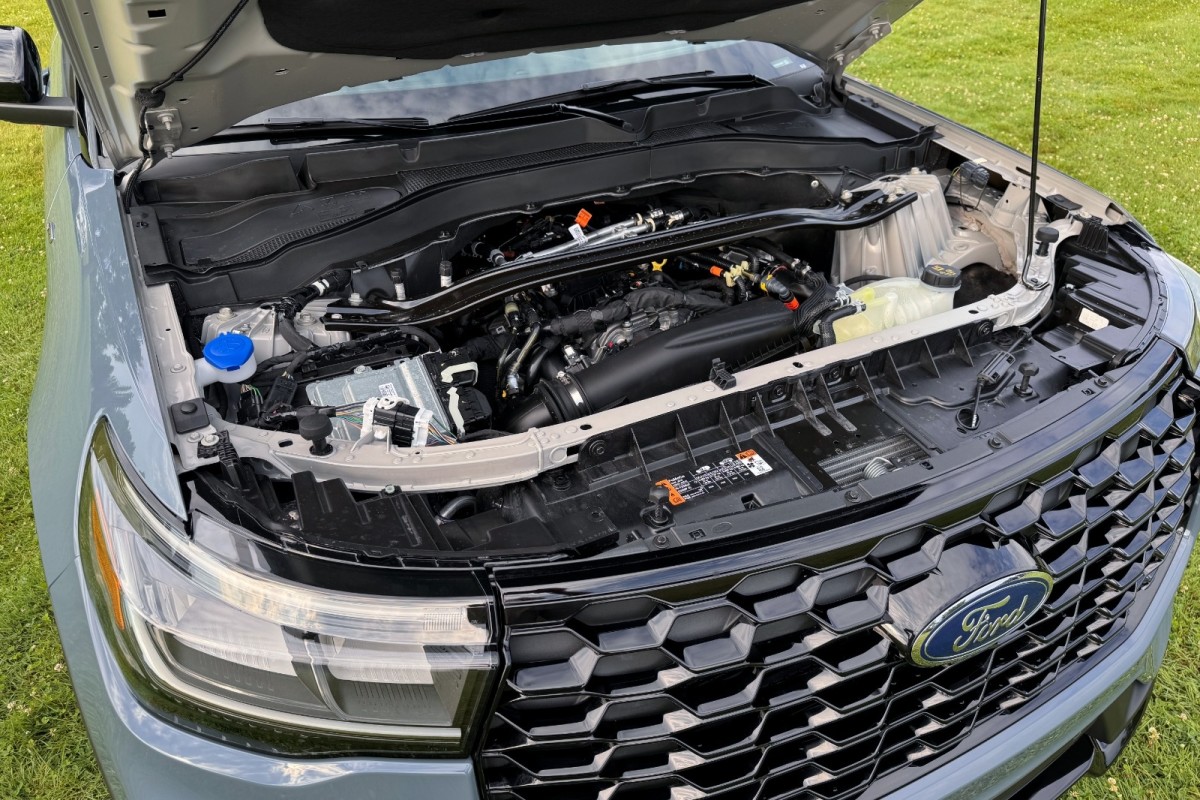
Ford offers two engines for the 2025 Explorer, both branded EcoBoost. All but the ST have a turbocharged 2.3-litre four-cylinder engine generating 300 horsepower and 310 pound-feet of torque. A twin-turbocharged 3.0-litre V6 cranking out 400 hp and 415 lb-ft of torque is standard on the Explorer ST and optional with Platinum trim.
All Explorers sold in Canada have a 10-speed automatic transmission and all-wheel drive (AWD). (Ford brands this system as four-wheel-drive (4WD), but it functions more similarly to what Canadians would classify as AWD.) Drivers can choose between several driving modes including Eco, Normal, Sport, Slippery, Trail, Tow/Haul, and Deep Snow/Sand.
Natural Resources Canada gives the 2025 Ford Explorer fuel economy ratings of 11.9 litres per 100 kilometres in the city, 8.7 on the highway, and 10.4 combined with the base 2.3-litre four-cylinder engine. When the Platinum is optioned with the V6, expect fuel consumption of 13.0 L/100 km city, 9.3 highway, and 11.3 combined. In the ST trim, the V6 averages 13.3 city, 9.6 highway, and 11.6 combined.
Thanks to its generous power ratings, the Explorer’s turbo four is all most people will need in this midsize SUV. It provides quick acceleration and the 10-speed automatic snaps off decisive shifts. Switch to Sport mode, and the standard powertrain feels more responsive while the steering weights up.
The extent of the ST-Line’s added performance capability is larger 20-inch wheels. Remember, this trim level is about the look, not the performance. But if you upgrade it with the reasonably priced ST-Line Street Package, you get the same 21-inch wheels and performance brakes that are standard on the Explorer ST.
Our test vehicle had that package, and we found the ride and handling delightful on two-lane winding back roads. The Explorer displayed enough firmness to restrict unwanted body motions and enough ride compliance to ensure comfort. We did not put the brakes to the test, so we cannot comment on their ability to withstand abuse. But the grip from the P275/45R21 Pirelli Scorpion Zero all-season tires was commendable.
Ford set up a short autocross and slalom exercise to showcase the Explorer ST’s performance chops. That version of the SUV has the twin-turbo V6 and the contents of the ST-Line Street Package plus a sport-tuned suspension. Unfortunately, the course was too short and tight to demonstrate much other than the SUV’s talent at scrubbing rubber off the edges of its pricey Pirellis.
Fortunately, a short drive in an Explorer Platinum equipped with the twin-turbo V6 showed us two things. First, that engine supplies fast acceleration. Second, it sounds better when revving. While the four-cylinder’s note is just this side of irritating, the V6 has a pleasant sound when accelerating.
As for our observed fuel consumption with the turbo V6, we’ll qualify our observed 12.3 L/100 km by saying most of our driving in the Platinum was on a highway while using the Explorer’s new BlueCruise hands-free driving assistance system.
We also took an Explorer Active on a muddy, wooded trail, and it handled the romp through the woods without any trouble. A typical car would not have been able to travel the slick two-track, but lots of other SUVs could.
And that underscores an important point: If you need an off-roader, buy an off-roader and not a Ford Explorer. There’s a Bronco sitting right next to it in the showroom. Get that.
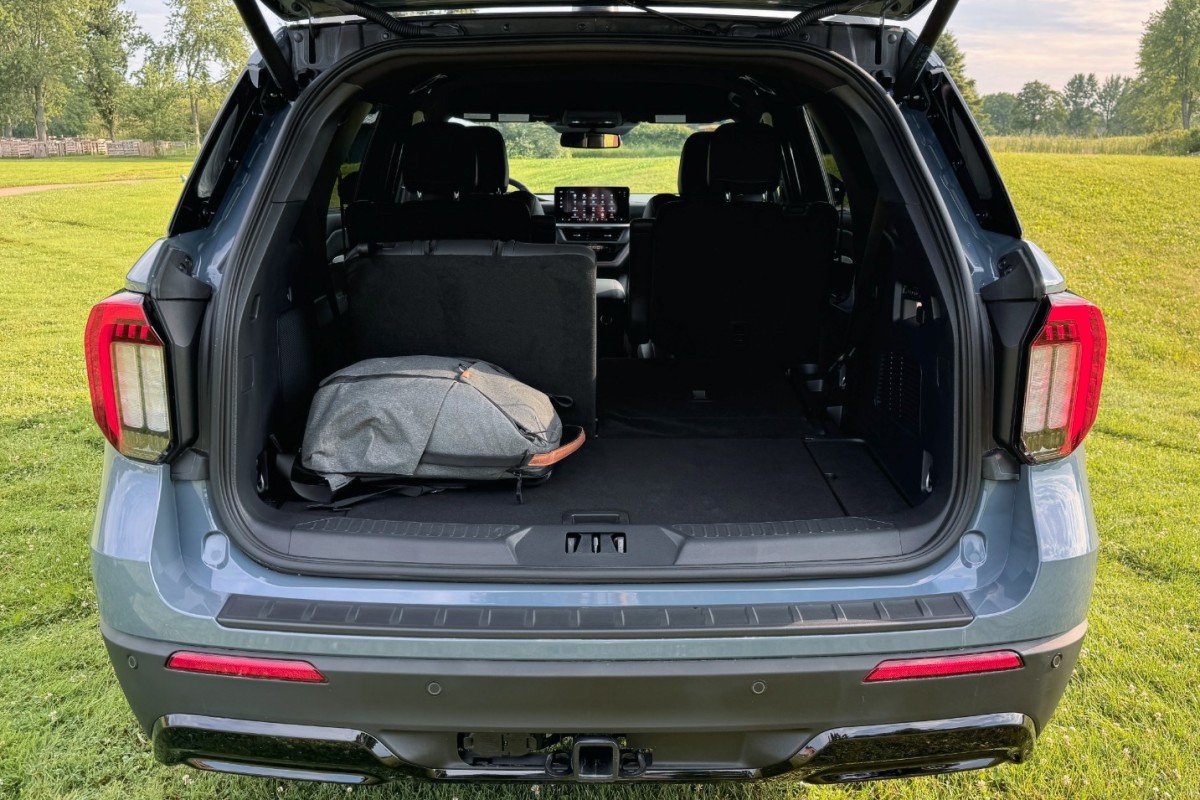
The 2025 Explorer seats six people in its standard configuration. However, Ford offers a no-cost second-row bench seat option, bringing maximum passenger capacity to seven. That bench seat is also great for families of five who plan to fold the Explorer’s third-row seat and rarely use it.
Our ST-Line test vehicle had a heated steering wheel, heated power-adjustable front seats, and the optional Premium Package. Among other things, in Canada that upgrade adds ambient interior lighting, a front seats with a memory function, heated second-row seats, and a wireless charging pad.
The ST-Line’s front seats were comfortable. This trim level has black artificial leather upholstery with cloth inserts, and in the steamy summer weather, we liked the breathability of the fabric. Plus, the seats are large and supportive without feeling too firm or restrictive. Moving to the second row, the captain’s chairs are just as comfy as what Ford installs up front. Getting into the third row is a chore for adults, and the low, flat seat is uncomfortable. Based on our seat-of-the-pants assessment, the Explorer swaps the balanced look and driving dynamics inherent in a rear-drive platform for third-row comfort. Kids will be happy enough with the accommodations, but not grown-ups.
Storage space is good, and the new tray that juts out from the centre of the dashboard is particularly useful. It also houses the available wireless smartphone charger. Cargo space measures 461 litres behind the third-row seat, 1,302 litres behind the second-row seats, and a maximum of 2,429 litres. All three of those figures are competitive in the segment.
With the 2025 Explorer, Ford isn’t trying to out-do the competition regarding screen acreage or features the company’s customers say they rarely, if ever, use. So, you won’t find the company’s semi-autonomous parking assist technology in the latest Explorer. There isn’t a rear-seat entertainment system, either, because if your kids are like ours, they prefer their phones and ear buds anyway.
What you will find is a 12.3-inch digital instrumentation panel and new 13.2-inch touchscreen infotainment system called Ford Digital Experience. The Explorer is the first Ford model equipped with the new technology, which the company will roll out to replace the existing Microsoft-powered Sync systems.
Ford Digital Experience equips the Explorer with Google Built-in, Amazon Alexa Built-in, wireless Apple CarPlay, wireless Android Auto, SiriusXM 360L satellite radio, and apps for streaming music or video. A 5G LTE Wi-Fi hotspot is available, and web browser apps provide internet access on the display. You can also play video games using a Bluetooth controller. But seriously, are you gonna do that in your car or in the comfort of your living room through a big-screen TV?
What’s important to know is that Ford Digital Experience is super simple to use. The Google Maps implementation is terrific, and through Google Play you can download new apps to the system. Google Assistant quickly and correctly responded to our standard list of testing commands, though it did not switch to the SiriusXM Bob Marley station when we said we wanted to listen to reggae music. Instead, it suggested we launch one of the internet radio apps in the system, such as Spotify.
The 2025 Explorer also offers B&O sound systems by Bang & Olufsen. The ST-Line gets 10 speakers, while the Platinum and ST boast 14 speakers and 980 watts of power. We recommend that audiophiles upgrade, because the ST-Line’s 10-speaker setup was unimpressive by Bang & Olufsen standards. Still, that means it beats the quality you’ll find in some rivals.

Every version of the 2025 Explorer has Ford CoPilot 360 Assist+, which equips the SUV with all of the advanced driving assistance systems (ADAS) you have come to expect in a modern vehicle. The “+” means the package contains adaptive cruise control with lane-centring assist technology in addition to common driver assistance and collision avoidance systems.
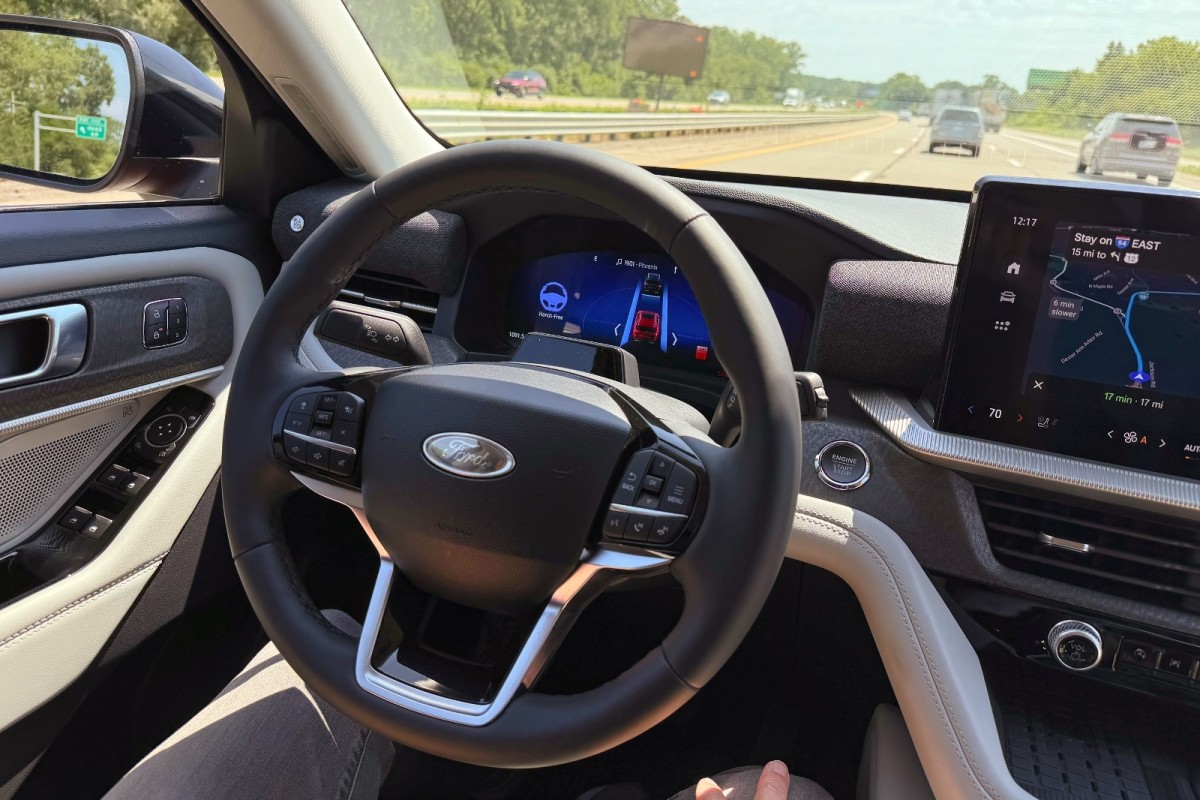
When you upgrade to ST-Line trim or higher, you get Ford CoPilot 360 2.0. That next-level enhancement pertains to a surround-view camera system. In addition, starting with the ST-Line, all Explorers feature BlueCruise, Ford’s hands-free highway driving system. A 90-day subscription to that feature is standard. Afterward, you can elect to subscribe.
In our ST-Line and Platinum test vehicles, we sampled BlueCruise on a typical highway, where it performed well. As is common with these types of systems, tighter curves required us to take control and heavier traffic across three or more lanes of travel made BlueCruise seem less sure of itself. Nevertheless, in this testing environment under partly cloudy weather conditions, the technology worked well, including the automated lane-change assist function.
However, Ford says this version of BlueCruise is also programmed to give drivers extra room when a large truck is in an adjacent lane, and we found the tech applied this behaviour inconsistently.
On one occasion, while waiting for BlueCruise to nudge the Explorer a little to the left to accommodate a semi to the right that was definitely drifting onto the white lane markers separating us, we momentarily thought we were going to have some explaining to do with Ford before the wandering truck driver tugged the rig right.
Likely due to the 2025 Explorer’s restyled front-end or some undisclosed safety changes Ford made under the SUV’s skin, the National Highway Traffic Safety Administration (NHTSA) had not fully rated the 2025 Explorer as we published this review. The SUV earns five-star side-impact and four-star rollover resistance ratings. According to the Insurance Institute for Highway Safety (IIHS), the 2025 Explorer performs well on crash tests but loses marks for the headlights on Active, ST-Line, and ST trims, which it ranks as Marginal. The Platinum’s headlights get a Good rating.
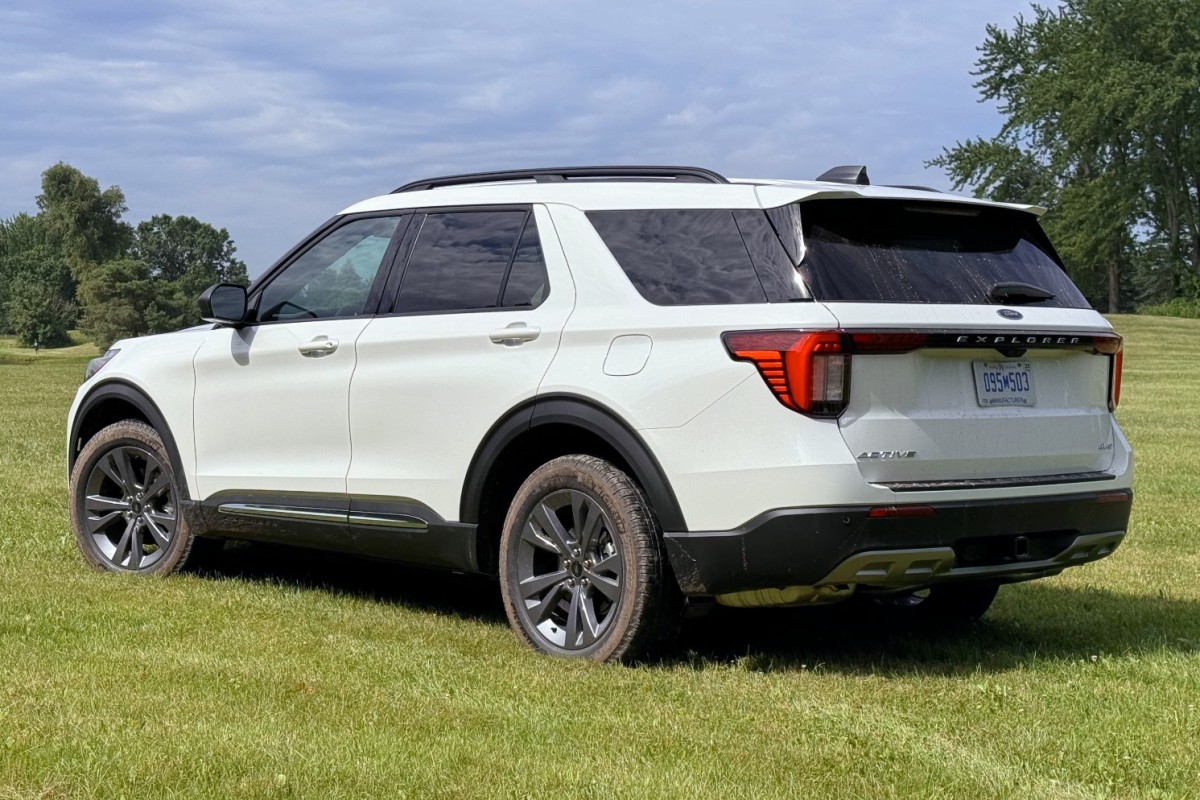
When the current-generation Explorer went on sale half a decade ago, price increases combined with reduced third-row comfort made it seem as though Ford has tossed the concept of value to the wind. However, since then, competitors have also pushed their prices higher, so the refreshed 2025 Explorer no longer seems like an outlier in the $50,000 club. Unfortunately, the new Explorer is missing a few things.
First, there isn’t an electrified powertrain option for people who want to drive a more efficient SUV. The driving enthusiast in us loves the idea behind the Ford Explorer ST, but nothing beats a plug-in hybrid for the daily ferrying of children, running of errands, and commuting to work, much of which you can accomplish without burning a drop of gasoline.
Second, the Timberline trim level is gone, leaving people who want to appear like they go off-roading all the time without a ruggedly styled choice. Of course, with the Bronco four-door in Ford’s lineup, perhaps the automaker determined the Timberline wasn’t necessary. But that bucks a growing trend in the Explorer’s segment.
Third, the rearmost row of seats remains unpleasant for grown-ups. If you need a three-row SUV because you plan to carry more than four people on a regular basis, the Explorer still isn’t among the best choices for that task.
Regardless, with the 2025 Explorer, Ford fixes a few issues. It looks better on the outside, the interior is much nicer than it used to be, the technology takes a quantum leap forward, and the simplification across the lineup makes picking one easier (though more paint colours would be nice). Plus, it strikes us as a better value than before.
Note: Images show a US model.

User reviews for 2025 Ford Explorer
Write a review2025 Ford Explorer Pricing
Trims & specs
Air Conditioning
Automatic climate control front air conditioning · Dual front air conditioning zones · Rear air conditioning: with independent controls · Single rear air conditioning zones
Airbags
Dual front airbags · Dual front knee airbags · Passenger airbag deactivation: occupant sensing deactivation · Front side airbags · Front side curtain airbags
Audio System
Antenna Type: mast · Voice recognition audio system · Bluetooth auxiliary audio input · Touch screen display radio · Satellite Radio: SiriusXM · Total Number of Speakers: 6
Brakes
ABS: 4-wheel · Braking assist: hill start assist · Electronic parking brake: auto off · Front brake diameter: 13.6 · Front brake width: 1.26 · Front brakes: ventilated disc · Rear brake diameter: 12.6 · Rear brake width: 0.47 · Rear brakes: disc
Comfort Features
Armrests: rear outboard seats · Center console trim: leatherette · Dash Trim: Leatherette · Door sill trim: scuff plate · Door trim: leatherette · Floor Mat Material: carpet · Floor Material: carpet · Floor Mats: front · Steering wheel trim: leather
Convenience Features
Adaptive stop and go cruise control: semi-automatic · Assist handle: rear · Autonomous lane guidance: lane centering · Cargo area power outlet: 12V · Center console: front console with armrest and storage · Cruise control: adaptive · Cupholders: front · Easy entry: manual rear seat · Memorized settings: liftgate · Multi-function remote: trunk release · One-touch windows: 2 · Power outlet(s): USB-C third row · Power steering: electric · Power windows: lockout button · Reading lights: rear · Rear power outlet: 12V · Steering wheel: tilt and telescopic · Steering wheel mounted controls: voice recognition controls · Storage: front seatback · Vanity mirrors: dual illuminating
Driver Seat
Adjustable lumbar support: power · Power adjustments: 10
Drivetrain
Axle ratio: 3.58
Engine
Battery: maintenance-free · Oil cooler: auxiliary
Exterior Features
Door handle color: body-color · Fender lip moldings: black · Front bumper color: body-color · Grille color: black with chrome accents · Mirror color: body-color · Rear bumper color: black · Rear spoiler: roofline spoiler · Rear spoiler color: body-color · Rear trunk/liftgate: liftgate · Rocker panel color: black · Window trim: black
Headrests
Front headrests: adjustable · Number of front headrests: 2 · Number of rear headrests: 2 · Number of third row headrests: 2
In Car Entertainment
Connected in-car apps: Amazon Alexa · Infotainment: Ford Digital Experience · Infotainment screen size: 13.2 in. · Smartphone integration: wireless Android Auto
Instrumentation
Fuel economy display: MPG · Instrument cluster screen size: 12.3 in. · Warnings and reminders: maintenance reminder
Lights
Daytime running lights: LED · Exterior entry lights: security approach lamps · Headlights: auto delay off · Tail and brake lights: LED
Mirrors
Exterior mirrors: manual folding · Inside rearview mirror: manual day/night
Passenger Seat
Power adjustments: 4
Rear Seats
Type: bucket
Roof
Roof rails: black
Safety
Automatic emergency braking: rear · Camera system: rearview · Camera system washer: rear · Child seat anchors: LATCH system · Cross Traffic Alert: rear · Crumple zones: front · Impact sensor: door unlock · Parking sensors: rear · Pre-Collision Warning System: audible warning · Pre-collision warning system: pedestrian detection · Rear pre-collision warning system: pedestrian detection · Rearview monitor: in dash · Traffic sign recognition: adaptive speed limiting
Seatbelts
Emergency locking retractors: front and rear · Front seatbelts: 3-point · Seatbelt force limiters: front · Seatbelt pretensioners: front · Seatbelt warning sensor: driver and passenger · Second row seatbelts: 3-point · Third row seatbelts: 3-point
Seats
Driver seat power adjustments: reclining · Front seat type: bucket · Passenger seat manual adjustments: reclining · Passenger seat power adjustments: height · Rear headrests: adjustable · Rear seat folding: flat · Rear seat manual adjustments: reclining · Third row headrests: adjustable · Third row seat folding: split · Upholstery: cloth
Security
Power door locks: anti-lockout
Spare Tire
Kit: tire sealant
Stability and Traction
Traction control: with trailer stability control
Steering
Steering ratio: 21.7
Suspension
Front Arm Type: lower control arms · Front Shock Type: gas shock absorbers · Front Spring Type: coil springs · Front Stabilizer Bar: diameter 35 mm · Front Suspension Classification: independent · Front Suspension Type: MacPherson struts · Rear Shock Type: gas shock absorbers · Rear Spring Type: coil springs · Rear Stabilizer Bar: diameter 22 mm · Rear Suspension Classification: independent · Rear Suspension Type: multi-link
Telematics
Electronic messaging assistance: with voice recognition · Navigation system: touch screen display · Phone: voice activated · Phone wireless data link: Bluetooth · Smart device app compatibility: FordPass Connect · Smart device app function: engine start · Wifi: hotspot
Third Row Seat
Type: 50-50 split bench
Tires
Type: all season
Tires and Rims
Wheels: painted aluminum
Towing and Hauling
Trailer hitch: Class III · Trailer wiring: 7-pin
Windows
Front wipers: variable intermittent · Laminated glass: acoustic · Liftgate window: fixed · Power windows: with safety reverse · Rear wiper: intermittent
Air Conditioning
Automatic climate control front air conditioning · Dual front air conditioning zones · Rear air conditioning: with independent controls · Single rear air conditioning zones
Airbags
Dual front airbags · Dual front knee airbags · Passenger airbag deactivation: occupant sensing deactivation · Front side airbags · Front side curtain airbags
Audio System
Antenna Type: diversity · Voice recognition audio system · USB auxiliary audio input · Touch screen display radio · Satellite Radio: SiriusXM · Total Number of Speakers: 6
Brakes
ABS: 4-wheel · Braking assist: hill start assist · Electronic parking brake: auto off · Front brake diameter: 13.6 · Front brake width: 1.26 · Front brakes: ventilated disc · Rear brake diameter: 12.6 · Rear brake width: 0.47 · Rear brakes: disc
Comfort Features
Armrests: rear outboard seats · Center console trim: leatherette · Dash Trim: Leatherette · Door sill trim: scuff plate · Door trim: leatherette · Floor Mat Material: carpet · Floor Material: carpet · Floor Mats: front · Steering wheel trim: leather
Convenience Features
Adaptive stop and go cruise control: semi-automatic · Assist handle: rear · Autonomous lane guidance: lane centering · Cargo area power outlet: 12V · Center console: front console with armrest and storage · Cruise control: adaptive · Cupholders: front · Easy entry: manual rear seat · Memorized settings: liftgate · Multi-function remote: keyless entry with panic alarm · One-touch windows: 2 · Power outlet(s): USB-C third row · Power steering: electric · Power windows: lockout button · Reading lights: rear · Rear power outlet: 12V · Steering wheel: tilt and telescopic · Steering wheel mounted controls: voice recognition controls · Storage: cargo tie-down anchors and hooks · Vanity mirrors: dual illuminating
Driver Seat
Adjustable lumbar support: power · Power adjustments: 10
Drivetrain
4WD Type: on demand · Axle ratio: 3.58
Engine
Battery: maintenance-free · Oil cooler: auxiliary
Exterior Features
Door handle color: body-color · Fender lip moldings: black · Front bumper color: body-color · Grille color: black with chrome accents · Mirror color: body-color · Rear bumper color: black · Rear spoiler: roofline spoiler · Rear spoiler color: body-color · Rear trunk/liftgate: liftgate · Rocker panel color: chrome accents · Window trim: black
Headrests
Front headrests: adjustable · Number of front headrests: 2 · Number of rear headrests: 2 · Number of third row headrests: 2
In Car Entertainment
Connected in-car apps: Amazon Alexa · Infotainment: Ford Digital Experience · Infotainment screen size: 13.2 in. · Smartphone integration: wireless Android Auto
Instrumentation
Fuel economy display: MPG · Instrument cluster screen size: 12.3 in. · Warnings and reminders: low fuel level
Lights
Daytime running lights: LED · Exterior entry lights: security approach lamps · Headlights: LED · Tail and brake lights: LED
Mirrors
Exterior mirrors: heated · Inside rearview mirror: manual day/night
Passenger Seat
Power adjustments: 4
Rear Seats
Type: bucket
Roof
Roof rails: black
Safety
Automatic emergency braking: front · Camera system: rearview · Camera system washer: rear · Child seat anchors: LATCH system · Cross Traffic Alert: rear · Crumple zones: front · Impact sensor: post-collision safety system · Parking sensors: rear · Pre-Collision Warning System: visual warning · Pre-collision warning system: pedestrian detection · Rear pre-collision warning system: pedestrian detection · Rearview monitor: in dash · Traffic sign recognition: adaptive speed limiting
Seatbelts
Emergency locking retractors: front and rear · Front seatbelts: 3-point · Seatbelt force limiters: front · Seatbelt pretensioners: front · Seatbelt warning sensor: driver and passenger · Second row seatbelts: 3-point · Third row seatbelts: 3-point
Seats
Driver seat power adjustments: height · Front seat type: bucket · Passenger seat manual adjustments: reclining · Passenger seat power adjustments: height · Rear headrests: adjustable · Rear seat folding: flat · Rear seat manual adjustments: reclining · Third row headrests: adjustable · Third row seat folding: fold flat into floor · Upholstery: cloth
Security
Power door locks: anti-lockout
Spare Tire
Kit: tire sealant
Stability and Traction
Traction control: with trailer stability control
Steering
Steering ratio: 21.7
Suspension
Front Arm Type: lower control arms · Front Shock Type: gas shock absorbers · Front Spring Type: coil springs · Front Stabilizer Bar: diameter 35 mm · Front Suspension Classification: independent · Front Suspension Type: MacPherson struts · Rear Shock Type: gas shock absorbers · Rear Spring Type: coil springs · Rear Stabilizer Bar: diameter 22 mm · Rear Suspension Classification: independent · Rear Suspension Type: multi-link
Telematics
Electronic messaging assistance: with voice recognition · Navigation system: over-the-air map updates (OTA) · Phone: voice activated · Phone wireless data link: Bluetooth · Smart device app compatibility: FordPass Connect · Smart device app function: lock operation · Wifi: hotspot
Third Row Seat
Type: 50-50 split bench
Tires
Type: all season
Tires and Rims
Wheels: painted aluminum
Towing and Hauling
Trailer hitch: Class III · Trailer wiring: 7-pin
Windows
Front wipers: variable intermittent · Laminated glass: acoustic · Liftgate window: fixed · Power windows: with safety reverse · Rear wiper: intermittent
Air Conditioning
Automatic climate control front air conditioning · Dual front air conditioning zones · Rear air conditioning: with independent controls · Single rear air conditioning zones
Airbags
Dual front airbags · Dual front knee airbags · Passenger airbag deactivation: occupant sensing deactivation · Front side airbags · Third row side curtain airbags
Audio System
Antenna Type: mast · Voice recognition audio system · Bluetooth auxiliary audio input · Premium Brand: Bang & Olufsen · AM/FM radio · Satellite Radio: SiriusXM · 1 subwoofer · Total Number of Speakers: 9 · Watts: 780
Brakes
ABS: 4-wheel · Braking assist: hill start assist · Electronic parking brake: auto off · Front brake diameter: 13.6 · Front brake width: 1.26 · Front brakes: ventilated disc · Rear brake diameter: 12.6 · Rear brake width: 0.47 · Rear brakes: disc
Comfort Features
Armrests: rear outboard seats · Center console trim: leatherette · Dash Trim: Leatherette · Door sill trim: scuff plate · Door trim: leatherette · Floor Mat Material: carpet · Floor Material: carpet · Floor Mats: front · Steering wheel trim: leather
Convenience Features
Adaptive stop and go cruise control: semi-automatic · Assist handle: rear · Autonomous lane guidance: lane changing · Cargo area power outlet: 12V · Center console: front console with armrest and storage · Cruise control: adaptive · Cupholders: rear · Easy entry: manual rear seat · Memorized settings: liftgate · Multi-function remote: trunk release · One-touch windows: 2 · Power outlet(s): USB-C third row · Power steering: speed-proportional · Power windows: lockout button · Reading lights: third row · Rear power outlet: 12V · Steering wheel: tilt and telescopic · Steering wheel mounted controls: audio · Storage: front seatback · Vanity mirrors: dual illuminating
Driver Seat
Adjustable lumbar support: power · Power adjustments: 10
Drivetrain
Axle ratio: 3.58
Engine
Battery: maintenance-free · Oil cooler: auxiliary
Exterior Features
Door handle color: body-color · Fender lip moldings: black · Front bumper color: body-color · Grille color: black · Mirror color: black · Rear bumper color: black · Rear spoiler: roofline spoiler · Rear spoiler color: body-color · Rear trunk/liftgate: power operated · Rocker panel color: black · Skid plate(s): front · Window trim: black
Headrests
Front headrests: adjustable · Number of front headrests: 2 · Number of rear headrests: 3 · Number of third row headrests: 2
In Car Entertainment
Connected in-car apps: Google POIs · Infotainment: Ford Digital Experience · Infotainment screen size: 13.2 in. · Smartphone integration: wireless Android Auto
Instrumentation
Fuel economy display: range · Instrument cluster screen size: 12.3 in. · Warnings and reminders: low oil pressure
Lights
Daytime running lights: LED · Exterior entry lights: puddle lamps · Front fog lights: LED · Headlights: Auto on/off · Tail and brake lights: LED
Mirrors
Exterior mirrors: manual folding · Inside rearview mirror: manual day/night
Passenger Seat
Adjustable lumbar support: power · Power adjustments: 8
Rear Seats
Type: 35-30-35 split bench
Roof
Roof rails: black
Safety
Automatic emergency braking: intersection/junction turn · Camera system: surround view · Camera system washer: rear · Child seat anchors: LATCH system · Cross Traffic Alert: rear · Crumple zones: front · Impact sensor: door unlock · Parking sensors: rear · Pre-Collision Warning System: audible warning · Pre-collision warning system: intersection/junction turn · Rear pre-collision warning system: pedestrian detection · Rearview monitor: in dash · Traffic sign recognition: adaptive speed limiting
Seatbelts
Emergency locking retractors: front and rear · Front seatbelts: 3-point · Seatbelt force limiters: front · Seatbelt pretensioners: front · Seatbelt warning sensor: driver and passenger · Second row seatbelts: 3-point · Third row seatbelts: 3-point
Seats
Driver seat power adjustments: reclining · Front seat type: bucket · Passenger seat power adjustments: reclining · Rear headrests: adjustable · Rear seat folding: split · Rear seat manual adjustments: reclining · Third row headrests: adjustable · Third row seat folding: fold flat into floor · Upholstery: leatherette · Upholstery accents: cloth
Security
Power door locks: anti-lockout
Spare Tire
Kit: tire sealant
Stability and Traction
Traction control: with trailer stability control
Steering
Steering ratio: 21.7
Suspension
Front Arm Type: lower control arms · Front Shock Type: gas shock absorbers · Front Spring Type: coil springs · Front Stabilizer Bar: diameter 35 mm · Front Suspension Classification: independent · Front Suspension Type: MacPherson struts · Rear Shock Type: gas shock absorbers · Rear Spring Type: coil springs · Rear Stabilizer Bar: diameter 22 mm · Rear Suspension Classification: independent · Rear Suspension Type: multi-link
Telematics
Electronic messaging assistance: with voice recognition · Navigation system: touch screen display · Phone: voice activated · Phone wireless data link: Bluetooth · Smart device app compatibility: FordPass Connect · Smart device app function: vehicle location · Wifi: hotspot
Third Row Seat
Type: 50-50 split bench
Tires
Type: all season
Tires and Rims
Wheels: aluminum with painted accents
Towing and Hauling
Trailer hitch: Class III · Trailer wiring: 7-pin
Windows
Front wipers: variable intermittent · Laminated glass: acoustic front side · Liftgate window: fixed · Power windows: with safety reverse · Rear wiper: with washer
Air Conditioning
Automatic climate control front air conditioning · Dual front air conditioning zones · Rear air conditioning: with independent controls · Single rear air conditioning zones
Airbags
Dual front airbags · Dual front knee airbags · Passenger airbag deactivation: occupant sensing deactivation · Front side airbags · Rear side curtain airbags
Audio System
Antenna Type: diversity · Voice recognition audio system · Bluetooth auxiliary audio input · Premium Brand: Bang & Olufsen · Touch screen display radio · Satellite Radio: SiriusXM · 1 subwoofer · Total Number of Speakers: 9 · Watts: 780
Brakes
ABS: 4-wheel · Braking assist: hill start assist · Electronic parking brake: auto off · Front brake diameter: 13.6 · Front brake width: 1.26 · Front brakes: ventilated disc · Rear brake diameter: 12.6 · Rear brake width: 0.47 · Rear brakes: disc
Comfort Features
Armrests: rear outboard seats · Center console trim: leatherette · Dash Trim: Leatherette · Door sill trim: scuff plate · Door trim: leatherette · Floor Mat Material: carpet · Floor Material: carpet · Floor Mats: front · Steering wheel trim: leather
Convenience Features
Adaptive stop and go cruise control: semi-automatic · Assist handle: front · Autonomous lane guidance: lane changing · Cargo area power outlet: 12V · Center console: front console with armrest and storage · Cruise control: adaptive · Cupholders: front · Easy entry: manual rear seat · Memorized settings: liftgate · Multi-function remote: keyless entry with panic alarm · One-touch windows: 2 · Power outlet(s): USB-C rear · Power steering: speed-proportional · Power windows: lockout button · Reading lights: front · Rear power outlet: 12V · Steering wheel: tilt and telescopic · Steering wheel mounted controls: voice recognition controls · Storage: door pockets · Vanity mirrors: dual illuminating
Driver Seat
Adjustable lumbar support: power · Power adjustments: 10
Drivetrain
4WD Type: on demand · Axle ratio: 3.58
Engine
Battery: maintenance-free · Oil cooler: auxiliary
Exterior Features
Door handle color: body-color · Fender lip moldings: black · Front bumper color: body-color · Grille color: black · Mirror color: black · Rear bumper color: black · Rear spoiler: roofline spoiler · Rear spoiler color: body-color · Rear trunk/liftgate: power operated · Rocker panel color: black · Skid plate(s): front · Window trim: black
Headrests
Front headrests: adjustable · Number of front headrests: 2 · Number of rear headrests: 3 · Number of third row headrests: 2
In Car Entertainment
Connected in-car apps: Google POIs · Infotainment: Ford Digital Experience · Infotainment screen size: 13.2 in. · Smartphone integration: wireless Apple CarPlay
Instrumentation
Fuel economy display: MPG · Instrument cluster screen size: 12.3 in. · Warnings and reminders: maintenance reminder
Lights
Daytime running lights: LED · Exterior entry lights: puddle lamps · Front fog lights: LED · Headlights: automatic high beam dimmer · Tail and brake lights: LED
Mirrors
Exterior mirrors: manual folding · Inside rearview mirror: manual day/night
Passenger Seat
Adjustable lumbar support: power · Power adjustments: 8
Rear Seats
Type: 35-30-35 split bench
Roof
Roof rails: black
Safety
Automatic emergency braking: intersection/junction turn · Camera system: surround view · Camera system washer: rear · Child seat anchors: LATCH system · Cross Traffic Alert: rear · Crumple zones: front · Impact sensor: door unlock · Parking sensors: front · Pre-Collision Warning System: visual warning · Pre-collision warning system: intersection/junction turn · Rear pre-collision warning system: pedestrian detection · Rearview monitor: in dash · Traffic sign recognition: adaptive speed limiting
Seatbelts
Emergency locking retractors: front and rear · Front seatbelts: 3-point · Seatbelt force limiters: front · Seatbelt pretensioners: front · Seatbelt warning sensor: driver and passenger · Second row seatbelts: 3-point · Third row seatbelts: 3-point
Seats
Driver seat power adjustments: height · Front seat type: bucket · Passenger seat power adjustments: height · Rear headrests: adjustable · Rear seat folding: flat · Rear seat manual adjustments: reclining · Third row headrests: adjustable · Third row seat folding: split · Upholstery: contrast stitching · Upholstery accents: cloth
Security
Power door locks: anti-lockout
Spare Tire
Kit: inflator kit
Stability and Traction
Traction control: with trailer stability control
Steering
Steering ratio: 21.7
Suspension
Front Arm Type: lower control arms · Front Shock Type: gas shock absorbers · Front Spring Type: coil springs · Front Stabilizer Bar: diameter 35 mm · Front Suspension Classification: independent · Front Suspension Type: MacPherson struts · Rear Shock Type: gas shock absorbers · Rear Spring Type: coil springs · Rear Stabilizer Bar: diameter 22 mm · Rear Suspension Classification: independent · Rear Suspension Type: multi-link
Telematics
Electronic messaging assistance: with voice recognition · Navigation system: touch screen display · Phone: voice activated · Phone wireless data link: Bluetooth · Smart device app compatibility: FordPass Connect · Smart device app function: engine start · Wifi: hotspot
Third Row Seat
Type: 50-50 split bench
Tires
Type: all season
Tires and Rims
Wheels: aluminum with painted accents
Towing and Hauling
Trailer hitch: Class III · Trailer wiring: 4-pin
Windows
Front wipers: variable intermittent · Laminated glass: acoustic front side · Liftgate window: fixed · Power windows: with safety reverse · Rear wiper: intermittent
Air Conditioning
Automatic climate control front air conditioning · Dual front air conditioning zones · Rear air conditioning: with independent controls · Single rear air conditioning zones
Airbags
Dual front airbags · Front passenger knee airbags · Passenger airbag deactivation: occupant sensing deactivation · Front side airbags · Rear side curtain airbags
Audio System
Antenna Type: mast · Voice recognition audio system · Bluetooth auxiliary audio input · AM/FM radio · Total Number of Speakers: 4
Brakes
ABS: 4-wheel · Front brake diameter: 14.29 · Front brake width: 1.26 · Front brakes: ventilated disc · Rear brake diameter: 13.8 · Rear brake width: 1.02 · Rear brakes: disc
Comfort Features
Door sill trim: scuff plate · Floor Material: rubber · Shift knob trim: urethane · Steering wheel trim: urethane
Convenience Features
Assist handle: rear · Multi-function remote: keyless entry · One-touch windows: 2 · Power outlet(s): USB-C front · Power windows: lockout button · Reading lights: rear · Steering wheel: tilt and telescopic · Steering wheel mounted controls: cruise controls · Storage: accessory hook
Driver Seat
Adjustable lumbar support: power · Power adjustments: 6
Drivetrain
4WD Type: full time · Axle ratio: 3.73
Engine
Alternator: 250 amps · Battery: heavy duty · Battery rating: 850 CCA · Oil cooler: auxiliary
Exterior Features
Door handle color: black · Exhaust: dual exhaust tips · Fender lip moldings: black · Front bumper color: body-color · Grille color: black · Mirror color: black · Rear bumper color: black · Rear spoiler: roofline spoiler · Rear spoiler color: black · Rear trunk/liftgate: liftgate · Rocker panel color: black · Window trim: black
Headrests
Front headrests: adjustable · Number of front headrests: 2 · Number of rear headrests: 3
In Car Entertainment
Infotainment: SYNC · Infotainment screen size: 8 in. · Smartphone integration: wireless Apple CarPlay
Instrumentation
Fuel economy display: range · Instrument cluster screen size: 12.3 in. · Warnings and reminders: maintenance reminder
Lights
Daytime running lights: LED · Headlights: Auto on/off · Tail and brake lights: LED
Mirrors
Exterior mirrors: manual folding · Inside rearview mirror: manual day/night
Passenger Seat
Adjustable lumbar support: power · Power adjustments: 8
Rear Seats
Type: 35-30-35 split bench · Upholstery: vinyl
Safety
Automatic emergency braking: front · Camera system: rearview · Child seat anchors: LATCH system · Cross Traffic Alert: rear · Crumple zones: front · Impact sensor: post-collision safety system · Parking sensors: rear · Pre-Collision Warning System: audible warning · Pre-collision warning system: pedestrian detection · Rear pre-collision warning system: pedestrian detection · Rearview monitor: in dash
Seatbelts
Emergency locking retractors: front · Front seatbelts: 3-point · Seatbelt force limiters: front · Seatbelt pretensioners: front · Seatbelt warning sensor: driver and passenger · Second row seatbelts: 3-point
Seats
Driver seat power adjustments: height · Front seat type: bucket · Passenger seat power adjustments: height · Rear headrests: adjustable · Rear seat folding: split · Rear seat manual adjustments: reclining · Upholstery: cloth
Spare Tire
Mount Location: underbody · Size: full-size
Spare Wheel
Rim Type: steel
Steering
Steering ratio: 21.7
Suspension
Front Arm Type: lower control arms · Front Shock Type: gas shock absorbers · Front Spring Type: coil springs · Front Stabilizer Bar: diameter 35 mm · Front Suspension Classification: independent · Front Suspension Type: MacPherson struts · Rear Shock Type: gas shock absorbers · Rear Spring Type: coil springs · Rear Stabilizer Bar: diameter 23 mm · Rear Suspension Classification: independent · Rear Suspension Type: multi-link
Telematics
Electronic messaging assistance: with read function · Phone: voice activated · Wifi: connection only
Tires
Type: all season
Tires and Rims
Wheels: steel
Towing and Hauling
Tow hooks: front · Trailer hitch: Class III · Trailer wiring: 7-pin
Wheels
Wheel covers: partial
Windows
Front wipers: variable intermittent · Laminated glass: acoustic · Liftgate window: fixed · Power windows: front · Rear wiper: dual speed
Air Conditioning
Automatic climate control front air conditioning · Dual front air conditioning zones · Automatic climate control rear air conditioning · Single rear air conditioning zones
Airbags
Dual front airbags · Dual front knee airbags · Passenger airbag deactivation: occupant sensing deactivation · Front side airbags · Rear side curtain airbags
Audio System
Antenna Type: mast · Voice recognition audio system · USB auxiliary audio input · Premium Brand: Bang & Olufsen · AM/FM radio · Satellite Radio: SiriusXM · 1 subwoofer · Total Number of Speakers: 13 · Watts: 980
Brakes
ABS: 4-wheel · Braking assist: hill start assist · Electronic parking brake: auto off · Front brake diameter: 13.6 · Front brake width: 1.26 · Front brakes: ventilated disc · Rear brake diameter: 12.6 · Rear brake width: 0.47 · Rear brakes: disc
Comfort Features
Armrests: rear outboard seats · Center console trim: leather · Dash trim: leather · Door sill trim: illuminated scuff plate · Door trim: leather · Floor Mat Material: carpet · Floor Material: carpet · Floor Mats: front · Steering wheel trim: leather
Convenience Features
Adaptive stop and go cruise control: semi-automatic · Ambient lighting: color-adjustable · Assist handle: front · Autonomous lane guidance: lane changing · Cargo area power outlet: 12V · Center console: front console with armrest and storage · Cruise control: adaptive · Cupholders: rear · Dimming rearview mirror: auto-dimming · Easy entry: manual rear seat · Footwell lights: color-adjustable · Memorized settings: steering wheel · Multi-function remote: proximity entry system · One-touch windows: 2 · Power outlet(s): USB front · Power steering: speed-proportional · Power windows: lockout button · Reading lights: rear · Rear power outlet: 115V · Steering wheel: power tilt and telescopic · Steering wheel mounted controls: audio · Storage: door pockets · Sunshade: side window · Vanity mirrors: dual illuminating
Driver Seat
Adjustable lumbar support: power · Power adjustments: 10
Drivetrain
Axle ratio: 3.58
Engine
Battery: maintenance-free · Oil cooler: auxiliary
Exterior Features
Door handle color: body-color · Exhaust: quad exhaust tips · Exhaust tip color: chrome · Fender lip moldings: black · Front bumper color: body-color · Grille color: black with chrome accents · Mirror color: black · Rear bumper color: black · Rear spoiler: roofline spoiler · Rear spoiler color: body-color · Rear trunk/liftgate: liftgate · Rocker panel color: chrome accents · Window trim: black
Headrests
Front headrests: adjustable · Number of front headrests: 2 · Number of rear headrests: 2 · Number of third row headrests: 2
In Car Entertainment
Connected in-car apps: Google Assistant · Infotainment: Ford Digital Experience · Infotainment screen size: 13.2 in. · Smartphone integration: wireless Android Auto
Instrumentation
Fuel economy display: range · Instrument cluster screen size: 12.3 in. · Warnings and reminders: low fuel level
Lights
Daytime running lights: LED · Exterior entry lights: puddle lamps · Front fog lights: LED · Headlights: Auto on/off · Tail and brake lights: LED
Mirrors
Exterior mirrors: integrated turn signals
Passenger Seat
Adjustable lumbar support: power · Power adjustments: 8
Rear Seats
Type: bucket
Roof
Moonroof: power panoramic · Roof rails: aluminum
Safety
Automatic emergency braking: intersection/junction turn · Camera system: surround view · Camera system washer: rear · Child seat anchors: LATCH system · Cross Traffic Alert: rear · Crumple zones: front · Impact sensor: post-collision safety system · Parking sensors: front · Pre-Collision Warning System: visual warning · Pre-collision warning system: intersection/junction turn · Rear pre-collision warning system: pedestrian detection · Rearview monitor: in dash · Traffic sign recognition: adaptive speed limiting
Seatbelts
Emergency locking retractors: front and rear · Front seatbelts: 3-point · Seatbelt force limiters: front · Seatbelt pretensioners: front · Seatbelt warning sensor: driver and passenger · Second row seatbelts: 3-point · Third row seatbelts: 3-point
Seats
Driver seat power adjustments: reclining · Front seat type: bucket · Passenger seat power adjustments: reclining · Rear headrests: adjustable · Rear seat folding: flat · Rear seat manual adjustments: reclining · Third row headrests: adjustable · Third row seat folding: power · Upholstery: contrast stitching · Upholstery accents: faux suede
Security
Power door locks: anti-lockout
Spare Tire
Kit: tire sealant
Stability and Traction
Traction control: with trailer stability control
Steering
Steering ratio: 21.7
Suspension
Front Arm Type: lower control arms · Front Shock Type: gas shock absorbers · Front Spring Type: coil springs · Front Stabilizer Bar: diameter 35 mm · Front Suspension Classification: independent · Front Suspension Type: MacPherson struts · Rear Shock Type: gas shock absorbers · Rear Spring Type: coil springs · Rear Stabilizer Bar: diameter 22 mm · Rear Suspension Classification: independent · Rear Suspension Type: multi-link
Telematics
Electronic messaging assistance: with read function · Navigation system: with voice recognition · Phone: voice activated · Phone wireless data link: Bluetooth · Smart device app compatibility: FordPass Connect · Smart device app function: maintenance status · Wifi: hotspot
Third Row Seat
Type: 50-50 split bench
Tires
Type: all season
Tires and Rims
Wheels: painted aluminum
Towing and Hauling
Trailer hitch: Class III · Trailer wiring: 7-pin
Windows
Front wipers: variable intermittent · Laminated glass: acoustic front side · Liftgate window: fixed · Power windows: remote operation · Rear wiper: with washer
Air Conditioning
Automatic climate control front air conditioning · Dual front air conditioning zones · Automatic climate control rear air conditioning · Single rear air conditioning zones
Airbags
Dual front airbags · Dual front knee airbags · Passenger airbag deactivation: occupant sensing deactivation · Front side airbags · Rear side curtain airbags
Audio System
Antenna Type: diversity · Voice recognition audio system · Bluetooth auxiliary audio input · Premium Brand: Bang & Olufsen · AM/FM radio · Satellite Radio: SiriusXM · 1 subwoofer · Total Number of Speakers: 13 · Watts: 980
Brakes
ABS: 4-wheel · Braking assist: hill start assist · Electronic parking brake: auto off · Front brake diameter: 13.6 · Front brake width: 1.26 · Front brakes: ventilated disc · Rear brake diameter: 12.6 · Rear brake width: 0.47 · Rear brakes: disc
Comfort Features
Armrests: rear outboard seats · Center console trim: leather · Dash trim: leather · Door sill trim: illuminated scuff plate · Door trim: leather · Floor Mat Material: carpet · Floor Material: carpet · Floor Mats: front · Steering wheel trim: leather
Convenience Features
Adaptive stop and go cruise control: semi-automatic · Ambient lighting: color-adjustable · Assist handle: rear · Autonomous lane guidance: lane changing · Cargo area power outlet: 12V · Center console: front console with armrest and storage · Cruise control: adaptive · Cupholders: rear · Dimming rearview mirror: auto-dimming · Easy entry: manual rear seat · Footwell lights: color-adjustable · Memorized settings: liftgate · Multi-function remote: proximity entry system · One-touch windows: 2 · Power outlet(s): USB front · Power steering: electric · Power windows: lockout button · Reading lights: front · Rear power outlet: 115V · Steering wheel: power tilt and telescopic · Steering wheel mounted controls: multi-function screen controls · Storage: accessory hook · Sunshade: side window · Vanity mirrors: dual illuminating
Driver Seat
Adjustable lumbar support: power · Power adjustments: 10
Drivetrain
4WD Type: on demand · Axle ratio: 3.58
Engine
Battery: maintenance-free · Oil cooler: auxiliary
Exterior Features
Door handle color: body-color · Exhaust: quad exhaust tips · Exhaust tip color: chrome · Fender lip moldings: black · Front bumper color: body-color · Grille color: black with chrome accents · Mirror color: black · Rear bumper color: black · Rear spoiler: roofline spoiler · Rear spoiler color: body-color · Rear trunk/liftgate: liftgate · Rocker panel color: black · Window trim: black
Headrests
Front headrests: adjustable · Number of front headrests: 2 · Number of rear headrests: 2 · Number of third row headrests: 2
In Car Entertainment
Connected in-car apps: Google search · Infotainment: Ford Digital Experience · Infotainment screen size: 13.2 in. · Smartphone integration: wireless Apple CarPlay
Instrumentation
Fuel economy display: MPG · Instrument cluster screen size: 12.3 in. · Warnings and reminders: low oil pressure
Lights
Daytime running lights: LED · Exterior entry lights: security approach lamps · Front fog lights: LED · Headlights: Auto on/off · Tail and brake lights: LED
Mirrors
Exterior mirrors: integrated turn signals
Passenger Seat
Adjustable lumbar support: power · Power adjustments: 8
Rear Seats
Type: bucket
Roof
Moonroof: tilt/slide · Roof rails: aluminum
Safety
Automatic emergency braking: rear pedestrian · Camera system: surround view · Camera system washer: rear · Child seat anchors: LATCH system · Cross Traffic Alert: rear · Crumple zones: front · Impact sensor: door unlock · Parking sensors: front · Pre-Collision Warning System: audible warning · Pre-collision warning system: pedestrian detection · Rear pre-collision warning system: pedestrian detection · Rearview monitor: in dash · Traffic sign recognition: adaptive speed limiting
Seatbelts
Emergency locking retractors: front · Front seatbelts: 3-point · Seatbelt force limiters: front · Seatbelt pretensioners: front · Seatbelt warning sensor: driver and passenger · Second row seatbelts: 3-point · Third row seatbelts: 3-point
Seats
Driver seat power adjustments: height · Front seat type: bucket · Passenger seat power adjustments: height · Rear headrests: adjustable · Rear seat folding: split · Rear seat manual adjustments: reclining · Third row headrests: adjustable · Third row seat folding: power · Upholstery: perforated · Upholstery accents: faux suede
Security
Power door locks: anti-lockout
Spare Tire
Kit: inflator kit
Stability and Traction
Traction control: with trailer stability control
Steering
Steering ratio: 21.7
Suspension
Front Arm Type: lower control arms · Front Shock Type: gas shock absorbers · Front Spring Type: coil springs · Front Stabilizer Bar: diameter 35 mm · Front Suspension Classification: independent · Front Suspension Type: MacPherson struts · Rear Shock Type: gas shock absorbers · Rear Spring Type: coil springs · Rear Stabilizer Bar: diameter 22 mm · Rear Suspension Classification: independent · Rear Suspension Type: multi-link
Telematics
Electronic messaging assistance: with read function · Navigation system: with voice recognition · Phone: voice activated · Phone wireless data link: Bluetooth · Smart device app compatibility: FordPass Connect · Smart device app function: vehicle location · Wifi: hotspot
Third Row Seat
Type: 50-50 split bench
Tires
Type: all season
Tires and Rims
Wheels: painted aluminum
Towing and Hauling
Trailer hitch: Class III · Trailer wiring: 7-pin
Windows
Front wipers: variable intermittent · Laminated glass: acoustic · Liftgate window: fixed · Power windows: with safety reverse · Rear wiper: with washer
Air Conditioning
Automatic climate control front air conditioning · Dual front air conditioning zones · Automatic climate control rear air conditioning · Single rear air conditioning zones
Airbags
Dual front airbags · Dual front knee airbags · Passenger airbag deactivation: occupant sensing deactivation · Front side airbags · Front side curtain airbags
Audio System
Antenna Type: mast · Voice recognition audio system · Bluetooth auxiliary audio input · Premium Brand: Bang & Olufsen · Touch screen display radio · Satellite Radio: SiriusXM · 1 subwoofer · Total Number of Speakers: 13 · Watts: 980
Brakes
ABS: 4-wheel · Braking assist: hill start assist · Electronic parking brake: auto off · Front brake diameter: 13.6 · Front brake width: 1.26 · Front brakes: ventilated disc · Rear brake diameter: 12.6 · Rear brake width: 0.47 · Rear brakes: disc
Comfort Features
Armrests: rear outboard seats · Center console trim: leatherette · Dash Trim: Leatherette · Door sill trim: scuff plate · Door trim: leatherette · Floor Mat Material: carpet · Floor Material: carpet · Floor Mats: front · Steering wheel trim: leather
Convenience Features
Adaptive stop and go cruise control: semi-automatic · Ambient lighting: color-adjustable · Assist handle: rear · Autonomous lane guidance: lane changing · Cargo area power outlet: 12V · Center console: front console with armrest and storage · Cruise control: adaptive · Cupholders: front, rear and third row · Dimming rearview mirror: auto-dimming · Easy entry: manual rear seat · Footwell lights: color-adjustable · Memorized settings: side mirrors · Multi-function remote: keyless entry with panic alarm · One-touch windows: 2 · Power outlet(s): 12V front · Power steering: electric · Power windows: lockout button · Reading lights: front · Rear power outlet: 115V · Steering wheel: power tilt and telescopic · Steering wheel mounted controls: phone · Storage: cargo net · Sunshade: side window · Vanity mirrors: dual illuminating
Driver Seat
Adjustable lumbar support: power · Power adjustments: 10
Drivetrain
Axle ratio: 3.31
Engine
Battery: maintenance-free · Oil cooler: auxiliary
Exterior Features
Door handle color: body-color · Exhaust: quad exhaust tips · Exhaust tip color: chrome · Fender lip moldings: black · Front bumper color: body-color · Grille color: black · Mirror color: black · Rear bumper color: black · Rear spoiler: roofline spoiler · Rear spoiler color: body-color · Rear trunk/liftgate: liftgate · Rocker panel color: black · Skid plate(s): front · Window trim: black
Headrests
Front headrests: adjustable · Number of front headrests: 2 · Number of rear headrests: 2 · Number of third row headrests: 2
In Car Entertainment
Connected in-car apps: app marketplace integration · Infotainment: Ford Digital Experience · Infotainment screen size: 13.2 in. · Smartphone integration: wireless Android Auto
Instrumentation
Fuel economy display: range · Instrument cluster screen size: 12.3 in. · Warnings and reminders: low oil pressure
Lights
Daytime running lights: LED · Exterior entry lights: puddle lamps · Front fog lights: LED · Headlights: auto delay off · Tail and brake lights: LED
Mirrors
Exterior mirrors: heated
Passenger Seat
Adjustable lumbar support: power · Power adjustments: 8
Rear Seats
Type: bucket
Roof
Roof rails: black
Safety
Automatic emergency braking: rear pedestrian · Camera system: surround view · Camera system washer: rear · Child seat anchors: LATCH system · Cross Traffic Alert: rear · Crumple zones: front · Impact sensor: door unlock · Parking sensors: rear · Pre-Collision Warning System: visual warning · Pre-collision warning system: pedestrian detection · Rear pre-collision warning system: pedestrian detection · Rearview monitor: in dash · Traffic sign recognition: adaptive speed limiting
Seatbelts
Emergency locking retractors: front · Front seatbelts: 3-point · Seatbelt force limiters: front · Seatbelt pretensioners: front · Seatbelt warning sensor: driver and passenger · Second row seatbelts: 3-point · Third row seatbelts: 3-point
Seats
Driver seat power adjustments: height · Front seat type: bucket · Passenger seat power adjustments: height · Rear headrests: adjustable · Rear seat folding: split · Rear seat manual adjustments: reclining · Third row headrests: adjustable · Third row seat folding: power · Upholstery: perforated · Upholstery accents: faux suede
Security
Power door locks: anti-lockout
Spare Tire
Kit: inflator kit
Stability and Traction
Traction control: with trailer stability control
Steering
Steering ratio: 21.7
Suspension
Front Arm Type: lower control arms · Front Shock Type: gas shock absorbers · Front Spring Type: coil springs · Front Stabilizer Bar: diameter 35 mm · Front Suspension Classification: independent · Front Suspension Type: MacPherson struts · Rear Shock Type: gas shock absorbers · Rear Spring Type: coil springs · Rear Stabilizer Bar: diameter 22 mm · Rear Suspension Classification: independent · Rear Suspension Type: multi-link
Telematics
Electronic messaging assistance: with voice recognition · Navigation system: over-the-air map updates (OTA) · Phone: voice activated · Phone wireless data link: Bluetooth · Smart device app compatibility: FordPass Connect · Smart device app function: lock operation · Wifi: hotspot
Third Row Seat
Type: 50-50 split bench
Tires
Type: all season
Tires and Rims
Wheels: painted aluminum
Towing and Hauling
Trailer hitch: Class III · Trailer wiring: 4-pin
Windows
Front wipers: rain sensing · Laminated glass: acoustic · Liftgate window: fixed · Power windows: with safety reverse · Rear wiper: with washer
Air Conditioning
Automatic climate control front air conditioning · Dual front air conditioning zones · Automatic climate control rear air conditioning · Single rear air conditioning zones
Airbags
Dual front airbags · Dual front knee airbags · Passenger airbag deactivation: occupant sensing deactivation · Front side airbags · Front side curtain airbags
Audio System
Antenna Type: mast · Voice recognition audio system · USB auxiliary audio input · Premium Brand: Bang & Olufsen · Touch screen display radio · Satellite Radio: SiriusXM · 1 subwoofer · Total Number of Speakers: 13 · Watts: 980
Brakes
ABS: 4-wheel · Braking assist: hill start assist · Electronic parking brake: auto off · Front brake diameter: 13.6 · Front brake width: 1.26 · Front brakes: ventilated disc · Rear brake diameter: 12.6 · Rear brake width: 0.47 · Rear brakes: disc
Comfort Features
Armrests: rear outboard seats · Center console trim: leatherette · Dash Trim: Leatherette · Door sill trim: scuff plate · Door trim: leatherette · Floor Mat Material: carpet · Floor Material: carpet · Floor Mats: front · Steering wheel trim: leather
Convenience Features
Adaptive stop and go cruise control: semi-automatic · Ambient lighting: color-adjustable · Assist handle: front · Autonomous lane guidance: lane changing · Cargo area power outlet: 12V · Center console: front console with armrest and storage · Cruise control: adaptive · Cupholders: front, rear and third row · Dimming rearview mirror: auto-dimming · Easy entry: manual rear seat · Footwell lights: color-adjustable · Memorized settings: driver seat · Multi-function remote: proximity entry system · One-touch windows: 2 · Power outlet(s): 12V front · Power steering: speed-proportional · Power windows: lockout button · Reading lights: front · Rear power outlet: 115V · Steering wheel: power tilt and telescopic · Steering wheel mounted controls: cruise controls · Storage: cargo net · Sunshade: side window · Vanity mirrors: dual illuminating
Driver Seat
Adjustable lumbar support: power · Power adjustments: 10
Drivetrain
4WD Type: on demand · Axle ratio: 3.31
Engine
Battery: maintenance-free · Oil cooler: auxiliary
Exterior Features
Door handle color: body-color · Exhaust: quad exhaust tips · Exhaust tip color: chrome · Fender lip moldings: black · Front bumper color: body-color · Grille color: black · Mirror color: black · Rear bumper color: black · Rear spoiler: roofline spoiler · Rear spoiler color: body-color · Rear trunk/liftgate: power operated · Rocker panel color: black · Skid plate(s): front · Window trim: black
Headrests
Front headrests: adjustable · Number of front headrests: 2 · Number of rear headrests: 2 · Number of third row headrests: 2
In Car Entertainment
Connected in-car apps: app marketplace integration · Infotainment: Ford Digital Experience · Infotainment screen size: 13.2 in. · Smartphone integration: wireless Android Auto
Instrumentation
Fuel economy display: range · Instrument cluster screen size: 12.3 in. · Warnings and reminders: maintenance reminder
Lights
Daytime running lights: LED · Exterior entry lights: security approach lamps · Front fog lights: LED · Headlights: LED · Tail and brake lights: LED
Mirrors
Exterior mirrors: power folding
Passenger Seat
Adjustable lumbar support: power · Power adjustments: 8
Rear Seats
Type: bucket
Roof
Roof rails: black
Safety
Automatic emergency braking: front · Camera system: surround view · Camera system washer: rear · Child seat anchors: LATCH system · Cross Traffic Alert: rear · Crumple zones: front · Impact sensor: door unlock · Parking sensors: front · Pre-Collision Warning System: audible warning · Pre-collision warning system: pedestrian detection · Rear pre-collision warning system: pedestrian detection · Rearview monitor: in dash · Traffic sign recognition: adaptive speed limiting
Seatbelts
Emergency locking retractors: front and rear · Front seatbelts: 3-point · Seatbelt force limiters: front · Seatbelt pretensioners: front · Seatbelt warning sensor: driver and passenger · Second row seatbelts: 3-point · Third row seatbelts: 3-point
Seats
Driver seat power adjustments: reclining · Front seat type: bucket · Passenger seat power adjustments: height · Rear headrests: adjustable · Rear seat folding: split · Rear seat manual adjustments: reclining · Third row headrests: adjustable · Third row seat folding: split · Upholstery: leatherette · Upholstery accents: faux suede
Security
Power door locks: anti-lockout
Spare Tire
Kit: inflator kit
Stability and Traction
Traction control: with trailer stability control
Steering
Steering ratio: 21.7
Suspension
Front Arm Type: lower control arms · Front Shock Type: gas shock absorbers · Front Spring Type: coil springs · Front Stabilizer Bar: diameter 35 mm · Front Suspension Classification: independent · Front Suspension Type: MacPherson struts · Rear Shock Type: gas shock absorbers · Rear Spring Type: coil springs · Rear Stabilizer Bar: diameter 22 mm · Rear Suspension Classification: independent · Rear Suspension Type: multi-link
Telematics
Electronic messaging assistance: with read function · Navigation system: over-the-air map updates (OTA) · Phone: voice activated · Phone wireless data link: Bluetooth · Smart device app compatibility: FordPass Connect · Smart device app function: lock operation · Wifi: hotspot
Third Row Seat
Type: 50-50 split bench
Tires
Type: all season
Tires and Rims
Wheels: painted aluminum
Towing and Hauling
Trailer hitch: Class III · Trailer wiring: 4-pin
Windows
Front wipers: rain sensing · Laminated glass: acoustic · Liftgate window: fixed · Power windows: with safety reverse · Rear wiper: with washer
