2025 Hyundai Kona Reviews, Pricing & Specs


Pros & cons
What we like
Plenty of cargo space
Standard advanced safety features
Spacious
What to consider
Fairly pedestrian performance
Potentially polarizing design
The CarGurus verdict
Mostly unchanged for 2025, the second-generation Hyundai Kona remains a great subcompact SUV.
That there are no major changes for the 2025 Hyundai Kona is neither a surprise nor a bad thing. Not a surprise because this second-generation model only made its debut a year ago, making it too soon to expect any major updates. And not a bad thing because, frankly, the second-generation Kona was already a great subcompact SUV.
Time does not stand still, though, particularly when it comes to crossovers, so it’s time to find out how the Kona performs one year on and whether it continues to deliver value in an increasingly busy part of the market.
out of 10 expert review
Look & feel
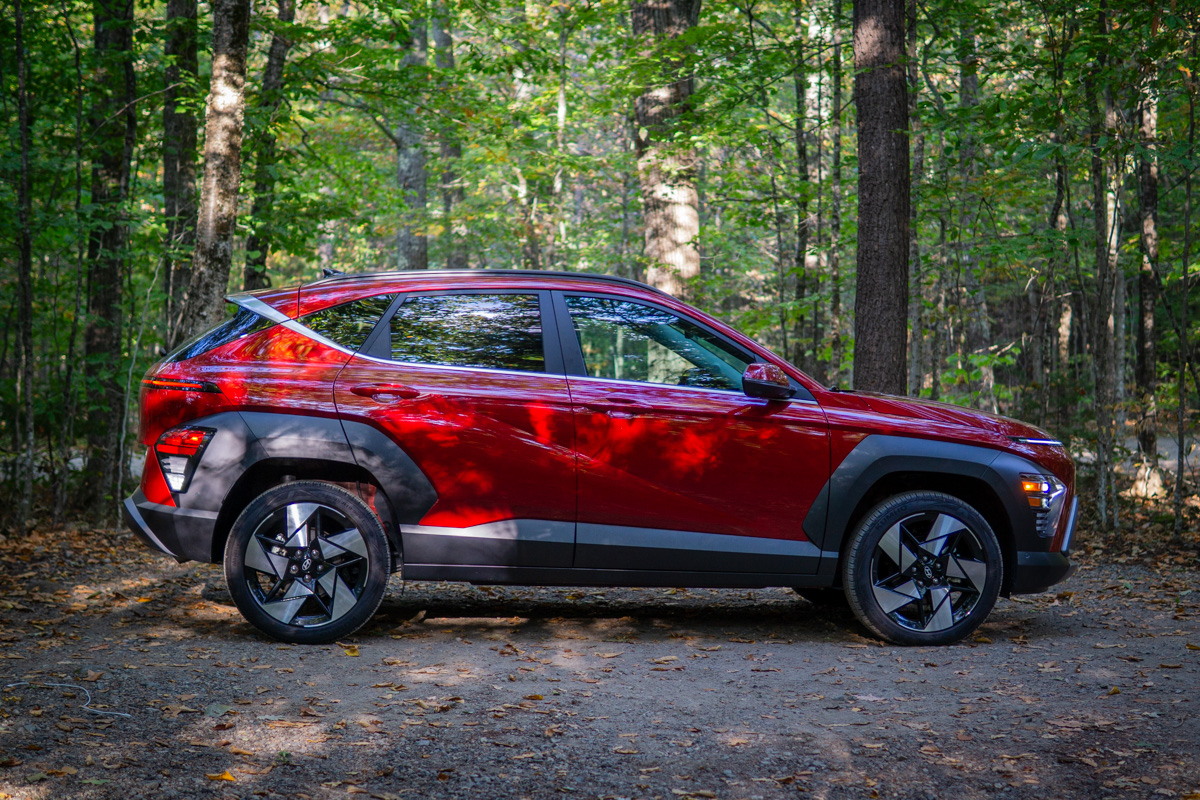
While visually unchanged over the 2024 Hyundai Kona, the 2025 model year is still fresh enough in appearance that you won’t mistake it for anything else in the crossover class—EV or otherwise. The largely flush, single-piece grille and the ultra-slim, front and rear LED light bars make even the gas-powered models reviewed here look futuristic. (Read our separate review for more info on the 2025 Hyundai Kona Electric). While not a classically handsome vehicle, from most angles the Kona’s myriad curves, bulges, and sharp angles collide in a satisfactory fashion.
Anybody coming from a previous-generation Kona will notice the extra size of the newer model because, at around 15 centimetres longer, it’s a significantly larger car. This not only helps with interior space but also gives it a more assertive stance. That’s particularly true if you opt for the Kona N Line, which has a sportier design that includes body-coloured bumpers and cladding in place of the slabs of contrasting plastic that you’ll find on other trims. Speaking of which, those other trims are named Essential and Preferred, which progressively add a little more visual bling in the form of larger alloy wheels (17-inch on the Essential, 18-inch on Preferred, and 19-inch on N Line). All models use LEDs for the headlights, daytime running lights, and taillights.
The interior is unchanged over 2024 and again that’s no bad thing. It feels solid, airy (helped because the drive selector for the automatic gearbox sits on a column beneath the wiper stalk), and has enough tech to impress.
Those wanting a sunroof will need to add the Trend package to the Preferred trim or choose the N Line. The same goes for a powered liftgate if that’s also on your wish list.

Performance
As noted, you can have the Kona with a fully electric drivetrain, and in many ways that’s the model we’d go for, particularly from a value perspective versus its rivals.
The gas-powered Kona reviewed here comes in two flavours, depending on the trim level. The Essential and Preferred trims use a 2.0-litre naturally aspirated four-cylinder engine producing 147 horsepower and 132 lb-ft of torque. This is paired with Hyundai's Intelligent Variable Transmission (IVT), which is a continuously variable transmission (CVT) by another name. This type of transmission prioritizes fuel efficiency over outright performance and won’t be to all tastes on account of the “rubber band” sensation when accelerating.
Perhaps best, then, to opt for a Kona N Line, which marries a more powerful turbocharged 1.6-litre four-cylinder engine (190 horsepower and 195 lb-ft of torque) with an eight-speed torque converter automatic transmission, providing conventional gear ratios to work with. The turbo engine's broader torque band, peaking from 1,700 to 4,500 rpm, means performance is more muscular, although in our test drives, we’ve found that even the turbocharged Kona can still feel a little flat at low revs. Push through that initial lethargy and performance is perfectly adequate by class standards, and while not the kind of engine that’ll have you dreaming about your next drive, the Kona’s turbo unit is undeniably fit for purpose.
All-wheel drive (AWD) is available with the Essential and Preferred trims for an additional $2,000 and standard on the N Line, providing active on-demand drive to the rear axle when needed, and a dedicated Snow mode–useful additions to what is still a relatively small and value-led package. AWD Konas also get a more expensive multi-link rear suspension setup versus the torsion beam on front-wheel-drive (FWD) models, for a more sophisticated ride and handling setup. Even with the technically superior suspension setup of AWD models, the Kona’s ride and handling major on competence in all situations rather than being laugh-out-loud fun on your favourite curvy back roads.

Form & function
As a family of four with a quartet of suitcases to haul, you might break a sweat when the rental car desk hands you the key for a Kona. You needn’t. With 723 litres of cargo capacity with the rear seats in place, growing to 1,803 litres when the seats are folded, the Kona’s trunk (complete with useful dual-level cargo floor) will swallow a surprising amount. More, in fact, than the Mercedes E-Class plug-in hybrid that would later attempt to ferry the same family and their luggage to the airport at the end of their trip.
Rear legroom isn’t at luxury sedan levels, but at 970 millimetres (combined with 972 mm of headroom) nor should anybody but the tallest of passengers complain about being in the back of the Kona.
It’s also easy to get comfortable in the front seats, which feature a generous range of movement, as does the reach- and height-adjustable steering wheel. Relocating the drive selector to a stalk on the steering column and filling its usual place with a large storage compartment creates a real sense of space. In fact, in-car storage in general is excellent, with countless shelves, trays, and cubbies in which to lose your wallet/house keys/phone etc.
The Essential and Preferred trims feature cloth upholstery, while the Trend package adds leatherette and the N Line has Alcantara sport seats. Heated front seats are standard in Canada, and a heated steering wheel comes in at the Preferred trim. On the top-spec N Line with the optional Ultimate package, the front seats are also ventilated.
Climate control progresses from basic single-zone air conditioning with the Essential and Preferred to dual-zone automatic climate control complete with rear air vents with the Preferred’s Trend package or the N Line trim. Usefully, the system has its own set of physical controls mounted beneath the touchscreen, rather than requiring you to operate it via the screen itself.

Technology
The 2025 Kona continues to offer a 12.3-inch central touchscreen infotainment display across all trims. It’s a neat system, with good graphics, clear menu layouts, and wireless Android Auto and wireless Apple CarPlay as standard. The Preferred trim with the Trend package and the N Line trim also get wireless smartphone charging and Hyundai’s digital key.
In Essential and Preferred, you’ll be using a 4.2-inch colour multi-information display as your trip computer, while the N Line trim gets a full 12.3-inch digital instrument cluster. This looks a lot smarter, provides more options for customization, and adds a sense of cohesion that’s missing from the more basic setup.
Audiophiles will want to upgrade to N Line and add the Ultimate package for the full eight-speaker Bose premium audio experience. Anything below that gets a more modest six-speaker setup, although every Kona comes with SiriusXM as standard equipment. You’ll also need the N Line with the Ultimate package to get built-in navigation, although pairing your smartphone in other trims and using something like Google Maps is an effective way to get around this limitation.
Hyundai’s Bluelink connectivity means over-the-air software updates are possible to keep features up to date and comes standard across all trims.

Safety
We’ve long been impressed by Hyundai’s approach to safety technology, which sees it equip even base models with advanced kit. The 2025 Kona is no different. Standard equipment across all trims includes Forward Collision-Avoidance Assist with pedestrian and cyclist detection, Lane Keeping Assist, Lane Following Assist, Blind-Spot Collision Warning, Rear Cross-traffic Collision Avoidance Assist, and Safe Exit Warning.
That’s not to say more equipment isn’t still available. For example, Preferred adds enhanced Forward Collision-Avoidance Assist that includes junction turning and door opening detection, and the N Line with the Ultimate package includes advanced features such as Highway Driving Assist and Hyundai’s Blind Spot View Monitor. But even at a base level the Kona impresses with its level of equipment, the ease with which it can be turned on and off, and the general smoothness with which it keeps you in lane and at a safe distance from the vehicle in front.
The N Line with the Ultimate package adds convenience tech designed to help with parking (think Parking Distance Warning, Surround View Monitor, and Remote Smart Parking Assist), although in a subcompact like this, you might find it’s far from essential.
Sticking with the safety-as-standard theme, all Konas include six airbags, electronic stability control, and a tire pressure monitoring system.
Given all the above, it is perhaps no surprise that the Kona has been named a Top Safety Pick+ by the Insurance Institute of Highway Safety (IIHS).

Cost-effectiveness
A 2025 Hyundai Kona in Essential trim with FWD costs $26,249, excluding destination charges and other fees. That’s a fair MSRP given this small SUV’s practicality, quality, and features. Spending $28,749 will move you up to a Kona Preferred, which again is not unreasonable by class standards. The value, however, is in the Preferred with the Trend package, which adds a power sunroof, a digital key, leatherette upholstery, dual-zone automatic climate control, a wireless charging pad, and a proximity-activated power liftgate, all for $32,749. That’s a lot of useful tech at a still compelling price.
At the top of the Hyundai Kona range, the N Line comes in at $35,749 before fees, and adding the Ultimate package to get a fully loaded version will cost $38,749. As is ever the case with flagship models you might want to see what that money might buy you from the class above before signing on the dotted line. In this case, a Hyundai Tucson would be within reach, albeit a base trim without the Kona N Line Ultimate’s fancy features.
You can add AWD to the base two trims for $2,000 more, while it comes standard with the N Line. And of course, you’ll have the reassurance of Hyundai’s new car warranty, which gives you five years or 100,000 kilometres of bumper-to-bumper coverage, and free roadside assistance for five years and unlimited kilometres.
Fuel economy for the FWD 2.0-litre base engine stands at 7.5 litres per 100 kilometres combined. Opting for AWD sees that number rise by a litre, which is a modest sacrifice for the added capability.
For comparison, a Honda HR-V uses a 2.0-litre, four-cylinder engine and a CVT, much like the entry-level Kona. The Honda’s engine is marginally more powerful at 158 horsepower (vs the Kona’s 147) and 138 lb-ft of torque (vs 132), but the Hyundai fights back by having a slightly better fuel estimate in FWD form of 7.5 L/100 km combined compared with 8.3 L/100 km combined for the Honda. Upgrade to AWD in both models and the figures go up to 8.5 L/100 km and 8.7 L/100 km respectively. Go for the Kona’s turbo engine in N Line trim and the Natural Resources Canada estimate is 9.0 L/100 km combined with standard AWD.

What owners say
"Overall, drivers are enthusiastic about the 2025 Hyundai Kona, praising its modern design, tech features, and comfortable ride. They particularly enjoyed the wireless Apple CarPlay/Android Auto and touchscreen radio. However, some drivers noted a lack of power with the engine for quicker acceleration and expressed a desire for better interior materials and a power-adjustable passenger seat."
The 2025 Hyundai Kona SEL Convenience is a great subcompact SUV with a modern design, solid tech features, and a comfortable ride. The wireless Apple CarPlay/Android Auto, heated front seats, and digital gauge cluster make it feel upscale for its price. It has decent cargo space and improved rear legroom, making it more practical than before. The 2.0L engine is fine for daily driving but lacks power for quicker acceleration. Some interior materials could be better, and there’s no power-adjustable passenger seat, which is a minor downside. Compared to rivals like the Honda HR-V or Mazda CX-30, it holds its own with value and features but could use a bit more refinement.
February 28, 2025I love the car’s features. It is definitely good value. The only thing that’s missing is heated seats and steering wheel but it has cloth seats so not too bad.
March 15, 2026I love all the features especially the touch screen radio and all around think the car is awesome and worth every penny.
April 30, 2025What owners say
The 2025 Hyundai Kona SEL Convenience is a great subcompact SUV with a modern design, solid tech features, and a comfortable ride. The wireless Apple CarPlay/Android Auto, heated front seats, and digital gauge cluster make it feel upscale for its price. It has decent cargo space and improved rear legroom, making it more practical than before. The 2.0L engine is fine for daily driving but lacks power for quicker acceleration. Some interior materials could be better, and there’s no power-adjustable passenger seat, which is a minor downside. Compared to rivals like the Honda HR-V or Mazda CX-30, it holds its own with value and features but could use a bit more refinement.
February 28, 2025I love the car’s features. It is definitely good value. The only thing that’s missing is heated seats and steering wheel but it has cloth seats so not too bad.
March 15, 2026I love all the features especially the touch screen radio and all around think the car is awesome and worth every penny.
April 30, 2025I love all the features especially the touchscreen radio. I think the car is all around awesome and worth every penny. Big thank you to Vanie
April 30, 2025Bigger than the older version, sporty too! Zippy fun smaller vehicle with decent gas mileage for a non-hybrid. Highly recommend it.
June 18, 2025Trims & specs
Base MSRP N/A | Seating 5 |
Engine 2.0L 147 hp I4 | Cargo Capacity 722 L |
Combined MPG 31 | Drivetrain FWD |
Base MSRP N/A | Seating N/A |
Engine N/A | Cargo Capacity N/A |
Combined MPG N/A | Drivetrain N/A |
Base MSRP N/A | Seating 5 |
Engine 1.6L 190 hp I4 | Cargo Capacity 722 L |
Combined MPG 29 | Drivetrain FWD |
Base MSRP N/A | Seating N/A |
Engine N/A | Cargo Capacity N/A |
Combined MPG N/A | Drivetrain N/A |
Base MSRP N/A | Seating 5 |
Engine 2.0L 147 hp I4 | Cargo Capacity 722 L |
Combined MPG 27 | Drivetrain AWD |
Base MSRP N/A | Seating 5 |
Engine 2.0L 147 hp I4 | Cargo Capacity 722 L |
Combined MPG 31 | Drivetrain FWD |
Base MSRP N/A | Seating N/A |
Engine N/A | Cargo Capacity N/A |
Combined MPG N/A | Drivetrain N/A |
Base MSRP N/A | Seating 5 |
Engine 2.0L 147 hp I4 | Cargo Capacity 722 L |
Combined MPG 27 | Drivetrain AWD |
Base MSRP N/A | Seating N/A |
Engine N/A | Cargo Capacity N/A |
Combined MPG N/A | Drivetrain N/A |
Base MSRP N/A | Seating N/A |
Engine N/A | Cargo Capacity N/A |
Combined MPG N/A | Drivetrain N/A |
Base MSRP N/A | Seating 5 |
Engine 2.0L 147 hp I4 | Cargo Capacity 722 L |
Combined MPG 27 | Drivetrain AWD |
Base MSRP N/A | Seating 5 |
Engine 2.0L 147 hp I4 | Cargo Capacity 722 L |
Combined MPG 31 | Drivetrain FWD |
Base MSRP N/A | Seating 5 |
Engine 1.6L 190 hp I4 | Cargo Capacity 722 L |
Combined MPG 26 | Drivetrain AWD |
Base MSRP N/A | Seating 5 |
Engine 1.6L 190 hp I4 | Cargo Capacity 722 L |
Combined MPG 26 | Drivetrain AWD |
Base MSRP N/A | Seating N/A |
Engine N/A | Cargo Capacity N/A |
Combined MPG N/A | Drivetrain N/A |
Base MSRP N/A | Seating 5 |
Engine 1.6L 190 hp I4 | Cargo Capacity 722 L |
Combined MPG 29 | Drivetrain FWD |
Base MSRP N/A | Seating N/A |
Engine N/A | Cargo Capacity N/A |
Combined MPG N/A | Drivetrain N/A |


Pricing trends
Current avg. market price
$28,767
Trending down by 2.8% this month
May 2026 - November 2026