2025 Mercedes-Benz GLC Reviews, Pricing & Specs
Write a reviewPros
Thrifty fuel economy (especially on GLC 350e)
Commendable handling and ride quality
Good size and cargo room
Cons
Buzzy engine note
Tighter backseat area
Complicated infotainment
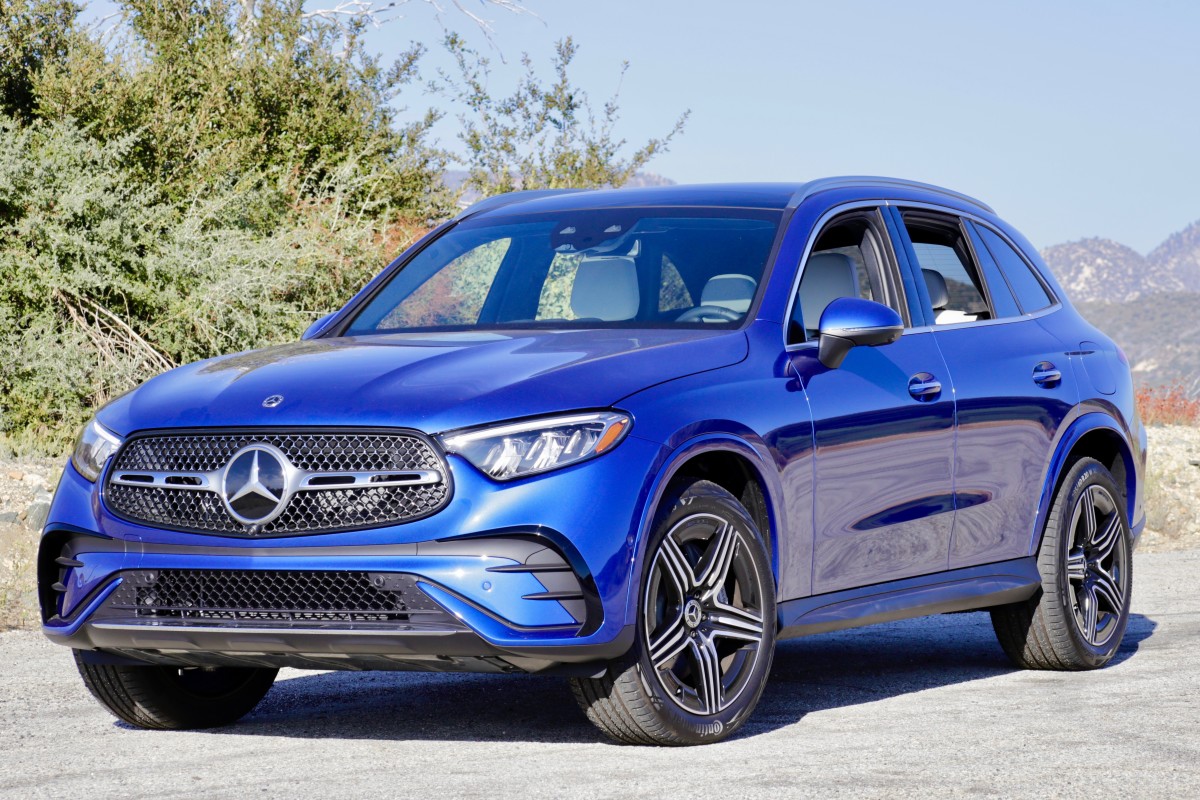
The Mercedes-Benz GLC has stylish looks, luxury amenities, and great driving dynamics in spades.
The handsome Mercedes-Benz GLC compact SUV continues into the 2025 model year with a few revisions and a new plug-in hybrid electric vehicle (PHEV) variant. The GLC shows us that a simple yet measured approach makes it a strong candidate up against compact luxury SUVs from Audi, BMW, Genesis, Lexus, Porsche, and Volvo. This review covers the non-AMG GLC models, while AMG GLC models are reviewed separately.
Verdict: The 2025 Mercedes-Benz GLC-class is a handsome and compelling new car fit for most duties

Following the current Mercedes design language quite well, the GLC is a sight for sore eyes after gazing across the compact crossover segment at large. Its taught lines create a more trim and muscular shape that elegantly flows from its Mercedes star pattern grille and standard LED headlights. Thanks to its taller, upright cabin area and short overhangs, it evokes a sense of multi-terrain capability, too, especially on non-AMG Line-equipped models with un-painted wheel arch liners.
We particularly dug the GLC’s crisp headlights and surprisingly detailed tail lights, which ensure its overall look will stay fresh for at least the next few years. Additionally, the extra-cost 20-inch AMG five-spoke wheels help bolster its overall athletic form.
Mercedes certainly doesn’t bury the luxury-focused lede, as opening the GLC’s nicely weighted doors revealed its beautifully designed, contrasting-leather-adorned interior door panels. The aesthetically pleasing, premium interior materials only continued from there. Our GLC 350e PHEV test unit came equipped with supple white leather seats sporting both heating and ventilation (the latter being a $600 option) which had great adjustability and the ability to have a commanding view of the road ahead. While its haptic steering wheel and climate controls consisted of piano black plastic, it was nicely contrasted by faux carbon fibre encasing the centre console, satin stitched leather atop its dash and doors, plus painted aluminum trim accents throughout.

In Canada, the Mercedes 4Matic all-wheel drive (AWD) system is standard on all GLC models. The foundation of the entry-level models is the brand’s 2.0-litre turbocharged four-cylinder engine situated longitudinally under the hood, and a nine-speed automatic transmission.
While it’s no firecracker like in its sibling the Mercedes-AMG GLC 43, this turbo-four produces 255 horsepower and 295 pound-feet of torque in the 300, whereas the 350e’s output is a tad lower at 201 hp and 236 lb-ft. These specs might not seem like much upon first glance, especially considering the GLC’s curb weight hovers around 1,900 kilograms (4,200 pounds). However, the 300 receives a 48-volt mild-hybrid system that chips in an additional 23 hp and 148 lb-ft of torque under certain situations — such as pulling away from a stop light with haste — which enables a 6.2 second 0-100 km/h time.
At the core of the 350e’s more substantial hybrid system is a 23.3-kilowatt-hour battery pack and single electric motor that contributes an extra 134 hp and 235 lb-ft of torque. Combined output is a very healthy 313 hp and 406 lb-ft. But the 350e has a slower 6.7-second 0-to-100 km/h time as it carries roughly an extra 500 kilograms (1,100 pounds).
Power always felt just right when driving around town and on the highway. The GLC may take a little over six seconds to hit 100 km/h in either powertrain configuration, but our 350e felt noticeably more expeditious where it counts: it quickly got up to 60 km/h on city streets, and passed cars with ease on the highway. This is thanks to the substantial added torque provided by either trim’s hybridization.
Just right encapsulates the GLC’s ride quality, steering, and overall handling, too. It soaked up all kinds of road imperfections quite well — despite our tester’s massive 20-inch wheels — and felt overall solid, with no floatiness or vagueness. Steering was very light and manageable at low speeds, and it gained reassuring weight once cruising along. Fast movements on the highway and atop winding mountain roads were followed by great overall vehicle composure, indicating that the GLC would serve well for both road trips and reaching distant campsites. For a high-sitting, non-performance SUV, body control was very good, too, and when mixed with its low-end torque it was fun to drive in the twisties.
Braking performance was perfectly adequate in any scenario, as was our 350e’s use of regenerative braking. Its intensity can be altered via the steering wheel’s paddles. We typically kept it on its most intense setting to prolong its impressive 87-kilometre electric range as much we could. When in Hybrid mode, it prioritized electricity over internal combustion, and there was even a detent in the gas pedal as easy reference for when the engine would fire up and help out. We liked this a lot. Electric-only was generally adequate, but for steep hills or especially spirited highway merges, we pushed past the detent to ensure we had the whole 313 hp and 406 lb-ft at our disposal.

In addition to its commanding view of the road, hip, shoulder, and leg room was quite good up front in the 2025 Mercedes-Benz GLC, even for a six-foot three-inch test driver. The same can’t be said for the back seats, as they were a little tight on leg and headroom. In the name of maximizing cargo room while also fitting into the compact crossover segment, this is a tough area for many manufacturers. The front seats do have a clever design, though, as they have a bit of a curve to them to allow as much leg room as possible in the back. They wouldn’t allow for rear-seat passengers to cross their legs and stretch out, but there’s definitely less of a chance of being scrunched up.
Thanks to the GLC’s boxy shape and 470 litres of cargo space—which expands to 1,530 litres with the rear seats folded down—the GLC 350e proved very practical despite being lower in both measures than the GLC 300 by roughly 150 litres. It was generally easy to stow luggage, groceries, and other everyday items in the cargo area, despite having smaller dimensions in this department for its segment. By comparison, the BMW X3 sports 812 and 1,775 litres with the second row up or down, respectively. The Audi Q3 comes in at 671 and 1,359 litres, nearly matching the Benz, while the Genesis GV70 possesses 818 and 1,611 litres.
The split rear seat drops instantly via two buttons just behind the hatch, and after quickly removing the retractable cover, we were able to fit an entire XL-sized road bike, laying flat, without removing either wheel. This is often no easy task in this size of vehicle, and we think the GLC’s 1,920-millimetre width helped in this area.
In terms of how the GLC’s hybridization makes life easier, financially speaking, we averaged 9.6 litres per 100 kilometres of estimated fuel economy across 440 kilometres of driving. It was a good mix, too: a lot of crawling through traffic during the day, in-town schlepping around, and higher-speed open highway cruising at night.
The 350e has an estimated Natural Resources Canada fuel economy of 10.2 L/100 km city, 8.5 on the highway, and 9.4 combined in hybrid mode, and estimated efficiency of 3.7 litres-equivalent per 100 kilometres combined in all-electric mode. The mild-hybrid 300 returns an estimated 10.0 L/100 km city, 7.6 highway, and 8.9 combined. This is undoubtedly due to weighing significantly less than the 350e.

As part of the latest third-generation suite of the MBUX (Mercedes-Benz User Experience) infotainment system, steering wheel, climate control, and infotainment controls are almost all haptic, the exception being a couple of actual, pressable buttons.
At the most basic level of user friendliness, figuring out the right amount of swipe intensity for MBUX haptic controls and the centre 11.9-inch touchscreen took some getting used to. An over-swipe motion moved various screens, stereo volume, and SiriusXM stations too quickly, whereas lighter, more precise movements didn’t register accurately.
Additionally, there was a sluggish touchscreen response that led to confusion at times, especially when trying to go back to previous menus. It was easiest to just hit the home button and start over. Though, over time, we figured out the best strategy for quickly navigating between comfort settings, changing SiriusXM stations, and jumping between MBUX and Apple CarPlay.
Despite our MBUX frustrations at times, we liked that wireless Apple CarPlay and Bluetooth connected quickly and seamlessly. Android Auto is also standard, but we did not test it. Screen resolution was quite good, and we got a kick out of its deep ambient lighting customizability. The latter really added to late night drives with a relaxing ambient/synth soundtrack playing through the GLC’s excellent stereo. A top-notch Burmester 3D surround sound system was included in our tester’s $3,700 Pinnacle Trim.

The 2025 Mercedes-Benz GLC comes standard with a few types of advanced safety features, including blind-spot monitoring, active parking assistance, automatic high beams, rain-sensing windshield wipers, and active braking assistance.
Our tester was also equipped with the much more extensive $2,500 Driver Assistance Package, which included adaptive cruise control and steering assist with stop-and-go capability, plus lane-change assist with automatic lane change, lane-keep assist, automatic emergency braking, evasive maneuvering, and speed limit assist.
All of these worked in a smooth and harmonious manner. Automatic emergency braking wasn’t too overzealous, and adaptive cruise control was in no way awkward. Then, combined with steering assist, the latter made for a breezy, easy-going crawl through stop-and-go traffic.

The 2025 Mercedes-Benz GLC-Class is an opulent, good-looking luxury compact crossover, sporting great fuel economy and a solid mix of tech and comfort amenities. The key downside is its MBUX infotainment tech is a little hard to get used to.
To hop into a brand-new 2025 Mercedes-Benz GLC 300 model in Canada, it’ll cost $59,500. (Note this price does not include destination charges or fees, which in Canada are set independently by Mercedes-Benz dealerships.) Here, you get a nice selection of driver-assist tech, full connectivity plus a 12.3-inch digital instrument cluster and 11.9-inch infotainment touchscreen, heated power seats, heated steering wheel, and a few other niceties. With all the package boxes checked, the GLC 300 rings up at $70,900. To mirror the same in the 350e 4Matic PHEV, pricing starts at $64,900, and adding all the packages commands a Canadian MSRP of $76,300.
The 2025 BMW X3 PHEV’s pricing hasn’t been announced yet, but the standard model kicks off at $59,700. The Audi Q5 comes in at $58,700, the Genesis GV70 starts at $61,000 (this is all-in pricing), and the Volvo XC60 is priced from $55,450. The Porsche Macan certainly fits in this range as well, though is much more expensive at $67,000.
When seeking the most fuel-efficient of the bunch, the only current competitor to the Mercedes-Benz GLC 350e is the Volvo XC60 Core PHEV, which starts at $59,950. This undercuts the Benz by five grand, and offers 58 kilometres of electric range and 8.5 L/100km combined hybrid fuel economy.
Note: Images show a US model.

User reviews for 2025 Mercedes-Benz GLC
Write a review2025 Mercedes-Benz GLC Pricing
Trims & specs
Air Conditioning
Active charcoal air filtration · Automatic climate control front air conditioning · Dual front air conditioning zones
Airbags
Dual front airbags · Driver knee airbags · Passenger airbag deactivation: occupant sensing deactivation · Front side airbags · Rear side curtain airbags
Audio System
Antenna Type: diversity · Voice recognition audio system · Bluetooth auxiliary audio input · Internet radio app: TIDAL · AM/FM radio · Satellite Radio: SiriusXM · 2 subwoofers · Total Number of Speakers: 6
Brakes
ABS: 4-wheel · Braking assist: hill start assist · Electronic parking brake: auto off · Front brake diameter: 13.5 · Front brake width: 1.3 · Front brakes: ventilated disc · Rear brake diameter: 12.6 · Rear brake width: 0.9 · Rear brakes: ventilated disc
Comfort Features
Armrests: rear center with cupholders · Center console trim: wood · Dash trim: faux suede · Door trim: aluminum · Floor Mat Material: carpet · Floor Material: carpet · Floor Mats: front · Steering wheel trim: leather
Convenience Features
Active parking system: fully automated · Ambient lighting: color-adjustable · Assist handle: rear · Cargo area power outlet: 12V · Cargo cover: retractable · Center console: front console with armrest and storage · Cupholders: front · Dimming rearview mirror: auto-dimming · Easy entry: power driver seat · Footwell lights: color-adjustable · Memorized settings: 3 driver · Multi-function remote: trunk release · One-touch windows: 4 · Power outlet(s): 12V front · Power steering: speed-proportional · Power windows: lockout button · Reading lights: front · Rear view camera: multi-view · Steering wheel: power tilt and telescopic · Steering wheel mounted controls: phone · Storage: front seatback · Universal garage door opener: Homelink · Vanity mirrors: dual illuminating
Driver Seat
Adjustable lumbar support: 4-way power · Power adjustments: 16
Drivetrain
Axle ratio: 3.27
Engine
Alternator: 150 amps · Battery: maintenance-free · Electric Motor HP: 23 · Electric Motor Power Output (Kilowatts): 17 · Electric Motor Torque: 148 · Hybrid Gas Engine HP: 255 · Hybrid Gas Engine HP@RPM: 5800 · Hybrid Gas Engine Torque: 295 · Hybrid gas Engine Torque@RPM: 2000
Exterior Features
Door handle color: body-color with chrome accents · Exhaust: integrated exhaust · Exhaust tip color: chrome · Fender lip moldings: body-color · Front bumper color: body-color · Grille color: black with chrome accents · Mirror color: body-color · Rear bumper color: body-color · Rear spoiler: roofline spoiler · Rear spoiler color: body-color · Rear trunk/liftgate: sensor-activated · Rocker panel color: black · Window trim: chrome
Headrests
Front headrests: adjustable · Number of front headrests: 2 · Number of rear headrests: 3
Hybrid
Starter Type: motor/generator
In Car Entertainment
Connected in-car apps: Apple Music · Infotainment: MBUX · Infotainment screen size: 11.9 in. · Smartphone integration: wireless Android Auto
Instrumentation
Fuel economy display: range · Instrument cluster screen size: 12.3 in. · Warnings and reminders: low oil pressure
Lights
Daytime running lights: LED · Exterior entry lights: puddle lamps · Headlights: LED · Tail and brake lights: LED
Mirrors
Exterior mirrors: reverse gear tilt
Passenger Seat
Power adjustments: 16
Rear Seats
Type: 40-20-40 split bench
Roof
Roof rails: aluminum
Safety
Automatic emergency braking: front pedestrian · Child seat anchors: LATCH system · Cross Traffic Alert: rear · Crumple zones: rear · Impact sensor: battery disconnect · Parking sensors: front · Pre-Collision Warning System: visual warning · Pre-collision warning system: pedestrian detection · Rearview monitor: in dash
Seatbelts
Emergency locking retractors: front · Front seatbelts: 3-point · Seatbelt force limiters: front and rear · Seatbelt pretensioners: front · Seatbelt warning sensor: driver and passenger · Second row seatbelts: 3-point
Seats
Driver seat power adjustments: reclining · Front seat type: bucket · Passenger seat power adjustments: reclining · Rear headrests: adjustable · Rear seat: power reclining · Rear seat folding: flat · Upholstery: leatherette
Spare Tire
Mount Location: inside · Size: temporary
Spare Wheel
Rim Type: steel
Stability and Traction
Traction control: with trailer stability control
Steering
Steering ratio: 16.0
Suspension
Front Shock Type: gas shock absorbers · Front Spring Type: coil springs · Front Suspension Classification: independent · Front Suspension Type: multi-link · Rear Shock Type: gas shock absorbers · Rear Spring Type: coil springs · Rear Suspension Classification: independent · Rear Suspension Type: multi-link · Stabilizer bar(s): front · Suspension control: electronic
Telematics
Driver assistance app: roadside assistance · Electronic messaging assistance: with voice recognition · Phone: voice activated · Phone wireless data link: Bluetooth · Smart device app compatibility: Mercedes me · Smart device app function: lock operation · Wifi: hotspot compatible
Tires
Type: all season
Tires and Rims
Wheel type: aluminum alloy
Wheels
Wheel spokes: 10
Windows
Front wipers: rain sensing · Liftgate window: fixed · Power windows: with safety reverse · Rear wiper: intermittent
Air Conditioning
Active charcoal air filtration · Automatic climate control front air conditioning · Dual front air conditioning zones
Airbags
Dual front airbags · Driver knee airbags · Passenger airbag deactivation: occupant sensing deactivation · Front side airbags · Rear side curtain airbags
Audio System
Antenna Type: diversity · Voice recognition audio system · Bluetooth auxiliary audio input · Internet radio app: Spotify · AM/FM radio · Satellite Radio: SiriusXM · 2 subwoofers · Total Number of Speakers: 6
Brakes
ABS: 4-wheel · Braking assist: hill start assist · Electronic parking brake: auto off · Front brake diameter: 13.5 · Front brake width: 1.3 · Front brakes: ventilated disc · Rear brake diameter: 12.6 · Rear brake width: 0.9 · Rear brakes: ventilated disc
Comfort Features
Armrests: rear center folding with pass-thru · Center console trim: wood · Dash trim: wood · Door sill trim: illuminated scuff plate · Door trim: aluminum · Floor Mat Material: carpet · Floor Material: carpet · Floor Mats: front · Steering wheel trim: leather
Convenience Features
Active parking system: fully automated · Ambient lighting: color-adjustable · Assist handle: front · Cargo area power outlet: 12V · Cargo cover: retractable · Center console: front console with armrest and storage · Cupholders: front · Dimming rearview mirror: auto-dimming · Easy entry: power driver seat · Footwell lights: color-adjustable · Memorized settings: 3 driver · Multi-function remote: proximity entry system · One-touch windows: 4 · Power outlet(s): USB-C front · Power steering: speed-proportional · Power windows: lockout button · Reading lights: front · Rear view camera: multi-view · Steering wheel: power tilt and telescopic · Steering wheel mounted controls: paddle shifter · Storage: sunglasses holder · Universal garage door opener: Homelink · Vanity mirrors: dual illuminating
Driver Seat
Adjustable lumbar support: 4-way power · Power adjustments: 16
Drivetrain
4WD Type: full time · Axle ratio: 3.27
Engine
Alternator: 150 amps · Battery: maintenance-free · Electric Motor HP: 23 · Electric Motor Power Output (Kilowatts): 17 · Electric Motor Torque: 148 · Hybrid Gas Engine HP: 255 · Hybrid Gas Engine HP@RPM: 5800 · Hybrid Gas Engine Torque: 295 · Hybrid gas Engine Torque@RPM: 2000
Exterior Features
Door handle color: body-color with chrome accents · Exhaust: integrated exhaust · Exhaust tip color: chrome · Fender lip moldings: body-color · Front bumper color: body-color · Grille color: black with chrome accents · Mirror color: body-color · Rear bumper color: body-color · Rear spoiler: lip · Rear spoiler color: body-color · Rear trunk/liftgate: sensor-activated · Rocker panel color: black · Window trim: chrome
Headrests
Front headrests: adjustable · Number of front headrests: 2 · Number of rear headrests: 3
Hybrid
Starter Type: motor/generator
In Car Entertainment
Connected in-car apps: Google search · Infotainment: MBUX · Infotainment screen size: 11.9 in. · Smartphone integration: wireless Android Auto
Instrumentation
Fuel economy display: MPG · Instrument cluster screen size: 12.3 in. · Warnings and reminders: low oil pressure
Lights
Daytime running lights: LED · Exterior entry lights: puddle lamps · Headlights: Auto on/off · Tail and brake lights: LED
Mirrors
Exterior mirrors: power
Passenger Seat
Power adjustments: 16
Rear Seats
Type: 40-20-40 split bench
Roof
Moonroof: power panoramic · Roof rails: aluminum
Safety
Automatic emergency braking: rear pedestrian · Camera system: surround view · Child seat anchors: LATCH system · Cross Traffic Alert: rear · Crumple zones: rear · Impact sensor: battery disconnect · Parking sensors: front · Pre-Collision Warning System: visual warning · Pre-collision warning system: pedestrian detection · Rearview monitor: in dash
Seatbelts
Emergency locking retractors: front · Front seatbelts: 3-point · Seatbelt force limiters: front and rear · Seatbelt pretensioners: front and rear · Seatbelt warning sensor: driver and passenger · Second row seatbelts: 3-point
Seats
Driver seat power adjustments: height · Front seat type: bucket · Passenger seat power adjustments: height · Rear headrests: adjustable · Rear seat: power reclining · Rear seat folding: split · Upholstery: leatherette
Spare Tire
Mount Location: inside · Size: temporary
Spare Wheel
Rim Type: steel
Stability and Traction
Traction control: with trailer stability control
Steering
Steering ratio: 15.1
Suspension
Front Shock Type: gas shock absorbers · Front Spring Type: coil springs · Front Suspension Classification: independent · Front Suspension Type: strut · Rear Shock Type: gas shock absorbers · Rear Spring Type: coil springs · Rear Suspension Classification: independent · Rear Suspension Type: multi-link · Stabilizer bar(s): front · Suspension control: electronic
Telematics
Driver assistance app: roadside assistance · Electronic messaging assistance: with voice recognition · Navigation system: with voice recognition · Phone: voice activated · Phone wireless data link: Bluetooth · Smart device app compatibility: Mercedes me · Smart device app function: vehicle location · Wifi: hotspot compatible
Tires
Type: all season
Tires and Rims
Wheel type: aluminum alloy
Wheels
Wheel spokes: multi-spoke
Windows
Front wipers: rain sensing · Liftgate window: fixed · Power windows: remote operation · Rear wiper: with washer
Air Conditioning
Active charcoal air filtration · Automatic climate control front air conditioning · Dual front air conditioning zones
Airbags
Dual front airbags · Driver knee airbags · Passenger airbag deactivation: occupant sensing deactivation · Front side airbags · Rear side curtain airbags
Audio System
Antenna Type: element · Voice recognition audio system · USB auxiliary audio input · Internet radio app: TIDAL · AM/FM radio · Satellite Radio: SiriusXM · 2 subwoofers · Total Number of Speakers: 6
Brakes
ABS: 4-wheel · Braking assist: hill start assist · Electronic parking brake: auto off · Front brake diameter: 13.5 · Front brake width: 1.3 · Front brakes: ventilated disc · Rear brake diameter: 12.6 · Rear brake width: 0.9 · Rear brakes: ventilated disc
Comfort Features
Armrests: rear center folding with pass-thru · Center console trim: wood · Dash trim: wood · Door trim: wood · Floor Mat Material: carpet · Floor Material: carpet · Floor Mats: front · Steering wheel trim: leather
Convenience Features
Active parking system: fully automated · Ambient lighting: color-adjustable · Assist handle: front · Cargo area power outlet: 12V · Cargo cover: retractable · Center console: front console with armrest and storage · Cupholders: front · Dimming rearview mirror: auto-dimming · Easy entry: power steering wheel · Footwell lights: color-adjustable · Memorized settings: steering wheel · Multi-function remote: trunk release · One-touch windows: 4 · Power outlet(s): 12V front · Power steering: speed-proportional · Power windows: lockout button · Reading lights: front · Rear view camera: multi-view · Steering wheel: power tilt and telescopic · Steering wheel mounted controls: paddle shifter · Storage: door pockets · Universal garage door opener: Homelink · Vanity mirrors: dual illuminating
Driver Seat
Adjustable lumbar support: 4-way power · Power adjustments: 16
Drivetrain
4WD Type: full time · Axle ratio: 3.27
Engine
Battery: maintenance-free · EV battery capacity: 24.8 kWh · Electric Motor Battery Type: lithium ion · Electric Motor HP: 134 · Electric Motor Power Output (Kilowatts): 100 · Electric Motor Torque: 325 · Electric charge cord: autoswitching 110V/240V · Electric motor charger: DC fast charging · Electric motor charger connector: SAE Combo CCS · Electric motor charging time: 3 hours · Electric motor miles per charge: 54 · Hybrid Gas Engine HP: 201 · Hybrid Gas Engine HP@RPM: 6100 · Hybrid Gas Engine Torque: 236 · Hybrid gas Engine Torque@RPM: 2000
Exterior Features
Door handle color: body-color with chrome accents · Exhaust: dual exhaust tips · Exhaust tip color: chrome · Fender lip moldings: body-color · Front bumper color: body-color · Grille color: black with chrome accents · Mirror color: body-color · Rear bumper color: body-color · Rear spoiler: roofline spoiler · Rear spoiler color: body-color · Rear trunk/liftgate: power operated · Rocker panel color: black · Window trim: chrome
Headrests
Front headrests: adjustable · Number of front headrests: 2 · Number of rear headrests: 3
Hybrid
Starter Type: motor/generator
In Car Entertainment
Connected in-car apps: Google search · Infotainment: MBUX · Infotainment screen size: 11.9 in. · Smartphone integration: wireless Android Auto
Instrumentation
Fuel economy display: MPG · Instrument cluster screen size: 12.3 in. · Warnings and reminders: maintenance reminder
Lights
Daytime running lights: LED · Exterior entry lights: puddle lamps · Headlights: auto delay off · Tail and brake lights: LED
Mirrors
Exterior mirrors: power
Passenger Seat
Power adjustments: 16
Rear Seats
Type: 40-20-40 split bench
Roof
Roof rails: aluminum
Safety
Automatic emergency braking: rear pedestrian · Child seat anchors: LATCH system · Cross Traffic Alert: rear · Crumple zones: front · Impact sensor: fuel cut-off · Parking sensors: front · Pre-Collision Warning System: visual warning · Pre-collision warning system: pedestrian detection · Rearview monitor: in dash
Seatbelts
Emergency locking retractors: front · Front seatbelts: 3-point · Seatbelt force limiters: front and rear · Seatbelt pretensioners: front · Seatbelt warning sensor: driver and passenger · Second row seatbelts: 3-point
Seats
Driver seat power adjustments: height · Front seat type: bucket · Passenger seat power adjustments: 4-way power lumbar · Rear headrests: adjustable · Rear seat: power reclining · Rear seat folding: flat · Upholstery: leatherette
Spare Tire
Mount Location: inside · Size: temporary
Spare Wheel
Rim Type: steel
Stability and Traction
Traction control: with trailer stability control
Steering
Steering ratio: 16.0
Suspension
Front Shock Type: gas shock absorbers · Front Spring Type: coil springs · Front Suspension Classification: independent · Front Suspension Type: multi-link · Leveling: self leveling suspension · Rear Shock Type: gas shock absorbers · Rear Spring Type: coil springs · Rear Suspension Classification: independent · Rear Suspension Type: multi-link · Stabilizer bar(s): rear · Suspension control: electronic
Telematics
Driver assistance app: roadside assistance · Electronic messaging assistance: with read function · Phone: voice activated · Phone wireless data link: Bluetooth · Smart device app compatibility: Mercedes me · Smart device app function: security event/collision alert · Wifi: hotspot compatible
Tires
Type: all season
Tires and Rims
Wheel type: aluminum alloy
Wheels
Wheel spokes: 10
Windows
Front wipers: rain sensing · Liftgate window: fixed · Power windows: remote operation · Rear wiper: intermittent
Air Conditioning
Active charcoal air filtration · Automatic climate control front air conditioning · Dual front air conditioning zones
Airbags
Dual front airbags · Driver knee airbags · Passenger airbag deactivation: occupant sensing deactivation · Front side airbags · Front side curtain airbags
Audio System
Antenna Type: diversity · Voice recognition audio system · USB auxiliary audio input · Internet radio app: TIDAL · HD radio · Satellite Radio: SiriusXM · 2 subwoofers · Total Number of Speakers: 6
Brakes
ABS: 4-wheel · Braking assist: hill start assist · Electronic parking brake: auto off · Front brake diameter: 14.6 · Front brake width: 1.42 · Front brakes: ventilated disc · Rear brake diameter: 14.2 · Rear brake width: 1.02 · Rear brakes: ventilated disc
Comfort Features
Armrests: rear center with cupholders · Center console trim: aluminium · Dash trim: aluminum · Door sill trim: illuminated scuff plate · Door trim: wood · Floor Mat Material: carpet · Floor Material: carpet · Floor Mats: front · Foot pedal trim: stainless steel · Steering wheel trim: leather
Convenience Features
Active parking system: fully automated · Ambient lighting: color-adjustable · Assist handle: rear · Cargo area power outlet: 12V · Cargo cover: retractable · Center console: front console with armrest and storage · Cupholders: front · Dimming rearview mirror: auto-dimming · Easy entry: power driver seat · Footwell lights: color-adjustable · Memorized settings: side mirrors · Multi-function remote: keyless entry with panic alarm · One-touch windows: 4 · Power outlet(s): 12V front · Power steering: electric · Power windows: lockout button · Reading lights: front · Rear view camera: multi-view · Steering wheel: power tilt and telescopic · Steering wheel mounted controls: phone · Storage: door pockets · Universal garage door opener: Homelink · Vanity mirrors: dual illuminating
Driver Seat
Adjustable lumbar support: 4-way power · Power adjustments: 16
Drivetrain
4WD Type: full time · Axle ratio: 3.69 · Limited slip differential: center
Engine
Alternator: 150 amps · Battery: maintenance-free · Exhaust: performance
Exterior Features
Door handle color: body-color with chrome accents · Exhaust: quad exhaust tips · Exhaust tip color: chrome · Fender lip moldings: body-color · Front bumper color: body-color · Grille color: black with chrome accents · Mirror color: body-color · Rear bumper color: body-color · Rear spoiler: lip · Rear spoiler color: body-color · Rear trunk/liftgate: power operated · Rocker panel color: black · Window trim: chrome
Headrests
Front headrests: adjustable · Number of front headrests: 2 · Number of rear headrests: 3
Hybrid
Starter Type: starter/belt alternator
In Car Entertainment
Connected in-car apps: Apple Music · Infotainment: MBUX · Infotainment screen size: 11.9 in. · Smartphone integration: wireless Android Auto
Instrumentation
Fuel economy display: range · Instrument cluster screen size: 12.3 in. · Warnings and reminders: low oil level
Lights
Daytime running lights: LED · Exterior entry lights: puddle lamps · Headlights: automatic high beam dimmer · Tail and brake lights: LED
Mirrors
Exterior mirrors: power
Passenger Seat
Power adjustments: 16
Rear Seats
Type: 40-20-40 split bench
Roof
Moonroof: anti-trapping feature · Roof rails: aluminum
Safety
Automatic emergency braking: rear · Camera system: surround view · Child seat anchors: LATCH system · Cross Traffic Alert: rear · Crumple zones: front · Impact sensor: door unlock · Parking sensors: front · Pre-Collision Warning System: visual warning · Pre-collision warning system: pedestrian detection · Rearview monitor: in dash
Seatbelts
Emergency locking retractors: front · Front seatbelts: 3-point · Seatbelt force limiters: front · Seatbelt pretensioners: front and rear · Seatbelt warning sensor: driver and passenger · Second row seatbelts: 3-point
Seats
Driver seat power adjustments: height · Front seat type: sport bucket · Passenger seat power adjustments: 4-way power lumbar · Rear headrests: adjustable · Rear seat: power reclining · Rear seat folding: power · Upholstery: leatherette · Upholstery accents: faux suede
Stability and Traction
Traction control: with trailer stability control
Steering
Steering ratio: 12.8
Suspension
Driver Adjustable Suspension: ride control · Front Shock Type: gas shock absorbers · Front Spring Type: coil springs · Front Suspension Classification: independent · Front Suspension Type: MacPherson struts · Rear Shock Type: gas shock absorbers · Rear Spring Type: coil springs · Rear Suspension Classification: independent · Rear Suspension Type: double wishbone · Stabilizer bar(s): rear · Suspension control: electronic
Telematics
Driver assistance app: roadside assistance · Electronic messaging assistance: with read function · Navigation system: touch screen display · Phone: voice activated · Phone wireless data link: Bluetooth · Smart device app compatibility: Mercedes me · Smart device app function: engine start · Wifi: hotspot compatible
Tires
Type: summer performance
Tires and Rims
Wheel type: aluminum alloy
Wheels
Wheel spokes: 10
Windows
Front wipers: rain sensing · Liftgate window: fixed · Power windows: with safety reverse · Rear wiper: intermittent
Air Conditioning
Active charcoal air filtration · Automatic climate control front air conditioning · Dual front air conditioning zones
Airbags
Dual front airbags · Driver knee airbags · Passenger airbag deactivation: occupant sensing deactivation · Front side airbags · Front side curtain airbags
Audio System
Antenna Type: diversity · Voice recognition audio system · Bluetooth auxiliary audio input · Internet radio app: Spotify · Premium Brand: Burmester · Touch screen display radio · Satellite Radio: SiriusXM · 2 subwoofers · Surround audio: 5.1 · Total Number of Speakers: 13 · 710 watts
Brakes
ABS: 4-wheel · Braking assist: hill start assist · Electronic parking brake: auto off · Front brake diameter: 15.4 · Front brake width: 1.42 · Front brakes: ventilated disc · Rear brake diameter: 14.6 · Rear brake width: 1.02 · Rear brakes: ventilated disc
Comfort Features
Armrests: rear center with cupholders · Center console trim: aluminium · Dash trim: wood · Door sill trim: illuminated scuff plate · Door trim: wood · Floor Mat Material: carpet · Floor Material: carpet · Floor Mats: front · Foot pedal trim: stainless steel · Steering wheel trim: leather
Convenience Features
Active parking system: fully automated · Ambient lighting: color-adjustable · Assist handle: front · Cargo area power outlet: 12V · Cargo cover: retractable · Center console: front console with armrest and storage · Cupholders: rear · Dimming rearview mirror: auto-dimming · Easy entry: power steering wheel · Footwell lights: color-adjustable · Memorized settings: passenger seat · Multi-function remote: proximity entry system · One-touch windows: 4 · Power outlet(s): 12V front · Power steering: speed-proportional · Power windows: lockout button · Reading lights: front · Rear view camera: multi-view · Steering wheel: power tilt and telescopic · Steering wheel mounted controls: cruise controls · Storage: cargo tie-down anchors and hooks · Universal garage door opener: Homelink · Vanity mirrors: dual illuminating
Driver Seat
Adjustable lumbar support: 4-way power · Power adjustments: 16
Drivetrain
4WD Type: on demand · Limited slip differential: center
Engine
Alternator: 150 amps · Battery: maintenance-free · Electric Motor HP: 201 · Electric Motor Power Output (Kilowatts): 150 · Electric Motor Torque: 236 · Electric motor charger connector: SAE J1772 · Exhaust: performance · Hybrid Gas Engine HP: 469 · Hybrid Gas Engine HP@RPM: 6750 · Hybrid Gas Engine Torque: 402 · Hybrid gas Engine Torque@RPM: 5000
Exterior Features
Door handle color: body-color with chrome accents · Exhaust: quad exhaust tips · Exhaust tip color: chrome · Fender lip moldings: body-color · Front bumper color: body-color · Grille color: black with chrome accents · Mirror color: body-color · Rear bumper color: body-color · Rear spoiler: lip · Rear spoiler color: body-color · Rear trunk/liftgate: liftgate · Rocker panel color: black · Window trim: chrome
Headrests
Front headrests: adjustable · Number of front headrests: 2 · Number of rear headrests: 3
Hybrid
Starter Type: starter/belt alternator
In Car Entertainment
Connected in-car apps: app marketplace integration · Infotainment: MBUX · Infotainment screen size: 11.9 in. · Smartphone integration: wireless Android Auto
Instrumentation
Fuel economy display: range · Instrument cluster screen size: 12.3 in. · Warnings and reminders: low battery
Lights
Daytime running lights: LED · Exterior entry lights: puddle lamps · Headlights: auto delay off · Tail and brake lights: LED
Mirrors
Exterior mirrors: heated
Passenger Seat
Power adjustments: 16
Rear Seats
Type: 40-20-40 split bench
Roof
Moonroof: sliding sunshade · Roof rails: aluminum
Safety
Automatic emergency braking: front · Camera system: surround view · Child seat anchors: LATCH system · Cross Traffic Alert: rear · Crumple zones: rear · Impact sensor: fuel cut-off · Parking sensors: front · Pre-Collision Warning System: audible warning · Pre-collision warning system: pedestrian detection · Rearview monitor: in dash
Seatbelts
Emergency locking retractors: front · Front seatbelts: 3-point · Seatbelt force limiters: front · Seatbelt pretensioners: front and rear · Seatbelt warning sensor: driver and passenger · Second row seatbelts: 3-point
Seats
Driver seat power adjustments: height · Front seat type: sport bucket · Passenger seat power adjustments: height · Rear headrests: adjustable · Rear seat: power reclining · Rear seat folding: split · Upholstery: leatherette · Upholstery accents: faux suede
Stability and Traction
Traction control: with trailer stability control
Suspension
Driver Adjustable Suspension: ride control · Front Shock Type: gas shock absorbers · Front Spring Type: coil springs · Front Suspension Classification: independent · Front Suspension Type: MacPherson struts · Rear Shock Type: gas shock absorbers · Rear Spring Type: coil springs · Rear Suspension Classification: independent · Rear Suspension Type: double wishbone · Stabilizer bar(s): front · Suspension control: electronic
Telematics
Driver assistance app: roadside assistance · Electronic messaging assistance: with read function · Navigation system: with voice recognition · Phone: voice activated · Phone wireless data link: Bluetooth · Smart device app compatibility: Mercedes me · Smart device app function: vehicle location · Wifi: hotspot compatible
Tires
Type: summer performance
Tires and Rims
Wheel type: aluminum alloy
Wheels
Wheel spokes: 10
Windows
Front wipers: rain sensing · Liftgate window: fixed · Power windows: remote operation · Rear wiper: with washer
