2025 Volvo EX30 Reviews, Pricing & Specs
Write a review$34,950 to $46,600
Original MSRP
8
of 10
expert review
avg user rating
(0 reviews)
Pros
Impressive electric range
Stylish design
Excellent value for money
Cons
Not much cargo space
Advanced safety features are not standard
Unintuitive technology
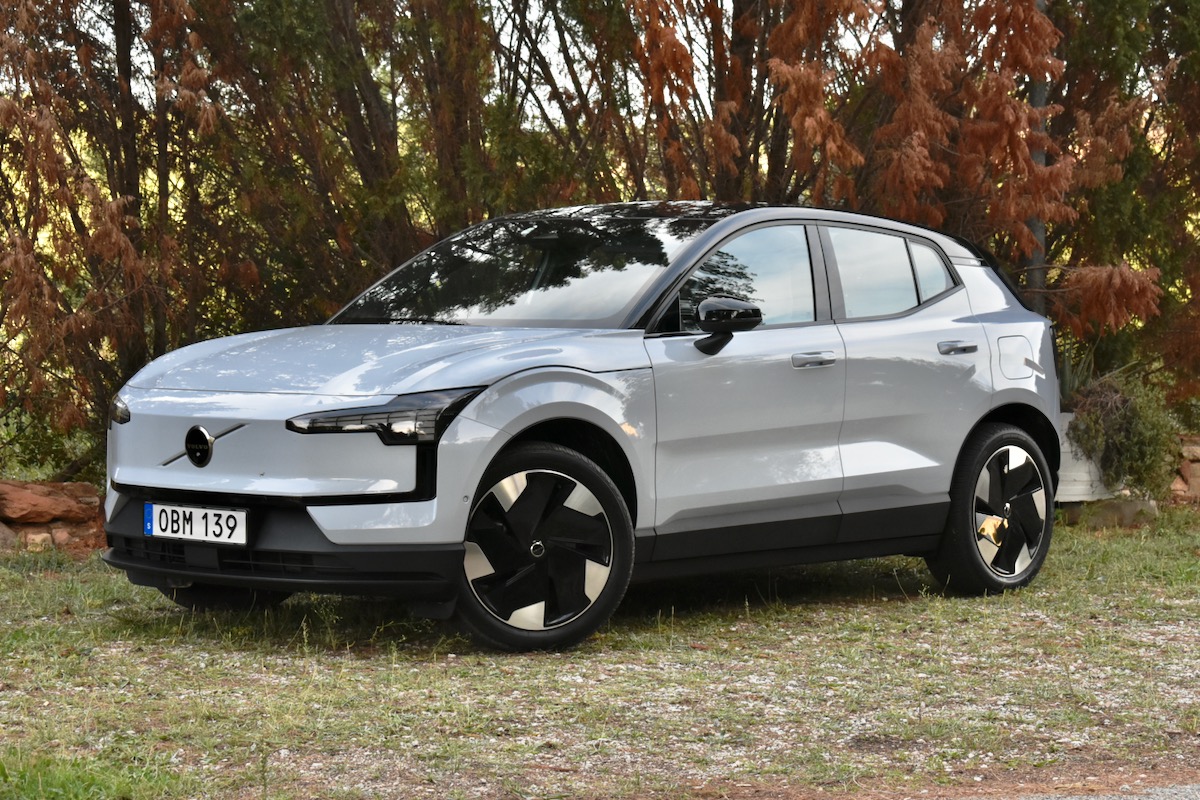
The EX30 is Volvo’s new entry-level model, and it bucks the trend of expensive EVs.
New for 2025, the EX30 is a big risk for Volvo, but one that could prove very rewarding for EV shoppers.
The EX30 is Volvo’s new entry-level model, positioned below the XC40 in the automaker’s lineup. Volvo’s previous attempts to move down-market in North America have produced mixed results, and the Swedish automaker is compounding the risk by making its cheapest model an EV. But it’s also reshaping the current EV landscape.
That’s because Volvo plans to offer the EX30 with over 400 kilometres of range for less than $50,000 once federal EV rebates are factored in. This combination brings to mind the now-defunct Chevrolet Bolt EV, not something from the more prestigious Volvo brand. It also means the EX30 will undercut mass-market EVs like the Hyundai Ioniq 5, Tesla Model Y, and Volkswagen ID.4 while aiming to deliver the same experience as traditional Volvo models.
The EX30 is scheduled to reach Canadian showrooms during the summer of 2024 in Single Motor Extended Range and Twin Motor Performance configurations, in Core (Single Motor only), Plus and Ultra trim levels. We drove single-motor and dual-motor versions, both in top Ultra spec.
Along with the delayed EX90 three-row electric SUV, the EX30 debuts a refreshed version of Volvo’s trademark minimalist Scandinavian design language. The automaker’s Iron Mark logo is set directly into the front fascia without a grille, and the body sides have a bit more sculpting than other recent Volvo models. The headlights have the same “Thor’s Hammer” shape but with new detailing that gives them a pixelated look not dissimilar to what Hyundai has been using on its Ioniq EVs.
Base Core models get 18-inch wheels, while Plus and Ultra models have 19-inch wheels—all with an aerodynamic design. The Plus and Ultra models can also be equipped with 20-inch wheels. Aside from bright Moss Yellow, the colour palette is fairly subdued. But that’s really the only drawback to what is otherwise an aesthetically pleasing small car.
Some new car buyers expecting a true SUV might be disappointed by the EX30’s small size and lack of rugged styling features. Volvo will address the latter with a Cross Country model, arriving after the launch of the standard version, with a raised ride height and black exterior cladding. And Cross Country or not, the EX30 has an elevated driving position likely to suit drivers of a variety of heights, plus good outward visibility front and rear. The thick rear pillars do create a bit of a blind spot, however.
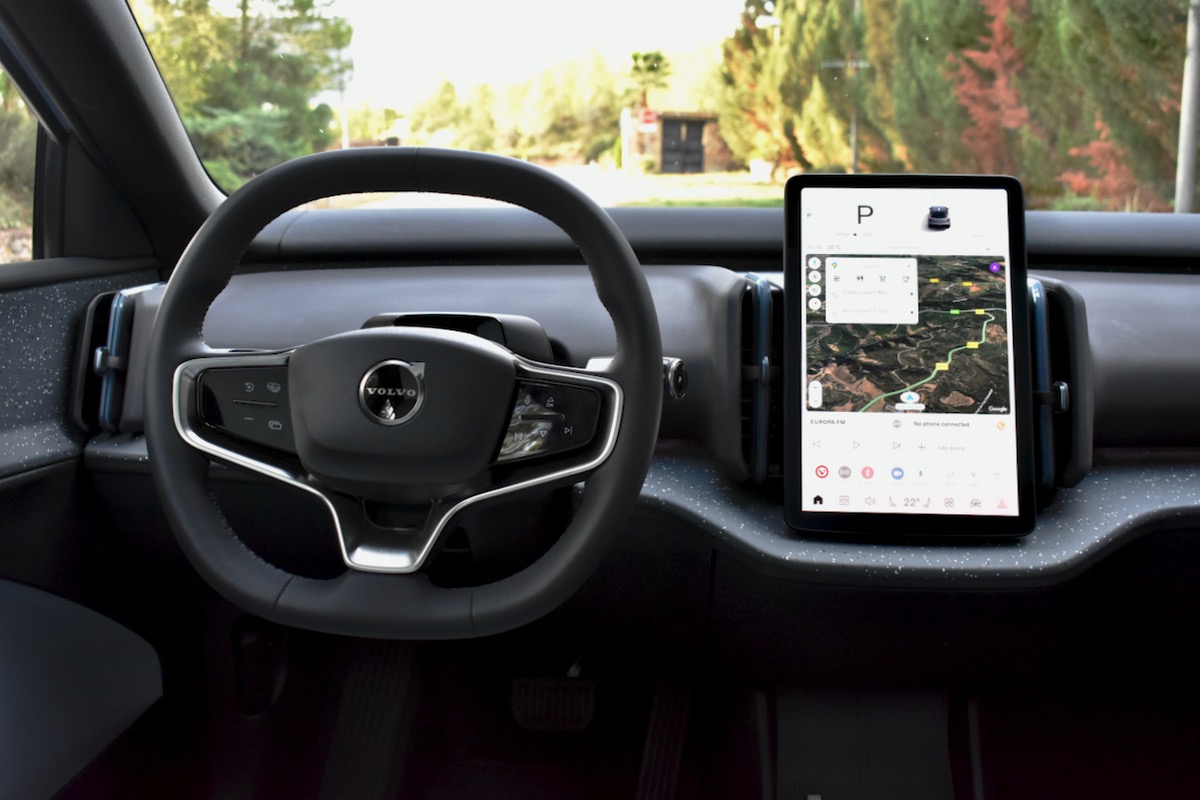
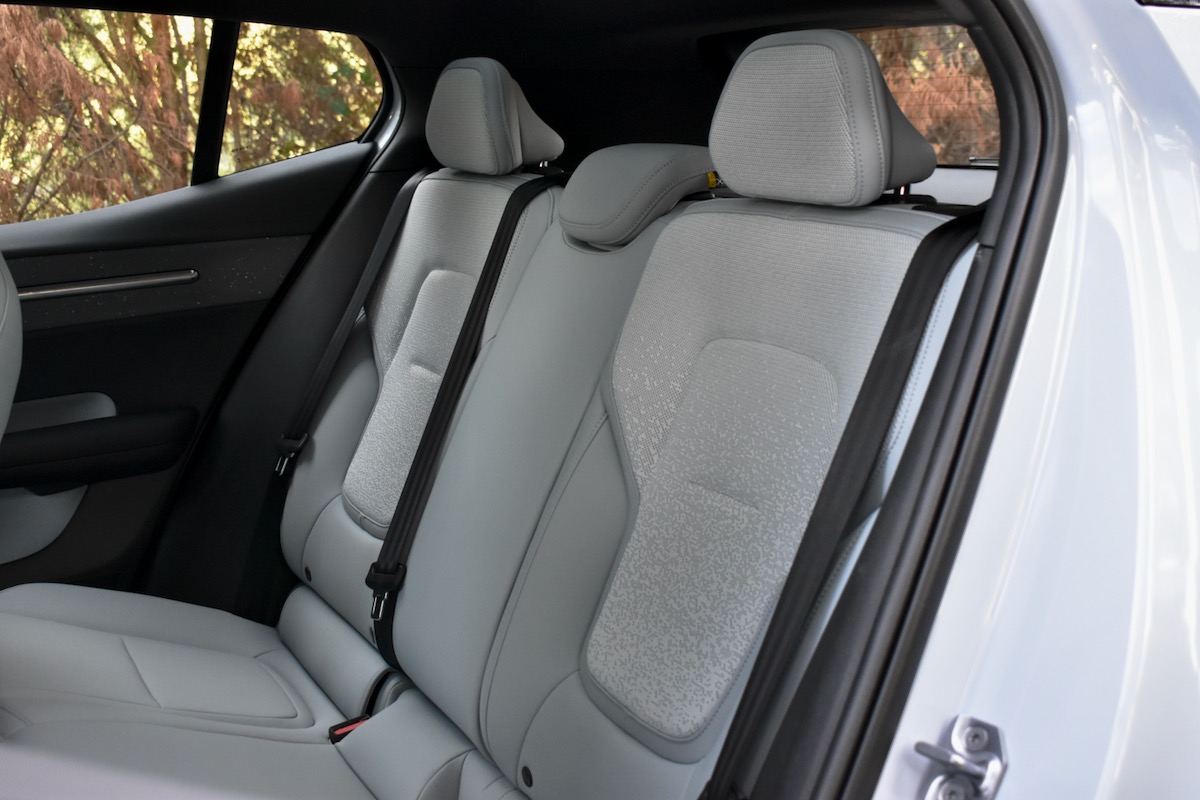
Volvo seems to have taken a page from Tesla’s playbook, eliminating most physical controls and centralizing functions on the touchscreen. Unlike Tesla, Volvo also gave the rest of the interior some personality. The square steering wheel, folds in the dashboard that cradle the touchscreen, and metal door pull rings are interesting design touches. And the EX30 features trim pieces made from recycled materials, including one called Particle Deco that has a spackled appearance, and flax trim that looks a bit like burlap. Like other Volvo models, the EX30 can also be equipped with wool upholstery.
The EX30 isn’t as luxurious as more expensive Volvo models (the main creature comforts are an optional heated steering wheel and front seats) but it still has a quality feel. Even our pre-production test cars seemed well put together, and the materials still felt a step above more mainstream brands.
Single Motor Extended Range base models are equipped with rear-wheel drive (RWD) and are rated at 268 horsepower and 253 pound-feet of torque. Twin Motor Performance models add a second motor powering the front wheels for all-wheel drive (AWD) and bump output to 422 hp and 400 lb-ft of torque.
Volvo estimates zero to 100 km/h times of 5.3 seconds for the Single Motor Extended Range and 3.6 seconds for the Twin Motor Performance. That means the dual-motor EX30 is quicker than the more expensive dual-motor versions of the Volvo XC40 Recharge and C40 Recharge, as well as the Polestar 2 from Volvo’s sportier and more exclusive sibling brand. In fact, it’s the quickest accelerating Volvo production car ever.
All Canadian-market EX30 models have a 69-kilowatt-hour nickel-manganese-cobalt (NMC) battery pack with 64 kWh of usable capacity. A smaller battery pack with lithium iron phosphate (LFP) chemistry is available in other markets.
The Twin Motor Performance felt as quick as the manufacturer-quoted acceleration time suggests, and the Single Motor Extended Range had plenty of thrust too. The dual-motor EX30 takes things further by pushing acceleration well into sports-car territory, but we can’t pretend that super quick acceleration from an otherwise ordinary EV is something new. The instant torque of electric motors has granted unassuming EVs impressive acceleration since the start of the modern electric-car era.
And don’t let the numbers make you think the EX30 is a performance car. It did well on narrow, twisty roads—highlighting the benefits of a truly compact car—but it’s in its element at a more relaxed pace. This may be the cheapest Volvo, but it’s still a Volvo. The EX30 has all of the poise of the automaker’s more expensive models, decent ride quality even with our test car’s fairly large wheels (19-inch for the Single Motor and 20-inch for the Twin Motor), and a quiet interior, albeit with some excessive wind noise at higher speeds. Overall, it’s a very pleasant car to drive.
Measuring about 20 centimetres shorter than the XC40 (which is also available with an all-electric powertrain in Recharge form), the EX30 is comfortably the smallest model in Volvo’s current lineup. It’s also pretty small for a crossover, measuring about 25 cm shorter than the Nissan Leaf hatchback.
Compared to other entry-level electric crossovers, the EX30 has a shorter overall length and wheelbase, but it's fairly wide for its size, and it stands about as tall as rivals. That translates to similar headroom in both rows when compared to EVs like the Hyundai Ioniq 5 and Tesla Model Y, as well as comparable front-seat legroom. However, rear-seat passengers will find less room to stretch their legs.
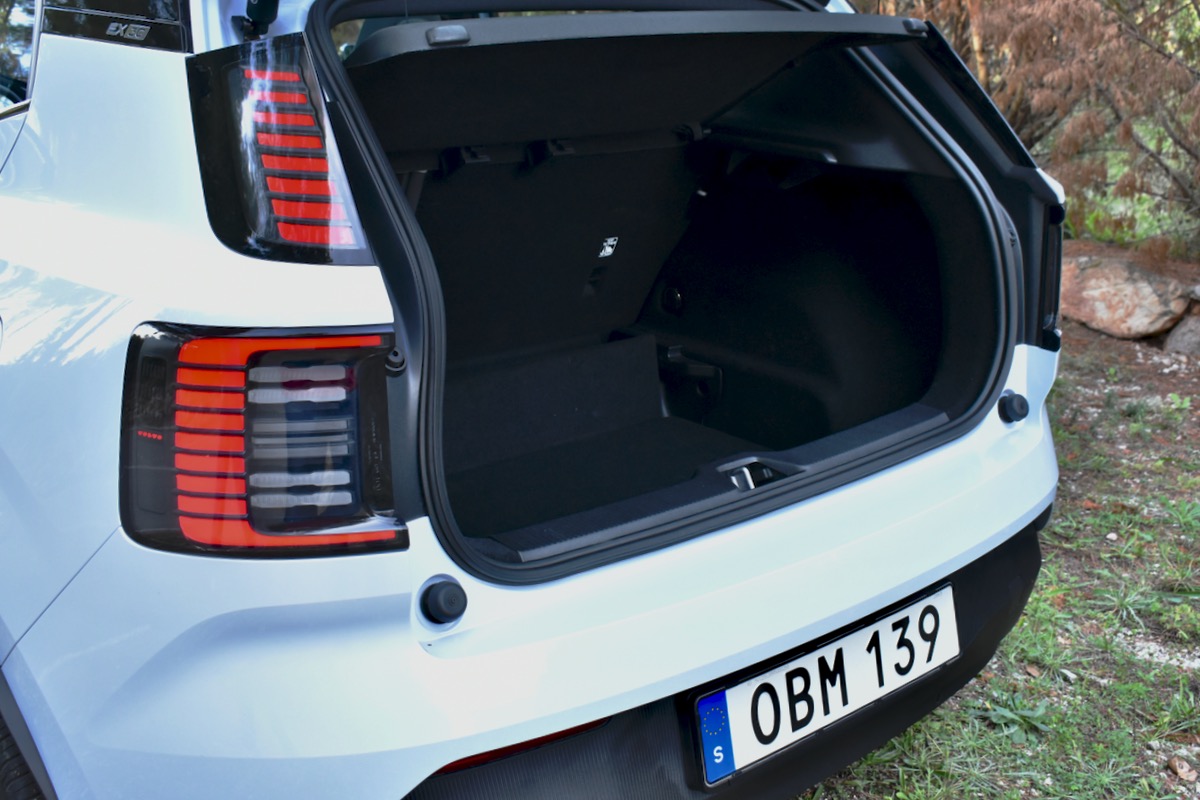
The EX30 also offers less cargo space than other small electric crossovers. The spec sheet lists 400 litres with the rear seats in place and 904 litres with the rear seats folded. For comparison, the Volkswagen ID.4 has nearly as much space (858 litres) with its second row in place, and 1,818 litres with the second row folded. Even the Kia Niro EV, which is a bit closer to the EX30 in size, offers substantially more space—646 litres with the rear seats up and 1,805 litres with the seats folded—for stuff.
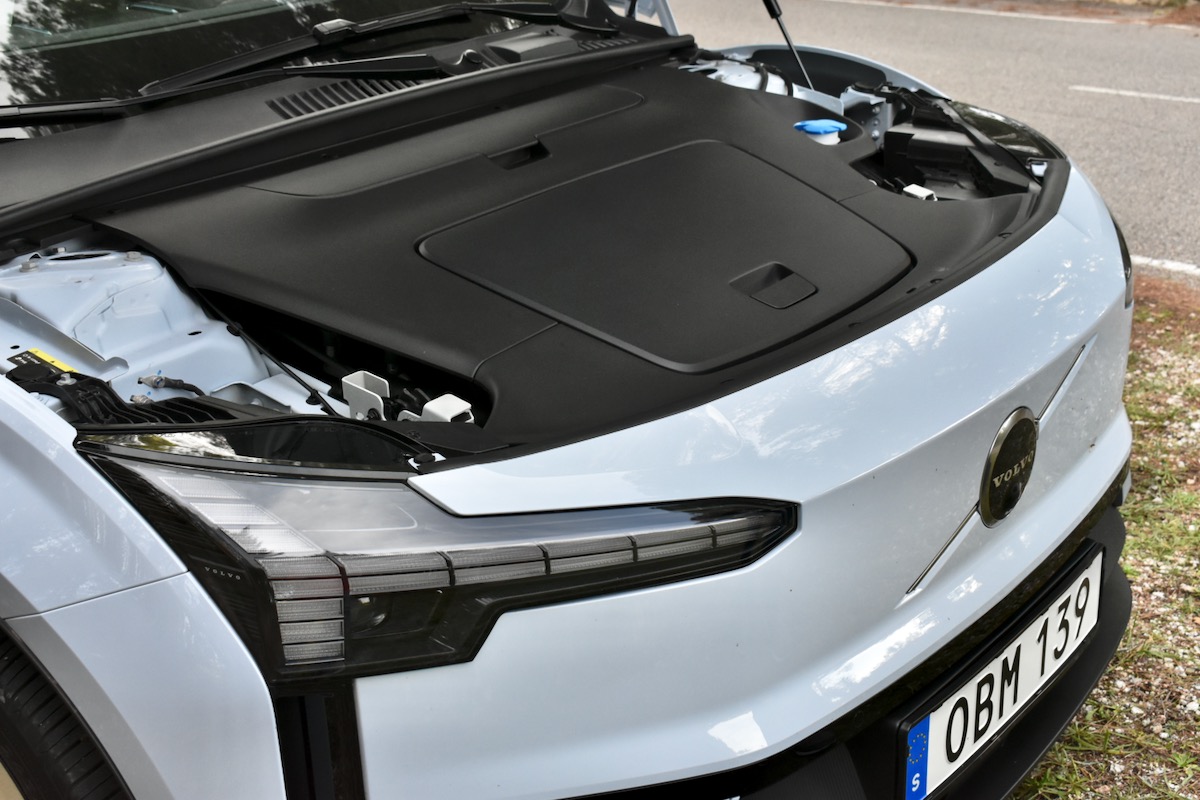
Volvo did include a front storage compartment, but instead of a Tesla-like frunk, it’s more of an oversized under-hood glovebox. Inside, designers worked to maximize space with some clever solutions. The audio system’s speakers are located on the dashboard in the form of a soundbar, leaving space for wide channels in the doors for holding water bottles and other items. The centre console includes a slide-out pair of cupholders that also double as handy phone holders, and a concealed channel below for holding larger items.
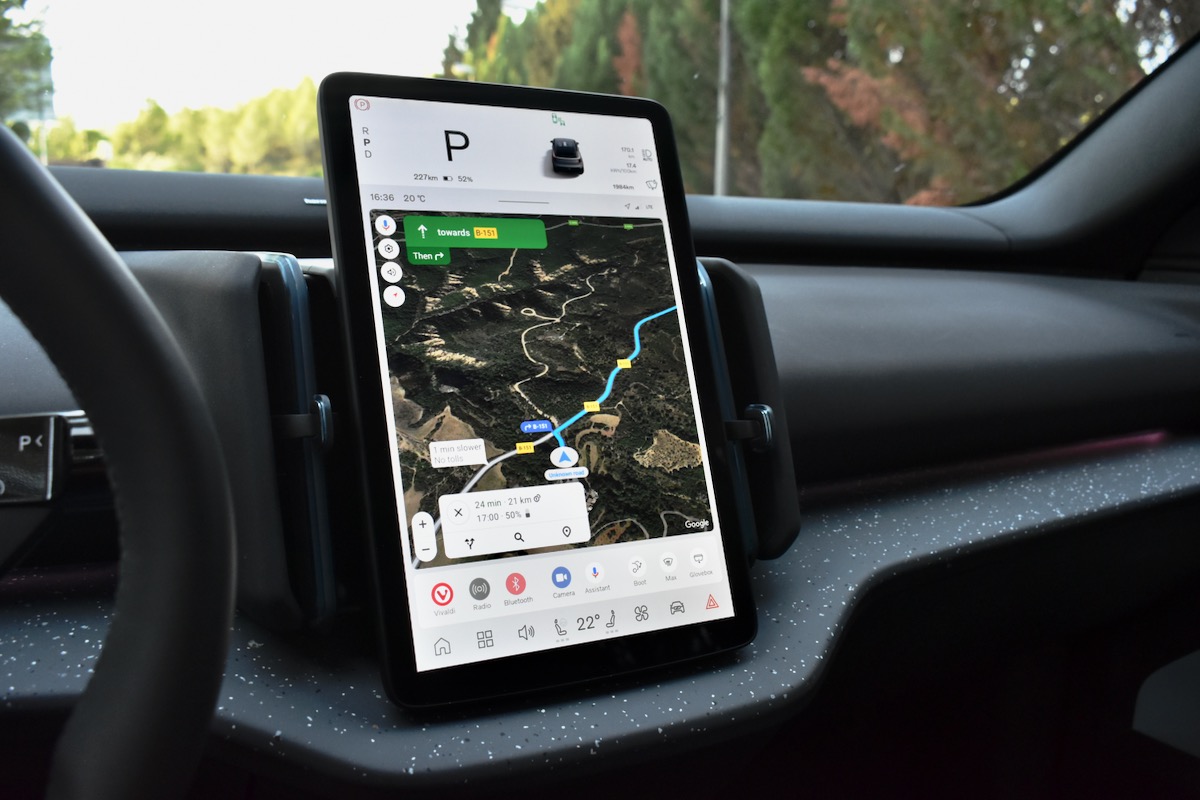
Like other recent Volvo models, the 2025 EX30 uses an Android-based infotainment with Google Built-in features, including Google Assistant, Google Maps, and Google Play (wireless Apple CarPlay is also included). But its 12.3-inch portrait-oriented touchscreen features a new menu layout, and it’s more central to the operation of the vehicle than in other Volvo models.
Information that would normally appear on an instrument cluster, including speed and the alerts from the car’s driver aids, live at the top of the touchscreen. Below that is a large and detailed Google Maps display, with icons and controls below that. The screen takes the place of physical controls for things like temperature and audio, which isn’t unusual these days, but also the mirrors, which are adjusted by selecting an icon on the screen and using steering-wheel controls to move them.
The only physical controls are the headlight/wiper and gearshift stalks, lock/unlock buttons, and window switches, the latter located on the centre console rather than the doors. This layout might be intuitive for someone who has never driven before, but it’ll take some adjustment for drivers coming out of pretty much any existing vehicle, except perhaps a screen-dependent Tesla.
Volvo also included digital key functionality, so your phone takes the place of a key fob. A key card is supplied for owners without compatible phones. In either case, approaching the car with a connected phone or card allows it to be unlocked, and then driven by simply sitting down in the driver’s seat. However, as we found out when trying to pick our test car out of a parking lot full of identical EX30s, you can’t use a key card to flash the headlights or beep the horn to help find your car.
Volvo has built its brand around safety, but we’ll have to wait awhile to see how the EX30 compares to other vehicles in crash testing. We drove an EX30 in late 2023, well ahead of its North American on-sale date, so safety ratings from the Insurance Institute for Highway Safety (IIHS) and National Highway Traffic Safety Administration (NHTSA) weren’t available.
Expected standard driver-assist features include blind spot monitoring, front and rear collision mitigation systems, a driver attention monitor, and Door Opening Alert. This warns the driver not to open the door if an approaching vehicle or cyclist is detected by sensors in the rear bumper. We didn’t have an opportunity to test out the latter feature, but did find that the driver attention monitor is a bit too sensitive. It was often triggered by gazes to the left or right to check mirrors or the speed readout, which requires the driver to look to the right and down slightly.
Upgrading to the top Ultra trim level adds Park Assist Pilot that can steer the EX30 into parallel or perpendicular spaces, the Pilot Assist highway driving-assistance system also offered on more expensive Volvo models, lane-change assist, and a 360-degree camera system with 3D view.
Our experience with Pilot Assist in the EX30 matches previous experiences in other Volvo models. Pilot Assist still requires drivers to keep their hands on the wheel, and allows the car to shift back and forth significantly in its lane, so its utility is somewhat limited. Park Pilot Assist, on the other hand, was able to back the EX30 into a fairly tight European-sized parking space at a reasonable speed, and with smooth movements. It’s likely one of the only examples of this technology that could actually be used in the real world.

Final range ratings will be confirmed closer to the EX30’s summer 2024 launch, but Volvo estimates 442 kilometres for the base Single Motor Extended Range configuration and 426 kilometres for the Twin Motor Performance version. Both variants can DC fast charge at 153 kilowatts and complete a 10%-80% charge in 26.5 minutes, according to Volvo.
Perhaps the most important numbers, though, are the ones with dollar signs in front of them. Pricing starts at $56,451 for a Single Motor Extended Range model in base Core trim, including destination charges and fees. Plus and Ultra trim levels start in Canada at $59,651 and $61,851 with destination, respectively.
The EX30 Twin Motor Performance skips the base Core trim level. Pricing starts at $62,651 for the Plus and $64,851 for the Ultra model. All trims of the 2025 Volvo EX30 are expected to qualify for the Canadian federal government’s iZEV rebate program as well as provincial and territorial programs where they exist. Expect Volvo’s current warranty coverage—including a four-year, 80,000-kilometre, basic warranty, a four-year, 80,000-kilometre powertrain warranty, and a four-year, 80,000-kilometre battery warranty—to carry over to EX30 models.
With rebates, the EX30 appears to be a strong value proposition. As things currently stand, the 2025 Volvo EX30 offers more range than comparable EVs at a lower price, a decent amount of standard equipment (albeit leaving some driver-assist features to the options list) and a design and driving experience worthy of the Volvo name. This isn’t a watered down Volvo or a watered down EV. It’s the real deal.
Note: Images show a US model.

User reviews for 2025 Volvo EX30
Write a review2025 Volvo EX30 Pricing
Trims & specs
Air Conditioning
Active charcoal air filtration · Single front air conditioning zones
Airbags
Dual front airbags · Passenger airbag deactivation: occupant sensing deactivation · Front side airbags · Rear side curtain airbags
Audio System
Antenna Type: element · Voice recognition audio system · Bluetooth auxiliary audio input · IHeartRadio internet radio · Internet radio app: Spotify · HD radio · Satellite Radio: SiriusXM · Total Number of Speakers: 5 · 100 watts
Brakes
ABS: 4-wheel · Braking assist: hill start assist · Electronic parking brake: auto off · Front brake diameter: 12.7 · Front brake width: 1.1 · Front brakes: ventilated disc · Rear brake diameter: 12.6 · Rear brake width: 0.79 · Rear brakes: disc
Comfort Features
Center console trim: leatherette · Dash trim: cloth · Door trim: cloth · Floor Mat Material: carpet · Floor Material: carpet · Floor Mats: front · Steering wheel trim: alloy
Convenience Features
Adaptive stop and go cruise control: semi-automatic · Ambient lighting: color-adjustable · Cargo area power outlet: 12V · Center console: front console with armrest and storage · Cruise control: adaptive · Cupholders: front · Dimming rearview mirror: auto-dimming · Footwell lights: color-adjustable · Memorized settings: climate control · Multi-function remote: keyless entry with panic alarm · One-touch windows: 4 · Power outlet(s): USB-C front · Power steering: speed-proportional · Power windows: lockout button · Reading lights: front · Steering wheel: tilt and telescopic · Steering wheel mounted controls: audio · Storage: door pockets · Vanity mirrors: dual
Driver Seat
Manual adjustments: 6
Engine
EV battery capacity: 69 kWh · EV on-board charger rating: 11 kW · Electric Motor Battery Type: lithium ion · Electric Motor HP: 268 · Electric Motor Power Output (Kilowatts): 200 · Electric Motor Torque: 253 · Electric charge cord: autoswitching 110V/240V · Electric motor charger: DC fast charging · Electric motor charger connector: SAE J1772 · Electric motor charging time: 8 hours · Electric motor miles per charge: 257
Exterior Features
Door handle color: body-color · Front bumper color: body-color · Grille color: body-color · Mirror color: black · Rear bumper color: black · Rear spoiler: roofline spoiler · Rear spoiler color: body-color · Rear trunk/liftgate: liftgate · Rocker panel color: black · Window trim: black
Headrests
Front headrests: integrated · Number of front headrests: 2 · Number of rear headrests: 3
In Car Entertainment
Connected in-car apps: Google Assistant · Infotainment: Google Built-In · Infotainment screen size: 12.3 in. · Smartphone integration: wireless Android Auto
Instrumentation
Fuel economy display: range · Warnings and reminders: maintenance reminder
Lights
Daytime running lights: LED · Exterior entry lights: security approach lamps · Headlights: automatic high beam dimmer · Rear fog lights: auto-off · Tail and brake lights: LED
Mirrors
Exterior mirrors: integrated turn signals
Passenger Seat
Manual Adjustments: 4
Rear Seats
Type: 60-40 split bench
Safety
Automatic emergency braking: intersection/junction turn · Camera system: rearview · Child seat anchors: LATCH system · Cross Traffic Alert: rear · Crumple zones: front · Evasive steering assist: head-on collision avoidance · Impact absorbing seats: dual front · Impact sensor: post-collision safety system · Parking sensors: rear · Pre-Collision Warning System: audible warning · Pre-collision warning system: intersection/junction turn · Programmable safety key: MyKey · Rear pre-collision warning system: rear-end impact · Rearview monitor: in dash
Seatbelts
Emergency locking retractors: front · Front seatbelts: 3-point · Seatbelt force limiters: front and rear · Seatbelt pretensioners: front · Seatbelt warning sensor: driver and passenger · Second row seatbelts: 3-point
Seats
Driver seat manual adjustments: height · Front seat type: bucket · Passenger seat manual adjustments: height · Rear headrests: adjustable · Rear seat folding: flat · Rear seat manual adjustments: reclining · Upholstery: two-tone · Upholstery accents: leatherette
Security
Power door locks: anti-lockout
Spare Tire
Kit: inflator kit
Steering
Steering ratio: 15.3 · Turns lock-to-lock: 2.8
Suspension
Front Shock Type: gas shock absorbers · Front Spring Type: coil springs · Front Suspension Classification: independent · Front Suspension Type: MacPherson struts · Rear Shock Type: gas shock absorbers · Rear Spring Type: coil springs · Rear Suspension Classification: independent · Rear Suspension Type: multi-link · Stabilizer bar(s): front
Telematics
Driver assistance app: roadside assistance · Electronic messaging assistance: with read function · Navigation app: Waze · Navigation system: touch screen display · Phone: voice activated · Phone wireless data link: Bluetooth · Satellite communications: On-Call (Volvo) · Smart device app compatibility: Google Assistant · Smart device app function: send destination to vehicle · Wifi: hotspot compatible
Tires
Type: all season
Tires and Rims
Wheels: painted aluminum
Towing and Hauling
Trailer hitch: ready
Wheels
Wheel spokes: 5
Windows
Front wipers: speed sensitive · Liftgate window: fixed · Power windows: with safety reverse · Rear wiper: with washer
Air Conditioning
Air filtration: ionizing · Automatic climate control front air conditioning · Dual front air conditioning zones
Airbags
Dual front airbags · Passenger airbag deactivation: occupant sensing deactivation · Front side airbags · Front side curtain airbags
Audio System
Antenna Type: element · Voice recognition audio system · USB auxiliary audio input · TuneIn internet radio · Internet radio app: Spotify · Premium Brand: Harman-Kardon · Radio: FM · Satellite Radio: SiriusXM · 1 subwoofer · Surround audio: 5.1 · Total Number of Speakers: 8 · Watts: 1040
Brakes
ABS: 4-wheel · Braking assist: hill start assist · Electronic parking brake: auto off · Front brake diameter: 12.7 · Front brake width: 1.1 · Front brakes: ventilated disc · Rear brake diameter: 12.6 · Rear brake width: 0.79 · Rear brakes: disc
Comfort Features
Center console trim: leatherette · Dash trim: cloth · Door trim: cloth · Floor Mat Material: carpet · Floor Material: carpet · Floor Mats: front · Steering wheel trim: leatherette
Convenience Features
Adaptive stop and go cruise control: semi-automatic · Ambient lighting: color-adjustable · Cargo area power outlet: 12V · Center console: front console with armrest and storage · Cruise control: adaptive · Cupholders: front · Dimming rearview mirror: auto-dimming · Footwell lights: color-adjustable · Memorized settings: driver seat · Multi-function remote: vehicle and key memory · One-touch windows: 4 · Power outlet(s): USB-C rear · Power steering: electric · Power windows: lockout button · Reading lights: rear · Steering wheel: tilt and telescopic · Steering wheel mounted controls: voice recognition controls · Storage: door pockets · Vanity mirrors: dual
Driver Seat
Manual adjustments: 6
Engine
EV battery capacity: 69 kWh · EV on-board charger rating: 11 kW · Electric Motor Battery Type: lithium ion · Electric Motor HP: 268 · Electric Motor Power Output (Kilowatts): 200 · Electric Motor Torque: 253 · Electric charge cord: autoswitching 110V/240V · Electric motor charger: DC fast charging · Electric motor charger connector: SAE J1772 · Electric motor charging time: 8 hours · Electric motor miles per charge: 261
Exterior Features
Door handle color: body-color · Front bumper color: body-color · Grille color: body-color · Mirror color: black · Paint: contrast roof · Rear bumper color: black · Rear spoiler: roofline spoiler · Rear spoiler color: black · Rear trunk/liftgate: liftgate · Rocker panel color: black · Window trim: black
Headrests
Front headrests: integrated · Number of front headrests: 2 · Number of rear headrests: 3
In Car Entertainment
Connected in-car apps: app marketplace integration · Infotainment: Android Automotive · Infotainment screen size: 12.3 in. · Smartphone integration: wireless Android Auto
Instrumentation
Fuel economy display: range · Warnings and reminders: low washer fluid
Lights
Daytime running lights: LED · Exterior entry lights: puddle lamps · Headlights: LED · Rear fog lights: auto-off · Tail and brake lights: LED
Mirrors
Exterior mirrors: power
Passenger Seat
Manual Adjustments: 4
Rear Seats
Type: 60-40 split bench
Roof
Sunroof: fixed glass
Safety
Automatic emergency braking: front · Camera system: rearview · Child seat anchors: LATCH system · Cross Traffic Alert: rear · Crumple zones: front · Evasive steering assist: head-on collision avoidance · Impact absorbing seats: dual front · Impact sensor: door unlock · Parking sensors: rear · Pre-Collision Warning System: visual warning · Pre-collision warning system: pedestrian detection · Programmable safety key: MyKey · Rear pre-collision warning system: rear-end impact · Rearview monitor: in dash
Seatbelts
Emergency locking retractors: front · Front seatbelts: 3-point · Seatbelt force limiters: front and rear · Seatbelt pretensioners: front and rear · Seatbelt warning sensor: driver and passenger · Second row seatbelts: 3-point
Seats
Driver seat manual adjustments: reclining · Front seat type: bucket · Passenger seat manual adjustments: reclining · Rear headrests: adjustable · Rear seat folding: flat · Rear seat manual adjustments: reclining · Upholstery: two-tone · Upholstery accents: leatherette
Security
Power door locks: anti-lockout
Spare Tire
Kit: tire sealant
Steering
Steering ratio: 15.3 · Turns lock-to-lock: 2.8
Suspension
Front Shock Type: gas shock absorbers · Front Spring Type: coil springs · Front Suspension Classification: independent · Front Suspension Type: multi-link · Rear Shock Type: gas shock absorbers · Rear Spring Type: coil springs · Rear Suspension Classification: independent · Rear Suspension Type: multi-link · Stabilizer bar(s): rear
Telematics
Driver assistance app: roadside assistance · Electronic messaging assistance: with voice recognition · Navigation app: Waze · Navigation system: touch screen display · Phone: voice activated · Phone wireless data link: Bluetooth · Satellite communications: On-Call (Volvo) · Smart device app compatibility: Google Assistant · Smart device app function: send destination to vehicle · Wifi: hotspot compatible
Tires
Type: all season
Tires and Rims
Wheels: painted aluminum
Towing and Hauling
Trailer hitch: ready
Wheels
Wheel spokes: 8
Windows
Front wipers: variable intermittent · Liftgate window: fixed · Power windows: with safety reverse · Rear wiper: variable intermittent
Air Conditioning
Air filtration: ionizing · Automatic climate control front air conditioning · Dual front air conditioning zones
Airbags
Dual front airbags · Passenger airbag deactivation: occupant sensing deactivation · Front side airbags · Rear side curtain airbags
Audio System
Antenna Type: diversity · Voice recognition audio system · USB auxiliary audio input · TuneIn internet radio · Internet radio app: Spotify · Premium Brand: Harman-Kardon · Touch screen display radio · Satellite Radio: SiriusXM · 1 subwoofer · Surround audio: 5.1 · Total Number of Speakers: 8 · Watts: 1040
Brakes
ABS: 4-wheel · Braking assist: hill start assist · Electronic parking brake: auto off · Front brake diameter: 12.7 · Front brake width: 1.1 · Front brakes: ventilated disc · Rear brake diameter: 12.6 · Rear brake width: 0.79 · Rear brakes: disc
Comfort Features
Center console trim: leatherette · Dash trim: cloth · Door trim: cloth · Floor Mat Material: carpet · Floor Material: carpet · Floor Mats: front · Steering wheel trim: alloy
Convenience Features
Active parking system: driver controlled brake, gas and gear selection · Adaptive stop and go cruise control: semi-automatic · Ambient lighting: color-adjustable · Autonomous lane guidance: lane changing · Cargo area power outlet: 12V · Center console: front console with armrest and storage · Cruise control: adaptive · Cupholders: front · Dimming rearview mirror: auto-dimming · Footwell lights: color-adjustable · Memorized settings: driver seat · Multi-function remote: trunk release · One-touch windows: 4 · Power outlet(s): USB-C front · Power steering: electric · Power windows: lockout button · Reading lights: front · Steering wheel: tilt and telescopic · Steering wheel mounted controls: multi-function screen controls · Storage: door pockets · Vanity mirrors: dual
Driver Seat
Adjustable lumbar support: 4-way power · Power adjustments: 12
Engine
EV battery capacity: 69 kWh · EV on-board charger rating: 11 kW · Electric Motor Battery Type: lithium ion · Electric Motor HP: 268 · Electric Motor Power Output (Kilowatts): 200 · Electric Motor Torque: 253 · Electric charge cord: autoswitching 110V/240V · Electric motor charger: DC fast charging · Electric motor charger connector: SAE J1772 · Electric motor charging time: 8 hours · Electric motor miles per charge: 261
Exterior Features
Door handle color: body-color · Front bumper color: body-color · Grille color: body-color · Mirror color: black · Paint: contrast roof · Rear bumper color: black · Rear spoiler: roofline spoiler · Rear spoiler color: black · Rear trunk/liftgate: liftgate · Rocker panel color: black · Window trim: black
Headrests
Front headrests: integrated · Number of front headrests: 2 · Number of rear headrests: 3
In Car Entertainment
Connected in-car apps: Google POIs · Infotainment: Google Built-In · Infotainment screen size: 12.3 in. · Smartphone integration: wireless Apple CarPlay
Instrumentation
Fuel economy display: range · Warnings and reminders: low washer fluid
Lights
Daytime running lights: LED · Exterior entry lights: security approach lamps · Headlights: auto delay off · Rear fog lights: auto-off · Tail and brake lights: LED
Mirrors
Exterior mirrors: power
Passenger Seat
Power adjustments: 8
Rear Seats
Type: 60-40 split bench
Roof
Sunroof: fixed glass
Safety
Automatic emergency braking: intersection/junction cross · Camera system: surround view · Child seat anchors: LATCH system · Cross Traffic Alert: rear · Crumple zones: rear · Evasive steering assist: head-on collision avoidance · Impact absorbing seats: dual front · Impact sensor: post-collision safety system · Parking sensors: rear · Pre-Collision Warning System: audible warning · Pre-collision warning system: intersection/junction turn · Programmable safety key: MyKey · Rear pre-collision warning system: rear-end impact · Rearview monitor: in dash
Seatbelts
Emergency locking retractors: front and rear · Front seatbelts: 3-point · Seatbelt force limiters: front · Seatbelt pretensioners: front · Seatbelt warning sensor: driver and passenger · Second row seatbelts: 3-point
Seats
Driver seat power adjustments: height · Front seat type: bucket · Passenger seat power adjustments: height · Rear headrests: adjustable · Rear seat folding: split · Rear seat manual adjustments: reclining · Upholstery: cloth · Upholstery accents: leatherette
Security
Power door locks: anti-lockout
Spare Tire
Kit: inflator kit
Steering
Steering ratio: 15.3 · Turns lock-to-lock: 2.8
Suspension
Front Shock Type: gas shock absorbers · Front Spring Type: coil springs · Front Suspension Classification: independent · Front Suspension Type: multi-link · Rear Shock Type: gas shock absorbers · Rear Spring Type: coil springs · Rear Suspension Classification: independent · Rear Suspension Type: multi-link · Stabilizer bar(s): rear
Telematics
Driver assistance app: roadside assistance · Electronic messaging assistance: with read function · Navigation app: Waze · Navigation system: touch screen display · Phone: voice activated · Phone wireless data link: Bluetooth · Satellite communications: On-Call (Volvo) · Smart device app compatibility: Volvo Cars · Smart device app function: phone as a key · Wifi: hotspot compatible
Tires
Type: all season
Tires and Rims
Wheels: painted aluminum
Towing and Hauling
Trailer hitch: ready
Wheels
Wheel spokes: 8
Windows
Front wipers: rain sensing · Liftgate window: fixed · Power windows: with safety reverse · Rear wiper: with washer
Air Conditioning
Air filtration: ionizing · Automatic climate control front air conditioning · Dual front air conditioning zones
Airbags
Dual front airbags · Passenger airbag deactivation: occupant sensing deactivation · Front side airbags · Front side curtain airbags
Audio System
Antenna Type: diversity · Voice recognition audio system · USB auxiliary audio input · TuneIn internet radio · Internet radio app: Spotify · Premium Brand: Harman-Kardon · Radio: FM · Satellite Radio: SiriusXM · 1 subwoofer · Surround audio: 5.1 · Total Number of Speakers: 8 · Watts: 1040
Brakes
ABS: 4-wheel · Braking assist: hill start assist · Electronic parking brake: auto off · Front brake diameter: 13.6 · Front brake width: 1.18 · Front brakes: ventilated disc · Rear brake diameter: 13.1 · Rear brake width: 0.79 · Rear brakes: disc
Comfort Features
Center console trim: leatherette · Dash trim: cloth · Door trim: cloth · Floor Mat Material: carpet · Floor Material: carpet · Floor Mats: front · Steering wheel trim: leatherette
Convenience Features
Adaptive stop and go cruise control: semi-automatic · Ambient lighting: color-adjustable · Cargo area power outlet: 12V · Center console: front console with armrest and storage · Cruise control: adaptive · Cupholders: front · Dimming rearview mirror: auto-dimming · Footwell lights: color-adjustable · Memorized settings: climate control · Multi-function remote: keyless entry with panic alarm · One-touch windows: 4 · Power outlet(s): USB-C rear · Power steering: electric · Power windows: lockout button · Reading lights: rear · Steering wheel: tilt and telescopic · Steering wheel mounted controls: audio · Storage: front seatback · Vanity mirrors: dual
Driver Seat
Adjustable lumbar support: 4-way power · Power adjustments: 12
Drivetrain
4WD Type: on demand
Engine
EV battery capacity: 69 kWh · EV on-board charger rating: 11 kW · Electric Motor Battery Type: lithium ion · Electric Motor HP: 422 · Electric Motor Power Output (Kilowatts): 315 · Electric Motor Torque: 400 · Electric charge cord: autoswitching 110V/240V · Electric motor charger: DC fast charging · Electric motor charger connector: SAE J1772 · Electric motor charging time: 8 hours · Electric motor miles per charge: 253
Exterior Features
Door handle color: body-color · Front bumper color: body-color · Grille color: body-color · Mirror color: black · Paint: contrast roof · Rear bumper color: black · Rear spoiler: roofline spoiler · Rear spoiler color: black · Rear trunk/liftgate: liftgate · Rocker panel color: black · Window trim: black
Headrests
Front headrests: integrated · Number of front headrests: 2 · Number of rear headrests: 3
In Car Entertainment
Connected in-car apps: app marketplace integration · Infotainment: Android Automotive · Infotainment screen size: 12.3 in. · Smartphone integration: wireless Android Auto
Instrumentation
Fuel economy display: range · Warnings and reminders: low washer fluid
Lights
Daytime running lights: LED · Exterior entry lights: puddle lamps · Headlights: automatic high beam dimmer · Rear fog lights: auto-off · Tail and brake lights: LED
Mirrors
Exterior mirrors: power
Passenger Seat
Power adjustments: 8
Rear Seats
Type: 60-40 split bench
Roof
Sunroof: fixed glass
Safety
Automatic emergency braking: front · Camera system: rearview · Child seat anchors: LATCH system · Cross Traffic Alert: rear · Crumple zones: front · Evasive steering assist: head-on collision avoidance · Impact absorbing seats: dual front · Impact sensor: door unlock · Parking sensors: rear · Pre-Collision Warning System: audible warning · Pre-collision warning system: pedestrian detection · Programmable safety key: MyKey · Rear pre-collision warning system: rear-end impact · Rearview monitor: in dash
Seatbelts
Emergency locking retractors: front and rear · Front seatbelts: 3-point · Seatbelt force limiters: front · Seatbelt pretensioners: front · Seatbelt warning sensor: driver and passenger · Second row seatbelts: 3-point
Seats
Driver seat power adjustments: reclining · Front seat type: bucket · Passenger seat power adjustments: reclining · Rear headrests: adjustable · Rear seat folding: flat · Rear seat manual adjustments: reclining · Upholstery: two-tone · Upholstery accents: leatherette
Security
Power door locks: anti-lockout
Spare Tire
Kit: tire sealant
Steering
Steering ratio: 15.3 · Turns lock-to-lock: 2.8
Suspension
Front Shock Type: gas shock absorbers · Front Spring Type: coil springs · Front Suspension Classification: independent · Front Suspension Type: multi-link · Rear Shock Type: gas shock absorbers · Rear Spring Type: coil springs · Rear Suspension Classification: independent · Rear Suspension Type: multi-link · Stabilizer bar(s): rear
Telematics
Driver assistance app: roadside assistance · Electronic messaging assistance: with voice recognition · Navigation app: Waze · Navigation system: over-the-air map updates (OTA) · Phone: voice activated · Phone wireless data link: Bluetooth · Satellite communications: On-Call (Volvo) · Smart device app compatibility: Google Assistant · Smart device app function: send destination to vehicle · Wifi: hotspot compatible
Tires
Type: all season
Tires and Rims
Wheels: painted aluminum
Towing and Hauling
Trailer hitch: ready
Wheels
Wheel spokes: 8
Windows
Front wipers: variable intermittent · Liftgate window: fixed · Power windows: with safety reverse · Rear wiper: auto-on in reverse
Air Conditioning
Active charcoal air filtration · Automatic climate control front air conditioning · Dual front air conditioning zones
Airbags
Dual front airbags · Passenger airbag deactivation: occupant sensing deactivation · Front side airbags · Rear side curtain airbags
Audio System
Antenna Type: diversity · Voice recognition audio system · Bluetooth auxiliary audio input · IHeartRadio internet radio · Internet radio app: Spotify · Premium Brand: Harman-Kardon · Touch screen display radio · Satellite Radio: SiriusXM · 1 subwoofer · Surround audio: 5.1 · Total Number of Speakers: 8 · Watts: 1040
Brakes
ABS: 4-wheel · Braking assist: hill start assist · Electronic parking brake: auto off · Front brake diameter: 13.6 · Front brake width: 1.18 · Front brakes: ventilated disc · Rear brake diameter: 13.1 · Rear brake width: 0.79 · Rear brakes: disc
Comfort Features
Center console trim: leatherette · Dash trim: cloth · Door trim: cloth · Floor Mat Material: carpet · Floor Material: carpet · Floor Mats: front · Steering wheel trim: alloy
Convenience Features
Active parking system: driver controlled brake, gas and gear selection · Adaptive stop and go cruise control: semi-automatic · Ambient lighting: color-adjustable · Autonomous lane guidance: lane changing · Cargo area power outlet: 12V · Center console: front console with armrest and storage · Cruise control: adaptive · Cupholders: front · Dimming rearview mirror: auto-dimming · Footwell lights: color-adjustable · Memorized settings: side mirrors · Multi-function remote: proximity entry system · One-touch windows: 4 · Power outlet(s): USB-C front · Power steering: speed-proportional · Power windows: lockout button · Reading lights: rear · Steering wheel: tilt and telescopic · Steering wheel mounted controls: audio · Storage: grocery bag holder · Vanity mirrors: dual
Driver Seat
Adjustable lumbar support: 4-way power · Power adjustments: 12
Drivetrain
4WD Type: on demand
Engine
EV battery capacity: 69 kWh · EV on-board charger rating: 11 kW · Electric Motor Battery Type: lithium ion · Electric Motor HP: 422 · Electric Motor Power Output (Kilowatts): 315 · Electric Motor Torque: 400 · Electric charge cord: autoswitching 110V/240V · Electric motor charger: DC fast charging · Electric motor charger connector: SAE J1772 · Electric motor charging time: 8 hours · Electric motor miles per charge: 250
Exterior Features
Door handle color: body-color · Front bumper color: body-color · Grille color: body-color · Mirror color: black · Paint: contrast roof · Rear bumper color: black · Rear spoiler: roofline spoiler · Rear spoiler color: black · Rear trunk/liftgate: liftgate · Rocker panel color: black · Window trim: black
Headrests
Front headrests: integrated · Number of front headrests: 2 · Number of rear headrests: 3
In Car Entertainment
Connected in-car apps: Google POIs · Infotainment: Google Built-In · Infotainment screen size: 12.3 in. · Smartphone integration: wireless Android Auto
Instrumentation
Fuel economy display: range · Warnings and reminders: maintenance reminder
Lights
Daytime running lights: LED · Exterior entry lights: puddle lamps · Headlights: Auto on/off · Rear fog lights: auto-off · Tail and brake lights: LED
Mirrors
Exterior mirrors: integrated turn signals
Passenger Seat
Power adjustments: 8
Rear Seats
Type: 60-40 split bench
Roof
Sunroof: fixed glass
Safety
Automatic emergency braking: intersection/junction cross · Camera system: surround view · Child seat anchors: LATCH system · Cross Traffic Alert: rear · Crumple zones: rear · Evasive steering assist: head-on collision avoidance · Impact absorbing seats: dual front · Impact sensor: post-collision safety system · Parking sensors: rear · Pre-Collision Warning System: visual warning · Pre-collision warning system: intersection/junction turn · Programmable safety key: MyKey · Rear pre-collision warning system: rear-end impact · Rearview monitor: in dash
Seatbelts
Emergency locking retractors: front · Front seatbelts: 3-point · Seatbelt force limiters: front and rear · Seatbelt pretensioners: front · Seatbelt warning sensor: driver and passenger · Second row seatbelts: 3-point
Seats
Driver seat power adjustments: height · Front seat type: bucket · Passenger seat power adjustments: height · Rear headrests: adjustable · Rear seat folding: split · Rear seat manual adjustments: reclining · Upholstery: cloth · Upholstery accents: leatherette
Security
Power door locks: anti-lockout
Spare Tire
Kit: inflator kit
Steering
Steering ratio: 15.3 · Turns lock-to-lock: 2.8
Suspension
Front Shock Type: gas shock absorbers · Front Spring Type: coil springs · Front Suspension Classification: independent · Front Suspension Type: multi-link · Rear Shock Type: gas shock absorbers · Rear Spring Type: coil springs · Rear Suspension Classification: independent · Rear Suspension Type: multi-link · Stabilizer bar(s): rear
Telematics
Driver assistance app: roadside assistance · Electronic messaging assistance: with voice recognition · Navigation app: Waze · Navigation system: with voice recognition · Phone: voice activated · Phone wireless data link: Bluetooth · Satellite communications: On-Call (Volvo) · Smart device app compatibility: Volvo Cars · Smart device app function: maintenance status · Wifi: hotspot compatible
Tires
Type: all season
Tires and Rims
Wheels: painted aluminum
Towing and Hauling
Trailer hitch: ready
Wheels
Wheel spokes: 8
Windows
Front wipers: variable intermittent · Liftgate window: fixed · Power windows: with safety reverse · Rear wiper: with washer
