2026 Cadillac Escalade Reviews, Pricing & Specs


Pros & cons
What we like
Stylish design
Stunning technology
Impressive ride quality
What to consider
Poor fuel economy
Brakes don’t inspire confidence
The CarGurus verdict
The 2026 Cadillac Escalade is a full-size luxury SUV that makes no apologies for its size, its ambition, or its price tag.
The standard-wheelbase Escalade seats up to eight passengers across three rows, rides on a body-on-frame platform shared with the Chevrolet Tahoe/Suburban and GMC Yukon/Yukon XL, and is powered exclusively by a naturally aspirated 6.2-litre V8. For 2026, the Escalade lineup receives a new base trim and some revised naming (Premium Luxury Platinum becomes Platinum Luxury, Sport Platinum is now Platinum Sport). The mechanicals carry over unchanged from the thoroughly refreshed 2025-model-year version. It competes with the Lincoln Navigator, BMW X7, Mercedes-Benz GLS, Infiniti QX80, and Lexus LX.
Verdict: The 2026 Cadillac Escalade remains the default choice in full-size luxury SUVs with good reason. Its platform limitations are real, but a well-optioned example is genuinely difficult to fault on comfort, technology, or presence. Buyers should budget accordingly for fuel.
out of 10 expert review
Look & feel
The 2026 Cadillac Escalade Platinum Sport is not a subtle vehicle. At 5,383 millimetres long and 1,948 mm tall, it doesn’t so much fill a parking space as consume one.
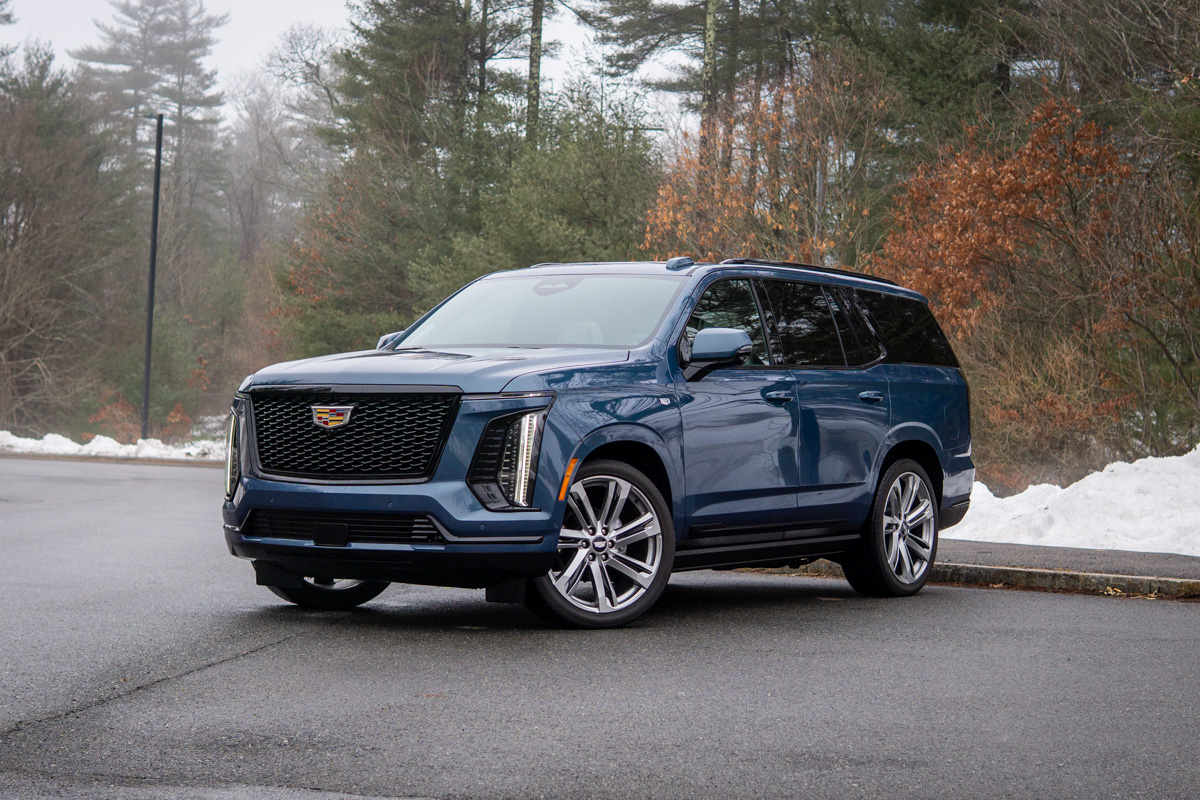
Cadillac splits the Escalade trim lineup between Sport and Luxury versions. The Sport trims feature a blacked-out exterior treatment with dark window surrounds, black roof rails, and a mesh grille. Luxury models are more chrome-heavy. Our Platinum Sport test vehicle had a more menacing presence than its shinier siblings, but it didn't sacrifice any of the Escalade's signature grandeur.
The vertical LED headlights, which debuted on the refreshed 2025 model and echo the styling of Cadillac's electric lineup, still read as distinctive rather than derivative. With Deep Sea Metallic paint and 24-inch seven-spoke wheels with Pearl Nickel and High Gloss Black inserts, our Escalade test vehicle was definitely a striking SUV.
Inside, our tester’s Sheer Grey and Jet Black semi-aniline leather with faceted quilting was well-executed. The pattern added visual texture without looking busy, and the material itself felt suitably premium for this price point.
Cadillac's broader interior design strategy of hiding the Escalade's truck-platform origins behind a screen-centric, near-horizontal dashboard holds up well in this trim. A 55-inch curved display spanning the full width of the dash makes an impression on first acquaintance and remains one of the more coherent executions of large-format in-cabin screens. Outside of the busy steering wheel, though, most controls are haptic touchscreen buttons rather than our preferred physical controls.
At the Platinum Sport level, the door trim switches to leather, the headliner to microsuede, and the steering wheel gets a leather wrap. The overall effect is a cabin that reads as genuinely premium rather than aspirational. No single surface undermines the price tag.
The honest limitation here is structural. The Escalade shares its body-on-frame T1 platform with the Chevrolet Tahoe/Suburban and the GMC Yukon/Yukon XL, and no amount of interior craftsmanship fully erases that reality. Rivals such as the BMW X7 and Mercedes-Benz GLS offer a more cohesive, unibody-derived refinement that the Cadillac can't fully match. But if the Escalade's platform is a compromise, it's one that won’t keep most buyers up at night.

Performance
The 2026 Cadillac Escalade is powered by a naturally aspirated 6.2-litre V8 producing 420 horsepower and 460 pound-feet of torque, paired with a 10-speed automatic transmission. In Canada, four-wheel drive (4WD) is standard on non-V-Series models.
This is the only engine on offer in the standard Escalade lineup for 2026 as Cadillac discontinued the turbodiesel inline-six after the 2025 model year, citing low demand. Those who want more power can opt for the Escalade-V, which uses a supercharged version of the same 6.2-litre V8 producing 682 hp. However, that's a separate and much more expensive model.
On a wintry 500-kilometre road trip, the Escalade returned 14.3 litres per 100 kilometres against a Natural Resources Canada estimate of 15.0 L/100 km combined. That's about what you'd expect from a 2,500-kilogram (nearly 6,000-pound) body-on-frame SUV on mostly highway driving, but it's higher than we recorded in the Ford Expedition (12.5 L/100 km over 650 highway kilometres), a similarly sized body-on-frame SUV.
On the bright side, the V8 is a willing engine with a pleasing note under hard acceleration. The 10-speed transmission manages its ratios smoothly and without fuss in normal driving.
Where the Escalade impresses most is ride quality. Our test vehicle was equipped with adaptive air suspension, and on winter-ravaged roads it absorbed imperfections with a composure that belies the Escalade's truck-based underpinnings. It isn't the last word in dynamic refinement; the BMW X7 and Mercedes-Benz GLS remain more polished on a winding road. But for the Escalade's target buyer, the ride balance is exactly right. It's planted and quiet at highway speeds and settled rather than floaty over broken pavement.
What the Escalade doesn't offer without the optional Performance Upgrade Package is strong braking confidence. The standard brakes are adequate for normal driving but feel less authoritative under harder stops than you might expect from a vehicle at this price point. The Brembo brake upgrade with red six-piston front calipers is seriously worth considering. Our Platinum Sport test vehicle was not so equipped, and we wish it had been.

Form & function
The standard-wheelbase Escalade offers 722 litres of cargo space behind the third row, 2,064 litres with the third row folded, and 3,412 litres with both rear rows down. They're class-leading figures, and the power-folding second and third rows make reconfiguring the interior straightforward. For a family of four with a full load of luggage, the Escalade has plenty of room. Buyers who need to regularly seat seven or eight passengers with meaningful cargo space behind them, however, should seriously consider the long-wheelbase Escalade ESV, which stretches cargo capacity behind the third row to 1,175 litres.
The Escalade seats up to eight, or seven with the optional second-row captain's chairs. Second-row legroom is generous at 1,060 mm, and the seats themselves are comfortable on long drives. The third row is a different story. It's workable for shorter passengers or children, but adults will find 886 mm of legroom tight on anything beyond a short trip. That's not unusual for this class, and the Escalade is competitive with the Lincoln Navigator and the Infiniti QX80 in that respect. However, it's worth knowing before configuring a vehicle at this price point around third-row use.
Towing capacity is 3,580 kilograms (7,900 pounds), which is competitive but trails the Lincoln Navigator's 3,945-kilogram (8,700-pound) rating. Cadillac doesn't offer Lincoln's trailer backup assist either, which is a meaningful omission for buyers who tow regularly.
The power-retractable side steps, standard on all Platinum Sport models, are useful given the Escalade's considerable height. Getting in and out of this vehicle without them would be an athletic undertaking for shorter passengers.

Technology
The interior’s centrepiece is a 55-inch curved display that spans the full width of the dashboard. The screen incorporates a digital instrument cluster, a 35-inch central infotainment touchscreen, and a 20-inch front passenger screen. A smaller touchscreen below handles climate and secondary controls. It's an ambitious setup, and overall it works pretty well. The system is responsive, the interface is logically organized, and wireless Apple CarPlay and Android Auto are standard across the lineup.
A 19-speaker AKG audio system is standard on most trims, while our Platinum Sport trim had a 34-speaker system with dual subwoofers. It took some fussing to get the upgraded stereo properly sorted, but once we found a good equalizer setting, the audio quality was impressive.
Super Cruise, GM's hands-free highway driving system, is standard on the Escalade and deserves a particular mention. Over 500 km of mostly highway driving in winter conditions, it proved one of the more effective driver-assistance systems available in any vehicle at any price. It uses a combination of GPS mapping, camera monitoring, and lidar-surveyed roads to enable genuine hands-free driving on compatible highways, and it meaningfully reduces fatigue on long trips. The system has also improved in its lane-centring behavior compared to earlier iterations. It isn't perfect as the handoff back to manual control can feel abrupt at times, but it's among the best implementations of this technology currently available.
Platinum Sport models also include standard dual 12.6-inch second-row entertainment screens, which will matter to buyers with children. The available Executive Second Row Seating Package adds an 8-inch centre console touchscreen, dual wireless charging, and upgraded second-row seat functions including massage.
One area where the Escalade trails its European rivals is voice recognition. Cadillac's system is functional but less sophisticated than equivalents from BMW and Mercedes-Benz, and buyers who rely heavily on voice commands will notice the gap.

Safety
The 2026 Cadillac Escalade is equipped with a plethora of standard driver-assistance technology. Every model includes automatic emergency braking with front and rear pedestrian detection, blind-spot monitors with lane-change alert, rear cross-traffic alert, adaptive cruise control, a 360-degree surround-view camera system, and GM's Safety Alert Seat, which vibrates to reinforce audio and visual warnings. Super Cruise, covered in detail in the Technology section, is also standard across the lineup.
One GM-specific feature worth noting is the Teen Driver system, which allows parents to set speed alerts, limit audio volume, and review a driving report card after each trip. It's a thoughtful inclusion for families, and it’s standard rather than optional.
The Escalade received a five-star (out of five) overall safety rating from the U.S. National Highway Traffic Safety Administration (NHTSA), but it had not been evaluated by the Insurance Institute for Highway Safety (IIHS) at the time of writing. For reference, the NHTSA awarded the previous-generation Escalade four out of five stars overall.
The Escalade's size works in its favour in many real-world safety scenarios, but it also creates genuine blind spot challenges despite the surround-view camera system. This is a very large vehicle, and drivers transitioning from smaller SUVs should plan for an adjustment period.

Cost-effectiveness
The 2026 Cadillac Escalade starts in Canada at $124,199, including a $2,900 destination fee but not including the federal government’s luxury tax, which applies to the portion of the price above $100,000. This price is for what we’d describe as the “livery-spec” base trim.
Our 2026 Cadillac Escalade Platinum Sport 4WD test vehicle started at $161,799. Tack on the Deep Sea Metallic paint, 24-inch wheels, and the destination charge, and the total price tag for our car came to $164,949. The estimated luxury tax adds just over $13,000. That's a significant sum, but it's worth understanding what it buys relative to the competition.
The Escalade's closest rival is the Lincoln Navigator, which starts at a comparable price point but offers more second- and third-row legroom and a strong argument for its own interior quality. The BMW X7 and the Mercedes-Benz GLS both demand similar or higher transaction prices and offer more dynamic refinement, but neither matches the Escalade's cargo volume or its standard technology suite. The Infiniti QX80 comes in somewhat lower and makes a reasonable case for itself on value, but it obviously trails the Escalade on interior quality and technology.
Fuel economy is the Escalade's biggest economic weakness. Natural Resources Canada estimates 15.0 L/100 km combined, and our observed 14.3 L/100 km over 500 mostly highway kilometres confirms that figure is, if anything, overly optimistic. (More city driving will send the fuel consumption through the roof.) In a segment not known for efficiency, the Escalade is nonetheless among the thirstiest options.
Cadillac backs the Escalade with a four-year/80,000-kilometre bumper-to-bumper warranty and a six-year/110,000-kilometre powertrain warranty, which compares favourably against most European rivals. Roadside assistance for six years/110,000 kilometres and a three-year OnStar subscription are included as standard.
For buyers willing to spend at this level, a well-optioned Escalade makes a credible case for itself. The platform's limitations are real, but the interior quality, technology, and sheer presence are difficult to replicate at the same price.

What owners say
Trims & specs
Base MSRP N/A | Seating 8 |
Engine 6.2L 420 hp V8 | Cargo Capacity 722 L |
Combined MPG 16 | Drivetrain 4X4 |
Base MSRP N/A | Seating 8 |
Engine 6.2L 420 hp V8 | Cargo Capacity 722 L |
Combined MPG 16 | Drivetrain 4X4 |
Base MSRP N/A | Seating 8 |
Engine 6.2L 420 hp V8 | Cargo Capacity 722 L |
Combined MPG 17 | Drivetrain RWD |
Base MSRP N/A | Seating 8 |
Engine 6.2L 420 hp V8 | Cargo Capacity 722 L |
Combined MPG 17 | Drivetrain RWD |
Base MSRP N/A | Seating 8 |
Engine 6.2L 420 hp V8 | Cargo Capacity 722 L |
Combined MPG 16 | Drivetrain 4X4 |
Base MSRP N/A | Seating 8 |
Engine 6.2L 420 hp V8 | Cargo Capacity 722 L |
Combined MPG 17 | Drivetrain RWD |
Base MSRP N/A | Seating 7 |
Engine 6.2L 420 hp V8 | Cargo Capacity 722 L |
Combined MPG 16 | Drivetrain 4X4 |
Base MSRP N/A | Seating 7 |
Engine 6.2L 420 hp V8 | Cargo Capacity 722 L |
Combined MPG 17 | Drivetrain RWD |
Base MSRP N/A | Seating 7 |
Engine 6.2L 420 hp V8 | Cargo Capacity 722 L |
Combined MPG 16 | Drivetrain 4X4 |
Base MSRP N/A | Seating 7 |
Engine 6.2L 420 hp V8 | Cargo Capacity 722 L |
Combined MPG 17 | Drivetrain RWD |


Pricing trends
Current avg. market price
$153,450
Trending down by 3.0% this month
August 2026 - November 2026

