2026 Cadillac VISTIQ Reviews, Pricing & Specs
Write a review$77,395 to $96,495
Original MSRP
7.7
of 10
expert review
avg user rating
(0 reviews)
Pros
Stylish design
Great handling
Standard all-wheel drive
Cons
Still no Apple CarPlay
Big step up in price from the base model to higher trim levels
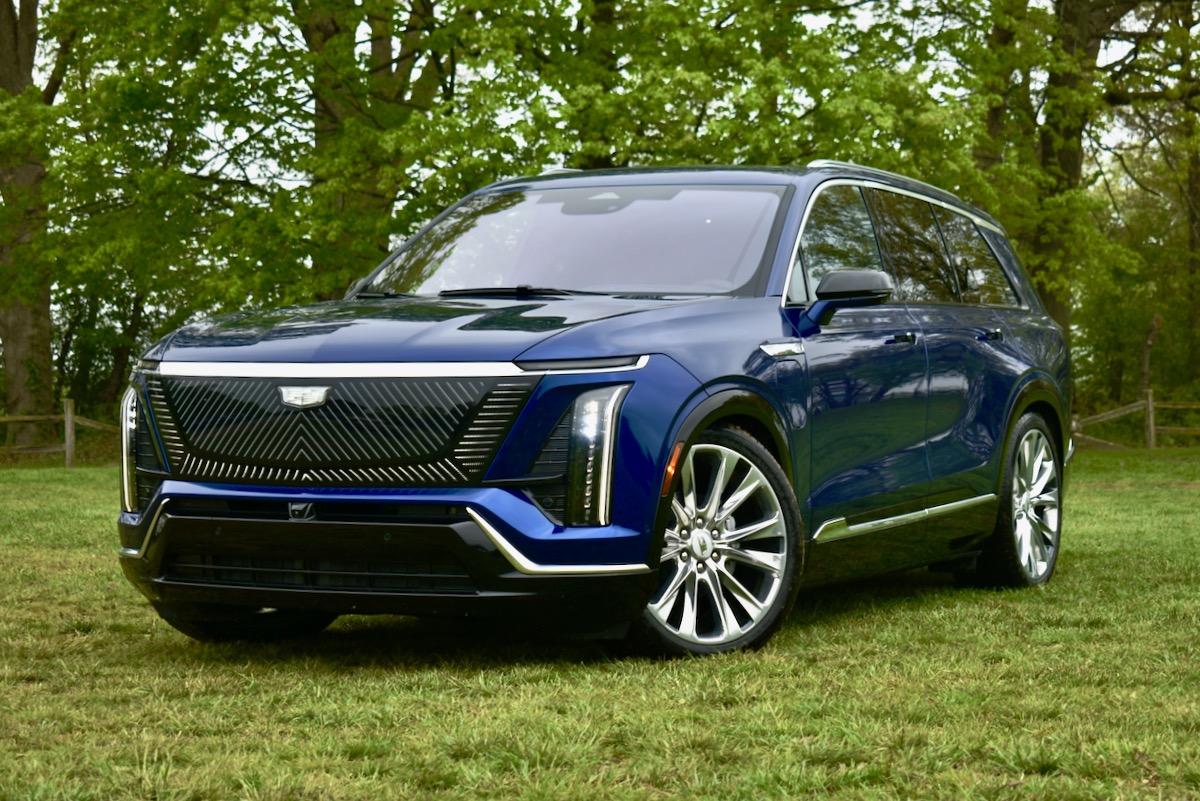
With the Vistiq, Cadillac adds a more sensible three-row electric SUV to its lineup.
Like the Vistiq, the Cadillac Escalade IQ already offers three rows of seats and electric power. However, just as Cadillac sells the midsize XT6 alongside the full-size Escalade SUV (both internal-combustion vehicles), there's space to launch a smaller but still generously proportioned three-row EV with a Cadillac crest. Enter the 2026 Cadillac Vistiq, a new model the brand describes as a “baby Escalade” that’s perfectly sized to compete with the Lucid Gravity, Mercedes-Benz EQS SUV, Rivian R1S, and Volvo EX90.
Verdict: The Vistiq is a practical three-row SUV that looks and drives like a true Cadillac, without the excess of its big sibling.
Cadillac proudly calls the Vistiq its “baby Escalade,” and that’s appropriate. It has the same unsubtle styling as Cadillac’s flagship luxury SUV, plus three rows of seats, but with somewhat more manageable proportions.
The Vistiq is more than 30 centimetres shorter than the all-electric Cadillac Escalade IQ, roughly 13 cm lower, and just under 19 cm narrower. Its 3,099-millimetre wheelbase is also 36 cm shorter than that of the electric Escalade IQ, but it's very close to the two-row Cadillac Lyriq’s wheelbase. That’s likely due to the Lyriq and Vistiq sharing a 102-kilowatt-hour battery pack and the General Motors Ultium platform, as the company’s EV design strategy ties pack size to wheelbase length.
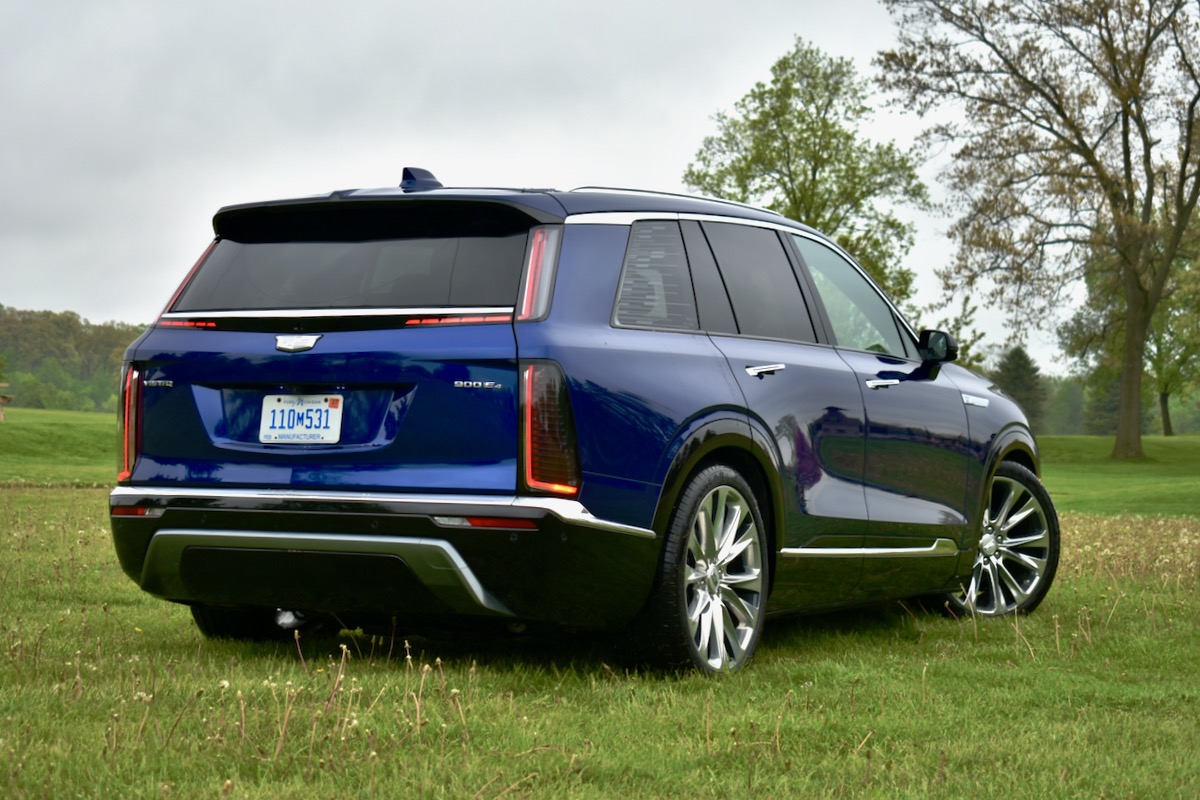
This still makes for a fairly large vehicle, and one that wears Cadillac’s current styling well. Like the Lyriq and Escalade IQ, the Vistiq has a large blanked-off grille to signify that it’s an EV. It nudges the headlights to the corners of the front fascia, giving the Vistiq an imposing and swaggering appearance. Detailing is close enough to the Escalade IQ that it’s actually a bit difficult to tell the two apart. The split-taillight arrangement from other Cadillac EVs is well integrated with the Vistiq’s upright tailgate, while Mondrian-pattern etching on the rearmost side windows adds some visual interest in the profile view.
In Canada, the Vistiq is available in Luxury, Sport, Premium Luxury, and Platinum trim levels. The Vistiq Luxury base model and the Premium Luxury have a more traditional Cadillac look, with plenty of bright chrome trim. The Vistiq Sport features darkened trim, plus a unique grille design. The range-topping Platinum model has sportier-looking front and rear fasciae and body-colour exterior moldings (they’re black on other trim levels). Even the base Luxury grade gets standard 21-inch wheels, while 22-inch and 23-inch wheels are optional.
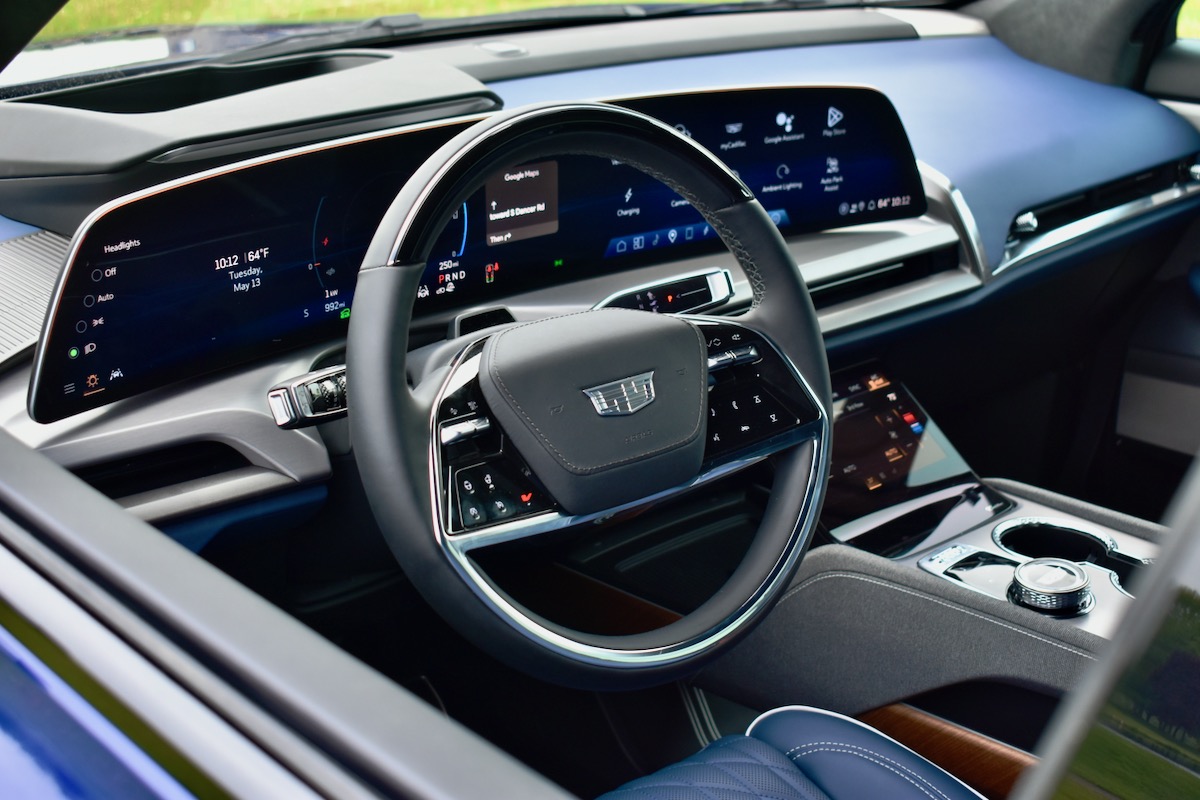
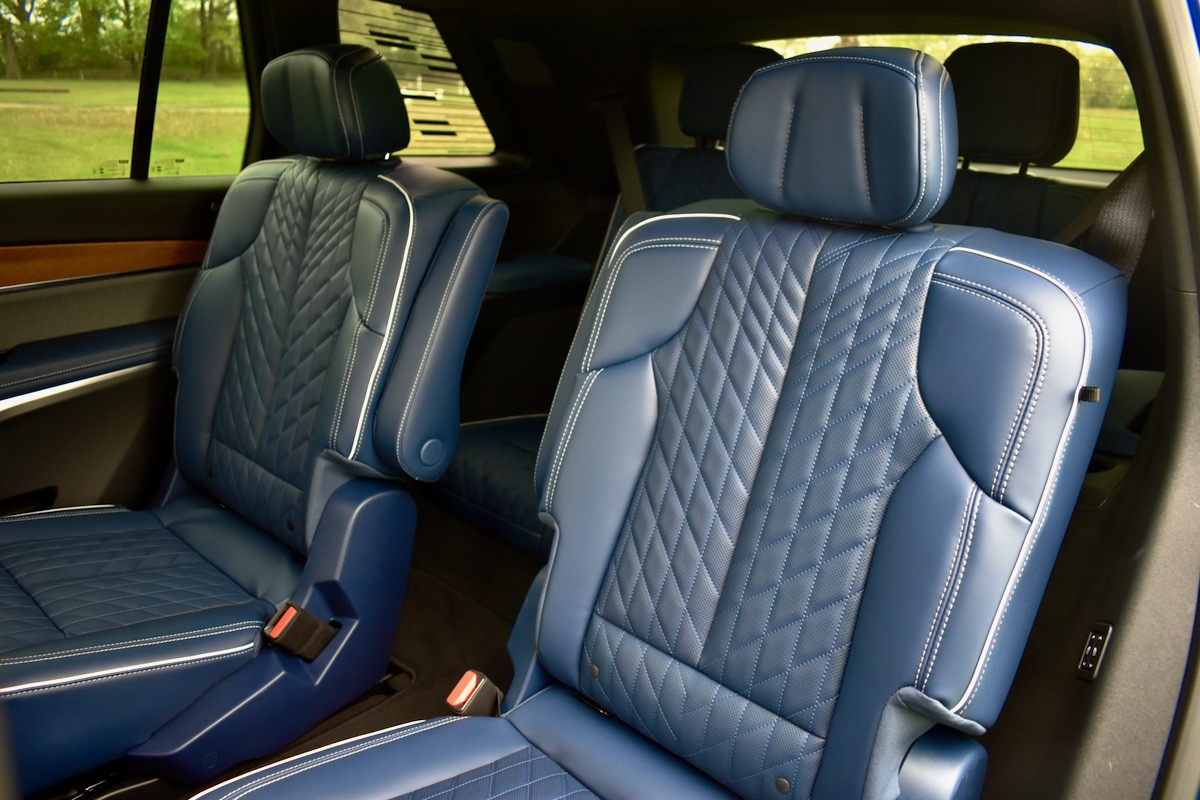
With a dashboard defined by an expansive curved screen, the interior layout will be familiar to anyone who has stepped into another recent Cadillac. The Vistiq makes the most of that appealingly minimalist foundation with impressive material choices. The available wood trim looks genuine and can be backlit, but carbon fibre is also available, as is a fabric made from recycled yarn. In our Premium Luxury test car, the wood and fabric were paired with metallic-looking plastic and blue leather upholstery for a look that was much more interesting than the typical basic black or gray.
The Vistiq launches with a single dual-motor all-wheel drive (AWD) powertrain configuration. A 102-kWh battery pack feeds a pair of permanent-magnet motors shared with the Cadillac Lyriq-V and Chevrolet Blazer EV SS, producing the same 615 horsepower and 650 lb-ft of torque as in those performance models. Maximum output is only available in the Velocity Max mode, but you can leave that turned on all the time.
Velocity Max also enables a Cadillac-estimated zero to 96 km/h time of 3.7 seconds. That’s 0.8 seconds quicker than a Mercedes-Benz EQS 580 4Matic — the most powerful version of the Mercedes three-row EV SUV — and a full second quicker than a Volvo EX90 Twin Motor Performance. But the Cadillac can’t hang with the Lucid Gravity, or most versions of the Rivian R1S.
Three-row SUVs aren’t supposed to be sports cars, though, and Cadillac kept that in mind when tuning the Vistiq’s chassis. Luxury and Sport models get coil springs with adaptive dampers, but our Vistiq Premium Luxury test car was equipped with air suspension that, in addition to slamming the Vistiq to the ground for easier ingress and egress when parked, imparts impressive ride comfort with resolute body control. Even the combination of 23-inch wheels and terrible northern pavement didn’t bother it.
We also experienced the optional rear-axle steering during our first drive, which GM previously limited to its bigger EVs. It isn’t a class-exclusive feature — the Mercedes-Benz EQS SUV also has it — but it’s certainly helpful in a vehicle as generously proportioned as this one. Backing into parking spaces doesn’t require a second thought, and the steerable rear wheels contribute to the feeling of stability that is one of the Vistiq’s most appealing handling attributes. It’s just too bad you have to upgrade to the Premium Luxury trim level to get it.
One thing you don’t have to upgrade for is GM’s excellent regenerative braking control system. Like other GM EVs going back to the Chevy Bolt EV, the Vistiq offers true one-pedal driving. But drivers can also adjust the default level of regen or get a bit more on demand by pulling a steering-wheel paddle — a bit like using engine braking in a combustion car. That provides plenty of options to suit circumstances and driver preference.
Cadillac offers a seven-seat configuration with a second-row bench, or a six-seat configuration with second row captain’s chairs, but either way you get a usable third row. Passengers seated in that row get an additional 5.3 cm of headroom compared to a Lucid Gravity and 9.4 cm more than in a Volvo EX90. The Lucid and Volvo offer a bit more third-row legroom, but the Vistiq still has enough room for smaller adults to sit without their knees touching the backs of the second-row seats, and without rubbing shoulders with fellow passengers. Large rear windows help combat claustrophobia, although the Mondrian-pattern graphics disrupt the view out.
The Vistiq also offers more first-row legroom than a Gravity, EX90, or Mercedes-Benz EQS SUV, although that seems to come at the expensive of second-row legroom, which is less than in all but the Volvo. Second-row headroom is also back-of-the-pack, and most competitors offer more front-seat headroom as well. The trade-off here is a standard panoramic sunroof that covers the first two rows, but does at least come with a full-length power shade. The third row also gets its own fixed glass panel, with an accessory clip-in shade.
Each row of seats gets its own complement of cupholders and USB ports, but while the third row gets air vents, occupants will have to rely on those in other seats for climate control. Up front, Cadillac provides a large wireless charging pad for two phones, plus narrow slots in the sides of the centre console that can hold unplugged phones or loose change. The tall console also incorporates both a traditional bin and a storage nook that does a good job of keeping items hidden.
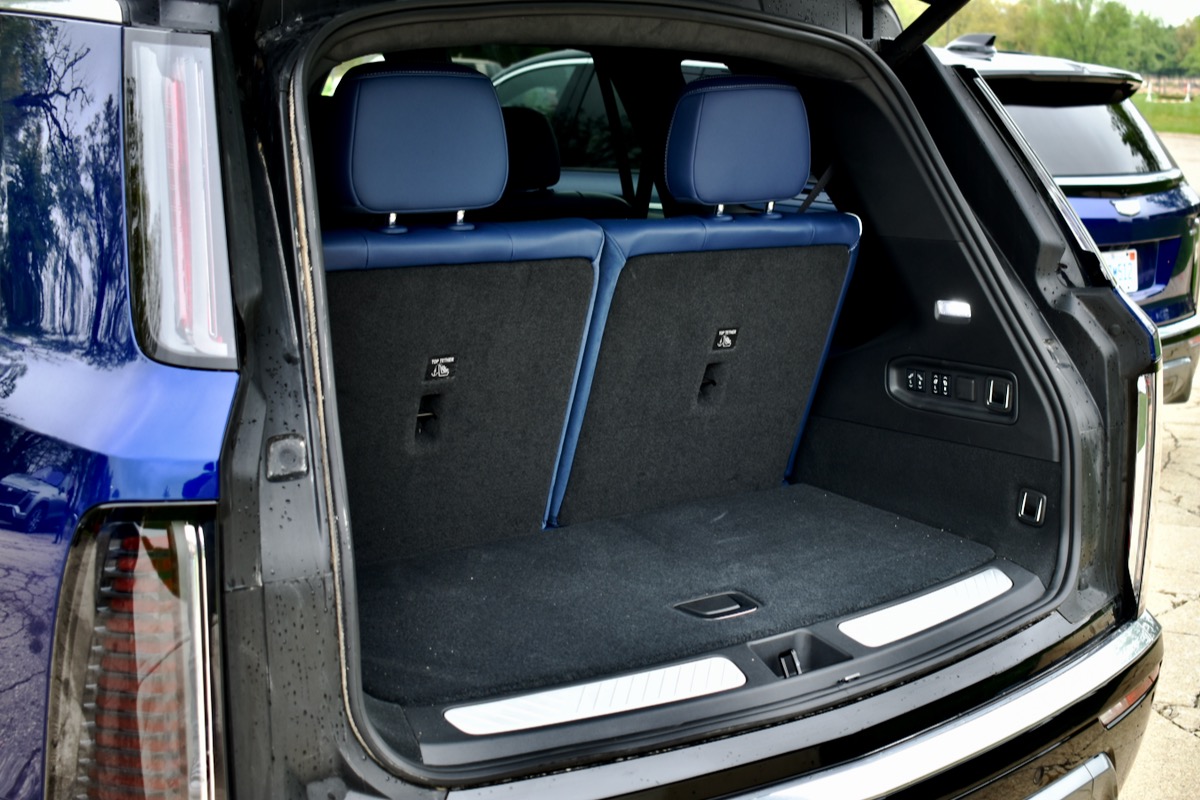
Open the standard automatic power tailgate, and the Vistiq provides 430 litres of cargo space behind its third row. That’s not much considering the overall size of the vehicle, and a typical compromise with a third row, and isn’t helped by a tall rear bumper. It’s likely easier to lift cargo into a Lucid Gravity, which also has 603 litres of space behind its third row. The Vistiq’s 1,218 litres of cargo space behind its second row and 2,271 litres behind its first row also trail the Gravity, but surpass the EX90 and EQS SUV. And while some rivals offer a frunk, Cadillac has even done away with the plastic cover for the under-hood mechanical components, negating any use of the considerable space under the hood.
Cadillac quotes a maximum towing capacity of 2,268 kilograms (5,000 pounds), roughly 450 kilograms (1,000 pounds) more than the Cadillac XT6. That’s also about the same as an EX90, but a Gravity or Rivian R1S will be able to tow more.
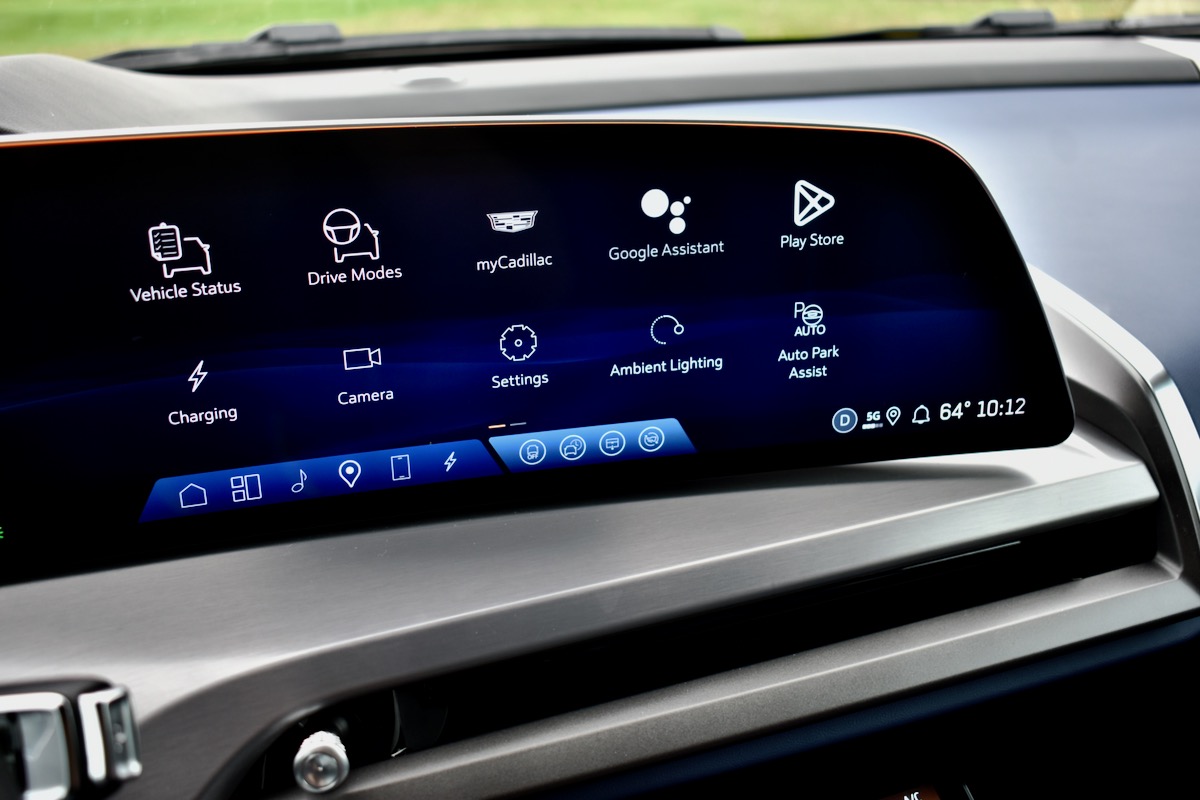
The Vistiq comes standard with the same 33-inch curved dashboard display as the smaller Cadillac Optiq and Lyriq, incorporating the instrument cluster and infotainment touchscreen in one attractive package. It’s easy to use as well, although the supplementary eight-inch touchscreen below it tasked with climate functions isn’t as nice to look at — or as user-friendly as analog controls. A duplicate eight-inch touchscreen gives second-row passengers access to climate controls.
The curved display debuted on the Lyriq, but since then GM has adopted an Android-based infotainment system with Google Built-in apps, so the Vistiq doesn’t get Apple CarPlay or standalone Android Auto. The integrated Google apps, including Google Maps navigation, Google Assistant voice recognition, and the Google Play Store, worked well enough in our test car, with none of the software issues that plagued earlier versions of this system. But given the number of drivers that rely on phone connectivity more than native software, the absence of Apple CarPlay still seems like a major drawback.
A standard 23-speaker AKG Studio audio system features Dolby Atmos sound-enhancement tech, which is rolling out across the Cadillac lineup for 2026. Atmos allows for greater separation of individual sounds for a more impressive experience, but it’s not exclusive to Cadillac (Mercedes has it too) and only works with certain music streaming services. Even with regular SiriusXM satellite radio, the sound system was pretty good.
Cadillac also makes both a rearview camera mirror and 360-degree camera system standard. While we’d be disappointed if features like this weren’t standard on a vehicle in this price range, they’re nonetheless welcome additions that help make parking lot maneuvers easier. The rearview camera mirror is also especially helpful in a three-row SUV, where the heads of third-row passengers can block the rear window.
Premium Luxury and Platinum models also have an augmented-reality head-up display (HUD) that can show turn-by-turn navigation directions. GM claims it offers brighter, clearer graphics than similar displays in its rivals, but since our test drive took place on a cloudy day — ideal conditions for HUD visibility — it was hard to judge. But we did appreciate that the HUD synced with the Vistiq’s Super Cruise driver-assist system so we could monitor it without having to look down at the cluster.
The Vistiq comes standard with expected driver-assist features such as adaptive cruise control, forward-collision warning, automatic emergency braking, blind-spot monitoring, rear cross-traffic alert, lane-keep assist, and lane-departure warning. Because this is a Cadillac, many of the warnings from those features are communicated through a vibrating Safety Alert Seating in addition to typical audio/visual cues. GM’s parental-control system for teen drivers and a buckle-to-drive interlock are standard as well.
Also standard is the same Super Cruise hands-free highway driving system available in numerous GM vehicles, but the Vistiq debuts a handful of key updates. It’s now possible to pre-select Super Cruise before setting off, eliminating a step to activate the system once you reach one of the pre-mapped stretches of road where it’s available. The navigation system also shows Super Cruise-compatible roads and lets drivers filter routes by Super Cruise compatibility.
Super Cruise’s automatic lane-change function will now also follow the route. Instead of changing lanes to get around slower cars — and potentially leaving you in the wrong lane for an exit or interchange — Super Cruise will now position the vehicle where it needs to be to stay on course. During a brief test on a stretch of highway, the system was able to successfully navigate a couple of interchanges, but it lost track of the lanes in a third one. It also won’t move the vehicle out of the Super Cruise operating zone, so drivers will have to take over for highway off-ramps that lead onto unmapped roads.
The Insurance Institute for Highway Safety (IIHS) and National Highway Traffic Safety Administration (NHTSA) hadn’t released crash-test ratings for the Vistiq at press time, but that’s because this brand new vehicle was only just going on sale when we drove it.
The Vistiq comes with Canadian range estimates of 491 kilometres in the Luxury and Sport trims and 483 km in the Premium Luxury and Platinum grades. Those are improvements on the Audi SQ6 e-Tron’s 443 kilometres, but really, it’s the bare minimum considering that the Volvo EX90 and dual-motor Mercedes EQS SUV max out at 499 and 510 kilometres respectively, while the Rivian R1S and Lucid Gravity are capable of even more—as is the BMW iX in higher trim levels.
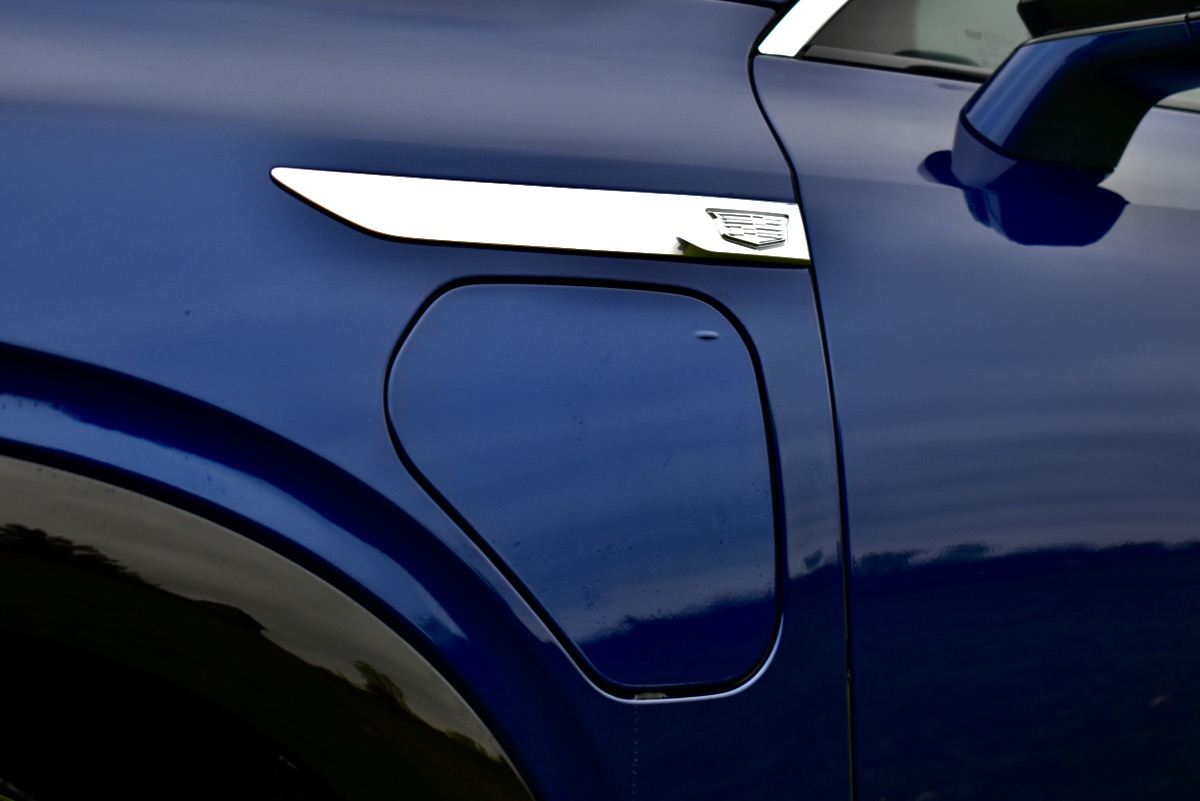
A standard 11.5-kilowatt AC onboard charger and optional 19.2-kW charger should make overnight home charges easy, assuming you have a powerful enough hookup. Caddy also claims the Vistiq can recover up to 130 kilometres of range in about 10 minutes of DC fast charging with its Combined Charging Standard (CCS) connector. A North American Charging Standard (NACS) adapter for Tesla Supercharger stations is also available.
Cadillac’s eight-year/160,000-kilometre warranty for the battery pack and related components is competitive with other electric vehicles. That’s in addition to the luxury brand’s standard four-year/80,000-kilometre, bumper-to-bumper warranty.
Pricing starts at $96,433 for the Luxury grade (all prices include the $2,600 destination charge plus other fees), with the Sport having the same starting price. However, these first impressions are based on the $117,080 Premium Luxury grade, which adds air suspension, rear-axle steering, and the augmented reality HUD, among other features. The top Platinum trim level starts at $125,120, and both top trims trigger the federal government’s luxury tax, which applies to the portion of the vehicle price above $100,000.
The need to upgrade to get a well-equipped vehicle like our Premium Luxury test car shows that the Vistiq isn’t setting new standards for value. Nor does it appear to be a standout in efficiency or charging performance. But it looks and drives like a true Cadillac, while being much more practical than the oversized Escalade IQ. In this case, the “baby” of the family has surpassed the elder sibling.

User reviews for 2026 Cadillac VISTIQ
Write a review2026 Cadillac VISTIQ Pricing
Trims & specs
Air Conditioning
Automatic climate control front air conditioning · Dual front air conditioning zones · Automatic climate control rear air conditioning · Dual rear air conditioning zones · Automatic climate control third row air conditioning · Single third row air conditioning zones
Airbags
Dual front airbags · Dual front knee airbags · Passenger airbag deactivation: occupant sensing deactivation · Front side airbags · Rear side curtain airbags
Audio System
Antenna Type: mast · Voice recognition audio system · USB auxiliary audio input · Premium brand: AKG · Touch screen display radio · Satellite Radio: SiriusXM · 1 subwoofer · Total speakers: 22
Brakes
ABS: 4-wheel · Braking assist: hill start assist · Electronic parking brake: auto off · Front brake diameter: 13.5 · Front brake width: 1.18 · Front brakes: ventilated disc · Rear brake diameter: 13.6 · Rear brake width: 0.78 · Rear brakes: ventilated disc
Comfort Features
Armrests: rear center with cupholders · Door sill trim: illuminated scuff plate · Floor Mat Material: carpet · Floor Material: carpet · Floor Mats: front · Foot pedal trim: alloy · Steering wheel trim: leatherette
Convenience Features
Active parking system: fully automated · Adaptive stop and go cruise control: semi-automatic · Ambient lighting: color-adjustable · Assist handle: front · Autonomous lane guidance: lane changing · Center console: front console with armrest and storage · Cruise control: adaptive · Cupholders: front · Dimming rearview mirror: auto-dimming · Easy entry: power rear seat · Footwell lights: color-adjustable · Memorized settings: liftgate · Multi-function remote: proximity entry system · One-touch windows: 4 · Power outlet(s): USB-C front · Power steering: speed-proportional · Power windows: lockout button · Reading lights: front · Rear power outlet: 115V · Rearview mirror: camera-based · Steering wheel: power tilt and telescopic · Steering wheel mounted controls: phone · Storage: door pockets · Universal garage door opener: Homelink · Vanity mirrors: dual illuminating
Driver Seat
Adjustable lumbar support: 4-way power · Power adjustments: 8
Drivetrain
4WD Type: on demand · Axle ratio: 9.87
Engine
Battery: maintenance-free · EV battery capacity: 102 kWh · EV on-board charger rating: 11.5 kW · Electric Motor HP: 615 · Electric Motor Power Output (Kilowatts): 459 · Electric Motor Torque: 650 · Electric charge cord: autoswitching 110V/240V · Electric motor battery type: Ultium lithium ion · Electric motor charger: DC fast charging · Electric motor charger connector: SAE J1772 · Electric motor charging time (240V): 10.5 hours · Electric motor miles per charge: 305
Exterior Features
Body side moldings: black · Door handle color: chrome · Fender lip moldings: black · Front bumper color: body-color · Grille color: chrome · Headlamp bezel color: black · Illuminated accent: grille · Mirror color: black · Rear bumper color: black · Rear spoiler: roofline spoiler · Rear spoiler color: body-color · Rear trunk/liftgate: sensor-activated · Rocker panel color: black · Running boards: black · Side door type: soft close · Window trim: chrome
Headrests
Front headrests: adjustable · Number of front headrests: 2 · Number of rear headrests: 3 · Number of third row headrests: 2
In Car Entertainment
Connected in-car apps: Google POIs · Infotainment: Google Built-In · Integrated dashboard screen size: 33 in.
Instrumentation
Fuel economy display: range · Warnings and reminders: maintenance reminder
Lights
Daytime running lights: LED · Exterior entry lights: security approach lamps · Headlights: Auto on/off · Tail and brake lights: LED
Mirrors
Exterior mirrors: integrated turn signals
Passenger Seat
Power adjustments: 8
Rear Seats
Type: 60-40 split bench
Roof
3rd Row Sunroof: fixed glass · Moonroof: power panoramic · Moonroof / Sunroof: power sunshade · Roof rails: chrome
Safety
Automatic emergency braking: front pedestrian · Camera system: surround view · Camera system washer: rear · Child seat anchors: LATCH system · Cross Traffic Alert: rear · Crumple zones: front · Impact sensor: battery disconnect · Parking sensors: rear · Pre-Collision Warning System: audible warning · Pre-collision warning system: pedestrian detection · Programmable safety key: MyKey · Rear pre-collision warning system: pedestrian detection · Rearview monitor: in dash
Seatbelts
Emergency locking retractors: front and rear · Front seatbelts: 3-point · Seatbelt force limiters: front · Seatbelt pretensioners: front · Seatbelt warning sensor: driver and passenger · Second row seatbelts: 3-point · Third row seatbelts: 3-point
Seats
Driver seat power adjustments: height · Front seat type: bucket · Passenger seat power adjustments: 4-way power lumbar · Rear headrests: adjustable · Rear seat folding: split · Rear seat manual adjustments: reclining · Third row headrests: adjustable · Third row seat folding: split · Upholstery: contrast stitching
Security
Power door locks: anti-lockout
Stability and Traction
Traction control: with trailer stability control
Steering
Steering ratio: 18.5
Suspension
Front Shock Type: gas shock absorbers · Front Spring Type: coil springs · Front Suspension Classification: independent · Front Suspension Type: strut · Rear Shock Type: gas shock absorbers · Rear Spring Type: coil springs · Rear Suspension Classification: independent · Rear Suspension Type: multi-link · Stabilizer bar(s): rear · Suspension control: electronic
Telematics
Driver assistance app: roadside assistance · Electronic messaging assistance: with voice recognition · Navigation system: with voice recognition · Phone: voice activated · Phone wireless data link: Bluetooth · Satellite communications: OnStar · Smart device app compatibility: myCadillac with Connected Access · Smart device app function: send destination to vehicle · Wifi: hotspot
Third Row Seat
Type: 50-50 split bench
Tires
Type: all season
Tires and Rims
Run flat tires: puncture sealing compound with electric compressor · Wheels: aluminum with painted accents
Towing and Hauling
Trailer wiring: 4-pin
Wheels
Wheel locks: front and rear
Windows
Front wipers: variable intermittent · Laminated glass: acoustic front side · Liftgate window: fixed · Power windows: with safety reverse · Rear wiper: intermittent
Air Conditioning
Automatic climate control front air conditioning · Dual front air conditioning zones · Automatic climate control rear air conditioning · Dual rear air conditioning zones · Automatic climate control third row air conditioning · Single third row air conditioning zones
Airbags
Dual front airbags · Dual front knee airbags · Passenger airbag deactivation: occupant sensing deactivation · Front side airbags · Rear side curtain airbags
Audio System
Antenna Type: mast · Voice recognition audio system · USB auxiliary audio input · Premium brand: AKG · AM/FM radio · Satellite Radio: SiriusXM · 1 subwoofer · Total speakers: 22
Brakes
ABS: 4-wheel · Braking assist: hill start assist · Electronic parking brake: auto off · Front brake diameter: 13.5 · Front brake width: 1.18 · Front brakes: ventilated disc · Rear brake diameter: 13.6 · Rear brake width: 0.78 · Rear brakes: ventilated disc
Comfort Features
Armrests: rear center with cupholders · Door sill trim: illuminated scuff plate · Floor Mat Material: carpet · Floor Material: carpet · Floor Mats: front · Foot pedal trim: alloy · Steering wheel trim: leatherette
Convenience Features
Active parking system: fully automated · Adaptive stop and go cruise control: semi-automatic · Ambient lighting: color-adjustable · Assist handle: front · Autonomous lane guidance: lane changing · Center console: front console with armrest and storage · Cruise control: adaptive · Cupholders: rear · Dimming rearview mirror: auto-dimming · Easy entry: power rear seat · Footwell lights: color-adjustable · Memorized settings: driver seat · Multi-function remote: trunk release · One-touch windows: 4 · Power outlet(s): USB-C front · Power steering: speed-proportional · Power windows: lockout button · Reading lights: front · Rear power outlet: 115V · Rearview mirror: camera-based · Steering wheel: power tilt and telescopic · Steering wheel mounted controls: multi-function screen controls · Storage: door pockets · Universal garage door opener: Homelink · Vanity mirrors: dual illuminating
Driver Seat
Adjustable lumbar support: 4-way power · Power adjustments: 8
Drivetrain
4WD Type: on demand · Axle ratio: 9.87
Engine
Battery: maintenance-free · EV battery capacity: 102 kWh · EV on-board charger rating: 11.5 kW · Electric Motor HP: 615 · Electric Motor Power Output (Kilowatts): 459 · Electric Motor Torque: 650 · Electric charge cord: autoswitching 110V/240V · Electric motor battery type: Ultium lithium ion · Electric motor charger: DC fast charging · Electric motor charger connector: SAE J1772 · Electric motor charging time (240V): 10.5 hours · Electric motor miles per charge: 305
Exterior Features
Body side moldings: black · Door handle color: body-color · Fender lip moldings: black · Front bumper color: body-color · Grille color: black · Headlamp bezel color: black · Illuminated accent: front emblem · Mirror color: black · Rear bumper color: black · Rear spoiler: roofline spoiler · Rear spoiler color: body-color · Rear trunk/liftgate: power operated · Rocker panel color: black · Running boards: black · Side door type: soft close · Window trim: black
Headrests
Front headrests: adjustable · Number of front headrests: 2 · Number of rear headrests: 3 · Number of third row headrests: 2
In Car Entertainment
Connected in-car apps: Google Assistant · Infotainment: Google Built-In · Integrated dashboard screen size: 33 in.
Instrumentation
Fuel economy display: range · Warnings and reminders: maintenance reminder
Lights
Daytime running lights: LED · Exterior entry lights: security approach lamps · Headlights: Auto on/off · Tail and brake lights: LED
Mirrors
Exterior mirrors: integrated turn signals
Passenger Seat
Power adjustments: 8
Rear Seats
Type: 60-40 split bench
Roof
3rd Row Sunroof: fixed glass · Moonroof: power panoramic · Moonroof / Sunroof: power sunshade · Roof rails: black
Safety
Automatic emergency braking: intersection/junction cross · Camera system: surround view · Camera system washer: rear · Child seat anchors: LATCH system · Cross Traffic Alert: rear · Crumple zones: rear · Impact sensor: alert system · Parking sensors: rear · Pre-Collision Warning System: vibrating driver seat · Pre-collision warning system: pedestrian detection · Programmable safety key: MyKey · Rear pre-collision warning system: pedestrian detection · Rearview monitor: in dash
Seatbelts
Emergency locking retractors: front and rear · Front seatbelts: 3-point · Seatbelt force limiters: front · Seatbelt pretensioners: front · Seatbelt warning sensor: driver and passenger · Second row seatbelts: 3-point · Third row seatbelts: 3-point
Seats
Driver seat power adjustments: height · Front seat type: bucket · Passenger seat power adjustments: 4-way power lumbar · Rear headrests: adjustable · Rear seat folding: split · Rear seat manual adjustments: reclining · Third row headrests: adjustable · Third row seat folding: split · Upholstery: perforated
Security
Power door locks: anti-lockout
Stability and Traction
Traction control: with trailer stability control
Steering
Steering ratio: 18.5
Suspension
Front Shock Type: gas shock absorbers · Front Spring Type: coil springs · Front Suspension Classification: independent · Front Suspension Type: strut · Rear Shock Type: coil over shock · Rear Spring Type: coil springs · Rear Suspension Classification: independent · Rear Suspension Type: multi-link · Stabilizer bar(s): rear · Suspension control: electronic
Telematics
Driver assistance app: roadside assistance · Electronic messaging assistance: with voice recognition · Navigation system: touch screen display · Phone: voice activated · Phone wireless data link: Bluetooth · Satellite communications: OnStar · Smart device app compatibility: myCadillac with Connected Access · Smart device app function: maintenance status · Wifi: hotspot
Third Row Seat
Type: 50-50 split bench
Tires
Type: all season
Tires and Rims
Run flat tires: puncture sealing compound with electric compressor · Wheels: aluminum with painted accents
Towing and Hauling
Trailer wiring: 4-pin
Wheels
Wheel locks: front and rear
Windows
Front wipers: rain sensing · Laminated glass: acoustic · Liftgate window: fixed · Power windows: with safety reverse · Rear wiper: intermittent
Air Conditioning
Automatic climate control front air conditioning · Dual front air conditioning zones · Rear air conditioning: with independent controls · Dual rear air conditioning zones · Automatic climate control third row air conditioning · Single third row air conditioning zones
Airbags
Dual front airbags · Dual front knee airbags · Passenger airbag deactivation: occupant sensing deactivation · Front side airbags · Third row side curtain airbags
Audio System
Antenna Type: diversity · Voice recognition audio system · Bluetooth auxiliary audio input · Premium brand: AKG · AM/FM radio · Satellite Radio: SiriusXM · 1 subwoofer · Total speakers: 22
Brakes
ABS: 4-wheel · Braking assist: hill start assist · Electronic parking brake: auto off · Front brake diameter: 13.5 · Front brake width: 1.18 · Front brakes: ventilated disc · Rear brake diameter: 13.6 · Rear brake width: 0.78 · Rear brakes: ventilated disc
Comfort Features
Armrests: rear outboard seats · Center console trim: wood · Door sill trim: illuminated scuff plate · Door trim: wood · Floor Mat Material: carpet · Floor Material: carpet · Floor Mats: front · Foot pedal trim: alloy · Headliner trim: Alcantara · Steering wheel trim: leatherette
Convenience Features
Active parking system: fully automated · Adaptive stop and go cruise control: semi-automatic · Ambient lighting: color-adjustable · Assist handle: rear · Autonomous lane guidance: lane changing · Center console: front console with armrest and storage · Cruise control: adaptive · Cupholders: front, rear and third row · Dimming rearview mirror: auto-dimming · Easy entry: power rear seat · Footwell lights: color-adjustable · Memorized settings: side mirrors · Multi-function remote: trunk release · One-touch windows: 4 · Power outlet(s): USB-C front · Power steering: electric · Power windows: lockout button · Reading lights: third row · Rear power outlet: 115V · Rearview mirror: camera-based · Steering wheel: power tilt and telescopic · Steering wheel mounted controls: audio · Storage: door pockets · Universal garage door opener: Homelink · Vanity mirrors: dual illuminating
Driver Seat
Adjustable lumbar support: 4-way power · Power adjustments: 8
Drivetrain
4WD Type: on demand · Axle ratio: 9.87
Engine
Battery: maintenance-free · EV battery capacity: 102 kWh · EV on-board charger rating: 19.2 kW · Electric Motor HP: 615 · Electric Motor Power Output (Kilowatts): 459 · Electric Motor Torque: 650 · Electric charge cord: autoswitching 110V/240V · Electric motor battery type: Ultium lithium ion · Electric motor charger: DC fast charging · Electric motor charger connector: SAE J1772 · Electric motor charging time (240V): 6.5 hours · Electric motor miles per charge: 300
Exterior Features
Body side moldings: black · Door handle color: chrome · Fender lip moldings: black · Front bumper color: body-color · Grille color: chrome · Headlamp bezel color: black · Illuminated accent: front emblem · Mirror color: black · Rear bumper color: black · Rear spoiler: roofline spoiler · Rear spoiler color: body-color · Rear trunk/liftgate: power operated · Rocker panel color: black · Running boards: black · Side door type: soft close · Window trim: chrome
Headrests
Front headrests: adjustable · Number of front headrests: 2 · Number of rear headrests: 2 · Number of third row headrests: 2
In Car Entertainment
Connected in-car apps: Google search · Infotainment: Google Built-In · Integrated dashboard screen size: 33 in.
Instrumentation
Fuel economy display: range · Head-up display: augmented reality · Warnings and reminders: low battery
Lights
Daytime running lights: LED · Exterior entry lights: security approach lamps · Headlights: wiper activated · Tail and brake lights: LED
Mirrors
Exterior mirrors: power
Passenger Seat
Power adjustments: 8
Rear Seats
Folding: power return · Type: captains chairs
Roof
3rd Row Sunroof: fixed glass · Moonroof: tilt/slide · Moonroof / Sunroof: power sunshade · Roof rails: chrome
Safety
Automatic emergency braking: front pedestrian · Camera system: surround view · Camera system washer: rear · Child seat anchors: LATCH system · Cross Traffic Alert: rear · Crumple zones: rear · Impact sensor: alert system · Parking sensors: rear · Pre-Collision Warning System: audible warning · Pre-collision warning system: intersection/junction turn · Programmable safety key: MyKey · Rear pre-collision warning system: pedestrian detection · Rearview monitor: in dash
Seatbelts
Emergency locking retractors: front · Front seatbelts: 3-point · Seatbelt force limiters: front · Seatbelt pretensioners: front, rear and third row · Seatbelt warning sensor: driver and passenger · Second row seatbelts: 3-point · Third row seatbelts: 3-point
Seats
Driver seat power adjustments: reclining · Front seat type: bucket · Passenger seat power adjustments: 4-way power lumbar · Rear headrests: adjustable · Rear seat manual adjustments: reclining · Third row headrests: adjustable · Third row seat folding: power · Upholstery: contrast stitching
Security
Power door locks: anti-lockout
Stability and Traction
Traction control: with trailer stability control
Steering
Steering ratio: 18.5
Suspension
Driver Adjustable Suspension: ride control · Front Shock Type: gas shock absorbers · Front Spring Type: pneumatic springs · Front Suspension Classification: independent · Front Suspension Type: multi-link · Leveling: self leveling suspension · Rear Shock Type: gas shock absorbers · Rear Spring Type: pneumatic springs · Rear Suspension Classification: independent · Rear Suspension Type: multi-link · Stabilizer bar(s): rear · Suspension control: electronic
Telematics
Driver assistance app: roadside assistance · Electronic messaging assistance: with voice recognition · Navigation system: touch screen display · Phone: voice activated · Phone wireless data link: Bluetooth · Satellite communications: Turn-by-Turn Navigation · Smart device app compatibility: OnStar Guardian · Smart device app function: security event/collision alert · Wifi: hotspot
Third Row Seat
Type: 50-50 split bench
Tires
Type: all season
Tires and Rims
Run flat tires: puncture sealing compound with electric compressor · Wheels: polished aluminum with painted accents
Towing and Hauling
Trailer wiring: 4-pin
Wheels
Wheel locks: front and rear
Windows
Front wipers: rain sensing · Laminated glass: acoustic front side · Liftgate window: fixed · Power windows: with safety reverse · Rear wiper: intermittent
Air Conditioning
Automatic climate control front air conditioning · Dual front air conditioning zones · Rear air conditioning: with independent controls · Dual rear air conditioning zones · Automatic climate control third row air conditioning · Single third row air conditioning zones
Airbags
Dual front airbags · Dual front knee airbags · Passenger airbag deactivation: occupant sensing deactivation · Front side airbags · Rear side curtain airbags
Audio System
Antenna Type: diversity · Voice recognition audio system · Bluetooth auxiliary audio input · Premium brand: AKG · AM/FM radio · Satellite Radio: SiriusXM · 1 subwoofer · Total speakers: 22
Brakes
ABS: 4-wheel · Braking assist: hill start assist · Electronic parking brake: auto off · Front brake diameter: 16.1 · Front brake width: 1.26 · Front brakes: ventilated disc · Premium brakes: Brembo · Rear brake diameter: 13.6 · Rear brake width: 0.78 · Rear brakes: ventilated disc
Comfort Features
Armrests: rear outboard seats · Center console trim: wood · Door sill trim: illuminated scuff plate · Door trim: wood · Floor Mat Material: carpet · Floor Material: carpet · Floor Mats: front · Foot pedal trim: alloy · Headliner trim: Alcantara · Steering wheel trim: leatherette
Convenience Features
Active parking system: fully automated · Adaptive stop and go cruise control: semi-automatic · Ambient lighting: color-adjustable · Assist handle: front · Autonomous lane guidance: lane changing · Center console: front console with armrest and storage · Cruise control: adaptive · Cupholders: front · Dimming rearview mirror: auto-dimming · Easy entry: power rear seat · Footwell lights: color-adjustable · Memorized settings: side mirrors · Multi-function remote: vehicle and key memory · One-touch windows: 4 · Power outlet(s): USB-C front · Power steering: speed-proportional · Power windows: lockout button · Reading lights: rear · Rear power outlet: 115V · Rearview mirror: camera-based · Steering wheel: power tilt and telescopic · Steering wheel mounted controls: multi-function screen controls · Storage: in-floor · Universal garage door opener: Homelink · Vanity mirrors: dual illuminating
Driver Seat
Adjustable lumbar support: 4-way power · Power adjustments: 8
Drivetrain
4WD Type: on demand · Axle ratio: 9.87
Engine
Battery: maintenance-free · EV battery capacity: 102 kWh · EV on-board charger rating: 19.2 kW · Electric Motor HP: 615 · Electric Motor Power Output (Kilowatts): 459 · Electric Motor Torque: 650 · Electric charge cord: autoswitching 110V/240V · Electric motor battery type: Ultium lithium ion · Electric motor charger: DC fast charging · Electric motor charger connector: SAE J1772 · Electric motor charging time (240V): 6.5 hours · Electric motor miles per charge: 300
Exterior Features
Door handle color: body-color · Fender lip moldings: body-color · Front bumper color: body-color · Grille color: black · Headlamp bezel color: black · Illuminated accent: grille · Mirror color: black · Paint: contrast roof · Rear bumper color: body-color · Rear spoiler: roofline spoiler · Rear spoiler color: black · Rear trunk/liftgate: liftgate · Rocker panel color: black · Running boards: black · Side door type: soft close · Window trim: black
Headrests
Front headrests: adjustable · Number of front headrests: 2 · Number of rear headrests: 2 · Number of third row headrests: 2
In Car Entertainment
Connected in-car apps: Google search · Infotainment: Google Built-In · Integrated dashboard screen size: 33 in.
Instrumentation
Fuel economy display: range · Head-up display: augmented reality · Warnings and reminders: maintenance reminder
Lights
Daytime running lights: LED · Exterior entry lights: security approach lamps · Headlights: automatic high beam dimmer · Tail and brake lights: LED
Mirrors
Exterior mirrors: power
Passenger Seat
Power adjustments: 8
Rear Seats
Folding: power return · Type: captains chairs
Roof
3rd Row Sunroof: fixed glass · Moonroof: one-touch open/close · Moonroof / Sunroof: power sunshade · Roof rails: black
Safety
Automatic emergency braking: intersection/junction turn · Camera system: surround view · Camera system washer: rear · Child seat anchors: LATCH system · Cross Traffic Alert: rear · Crumple zones: front · Impact sensor: battery disconnect · Parking sensors: rear · Pre-Collision Warning System: vibrating driver seat · Pre-collision warning system: intersection/junction turn · Programmable safety key: MyKey · Rear pre-collision warning system: pedestrian detection · Rearview monitor: in dash
Seatbelts
Emergency locking retractors: front, rear, third, and fourth row · Front seatbelts: 3-point · Seatbelt force limiters: front · Seatbelt pretensioners: front · Seatbelt warning sensor: driver and passenger · Second row seatbelts: 3-point · Third row seatbelts: 3-point
Seats
Driver seat power adjustments: reclining · Front seat type: bucket · Passenger seat power adjustments: 4-way power lumbar · Rear headrests: adjustable · Rear seat manual adjustments: reclining · Third row headrests: adjustable · Third row seat folding: split · Upholstery: contrast stitching
Security
Power door locks: anti-lockout
Stability and Traction
Traction control: with trailer stability control
Steering
Steering ratio: 18.5
Suspension
Driver Adjustable Suspension: ride control · Front Shock Type: gas shock absorbers · Front Spring Type: pneumatic springs · Front Suspension Classification: independent · Front Suspension Type: multi-link · Leveling: self leveling suspension · Rear Shock Type: gas shock absorbers · Rear Spring Type: pneumatic springs · Rear Suspension Classification: independent · Rear Suspension Type: multi-link · Stabilizer bar(s): front · Suspension control: electronic
Telematics
Driver assistance app: roadside assistance · Electronic messaging assistance: with read function · Navigation system: touch screen display · Phone: voice activated · Phone wireless data link: Bluetooth · Satellite communications: Turn-by-Turn Navigation · Smart device app compatibility: myCadillac with Connected Access · Smart device app function: send destination to vehicle · Wifi: hotspot
Third Row Seat
Type: 50-50 split bench
Tires
Type: all season
Tires and Rims
Run flat tires: puncture sealing compound with electric compressor · Wheels: polished aluminum with painted accents
Towing and Hauling
Trailer wiring: 4-pin
Wheels
Wheel locks: front and rear
Windows
Front wipers: variable intermittent · Laminated glass: acoustic front side · Liftgate window: fixed · Power windows: with safety reverse · Rear wiper: intermittent
