2026 Chevrolet Suburban Reviews, Pricing & Specs

Pros & cons
What we like
Best-in-class cargo capacity
Multiple engine options
Comfortable for long hauls
What to consider
Sizable base-price increase for essentially no new capability
Missing driver assists on the base trim
Unwieldy in tight urban settings
The CarGurus verdict
The 2026 Chevrolet Suburban plays it safe, and it works.
The Suburban carries the longest-running nameplate in the auto industry, tracing back to 1935. In 2026, Chevrolet dominates the full-size SUV segment. A new Polar White Tricoat colour and an available RST Dark Essentials Package refresh the exterior, but the mechanical story is identical to last year's. As they say, if it isn’t broke, don’t fix it.
Verdict: Shoppers who need class-leading cargo space and towing capability should look past the sticker price increase and keep the Suburban at the top of their full-size SUV shortlist.
out of 10 expert review
Look & feel
Few nameplates carry the weight of the Suburban. It debuted in 1935, making it the longest-running model name in the industry. Ninety-plus years later, it still owns the segment it essentially invented. That's a lot of brand equity to protect, and for 2026 Chevrolet isn't taking any chances with it.
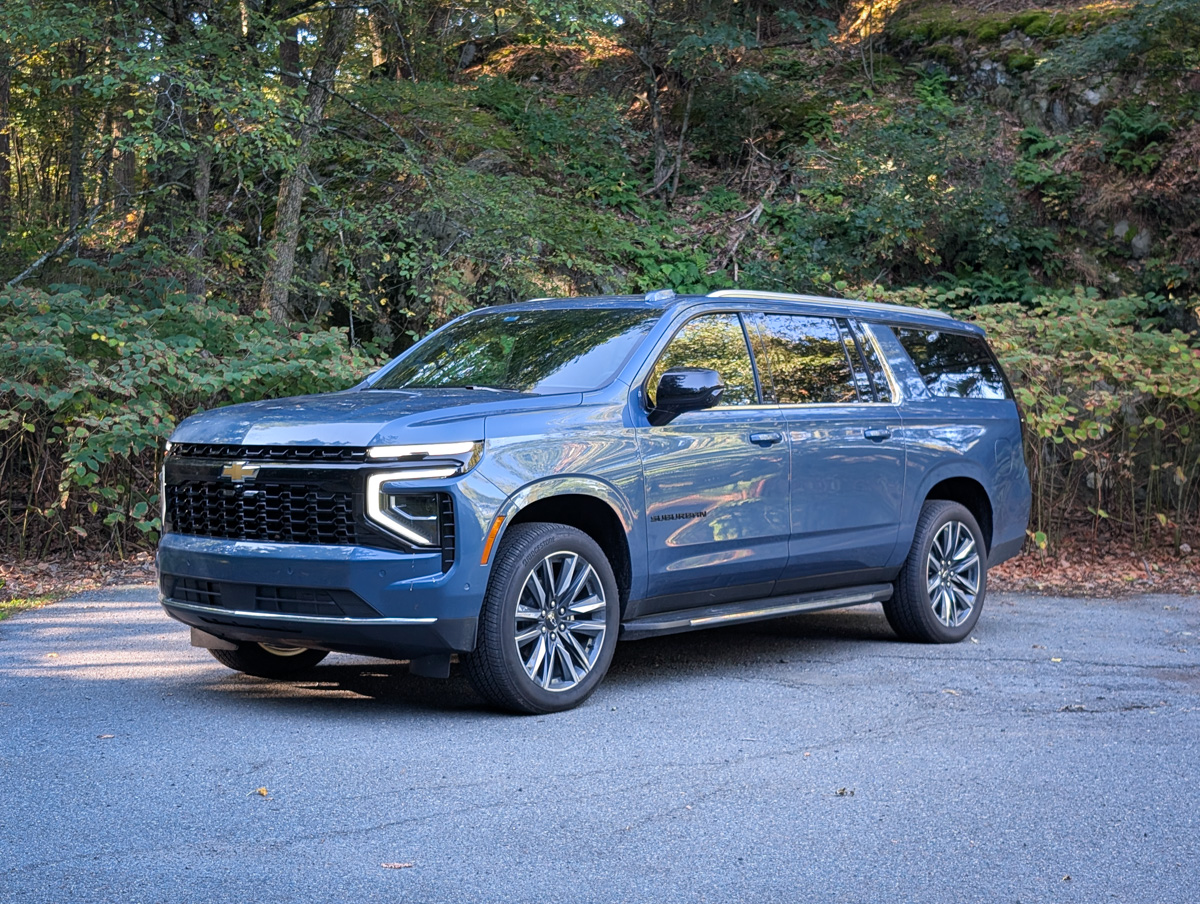
The changes this year are cosmetic: a new Polar White Tricoat paint option joins the colour sheet, 22-inch bright split-spoke wheels become available, and shoppers chasing a more aggressive look can add the RST Dark Essentials Package, which bundles massive 24-inch black wheels with black nameplates and black mirror caps. None of it changes how the Suburban drives, but it does give returning shoppers a reason to look twice.
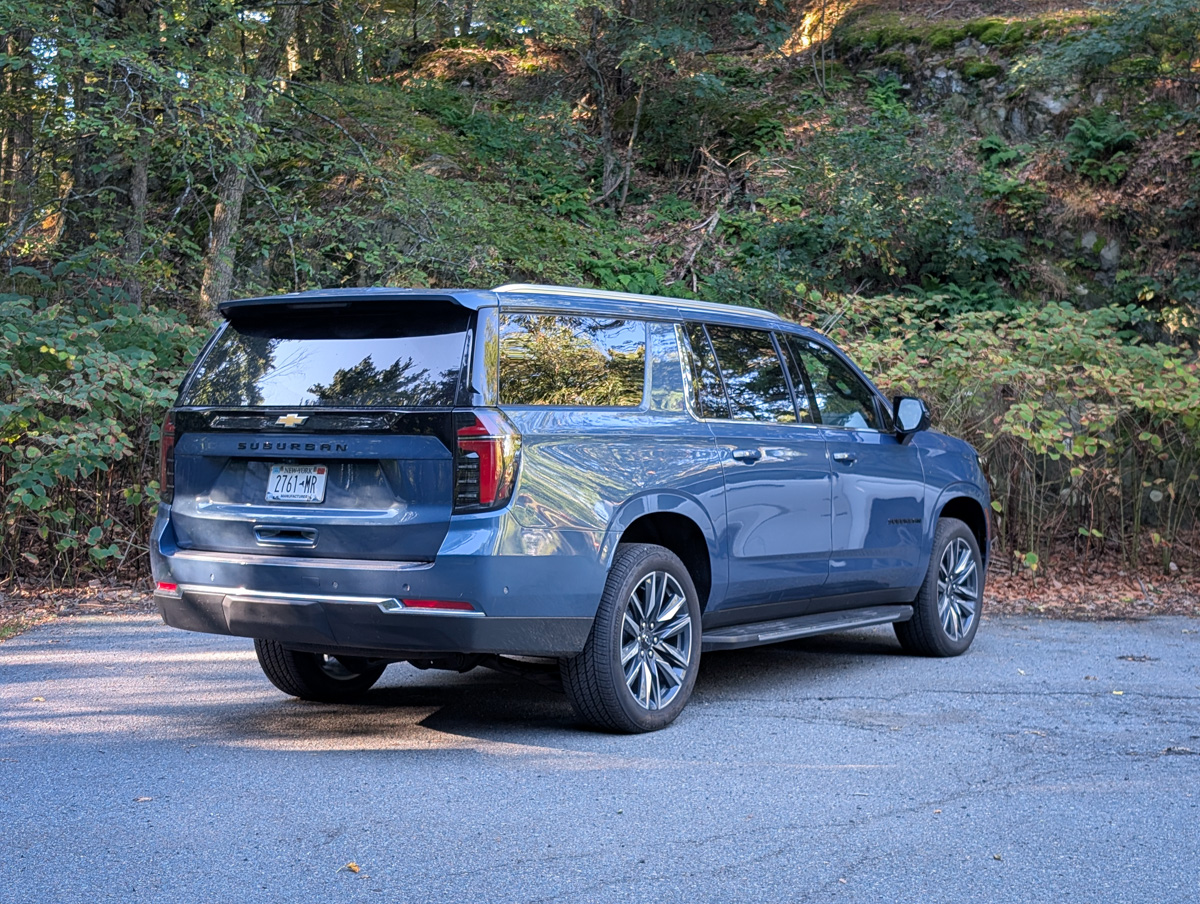
The shorter Chevrolet Tahoe shares the same basic architecture, but the Suburban's added length changes the proportions enough that the two don't read as twins from the curb. The LS trim we evaluated for this review keeps the exterior relatively restrained with body-colour bumpers and chrome trim doing most of the visual work. The second-step LT feels very similar. Higher trims lean harder into their personalities: the RST adds black exterior accents and quad exhaust tips for a sportier look, the Z71 brings skid plates and black trim for an off-road bent, and the Premier and High Country trims dress the same body in chrome and wood-look interior accents for a more formal presentation.
While driving the Suburban around in the suburbs for a week, we heard one observation more than any other: the Suburban is huge. At 5,748 millimetres long, the Suburban dwarfs nearly everything else in a dealer's lot, minivans included. It’s a lot to handle in crowded city driving, but the Suburban manages its size well once the roads open up. We drove this Suburban more than 600 kilometres on rural roads and never once felt like the length was working against us. Around the city, it's a different story. Threading this much SUV through city blocks and tight parking garages takes more concentration than doing so in a Chrysler Pacifica or a comparably sized crossover ever would. If most of your driving happens somewhere with more breathing room, the trade-off is less noticeable.
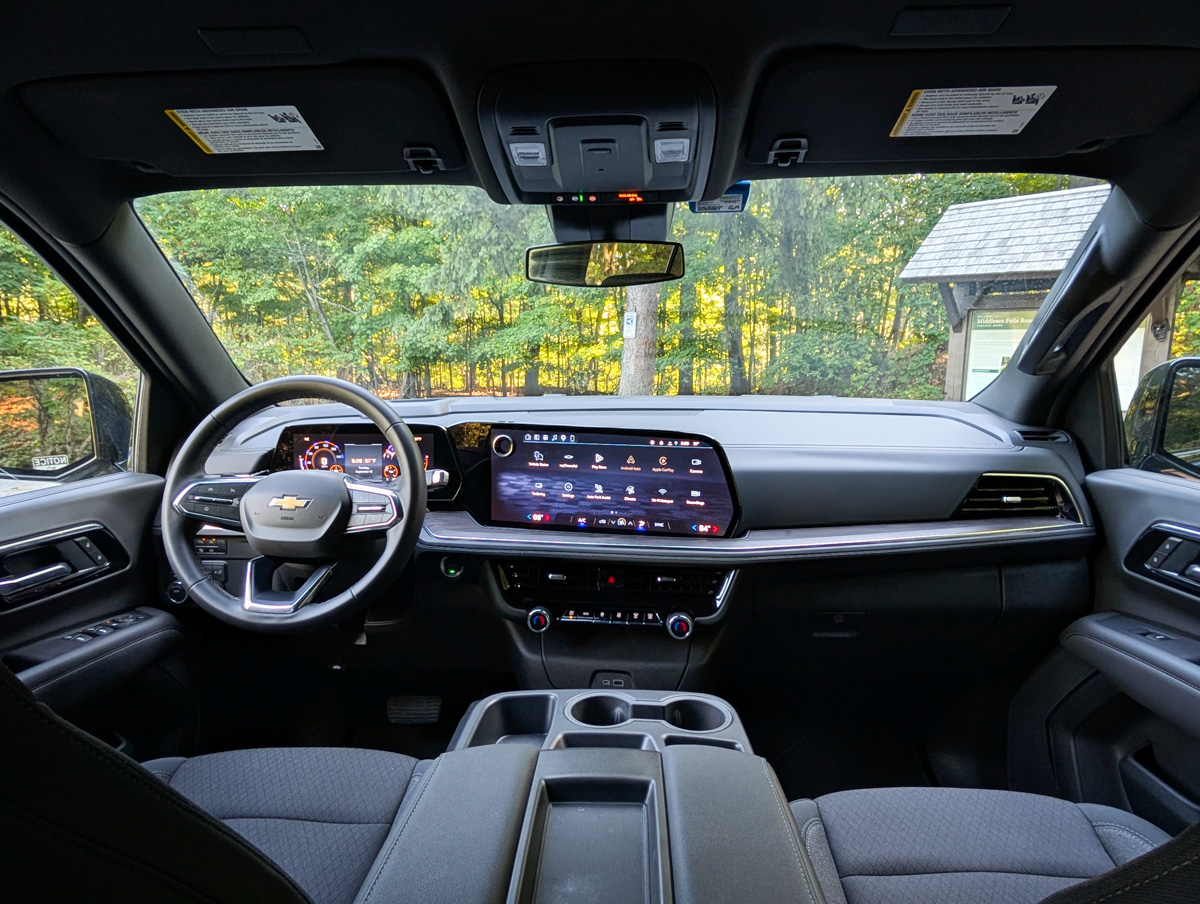
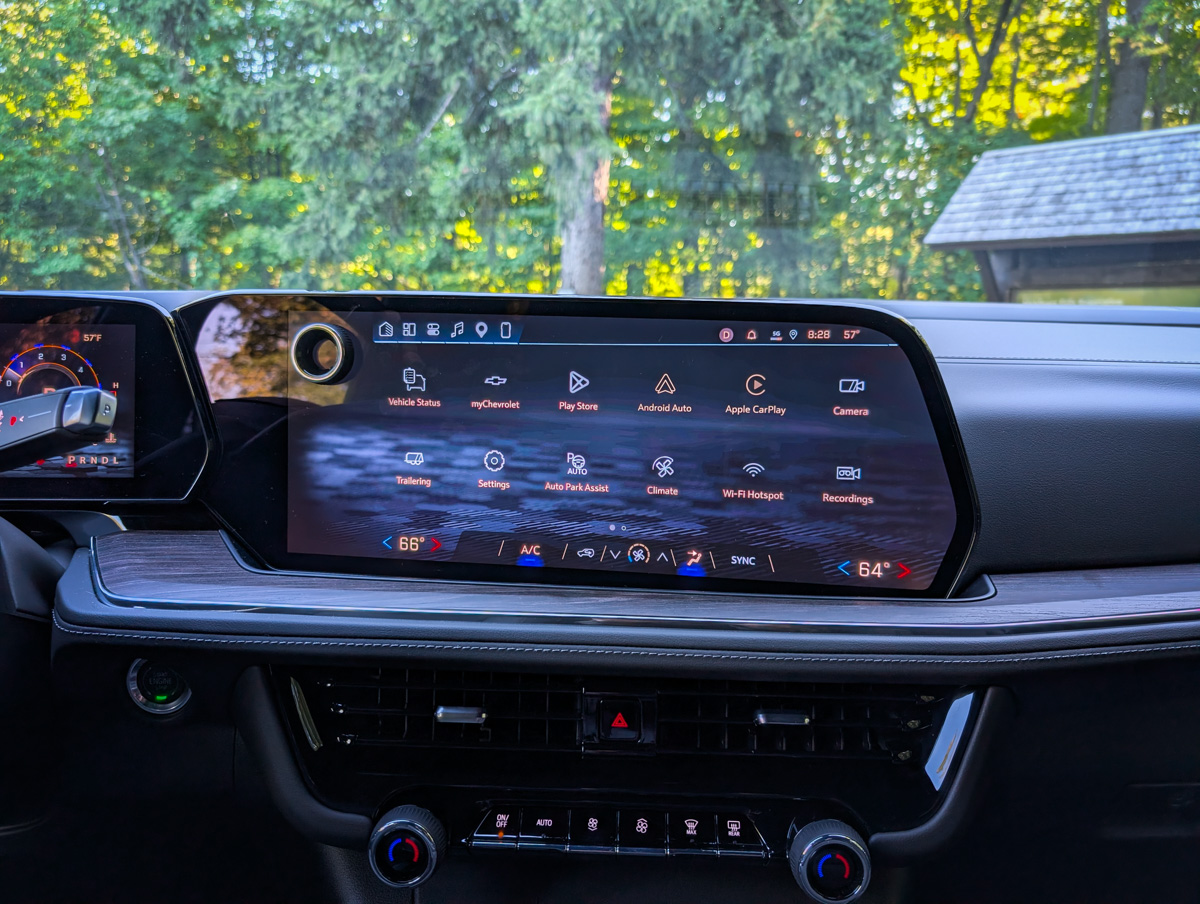
We tested the LS trim, which sits at the bottom of the ladder below the LT, RST, Z71, Premier, and top-tier High Country. Spend time in the LS and the Suburban still feels like a decidedly old-school SUV in places. There's no Super Cruise hands-free driving here — that's reserved for higher trims. But despite the lack of advanced tech, the cabin doesn't feel stripped down that much at all. A 17.7-inch touchscreen dominates the dash even on the entry trim, and physical buttons for climate control sit just below it. This combination gives the LS a more usable, less try-hard interior than some of its rivals. It goes a long way toward making the base Suburban feel like less of a rental-fleet special than its LS badge would suggest.
Performance
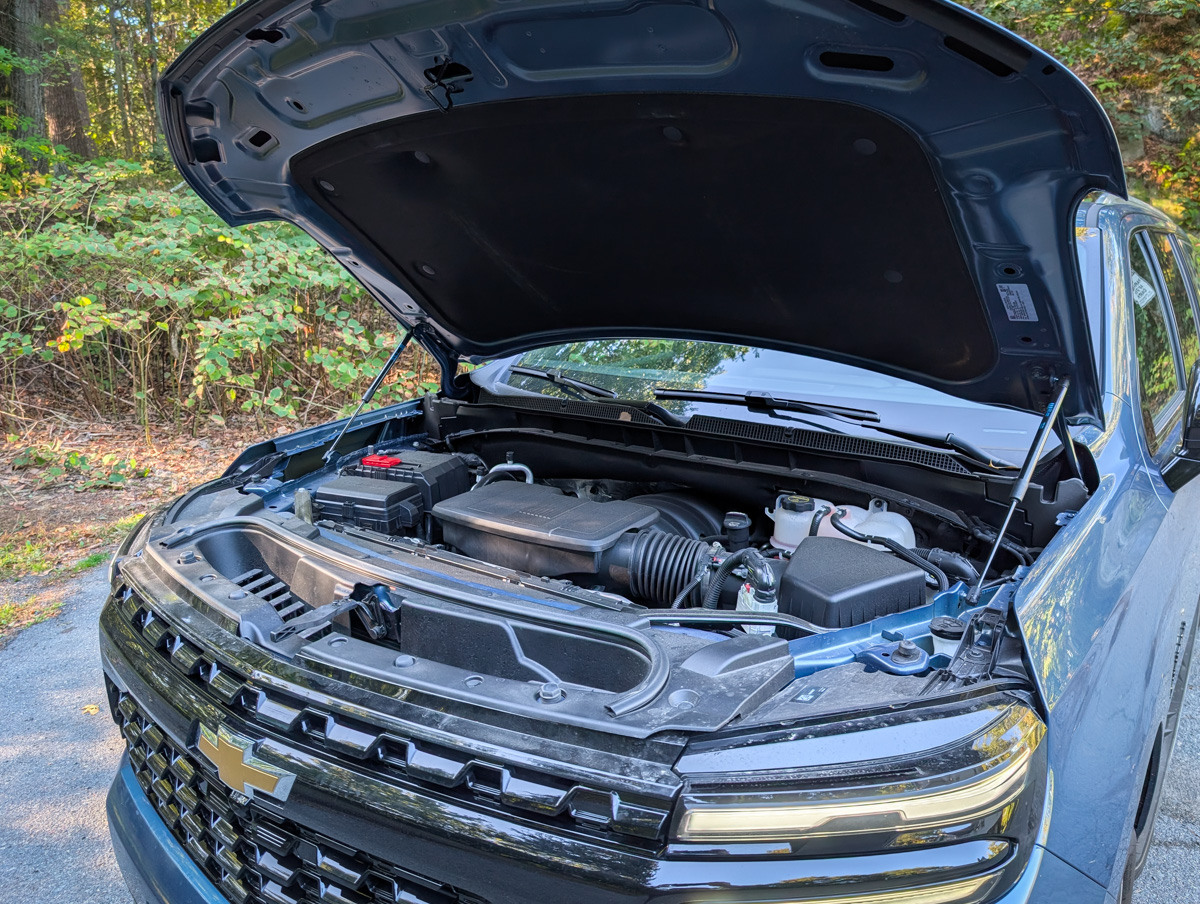
Underneath the sheet metal, the Suburban is still a truck, and it drives like one in the best sense of that word. The standard engine is a 5.3-litre V8 making 355 horsepower, plenty for a vehicle this size to feel unhurried rather than strained. Step up and a 6.2-litre V8 delivers a more assertive 420 horsepower, while a 3.0-litre Duramax diesel burns as little as 8.9 litres per 100 kilometres on the highway and remains the pick for anyone who spends real time there.
Our test vehicle was rated to tow up to 3,720 kilograms (8,200 pounds), and a properly equipped Suburban with the Max Towing Package can push that figure to 3,810 kilograms (8,400 pounds). That’s enough for most trailers, boats, or campers shoppers in this segment are hauling. All three engines pair with a 10-speed automatic transmission that shuffles through gears smoothly, although we did notice a few moments of gear indecision when chugging up some steeper inclines.
In Canada, rear-wheel drive (RWD) comes standard on the LS trim, while four-wheel drive (4WD) is available on this and standard on every other trim. We came away impressed with how little the Suburban's size worked against it once underway. Steering effort stays reasonably light for something this large, and the ride settles into a composed rhythm on the highway. Last year, we tested a 2025 model equipped with Magnetic Ride Control and came away particularly impressed. This year, our LS trim didn’t have that suspension tech, and it was noticeable.
The Chevy Suburban is the kind of vehicle that asks you to plan a bit further ahead in parking lots and narrow streets, but it rewards you the moment you point it toward open road. The diesel in particular stays impressively quiet at highway speeds, enough so that passengers unfamiliar with the Suburban's engine lineup would be unlikely to guess it isn't a gas V8. Nothing else in the segment beats the combination of towing muscle and everyday drivability that the 2026 Chevrolet Suburban offers.
Form & function
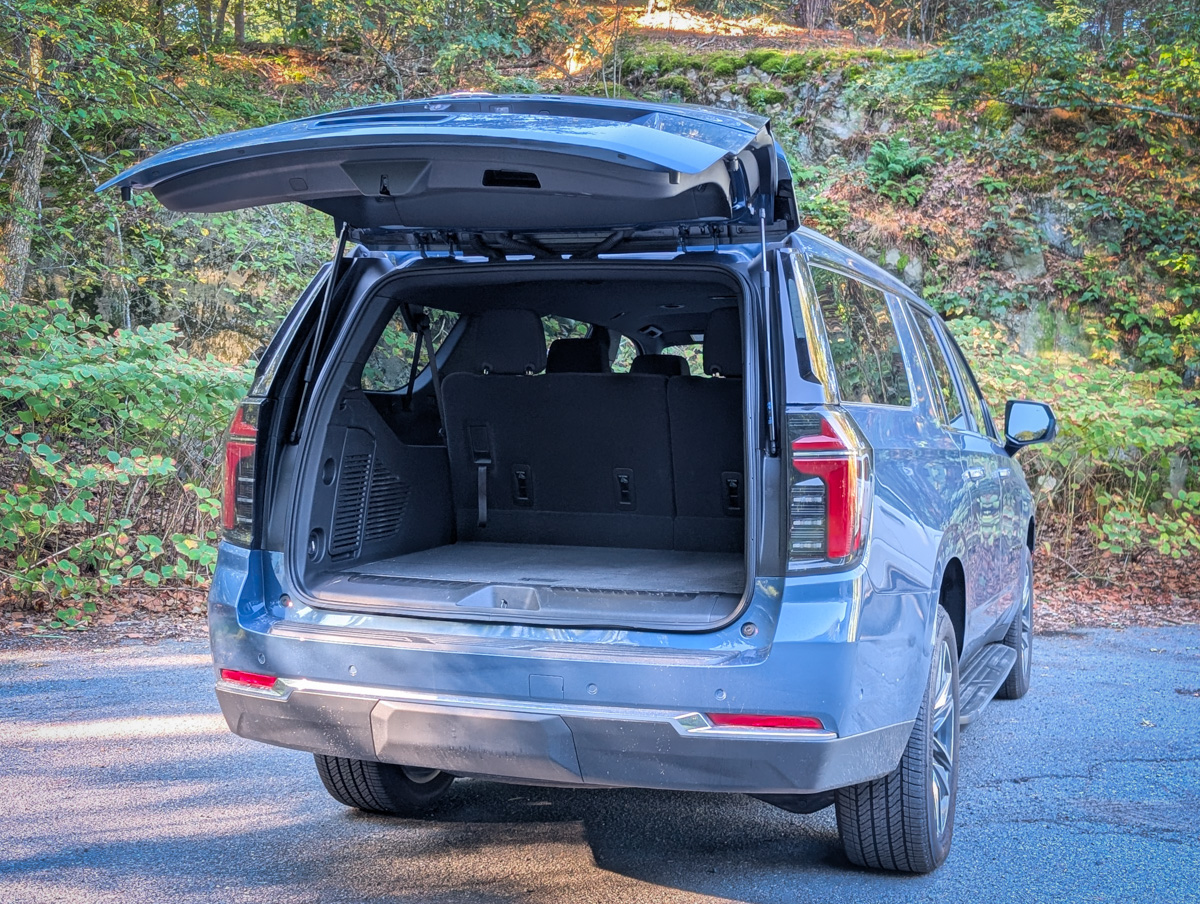
This is where the Suburban still separates itself from nearly everything else on sale. Behind the third row there's 1,175 litres of cargo space, already enough for a family's worth of luggage. Fold the third row and that grows to 2,656 litres. Fold everything down to the first row and the Suburban opens up to 4,092 litres of total cargo volume. For context, the Chrysler Pacifica, one of the few vehicles that can plausibly compete on outright interior volume, falls short of the Suburban in every one of those three configurations. The Pacifica is easier to drive day to day, but if cargo space is the deciding factor in your shopping process, this comparison alone should settle it.
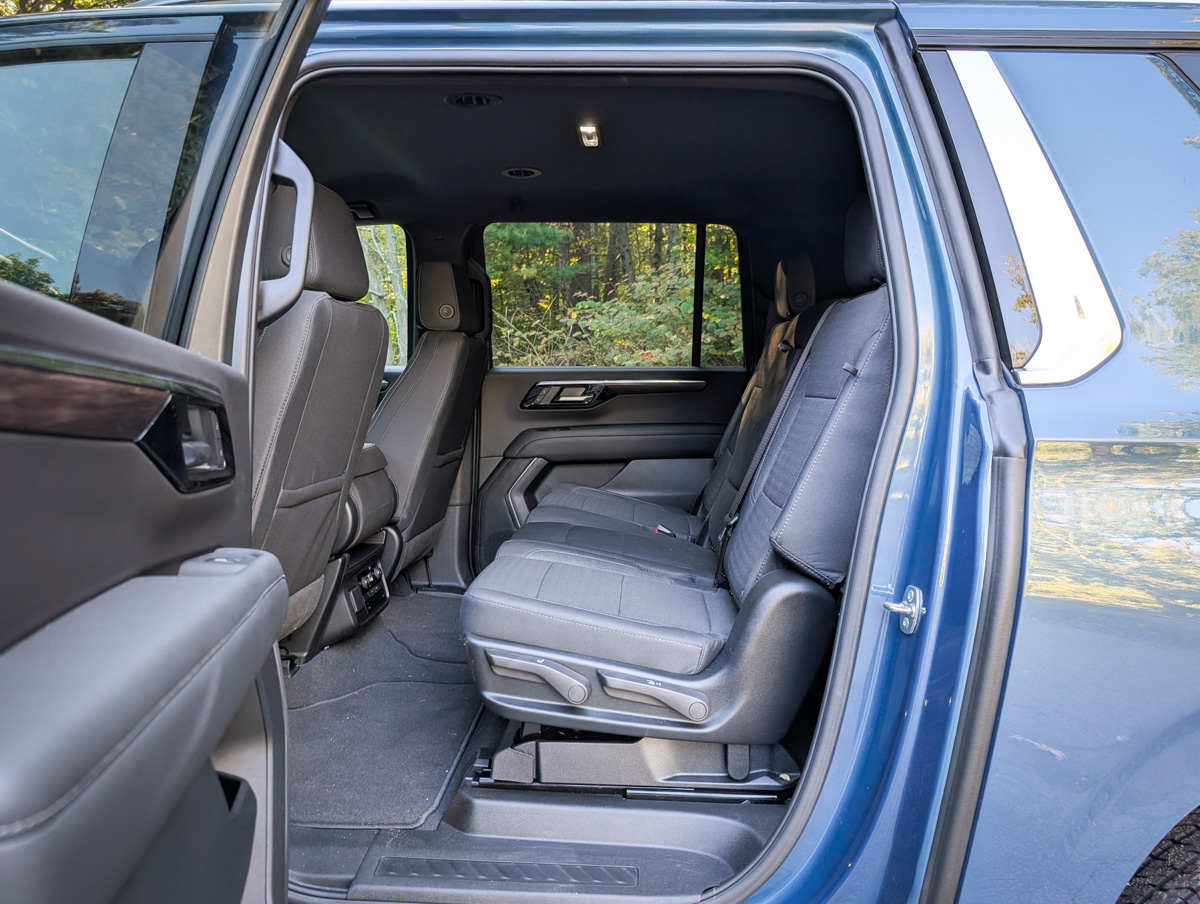
Passenger flexibility adds another layer. Depending on how you configure the front and second rows, the Suburban can be optioned to seat up to nine passengers, including a front bench seat option that trades individual bucket seats for a third front-row spot. Buyers who would rather prioritize comfort over headcount can swap the second-row bench for a pair of captain's chairs, which also makes climbing into the third row noticeably easier for adults, not just kids. Third-row legroom itself is generous by segment standards, and unlike some three-row competitors, nobody in the back is likely to describe the Suburban's rearmost seats as a penalty box.
Cargo tie-down anchors, a low load floor, and a power-folding third row on higher trims all make the space genuinely usable rather than just impressive on paper. Between the towing capacity, cargo figures, and seating flexibility, the Suburban continues to justify its footprint in a way few competitors can match.
Technology
A 17.7-inch touchscreen remains the centrepiece of the Suburban's cabin. It's a genuinely impressive piece of tech, even on the LS trim we tested. Wireless Apple CarPlay and Android Auto both come standard, and Google Built-In integrates Google Maps and the Play Store directly into the system for shoppers who would rather skip the phone mirroring step altogether. An 11-inch driver information display sits ahead of the steering wheel, and an available head-up display adds yet another readout for higher trims.
Driver assistance is a mixed bag by trim, though not for the reasons we expected. Adaptive cruise control comes standard even on the base LS. Super Cruise, GM's hands-free highway driving system, is a different story: it's optional only on higher trims. The steering wheel has more buttons and toggles than the simpler wheel it replaced a few years back, but most owners will adjust within the first few drives. The available Bose stereo is a pleasant upgrade over the standard system, even if it still trails the premium setups offered in some rivals.
The entry-level Suburban is better equipped than its badge suggests, but Chevy’s top-tier hands-free experience stays out of reach until you climb several trims up the ladder.
Safety
The Insurance Institute for Highway Safety (IIHS) hasn’t published fresh crash test results for the Suburban's current generation, but the U.S. National Highway Traffic Safety Administration (NHTSA) awarded it five stars in its overall evaluation.
Chevrolet offers a solid list of standard driver assistance features including automatic emergency braking, lane keeping assist, pedestrian and bicycle detection, a surround-view camera system, and a teen driver monitoring mode that lets parents set speed and volume limits for younger drivers. Trailer sway control comes standard as well, a detail towing-focused shoppers shouldn't overlook given how much of the Suburban's appeal rests on that capability.
It's the specifics within that list, like which trims have available Super Cruise versus only adaptive cruise control, that shoppers should verify before assuming a feature is included. We'd also point out that the absence of updated IIHS crash test data isn't the same as evidence of a problem, just an open question that cautious shoppers may want to weigh against the Suburban's otherwise strong feature set.
Cost-effectiveness
At the time of writing, the 2026 Suburban LS starts at $85,099 in Canada with the $2,700 destination fees included, a notable jump over where the base trim landed last year. Adding 4WD to the LS trim adds $3,500 to that price. Moving up the lineup, the LT starts at $92,699 with standard 4WD, the Z71 at $97,699, the RST at $98,699, the Premier at $106,699, and the High Country at $113,199. The diesel engine is available as a mid-tier upgrade on most trims that costs less than stepping up to the 6.2-litre V8. Note these prices do not include the federal luxury tax, which applies to the portion of the purchase price above $100,000.
Our Suburban tester remains an expensive proposition, especially when its base price rose without any accompanying jump in standard capability. Rivals like the GMC Yukon XL and Ford Expedition Max compete in a similar price band, and shoppers cross-shopping those options should weigh the price increase against what else has or hasn't changed.
Fuel costs are worth budgeting for too. The diesel's real-world highway fuel economy should help offset its higher upfront cost over time, particularly for owners who put serious highway klicks on their SUVs. Resale value has historically been a bright spot for the nameplate as well, which softens the blow of the higher sticker price somewhat since Suburbans tend to hold their value better than many three-row competitors once they hit the used market.
For buyers who genuinely need the Suburban's towing capacity and class-leading cargo room, it still earns its keep. For buyers on the fence, the higher entry price makes this a tougher sell than it was a year ago.
What owners say
Trims & specs
Base MSRP N/A | Seating 9 |
Engine 5.3L 355 hp V8 | Cargo Capacity 1175 L |
Combined MPG 17 | Drivetrain 4X2 |
Base MSRP N/A | Seating 8 |
Engine 5.3L 355 hp V8 | Cargo Capacity 1175 L |
Combined MPG 16 | Drivetrain 4X4 |
Base MSRP N/A | Seating 7 |
Engine 5.3L 355 hp V8 | Cargo Capacity 1175 L |
Combined MPG 17 | Drivetrain 4X2 |
Base MSRP N/A | Seating 8 |
Engine 6.2L 420 hp V8 | Cargo Capacity 1175 L |
Combined MPG 17 | Drivetrain 4X2 |
Base MSRP N/A | Seating 9 |
Engine 5.3L 355 hp V8 | Cargo Capacity 1175 L |
Combined MPG 16 | Drivetrain 4X4 |
Base MSRP N/A | Seating 8 |
Engine 6.2L 420 hp V8 | Cargo Capacity 1175 L |
Combined MPG 16 | Drivetrain 4X4 |
Base MSRP N/A | Seating 7 |
Engine 5.3L 355 hp V8 | Cargo Capacity 1175 L |
Combined MPG 16 | Drivetrain 4X4 |
Base MSRP N/A | Seating 8 |
Engine 5.3L 355 hp V8 | Cargo Capacity 1175 L |
Combined MPG 17 | Drivetrain 4X2 |
Base MSRP N/A | Seating 8 |
Engine 5.3L 355 hp V8 | Cargo Capacity 1175 L |
Combined MPG 16 | Drivetrain 4X4 |
Base MSRP N/A | Seating 8 |
Engine 5.3L 355 hp V8 | Cargo Capacity 1175 L |
Combined MPG 17 | Drivetrain 4X2 |
Base MSRP N/A | Seating 8 |
Engine 5.3L 355 hp V8 | Cargo Capacity 1175 L |
Combined MPG 16 | Drivetrain 4X4 |


Pricing trends
Current avg. market price
$98,555
Trending down by 6.2% this month
June 2026 - November 2026

