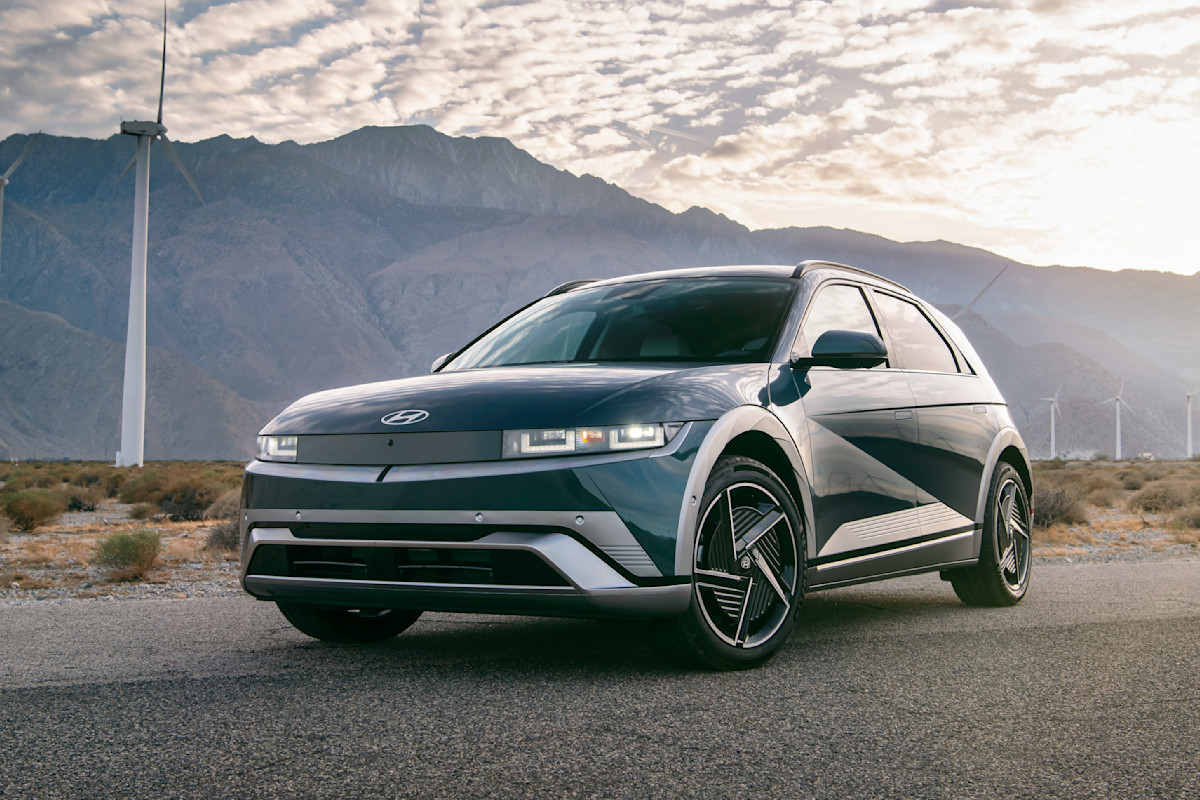
2026 Hyundai IONIQ 5 Reviews, Pricing & Specs


Pros & cons
What we like
Appealing styling
Easy-to-use technology
Extra-fast charging
What to consider
Less cargo space than gasoline crossovers
The CarGurus verdict
Even five years into its run, the Ioniq 5 remains one of the best EVs around.
Many automakers have had a tough time launching electric vehicles. Teething problems have resulted in build quality issues, gremlins, and production delays. Hyundai, however, got it right from the start with the Ioniq 5. Not only did this compact crossover nail the basics, it has also struck a chord for its stylish looks, fast charging capability, good range, and practicality.
Verdict: Five years into its run, the Ioniq 5 is still the electric vehicle we would recommend to most EV buyers.
out of 10 expert review
Look & feel
Combine a 1980s hatchback with a hint of modern crossover SUV and you have the Ioniq 5. That combination shouldn’t work, but it does. The profile is pure hatchback, though it’s larger than the Volkswagen Golf GTIs and Toyota Corollas we’re used to. It sports angular lines highlighted by a character line that rises straight from the rear wheels to the front of the doors where it meets the shoulder line. Together, they create a triangular shape that defines much of the profile. Dark cladding around the wheels and lower body adds to the crossover flavour.
Up front, a visor slit houses rectangular headlights, and a small grille opens in a darkened fascia that droops into a frown. The rear has an integrated spoiler, a darkened top panel that houses rectangular taillights, and a dark lower fascia to play off the front end. The result is an attractive crossover that comes off more like a car. The hatchback design also makes it look smaller than it is. In Canada, 19-inch wheels are the default.
Inside, the Ioniq 5 is more utilitarian than upscale but with a healthy dose of technology. Cloth upholstery is standard, while synthetic leather is available in the Ultimate Package, so there is no soft genuine leather. Black, grey, and teal-grey upholstery options are available, all of which create a rather cold theme. The tech includes a pair of 12.3-inch screens side by side as well as some touch controls for the climate system below. The overall look is somewhat sterile, which isn't unusual for a modern EV.

Performance
Hyundai offers the Ioniq 5 with a single-motor, rear-wheel-drive (RWD) powertrain that makes 225 hp and 258 lb-ft. Buyers can also pick a dual-motor, all-wheel-drive (AWD) powertrain that ups output to 320 hp and 446 lb-ft. The Ioniq 5 N performance model has its own dual-motor powertrain, good for up to 641 hp and 568 lb-ft of torque.
For our test drive, we sampled two U.S.-only trims (Limited and XRT), though each comes with the same dual-motor powertrain available in Canadian Preferred Long Range AWD models. The motors provide quiet, easy power that's especially robust from a stop. Sport mode makes the throttle livelier and passing easier, and the estimated 5.3-second 0 to 100 km/h time means the Ioniq 5 is quicker than any gas-powered crossover short of the turbocharged six-cylinder or V8 engines of the luxury segment.
Using the steering wheel paddles, drivers can choose from five settings of regenerative braking, which range from freewheeling in the 0 setting to one-pedal driving that creates a lot of drag when drivers back off the throttle in the i-Pedal Max setting. Freewheeling is less intrusive on a highway, and the Max setting works well for city or neighbourhood driving.
Like many EVs, the steering is direct but rather numb, and the handling is pleasant but not overly agile. There is some lean in corners, and the 2,000 kilograms (4,400 pounds) or so of curb weight means it can push rather than rotate if driven hard into a corner.

Form & function
The Ioniq 5 has spacious front seats. An eight-way power-adjustable driver’s seat is standard, and the same goes for the front passenger seat in the Ultimate Package. (Six-way manual adjustments are the default for the passenger without this package.) The front seats are heated in every Ioniq 5, and the Ultimate Package adds ventilated front seats, heated outboard rear seats, driver’s seat memory, and a “Relaxation” seat for the driver that reclines to an extreme angle and has a power footrest so the driver can stretch out when the car is charging.
The rear seat is also spacious thanks to a generous 1,002 millimetres of legroom. Two adults can fit back there easily. A third will be cramped for shoulder room, but they won’t have to deal with a driveshaft hump because there isn’t one.
Cargo space is slightly smaller than the average compact crossover. With the rear seats up, the Ioniq 5 has 745 litres of cargo space. Fold the second row down and that expands to 1,655 litres. That’s aided ever so slightly by the 24-litre front trunk. Maximum cargo space is about 150 to 300 litres less than that of gas-powered compact crossovers such as the Honda CR-V and the Toyota RAV4 though just 96 litres less than the Mustang Mach-e, and the steep angle of the rear hatch also saps some of the cargo usability.

Technology
The Ioniq 5’s technology is up to date and easy to use. It starts with a 12.3-inch digital instrument cluster and a 12.3-inch infotainment touchscreen under a single piece of glass. Also standard are wireless Apple CarPlay and Android Auto along with built-in navigation. A wireless smartphone charger and a head-up display are included with the Ultimate Package, as is a Bose eight-speaker audio system (as opposed to the standard six-speaker unit).
The Ioniq 5 also comes with MyHyundai smartphone app functionality. The app lets owners precondition the car, monitor the state of charge, unlock the doors remotely, set charging schedules, check the battery level, and use connected navigation with real-time traffic information. A digital key function is part of the Ultimate Package.
The infotainment screen is well within the driver's reach and features a simple command structure that makes functions easy to find and set. Voice commands can also be used to control numerous functions. The climate functions are largely controlled by touch in a separate group of controls below the centre screen, and we like that they’re separate.

Safety
The 2026 Hyundai Ioniq 5 comes standard with a healthy list of safety features and offers even more as options. Standard fare includes blind spot monitoring, front and rear parking sensors, rear cross-traffic alert, forward collision warning with pedestrian and cyclist detection and intersection assist, automatic emergency braking, lane keep assist, a driver attention monitor, safe exit assist, adaptive cruise control, high beam assist, rear occupant alert, and Hyundai's Highway Driving Assist 1 that can handle the controls on select stretches of highway, though the driver’s hands have to stay on the wheel.
The Ultimate Package adds a surround-view camera system, blind spot cameras, side parking sensors, brake support for the parking sensors, evasive steering assist for the forward collision warning system, and Highway Driving Assist 2 that adds automatic lane changes to Highway Driving Assist 1.
The Ioniq 5 has great but limited crash test results. It earned Top Safety Pick+ from the Insurance Institute for Highway Safety (IIHS), but no crash test ratings from the U.S. National Highway Traffic Safety Administration (NHTSA) were available at the time of writing.
The lane keep assist doesn’t allow the Ioniq 5 to ping pong from lane marker to lane marker, and the blind spot camera system is an especially useful feature that more automakers should adopt.

Cost-effectiveness
In Canada, Hyundai offers the 2026 Ioniq 5 in Preferred Long Range, Preferred Long Range AWD, and high-performance N trim levels. The Preferred Long Range is RWD and starts at $57,799 including a $2,300 destination charge. As of this writing, a $5,000 discount is being offered. If you can negotiate another $500 off from the dealer to bring the before-fees invoice price to below $50,000, the Ioniq 5 can qualify for another $5,000 rebate through the federal government’s Electric Vehicle Affordability Program.
Pricing on the Preferred Long Range AWD starts at $59,799 including delivery fees, and the Ultimate Package adds $6,000 to this price. The $5,000 manufacturer incentive is available on this model as well as of this writing. The 2027 Hyundai Ioniq 5 N is priced in Canada at $80,499.
With RWD, the 2026 Ioniq 5 has a Natural Resources Canada rated range of 504 kilometres. Adding AWD brings this down to 463 km. The performance-oriented Ioniq 5 N has a 356-km range. We prefer the additional power of the second motor, even though it drops the range. We averaged 18.8 kWh/100 km in the U.S. Limited model we drove, which was actually better than the 21.5 kWh/100 km NRCan rating.
An 800-volt electrical architecture allows the Ioniq 5 to charge from 10%–80% in 20 minutes with a Combined Charging System (CCS) adapter at a rate of up to 250 kW. The vehicle has a standard NACS adapter that lets it charge on Tesla Superchargers. However, those chargers top out at 150 kW, which increases the charge time with the larger battery to 30 minutes. An 11-kW onboard charger lets the Ioniq 5 charge from 10%–100% in seven hours and 20 minutes on a Level 2 home charger. The high-voltage electrical architecture is quite advanced and gives the Ioniq 5 a charging speed advantage over several rivals, even over more aspirational models from Mercedes-Benz.
No matter which Ioniq 5 shoppers pick, they'll get one of the best EVs available, even though it’s five years into its run.

What owners say
Trims & specs
Base MSRP $43,300 | Seating 5 |
Engine 320 hp Electric | Cargo Capacity 26.3 cu ft |
Combined MPG 107 | Drivetrain AWD |
Base MSRP $39,800 | Seating 5 |
Engine 225 hp Electric | Cargo Capacity 26.3 cu ft |
Combined MPG 116 | Drivetrain RWD |
Base MSRP $48,975 | Seating 5 |
Engine 320 hp Electric | Cargo Capacity 26.3 cu ft |
Combined MPG 99 | Drivetrain AWD |
Base MSRP $45,075 | Seating 5 |
Engine 225 hp Electric | Cargo Capacity 26.3 cu ft |
Combined MPG 116 | Drivetrain RWD |
Base MSRP N/A | Seating N/A |
Engine N/A | Cargo Capacity N/A |
Combined MPG N/A | Drivetrain N/A |
Base MSRP $41,000 | Seating 5 |
Engine 320 hp Electric | Cargo Capacity 26.3 cu ft |
Combined MPG 107 | Drivetrain AWD |
Base MSRP $37,500 | Seating 5 |
Engine 225 hp Electric | Cargo Capacity 26.3 cu ft |
Combined MPG 116 | Drivetrain RWD |
Base MSRP $35,000 | Seating 5 |
Engine 168 hp Electric | Cargo Capacity 26.3 cu ft |
Combined MPG 117 | Drivetrain RWD |
Base MSRP $46,275 | Seating 5 |
Engine 320 hp Electric | Cargo Capacity 26.3 cu ft |
Combined MPG 95 | Drivetrain AWD |
Base MSRP $46,725 | Seating 5 |
Engine 320 hp Electric | Cargo Capacity 26.3 cu ft |
Combined MPG 95 | Drivetrain AWD |
Base MSRP N/A | Seating N/A |
Engine N/A | Cargo Capacity N/A |
Combined MPG N/A | Drivetrain N/A |
Base MSRP N/A | Seating 5 |
Engine 225 hp Electric | Cargo Capacity 18.8 cu ft |
Combined MPG 71 | Drivetrain RWD |
Base MSRP N/A | Seating N/A |
Engine N/A | Cargo Capacity N/A |
Combined MPG N/A | Drivetrain N/A |