2026 Hyundai Ioniq 9 Reviews, Pricing & Specs
Write a review$58,995 to $76,490
Original MSRP
7.3
of 10
expert review
avg user rating
(0 reviews)
Pros
Very energy efficient
Great interior space
Competitive price tag
Cons
Polarizing design
Unimpressive driving dynamics
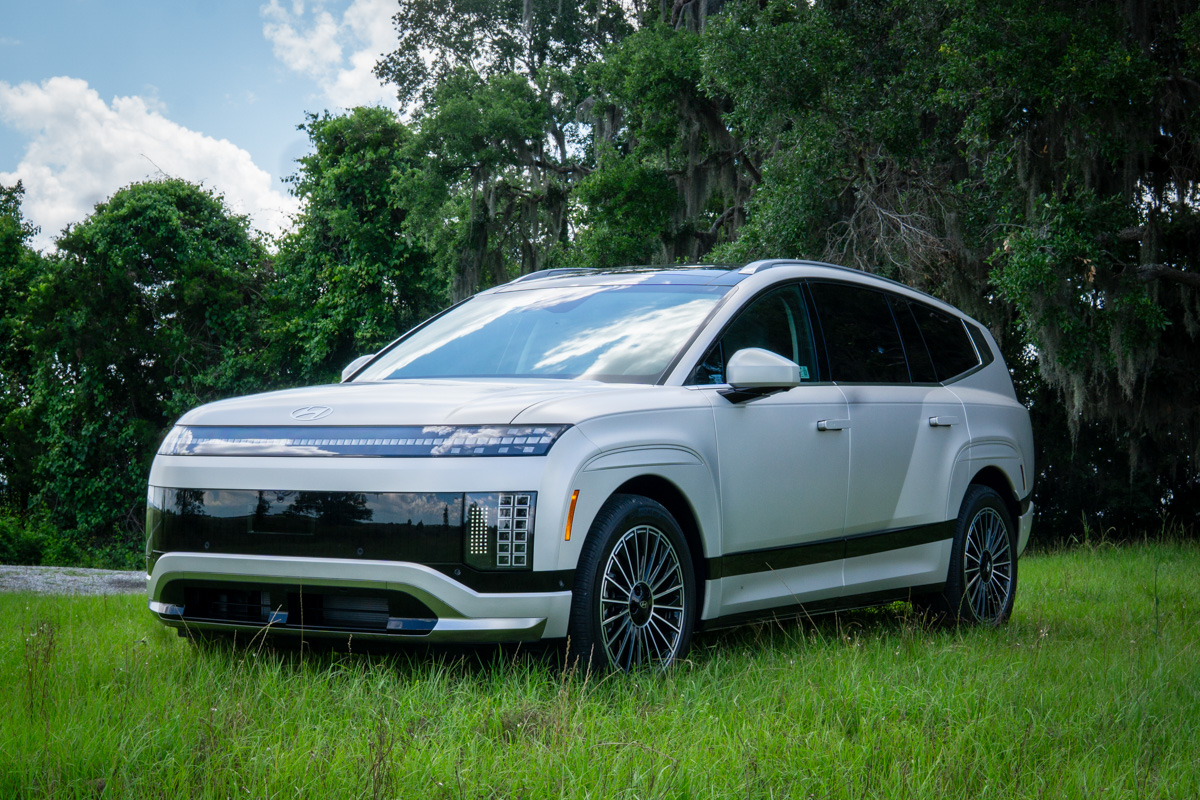
Hyundai’s three-row SUV offers seating for seven, a minimum of 500 kilometres of range, and access to Canada’s remaining EV rebates.
Although the 2026 Hyundai Ioniq 9 isn’t the first three-row electric SUV through the door, it may be the best choice for most shoppers. With a starting price of $59,999 before fees and qualifying for EV rebates where they still exist, it’s much more affordable than a Tesla Model X or a Rivian R1S. And its standard 110.3-kWh battery pack provides a long range compared to a base-model Kia EV9.
Verdict: The Hyundai Ioniq 9 isn’t a perfect vehicle, but it offers terrific passenger space, good tech, and family-friendly features. Shoppers may find its design polarizing — you could easily say the same about the Hyundai Ioniq 5 or the Ioniq 6 — but families interested in electric vehicles will do well to test drive this new option.

“Good” design is inherently subjective, and from time to time that presents some challenges. Take the 2026 Hyundai Ioniq 9. Many onlookers will appreciate this new electric crossover’s distinctive design. Others will recoil. Hyundai’s design team claims many sources of inspiration when talking about the Ioniq 9’s curved sheet metal, from smooth pebbles to midcentury modern sofas, but it seems clear the mission was first and foremost to produce a slippery, aerodynamic shape that could comfortably house seven passengers.
And, by the numbers, the team succeeded. The Ioniq 9 is 5,060 millimetres long and rides on a 3,130 mm wheelbase. For reference, that puts it at just barely shorter in length than a Honda Pilot, yet its wheelbase stretches longer than a Chevy Tahoe. These dimensions, made possible by Hyundai’s EV architecture, result in terrific interior volume. However, despite the Ioniq 9’s size, it manages a 0.27 drag coefficient, making it much more aerodynamic than a big Rivian SUV.
Although the Ioniq 9’s design is clearly effective in terms of efficient space, it’s tough to classify this as a truly beautiful car. The swooping roofline is offset by a dramatically stubby rear end — Hyundai claims a ship’s stern as the inspiration here — and horizontal character lines above each wheel well add further dissonance to the Ioniq 9’s styling. The rear view of the Ioniq 9 is definitely the most recognizable angle, with LED taillights wrapping around nearly 75 percent of the tail’s circumference.
Hyundai offers the 2026 Ioniq 9 in seven paint colours in Canada, although many are trim-specific. The base Essential RWD trim defaults to Sunset Brown, while the Preferred AWD opens options up to black, white, and grey. Add the Luxury package to the latter to access Biophilic Blue and Ionosphere Green as well as an extra gloss grey and a matte grey finish. Preferred AWD+ reverts to Sunset Brown, while adding the Ultimate Calligraphy package to the latter restores the full palette of colour options.
Wheels range from 19 to 21 inches, with the Preferred AWD+, Preferred AWD with Luxury Package, and Preferred AWD+ with Ultimate Calligraphy Package receiving their own unique designs. Our test car, the U.S. equivalent of Canada’s Preferred AWD+ Ultimate Calligraphy, came with matte paint, and we particularly liked its jet-turbine-inspired 21-inch wheels.
Inside, the Ioniq 9 is a spacious and airy masterpiece. As with the Ioniq 5, the Ioniq 9’s EV platform allows for flat floors in the front and back, and Hyundai doesn’t clutter the space with unnecessarily large consoles. The dashboard offers multiple cubbies, the doors have a nicely scalloped shape, and on the Luxury and Ultimate Calligraphy packages, a panoramic sunroof stretches nearly the entire length of the roof. The centre console slides forward and backward as well.
Hyundai sells the Essential and Preferred AWD+ trim levels with cloth upholstery in black and grey. The other configurations upgrade to leatherette, which is black by default but can be black and grey in the Luxury and Ultimate Calligraphy packages at no extra cost.
The Ioniq 9’s interior does feature quite a bit of plastic, but it is at least high quality. A dashboard insert ahead of the front passenger seat in our test vehicle had a hammered aluminum look, but it felt a bit underwhelming, almost as if it was an applied decal. Similarly, the Ioniq 9’s seats are soft but not overly supportive; they particularly lack thigh support.

Every 2026 Hyundai Ioniq 9 comes equipped with a 110.3-kWh battery pack, mounted in the skateboard style on the company’s lauded e-GMP platform. This is a bigger battery than you’ll find in the otherwise similar Kia EV9 and the Tesla Model X, but it’s significantly smaller than the massive batteries used by Rivian and GM.
The base Essential trim is offered with rear-wheel drive (RWD) only thanks to a single, rear-mounted 160-kW electric motor, which translates to 215 horsepower. Every other trim receives a dual-motor all-wheel-drive (AWD) system, although power output depends on trim level. The Preferred AWD makes 303 hp, while the Preferred AWD+ powertrain generates 422 hp.
Despite driving the most powerful iteration, we saw impressive energy efficiency during our first drive, with the trip computer regularly reporting more remaining range than what Natural Resources Canada’s 500-kilometre estimate for this powertrain would suggest. Consider us impressed.
EVs are heavy vehicles — batteries weigh a lot — and the Ioniq 9’s chassis is very softly sprung, which leads to a smooth and pillowy ride on most roads. Unfortunately, the combination of the vehicle’s weight and the soft suspension make the Ioniq 9 an unsophisticated corner carver. Although it looks the part of a futuristic SUV, it corners more like a minivan. Luckily, most shoppers will be happy to trade some dexterity for an ultra-smooth ride. In the same vein, the Ioniq 9 is astonishingly quiet. Even at highway speeds, the top trim’s active noise cancellation, sound-absorbing tires, and first- and second-row acoustic glass do a terrific job of quieting down any wind and road noise from creeping into the cabin.
Hyundai claims 1,587 kilograms (3,500 pounds) of towing capacity on the RWD Ioniq 9 Essential, while AWD models can tow 2,268 kilograms (5,000 pounds). Note that the driving range will drop when towing, however. When it does come time to charge the Ioniq 9’s batteries, owners can use either the Tesla-style NACS superchargers or, via an included adapter, other CCS-port Level 3 chargers, such as those found from Electrify Canada or Flo. Hyundai claims charging the battery from 10 to 80% on a NACS V3 Supercharger will take 40 minutes, or 24 minutes on a 350-kW CCS-port DC Fast Charger (if you can find one). Plug your Ioniq 9 into an AC Level 2 (240-volt) home charging port, and it should go from 10 to 100% in 9 hours 40 minutes.

There’s a strong family-SUV focus with the Ioniq 9, which is evident given the interior’s practical dimensions. Most configurations seat seven thanks to a middle-row bench seat, while the Preferred AWD+ with the Ultimate Calligraphy Package trades the bench for ventilated captain’s chairs and seating for six. This package also adds Hyundai’s sliding centre console, which can be opened from the front seats and the second row. It slides forward and aft to improve access for the middle-row passengers.
1,086 millimetres of legroom in the middle row is superb, although 813 mm in the third row did feel a bit tight for adults. These figures put the Ioniq 9’s interior passenger space on par with the Hyundai Palisade. We were particularly impressed by the ease of access and the headroom, though. The rear doors are massive and swing out wide, creating a huge entryway. Loading and unloading children from the second-row or third-row seats will be nearly as easy in an Ioniq 9 as it would be in a minivan with sliding doors.
Dual-zone climate control comes standard, and there are air vents in all three rows. A heat pump is also standard, which should help negate energy loss during colder months. Heated front seats are standard, but a heated steering wheel doesn’t come in until the Preferred AWD grade. To get heated second-row seats, you’ll need to add either the Luxury or Ultimate Calligraphy package.
We found it difficult to position the driver’s seat into a comfortable position, leading us to wish the Ioniq 9’s seats were available with more than eight-way adjustability. Additionally, the glove compartment is mounted strangely low, and it’ll bang into your front passenger’s shins if they’re not careful when opening it.
Behind the third row, the Ioniq 9 offers 620 litres of cargo space, which expands to 1,323 and 2,462 litres when the third and second rows are folded, respectively. This is as much as you can hope to expect in a unibody crossover, but don’t expect to squeeze much into the small front trunk. That space is best utilized as storage for the charging cable and CCS adapter.

Hyundai has installed a familiar infotainment interface in the Ioniq 9. Made up of dual curved 12.3-inch displays, it’s the same setup you’ll find in higher-level Hyundai Tucsons and the Hyundai Santa Fe. The screens look good and work well, although they collect fingerprints easily and can reflect a pretty significant amount of glare when the sun is positioned just so.
SiriusXM Satellite Radio capability is standard fare in the Ioniq 9, as are wireless Android Auto and wireless Apple CarPlay. A wireless charging pad comes standard as well, but we found it couldn’t keep up with our Google Pixel 9 phone’s battery demands while projecting Android Auto. The charging pad also isn’t ventilated, and as a result our phone got awfully toasty while driving on a hot day.
However, don’t worry about devices running out of juice when you’re in an Ioniq 9. Every trim comes standard with six USB-C ports capable of pumping out 100 watts of power — enough to charge a laptop, given the proper cable.
Our test car came with a 14-speaker Bose audio system (standard with the Luxury package and all Preferred AWD+ configurations), which provided an unexpectedly crisp soundstage with such balanced tones that we could pick out individual instruments in a variety of music. Bose stereos don’t always get the same level of appreciation that Harmon Kardon or McIntosh systems do — let alone high-end stereos from Bang and Olufson or Burmester — but we found the optional system in the Ioniq 9 very impressive.

Crash-test ratings from the National Highway Traffic Safety Administration (NHTSA) and the Insurance Institute for Highway Safety (IIHS) have not yet been compiled.
Hyundai does include an impressive array of advanced driver assistance systems (ADAS) as standard equipment. In addition to collision avoidance and lane-guidance technologies now standard on most new vehicles, the Ioniq 9 includes a driver attention warning, safe-exit assist, and the company’s Highway Driving Assist 2 on every trim level. HDA 2 essentially pairs lane-keeping assist with adaptive cruise control to provide supervised hands-free driving. It’s not as sophisticated as Ford’s BlueCruise or GM’s SuperCruise, but it doesn’t require a subscription, either.
The Preferred AWD’s Luxury package and all versions of the Preferred AWD+ receive a helpful surround-view monitor, plus the terrific blind-spot view monitor that shows a camera feed of the vehicle’s blind spots when you flick the corresponding turn signal. Additional parking aids are equipped on Preferred AWD+ as well.

At $62,779 (including a $2,050 destination charge and other fees) for the base Essential RWD trim, the Ioniq 9’s starting MSRP sits on par with the Kia EV9. However, the base Ioniq 9 offers significantly more driving range.
Prices rise to $67,779 for either the Preferred AWD or the Preferred AWD+. Adding the Luxury package to the former raises the price by $11,500 for a total of $79,665, while the Ultimate Calligraphy package adds $16,500 to the Preferred AWD+ for a total of $84,665.
At the top end, these prices make the 2026 Ioniq 9 the most expensive Hyundai ever produced, at least for North America. However, even the most expensive Ioniq 9 is still priced well below the Canadian average in the three-row crossover EV market. A Rivian R1S, for example, opens at $140,990. A Model X starts at $149,990, and a Cadillac Escalade IQ — admittedly a much larger and more luxurious vehicle — has a starting price north of $160,000. In fact, the Ioniq 9 is the only vehicle among these priced affordably enough to qualify for provincial and territorial EV rebates where they still exist.
Truthfully, the only vehicle in the Ioniq 9’s ballpark is the Kia EV9, and the top-level GT-Line trim of that car costs only a couple thousand dollars less than the Ioniq 9 Preferred AWD+ Ultimate Calligraphy.
Given the Ioniq 9’s impressive battery capacity, energy efficiency, advanced tech, and comfortable interior, we view it as an impressive value in the continuously evolving three-row EV space. Particularly if you’re shopping with a family in mind, it’s worth a test drive.

User reviews for 2026 Hyundai Ioniq 9
Write a review2026 Hyundai Ioniq 9 Pricing
Trims & specs
Air Conditioning
Automatic climate control front air conditioning · Dual front air conditioning zones · Automatic climate control rear air conditioning · Single rear air conditioning zones · Second and third row rear heat vents
Airbags
Dual front airbags · Driver knee airbags · Passenger airbag deactivation: occupant sensing deactivation · Front side airbags · Third row side curtain airbags
Audio System
Antenna Type: diversity · Voice recognition audio system · USB auxiliary audio input · AM/FM radio · Satellite Radio: SiriusXM · Total Number of Speakers: 8
Brakes
ABS: 4-wheel · Braking assist: hill start assist · Electronic parking brake: auto off · Front brake diameter: 14.2 · Front brake width: 1.2 · Front brakes: ventilated disc · Rear brake diameter: 13.6 · Rear brake width: 0.79 · Rear brakes: ventilated disc
Comfort Features
Armrests: rear center with cupholders · Door sill trim: scuff plate · Floor Material: carpet · Steering wheel trim: leatherette
Convenience Features
Adaptive stop and go cruise control: semi-automatic · Assist handle: rear · Autonomous lane guidance: lane centering · Cargo area power outlet: 12V · Center console: front console with armrest and storage · Cruise control: adaptive · Cupholders: rear · Multi-function remote: proximity entry system · One-touch windows: 2 · Power outlet(s): USB-C front · Power steering: speed-proportional · Power windows: lockout button · Reading lights: rear · Steering wheel: tilt and telescopic · Steering wheel mounted controls: audio · Storage: accessory hook · Vanity mirrors: dual illuminating
Driver Seat
Adjustable lumbar support: power · Power adjustments: 8
Drivetrain
Axle ratio: 13.16
Engine
Battery: maintenance-free · EV battery capacity: 110 kWh · Electric Motor Battery Type: lithium ion · Electric Motor HP: 215 · Electric Motor Power Output (Kilowatts): 160 · Electric Motor Torque: 258 · Electric charge cord: autoswitching 110V/240V · Electric motor charger: DC fast charging · Electric motor charger connector: Tesla (SAE J3400) · Electric motor charging time (120V): 93 hours · Electric motor charging time (240V): 9.7 hours · Electric motor miles per charge: 335
Exterior Features
Body side moldings: black · Door handle color: body-color · Fender lip moldings: black · Front bumper color: body-color · Grille color: black · Mirror color: body-color · Rear bumper color: body-color · Rear spoiler: roofline spoiler · Rear spoiler color: black · Rear trunk/liftgate: power operated · Rocker panel color: black · Window trim: chrome
Headrests
Front headrests: adjustable · Number of front headrests: 2 · Number of rear headrests: 3 · Number of third row headrests: 2
In Car Entertainment
Connected in-car apps: Google POIs · Infotainment: Blue Link · Infotainment screen size: 12.3 in. · Smartphone integration: wireless Android Auto
Instrumentation
Fuel economy display: range · Instrument cluster screen size: 12.3 in. · Warnings and reminders: low battery
Lights
Daytime running lights: LED · Headlights: Auto on/off · Tail and brake lights: LED
Mirrors
Exterior mirrors: integrated turn signals · Inside rearview mirror: manual day/night
Passenger Seat
Manual Adjustments: 4
Rear Seats
Type: 60-40 split bench
Roof
Roof rails: chrome
Safety
Automatic emergency braking: intersection/junction turn · Camera system: rearview · Child seat anchors: LATCH system · Cross Traffic Alert: rear · Evasive steering assist: head-on collision avoidance · Impact sensor: door unlock · Parking sensors: front · Pre-Collision Warning System: vibrating steering wheel · Pre-collision warning system: intersection/junction turn · Programmable safety key: MyKey · Rearview monitor: in dash · Traffic sign recognition: adaptive speed limiting
Seatbelts
Emergency locking retractors: front · Front seatbelts: 3-point · Seatbelt force limiters: front · Seatbelt pretensioners: front, rear and third row · Seatbelt warning sensor: driver and passenger · Second row seatbelts: 3-point · Third row seatbelts: 3-point
Seats
Driver seat power adjustments: height · Front seat type: bucket · Passenger seat manual adjustments: reclining · Third row seat folding: flat · Upholstery: cloth
Security
Power door locks: anti-lockout
Spare Tire
Kit: inflator kit
Steering
Steering ratio: 16.0 · Turns lock-to-lock: 2.90
Suspension
Front Arm Type: lower control arms · Front Shock Type: gas shock absorbers · Front Spring Type: coil springs · Front Suspension Classification: independent · Front Suspension Type: MacPherson struts · Rear Shock Type: gas shock absorbers · Rear Spring Type: coil springs · Rear Suspension Classification: independent · Rear Suspension Type: multi-link · Stabilizer bar(s): rear
Telematics
Driver assistance app: roadside assistance · Electronic messaging assistance: with read function · Navigation system: with voice recognition · Phone: voice activated · Phone wireless data link: Bluetooth · Smart device app compatibility: MyHyundai with Blue Link · Smart device app function: maintenance status · Wifi: hotspot
Third Row Seat
Type: 50-50 split bench
Tires
Type: all season
Tires and Rims
Wheel type: aluminum alloy
Windows
Front wipers: rain sensing · Laminated glass: acoustic · Liftgate window: fixed · Power windows: with safety reverse · Rear wiper: with washer · Solar-tinted glass: front
Air Conditioning
Automatic climate control front air conditioning · Dual front air conditioning zones · Automatic climate control rear air conditioning · Single rear air conditioning zones · Second and third row rear heat vents
Airbags
Dual front airbags · Driver knee airbags · Passenger airbag deactivation: occupant sensing deactivation · Rear side airbags · Rear side curtain airbags
Audio System
Antenna Type: element · Voice recognition audio system · Bluetooth auxiliary audio input · Touch screen display radio · Satellite Radio: SiriusXM · Total Number of Speakers: 8
Brakes
ABS: 4-wheel · Braking assist: hill start assist · Electronic parking brake: auto off · Front brake diameter: 14.2 · Front brake width: 1.2 · Front brakes: ventilated disc · Rear brake diameter: 13.6 · Rear brake width: 0.79 · Rear brakes: ventilated disc
Comfort Features
Armrests: rear center with cupholders · Door sill trim: scuff plate · Floor Material: carpet · Steering wheel trim: leatherette
Convenience Features
Adaptive stop and go cruise control: semi-automatic · Assist handle: front · Autonomous lane guidance: lane centering · Cargo area power outlet: 12V · Center console: front console with armrest and storage · Cruise control: adaptive · Cupholders: front, rear and third row · Multi-function remote: proximity entry system · One-touch windows: 2 · Power outlet(s): USB-C rear · Power steering: speed-proportional · Power windows: lockout button · Reading lights: front · Steering wheel: tilt and telescopic · Steering wheel mounted controls: multi-function screen controls · Storage: door pockets · Vanity mirrors: dual illuminating
Driver Seat
Adjustable lumbar support: power · Power adjustments: 8
Drivetrain
4WD Type: on demand · Axle ratio: 10.65
Engine
Battery: maintenance-free · EV battery capacity: 110 kWh · Electric Motor Battery Type: lithium ion · Electric Motor HP: 303 · Electric Motor Power Output (Kilowatts): 226 · Electric Motor Torque: 446 · Electric charge cord: autoswitching 110V/240V · Electric motor charger: DC fast charging · Electric motor charger connector: Tesla (SAE J3400) · Electric motor charging time (120V): 93 hours · Electric motor charging time (240V): 9.7 hours · Electric motor miles per charge: 320
Exterior Features
Body side moldings: black · Door handle color: body-color · Fender lip moldings: black · Front bumper color: body-color · Grille color: black · Mirror color: body-color · Rear bumper color: body-color · Rear spoiler: roofline spoiler · Rear spoiler color: black · Rear trunk/liftgate: liftgate · Rocker panel color: black · Window trim: chrome
Headrests
Front headrests: adjustable · Number of front headrests: 2 · Number of rear headrests: 3 · Number of third row headrests: 2
In Car Entertainment
Connected in-car apps: Google Assistant · Infotainment: Blue Link · Infotainment screen size: 12.3 in. · Smartphone integration: wireless Android Auto
Instrumentation
Fuel economy display: range · Instrument cluster screen size: 12.3 in. · Warnings and reminders: low washer fluid
Lights
Daytime running lights: LED · Headlights: Auto on/off · Tail and brake lights: LED
Mirrors
Exterior mirrors: heated · Inside rearview mirror: manual day/night
Passenger Seat
Adjustable lumbar support: power · Power adjustments: 8
Rear Seats
Type: 60-40 split bench
Roof
Roof rails: chrome
Safety
Automatic emergency braking: front pedestrian · Camera system: rearview · Child seat anchors: LATCH system · Cross Traffic Alert: rear · Evasive steering assist: head-on collision avoidance · Impact sensor: door unlock · Parking sensors: rear · Pre-Collision Warning System: vibrating steering wheel · Pre-collision warning system: pedestrian detection · Programmable safety key: MyKey · Rearview monitor: in dash · Traffic sign recognition: adaptive speed limiting
Seatbelts
Emergency locking retractors: front and rear · Front seatbelts: 3-point · Seatbelt force limiters: front and rear · Seatbelt pretensioners: front, rear and third row · Seatbelt warning sensor: driver and passenger · Second row seatbelts: 3-point · Third row seatbelts: 3-point
Seats
Driver seat power adjustments: height · Front seat type: bucket · Passenger seat power adjustments: height · Third row seat folding: flat · Upholstery: cloth
Security
Power door locks: anti-lockout
Spare Tire
Kit: inflator kit
Steering
Steering ratio: 16.0 · Turns lock-to-lock: 2.90
Suspension
Front Arm Type: lower control arms · Front Shock Type: gas shock absorbers · Front Spring Type: coil springs · Front Suspension Classification: independent · Front Suspension Type: MacPherson struts · Rear Shock Type: gas shock absorbers · Rear Spring Type: coil springs · Rear Suspension Classification: independent · Rear Suspension Type: multi-link · Stabilizer bar(s): rear
Telematics
Driver assistance app: roadside assistance · Electronic messaging assistance: with voice recognition · Navigation system: with voice recognition · Phone: voice activated · Phone wireless data link: Bluetooth · Smart device app compatibility: MyHyundai with Blue Link · Smart device app function: maintenance status · Wifi: hotspot
Third Row Seat
Type: 50-50 split bench
Tires
Type: all season
Tires and Rims
Wheel type: aluminum alloy
Windows
Front wipers: variable intermittent · Laminated glass: acoustic · Liftgate window: fixed · Power windows: with safety reverse · Rear wiper: with washer · Solar-tinted glass: front
Air Conditioning
Automatic climate control front air conditioning · Dual front air conditioning zones · Automatic climate control rear air conditioning · Single rear air conditioning zones · Second and third row rear heat vents
Airbags
Dual front airbags · Driver knee airbags · Passenger airbag deactivation: occupant sensing deactivation · Front side airbags · Front side curtain airbags
Audio System
Antenna Type: element · Voice recognition audio system · USB auxiliary audio input · HD radio · Satellite Radio: SiriusXM · Total Number of Speakers: 8
Brakes
ABS: 4-wheel · Braking assist: hill start assist · Electronic parking brake: auto off · Front brake diameter: 14.2 · Front brake width: 1.2 · Front brakes: ventilated disc · Rear brake diameter: 13.6 · Rear brake width: 0.79 · Rear brakes: ventilated disc
Comfort Features
Armrests: rear center with cupholders · Door sill trim: scuff plate · Floor Material: carpet · Steering wheel trim: leatherette
Convenience Features
Adaptive stop and go cruise control: semi-automatic · Ambient lighting: color-adjustable · Assist handle: front · Autonomous lane guidance: lane centering · Cargo area power outlet: 12V · Center console: front console with armrest and storage · Cruise control: adaptive · Cupholders: front · Dimming rearview mirror: auto-dimming · Footwell lights: color-adjustable · Multi-function remote: trunk release · One-touch windows: 2 · Power outlet(s): 12V front · Power steering: speed-proportional · Power windows: lockout button · Reading lights: rear · Steering wheel: tilt and telescopic · Steering wheel mounted controls: cruise controls · Storage: accessory hook · Universal garage door opener: Homelink · Vanity mirrors: dual illuminating
Driver Seat
Adjustable lumbar support: power · Power adjustments: 8
Drivetrain
4WD Type: on demand · Axle ratio: 10.65
Engine
Battery: maintenance-free · EV battery capacity: 110 kWh · Electric Motor Battery Type: lithium ion · Electric Motor HP: 303 · Electric Motor Power Output (Kilowatts): 226 · Electric Motor Torque: 446 · Electric charge cord: autoswitching 110V/240V · Electric motor charger: DC fast charging · Electric motor charger connector: Tesla (SAE J3400) · Electric motor charging time (120V): 93 hours · Electric motor charging time (240V): 9.7 hours · Electric motor miles per charge: 320
Exterior Features
Body side moldings: black · Door handle color: body-color · Fender lip moldings: black · Front bumper color: body-color · Grille color: black · Mirror color: body-color · Rear bumper color: body-color · Rear spoiler: roofline spoiler · Rear spoiler color: black · Rear trunk/liftgate: power operated · Rocker panel color: black · Window trim: chrome
Headrests
Front headrests: adjustable · Number of front headrests: 2 · Number of rear headrests: 3 · Number of third row headrests: 2
In Car Entertainment
Connected in-car apps: Google Assistant · Infotainment: Blue Link · Infotainment screen size: 12.3 in. · Smartphone integration: wireless Android Auto
Instrumentation
Fuel economy display: range · Instrument cluster screen size: 12.3 in. · Warnings and reminders: low washer fluid
Lights
Daytime running lights: LED · Headlights: auto delay off · Tail and brake lights: LED
Mirrors
Exterior mirrors: power
Passenger Seat
Adjustable lumbar support: power · Power adjustments: 8
Rear Seats
Type: 60-40 split bench
Roof
Roof rails: chrome
Safety
Automatic emergency braking: front · Blind spot safety: passenger side camera · Camera system: surround view · Child seat anchors: LATCH system · Cross Traffic Alert: rear · Evasive steering assist: head-on collision avoidance · Impact sensor: door unlock · Parking sensors: rear · Pre-Collision Warning System: visual warning · Pre-collision warning system: pedestrian detection · Programmable safety key: MyKey · Rear pre-collision warning system: pedestrian detection · Rearview monitor: in dash · Traffic sign recognition: adaptive speed limiting
Seatbelts
Emergency locking retractors: front · Front seatbelts: 3-point · Seatbelt force limiters: front · Seatbelt pretensioners: front, rear and third row · Seatbelt warning sensor: driver and passenger · Second row seatbelts: 3-point · Third row seatbelts: 3-point
Seats
Driver seat power adjustments: height · Front seat type: bucket · Passenger seat power adjustments: height · Third row seat folding: flat · Upholstery: leatherette
Security
Power door locks: anti-lockout
Spare Tire
Kit: inflator kit
Steering
Steering ratio: 16.0 · Turns lock-to-lock: 2.90
Suspension
Front Arm Type: lower control arms · Front Shock Type: gas shock absorbers · Front Spring Type: coil springs · Front Suspension Classification: independent · Front Suspension Type: MacPherson struts · Rear Shock Type: gas shock absorbers · Rear Spring Type: coil springs · Rear Suspension Classification: independent · Rear Suspension Type: multi-link · Stabilizer bar(s): rear
Telematics
Driver assistance app: roadside assistance · Electronic messaging assistance: with voice recognition · Navigation system: with voice recognition · Phone: voice activated · Phone wireless data link: Bluetooth · Smart device app compatibility: MyHyundai with Blue Link · Smart device app function: vehicle location · Wifi: hotspot
Third Row Seat
Type: 50-50 split bench
Tires
Type: all season
Tires and Rims
Wheel type: aluminum alloy
Windows
Front wipers: rain sensing · Laminated glass: acoustic rear side · Liftgate window: fixed · Power windows: with safety reverse · Rear wiper: intermittent · Solar-tinted glass: front
Air Conditioning
Automatic climate control front air conditioning · Dual front air conditioning zones · Automatic climate control rear air conditioning · Single rear air conditioning zones · Second and third row rear heat vents
Airbags
Dual front airbags · Driver knee airbags · Passenger airbag deactivation: occupant sensing deactivation · Rear side airbags · Rear side curtain airbags
Audio System
Antenna Type: element · Voice recognition audio system · USB auxiliary audio input · Premium Brand: Bose · AM/FM radio · Satellite Radio: SiriusXM · 1 subwoofer · Surround audio: 5.1 · Total Number of Speakers: 13
Brakes
ABS: 4-wheel · Braking assist: hill start assist · Electronic parking brake: auto off · Front brake diameter: 14.2 · Front brake width: 1.2 · Front brakes: ventilated disc · Rear brake diameter: 13.6 · Rear brake width: 0.79 · Rear brakes: ventilated disc
Comfort Features
Armrests: rear outboard seats · Door sill trim: scuff plate · Floor Material: carpet · Steering wheel trim: leatherette
Convenience Features
Adaptive stop and go cruise control: semi-automatic · Ambient lighting: color-adjustable · Assist handle: front · Autonomous lane guidance: lane centering · Cargo area power outlet: 12V · Center console: front console with armrest and storage · Cruise control: adaptive · Cupholders: rear · Dimming rearview mirror: auto-dimming · Easy entry: power rear seat · Footwell lights: color-adjustable · Memorized settings: driver seat · Multi-function remote: proximity entry system · One-touch windows: 2 · Power outlet(s): USB-C front · Power steering: speed-proportional · Power windows: lockout button · Reading lights: rear · Steering wheel: power tilt and telescopic · Steering wheel mounted controls: paddle shifter · Storage: door pockets · Sunshade: side window · Universal garage door opener: Homelink · Vanity mirrors: dual illuminating
Driver Seat
Adjustable lumbar support: 4-way power · Power adjustments: 8
Drivetrain
4WD Type: on demand · Axle ratio: 10.65
Engine
Battery: maintenance-free · EV battery capacity: 110 kWh · Electric Motor Battery Type: lithium ion · Electric Motor HP: 422 · Electric Motor Power Output (Kilowatts): 315 · Electric Motor Torque: 516 · Electric charge cord: autoswitching 110V/240V · Electric motor charger: DC fast charging · Electric motor charger connector: vehicle-to-load capable (V2L) · Electric motor charging time (120V): 93 hours · Electric motor charging time (240V): 9.7 hours
Exterior Features
Body side moldings: black · Door handle color: body-color · Fender lip moldings: black · Front bumper color: body-color · Grille color: black · Mirror color: body-color · Rear bumper color: body-color · Rear spoiler: roofline spoiler · Rear spoiler color: black · Rear trunk/liftgate: power operated · Rocker panel color: black · Window trim: chrome
Headrests
Front headrests: adjustable · Number of front headrests: 2 · Number of rear headrests: 2 · Number of third row headrests: 2
Hybrid
Electric motor miles per charge: 311
In Car Entertainment
Connected in-car apps: Google search · Infotainment: Blue Link · Infotainment screen size: 12.3 in. · Smartphone integration: wireless Apple CarPlay
Instrumentation
Fuel economy display: range · Instrument cluster screen size: 12.3 in. · Warnings and reminders: turn off headlights
Lights
Daytime running lights: LED · Headlights: Auto on/off · Tail and brake lights: LED
Mirrors
Exterior mirrors: integrated turn signals
Passenger Seat
Power adjustments: 8
Rear Seats
Power adjustments: 4 · Type: captains chairs
Roof
Moonroof: power panoramic · Moonroof / Sunroof: power sunshade · Roof rails: chrome
Safety
Automatic emergency braking: intersection/junction cross · Blind spot safety: passenger side camera · Camera system: surround view · Child seat anchors: LATCH system · Cross Traffic Alert: rear · Evasive steering assist: head-on collision avoidance · Impact sensor: door unlock · Parking sensors: rear · Pre-Collision Warning System: visual warning · Pre-collision warning system: intersection/junction turn · Programmable safety key: MyKey · Rear pre-collision warning system: pedestrian detection · Rearview monitor: in dash · Traffic sign recognition: adaptive speed limiting
Seatbelts
Emergency locking retractors: front and rear · Front seatbelts: 3-point · Seatbelt force limiters: front and rear · Seatbelt pretensioners: front, rear and third row · Seatbelt warning sensor: driver and passenger · Second row seatbelts: 3-point · Third row seatbelts: 3-point
Seats
Driver seat power adjustments: reclining · Front seat type: bucket · Passenger seat power adjustments: 4-way power lumbar · Rear seat: ventilated · Third row manual adjustments: reclining · Third row seat folding: power · Upholstery: leatherette
Security
Power door locks: anti-lockout
Spare Tire
Kit: tire sealant
Steering
Steering ratio: 16.0 · Turns lock-to-lock: 2.90
Suspension
Front Arm Type: lower control arms · Front Shock Type: gas shock absorbers · Front Spring Type: coil springs · Front Suspension Classification: independent · Front Suspension Type: MacPherson struts · Rear Shock Type: gas shock absorbers · Rear Spring Type: coil springs · Rear Suspension Classification: independent · Rear Suspension Type: multi-link · Stabilizer bar(s): rear
Telematics
Driver assistance app: roadside assistance · Electronic messaging assistance: with read function · Navigation system: with voice recognition · Phone: voice activated · Phone wireless data link: Bluetooth · Smart device app compatibility: MyHyundai with Blue Link · Smart device app function: EV battery charging control · Wifi: hotspot
Third Row Seat
Type: 50-50 split bench
Tires
Type: all season
Tires and Rims
Wheel type: aluminum alloy
Windows
Front wipers: rain sensing · Laminated glass: acoustic front side · Liftgate window: fixed · Power windows: with safety reverse · Rear wiper: with washer · Solar-tinted glass: front
Air Conditioning
Automatic climate control front air conditioning · Dual front air conditioning zones · Automatic climate control rear air conditioning · Single rear air conditioning zones · Second and third row rear heat vents
Airbags
Dual front airbags · Driver knee airbags · Passenger airbag deactivation: occupant sensing deactivation · Front side airbags · Front side curtain airbags
Audio System
Antenna Type: diversity · Voice recognition audio system · USB auxiliary audio input · Premium Brand: Bose · AM/FM radio · Satellite Radio: SiriusXM · 1 subwoofer · Surround audio: 5.1 · Total Number of Speakers: 13
Brakes
ABS: 4-wheel · Braking assist: hill start assist · Electronic parking brake: auto off · Front brake diameter: 14.2 · Front brake width: 1.2 · Front brakes: ventilated disc · Rear brake diameter: 13.6 · Rear brake width: 0.79 · Rear brakes: ventilated disc
Comfort Features
Armrests: rear outboard seats · Center console trim: aluminium · Dash Trim: Leatherette · Door sill trim: scuff plate · Door trim: leatherette · Floor Material: carpet · Foot pedal trim: aluminum · Headliner trim: Alcantara · Steering wheel trim: leatherette
Convenience Features
Active parking system: fully automated · Adaptive stop and go cruise control: semi-automatic · Ambient lighting: color-adjustable · Assist handle: rear · Autonomous lane guidance: lane centering · Cargo area power outlet: 12V · Center console: locking with fingerprint scanner · Cruise control: adaptive · Cupholders: rear · Easy entry: power rear seat · Footwell lights: color-adjustable · Memorized settings: driver seat · Multi-function remote: keyless entry with panic alarm · One-touch windows: 4 · Power outlet(s): USB-C third row · Power steering: electric · Power windows: lockout button · Reading lights: front · Rearview mirror: camera-based · Remote parking assist: key fob operated · Steering wheel: power tilt and telescopic · Steering wheel mounted controls: phone · Storage: front seatback · Universal garage door opener: Homelink · Vanity mirrors: dual illuminating
Driver Seat
Adjustable lumbar support: 4-way power · Power adjustments: 8
Drivetrain
4WD Type: on demand · Axle ratio: 10.65
Engine
Battery: maintenance-free · EV battery capacity: 110 kWh · Electric Motor Battery Type: lithium ion · Electric Motor HP: 422 · Electric Motor Power Output (Kilowatts): 315 · Electric Motor Torque: 516 · Electric charge cord: autoswitching 110V/240V · Electric motor charger: DC fast charging · Electric motor charger connector: Tesla (SAE J3400) · Electric motor charging time (120V): 93 hours · Electric motor charging time (240V): 9.7 hours
Exterior Features
Body side moldings: black · Door handle color: body-color · Fender lip moldings: body-color · Front bumper color: body-color · Grille color: black · Mirror color: body-color · Rear bumper color: body-color · Rear spoiler: roofline spoiler · Rear spoiler color: black · Rear trunk/liftgate: sensor-activated · Rocker panel color: black · Window trim: chrome
Headrests
Front headrests: adjustable · Number of front headrests: 2 · Number of rear headrests: 2 · Number of third row headrests: 2
Hybrid
Electric motor miles per charge: 311
In Car Entertainment
Connected in-car apps: Google POIs · Infotainment: Blue Link · Infotainment screen size: 12.3 in. · Smartphone integration: wireless Android Auto
Instrumentation
Fuel economy display: range · Instrument cluster screen size: 12.3 in. · Warnings and reminders: low battery
Lights
Daytime running lights: LED · Exterior entry lights: security approach lamps · Headlights: LED · Tail and brake lights: LED
Mirrors
Exterior mirrors: power folding
Passenger Seat
Power adjustments: 8
Rear Seats
Power adjustments: 4 · Type: captains chairs
Roof
Moonroof: anti-trapping feature · Moonroof / Sunroof: power sunshade · Roof rails: chrome
Safety
Automatic emergency braking: front · Blind spot safety: passenger side camera · Camera system: surround view · Child seat anchors: LATCH system · Cross Traffic Alert: rear · Evasive steering assist: head-on collision avoidance · Impact sensor: door unlock · Parking sensors: front · Pre-Collision Warning System: vibrating steering wheel · Pre-collision warning system: pedestrian detection · Programmable safety key: MyKey · Rear pre-collision warning system: pedestrian detection · Rearview monitor: in dash · Traffic sign recognition: adaptive speed limiting
Seatbelts
Emergency locking retractors: front and rear · Front seatbelts: 3-point · Seatbelt force limiters: front and rear · Seatbelt pretensioners: front and rear · Seatbelt warning sensor: driver and passenger · Second row seatbelts: 3-point · Third row seatbelts: 3-point
Seats
Driver seat power adjustments: reclining · Front seat type: bucket · Passenger seat power adjustments: reclining · Rear seat: ventilated · Third row manual adjustments: reclining · Third row seat folding: power · Upholstery: leatherette
Security
Power door locks: anti-lockout
Spare Tire
Kit: tire sealant
Steering
Steering ratio: 16.0 · Turns lock-to-lock: 2.90
Suspension
Front Arm Type: lower control arms · Front Shock Type: gas shock absorbers · Front Spring Type: coil springs · Front Suspension Classification: independent · Front Suspension Type: MacPherson struts · Rear Shock Type: gas shock absorbers · Rear Spring Type: coil springs · Rear Suspension Classification: independent · Rear Suspension Type: multi-link · Stabilizer bar(s): front
Telematics
Driver assistance app: roadside assistance · Electronic messaging assistance: with voice recognition · Navigation system: over-the-air map updates (OTA) · Phone: voice activated · Phone wireless data link: Bluetooth · Smart device app compatibility: MyHyundai with Blue Link · Smart device app function: horn/light operation · Wifi: hotspot
Third Row Seat
Type: 50-50 split bench
Tires
Type: all season
Tires and Rims
Wheel type: aluminum alloy
Windows
Front wipers: variable intermittent · Laminated glass: acoustic front side · Liftgate window: fixed · Power windows: with safety reverse · Rear wiper: intermittent · Solar-tinted glass: front
Air Conditioning
Automatic climate control front air conditioning · Dual front air conditioning zones · Automatic climate control rear air conditioning · Single rear air conditioning zones · Second and third row rear heat vents
Airbags
Dual front airbags · Driver knee airbags · Passenger airbag deactivation: occupant sensing deactivation · Rear side airbags · Front side curtain airbags
Audio System
Antenna Type: element · Voice recognition audio system · Bluetooth auxiliary audio input · Premium Brand: Bose · Touch screen display radio · Satellite Radio: SiriusXM · 1 subwoofer · Surround audio: 5.1 · Total Number of Speakers: 13
Brakes
ABS: 4-wheel · Braking assist: hill start assist · Electronic parking brake: auto off · Front brake diameter: 14.2 · Front brake width: 1.2 · Front brakes: ventilated disc · Rear brake diameter: 13.6 · Rear brake width: 0.79 · Rear brakes: ventilated disc
Comfort Features
Armrests: rear outboard seats · Center console trim: aluminium · Dash Trim: Leatherette · Door sill trim: scuff plate · Door trim: leatherette · Floor Material: carpet · Foot pedal trim: aluminum · Headliner trim: Alcantara · Steering wheel trim: leatherette
Convenience Features
Active parking system: fully automated · Adaptive stop and go cruise control: semi-automatic · Ambient lighting: color-adjustable · Assist handle: rear · Autonomous lane guidance: lane centering · Cargo area power outlet: 12V · Center console: front console with armrest and storage · Cruise control: adaptive · Cupholders: front, rear and third row · Easy entry: power rear seat · Footwell lights: color-adjustable · Memorized settings: steering wheel · Multi-function remote: proximity entry system · One-touch windows: 4 · Power outlet(s): USB-C front · Power steering: speed-proportional · Power windows: lockout button · Reading lights: rear · Rearview mirror: camera-based · Remote parking assist: parallel · Steering wheel: power tilt and telescopic · Steering wheel mounted controls: voice recognition controls · Storage: accessory hook · Universal garage door opener: Homelink · Vanity mirrors: dual illuminating
Driver Seat
Adjustable lumbar support: 4-way power · Power adjustments: 8
Drivetrain
4WD Type: on demand · Axle ratio: 10.65
Engine
Battery: maintenance-free · EV battery capacity: 110 kWh · Electric Motor Battery Type: lithium ion · Electric Motor HP: 422 · Electric Motor Power Output (Kilowatts): 315 · Electric Motor Torque: 516 · Electric charge cord: autoswitching 110V/240V · Electric motor charger: DC fast charging · Electric motor charger connector: vehicle-to-load capable (V2L) · Electric motor charging time (120V): 93 hours · Electric motor charging time (240V): 9.7 hours
Exterior Features
Body side moldings: black · Door handle color: body-color · Fender lip moldings: body-color · Front bumper color: body-color · Grille color: black · Mirror color: body-color · Rear bumper color: body-color · Rear spoiler: roofline spoiler · Rear spoiler color: black · Rear trunk/liftgate: liftgate · Rocker panel color: black · Window trim: chrome
Headrests
Front headrests: adjustable · Number of front headrests: 2 · Number of rear headrests: 2 · Number of third row headrests: 2
Hybrid
Electric motor miles per charge: 311
In Car Entertainment
Connected in-car apps: Google search · Infotainment: Blue Link · Infotainment screen size: 12.3 in. · Smartphone integration: wireless Android Auto
Instrumentation
Fuel economy display: range · Instrument cluster screen size: 12.3 in. · Warnings and reminders: low battery
Lights
Daytime running lights: LED · Exterior entry lights: security approach lamps · Headlights: auto delay off · Tail and brake lights: LED
Mirrors
Exterior mirrors: integrated turn signals
Passenger Seat
Power adjustments: 8
Rear Seats
Power adjustments: 4 · Type: captains chairs
Roof
Moonroof: tilt/slide · Moonroof / Sunroof: power sunshade · Roof rails: chrome
Safety
Automatic emergency braking: rear · Blind spot safety: passenger side camera · Camera system: surround view · Child seat anchors: LATCH system · Cross Traffic Alert: rear · Evasive steering assist: head-on collision avoidance · Impact sensor: door unlock · Parking sensors: front · Pre-Collision Warning System: vibrating steering wheel · Pre-collision warning system: pedestrian detection · Programmable safety key: MyKey · Rear pre-collision warning system: pedestrian detection · Rearview monitor: in dash · Traffic sign recognition: adaptive speed limiting
Seatbelts
Emergency locking retractors: front · Front seatbelts: 3-point · Seatbelt force limiters: front and rear · Seatbelt pretensioners: front, rear and third row · Seatbelt warning sensor: driver and passenger · Second row seatbelts: 3-point · Third row seatbelts: 3-point
Seats
Driver seat power adjustments: reclining · Front seat type: bucket · Passenger seat power adjustments: height · Rear seat: ventilated · Third row manual adjustments: reclining · Third row seat folding: power · Upholstery: leatherette
Security
Power door locks: anti-lockout
Spare Tire
Kit: inflator kit
Steering
Steering ratio: 16.0 · Turns lock-to-lock: 2.90
Suspension
Front Arm Type: lower control arms · Front Shock Type: gas shock absorbers · Front Spring Type: coil springs · Front Suspension Classification: independent · Front Suspension Type: MacPherson struts · Rear Shock Type: gas shock absorbers · Rear Spring Type: coil springs · Rear Suspension Classification: independent · Rear Suspension Type: multi-link · Stabilizer bar(s): rear
Telematics
Driver assistance app: roadside assistance · Electronic messaging assistance: with voice recognition · Navigation system: with voice recognition · Phone: voice activated · Phone wireless data link: Bluetooth · Smart device app compatibility: MyHyundai with Blue Link · Smart device app function: maintenance status · Wifi: hotspot
Third Row Seat
Type: 50-50 split bench
Tires
Type: all season
Tires and Rims
Wheel type: aluminum alloy
Windows
Front wipers: rain sensing · Laminated glass: acoustic · Liftgate window: fixed · Power windows: with safety reverse · Rear wiper: with washer · Solar-tinted glass: front
