2026 Hyundai Kona Reviews, Pricing & Specs


Pros & cons
What we like
Spacious
Impressive technology
Great warranty
What to consider
Polarizing design
No hybrid option
Hard to read some controls
The CarGurus verdict
The styling is the only controversial thing about the 2026 Hyundai Kona.
Among subcompact crossovers, the 2026 Kona is one of the biggest in size, passenger room, and cargo volume. Turbocharging and all-wheel drive (AWD) are available, and for this class, the technology is impressive. In Canada, the Kona carries over into the 2026 model year with no changes.
Verdict: With the 2026 Kona, Hyundai offers a terrific small SUV. Putting the polarizing design and the unimpressive base powertrain aside, there are few reasons to skip it and a long list of reasons to choose it.
out of 10 expert review
Look & feel
Hyundai sells the 2026 Kona in three trim levels in Canada. The easiest way to tell them apart is by their wheel size and design, though each one also features subtle styling modifications to help identify them. You can choose from Essential, Preferred, and N Line trims with prices ranging from $28,949 to $38,899, including the $2,200 destination charge.
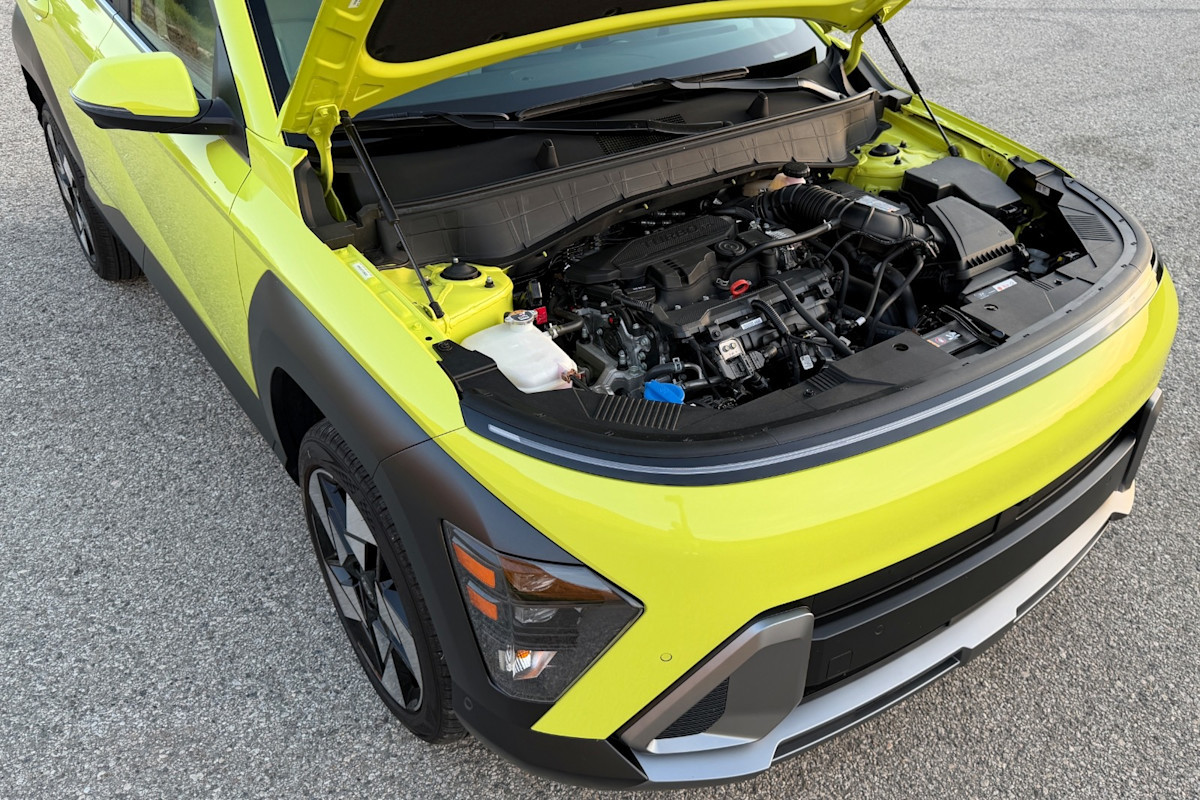
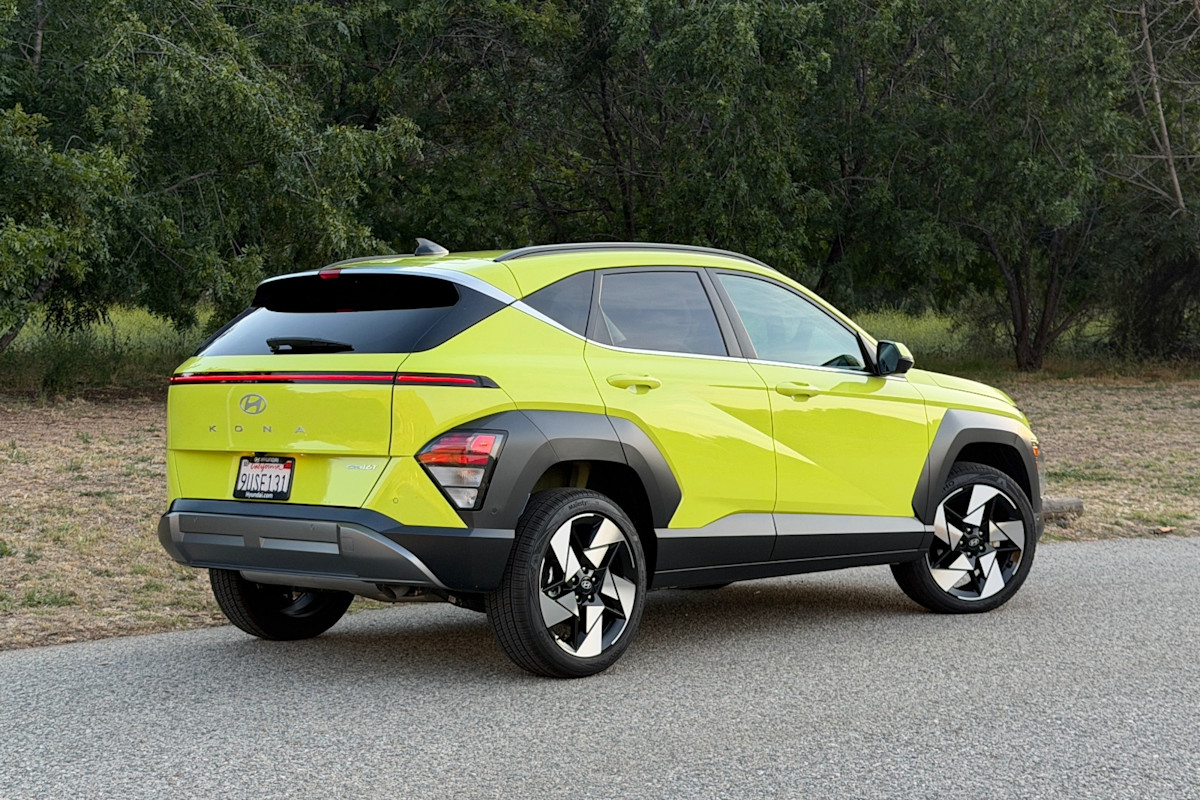
When it comes to the Kona’s design, there isn’t much middle ground: you either love it or hate it. Our test vehicle came fitted in the U.S. equivalent of the N Line trim (note the Neoteric Yellow paint shown is not offered in Canada), and its manufacturer’s suggested retail price (MSRP) of $38,899 is less controversial: its sub-$40,000 figure is very competitive among top-trim subcompact SUVs.
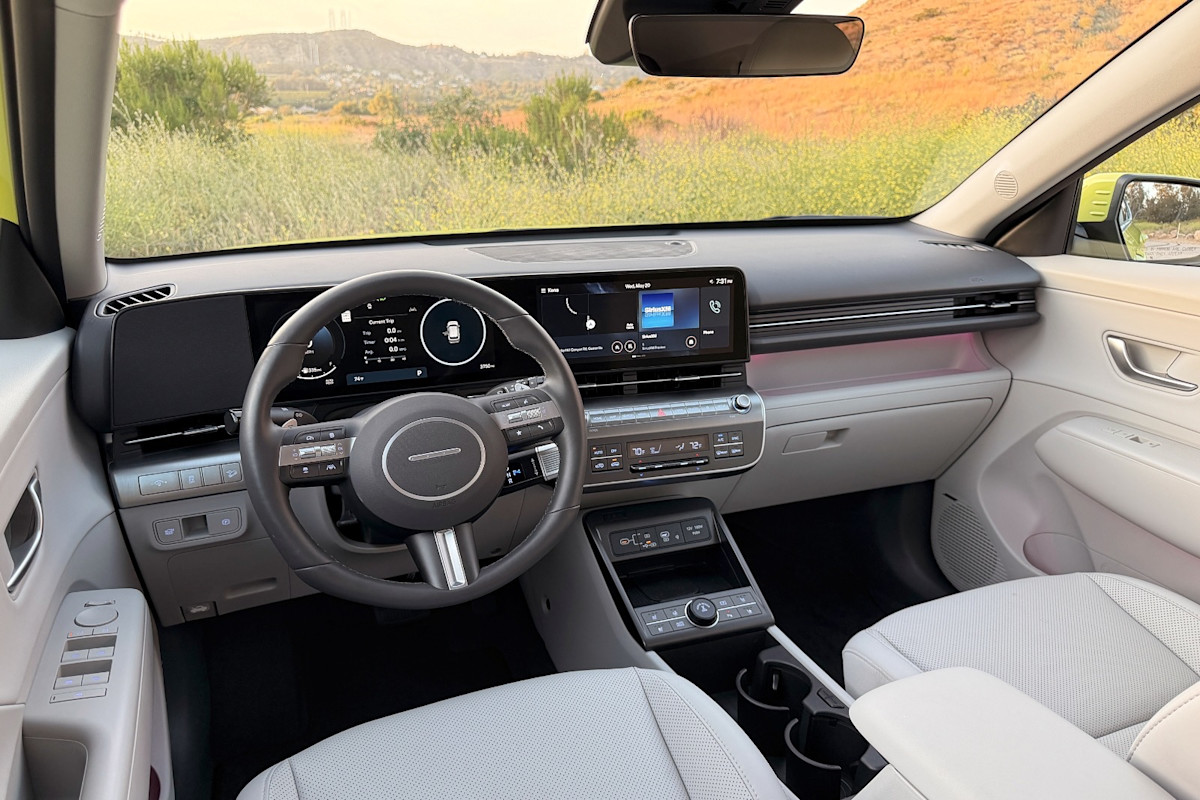
The Kona exudes quality, refinement, and attention to detail, which furthers its position even more. Open a door and one of the roomiest interiors in the class awaits, able to carry four adults in comfort for long stretches at a time.
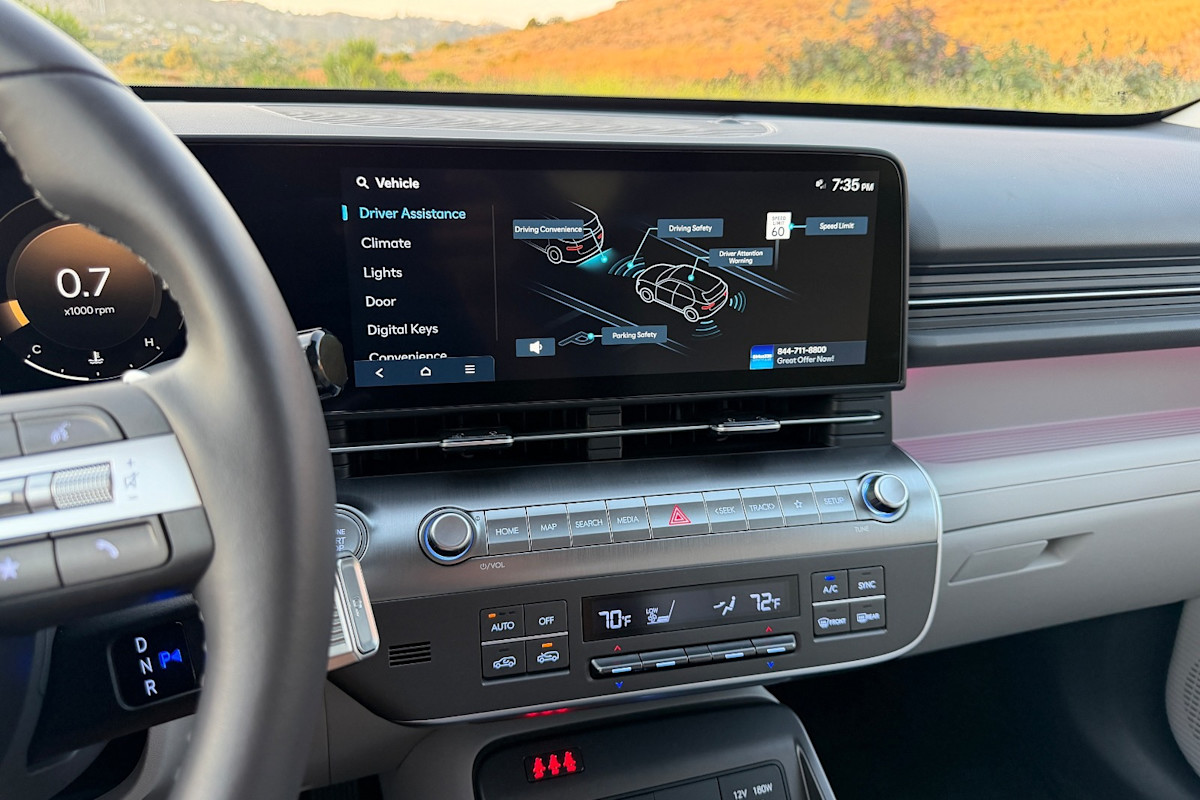
The Kona’s widescreen digital instrumentation and touchscreen infotainment system underscore its technological sophistication. Hyundai also includes traditional analog controls, understanding how important it is to make common adjustments using buttons, knobs, and toggles without looking away from the road. It is a refreshingly thoughtful approach that more car companies should emulate.
If there is a misstep in this cabin, it’s the use of white control labels on a metallic background. That’s fine at night because the lettering glows, but during the day glare can render them unreadable.
Performance
If satisfying acceleration is high on your list of desirable features in a small SUV, skip the base engine and proceed directly to the N Line trim level. It features a turbocharged 1.6-litre four-cylinder engine supplying 190 horsepower and 195 pound-feet of torque instead of the wheezy lump of a 2.0-litre four in the Essential and Preferred, which makes a meager 147 hp and 132 lb-ft.
Another benefit of going turbo is the transmission. The underpowered base engine employs a continuously variable transmission (CVT). While it can simulate soft gear changes when you’re bopping around town, every time you demand more power from the 2.0-litre — such as when accelerating to get on a highway, pass slower vehicles, or climb a hill — it drones on and on and on. The turbocharged engine bolts to a more satisfying eight-speed automatic.
You might also want the AWD upgrade, and not just for the added traction and extra 3.5 centimetres of ground clearance. With front-wheel drive (FWD), Hyundai employs a torsion beam rear suspension design, which produces a busier ride. With AWD, the Kona has a more sophisticated multi-link rear suspension that improves ride quality.
If you’re wondering what kind of a hit on fuel economy you’ll suffer with the turbo, it’s not too bad. The base engine’s Natural Resources Canada fuel economy ratings range from 7.5 to 8.6 litres per 100 kilometres in combined driving, depending on the trim and whether you’ve checked the AWD option box. Turbos clock in at 9.0 L/100 km combined with standard AWD. During testing, we observed 8.9 L/100 km on our fuel economy loop and on the mountainous evaluation loop.
Driving the Kona reveals some shortcomings. For example, suspension isolation is lacking, and the N Line trim level’s 19-inch wheels telegraph brittleness that erodes the overall sense of quality. Speed bumps require slowing to a crawl, and the ride is firm when traveling over sharper road irregularities.
Simultaneously, the Kona can feel too soft at higher speeds on undulating or patched pavement. It excessively bounds and sways while still delivering sharp, unfiltered punches from cracks and holes in the pavement. Overall, the ride and handling come across as poorly sorted. It serves as the most significant reminder to the owner that this is, at its core, an entry-level SUV.
We packed a family of four aboard the Kona for a day trip, and the Kona served reasonably well for this purpose. Road noise was the most consistently bothersome trait on the highway. As far as the highway ride quality and power to get around slower traffic and climb mountain grades were concerned, the Kona and its turbocharged engine passed the road trip test without any trouble.
The most concerning dynamic was how quickly the brakes heated up and began issuing pulsations through the pedal while descending a long highway grade. That same issue cropped up on the evaluation route in the mountains with just a driver aboard instead of four people. So, either the brakes on our test vehicle were not up to snuff, or Hyundai needs to install more robust brake components.
Turbocharging helps the Kona N Line squirt around with athleticism, and as you might expect, the powertrain feels more responsive when you switch it into Sport mode. That setting also adds some unnatural-feeling heft to the steering, which is already short on communication with the driver.
Form & function
Unquestionably, the 2026 Kona is a practical subcompact SUV. With more interior room and cargo space than most of its rivals, it is one of the largest of the littles. The N Line trim’s interior upgrades also make the Kona a lot easier to live with. The highlights include ambient lighting, sport pedals, leather and suede seat upholstery with red accents and stitching, a 12.3-inch fully digital instrument cluster, and ventilated front seats.
Heated front seats are standard in Canada, and a heated steering wheel, a height-adjustable front passenger seat, and auto up-down front windows come in at the Preferred grade. A Trend package is available for the Preferred trim that equips a wireless charging pad, digital key functionality, dual-zone climate control, and a hands-free power liftgate. The N Line’s available Ultimate package adds an eight-way power driver’s seat, on-board navigation, and a Bose premium audio system.
We had no trouble dialing in a commanding driving position behind the Kona’s steering wheel. During the day-long road trip, the front passenger expressed deep appreciation for the ability to raise the seat so that she didn’t feel like she was sitting on the floor.
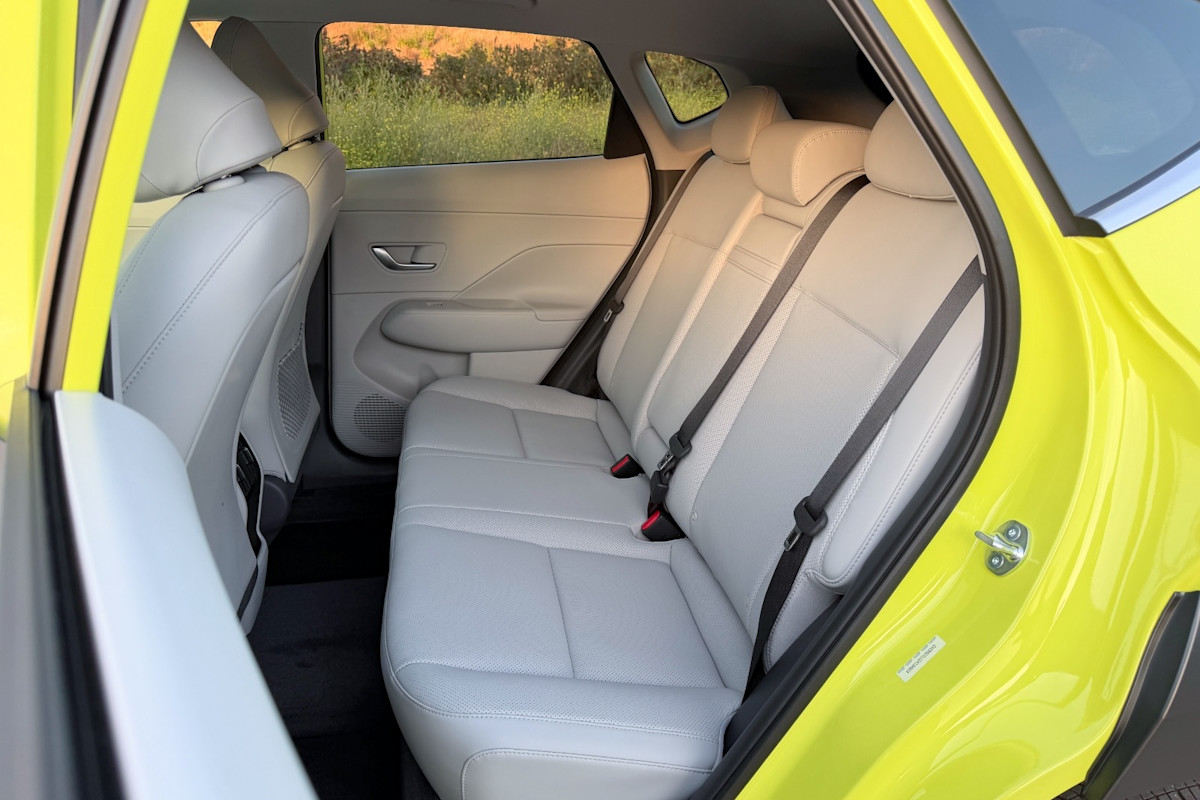
Teenagers riding in the back seat reported satisfactory comfort levels by virtue of their silence on the subject. The taller one asked if the front passenger could slide forward a bit, which was not a big ask because the Kona’s dashboard does not intrude on passenger space. Everyone found it easy to get in and out as well.
Front storage space is impressive with a tray embedded into the dashboard, the N Line’s collapsing cupholder clasps that allow that area to pull double duty as a large storage tray, and a roomy centre console bin with a small upper tray. However, that bin is not enclosed, so items may be visible and this area is likely to collect dust, dirt, and grit over time. Rear passengers benefit from more places to stash items than you might expect including trays in the door armrests, a bin near the rear air vents, and USB charging ports.
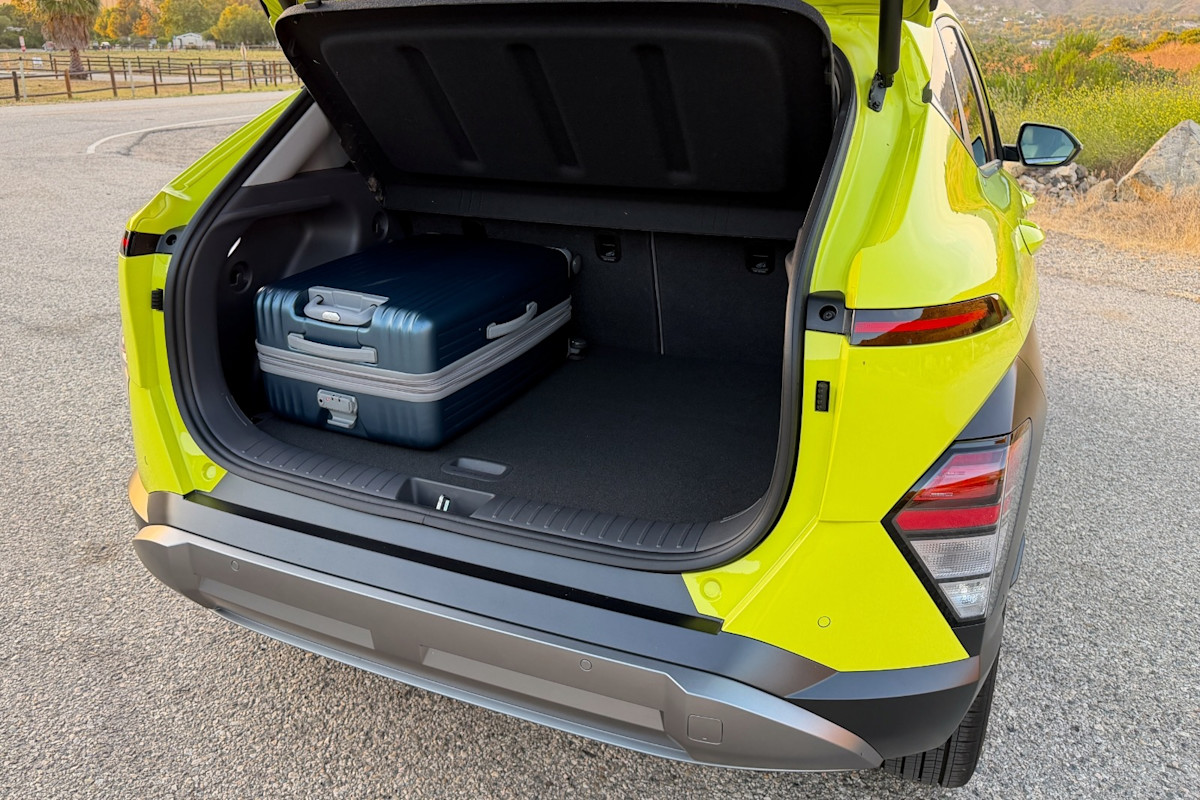
Around back, you’ll find an available “smart” hands-free power liftgate. What makes it smart? It can sense the key fob and will open automatically after a few seconds without forcing you to dance around on one foot to activate a sensor. What isn’t very smart is that the liftgate can also open even if you just happen to be standing near the back of the Kona and don’t need to put something in the cargo area. That’s not very “smart,” but this feature can be turned off.
Once the liftgate is open, it reveals 723 litres of cargo space behind the back seat. That includes the storage area under the load floor, which you can drop to make more room above it. Maximum cargo space measures 1,803 litres, which is generous for the subcompact SUV segment.
Technology
Every Kona appears to have a widescreen configurable digital instrument cluster, but only the N Line trim has two 12.3-inch screens sitting side by side. On the left, the N Line’s 12.3-inch configurable digital driver display replaces the standard static displays and 4.2-inch configurable centre section. The 12.3-inch infotainment touchscreen on the right is standard on all Konas.
Wireless Apple CarPlay and Android Auto, SiriusXM satellite radio, and BlueLink connected services functionality come standard. Wireless smartphone charging comes in with the Preferred trim’s Trend package, as does digital key functionality, which transforms your smartphone into the Kona’s key and allows you to unlock, start, and drive it using your device. Our test vehicle had the on-board navigation system and Bose premium sound system that come with the N Line’s Ultimate package.
We found the Kona’s infotainment system easy and intuitive to use. Pairing an iPhone and running Apple CarPlay was no trouble.
Additional tech equipped on our tester, which is part of the N Line’s Ultimate package, included a surround-view camera system that came in handy when parking and Remote Smart Parking Assist. That feature allows you to stand outside of the Kona and, using the key fob, command the SUV to autonomously drive into or out of a tight parking space. If you’ve ever been to Korea, then you’ve seen the tiny parking spaces and you know why Hyundai offers this feature.
Safety
The Kona’s list of standard driver assistance systems is remarkable for this segment. Everything you might expect to find on a more expensive model is standard here.
Forward collision warning with pedestrian and cyclist detection, automatic emergency braking, lane departure warning, lane keep assist, lane centring assist, high beam assist, blind spot monitoring, and rear cross-traffic alert are all standard. This SUV also has a rear occupant warning system, and, for older kids, a safe exit warning system. The Kona Preferred adds adaptive cruise control and a system that can brake to avoid collisions when making a left turn across traffic or when an oncoming vehicle is headed straight for the Kona.
Our Kona N Line test vehicle also had the driver assistance features included in the Ultimate package: a camera-based Blind-View Monitor, a surround-view camera system, reverse automatic braking, and parking sensors in front, in back, and to the sides. The package also comes with Highway Driving Assist (HDA), a driving aid pairing the adaptive cruise control and lane-centring assist systems.
HDA works well. However, the steering wheel can’t detect grip, so you have to make occasional inputs to prove you’re still paying attention. Fortunately, HDA can operate without those inputs for longer than other similar systems allow, so it’s not too intrusive about its reminders.
The Insurance Institute for Highway Safety (IIHS) gave the 2026 Kona its highest Top Safety Pick+ rating for the 2026 calendar year. The U.S. National Highway Traffic Safety Administration (NHTSA) gave the Kona a four-star overall rating (out of five stars). The imperfect score is due to four-star ratings for the driver and front passenger in a frontal-impact collision.
Cost-effectiveness
In Canada, the Kona offers a 5-year/100,000-kilometre bumper-to-bumper warranty and complimentary roadside assistance for five years and unlimited kilometres.
Factor in the impressive standard and available technology, that Top Safety Pick+ rating, and the turbocharged engine, all less than $42,000 fully loaded, and you have a cost-effectiveness winner.
However, the Kona does not offer a hybrid powertrain. The Hyundai Kona Electric remains on sale in Canada, but it appeals to a different audience. If fuel economy is a high priority for you, this Hyundai might not be the best fit. Consider a Subaru Crosstrek Hybrid or a Toyota Corolla Cross Hybrid instead.
Otherwise, and with few exceptions, it’s hard to go wrong with a 2026 Hyundai Kona.
What owners say
Terrible Stock Speakers, Not compatible with Hyundai Bluelink. Other than that great vehicle
November 4, 2025Trims & specs
Base MSRP N/A | Seating N/A |
Engine N/A | Cargo Capacity N/A |
Combined MPG N/A | Drivetrain N/A |
Base MSRP N/A | Seating N/A |
Engine N/A | Cargo Capacity N/A |
Combined MPG N/A | Drivetrain N/A |
Base MSRP N/A | Seating 5 |
Engine 1.6L 190 hp I4 | Cargo Capacity 722 L |
Combined MPG 28 | Drivetrain FWD |
Base MSRP N/A | Seating N/A |
Engine N/A | Cargo Capacity N/A |
Combined MPG N/A | Drivetrain N/A |
Base MSRP N/A | Seating N/A |
Engine N/A | Cargo Capacity N/A |
Combined MPG N/A | Drivetrain N/A |
Base MSRP N/A | Seating N/A |
Engine N/A | Cargo Capacity N/A |
Combined MPG N/A | Drivetrain N/A |
Base MSRP N/A | Seating 5 |
Engine 2.0L 147 hp I4 | Cargo Capacity 722 L |
Combined MPG 27 | Drivetrain AWD |
Base MSRP N/A | Seating N/A |
Engine N/A | Cargo Capacity N/A |
Combined MPG N/A | Drivetrain N/A |
Base MSRP N/A | Seating 5 |
Engine 2.0L 147 hp I4 | Cargo Capacity 722 L |
Combined MPG 31 | Drivetrain FWD |
Base MSRP N/A | Seating 5 |
Engine 1.6L 190 hp I4 | Cargo Capacity 722 L |
Combined MPG 26 | Drivetrain AWD |
Base MSRP N/A | Seating 5 |
Engine 2.0L 147 hp I4 | Cargo Capacity 722 L |
Combined MPG 28 | Drivetrain AWD |
Base MSRP N/A | Seating 5 |
Engine 2.0L 147 hp I4 | Cargo Capacity 722 L |
Combined MPG 31 | Drivetrain FWD |
Base MSRP N/A | Seating 5 |
Engine 1.6L 190 hp I4 | Cargo Capacity 722 L |
Combined MPG 26 | Drivetrain AWD |
Base MSRP N/A | Seating N/A |
Engine N/A | Cargo Capacity N/A |
Combined MPG N/A | Drivetrain N/A |
Base MSRP N/A | Seating 5 |
Engine 1.6L 190 hp I4 | Cargo Capacity 722 L |
Combined MPG 28 | Drivetrain FWD |
Base MSRP N/A | Seating N/A |
Engine N/A | Cargo Capacity N/A |
Combined MPG N/A | Drivetrain N/A |


Pricing trends
Current avg. market price
$32,330
Trending up by 2.2% this month
May 2026 - November 2026

