2026 Jeep Cherokee Reviews, Pricing & Specs


Pros & cons
What we like
Standard all-wheel drive
Standard advanced safety features
Less-polarizing styling than before
What to consider
Overly-complicated vehicle settings
Less cargo space than some competitors
The CarGurus verdict
Jeep rethinks a popular model by taking a page from rivals.
The Jeep Cherokee returns for the 2026 model year after a two-year hiatus. It’s once again a compact crossover SUV aimed at popular models such as the Honda CR-V and the Toyota RAV4, but it features more traditional styling than its predecessor. That’s not the only thing about the Cherokee that got a major rethink. This is also the first Cherokee — and the only current North American-market Jeep — with a hybrid powertrain.
Verdict: The redesigned Cherokee successfully merges traditional Jeep styling with the winning template for mainstream crossover SUVs.
out of 10 expert review
Look & feel
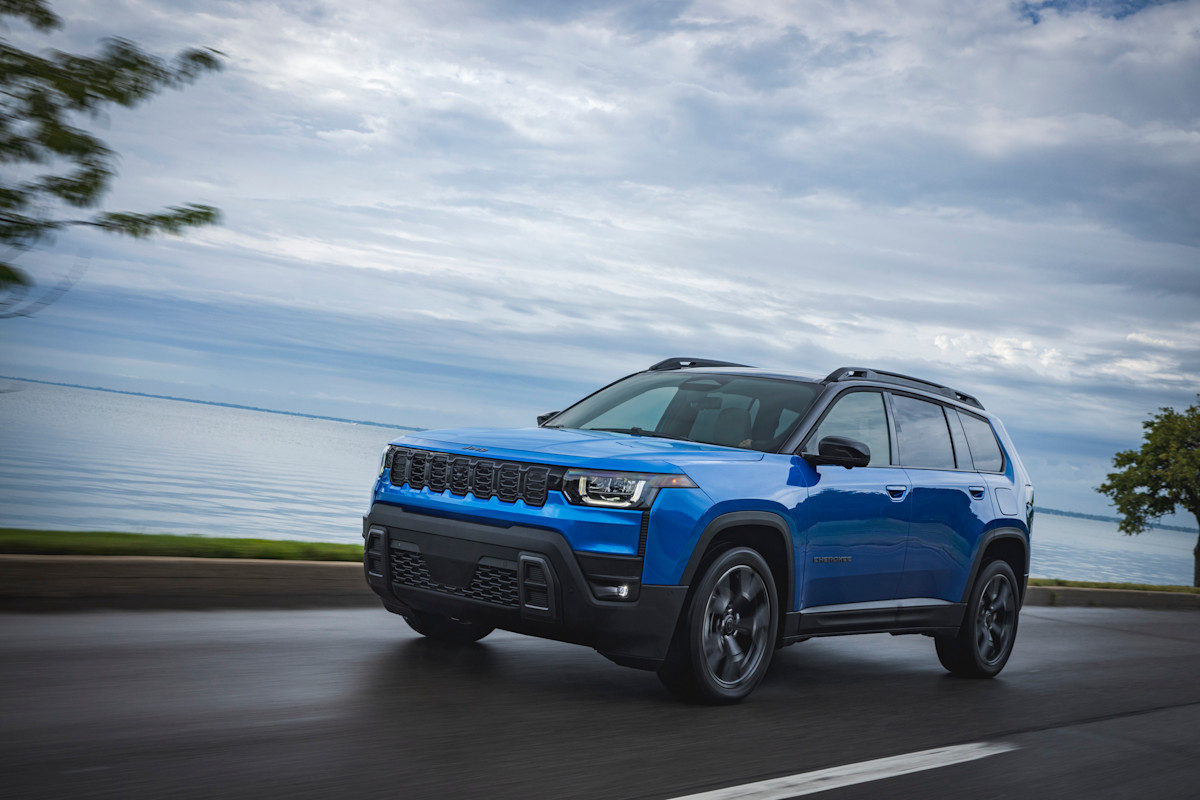
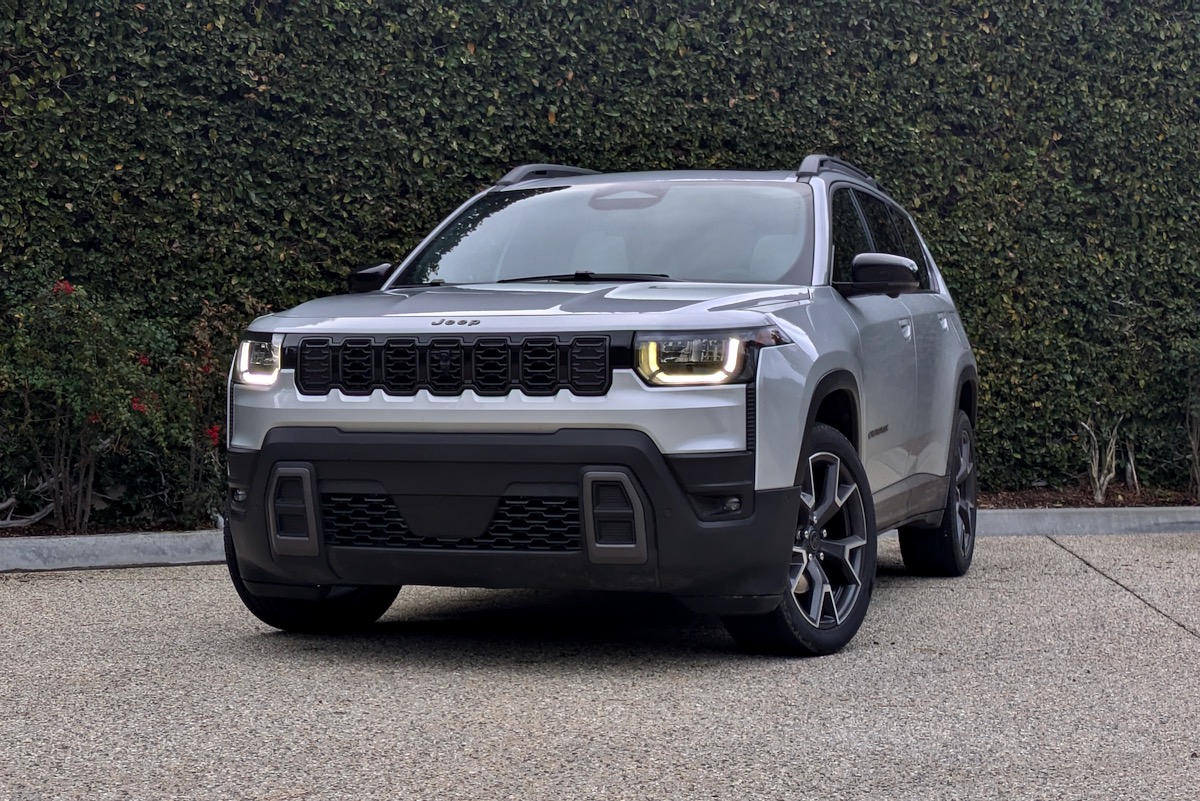
Compared to the previous-generation KL model, the new KM Cherokee should be a lot less polarizing. Its boxy shape is more in line with the classic XJ Cherokee of the 1980s and 1990s. That said, with so many other crossovers going for the same rugged look, this Jeep also comes across as a bit generic. Even the trademark seven-slot grille looks like it came from a Jeep knockoff rather than the genuine article.
The rear-end treatment is a bit more successful, combining an XJ-like profile with aerodynamic surfacing and taillights with the distinctive “X” pattern of jerry cans. The proportions are also fairly good for a compact SUV that shares the Stellantis STLA Large platform with the Dodge Charger, Jeep Wagoneer S, and the upcoming Jeep Recon.
Buyers also get basically the same appearance whether they choose the base, Laredo, Limited, or Overland trim levels. The high-end Cherokee Overland has 20-inch wheels instead of the 18-inch wheels on other trim levels, but that’s about it — although the interior is a different story. The two lower trim levels have cloth upholstery, while the Limited and Overland have leatherette seats. Jeep claims the lack of genuine leather is an environmental move, not a cost-cutting one, noting that some recycled material is also used in the carpets and interior trim.
That interior trim is mostly plastic, but that’s to be expected at this price point. We also applaud Jeep’s use of muted finishes instead of smudge-prone, glare-inducing piano black. With its concave dashboard and rotary shifter that looks like it came out of the flagship Grand Wagoneer, the Cherokee’s interior also exceeds expectations for style.

Performance
The new Cherokee’s specs don’t seem very Jeep-like at first. The only powertrain available at launch consists of a 1.6-litre turbocharged four-cylinder engine connected to a two-motor hybrid system with a planetary gearset taking the place of a conventional transmission, similar to what Subaru and Toyota use. It’s good for 210 horsepower and 230 pound-feet of torque, splitting the difference between the Subaru Forester and Toyota RAV4 hybrids in horsepower.
The standard all-wheel drive (AWD) system is fairly basic by Jeep standards. Instead of a centre differential, it has a clutch-based rear-axle disconnect system, allowing only the front wheels to receive power under light loads. That’s better for fuel economy on the road, but it isn’t as capable as the four-wheel drive (4WD) systems with low range found in a Grand Cherokee or a Wrangler. Jeep is likely saving something for a new Cherokee Trailhawk model. Given how competitors are encroaching on Jeep’s traditional territory with off-road models such as the Honda CR-V TrailSport Hybrid and the Toyota RAV4 Hybrid Woodland, it can’t arrive soon enough.
Jeep’s Selec-Terrain drive modes (Auto, Sport, Snow, Sand/Mud) help somewhat, as do 19.6-degree approach and 29.4-degree departure angles that Jeep claims are best-in-class. The breakover angle is 18.8 degrees, and 20.3 centimetres of ground clearance is 1.7 cm less than a Subaru Forester Hybrid and 0.3 mm less than a Toyota RAV4 Hybrid Woodland. We didn’t have an opportunity to use any of that on this test drive as the planned off-roading location was waterlogged.
There’s a lot to like from behind the wheel, though. Jeep nailed the hybrid system on its first attempt, achieving faultless power application and comparable smoothness in the handoff between gasoline and electric power to Toyota and Honda. Both the Laredo and Overland models we sampled (covering both wheel and tire sizes) were remarkably quiet. And while the Cherokee wasn’t much fun in corners, it was at least comfortable.
The steering wasn’t as well executed, and we experienced a significant amount of play in the wheel before the vehicle actually started to change direction. Switching from the Normal or Comfort steering settings to Sport improved things, but the steering settings are independent of drive modes, requiring drivers to make a second adjustment through the touchscreen that seems unnecessarily complicated. Drivers coming from other hybrids will also find the amount of regenerative braking lacking. There’s a “low mode” that adds a bit more, but we found that leaving it on during steep descents caused the engine to remain at high rpms even after the grades have leveled out.

Form & function
Drivers and front-seat passengers in this five-seat crossover will find comparable headroom and legroom to competitors such as the Subaru Forester and Kia Sportage hybrids, and a little more headroom than the Honda CR-V and Toyota RAV4 hybrids. A deep dashboard and steeply raked windshield hinder forward visibility a little for shorter drivers, but the seats are very comfortable despite being wedged between a wide centre console and door pockets.
Buyers have to upgrade from the base model to the Cherokee Laredo to get a power driver’s seat and to the Cherokee Limited to get one for the front passenger. In Canada, heated front seats are standard equipment, while a heated steering wheel is available beginning at the Laredo grade.
Rear-seat passengers also get similar headroom to rival crossovers, but the CR-V, Sportage, and Hyundai Tucson hybrids all provide more legroom. (Heated rear seats are available on Overland models.) Most competitors also provide more cargo space than the 951 litres behind the Cherokee’s rear seats (accessible via a foot-activated power liftgate on Overland models), and the 1,934 litres available with the rear seats folded. When it comes to cargo that’s hauled outside the vehicle, the Cherokee’s 1,587-kilogram (3,500-pound) towing capacity impresses. Only certain versions of the Toyota RAV4 Hybrid match it.
Jeep managed to keep the dashboard relatively uncluttered while strategically maintaining important analog controls such as a volume knob, drive-mode toggle, and buttons for the high-regen “low mode” and for turning off the traction control and lane keep assist. However, some of these buttons can be hard to find at a glance, and the climate controls and seat and steering-wheel heaters use touch sensors that don’t provide any feedback, making them tricky to use while driving.

Technology
The 2026 Cherokee comes standard with a 12.3-inch touchscreen and a 10.2-inch digital instrument cluster, still running the same Uconnect 5 infotainment system as the outgoing Cherokee from the 2023 model year. Wireless Apple CarPlay and Android Auto remain standard along with a pair of USB-C ports for both the front and rear rows on all but the base model. Wireless device charging is standard on Limited and Overland models.
There’s a reason why Stellantis hasn’t replaced Uconnect 5, which dates back to the automaker’s pre-merger identity of Fiat Chrysler Automobiles. This system is stable and upgradable via over-the-air (OTA) updates with 10 years of support guaranteed with the Cherokee’s standard data package.
That said, the digital instrument cluster’s graphics are plain with little differentiation between the available layouts. Vehicle settings are also split between the touchscreen and various dashboard buttons, which makes things a bit confusing. We also find the native navigation system in the Overland test car (lower trim levels go without built-in nav) to be a bit laggy compared to Android Auto. There also wasn’t a dramatic difference between the six-speaker audio system in lower trim levels and the 10-speaker system in the top Overland model.

Safety
Jeep offers similar standard driver assistance features to other mainstream brands, including forward collision warning, automatic emergency braking, lane keep assist, and adaptive cruise control with stop-and-go functionality. Active Driving Assist, which pairs automated lane centring with adaptive cruise control for highway driving, is also standard. In addition to these features, traffic sign recognition is standard on the Overland model, while a surround-view camera system is an available option.
Crash test ratings from the Insurance Institute for Highway Safety (IIHS) and U.S. National Highway Traffic Safety Administration (NHTSA) weren’t available at the time of writing.

Cost-effectiveness
Natural Resources Canada estimates fuel economy of 6.3 litres per 100 kilometres combined (6.1 city, 6.7 highway) — a massive improvement over the outgoing Cherokee. It’s also right in the ballpark of most competitor hybrid crossovers. The redesigned 2026 Toyota RAV4 Hybrid offers better fuel economy in some configurations, but the Woodland grade that’s closest to the Jeep’s rugged intent comes in at a just slightly better 6.2 L/100 km combined (5.7 city, 6.7 highway).
Pricing starts at $42,390 for the base model (all prices include destination charges and other fees). The Laredo and the Limited start at $47,390 and $52,390 respectively, while the Cherokee Overland sits atop the lineup at $56,390. These prices are reasonable if both AWD and a hybrid powertrain are must-haves. The Subaru Forester Hybrid starts at $51,532 with standard AWD, while $49,041 is as cheap as a Honda CR-V Hybrid gets with AWD. The RAV4 — which gets a standard hybrid powertrain for 2026 — undercuts the Cherokee’s starting price at $36,807 for an LE AWD model.
The Hyundai Tucson Hybrid also boasts standard AWD and a $46,396 base price, while a Kia Sportage Hybrid can be had for $44,765. For shoppers willing to go without a hybrid powertrain or AWD, there are even cheaper front-wheel drive (FWD) versions of some small crossovers available.
Jeep’s three-year/60,000-kilometre basic warranty and five-year/100,000-kilometre powertrain warranty match most other mainstream brands.
The Cherokee’s biggest asset is its badge. New car shoppers will find a crossover that does everything the segment's usual suspects can but with the undeniable mystique of the Jeep brand. As such, the Cherokee is notable mostly as an entry point for the brand, even if it doesn’t really move the needle compared to rivals. Other hybrid crossovers match (or even surpass) the new Cherokee on interior space, driving dynamics, efficiency, or tech, but they don’t have anything like Jeep’s heritage.

What owners say
Trims & specs
Base MSRP N/A | Seating 5 |
Engine 1.6L 210 hp I4 Hybrid | Cargo Capacity 951 L |
Combined MPG 37 | Drivetrain 4X4 |
Base MSRP N/A | Seating 5 |
Engine 1.6L 210 hp I4 Hybrid | Cargo Capacity 951 L |
Combined MPG 37 | Drivetrain 4X4 |
Base MSRP N/A | Seating 5 |
Engine 1.6L 210 hp I4 Hybrid | Cargo Capacity 951 L |
Combined MPG 37 | Drivetrain 4X4 |
Base MSRP N/A | Seating 5 |
Engine 1.6L 210 hp I4 Hybrid | Cargo Capacity 951 L |
Combined MPG 37 | Drivetrain 4X4 |
Base MSRP N/A | Seating 5 |
Engine 1.6L 210 hp I4 Hybrid | Cargo Capacity 951 L |
Combined MPG 37 | Drivetrain 4X4 |
Base MSRP N/A | Seating 5 |
Engine N/A | Cargo Capacity 951 L |
Combined MPG N/A | Drivetrain N/A |


Pricing trends
Current avg. market price
$48,657
Trending up by 0.4% this month
May 2026 - November 2026