2026 Subaru Crosstrek Hybrid Reviews, Pricing & Specs



Pros & cons
What we like
Capable AWD
Smooth engine performance
Stylish design
What to consider
Expensive
Trades fuel efficiency for AWD capability
Unimpressive technology
The CarGurus verdict
Subaru improves the 2026 Crosstrek with a new hybrid powertrain.
There aren’t many subcompact crossovers on the market with hybrid powertrains. As such, it’s tough to weigh the new 2026 Subaru Crosstrek Hybrid against a field of other options. The Toyota Corolla Cross Hybrid is its primary competition. The Kia Niro Hybrid is exclusively front-wheel drive (FWD), and vehicles such as the Hyundai Tucson Hybrid, Honda CR-V Hybrid, and Toyota RAV4 Hybrid all compete in the larger compact crossover segment. If shoppers want a fuel-efficient and genuinely small crossover with great all-wheel-drive capability, the new Crosstrek Hybrid is the best available choice.
Verdict: With its attractive styling, comfortable interior, and tested AWD system, the 2026 Subaru Crosstrek delivers a terrific package, even if it’s not as efficient as some larger (and more expensive) competitors.
out of 10 expert review
Look & feel
The Subaru Crosstrek has been an attractive vehicle since its earliest days—something that can’t be said for many Subarus. We are now on the third generation of the Crosstrek, and with each redesign, Subaru has made evolutionary improvements.
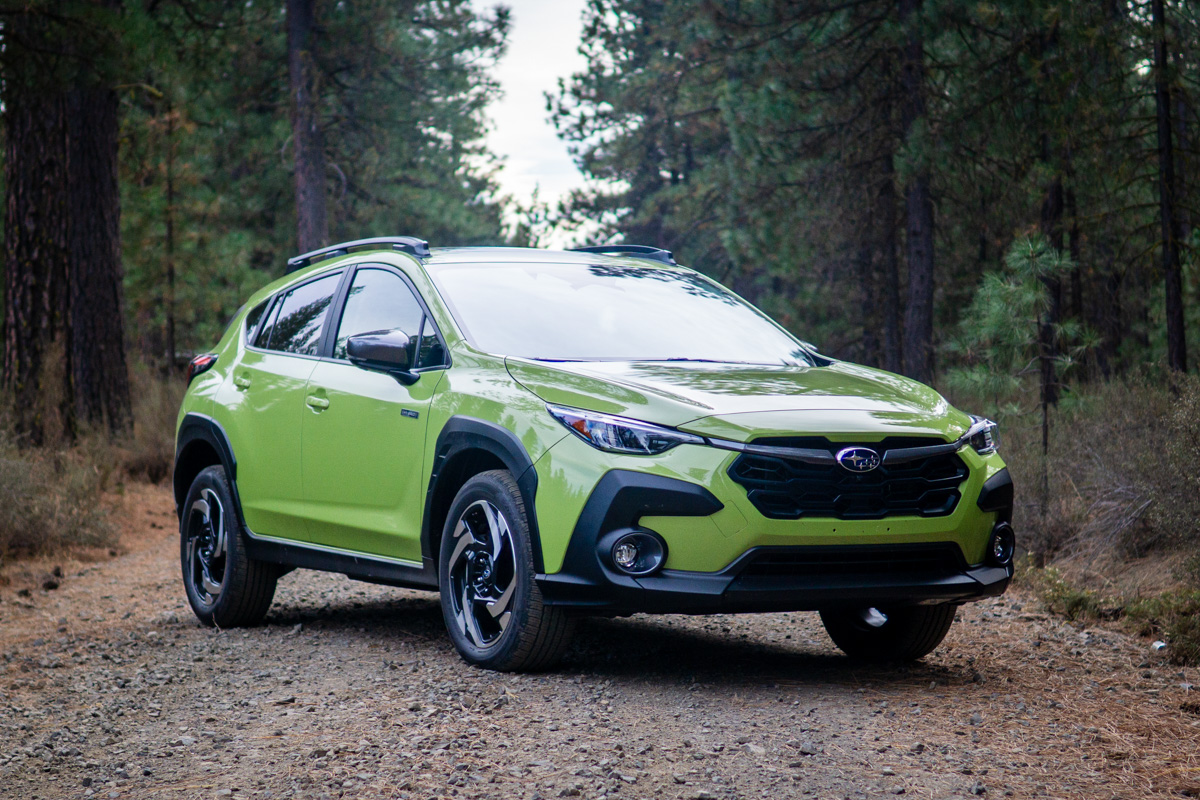
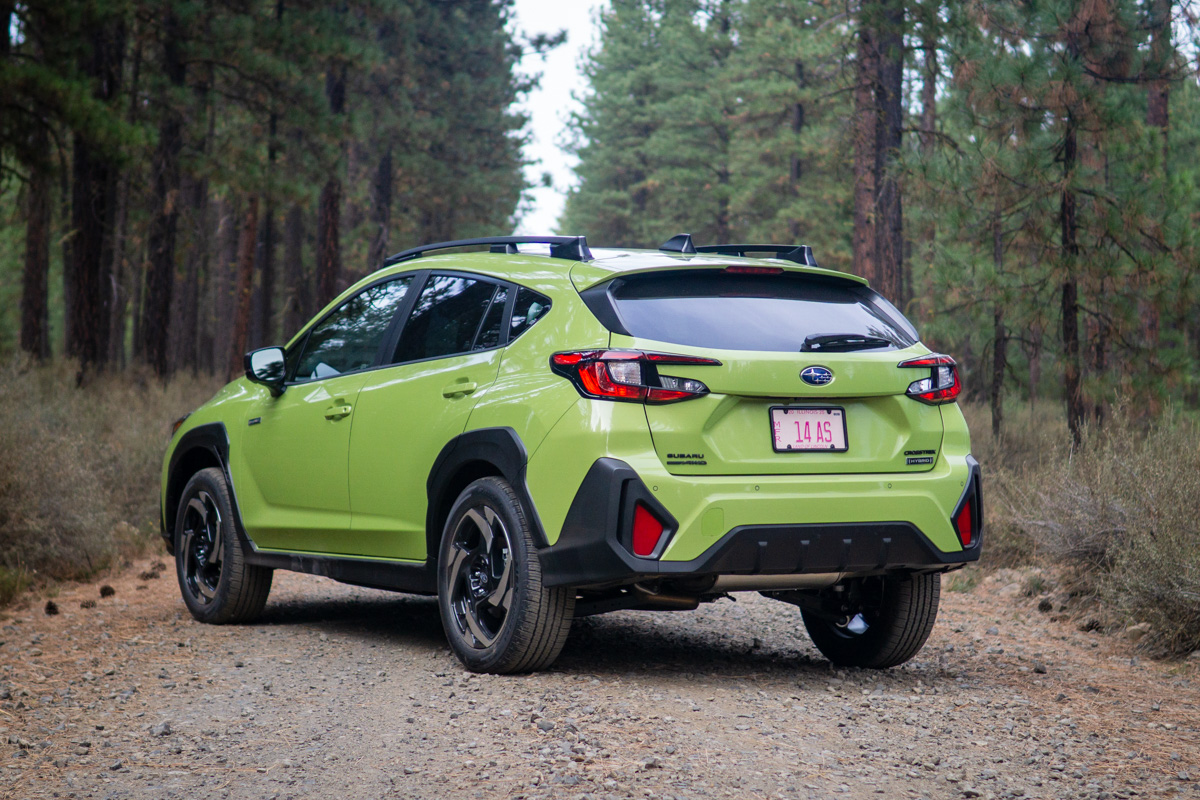
The 2026 Crosstrek carries forward changes introduced for 2024, which included all-new sheet metal and chassis construction. Honestly, though, you'd be hard-pressed to spot the differences at a glance. The most noticeable update appeared up front, where the frameless grille incorporates a curved wing bar that creates a clever visual connection with the headlights, giving the fascia an almost Cheshire cat-like smile. The black-plastic cladding around the wheel arches includes integrated aerodynamic air inlets and outlets that smooth airflow around the wheels. This improves fuel efficiency while reducing road noise.
In Canada, the Crosstrek Hybrid is sold in a single trim that sits at the top of the Crosstrek line-up.
Inside, we were greeted by a thoughtful balance of rugged utility and refined comfort. The cabin maintains Subaru's signature straightforward design philosophy with clean lines and visual language that prioritizes function over flash.
Material quality feels consistent throughout, with soft-touch surfaces in key contact points and durable plastics in appropriate locations. Canadian units come with black leather upholstery (as opposed to the grey StarTex artificial leather shown in our U.S.-spec test unit, which is not offered in our market).
Our test vehicle’s chrome-trimmed power window switches provided an unexpectedly upscale accent, while the "Hybrid"-stitched floor mats will serve to remind you of the Crosstrek's electrified powertrain. As is the case with most Crosstrek models, heated front seats, a heated steering wheel, and a power moonroof are standard. The latter helps create an airy atmosphere, although it’s not nearly as large as what you’ll find in a Forester.

Performance
All Subaru Crosstreks come standard with all-wheel drive (AWD) and a continuously variable transmission (CVT). Subaru will continue to sell the 2026 Crosstrek with a naturally aspirated 2.5-litre four-cylinder gas engine in addition to the new hybrid powertrain, but the weak 2.0-litre engine that previously came standard in the base trim level has been shelved. That means all non-hybrid Crosstreks will make 180 horsepower and 178 pound-feet of torque. That alone is noteworthy, elevating the Crosstrek from slowpoke status in the subcompact crossover segment to a mid-pack option. It won’t keep up with turbocharged versions of the Kia Seltos or Hyundai Kona, but it should outperform their base-engine variants as well as the Honda HR-V and Toyota Corolla Cross. For shoppers who value horsepower above all else, all versions of the Mazda CX-30 provide more giddy-up than the Subaru.
Those power-hungry buyers, however, may be surprised to learn that it’s the hybrid that takes the title of “fastest Crosstrek of all time”. The 2.5-litre engine powering the hybrid is an Atkinson/Miller-cycle unit for improved efficiency, yet when paired with an 118 hp traction motor, the total system output comes to 194 hp. Acceleration is noticeably quicker and smoother in the hybrid than the gas-only Crosstrek, although it doesn’t actually feel that much faster on the highway. You’ll still want to calculate carefully before passing anyone on a dotted yellow line.
How does the 2026 Subaru Crosstrek Hybrid’s powertrain work? It leverages two motor-generators along with the 2.5-litre Boxer H4 engine. The first motor-generator handles the engine start/stop function and charges the hybrid’s battery using engine power. The second motor-generator acts as a drive motor to assist the engine with turning the Crosstrek’s wheels and can also move them on its own at low speeds. In addition to acting as the drive motor, this second motor-generator charges the battery via regenerative braking.
We test-drove the 2026 Subaru Crosstrek Hybrid on a roughly one-hour loop and recorded 7.6 litres per 100 kilometres. That falls well above Natural Resources Canada’s estimate of 6.5 L/100 km in city, highway, and combined driving. However, a good portion of our test drive did take place on dirt roads, which may have contributed to the underperformance. A non-hybrid Crosstrek should return 8.9 L/100 km city, 7.2 highway, and 8.1 combined, so while the hybrid presents an improvement, it’s not a dramatic one.
Compared with the Toyota Corolla Cross Hybrid, the Crosstrek should be much more capable on variable terrain. While Toyota employs an electric AWD system, Subaru’s AWD system still relies on a driveshaft to send power to the wheels. This mechanical connection does suffer some fuel-efficiency loss due to friction, but the upside is a more capable and predictable power flow. Subaru’s X-Mode traction management system helps, too. The standard X-Mode offers specific dirt/snow settings and hill descent control, while the dual-function X-Mode equipped on the Crosstrek’s top trims (including the hybrid) adds deep snow/mud settings. When the X-Mode is in deep snow/mud and the Crosstrek is heading downhill, it will automatically maintain the vehicle’s speed without any throttle input.
The Crosstrek’s steering remains very light and somewhat disconnected, but it’s not sloppy or imprecise. That’s in large part thanks to a revised dual-pinion steering rack that Subaru implemented with the 2024 Crosstrek’s generational update. Similarly, the current Crosstrek exhibits noticeably less body lean than older models. The off-road-oriented Wilderness trim level does introduce additional roll when navigating tight turns on pavement, though that trade-off comes with the territory of its off-road-tuned suspension setup and all-terrain tires. (Note that sales of the Indiana-built 2026 Crosstrek Wilderness are on hold in Canada due to tariffs at the time of writing.)

Form & function
This is, in fact, Subaru’s third attempt at a hybrid Crosstrek. The first, which was sold from 2014 to 2016, offered unimpressive fuel economy given its anemic powertrain, and it was sold in limited numbers. The second iteration was a more compelling plug-in hybrid (PHEV) but had its own set of compromises: mainly, it had a small gas tank, a small trunk, and a big price tag.
The latest Crosstrek Hybrid looks to be the best option yet, in part because it doesn’t seem to make the same compromises. In addition to making more horsepower than the older versions, it also offers more cargo space. The 2026 model doesn’t have a high trunk floor like the PHEV because it doesn’t need to house a large battery. As such, cargo volume behind the rear seats measures 527 litres, and the total capacity is 1,433 litres when the rear row is folded.
Subaru didn’t shrink the Crosstrek Hybrid's tank, so it’s the same big 63 litres as the all-gas models. For those doing the math, 7.6 L/100 km multiplied by a 63-litre tank means this little hybrid should be able to cover 829 kilometres between fill-ups. Owners living in downtown Toronto could hypothetically drive to Quebec City without needing to stop for fuel.
Like all Crosstreks, the Hybrid also offers a good amount of rear-seat space, with 926 millimetres of legroom. That’s significantly more than the Corolla Cross Hybrid, which offers only 813 mm. Up front the Crosstrek is a bit short on storage; a small tray ahead of the PRNDL shifter houses a standard wireless charging pad, and two cupholders sit ahead of the centre console bin. Other than that, you’ll make do with some deep door pockets and a standard-size glove compartment.

Technology
Because Subaru sells the Crosstrek Hybrid in a single trim level, every one comes equipped with a big and visually impressive 11.6-inch touchscreen. The bad news, unfortunately, is that this tech simply isn’t competitive when compared with the infotainment systems currently in the Kia Niro Hybrid and Hyundai Kona. Even when compared with the Toyota Corolla Cross or the Nissan Kicks, the Subaru display looks good but is more frustrating to use.
The software is slow and visibly lags when you try to swipe between screens. It’s also a fingerprint magnet, both on the big, piano-black bezels and on the screen itself. Finally, too many controls—such as the auto-hold function, X-Mode settings, and fan speed settings—are managed via touchscreen buttons when we would have preferred physical controls.
The good news is that wireless Apple CarPlay and wireless Android Auto are both standard, so most drivers can rely on those rather than the Starlink software. There are also physical buttons for the volume and tuning as well as the defroster settings and the HVAC temperature controls. Unfortunately, these small blessings are too few and too insignificant to make up for Subaru’s tech shortcomings.
The Crosstrek Limited Hybrid gets an impressive Harman Kardon stereo and a very striking 12.3-inch digital gauge cluster. The cluster can be configured with a number of different displays, including one that shows the navigation map—a handy feature. Unfortunately, that map won’t display Google Maps if you’re navigating using your phone’s projection, meaning you’ll still need to look to the touchscreen for directions.

Safety
The Insurance Institute for Highway Safety (IIHS) did not award the 2025 Crosstrek a Top Safety Pick designation. It scored only a “Marginal” in the updated moderate overlap front crash test and an “Acceptable” in the updated side-impact test. To address these issues, Subaru has added side-curtain airbags to the rear seats.
The U.S. National Highway Traffic Safety Administration (NHTSA) testing was more favourable, giving the 2025 Crosstrek five out of five stars in its overall safety rating. Neither organization has yet rated the 2026 Crosstrek.
As the top model in the Crosstrek range, Subaru Canada includes the full range of its EyeSight advanced driver assistance systems (ADAS) on the Crosstrek Hybrid. Every model benefits from adaptive cruise control, lane-keeping assist, pre-collision braking and automatic emergency braking, plus a surround-view camera, the DriverFocus driver distraction mitigation system, lane centring assist, reverse automatic braking, and more. Subaru doesn’t yet have a semi-autonomous driving system on par with Ford’s BlueCruise, GM’s SuperCruise, or Highway Driving Assist from Hyundai.

Cost-effectiveness
The 2026 Subaru Crosstrek Hybrid comes very well equipped. Unlike the standard Crosstrek, which has a range of trims (Convenience, Touring, Onyx, and Limited), the Crosstrek Hybrid holds the top spot in the nameplate’s line-up.
That’s good news if you want a subcompact crossover with good fuel economy and lots of features. It’s less good if you want a subcompact crossover with good fuel economy and that’s it.
Pricing in Canada for the 2026 Subaru Crosstrek Hybrid is set at $43,284, including a $2,295 destination charge and other fees. Our test vehicle was painted Citron Yellow Pearl for no extra charge. With pricing that overlaps with mid-trims in some larger compact hybrid SUVs, it’s tough to see a lot of value in our Crosstrek Hybrid.
The Crosstrek Hybrid does provide an interesting combination of fuel efficiency and AWD capability, and it delivers it in a very handsome and compact package, but it’s not necessarily the best buy. If AWD isn’t a necessity, the FWD Kia Niro Hybrid offers more cargo space, much better fuel economy, and a lower price tag. If AWD is a must-have, the Toyota Corolla Cross Hybrid is another less-expensive option, and it also delivers better fuel economy.
What owners say
Trims & specs
Base MSRP N/A | Seating 5 |
Engine N/A | Cargo Capacity 527 L |
Combined MPG N/A | Drivetrain N/A |
Base MSRP N/A | Seating 5 |
Engine N/A | Cargo Capacity 527 L |
Combined MPG N/A | Drivetrain N/A |


Pricing trends
Current avg. market price
$41,194
Trending down by 1.9% this month
July 2026 - November 2026