2026 Toyota Sequoia Reviews, Pricing & Specs

Pros & cons
What we like
Powerful hybrid powertrain
Capable off-road TRD Pro model
Lots of space for people and cargo, but…
What to consider
…poor use of that available cargo space
Minor hybrid fuel economy gains
Cumbersome handling
The CarGurus verdict
Toyota’s entry in the full-size SUV class, the Sequoia, stands out for its hybrid powertrain but also suffers from compromises.
The Toyota Sequoia’s hybrid system offers great power and makes it the most efficient vehicle in the class outside of expensive diesels, but it provides only minor efficiency gains. The hybrid system also cuts into cargo space, but it doesn’t prevent the Sequoia from doing what a body-on-frame SUV is meant to do: carrying up to eight passengers while towing a heavy load.
Verdict: The Toyota Sequoia suffers from the same issues as all full-size body-on-frame SUVs — cumbersome handling, poor fuel economy, and hefty prices. However, its hybrid system makes it more efficient than gas-powered rivals, and it can still do all the work expected of these big brutes. It’s worth considering for anyone planning to tow a boat while carrying the family. Just avoid the optional tow mirrors.
out of 10 expert review
Look & feel
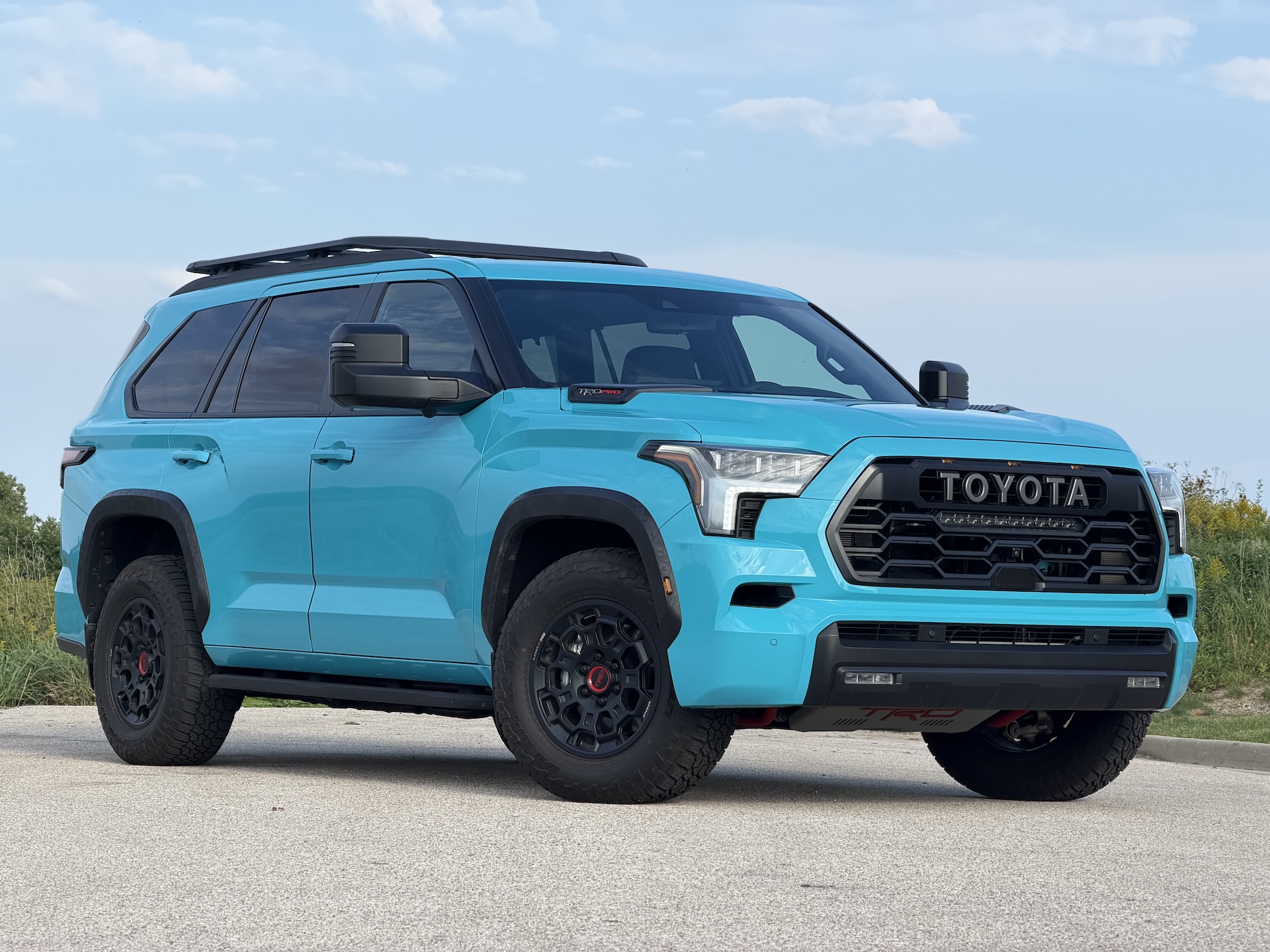
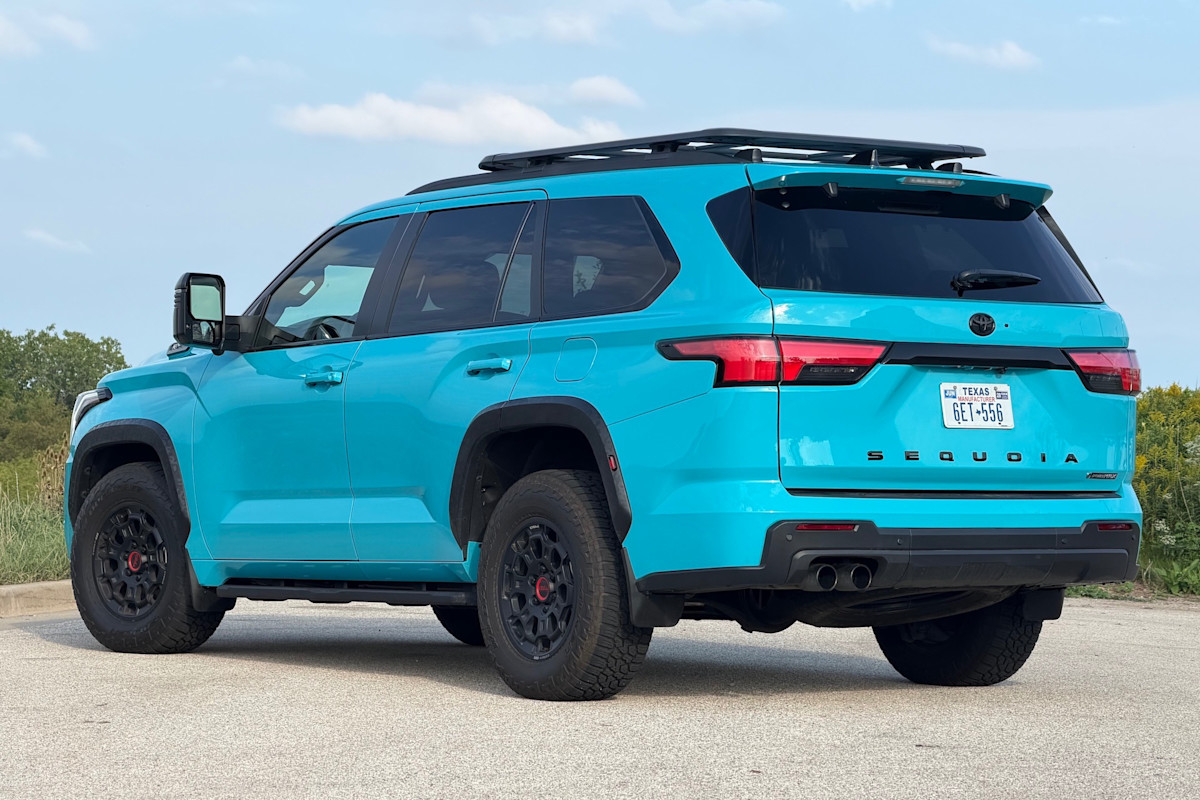
The Sequoia has a family look related to the Tundra pickup, which shares its ladder-frame platform. It’s tall and wide with blocky features. The nose has a big black grille, but it’s better contained than the Tundra’s as the blacked-out look is confined within the grille instead of extending all the way down the face.
Along the sides, the shoulder line steps down from a tall hood to the front doors. Pronounced haunches over the wheels take on that chunky look. All models get black wheel flares except the top Capstone trim, which goes with body-coloured flares. The front pillars are blacked out, and the rear side window line tilts forward for a slight sense of motion.
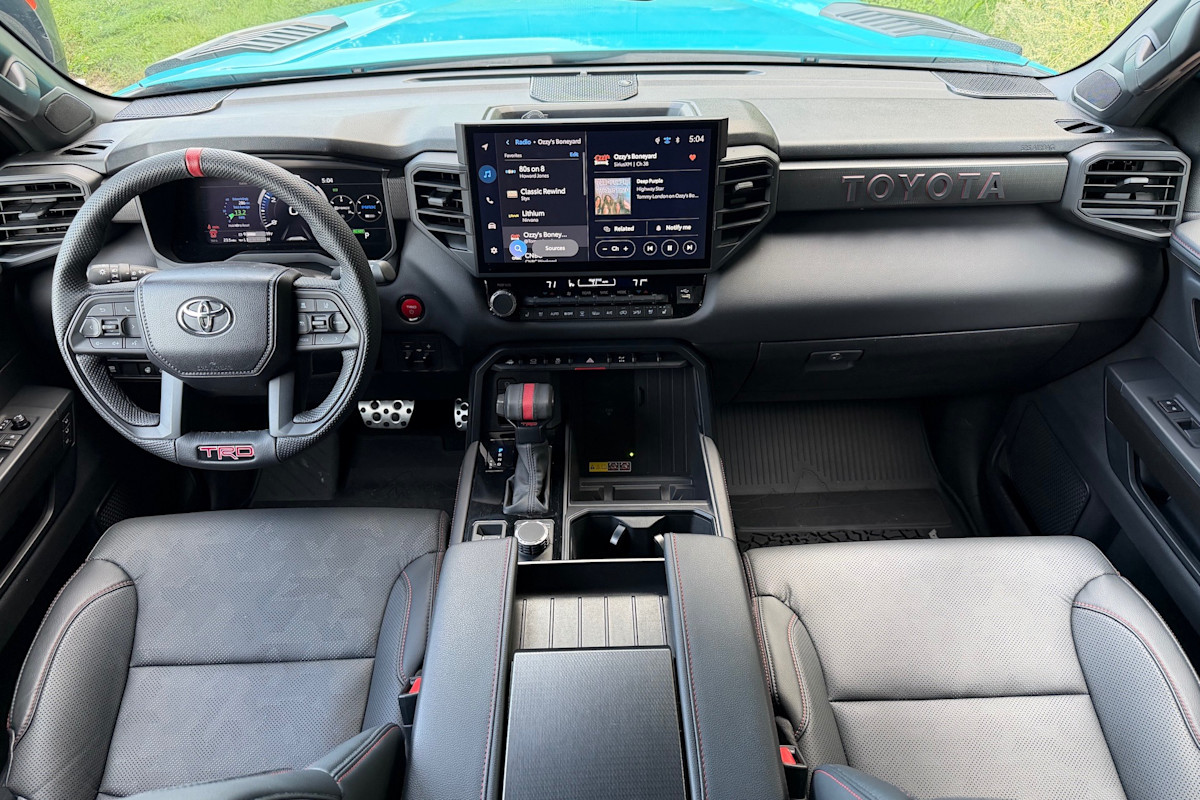
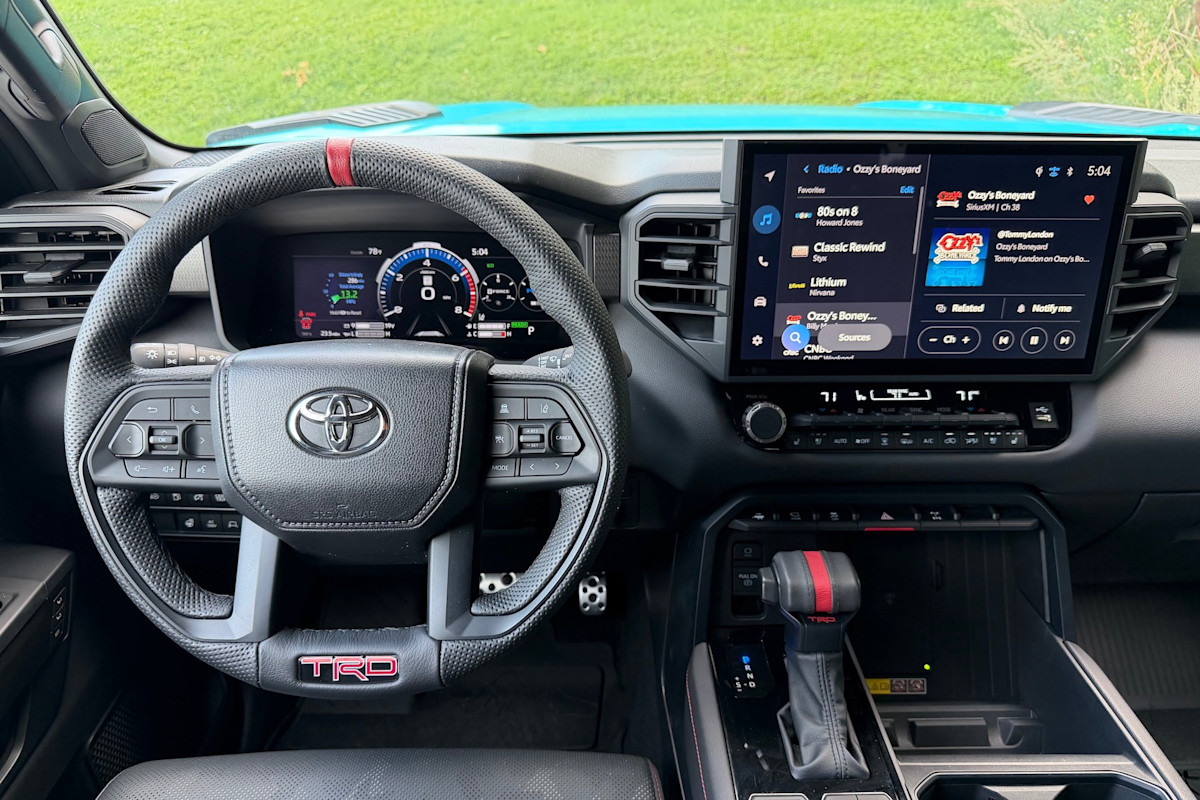
A standard rear spoiler and tailgate Sequoia lettering mark the rear end. Toyota sets it on 18-, 20-, or 22-inch wheels, and the TRD Pro’s all-terrain tires give away its off-road intent. The chunky design extends to the cabin where the large dials work well with gloved hands. The cabin of our TRD Pro tester felt purpose-built for work and off-roading. It comes with black synthetic leather upholstery with a unique camouflage pattern, TRD Pro embroidery on the headrests, and red contrast stitching.
The quality is merely acceptable at these prices. Soft-touch surfaces adorn the door tops, centre console, armrests, and portions of the dash, but there's also a lot of hard plastic on the centre console, dash, and doors. In TRD Pro form, at least, the Sequoia feels utilitarian, not luxurious.
In Canada, all Sequoia trims come with real leather upholstery except the TRD Pro, which is equipped with SofTex artificial leather for easier clean-up. The Capstone trim adds semi-aniline leather with contrast stitching.
Performance
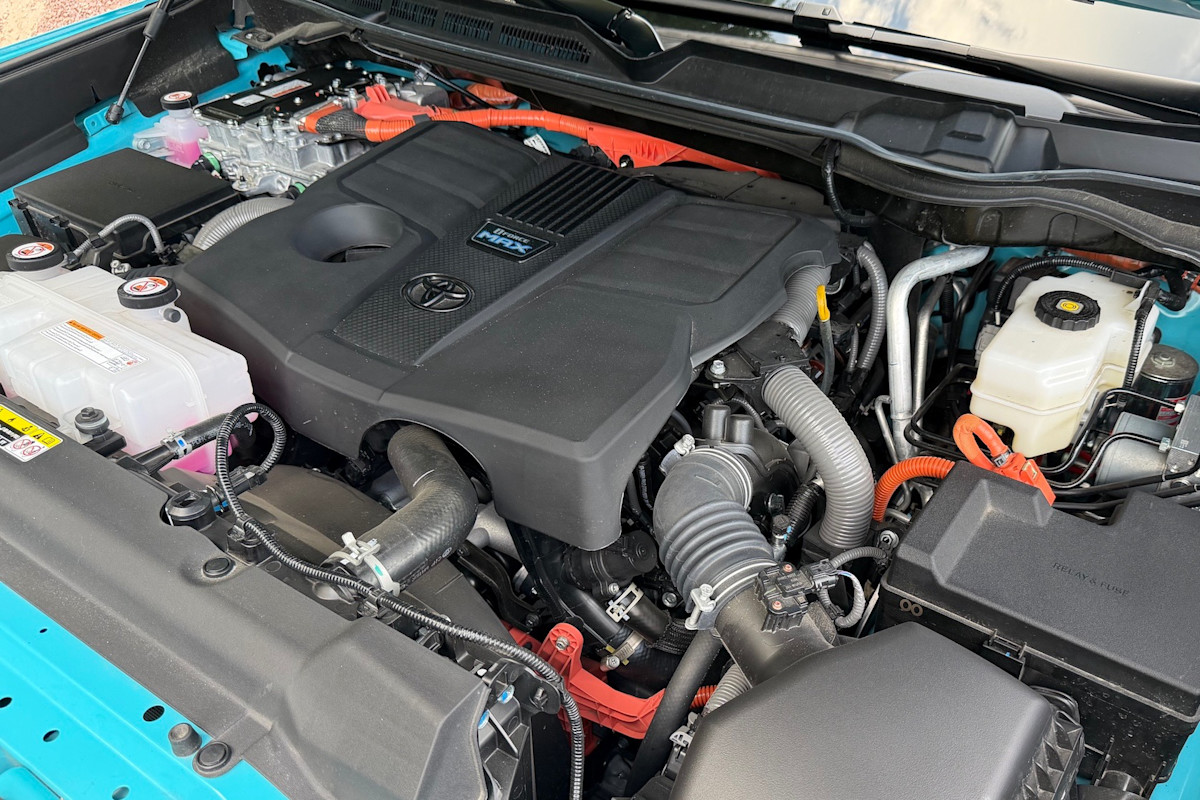
The Sequoia no longer has a V8, but that isn't obvious from behind the wheel. The powertrain is a hybrid that Toyota calls i-Force Max, but that isn't obvious, either. A twin-turbocharged 3.4-litre V6 makes 437 horsepower and 583 pound-feet of torque. An electric motor between the engine and 10-speed automatic transmission can add 48 hp and 184 lb-ft to aid acceleration, and it draws its power from a 1.87-kWh battery pack below the rear floor.
The engine feels and sounds like a V8. In fact, it’s more powerful than the Sequoia’s old V8, both by the numbers and from behind the wheel. It’s strong from a stop with lots of passing punch, and the 0 to 100 km/h run takes an estimated 6.8 seconds. It’s also loud and consistently emits a V8-like growl.
The Sequoia can tow up to 4,137 kilograms (9,121 pounds), which is quite competitive for the class. A haul mode helps with towing, as does the standard heavy-duty tow hitch receiver. The optional towing mirrors may also aid towing thanks in part to convex lower mirrors, but they hurt otherwise. They’re overly large and stick out too far from the doors, blocking the view of pedestrians at neighbourhood intersections. They can also extend about another 10 centimetres via a button to the left of the steering wheel to better see the end of a 28-foot trailer. We’ve never been so annoyed by a pair of exterior mirrors.
Handling is also rather annoying, but that's par for the course with body-on-frame full-size SUVs. The Sequoia sits 22.1 centimetres off the ground with its standard-in-Canada four-wheel drive (4WD). It weighs 2,790 kilograms (6,150 pounds) and lacks any fancy suspension technology with one exception: it has a double-wishbone front suspension and a multi-link rear suspension with coil springs. There are no adaptive dampers, no air suspension, and no active anti-roll bars. The TRD Pro we drove had an off-road-tuned suspension with 2.5-inch Fox internal bypass coil-overs and rear remote-reservoir shocks, plus a unique front stabilizer bar.
The weight and ride height result in copious body lean in corners, and the Sequoia isn’t too happy about gathering its weight to head off in a different direction. The steering is slow with some play on centre, but it’s well weighted. Ride quality is generally good. There’s a bit of truck-like bounding over bumps, but jiggle is well controlled and few road imperfections can pound through to upset passenger comfort. The TRD Pro’s tall-sidewall 285/65R18 all-terrain tires do an even better job of absorbing bumps and ruts than the 20s or 22s on other models.
The TRD Pro is the off-roader. In addition to the all-terrain tires and suspension, it gets a front grille light bar, an aluminum front skid plate, a locking rear differential, and a platform roof rack. The 4WD system of every Sequoia works part-time and shouldn’t be used on dry pavement. It has low-range gearing for low-speed rock crawling and comes with hill descent control. Engaging 4Hi or 4Lo also unlocks off-road drive modes that include Deep Snow, Mud, Sand, Dirt, and Auto.
The surround-view camera system aids off-roading with forward, rear, and front and rear side views, plus readouts for degrees of pitch and yaw.
Form & function
As a full-size SUV, the Sequoia can carry seven or eight passengers. The first row comes standard with eight-way power seat adjustments and two-way power lumbar adjustments. The seats, while wide enough for bigger folks, are too flat for long trip comfort, though headroom and legroom are plentiful. Heated front seats and a heated steering wheel are standard in Canada, and most trims also have ventilation. The Platinum and Capstone trims also get heated and ventilated second row seats.
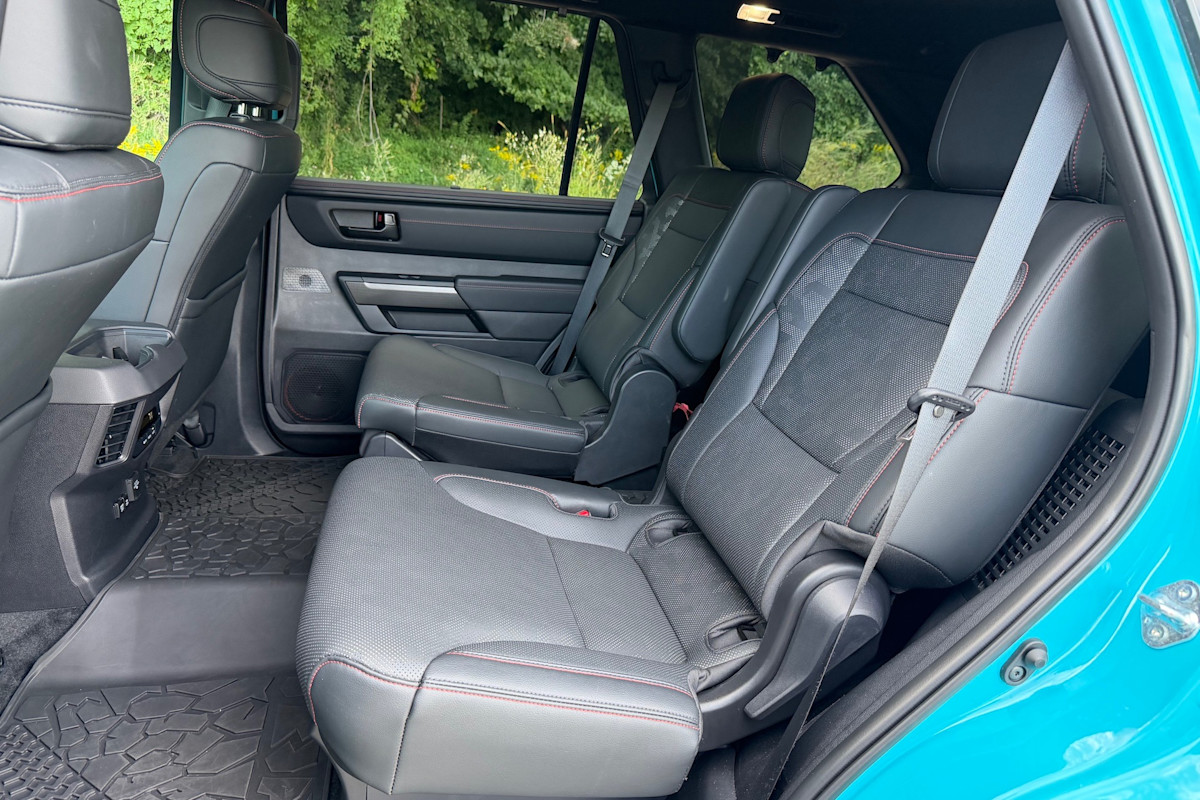
Second row comfort is quite good, especially with the available captain’s chairs. With the bench, the Sequoia is wide enough to fit three across in the second row and even the third row in a pinch. The second row has a pair of USB-C ports for charging phones and a 115-volt outlet to plug in whatever backseat riders may want.
Getting back to the third row is easiest with centre access between the captain’s chairs, but the second row seats also tilt and flip forward. Once they're back there, adults up to six feet tall will have enough headroom and legroom to handle short trips. Low seat bottoms create a knees-up seating position, though, which means there’s no thigh support for comfort on trips over a half hour. Available buttons allow third row passengers to recline the seatbacks for more space.
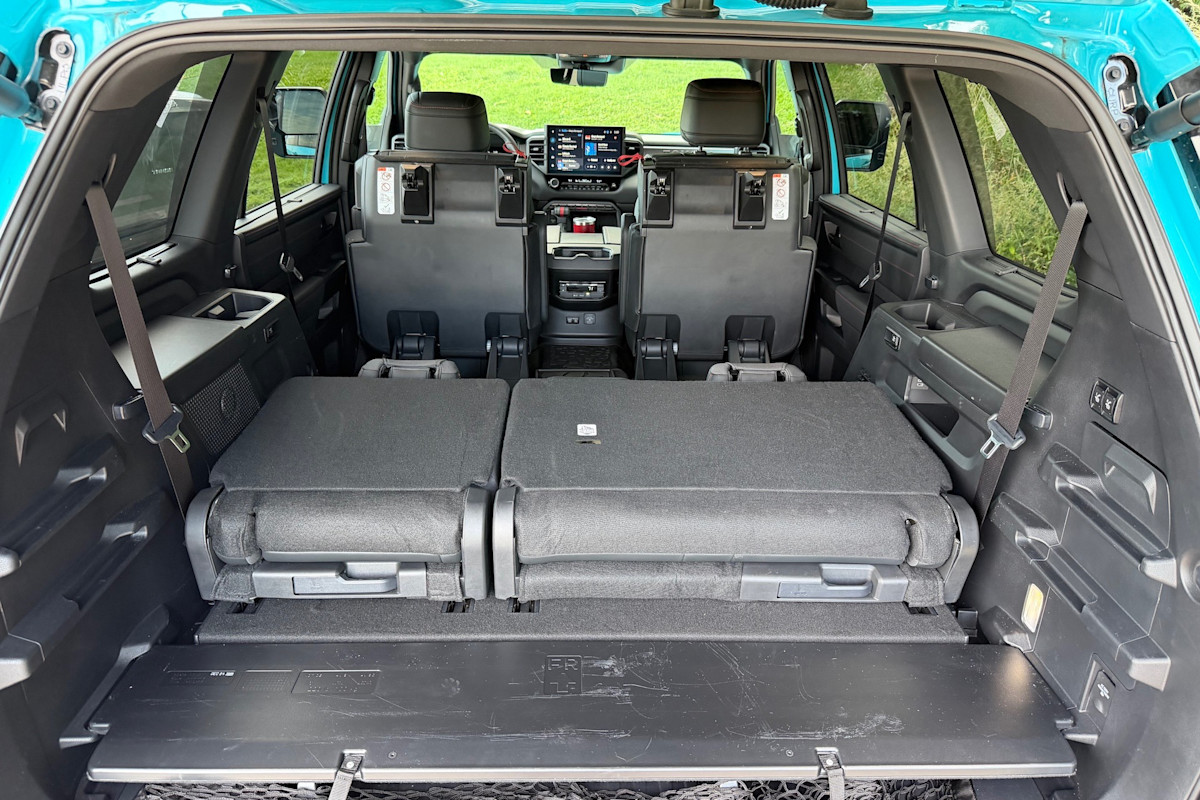
Cargo space in the Sequoia is a strength and a weakness — the former simply because of this monster’s size. By the numbers, the Sequoia has a rather small 325 litres of cargo space behind the third row, though that expands to 637 litres with those seats moved forward far enough that they essentially allow for no legroom. It also has 1,387 litres behind the second row with the third row folded down and 2,460 litres with the third row down, the second-row seat bottoms tilted forward, and those seatbacks folded down.
When folded, the third row sits above floor level instead of flush with the floor. All the Sequoia’s rivals have more cargo space and more user-friendly load floors, most of which are flat. To help even out the floor, Toyota provides a cargo shelf that can also sit below or above the level of the folded third row.
Technology
The Sequoia has a standard 12.3-inch digital instrument cluster and 8-inch infotainment touchscreen. However, moving up just one trim level brings a 14-inch touchscreen. The instrument cluster is sharp and includes the likes of trip information, fuel economy, trailer gain, current audio, and a compass on the left, the speedometer and tach in the middle, and boost PSI and battery state of charge on the right.
The climate controls sit just below the screen, and the drive mode selector and 4WD controller are within easy reach on the centre console.
The 14-inch touchscreen is sharp and quite easy to use. It has shortcuts to the standard wireless Apple CarPlay and Android Auto as well as paired phones, navigation, music and entertainment, vehicle trip and fuel economy information, and vehicle settings. Other systems offer more connectivity, but few come simpler.
Other standard tech features include a three-month satellite radio trial, an eight-speaker audio system, and five years of Safety Connect and Service Connect. Remote Connect and Drive Connect require a subscription from day one on the base infotainment system and have three-year trial periods on versions with the 14-inch screen. Remote Connect provides access to the Toyota app for remote vehicle controls, and Safety Connect offers emergency assistance, a stolen vehicle locator, and roadside assistance. Drive Connect enables natural voice control and cloud-based navigation, and Service Connect issues maintenance reminders.
A head-up display, 120-volt outlet in the cargo area, wireless phone charger, and 14-speaker JBL audio system are available on higher trims.
Safety
Toyota equips the Sequoia with its Safety Sense 2.5 suite of standard safety features. It includes forward collision warning with oncoming traffic and pedestrian detection and emergency steering assist, adaptive cruise control, lane departure warning with lane keep assist, and high beam assist. Also standard but not part of Safety Sense 2.5 are blind spot monitoring, rear cross-traffic alert, and front and rear parking sensors with automatic braking. A surround-view camera system is offered on higher grades.
The Sequoia had not been tested by the U.S. National Highway Traffic Safety Administration (NHTSA) at the time of writing and received mixed crash test results from the Insurance Institute for Highway Safety (IIHS). It scored a top Good in the IIHS’s small overlap and updated side crash tests and a Marginal score in the updated moderate front overlap test. Its available headlights split their scores between the worst Poor score and top Good score, and its front crash prevention system gets a Good rating for its ability to avoid or mitigate crashes with pedestrians but only a Marginal vehicle-to-vehicle rating.
The Sequoia's safety systems worked as they were supposed to during our test, and the surround-view camera system is a boon for both off-roading and tight spots. Speaking of tight spots, those wide tow mirrors make the Sequoia hard to park in addition to the possible danger they represent by blocking the driver’s view of pedestrians. Toyota also does not offer a hands-free highway driving system as other automakers do, so it’s behind the times.
Cost-effectiveness
In Canada, the 2026 Toyota Sequoia comes in SR5 TRD Off-road, Limited (with available TRD Pro package), Platinum, and Capstone trim levels. Prices start at $87,620 including a mandatory $1,930 destination charge and top out at $105,242 for the Capstone. The latter does not include the federal luxury tax, which applies to the portion of the purchase price above $100,000. The TRD Pro adds $12,238 to the Limited trim for a total price with destination of $103,188 before luxury tax.
The Sequoia’s 4WD system only works part time, and Toyota does not offer a full-time version with an Auto setting. That means it shouldn’t be used on dry pavement, and some owners may forget to engage it in inclement weather. Many rivals have systems with an Auto mode that can send power to the front wheels when needed.
The Sequoia doesn’t get very good fuel economy, even though it's a hybrid. It’s rated by Natural Resources Canada at 12.6 litres per 100 kilometres in the city, 10.5 on the highway, and 11.7 combined. We did even worse than that in the TRD Pro model we tested, averaging only 15.3 L/100 km over 200 kilometres of mixed city and highway driving. Still, the Sequoia does better than its competition.
In Canada, Sequoia pricing is roughly on par with most rivals. Its base price is approximately $1,500 more than the Ford Expedition, $2,500 more than the cheapest 4WD Chevrolet Tahoe, and almost identical to the Nissan Armada. None of those offer a hybrid option, but given the Sequoia’s modest efficiency gains, buyers can weigh whether to consider that a factor. Of those rivals, only the Expedition offers a comparable off-road grade, but all have better cargo holds.
What owners say
Trims & specs
Base MSRP N/A | Seating 8 |
Engine 3.4L 437 hp V6 Hybrid | Cargo Capacity 631 L |
Combined MPG 22 | Drivetrain 4X2 |
Base MSRP N/A | Seating N/A |
Engine N/A | Cargo Capacity N/A |
Combined MPG N/A | Drivetrain N/A |
Base MSRP N/A | Seating 7 |
Engine 3.4L 437 hp V6 Hybrid | Cargo Capacity 631 L |
Combined MPG 20 | Drivetrain 4X4 |
Base MSRP N/A | Seating N/A |
Engine N/A | Cargo Capacity N/A |
Combined MPG N/A | Drivetrain N/A |
Base MSRP N/A | Seating 7 |
Engine 3.4L 437 hp V6 Hybrid | Cargo Capacity 631 L |
Combined MPG 20 | Drivetrain 4X4 |
Base MSRP N/A | Seating 7 |
Engine 3.4L 437 hp V6 Hybrid | Cargo Capacity 631 L |
Combined MPG 20 | Drivetrain 4X4 |
Base MSRP N/A | Seating 8 |
Engine 3.4L 437 hp V6 Hybrid | Cargo Capacity 631 L |
Combined MPG 20 | Drivetrain 4X4 |
Base MSRP N/A | Seating 8 |
Engine 3.4L 437 hp V6 Hybrid | Cargo Capacity 631 L |
Combined MPG 22 | Drivetrain 4X2 |
Base MSRP N/A | Seating 8 |
Engine 3.4L 437 hp V6 Hybrid | Cargo Capacity 631 L |
Combined MPG 20 | Drivetrain 4X4 |
Base MSRP N/A | Seating 7 |
Engine 3.4L 437 hp V6 Hybrid | Cargo Capacity 631 L |
Combined MPG 20 | Drivetrain 4X4 |


Pricing trends
Current avg. market price
$102,196
Trending down by 5.9% this month
May 2026 - November 2026

