The Dodge Ram 3500 is a one-ton pickup truck introduced in 1994 as an extension of the Dodge Ram line. Though the Dodge Ram 1500 was introduced in 1981, the Dodge Ram 3500 didn’t appear until the beginning of the 1500’s second generation. For some years, the Dodge Ram 3500 was also available as a chassis cab, intended for customization or upfitting for specific applications.
Dodge RAM 3500 Buying Guide: Cost, Reliability, and the Best Years to Buy
Search for Dodge Ram-3500
See all


This guide covers the truck’s three generations through the 2010 model year, when Dodge spun off the Ram name into its own truck-specific brand. We cover the model years after this branding and marketing change in a separate buying guide.
Over the years covered in this guide, the Dodge Ram 3500 paled in popularity not only compared to the regular full size Dodge Ram 1500 but also compared to heavy duty trucks from competing brands, particularly Ford, Chevrolet, and GMC. That means shopping for a good used version of this truck may be more challenging than shopping for one of its rivals.
Compared to the Dodge Ram 1500, the Dodge Ram 3500’s packaging is pretty straightforward. Since it was more work- and fleet-focused than consumer-focused, it typically lacked the special editions and optional features that take some navigating. That means finding a used Dodge Ram 3500 can be as simple as finding an example you like that meets your budget, without numerous complicating factors.
Available Dodge Ram 3500 trim levels from these years had a tradesman-like approach, with basic upholstery such as cloth seats. However, you won’t find luxurious features like you’ll see in more current Ram 3500 Big Horn or Ram 3500 Laramie models, or even in Ram 1500 models. Features such as air suspension, off-road packages, upgraded aluminium wheels, and appearance package choices are less of a priority here.
Dodge RAM 3500 Buying Guide: Cost, Reliability, and the Best Years to Buy
- Frequently Asked Questions
- Dodge RAM 3500 Pros and Cons
- Dodge Ram 3500 Generations
- Third Generation (2010-2010)
- Second Generation (2003-2008)
- First Generation (1994-2001)
Frequently Asked Questions
Which Dodge RAM 3500 years are the best?
Experts suggest the second-generation Dodge Ram 3500 is the best if you’re looking for an older truck. That’s because this generation is available with a 5.9-litre Cummins diesel engine that has a great reputation for reliability, particularly with its fuel injection system. It also has good towing capability and payload capacity, and a well-designed cabin. That said, there are some exceptions, so see below.
Keep in mind that if you’re looking for features such as a 12-inch touchscreen, Android Auto and Apple CarPlay connectivity, Uconnect infotainment, navigation, and safety features such as blind spot monitoring, you’ll want to visit a dealership to test drive a newer Ram truck. These features were not available on the model years covered in this guide.
What are the worst Dodge RAM 3500 years?
The 2003 and 2006 Dodge Ram 3500s are known for specific issues. The 2003 model is prone to dashboard cracking, so carefully inspect the interior of any 2003 model you consider buying and ask the owner if the dashboard has been replaced. Owners of 2006 Ram 3500s have complained of faults in the HVAC system, generally related to the power supply for the air conditioner pump. Again, ask the owner of any 2006 model if it’s been an issue.
For first-generation versions of the Dodge Ram 3500, the issues are numerous. They’re prone to rust, electric problems, and unreliable speedometers and odometers.
Is a used Dodge RAM 3500 a good deal?
Yes, if you shop carefully. The Dodge Ram 3500 is not as popular as other heavy-duty trucks, which means they may be less expensive. If you avoid model years with known issues or are comfortable with those potential problems, you may be able to find a good deal. Models with the high-output Cummins turbo diesel engine can be a particularly good find. The biggest issue is finding one; at the time of writing, there were fewer than 20 Dodge Ram 3500s for sale on the used car market across Canada.
Dodge RAM 3500 Pros and Cons
Pros:
- Strong engines and competitive specs
- Good towing capability
- May be overlooked by other buyers
Cons:
- Not as many examples on the market as competing brands
- Limited configurations
- Scarce parts
Dodge Ram 3500 Generations

Third Generation (2010-2010)
Though the fourth generation of the Dodge Ram 1500 was introduced for the 2009 model year, as you’ll see, the heavy-duty versions tended to run on a slightly different schedule. That means the Dodge Ram 3500 pickup truck was redesigned for its third generation for the 2010 model year alongside the Dodge Ram 2500, and the chassis cab version went on sale for 2011 alongside the 4500 and 5500 versions. Notably, the 2011 model year marked Ram’s spinoff as a separate brand, which we review separately. That means we cover only one year of the Dodge Ram 3500’s third generation here, that being 2010.
The Dodge Ram 3500 was available in 2010 with rear- or four-wheel drive. It was powered by a 6.7-litre six-cylinder diesel engine and driven by the choice of six-speed manual or automatic transmissions.
The 2010 Dodge Ram 3500 was available in regular cab, Quad Cab, all-new Crew Cab, and Mega Cab configurations, with 6'3" or 8' beds, depending on the configuration. Mega Cab models had reclining rear seats. Some versions of the Dodge Ram 3500 were available with dual rear wheels, so if you’re looking for a dually version, check out a long-wheelbase or Mega Cab configuration.
For 2010, the Dodge Ram 3500 was available in ST, SLT, and Laramie trims, though not all trims were available with all bed and cab combinations.
In its last year before dropping the Dodge name, the 2010 Dodge Ram 3500 is prone to several problem areas that should be examined by potential buyers. There have been recalls for problems with the brake lights, so ensure that recall work has been performed. The power steering system and transmission are also prone to failure.
The small handful of 2010 Dodge Ram 3500s we found in our search at CarGurus.ca were all located in the Prairie provinces and priced between $15,000 and $25,000, and those units had odometer readings of 300,000 kilometres or more. If you come up short in your search, however, keep in mind that this generation and model continued into 2011 under the Ram 3500 name.
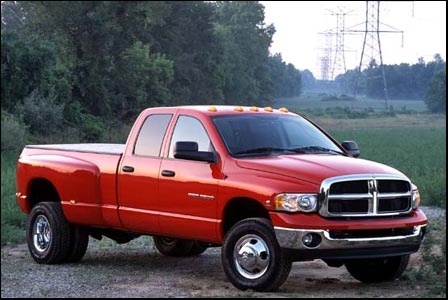
Second Generation (2003-2008)
The second-generation Dodge Ram 3500 coincides with the third-generation Dodge Ram 1500. This Dodge Ram 3500 featured a new frame, suspension, body panels, interior design, and a powertrain lineup from its predecessor, with a distinctive grille and bumpers. The 3500 had a live-axle suspension system, and the rear-wheel drive version had a rack and pinion steering system that was exclusive to its class.
The lineup was refreshed for the 2006 model year with updated exterior styling and a new infotainment interface with Bluetooth. The chassis cab 3500 model was introduced in 2007, suitable for upfitting and customization. In 2008, it was joined by 4500 and 5500 versions.
The Dodge Ram 3500 was available in regular, Quad Cab, and Mega Cab configurations, the latter introduced in 2006. These could be paired with 6'4" or 8' beds. Engine options were a 5.7-litre Hemi V8, a 5.9-litre Magnum V8, and a 5.9-litre Cummins turbodiesel inline-six, with the V8 engine options being more popular. Depending on the model year, transmission options were a four-speed automatic, five-speed automatic, five-speed manual, or six-speed manual.
The chassis cab version was available in regular and Quad Cab versions. It was available with rear- or four-wheel drive and 5.7-litre Hemi V8 or 6.7-litre Cummins diesel engines, with a standard six-speed manual or five-speed (Hemi) or six-speed (diesel) automatic transmissions. Drivetrains were rear- or four-wheel drive.
Trim levels in Canada included ST, SLT, and Laramie, though not all trims were available with all bed, cab, and powertrain configurations.
Though this generation of the Dodge Ram 3500 is generally well regarded for its reliability, there are a few problems. If you’re looking at a 2003 model, carefully inspect for cracks in the dashboard—including behind the steering wheel—because this is a well-known issue with these model years. If it’s crack-free, ask the owner if it’s been repaired or replaced. As for 2006 models, you’ll want to ask the seller if the a/c pump has issues with the power supply and if it’s been repaired.
If you’re shopping for a second-generation Dodge Ram 3500, budget at least $15,000, and expect to pay closer to $25,000 for a model with less than 300,000 kilometres on the odometer. The vast majority of second-generation Dodge Ram 3500s available used in Canada as of this writing are located in Western Canada, namely Saskatchewan, Alberta, and British Columbia.
First Generation (1994-2001)
Since heavy-duty versions of the Dodge Ram were introduced later than the original Dodge Ram 1500, the first generation of the Dodge Ram 2500 and Dodge Ram 3500 coincided with the start of the 1500’s second generation. The 2500 and 3500 were the first pickup trucks available from the factory with a V10 engine.
Engine options were a 5.9-litre Magnum V8, 8.0-litre Magnum V10, and 5.9-litre Cummins turbodiesel inline-six. Depending on the model year, transmission options were a four-speed automatic, a five-speed automatic, or a six-speed manual. Drivetrains were rear- or four-wheel drive.
The first-generation Dodge Ram 3500 was available with regular and Quad Cabs, but only with an 8' bed. Regular and dual rear wheel configurations were available.
Shop carefully for first generation versions of the Dodge Ram 3500. They’re old and tend to be used hard in work or commercial environments. Furthermore, they’re prone to some specific issues. It’s unlikely, for example, that you’ll find a rust-free version of a work truck of this age, so carefully inspect any truck to determine the extent and severity of rust damage. These versions of the Ram 3500 were also prone to problems with the electrical systems and wiring, transmission failure, and inaccurate or unreliable instrument clusters, particularly the odometer and the speedometer. An unreliable speedometer is a safety and potentially legal issue, while odometer problems may cause issues when you register the vehicle if it gets flagged for fraud.
Due to their age and the aforementioned rust issues, there are very few first-generation Dodge Ram 3500s left in Canada. Our research for this guide turned up exactly one, a restored truck with 250,000 kilometres on the odometer priced at $45,000. The average heavily used and abused work truck won’t go for nearly this much, so you may need to watch the listings—use CarGurus.ca’s Save Search and listing value ratings tools to save time—or shop the more plentiful selection in the United States, where this vintage goes for between USD$16,000 and USD$33,000 on average.
Related Topics:


by Stephanie Wallcraft
Stephanie Wallcraft is a multiple award-winning professional automotive journalist based in Toronto, Ontario, Canada. In addition to CarGurus Canada, her byline has appeared in major Canadian publications including Toronto Star Wheels, Driving.ca, and AutoTrader.ca, among others. She is a Past President of the Automobile Journalists Association of Canada and was named 2024 Canadian Automotive Journalist of the Year.
The content above is for informational purposes only and should be independently verified. Please see our Terms of Use for more details.

