Hyundai first introduced the Veloster hatchback for the 2012 model year as a replacement for the aging Tiburon compact coupe. In addition to being larger than the Tiburon, the Veloster’s three-door hatchback configuration made it more practical due to the extra door on the passenger side. The second generation was launched for the 2019 model year featuring a much sleeker design but keeping that odd door layout.
It didn’t take long for Hyundai’s Motorsport division to take the Veloster racing. In 2011, Hyundai prepared a Rallycross competitor with the legendary Rhys Millen behind the wheel. For the second generation, Hyundai competed with the Veloster on the racetrack in TCR specification prepared for Touring Car races in North America and the UK.
To bring its racing program to the masses, Hyundai established its N division in 2012 — think BMW M or Mercedes AMG. In developing the Veloster N, Hyundai’s N division went to great lengths to make the best hot hatchback it could, and all Veloster N models received significant improvements over the standard car. Body shells were reinforced with extra welds and structural bracing, and adaptive dampers were standard.
Although the Veloster was discontinued in Canada after 2020, the development program lives on in the Elantra N and the Kona N. Those looking for the Veloster N experience with a standard sedan body style should consider the Elantra N.
Hyundai Veloster N Buying Guide: Cost, Reliability, and the Best Years to Buy
Frequently Asked Questions
Which Hyundai Veloster N years are the best?
In Canada, the Veloster N was sold in a single configuration and didn’t change appreciably through its production run. The most important thing to note is that you’ll need to look for a 2021 or 2022 Veloster N if you want the eight-speed dual clutch automatic transmission (DCT) with paddle shifters as the six-speed manual was the only option in earlier model years.
What are the worst Hyundai Veloster N years?
Since the Veloster N was only ever sold in a single configuration in Canada in each model year and didn’t change much during its life, there aren’t any model years to avoid. 2021 and 2022 models equipped with the DCT may be more problematic than the manual due to its comparative complexity.
Is a used Hyundai Veloster N a good deal?
Yes. If you’re looking for a hot hatch, then the Veloster N can be a great deal. It’s a more exciting alternative to the Volkswagen Golf GTI or the Ford Focus ST and outperforms both. It fills an interesting gap, although some say it has one too many doors. Or is it missing a door? You decide.
Hyundai Veloster N Pros and Cons
Pros:
- Quick
- Fun to drive
- Great handling
Cons:
- Stiff ride
- Lots of road noise
- Three Doors
Hyundai Veloster N Generations
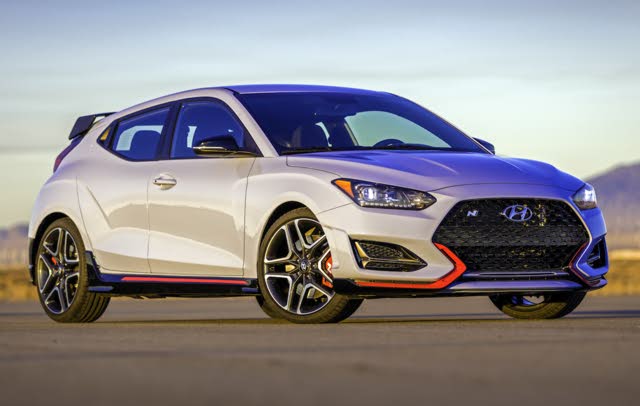
First Generation (2019 - 2022)
Introduced for the 2019 model year along with the second-generation Veloster, the Veloster N immediately drew praise for its impressive performance and playful driving experience.
All Veloster Ns were front-wheel drive with a turbocharged four-cylinder engine producing 275 horsepower and 260 lb-ft of torque along with a six-speed manual transmission, an electronically controlled limited-slip differential, and an active exhaust system. Outside, the Veloster N received more aggressive styling with improved aerodynamics, complete with a rear wing and red accents around the perimeter, plus a set of 19-inch alloy wheels. The Veloster N was available in four colours: Ultra Black, Chalk White, Racing Red, and N-exclusive Performance Blue, inspired by Hyundai Motorsport.
Inside, the Veloster N came standard with heavily bolstered performance seats, a sports steering wheel with large paddles for the N and N Custom drive modes, and blue seat belts. There was a unique gauge cluster with racing-style shift lights, while an auto rev-matching feature smoothed out shifts on a back road or racetrack.
The standard infotainment system used an eight-inch touchscreen with Android Auto and Apple Carplay functionality. Notably, Canadian Veloster N models skip the active driving assistance systems like forward collision, blind spot monitoring, and lane keeping assist.
Changes over the years were minimal. For the 2021 model year, Hyundai released an eight-speed wet dual clutch transmission (DCT) option. An overboost function could be enabled to up the torque output to 278 lb-ft with the DCT. Inside, new high-performance bucket seats with a light-up N logo were standard.
The Veloster N has generally proved reliable, although there are a few common problems to watch out for. The first is the high-pressure fuel pump (HPFP) for which a recall was issued, and there are now aftermarket replacements that fix the problem. Look closely at the factory wheels for peeling clear coat — you may have to refinish the wheels on your own dime now that these cars are running out of warranty. Finally, a recall was issued for 2021 and 2022 Veloster Ns equipped with the DCT transmission.
In Canada, prices for the Hyundai Veloster N on the used vehicle market range from $20,000 to $28,000 depending on the model year, odometer reading, condition, and whether it’s sold by a dealership or a private party. Later examples command a premium, particularly the final 2022 model year. The 2019 and 2020 models can be good value if you’re happy with the manual transmission.
Related Topics