The Jeep Wrangler is an iconic vehicle that defines its brand’s reputation for stalwart off-road prowess. Its roots date back to World War II and the original Willys Jeep. After the war, the Civilian Jeep (CJ) was produced from the mid-1940s through 1986, first by Willys, then by Kaiser-Jeep and American Motors Corporation (AMC). Then, when Chrysler purchased AMC in 1987, it created the first Jeep Wrangler with a lot of AMC-produced parts. In fact, the last AMC-developed engine wasn’t discontinued until 2012.
Jeep Wrangler Buying Guide: Cost, Reliability, and the Best Years to Buy
Search for Jeep Wrangler
See all


Though the Jeep Wrangler has been modernized throughout the years — adding digital displays, a four-door option, and even a power-operated canvas top — it stays true to its roots with a separate body and frame, rigid live axles, a tapered nose, fender flares, a fold-flat windshield, removable doors, and a heavy-duty four-wheel drive (4WD) system.
Today’s Jeep Wrangler is a picture of modernity with power windows, navigation systems, premium audio, wireless Apple CarPlay and Android Auto, heated front seats, front and side airbags, and push-button start. But the design perpetually harks back to an earlier time with the classic seven-slot grille and the option to ditch the windshield and the doors.
Jeep Wrangler: Cost, Reliability, and the Best Years to Buy
- Frequently Asked Questions
- Jeep Wrangler Pros and Cons
- Jeep Wrangler Generations
- Jeep Wrangler Fourth Generation (2018–Present)
- Jeep Wrangler Third Generation (2007–2017)
- Jeep Wrangler Second Generation (1997–2006)
- Jeep Wrangler First Generation (1987–1995)
Frequently Asked Questions
Which Jeep Wrangler years are the best?
If you look at CarComplaints.com, the second generation and current generation of the Jeep Wrangler have the fewest problems and complaints. Consumer Reports generally shows poor predictive reliability across the board, but the last couple years have been trending upwards. So, we’d say newer is probably better, especially if the factory warranty is still valid.
What are the worst Jeep Wrangler years?
The third generation Jeep Wrangler logs the most problems on CarComplaints.com. The 2007 model is known for the “death wobble,” a sudden and uncontrollable movement of the front suspension, which is very apparent through the steering wheel. That and 2008 log more complaints than any other model year. However, the website dubs 2012 the worst model year due to electrical problems.
Is a used Jeep Wrangler a good deal?
If you’re willing to take a risk on a vehicle known for reliability issues, there are plenty of good deals to be had. We see second-generation Wranglers on sale for less than $5,000, and third-gen vehicles priced at less than $10,000. We’ve even seen a rare example of the most recent fourth-generation model for less than $15,000. But these deals can come with expensive problems, so be sure to do plenty of digging before you sign on the dotted line.
Jeep Wrangler Pros and Cons
Pros:
- Unparalleled offroad chops
- Removable top and doors
- Highly customizable
Cons:
- Poor ride quality on tarmac
- Excessive wind noise at highway speeds
- Less cargo volume than other SUVs
Jeep Wrangler Generations
Jeep Wrangler Fourth Generation (2018–Present)
The fourth-generation Jeep Wrangler — referred to by the manufacturer as the Wrangler JL — looks remarkably similar to its predecessors, but it received significant upgrades. It’s longer and wider for better accessibility, plus it offers new and updated engines, an easier-to-fold windshield, easier-to-remove doors, an optional Sky One-Touch Power Top, zipperless soft tops, blind-spot monitoring, improved off-road capability, and better on-road performance.
This new Jeep generation retains the standard 3.6-litre Pentastar V6 engine and adds a 270-horsepower, 2.0-litre turbo four-cylinder engine, which is available with all trims. A six-speed manual transmission is standard with the V6, while an eight-speed automatic is optional with the V6 and standard with the four-cylinder engine. A 260-hp 3.0-litre turbocharged EcoDiesel engine was available from 2020 to 2023 and, in 2021, Jeep introduced a Hemi V8-powered version of the Rubicon trim level, called the Rubicon 392, which delivers 470 hp and 470 pound-feet of torque. In Canada, the Rubicon 392 was discontinued at the end of the 2024 model year.
This generation also saw the debut of the first electrified version in 2021: the Jeep Wrangler 4xe with a plug-in hybrid drivetrain.
The interior may look retro, but it’s thoroughly modern with push-button start as standard and an available digital gauge cluster. All models can be equipped with heated front seats and a heated steering wheel (but notably, these are not standard, even in Canada). The fourth-gen Wrangler uses the Uconnect infotainment system across the board, but the screen is available in five, seven, or 8.4-inch displays, depending on trim.
In terms of safety, the Wrangler JL adds standard side-impact airbags, available driver-assist features, and a lower beltline to increase visibility out of the windows. However, the Insurance Institute for Highway Safety has found this generation has the propensity to overturn during the small front overlap crash test and gives it a marginal score for this metric.
Changes throughout this generation have included the addition of optional adaptive cruise control in 2019 and an Xtreme Recon package with 35-inch all-terrain tires and suspension lift in 2021.
The JL got a mid-cycle refresh in 2024, which included new tire and wheel combinations, a different grille design, a new Rubicon X trim, updated Uconnect, a standard 12-inch infotainment screen with wireless Apple CarPlay and Android Auto, and a redesigned centre stack.
The original MSRP for vehicles in this generation range from $29,295 (not including fees) for a base Wrangler Sport in 2018 to $121,220 for a Wrangler Rubicon 392 in 2024. Even early vehicles in this current-generation Jeep Wrangler still command a hefty price. Some very high-kilometre or as-is vehicles sell for around $15,000, but you’re likely to pay at least $25,000 for a low-odometer example in good shape. The now-discontinued Wrangler Rubicon 392 can still run north of six figures on the Canadian used vehicle market.
Jeep Wrangler Third Generation (2007–2017)
The third-generation Jeep Wrangler was the first clean-sheet redesign of the body, frame, and suspension. Known as the JK, these Wrangler models added features such as power windows, remote power door locks, a navigation system, and available detachable sway bars. In addition to the traditional two-door models, a standard four-door Unlimited version was permanently added to the lineup. However, unlike the TJ-based Unlimited model, the wheelbase was 50 centimetres longer rather than 25 centimetres.
Stability control was a new safety feature offered on the JK Wrangler, and all trims had off-road tuned anti-lock brakes and traction control with an electronic limited slip differential. The Rubicon came standard with an electronic sway bar disconnect system. The Sunrider convertible soft top was standard beginning in 2009, and an optional three-piece modular hardtop was available.
Though some luxury amenities were added and most functions were under computer software control, the Wrangler JK still had a separate body-on-frame chassis, rigid live axles, a fold-flat windshield, and the ability to be driven without doors. The 4X4 models also still had part-time four-wheel drive with high and low gearing.
The third-generation Jeep Wrangler also had a wider track and was available with bigger tires. The two-door model was 6 cm shorter than the previous generation, and the Unlimited four-door model was 35.5 cm longer than the TJ Unlimited.
The initial powertrain in the JK Jeep Wrangler was the 202-hp 3.8-litre V6, paired with a base six-speed manual or an optional four-speed automatic transmission. It was offered through 2011, when it was replaced for 2012 by the 285-hp, Chrysler 3.6-litre Pentastar V6. This retained the same six-speed manual transmission, but the automatic was upgraded to a five-speed.
Hill Start Assist was added in 2009, and 2010 brought an easier-to-fold soft top. DaimlerChrysler’s Uconnect touchscreen infotainment system became standard on models with the MyGig radio at that time. 2011 brought cruise control and available heated front seats and side mirrors. Small changes occurred throughout the rest of this generation’s run, including a one-handed rear-folding seat, improved seat materials, and ambient lighting in 2013; a new 552-watt Alpine premium audio system in 2015; and a 75th Anniversary edition for 2017.
Even with some of the problems in this generation (such as the aforementioned death wobble), used prices remain high. However, there is a lot of availability and deals can be found if you’re willing to travel for them. Some Jeep Wranglers in this generation are priced as low as $10,000, but these tend to have 200,000 kilometres or more on the odometer. Lower-mileage, high-trim examples can go for $40,000 or more. However, you should be able to find a good third-gen Wrangler with lower kilometres and zero accidents in the $17,000 to $25,000 bracket.

Jeep Wrangler Second Generation (1997–2006)
Though the second-gen Jeep Wrangler was introduced in early 1996, it was positioned as a 1997 model and Jeep skipped the 1996 model year. Known as the TJ, this generation re-introduced the round headlamps from the classic Jeeps. Instead of leaf springs, this generation used coil-spring suspension for better ride and handling.
Other changes included dual front airbags, optional anti-lock brakes, integrated air vents, the addition of a glove box, and car-like stereo controls.
The 2.5-litre inline-four and 4.0-litre inline-six engines were carried over from the previous generation, as were the three-speed automatic and five-speed manual transmissions. In 2003, however, Jeep ditched the 2.5-litre engine in favour of a 147-hp, 2.4-litre four-cylinder engine, previously used in the Chrysler PT Cruiser. At the same time, the three-speed automatic was replaced by a four-speed equivalent and, in 2005, the five-speed manual was swapped a six-speeder.
The Jeep Wrangler Rubicon model, named for the Rubicon Trail, was added in 2002 featuring rear air-actuated locking Dana 44 axles with the Rock-Trac NV241 4:1 ratio transfer case, 16-inch alloy wheels, and Goodyear MTR P245/75-R16 tires. The Jeep Wrangler Unlimited arrived 2004 with a 25-centimetre longer wheelbase, which added a standard Dana 44 rear axle with a 3.73 gear ratio and the Command-Trac NV231 transfer case.
A mid-cycle refresh in 2003 brought new wheel designs and exterior decals, the new 2.4-litre engine, a new steering wheel, revised interior switch gear, new audio systems, and redesigned seats. For the last model year of the Wrangler TJ, the four-cylinder engine was dropped and the 4.0-litre inline six became standard.
Second-generation Jeep Wranglers are now hard to come by on the Canadian used car market. Prices range from as-is units for $5,000 or less up to $40,000 for well-maintained and heavily modified units. On average, expect to pay somewhere between $15,000 and $25,000.
Jeep Wrangler First Generation (1987–1995)
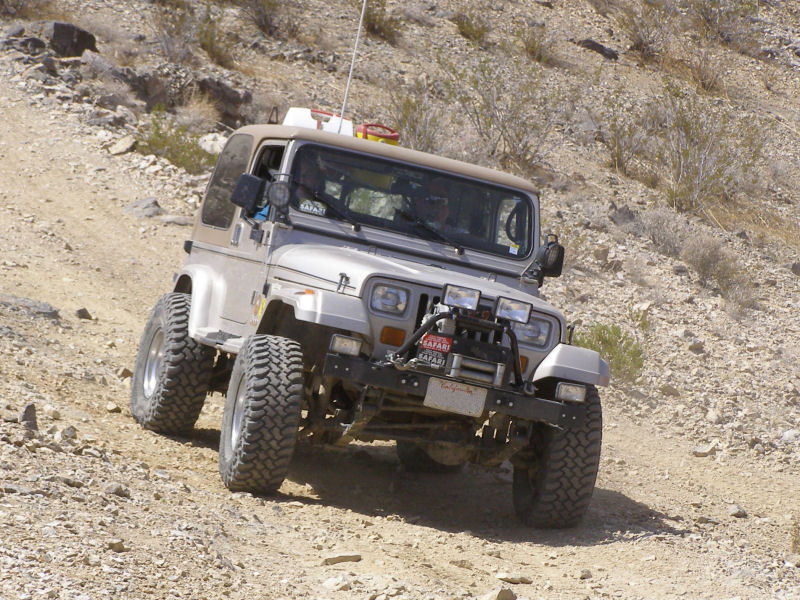
The first official Jeep Wrangler appeared under the Chrysler umbrella after the Civilian Jeep (CJ) series was discontinued. Internally known as the Wrangler YJ, the first-generation Wrangler distinguished itself from its predecessor with its square headlights, but it rode on the same wheelbase. Though the grille was new, the body was still very similar to the old CJ, while several parts were interchangeable.
In an attempt to attract more daily drivers, the first-gen Wrangler got a wider track than the CJ and had less ground clearance, more comfort, and improved handling. It also got trackbar suspension links and anti-roll bars for improved safety, which made it harder to flip.
Here’s a fun fact: some of the earliest Jeep Wranglers were assembled in Canada. When Chrysler bought AMC in 1987, it inherited not only the automaker’s assembly plant in Bramalea, Ontario — which had just opened a year earlier — but also the original Brampton Assembly Plant located at Steeles Avenue and Kennedy Road in Brampton, Ontario. AMC built Jeep CJs there in 1979 and 1980, and the Jeep Wrangler was assembled there from its launch in 1987 until the plant was shuttered in 1992.
The base engine in the first-gen Jeep Wrangler was a 117-hp 2.5-litre inline four-cylinder, while a larger 112-hp 4.2-litre inline six was available — both developed by AMC. A five-speed manual transmission was standard, and a three-speed automatic was an option with the inline six.
Jeep introduced the high-end Wrangler Sahara model in 1988, and in 1991 a fuel-injected 190-hp 4.0-litre straight-six engine replaced the original inline six. The roll cage was extended in 1992, which allowed for rear shoulder belts, and anti-lock brakes were added as an option in 1993. In 1994, the four-cylinder engines gained a three-speed automatic as an option.
Unfortunately, rust took a heavy toll on Jeeps of this era, and there aren’t many left in Canada as a result. Expect to pay at least $10,000 for a Jeep Wrangler YJ in serviceable condition, while units in collectible shape can command $40,000 or more. On the other hand, models of this vintage qualify for Canada’s classic car import exemptions, so perhaps repatriating a Brampton-built unit would interest you. If so, you’ll find examples on the U.S. used car market for between USD$5,000 and USD$10,000 ballpark.
Related Topics

by Stephanie Wallcraft
Stephanie Wallcraft is a multiple award-winning professional automotive journalist based in Toronto, Ontario, Canada. In addition to CarGurus Canada, her byline has appeared in major Canadian publications including Toronto Star Wheels, Driving.ca, and AutoTrader.ca, among others. She is a Past President of the Automobile Journalists Association of Canada and was named 2024 Canadian Automotive Journalist of the Year.
The content above is for informational purposes only and should be independently verified. Please see our Terms of Use for more details.

