This was an era of upheaval at Land Rover. The brand struggled with financial problems until it was acquired by BMW in 1994. Ford then bought it, but that ownership only lasted until 2007 when it was put up for sale before the financial crisis in 2008. Since then, Indian carmaker Tata has controlled the brand under the Jaguar Land Rover banner and has poured money into their respective coffers to reinvigorate the lineups.
Fast forward to 2020 and the debut of an all-new, second-generation Defender. It incorporated decades of expertise and technology that was missing from its predecessor, emerging as a luxurious SUV with impressive off-road credentials. As a Land Rover, it was also pricier than your average SUV, even against other luxury brands.
The combination of luxury and all-terrain abilities is rare among contemporary SUVs, but the competition is fierce. The Mercedes-Benz G-Class takes the luxury quotient further while still having the off-road capability to conquer rough terrain, but it's even more expensive than the Defender. There's also the Ineos Grenadier, which could easily be mistaken for a first-generation Defender and blends modern tech with old-school cool. The Lexus GX and LX models are also strong adventurers but aren't as posh as the Land Rover. Indeed, the closest rivals come from within Land Rover itself in the form of the family-friendly Discovery and opulent Range Rover.
Land Rover Defender Buying Guide: Cost, Reliability, and the Best Years to Buy
Frequently Asked Questions
Which Land Rover Defender years are the best?
That’s a loaded question. Objectively, the second-generation Defender is the best because it's significantly more comfortable, more refined, and safer than its predecessor. It's also easier to live with, drive, and maintain. If you ask a Defender enthusiast, their love for the original may well cloud their judgment, and we wouldn't blame them. That generation is an icon in off-road circles and has tons of personality.
Which Land Rover Defender years are the worst?
That’s another tough one. Finding a trustworthy mechanic to keep your first-generation Defender in top running condition is no easy feat, and parts availability is yet another challenge. Land Rovers of this vintage are known for their durability but not reliability. For those dedicated enough to consider one, we suggest thinking of it as a classic vehicle with all the associated joys and pitfalls.
As for second-generation Defenders, there have been a few mechanical gremlins that have caused recalls. As is typical, the first year of production saw the most with notices sent out for a possible fire caused by an oil leak (which persisted into the 2024 model year), unexpected engine stalling, seat belts, seat brackets, and taillights. Other notable recalls included the brake callipers and third-row child seat in 2023 and an issue with the rear-view camera in 2024. We recommend checking out the Transport Canada website to see which recalls may apply to your potential Defender.
Is the Land Rover Defender a good deal?
First-generation Defenders vary widely in price and quality, and for the most part prices remain uncomfortably high, but Defender fans can justify the cost with passion. The second-generation models have held their value better than many luxury SUVs, which may be an obstacle if you're looking for a pre-owned model. The good news is it should also apply to subsequent owners, so you won't have to worry so much about later depreciation.
Land Rover Defender Pros and cons
Pros:
- Spectacular all-terrain capabilities
- Refined and comfortable second generation
- Iconic style and rich history
Cons:
- Expensive compared to rivals
- Primitive first-generation models
- Questionable reliability
Land Rover Defender generations
Second generation (2020 - present)
Under the ownership of Indian carmaker Tata, which also owns Jaguar, an all-new Defender finally debuted in 2020. With more than a quarter century between it and the first generation's introduction, the second-generation Defender benefits from a wealth of new engineering and technology. From a styling standpoint, the new Defender retains the familiar boxy silhouette and round headlights, but the corners are rounded for a more modern look.
That theme continues inside with a rather simple and industrial dashboard that houses modern digital displays and touchscreens. More importantly, the cabin is no longer a primitive, bare-bones enclosure, and the quality is drastically improved. It is a Land Rover, after all, but it isn't nearly as opulent as the luxurious Range Rover, nor should it be.
For its inaugural year, the 2020 Land Rover Defender was only available in the longer, four-door 110 configuration. It could seat five passengers in standard form, while an optional centre front jump seat increased that to six. A pair of third row seats was also offered, but not in conjunction with the front jump seat, for a maximum capacity of seven.
The base engine was a turbocharged 2.0-litre four-cylinder engine that produced 296 horsepower and 295 lb-ft of torque. A 3.0-litre six-cylinder mild hybrid engine was available and increased output to 395 hp and 406 lb-ft of torque. An eight-speed automatic transmission, a two-speed transfer box, and four-wheel drive were standard on all models.
The S model, which acted as the entry level trim in Canada, included adjustable air suspension, cloth and leather seat upholstery, and plenty of connectivity features, including Jaguar Land Rover’s Pivi Pro infotainment system with a 10-inch touchscreen, and Apple CarPlay and Android Auto. Standard safety features included frontal collision warning with automatic emergency braking, lane keep assist, a blind spot monitor, and a surround-view camera system.
The SE trim added the V6 engine, 20-inch wheels, 14-way powered and heated front seats, a 10-speaker stereo, and a digital rear-view mirror. The First Edition model was only offered for 2020 and dressed things up with unique paint choices and exterior trim, all-terrain tires, and additional off-road drive modes with an upgraded differential for improved traction.
The HSE trim was more on the luxurious side with a glass panoramic roof, 18-way power heated and ventilated front seats, premium leather upholstery, and adaptive cruise control. At the top of the lineup, the X trim was essentially a fully-loaded model, both in terms of all-terrain equipment and interior luxury.
To say this second generation is an improvement over the first is a massive understatement. Not only is this new Defender impressively capable over treacherous terrain, but unlocking this capability is much easier. The driver simply needs to set the Terrain Response System to automatic, and the many systems figure out the best settings to maximize traction and stability. More knowledgeable drivers also have the ability to manually select their preferred settings.
The new Defender is also significantly more comfortable on the tarmac. The adaptive suspension delivers a smooth ride, and the cabin is as quiet as any other SUV as long as you don’t have your Defender outfitted with all-terrain tires. It's also easier to drive thanks to modern steering components that keep it tracking straight on the highway and deliver much more confident cornering abilities.
On the downside, the rear cargo door is quite heavy and is hinged on what we North Americans might consider the wrong side. You'll have to load it from the driver's side rather than from the sidewalk, but at least there's no risk of the hatch opening into traffic. The Defender has also been pricy for the class from the start, with a 2020 manufacturer’s suggested retail price (MSRP) of just over $65,000 before fees and a top end above $93,000.
The two-door Defender 90 joined the lineup in 2021, after a delay caused by COVID-19. Also new was an X-Dynamic SE trim that added the top X trim's aesthetic elements but not the mechanical or luxury features. The First Edition trim remained, but only for the Defender 90, and some minor features also moved from the options column to the standard features list.
Defender enthusiasts had been clamouring for a V8 engine since its revival, and they got it in 2022. This 5.0-litre supercharged powerplant produced a snarling 518 hp and 461 lb-ft of torque, and it started in Canada at just over $125,000. A new XS trim level added more comfort and luxury features.
In 2023, the trim line-up was scaled back to S, SE, X-Dynamic SE, X, and the V8. A First Edition trim also returned for the new Defender 130, which was a long-wheelbase three-row variant. There was also a 75th Limited Edition that celebrated Land Rover's birthday.
The lineup ballooned again in 2024 with a new Outbound trim that deleted the Defender 130's third row and windows to make room for more cargo space. A County Exterior package made things fancier with two-tone paint schemes, unique wheels, and other accessories, and the V8 was offered with the 130 model for the first time.
In 2025, a flagship Octa trim debuted, with a 626 hp twin-turbocharged V8, upgraded suspension, and a more luxurious interior. Elsewhere, the Defender 130 gained second-row captain's chairs, 11.4-inch touchscreens became standard, and synthetic leather replaced the standard upholstery.
In its inaugural year, the Defender 110 with the six-cylinder engine was estimated for fuel economy of 12.3 litres per 100 kilometres combined, while the four-cylinder—which you’d expect to be more economical—received the exact same combined rating and performed worse on the highway. When the Defender 90 went on sale the following year, it was also estimated at 12.3 L/100 km combined with both engines. The short-wheelbase V8 received a rating of 14.3 L/100 km combined, while the 110 model came in at 14.7 L/100 km combined. The Defender 130 started out at 12.6 L/100 km combined with the six-cylinder and 15.0 L/100 km combined with the V8. These numbers have fluctuated slightly across model years as equipment has changed.
As is the case with some high-end vehicles, the Land Rover Defender hasn’t been evaluated by either the U.S. National Highway Traffic Safety Administration (NHTSA) or the Insurance Institute for Highway Safety (IIHS), so we can't compare its crashworthiness to other SUVs in its class. Besides the aforementioned standard safety features, there aren't any significant options to add.
Used Defenders have held their value better than some other vehicles in the Land Rover portfolio. For example, a 2020 Defender 110 X that cost around $93,000 new before fees would sell at around $66,000 in 2025. The Defender may have been helped a bit by its COVID-era launch with low inventory and very high demand that sent prices skyward. Once demand and production normalized, the Defender remained a very desirable SUV, whether you planned to use its off-road potential or you just wanted to look like you could. Generally, you should expect to pay between $50,000 and $110,000 for a used Land Rover Defender in Canada, with exceptional models like the OCTA going for as much as $200,000.
First generation (1983 - 2016)
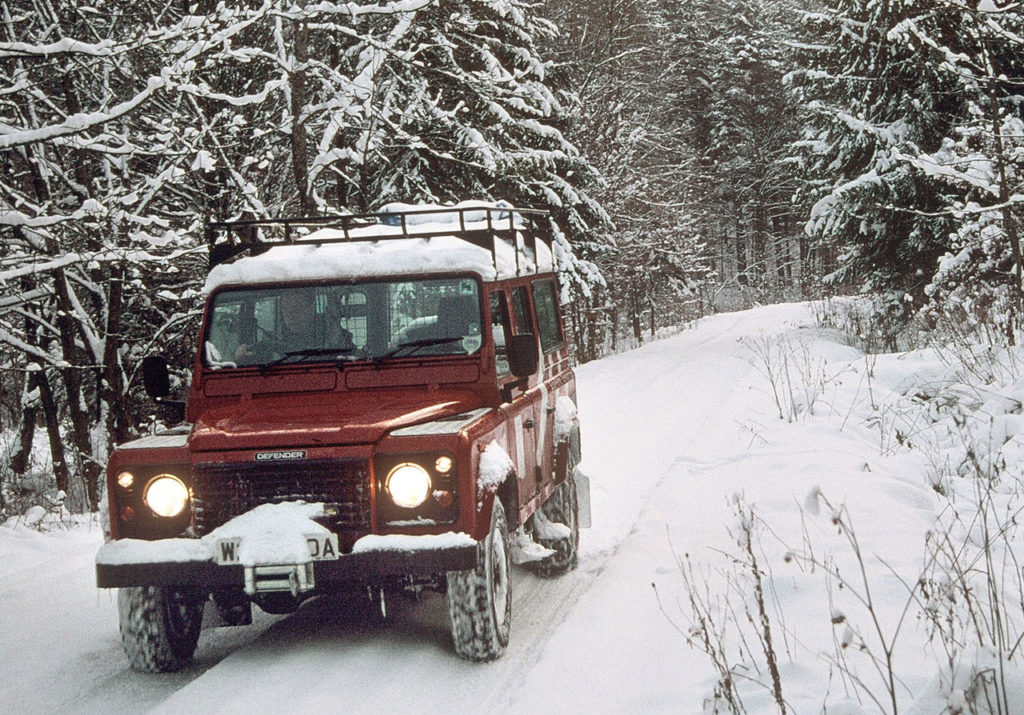
In 1983—long before the term "sport utility vehicle" was coined—Land Rover introduced the 110, a follow-up to the iconic Land Rover Series I, II, and III, which were essentially Britain's answer to the iconic Jeep. Like the Series models before, the 110 was easily identifiable by its boxy shape and tall ride height. In 1990, it was renamed the Defender. But here in North America, we could only admire it from a distance because it wasn't officially imported. Some models snuck past in grey market transactions, but we'd have to wait some time before buyers could pick one up at an official retailer.
In the mid-1990s, a handful of first-generation Land Rover Defenders were sold new in Canada over the span of two years. All were the longer 110 models and came with a 3.9-litre V8 engine that produced 180 horsepower and 227 pound-feet of torque. It was paired with a five-speed manual transmission, four-wheel drive, and a transfer case, giving it the all-terrain abilities to take on the most accomplished off-roaders of the time—and those yet to come.
As capable as these first-generation Defenders were over challenging terrain, they were less adept at everyday duties. The interior was primitive with an abundance of painted steel and hard plastic surfaces, and a roof that leaked air and rain. It came standard with only two front seats, with a rear bench offered as an option. The cabin was particularly loud on the highway, too, and the all-terrain tires would howl constantly.
The original Defender’s ultimate demise in North America was new U.S. safety regulations. These would have required significant side crash protection upgrades and the installation of airbags, and these updates were deemed too expensive and challenging.
In the short time the Defender was sold in North America, it gained a cult-like following that continues to this day. The main draw is obviously its off-road prowess and rugged style, and for many fans, that's all they need. Fuel economy was dreadful, though: while no official Natural Resources Canada ratings are available from that era, ratings in the U.S. equate to 26.1 L/100 km city and 21.3 highway.
Safety wasn't as advanced as it is today, and the Defender was pretty light in that department, even back then. It did, at least, have disc brakes, but the top-heavy weight distribution and the soft suspension made it prone to rollovers. Crash test evaluations aren’t available, but it's a fair assumption that these Defenders are not a good choice for the safety minded.
With the relative scarcity of these models and their popularity among enthusiasts, used prices vary by a wide margin. Anything cheaper than $50,000 will likely need a lot of repairs. On the high end, a low-kilometre model in excellent condition can fetch over $150,000 on the collector market.
Related Topics