The Toyota Highlander Hybrid, first introduced for the 2006 model year, earned the distinction of being the first mass-market hybrid with seating for seven passengers. Every generation of the Highlander Hybrid has three rows of seats, which makes for excellent family transportation, although the third row tends to be a little cramped and best suited to kids. When you need the additional room, folding down the second and third rows opens up an impressive amount of cargo space.
Toyota Highlander Hybrid Buying Guide: Cost, Reliability, and the Best Years to Buy
Search for Toyota Highlander-Hybrid
See all


While options for early models were limited, the Highlander Hybrid quickly became a top choice for buyers looking for quality, reliable transport. Combined with dependable and efficient powertrains, this hybrid SUV is a difficult combination to beat, while its all-wheel drive systems deliver extra grip and confidence when the road gets slippery.
The 2026 model year is the final one for the Highlander Hybrid as Toyota is introducing a fully electric Highlander for 2027. If you're set on a hybrid model, the larger Grand Highlander will continue to be available in gas and hybrid powertrains.
Safety has always been a priority with each generation earning top crash test ratings from the Insurance Institute for Highway Safety (IIHS) and the U.S. National Highway Traffic Safety Administration (NHTSA). This commitment to safety started with the first generation in 2007 with standard side airbags, and all Highlander Hybrids come with standard ABS and vehicle stability control systems. Newer models are equipped with the latest Toyota Safety Sense suite of driver assistance systems.
Toyota Highlander Hybrid Buying Guide: Cost, Reliability, and the Best Years to Buy
- Frequently Asked Questions
- Toyota Highlander Hybrid Pros and Cons
- Toyota Highlander Hybrid Generations
- Fourth Generation (2020-present)
- Third Generation (2014-2019)
- Second Generation (2008-2013)
- First Generation (2006-2007)
Frequently Asked Questions
Which Toyota Highlander Hybrid years are the best?
The third- and fourth-generation Highlander Hybrids are great buys. The third generation, built from 2013 to 2019, offers great value with a less efficient but nonetheless reliable V6 gasoline engine. The fourth generation from 2020 on uses a more efficient four-cylinder gasoline engine that delivers impressive fuel economy for a large family crossover.
What are the worst Toyota Highlander Hybrid years?
The first-generation Highlander Hybrid produced for 2006 and 2007 is the worst. Hybrid technology was relatively novel at the time, and there were some common problems to watch out for. Compared to a modern crossover, the first generation is small with cramped third-row seats.
Is a used Toyota Highlander Hybrid a good deal?
Yes, the Highlander Hybrid can be a good deal. Demand is high thanks to its popularity, which can make finding the best deal difficult. The latest fourth-generation model is holding its value quite well with newer cars commanding a premium.
Toyota Highlander Hybrid Pros and Cons
Pros:
- Lots of space and three rows of seats
- Typical Toyota reliability and dependability
- Efficient hybrid powertrain
Cons:
- Not the most exciting car to drive
- Tight third-row accommodations
- Limited towing capacity
Toyota Highlander Hybrid Generations
Fourth Generation (2020-2026)
The fourth-generation Toyota Highlander Hybrid was launched for the 2020 model year, and it was the last generation as Toyota made the Highlander fully electrified beginning with the 2027 model year.
Gone was the Highlander Hybrid’s six-cylinder engine from the previous generation, replaced by a four-cylinder hybrid powertrain paired with a continuously variable transmission (CVT). In Canada, all-wheel drive (AWD) was standard throughout this generation.
Interestingly, the latest AWD system was a little different from a traditional system. Instead of using a transfer case to link the front and rear axles, Toyota employed a third electric motor to drive the rear axle, which gave the Highlander Hybrid the traction of all-wheel drive and much improved efficiency. Natural Resources Canada estimates the Highlander Hybrid will have fuel efficiency of 6.7 litres per 100 kilometres combined.
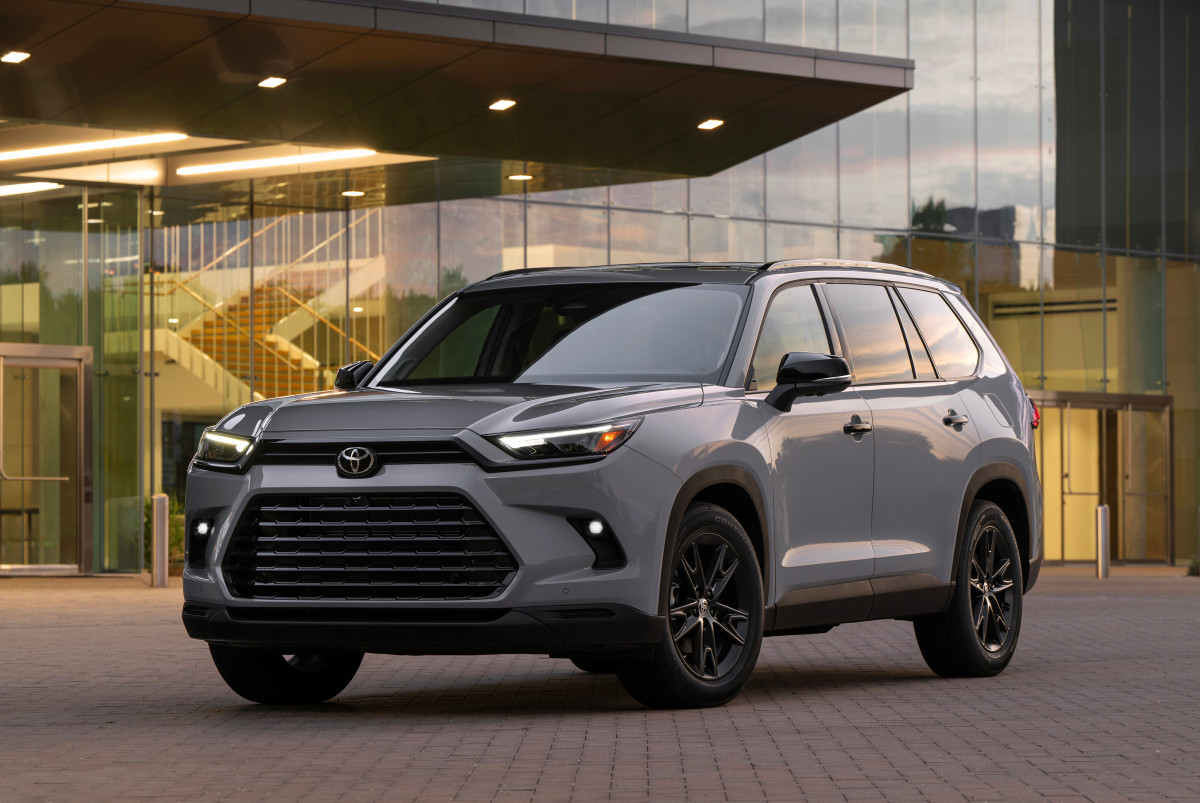
Outside, the fourth-generation Highlander Hybrid got handsome styling with chiseled fenders and an assertive stance. The hybrid model lineup was launched with four trims: LE, XLE, Limited, and Platinum. In 2024, Toyota introduced Nightshade Edition, which offered blacked-out elements. Inside, the Highlander Hybrid offered a smart cabin with three rows of seats. Depending on the trim, it came standard with cloth seats or leather on the higher Limited and Platinum trims. Lower-end versions came standard with a second-row bench seat providing seating for eight, while the higher-end trims got captain's chairs in the second row and a panoramic moonroof.
Every version had an impressive amount of technology and safety features as standard, including Android Auto or Apple CarPlay compatibility, either through an eight-inch touchscreen or a 12.3-inch touchscreen on the Highlander Hybrid Platinum trim.
Even better, all fourth-generation Highlander Hybrids got Toyota Safety Sense 2.0 or better as standard. This system included a full suite of driving safety features such as adaptive cruise control, automatic emergency braking, lane keep assist, lane departure alert, and automatic high beams. Rear cross-traffic alert and blind spot monitoring were also standard.
Changes were few and far between over the years. Wireless Apple CarPlay and Android Auto were introduced for the 2023 model year. A power liftgate was added starting from the XLE grade for the 2024 model year. This was also when the Grand Highlander was introduced, providing an option for buyers looking for more space.
Fourth-generation Highlander Hybrids are incredibly reliable vehicles with no major problems to report. As always, check the maintenance records since a vehicle that has been well cared for is often more important than low kilometres.
The new car MSRP for the base XLE with standard AWD started at $57,957 in Canada at the time of writing, topping out at $63,337 for the Platinum trim including destination charges and other fees. Average used prices are strong with values for the 2020 model year around $40,000 depending on odometer reading and condition, though the average value for 2024 models isn’t far off new vehicle pricing.
Third Generation (2014-2019)
The third-generation Highlander Hybrid was released for the 2014 model year. It was much bigger than its predecessor with sleek new styling. Designed with growing families in mind, it could comfortably seat eight passengers and had a sliding second-row bench seat. Higher trim levels had optional second-row captain's chairs for easier access to the third-row bench.
All models were equipped with a 3.5-litre V6 mated to Toyota's Hybrid Synergy Drive hybrid system and an automatic transmission. Toyota's AWD-i system was standard, too, with a third electric motor driving the rear axle. Like the fourth-generation AWD system, this one wasn't mechanically linked front to rear, so it also lacked a transfer case.
The family-friendly Highlander Hybrid was nicely appointed inside with a leather dash, a leather steering wheel, and tri-zone climate control. The cargo capacity was usable when all three rows were up and impressive with the second- and third-row seats folded down.
In Canada, the initial trim line-up was LE, XLE, and Limited. Standard equipment included a 6.1” Display Audio touchscreen, 18-inch alloy wheels, cloth and Softex leatherette upholstery, heated front seats, cruise control, Bluetooth connectivity, a back-up camera, a power liftgate, and keyless entry with push-button start. Premium features on the Limited included 19-inch wheels, an eight-inch touchscreen with navigation, a 12-speaker JBL audio system, ventilated and power-adjustable front seats with driver’s seat memory, heated second-row seats, a heated steering wheel, adaptive cruise control, a panoramic sunroof, automatic high beams, and safety features such as automatic emergency braking, lane departure alert, blind spot monitoring, and rear cross-traffic alert.
Toyota refreshed the Highlander Hybrid for the 2017 model year with a restyled front fascia, new headlights, and new taillights. Under the hood, the hybrid powertrain received a slight power bump to 306 hp. Toyota Safety Sense — which initially included automatic high beams, automatic emergency braking, lane departure warning, and automatic high beams — became standard for all trims.
The third-generation Highlander Hybrid is generally a reliable vehicle, and there are few problems to report. The 2017 to 2019 model years with the updated V6 engine are more prone to oil leaks than the earlier 2014 to 2016 versions, while the 2014 and 2015 models can have problems with the rear power liftgate. Finally, check the maintenance records because coolant for the hybrid battery must be changed regularly and is easily overlooked at maintenance intervals.
Expect to pay around $20,000 to $26,000 for pre-facelift 2014 to 2016 models, while the updated 2017 to 2019 versions command around $24,000 to $30,000, although prices vary depending on odometer reading, condition, and trim level.

Second Generation (2008-2013)
The second-generation Highlander Hybrid, introduced for the 2008 model year, was bigger and more capable than its forebear. The powertrain was mostly carried over from the first generation and comprised a 3.3-litre V6 gasoline engine, a trio of electric motors, and standard all-wheel drive. It was just as powerful as the non-hybrid version and, like the third and fourth generations, used an electric motor for the rear axle instead of transfer cases and driveshafts to mechanically link the front and rear wheels.
Based on the popular Camry platform, the updated Highlander Hybrid was 10 centimetres longer and roughly 7.5 cm wider than its predecessor. Its wheelbase was stretched by roughly 7.5 cm, which translated to a noticeable increase in passenger space and comfort. This second generation was designed as a three-row SUV that could fit adults in the third row, and with the second and third rows folded down, the Highlander could accommodate a surprising amount of cargo.
Despite the increase in size and weight, the second generation was just as efficient as its smaller predecessor. Thanks to standard all-wheel drive, the Highlander Hybrid could tow up to 1,587 kilograms (3,500 pounds) — enough for a lightweight camper.
Two trim levels were available upon release: base and Limited. The base model came with cloth seats and a relatively bare bones interior, but the Limited got leather seats and an upgraded audio system. Generally, the Highlander Hybrid was almost indistinguishable from its gasoline counterparts, even from the driver's seat. The biggest difference was the power gauge in the instrument cluster replacing a traditional tachometer, plus discreet hybrid badging.
The 2011 model year brought a thorough mid-cycle refresh. From the front, the Highlander Hybrid received new headlights, a new grille, and new chrome accents. A new 3.5-litre V6 engine was installed under the hood, delivering a further 10 horsepower and improved fuel efficiency. Inside, newly standard Bluetooth functionality was added for wireless audio and hands-free calling.
The second-generation Highlander Hybrid is generally reliable. Both V6 engines are prone to oil leaks, so take a look underneath. The hybrid battery can be damaged if it overheats, and replacements can cost thousands. Check the vents for the battery cooling system to make sure they're not obstructed.
Toyota Highlander Hybrids of this vintage are now hard to find in Canada. Prices for the pre-facelift 2008 to 2010 model years average around $12,000, while the facelift 2011 to 2013 models average around $15,000.

First Generation (2006-2007)
Introduced for the 2006 model year, the Highlander Hybrid was launched along with the mid-cycle refresh of the standard gas-powered Toyota Highlander. Toyota combined the Hybrid Synergy Drive system with the 3.3-litre V6 engine with standard all-wheel drive. The original model was almost indistinguishable from its gasoline-only sibling.
Standard third-row seats made the first-generation Hylander Hybrid the first mass-production, seven-passenger hybrid vehicle. Available in either base or Limited trim, the Highlander Hybrid was a premium offering. The Limited came with an impressive list of standard features such as leather seats and heated front seats.
Instead of using a traditional 4x4 system with a transfer case and driveshafts to link all four wheels, the Highlander Hybrid employed a second electric motor to drive the rear axle for standard all-wheel drive. The result was an impressive boost to fuel economy while improving traction in slippery conditions.
Fuel economy was significantly improved compared to the gas-powered version, rated at 8.9 L/100 km city and 9.8 L/100 km highway. This made the Highlander Hybrid the most fuel-efficient SUV in its class, beating competition from Honda and Kia. Combined with a spacious interior, it was a great, eco-friendly family hauler.
First-generation models can have problems with the hybrid system. The inverter is a common failure point. The condition of the hybrid battery can be a concern due to the age of the first-generation models, and repair or replacement costs can quickly exceed the value of the car.
Prices for the first-generation Highlander Hybrids average around $7,000 in Canada depending on the odometer reading and trim level. The Limited trim, with its leather seats and navigation system, will command a premium, especially with below-average kilometres. Impressively, we spotted one 2006 unit for sale with an odometer reading above 500,000 kilometres, which is a testament to this vehicle’s longevity.
Related Topics



by Alex Wagner
Alex’s first word was “voiture.” Growing up, he spent summers karting in France and zipping around Downeast Maine on an old Honda Trail 70, and his lifelong automotive passion has only grown as an adult. Alex began writing for CarGurus in 2023, lending his car-shopping expertise as an industry analyst. He can usually be found tinkering with an old car or reading about new cars—sometimes even the next car. He currently owns an ‘88 Peugeot 505 and a ‘94 4Runner.
The content above is for informational purposes only and should be independently verified. Please see our Terms of Use for more details.

