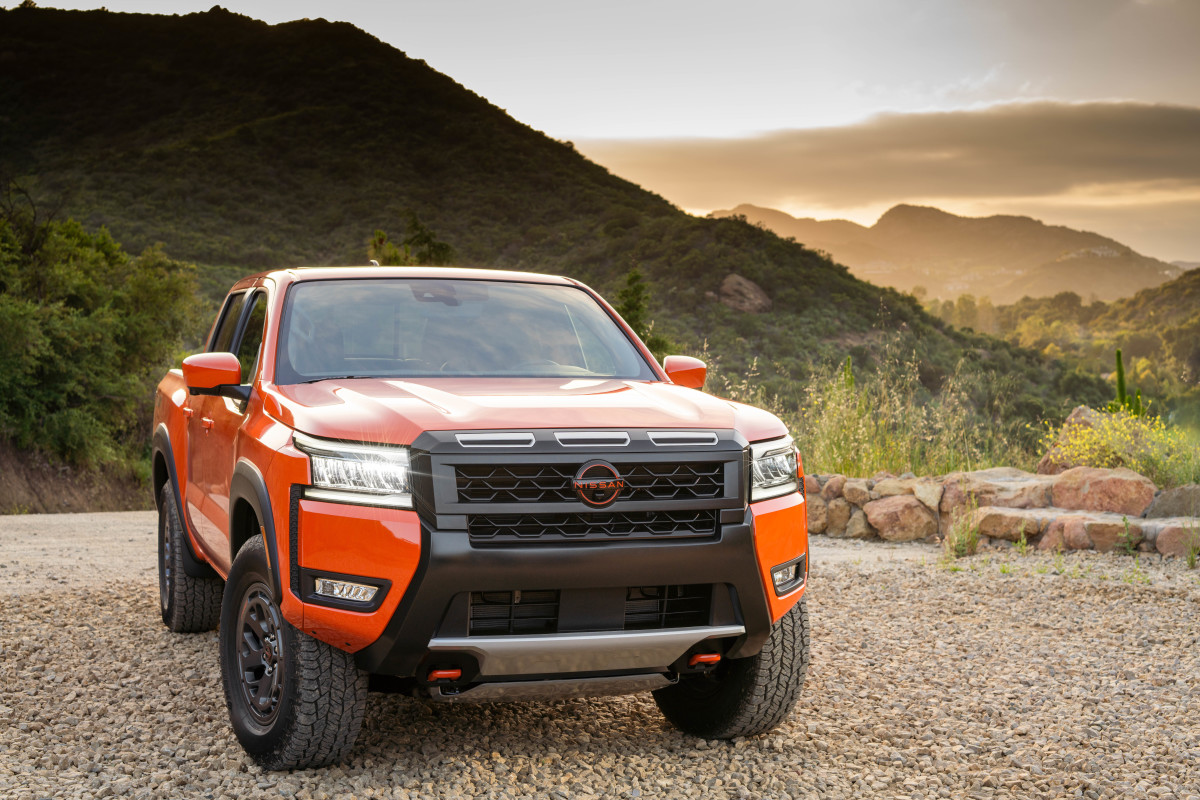
The Toyota Tundra is the first full-size truck from overseas to take a real stab at the big three American trucks, competing squarely with the Ford F-150, Chevrolet Silverado 1500, and Ram 1500. The interior quality has often been called cheap, and the lack of a diesel engine could have truck guys saying it’s not the genuine article. But the reliability — especially from the second-generation models — is undeniable.
The Toyota Tundra is the first Japanese full-size truck built in North America. This moved helped it avoid the Chicken Tax in the United States, a 25% tariff on imported light trucks that’s been around since the 1960s in response to tariffs on U.S. chicken by France and West Germany. For its second generation, production moved to the land of trucks: Texas.
While it often costs more than its domestic competition, it boasts a long list of standard safety features and a modern infotainment system. The current generation took a bit of a hit for reliability in its first two model years, but according to Consumer Reports, predictive reliability is on an upward trend.
Though truck guys bemoan the loss of the V8 in the new Toyota Tundra, the twin-turbo i-Force Max hybrid powertrain boasts 437 horsepower and 583 pound-feet of torque, which ups its chops in the towing department.
In general, Tundras are solid trucks with bulletproof reliability, so these are vehicles a lot of people buy and keep for the long haul. But if you do plan to sell, you’ll make a decent return on your investment: Tundras tend to hold their value better than other full-size trucks.
Toyota Tundra: Cost, Reliability, and the Best Years to Buy
Frequently Asked Questions
Which Toyota Tundra years are the best?
If you’re looking for something older, the 2009 model year in the second generation has the fewest complaints according to CarComplaints.com. More recently, the last three years of the second generation — 2019, 2020, and 2021 — also saw few complaints. The 2021 model year specifically logged just three complaints on the website and had only three recalls. According to Consumer Reports, the second generation generally has higher reliability ratings than either the first or current generations. If it were our money, we’d opt for something in the last three years of that generation.
What are the worst Toyota Tundra years?
While the second-generation Toyota Tundra typically has good reliability ratings, CarComplaints.com rates the 2012 the worst model year due to engine problems. Another year to avoid is the first model year of the second generation (2007) for which there are also a lot of complaints. CarComplaints.com also points to a large number of problems in the 2005 model year due to secondary air pump failures. As far as the current generation is concerned, the 2022 and 2023 model years get the lowest reliability ratings we see from Consumer Reports compared to any other Tundra. So, maybe wait a beat before you buy anything from the third generation.
Is a used Toyota Tundra a good deal?
Second-generation Toyota Tundras are generally considered bulletproof, which is why they retain their value. Looking at the 2021 model year, we only see a $5,000 to $6,000 cost reduction to buy used unless you’re willing to take a huge hit on the odometer reading. If you go back to 2019 you’ll start to see prices in the $38,000 to $50,000 range, so if you want a deal, start there and work backwards.
Toyota Tundra Pros and Cons
Pros:
- Powerful engines
- Strong resale value
- Excellent ride quality
Cons:
- No diesel option
- Poor forward visibility
- No bargain-priced work truck
Toyota Tundra Generations
Toyota Tundra Third Generation (2022–present)
The third-generation Toyota Tundra ditched the V8 engine in favour of a pair of twin-turbo V6s, one of which included hybrid components and was called the i-Force Max. Both powertrains were mated to an Aisin-sourced 10-speed automatic transmission, while max towing capacity rose to 5,440 kilograms (12,000 pounds) and payload was 880 kilograms (1,940 pounds).
The new vehicle came standard with rear-wheel drive (RWD) and was available with four-wheel drive (4WD). It was offered in two cab configurations: a four-door Double Cab and a four-door CrewMax. There were three bed lengths — standard, long, and short — but not all beds were available with all cab configurations. This new generation of Tundra had a stronger and lighter chassis along with coil spring rear suspension, which replaced leaf springs.
Beyond structural and design changes, the third-generation Tundra gained technological advances including the newest generation of Toyota’s infotainment system, a standard eight-inch touchscreen and optional 14-inch touchscreen, wireless Apple CarPlay and Android Auto, and a voice recognition program that allowed for more natural commands such as saying “I’m cold” to turn up the heat.
Five trim levels were available at launch: SR and SR5 (each with an available TRD Off-road package), Limited (with available TRD Off-Road and TRD Pro packages), Platinum (with an available 1794 Edition package), and Capstone. Standard features included cloth seats, 18-inch steel wheels, LED headlights, and keyless entry and push-button start. Toyota Safety Sense 2.5 was also standard, which included pre-collision warning with automatic emergency braking, pedestrian detection, adaptive cruise control, and lane keep assist.
Available features further up the trim levels included heated and ventilated front and rear seats, leather upholstery, dual-zone automatic climate control, blind spot monitoring, rear cross-traffic alert, ambient interior lighting, a premium JBL audio system, a wireless phone charger, a heated steering wheel, and a 360-degree camera.
Capstone, the top-tier luxury trim, was a new addition for this generation and added upmarket features such as power running boards, sound-reducing front windows, 22-inch wheels, exclusive exterior accents, and a head-up display.
The Toyota Tundra TRD Pro was an off-road ready truck with Fox shocks, all-terrain tires, Multi-Terrain Select that included Crawl Control and an electronically controlled locking rear differential, and a multi-terrain monitor.
There have been few significant changes since the latest Tundra’s introduction. For 2024, a Nightshade package became available on the Limited trim and power-extending tow mirrors became available. For 2025, the TRD Rally Package became available with all trims, adding cool styling items such as black 18-inch alloy wheels and luxurious interior features. Multifunction massaging front seats also became available on select trims.
While there is no shortage of used third-generation Toyota Tundras in Canada, they don’t come cheap. The lowest prices we saw in our research were in the $40,000 range, and those trucks had exceptionally high odometer readings for their age. In general, even the best deals are only a few thousand dollars off buying new.
Toyota Tundra Second Generation (2007–2021)
The second-generation Toyota Tundra made big changes to the styling, size, configurations, and capacities of this truck. Furthermore, production moved from Toyota’s Indiana plant to Texas. It offered a V6 and two V8 engine options for the entirety of its 14-year lifespan with some impressive specs. Max towing capacity increased to 4,535 kilograms (10,000 pounds) with a payload of more than 900 kilograms (2,000 pounds) with the top-tier 381-hp 5.7-litre V8.
At launch, this second-gen Tundra had a staggering 31 different configurations, with three bed lengths, three cab configurations, three wheelbases, and two transmissions. Trims included the Deluxe, SR5, and Limited. The Access Cab from the prior generation became the Double Cab, and the previous Double Cab became the CrewMax, which was only available with the short bed. The Regular and the Double Cab were available with both long and regular bed options, and the Tundra was available with either rear-wheel drive or four-wheel drive.
When Toyota revealed this new Tundra at the 2006 Chicago Auto Show, it made a big deal about how it would be useful for construction workers with extra-large door handles (you can allegedly open them while wearing work gloves), a deck rail system, an integrated tow hitch, and head rests that could accommodate a worker with a hard hat. Standard features included an electronic automatic limited-slip differential, stability control, traction control, electronic brake-force distribution, brake assist, anti-lock brakes, and tailgate assist.
Other new features for this generation included optional tow mirrors, a 100-litre fuel tank, an available back-up camera, and a centre console large enough to stow a laptop.
A styling update in 2010 heralded a new grille and taillamps and added front knee airbags. By this point, the Tundra used the same trim level names we see today including SR5, Limited, and Platinum.
There was a significant mid-cycle refresh in 2014 with a new front end, a redesigned tailgate, a new interior, and an improved infotainment system. Trims included the SR, SR5, Limited, Platinum, and 1794 Edition. The suspension tuning was revised, Bluetooth and a backup camera became standard, and blind spot monitoring and rear cross-traffic alert were available.
For 2015, Toyota added TRD Off-road equipment to the Limited Double Cab and CrewMax models. For 2016, the TRD Pro package was added, and the grille was updated on the Tundra SR5 and 1794 Edition. The Limited’s TRD Off-road equipment was discontinued.
For 2018, the Toyota Safety Sense-P (TSS-P) became standard on all trucks, adding adaptive cruise control and lane departure warning to the entire lineup. The TRD Sport package was also added. In 2020, the base V8 was dropped and the 5.7-litre V8 became the sole powertrain.
This generation had a long run, so there are plenty of used examples around at a wide range of prices. You’ll see exceptionally high-kilometre trucks for less than $10,000 and late model, low-kilometre models hitting north of $60,000. If you want less than 150,000 kilometres, you’ll probably find a solid truck in the high $30,000s to low-$40,000s price range.
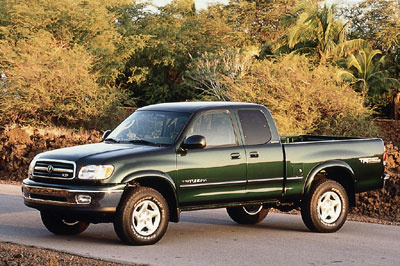
Toyota Tundra First Generation (2000–2006)
The first-generation Toyota Tundra replaced the outgoing T100. It was nicknamed the T150, but after a Ford Motor Co. lawsuit that claimed the name was too similar to the Ford F-150, the production version was renamed Tundra. It had the distinction of being the first full-size pickup truck from a Japanese automaker to be built in North America.
Originally available in Regular or Access Cab configurations, the Toyota Tundra could be ordered with either rear- or front-wheel drive. Throughout this generation, it offered both V6 and V8 engines with increased power availability as the generation progressed. Interestingly, the “i-Force” moniker applied to the third generation’s hybrid powertrain originated with the first 245 hp 4.7-litre V8. The truck had both manual and automatic transmissions available with the V6, but the V8 was automatic only.
The first-gen Tundra got a mid-cycle refresh in 2003 with a new grille, minor design tweaks, and an available side-step bed. The Double Cab (or crew-cab) model, only available with a V8, was added for the 2004 model year.
Max towing capacity for the V8-equipped Tundra was 3,130 kilograms (6,900 pounds) for the Double Cab, and 3,220 kilograms (7,100 pounds) for the Access and Regular Cab models.
Notably, this first-generation Toyota Tundra was the first full-size truck that received a Good overall rating from the Insurance Institute for Highway Safety (IIHS) in its front offset crash test. At the time, the Ford F-150 and Dodge Ram got Poor ratings, and the Chevrolet Silverado got a Marginal rating.
Toyota Tundras of this vintage are now hard to come by in Canada. Rust has taken many of them out, so be sure to inspect for it carefully when shopping for a used truck. With rare exceptions for immaculate trucks with low odometer readings, you should find trucks from this era priced below $10,000.
Related Topics