The Volkswagen Tiguan was introduced for the 2009 model year as the brand’s first compact SUV, when the segment was still something of an unknown quantity. Perhaps that’s why the original Tiguan feels like a toe in the water. Offered with just one engine and a limited range of trims, it was a tentative step into a new market. Today, that market is mature and has hugely expanded, and the Tiguan is one of two compact SUVs (including the ID.4 electric crossover) the brand sells in Canada.
Although it’s tempting to think of the first-generation Tiguan as little more than a slightly taller Golf, the truth is that it actually shared its basic platform with the Volkswagen Passat of the time. And while it appeared to be on the small side of compact, it was actually slightly longer and taller than one of its key rivals, the Toyota RAV4. The Tiguan also offered more ground clearance than the RAV4, but it wasn’t pitched as a rugged off-road machine, with front-wheel drive as standard and “4Motion” all-wheel drive (AWD) as an option for higher-spec models.
The engine was a “TSI” turbocharged 2.0-litre four-cylinder with 200 horsepower, giving the Tiguan strong performance. It had handling to match and felt more responsive than many similar SUVs through corners. With a roomy, good-quality interior, the Tiguan had everything it needed to succeed, but it was also expensive and sales were relatively low.
That all changed with the second-generation Tiguan, which arrived for 2018. This time around, it was significantly longer with a seven-seat rather than five-seat capacity. In fact, the Tiguan for North America is sold as the Tiguan Allspace in European markets as a separate seven-seat, long-wheelbase version of the standard five-seater. The switch to the new layout was a commercial success, with more than four times as many sold in the second generation’s first full year of sales.
As before, just one 2.0-litre turbocharged engine was available, this time with 184 horsepower, but now with an eight-speed automatic transmission as standard. Front-wheel drive remained the default drivetrain, though by this point all-wheel drive was standard on most trims in Canada.
An all-new, third-generation version of the Tiguan arrived in North America in the middle of 2025. It dropped the seven-seat layout of its predecessor, which had often been criticized for its cramped configuration and difficult access. If you want a three-row family SUV with a VW badge, you’ll now need to step up to the larger Volkswagen Atlas.
As with the second-generation car, power comes from a 2.0-litre turbocharged engine, though this time with 201 horsepower as opposed to 184. A more powerful Turbo model is on the way for 2026 with 268 hp.
Here’s our guide to the Volkswagen Tiguan, giving you the lowdown on which models are available, the best and worst versions for reliability, and how much you should pay.
Volkswagen Tiguan Buying Guide: Cost, Reliability, and the Best Years to Buy
Frequently Asked Questions
Which Volkswagen Tiguan years are the best?
The second-generation Volkswagen Tiguan seems to have a superior record for reliability relative to the first. It’s a better car on the whole, giving you more space and tech for your money.
What are the worst Volkswagen Tiguan years?
The earliest Volkswagen Tiguan models from 2008 to 2010 are the worst for reliability. These have a comparatively large number of owners citing engine problems at CarComplaints.com.
Is a used Volkswagen Tiguan a good deal?
The Volkswagen Tiguan can be a good deal if you can find a well-looked-after example at the right price. The second-generation model in particular is a decent value and offers the flexibility of a seven-seat layout.
Volkswagen Tiguan Pros and Cons
Pros:
- Good to drive, especially sporty first-generation model
- Spacious interior with easy-to-use controls
- Lots of safety tech with latest models
Cons:
- Just one engine
- Some reliability concerns, especially with early versions
- Unremarkable fuel economy and no hybrid option
Volkswagen Tiguan Generations
Third Generation (2025-present)
For its third generation, the Volkswagen Tiguan has been completely redesigned. Its front-end styling especially mirrors its all-electric ID.4 and ID.5 cousins. Nevertheless, the underpinnings of the Tiguan are the MQB Evo, which means it shares more in common with the Golf GTI hot hatchback.
Meanwhile, the seven-seat three-row layout from the second-generation model has been ditched. While this reduces flexibility to a certain extent, it does mean Volkswagen has been able to move the second-row seats back a touch, making nearly 4 centimetres more rear legroom.
Power comes from a 2.0-litre turbocharged four-cylinder engine. This delivers 201 horsepower and 207 lb-ft of torque. A 268-horsepower version badged ‘Turbo’ is joining the line-up for 2026. There is also a hybrid version on the way, but no specific details—including fuel efficiency—have yet been released on that as of writing.
With the regular 2.0-litre model, however, the Tiguan will reach 100 km/h in around 8.5 seconds, and Natural Resources Canada rates it at 9.3 litres per 100 kilometres combined with the standard 4Motion all-wheel drive (AWD) system.
This model is too new for us to provide reliability or depreciation data at the time of writing. These metrics will become clearer once the Tiguan has been on the market for roughly three years, beginning in 2028.
Read our full 2025 Volkswagen Tiguan review here
Second Generation (2017-2024)
While it’s not unusual for a new model to be slightly larger than its predecessor, the latest Tiguan introduced for 2018 was more than 26 centimetres longer than the first-generation model. This major repositioning happened because this North American Tiguan was the long-wheelbase, seven-seat version also sold in other markets. That extra practicality came as standard because a seven-seat configuration was the default layout, whereas the first Tiguan maxed out with five.
Apart from its extra length and seats, the second Volkswagen Tiguan had a similar model lineup to the first. Again, there was just one inline four-cylinder engine available: a turbocharged 2.0-litre TSI unit with 184 horsepower. That was 16 horsepower less than before, but there was more torque, with 221 lb-ft—a 14 lb-ft increase. This time there was no manual transmission option, with a conventional eight-speed “Tiptronic” automatic transmission the only choice. Once again, front-wheel drive was the default layout, with 4Motion all-wheel drive as an option on the base trim and standard on all other trims.
With its extra length and greater focus on comfort, the second-generation VW Tiguan had a less responsive driving experience than the first, although it felt solid and reassuring from behind the steering wheel. Inside, it was more modern with a sharp-edged design and, to start with, either a 6.5-inch or eight-inch touchscreen infotainment system, depending on trim level. There was vast space in the front two rows of seats, while legroom in the pair of third-row seats was limited, but they were still handy and folded away to leave a huge cargo space. Second-generation Tiguan trim levels in Canada were initially Trendline, Comfortline, and Highline.
From the 2019 model year onwards, an R-Line package available on the Comfortline trim added a sportier look and larger alloy wheels. An update for the 2022 model year gave the Tiguan a major cosmetic makeover with an entirely new design for the grille, bumper, headlights, and even the front fenders. Changes were more subtle elsewhere, but the interior gained new materials and tech for a slightly more upmarket feel. This was also the year when VW’s 4Motion AWD became standard across the entire line in Canada.
Volkswagen’s reputation for reliability is at odds with its semi-premium image. In the years the second-generation Tiguan has been included in the annual J.D. Power U.S. Dependability Study, Volkswagen as a brand has finished in the bottom half of the table, well below the industry average. The Tiguan itself has been known to suffer from engine and electric troubles, as well as infotainment system glitches.
If you want to take your chances with a high-kilometre example, you can pick up a leggy second-generation VW Tiguan for just over $10,000. A safer bet would be a sub-150,000-kilometre car, which will set you back at least $15,000. Prices for post-facelift models with under 100,000 kilometres start from about $24,000.
First Generation (2008-2017)
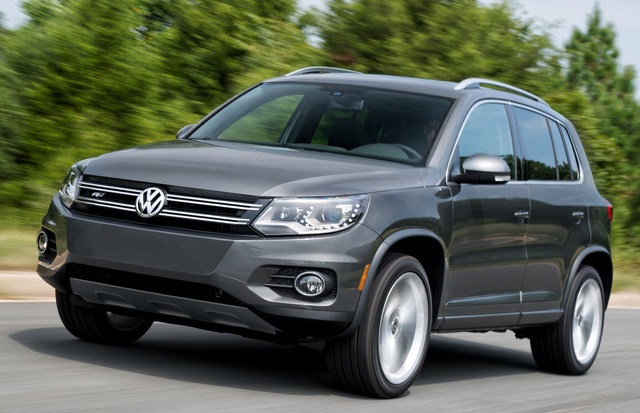
As a first attempt at a compact SUV, the first-generation Volkswagen Tiguan more or less hit the spot. Introduced in 2008 for the 2009 model year, it was pitched as a slightly sportier, more premium alternative to cars such as the Honda CR-V and the Toyota RAV4.
This was no rough-and-ready off-roader, as the Tiguan was conceived with a smooth and responsive drive in mind. Front-wheel drive was the default drivetrain layout on the base Trendline trim, with 4Motion all-wheel drive an option on that and standard on the Comfortline and Highline trim levels.
Power came from a version of the same turbocharged engine used in the VW Golf GTI of the time. It was a 2.0-litre unit with 200 horsepower and 207 lb-ft of torque, which was punchy but didn’t give great fuel economy. While the entry-level model had a six-speed manual transmission as standard, the rest of the range has a six-speed “Tiptronic” automatic transmission.
An update for the 2012 model year gave the Tiguan updated styling, with a much sleeker front end, as well as equipment upgrades. An R-Line package was added for the 2013 model year with a sportier look thanks to the additional side skirts, the rear spoiler, and the extended wheel arches. A Wolfsburg trim level joined the line-up for the final model year in 2017.
Although it feels like a quality product, the first-generation Tiguan doesn’t have a great reputation for reliability. Considering the comparatively low numbers sold, lots of issues have been raised for the model on CarComplaints.com, especially for 2009 and 2010 models. The bulk of these are for engine problems with issues including turbo failure, intake manifold failure, and slipping timing chains. Cooling system and electrical problems are relatively common, too, so it’s imperative that any dealership or seller lets you take it for a decent test drive before you commit to buying.
You can pick up a first-generation Volkswagen Tiguan that’s covered plenty of kilometres for under $5,000. If you want one that’s not as long in the tooth, budget $8,000 to $15,000 for one that’s covered less than 150,000 kilometres. At the top end, late-model Highlines with fewer than 100,000 kilometres on the odometer commonly go for around $20,000.
Related Topics