The original Volvo S80 was a decided shift away from the boxy designs for which the brand was known. Along with the compact executive Volvo S60 of the time — both were launched around the turn of the millennium — it added then-novel curves while continuing to reinforce Volvo’s reputation for safety. It offered the likes of blind spot monitoring, automatic emergency braking, adaptive headlights, lane departure warning, side curtain airbags, and adaptive cruise control before they were widely available.
While it was a viable competitor in the luxury midsize sedan segment, it lacked the pizzazz of its German counterparts. Instead, the Volvo S80 had more formal styling and a minimalist Scandinavian interior.
The Volvo S80’s life ended before modern technologies such as Apple CarPlay and Android Auto, but the Sensus infotainment system offered a navigation system with real-time traffic updates, Bluetooth audio streaming, and SiriusXM satellite radio.
If you can forgo modern tech and are looking for a large, safe, and comfortable sedan, the Volvo S80 might just fit the bill.
Volvo S80: Cost, Reliability, and the Best Years to Buy
Frequently Asked Questions
Which Volvo S80 years are the best?
If you’re looking for a first-generation Volvo S80, focus on the latter years. By 2005 and 2006, most of the early reliability issues had been addressed and there was more in the way of electric equipment. The same applies to the second generation: there are far fewer consumer complaints from the 2011 model year on according to the U.S. National Highway Traffic Safety Administration (NHTSA). 2014 seems to be the best model year out there with just one complaint and one recall.
What are the worst Volvo S80 years?
There were some issues in the S80’s early years, and there are lots of complaints for 1999 to 2002 models according to NHTSA. CarComplaints.com calls 2000 the worst model year because there have been a number of problems with the engine, including stalling and vehicle speed control.
Is a used Volvo S80 a good deal?
The Volvo S80 has the potential to be a very good deal. The average price purchase price for a 2016 example—the final year in which the S80 was produced—is less than half of the original MSRP. The base sedan cost about $50,000, and today you can snap one up for $20,000. The average transaction price for first-generation models is less than $7,000. Your biggest issue will likely be finding one: the Volvo S80 is now rare on the used vehicle market in Canada.
Volvo S80 Pros and Cons
Pros:
- Excellent safety technology
- Comfortable seats
- Understated, luxurious interior
Cons:
- Poor fuel economy
- Underwhelming base engine
- Cramped rear head room
Volvo S80 Generations
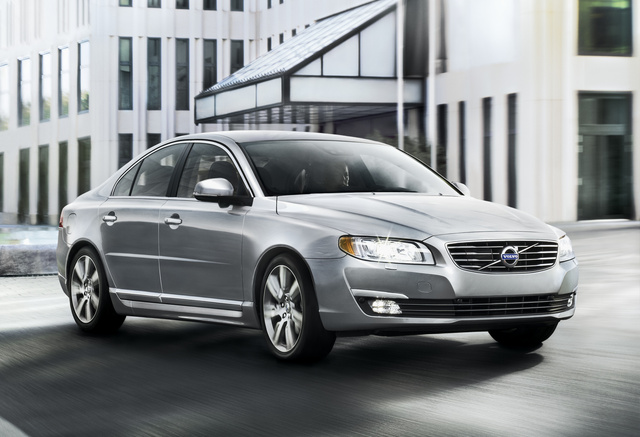
Volvo S80 Second Generation (2007–2016)
The second-generation Volvo S80 heralded new engines, a complete redesign, a more spacious cabin, and lots of standard safety kit. Built on the same Volvo P3 platform as the Ford Mondeo and S-MAX and the Volvo XC60, this S80 has more conservative styling, high-quality materials, and a clean Scandinavian interior design — all with its German competitors in its sights.
A pair of new engines was available at launch: a 235-horsepower 3.2-litre inline six, and a 311-hp 4.4-litre V8 engine. The latter was built in Japan by Yamaha and came with a hefty 325 lb-ft of torque. The V8 was a first for the S80, and it was the same unit that debuted in the 2006 XC90. The engines acted as trim levels, and all models sold in Canada came with all-wheel drive (AWD).
Standard features included leather upholstery, wood trim, power heated front seats, a power sunroof, front fog lamps, rain-sensing wipers, headlamp cleaners, 17-inch alloy wheels, a six-disc CD changer, and a 160-watt eight-speaker audio system. Standard safety features included Dynamic Stability Traction Control (DSTC), Volvo’s Whiplash Protection System (WHIPS), anti-lock brakes, and side-curtain airbags. Available safety features included the Blind Spot Information System (BLIS) and adaptive cruise control.
Available equipment included heated outboard rear seats, the “Four-C” Continuously Controlled Chassis Concept adaptive suspension, 18-inch wheels, on-board navigation, a dual-screen rear entertainment system, and active bi-xenon headlights that turned with the steering.
In 2009, the base model was switched to front-wheel drive (FWD). There were some minor interior and exterior updates until 2010, when the big change was the addition of a new 281-hp 3.0-litre turbocharged inline-six-cylinder engine and the mid-level T6 Sedan trim.
There was another engine shake-up in 2011, when the base engine received a five-hp boost and the turbo unit was bumped to 300 hp. The Volvo S80 V8 bowed out that year, the Inscription package was added to the lineup, and satellite radio became standard. Volvo’s Sensus infotainment system was upgraded in 2012, but the bigger news was that City Safety, the manufacturer’s low-speed automatic braking system, became standard across all models.
The S80 received a mid-cycle refresh in 2014 comprising a revised front fascia, new wheels, a new instrument cluster, and a new trim structure. Both engines were available in three trims: base, Premier Plus, and Platinum. There was yet another change to the engine lineup in 2015 with the 3.2-litre replaced by a 240-hp 2.0-litre turbocharged inline-four. The Premier Plus trim was eliminated, leaving just the base and Platinum trims. A new eight-speed Geartronic automatic transmission arrived, promising smoother shifts and better fuel economy than the old six-speed transmission.
The Volvo S80 T6 and AWD were dropped in 2016, which was the S80’s final year.
Used S80 for sale from this generation are very scarce in Canada. We found just four second-gen S80s for sale nationwide during our research with prices ranging from $5,000 for early models to $20,000 for later lower-kilometre units.
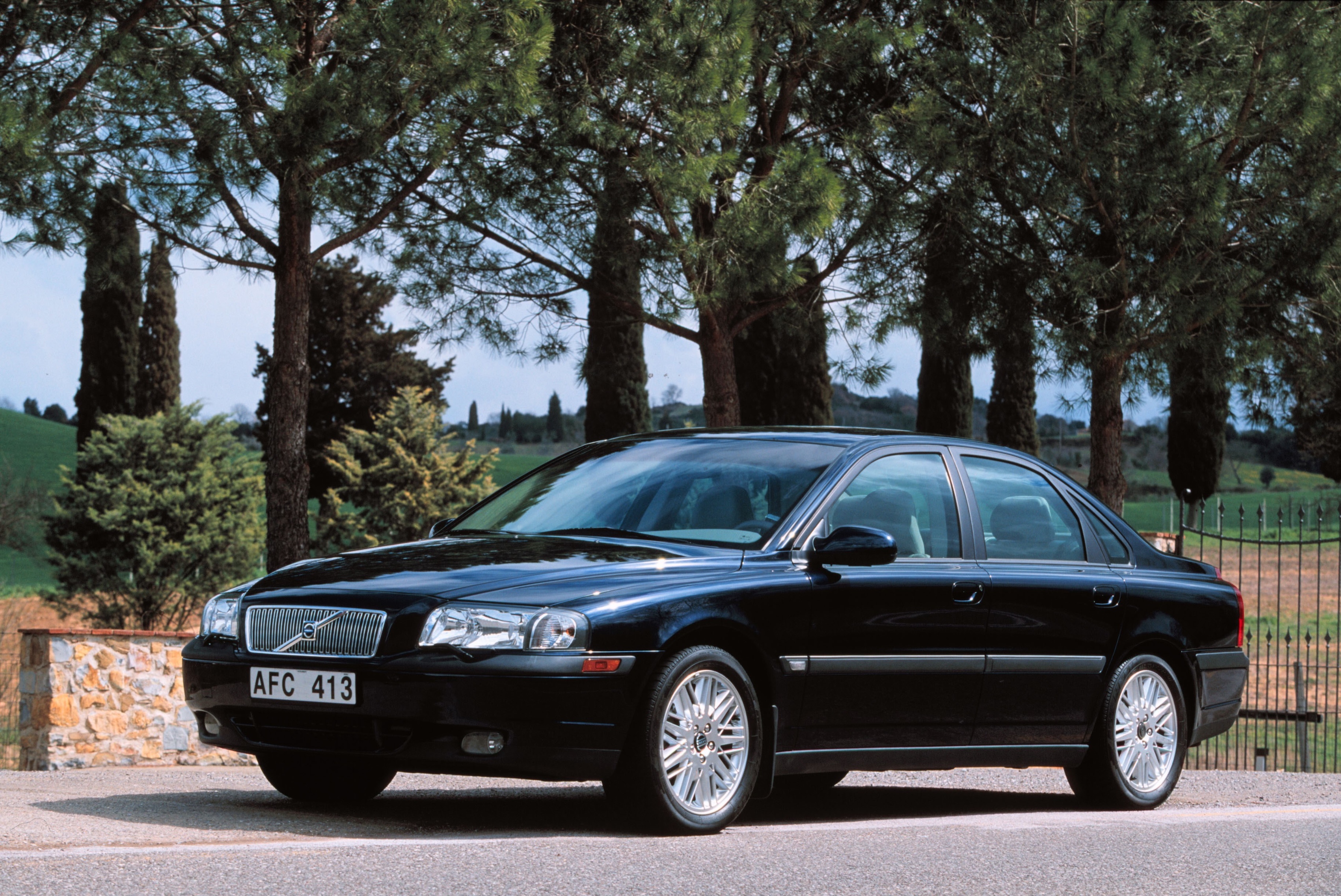
Volvo S80 First Generation (1999–2006)
The first-generation Volvo S80 had a modern design and a curvier façade than its boxy predecessors. It took aim at the BMW 5 Series, Mercedes-Benz E-Class, and Audi A6. It was built on the Volvo P2 Platform, which later became the foundation for several other Volvo models of the time.
At launch it had a pair of inline-six engines: a base 201-hp 2.9-litre unit and a 268-hp T6 twin-turbo. At this time, the S80 was only available with front-wheel drive.
It continued Volvo’s safety tradition with front and rear integrated crumple zones, driver and front passenger dual-stage airbags, a Side Impact Protection System (SIPS), side curtain airbags, five padded head restraints with Volvo’s Whiplash Protection System (WHIPS), and automatic seat belt pretensioners.
An emergency trunk release handle, emergency brake assist, and an improved traction control system were added in 2000. 2002 ushered in some minor styling changes such as an updated grille, a revised rear fascia, and a new gauge cluster. The 2003 model added a revised six-cylinder bi-turbo engine.
There were more significant changes in 2004 such as the introduction of a base 208-hp, 2.5-litre turbocharged inline-five-cylinder engine paired with an AWD drivetrain. There were new taillights, bumpers, and a new trunk lid. The 2.9 Sedan was dropped from the lineup for 2005.
In 2006, the final year of this generation, the 2.5T trim became the sole offering with standard leather seats, heated front seats, a power moonroof, and 16-inch alloy wheels.
You’ll be hard pressed to find a used Volvo S80 of this generation in Canada, and you’ll likely have to travel for it. We found a total of two vehicles for sale in this generation at the time of writing, both priced at $6,000 or less.
Related Topics