2025 Mercedes-Benz G-Class Reviews, Pricing & Specs
Write a reviewPros
Distinctive design
Powerful engines
Impressive off-road capability
Cons
Not much cargo space
Uncomfortable seats
Poor value for money
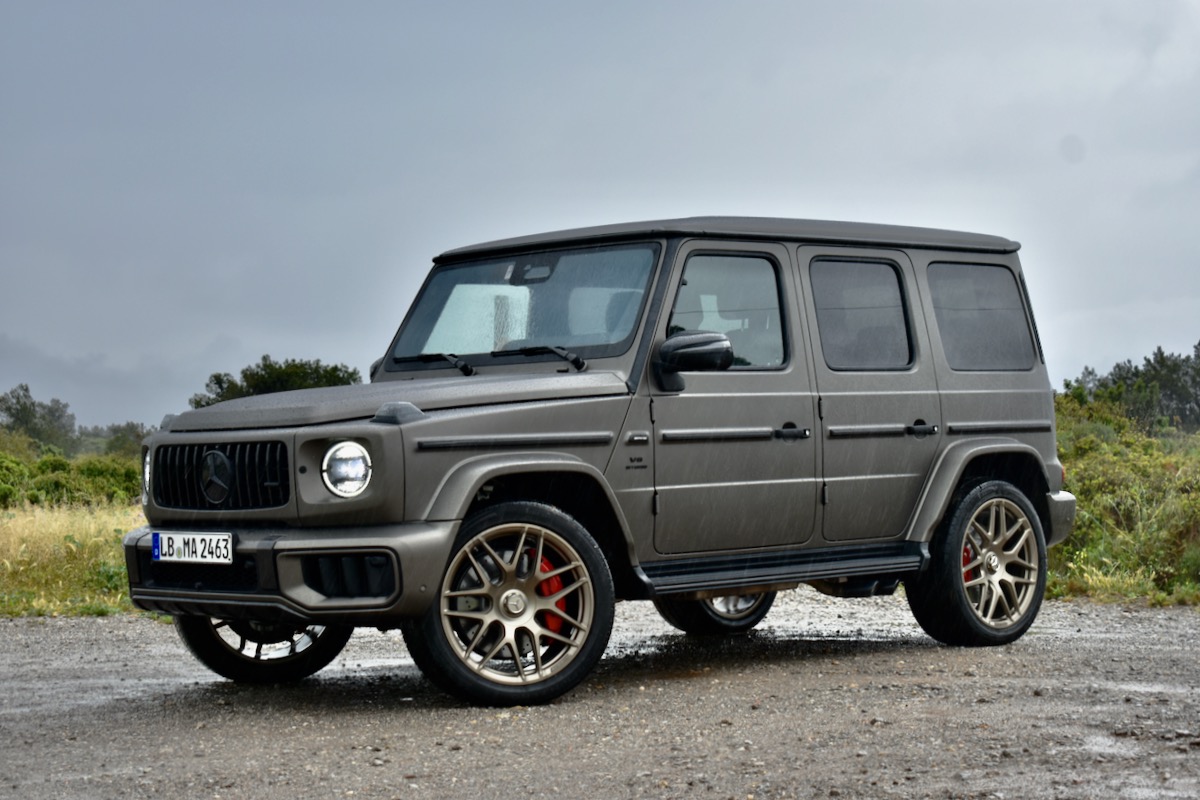
Mercedes-Benz’s inimitable G-Wagen brings luxury to the wilderness.
The Mercedes-Benz G-Class is unique in the automotive world. It combines the glitziness of the Cadillac Escalade, the off-road capability of the Range Rover, and the militaristic aesthetic of the Hummer with typical Mercedes luxury. For 2025, the G-Class gets a refresh highlighted by updated powertrains and tech.
Note that specifications cited in this review are for a first drive of models for the U.S. market. While elements such as powertrain specifications are unlikely to change, Canada-specific packaging details for the 2025 Mercedes-Benz G-Class have not been finalized as of this writing.
Verdict: The new G-Wagen is rougher around the edges than other luxury SUVs, but it still delivers when it comes to off-road capability and creature comforts.
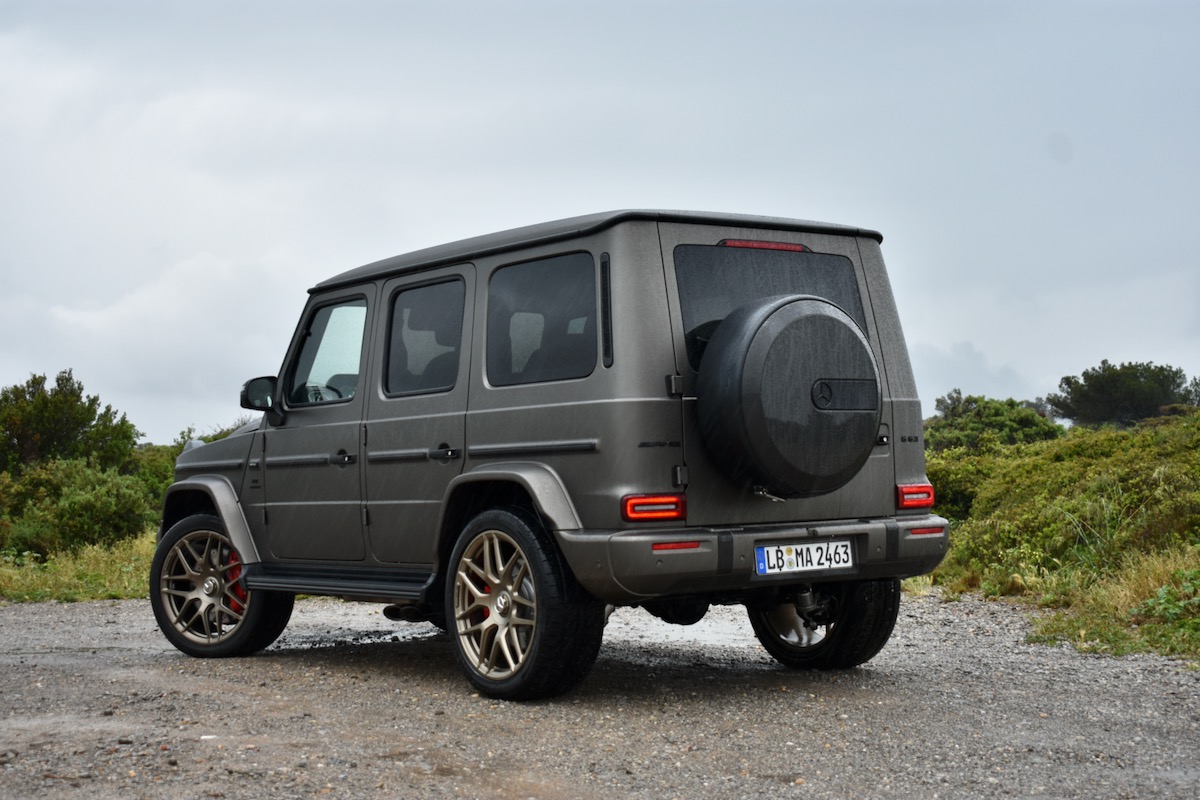
While it’s been redesigned and updated continuously over the years, the G-Class traces its heritage back to 1979 and the utilitarian Mercedes “Geländewagen,” or “G-Wagen.” The modern G-Class—which dates back to the 2018 model year—is bigger and more luxurious than that original G-Wagen, but Mercedes has kept the same distinctive, boxy design.
Mercedes claims some styling updates for 2025, including a new grille and front and rear bumpers, but they’re very subtle. Unchanged are the traditional G-Class design features, including a flat hood stack on top of equally flat front fenders, prominent corner lights, and body sides that could serve as plumb lines. The G-Class also has surprisingly beefy doors and latches, which make a loud clacking noise whenever the doors are locked and unlocked. No other luxury vehicle could get away with this, but it’s all part of the G-Class’s character.
Mercedes made some functional changes as well. The rearview camera is now positioned at the centre of the rear bumper, atop the license plate holder. Base G 550 models also get new A-pillar trim and a subtle rear spoiler designed to reduce noise. We expect Canadian base models to come standard with 19-inch wheels, with 18-inch wheels (with all-terrain tires) and 20-inch wheels available. AMG G 63 performance models will likely come standard 20-inch wheels, with optional 22-inch wheels and carbon-fibre exterior trim. Mercedes also claims its Manufaktur program offers over a million combination of exterior paint colours and interior trim—for buyers willing to pay extra.
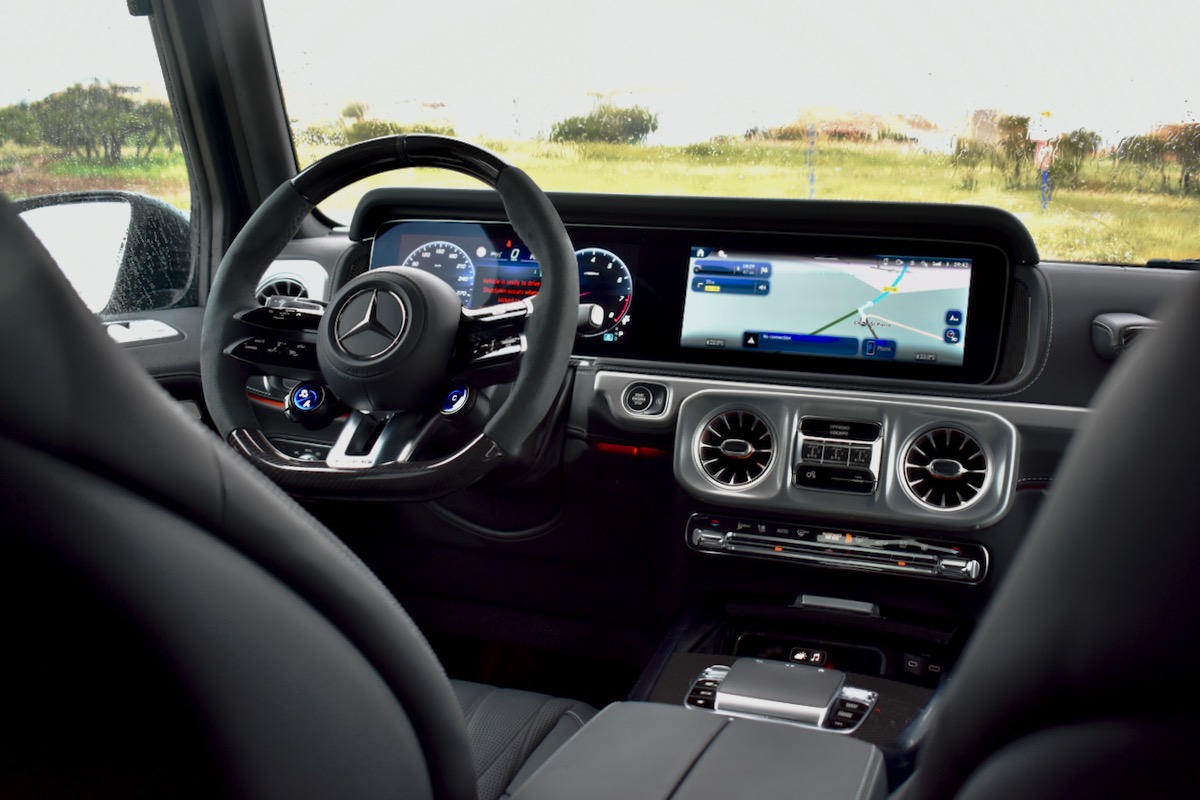
Even the off-the-rack G-Class interior is pretty opulent, though. The current Mercedes design aesthetic carries over to this rugged SUV, with large round vents, 64-colour ambient lighting, and liberal use of shiny metallic trim giving the cabin a vaguely sci-fi look. For the G-Class, Mercedes also places the switches for the three differential locks prominently on the dashboard, while AMG models have sportier-looking steering wheel with buttons and switches for the various settings. The AMG wheel also just seems like a better fit than the dainty looking item that’s standard on non-AMG models.
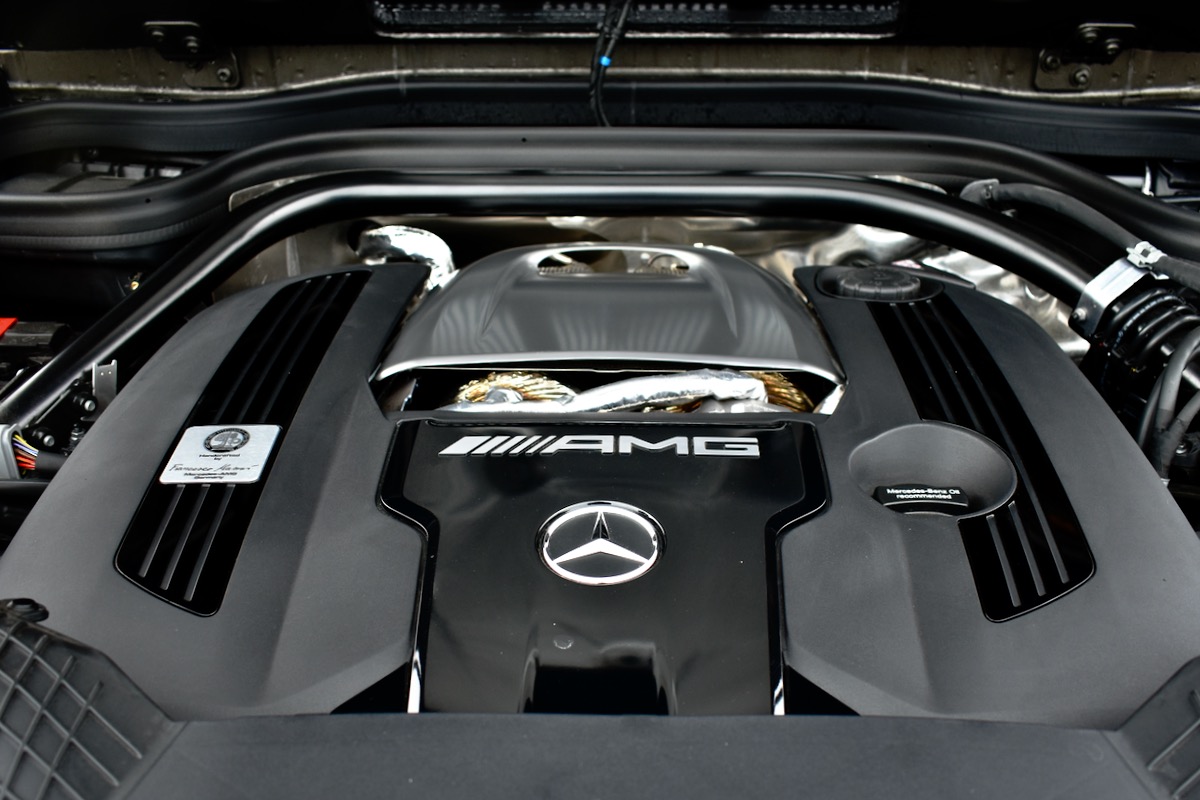
For 2025, the G-Class lineup consists of gasoline G 550 and AMG G 63 models, and a first-ever all-electric G 580 with EQ Technology variant. We’ll focus on the gasoline G-Class models for now.
The base G 550 trades last year’s twin-turbocharged 4.0-litre V8 engine for a turbocharged 3.0-litre inline-six rated at 443 horsepower and 413 pound-feet of torque, while the AMG G 63 keeps its 4.0-litre twin-turbo V8, which produces 577 hp and 627 lb-ft of torque. Both models add a mild-hybrid system providing 20 hp and 148 lb-ft at lower speeds, with everything connected to nine-speed automatic transmissions and permanent four-wheel drive (4WD) with locking front, centre, and rear differentials.
The G-Class may have the weight and aerodynamic properties of a house, but Mercedes gives it enough power to be genuinely quick. The G 550 will scoot from zero to 96 km/h in 5.3 seconds, while the G 63 will do the same in 4.2 seconds. Top speed is electronically limited to 210 km/h for the G 550 and 220 km/h for the G 63. In the AMG model, that acceleration is still accompanied by a lovely bellow from the V8, something the G 550’s new inline-six can’t quite match. The six-cylinder engine doesn’t sound bad, but it’s hard to beat the drama of the V8.
The G63 also features a new AMG Active Ride Control suspension system for 2025. This employs hydraulic anti-roll control, which pumps hydraulic fluid from one side of the car to the other to counteract body roll. When the car leans to one side in a corner, the suspension on that side stiffens up to level the body. Drivers can even select the level of body roll that’s allowed, giving the G 63 a more compliant, cushier ride or a more buttoned-down feel as desired.
This new suspension system differentiates the AMG model from the base G-Class in way it’s never been before. While any G-Class is a good off-roader, the G 63 can now traverse rough terrain comfortably at higher speeds—taking full advantage of its more powerful engine—like a more luxurious Ford Bronco Raptor. If you don’t have wide open spaces to blast through, though, the G 550 still excels at low-speed, technical off-road driving.
AMG Active Ride Control also improves the G 63’s on-road driving dynamics, although both G-Class models feel decidedly truck-like. Corners may be the enemy, but even the G 550 provides a decently plush ride with its less-sophisticated suspension. Wind and tire noise are also reasonably low, even at highway speeds. So, while the drive out to the trail may not be entertaining, it will at least be comfortable.
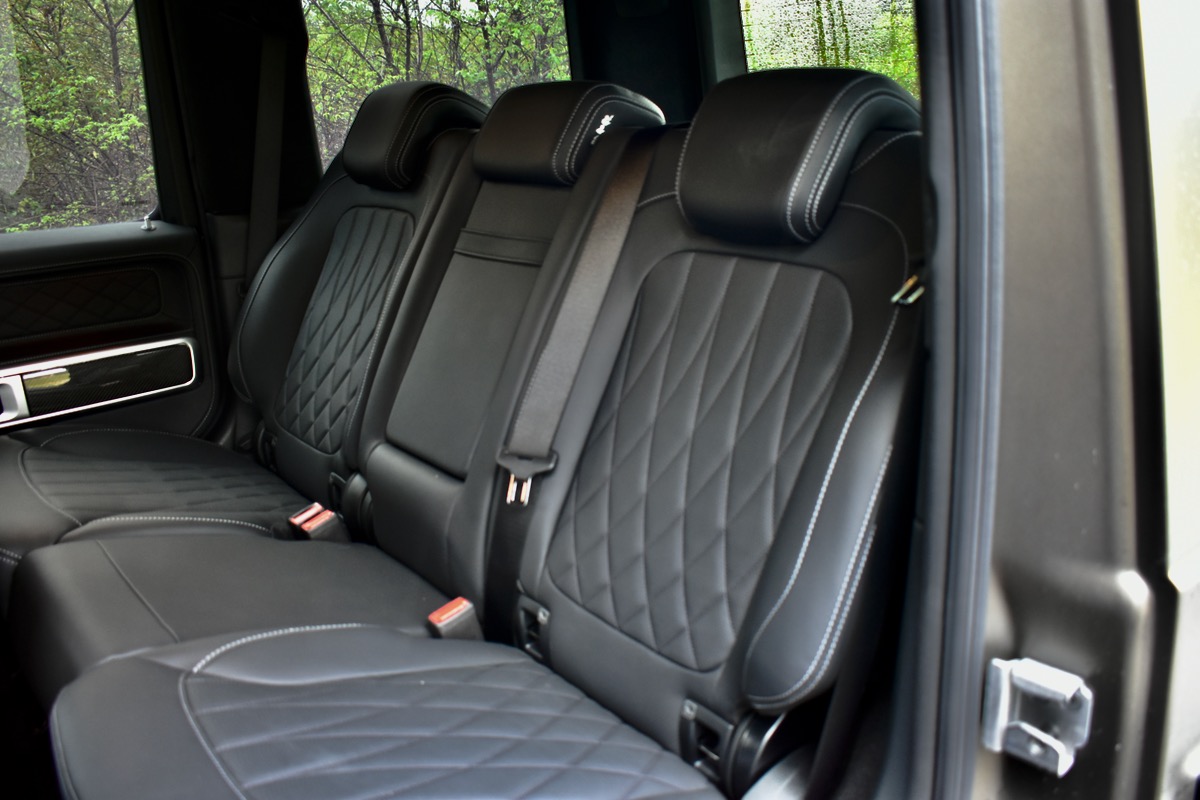
The G-Class is not a small vehicle, but it is a bit more compact than other high-end luxury SUVs. It’s almost 23 centimetres shorter than a standard-wheelbase Range Rover, for example, with a wheelbase about 12 centimetres shorter, as well as about 10 centimetres narrower. This gives the G-Class a tall-yet-short passenger compartment that provides plenty of headroom, but not as much legroom as you’d expect for its footprint. The driving position is also decidedly old school. You sit more upright than in other modern SUVs, an evolutionary leftover from the G-Class’s utilitarian origins.
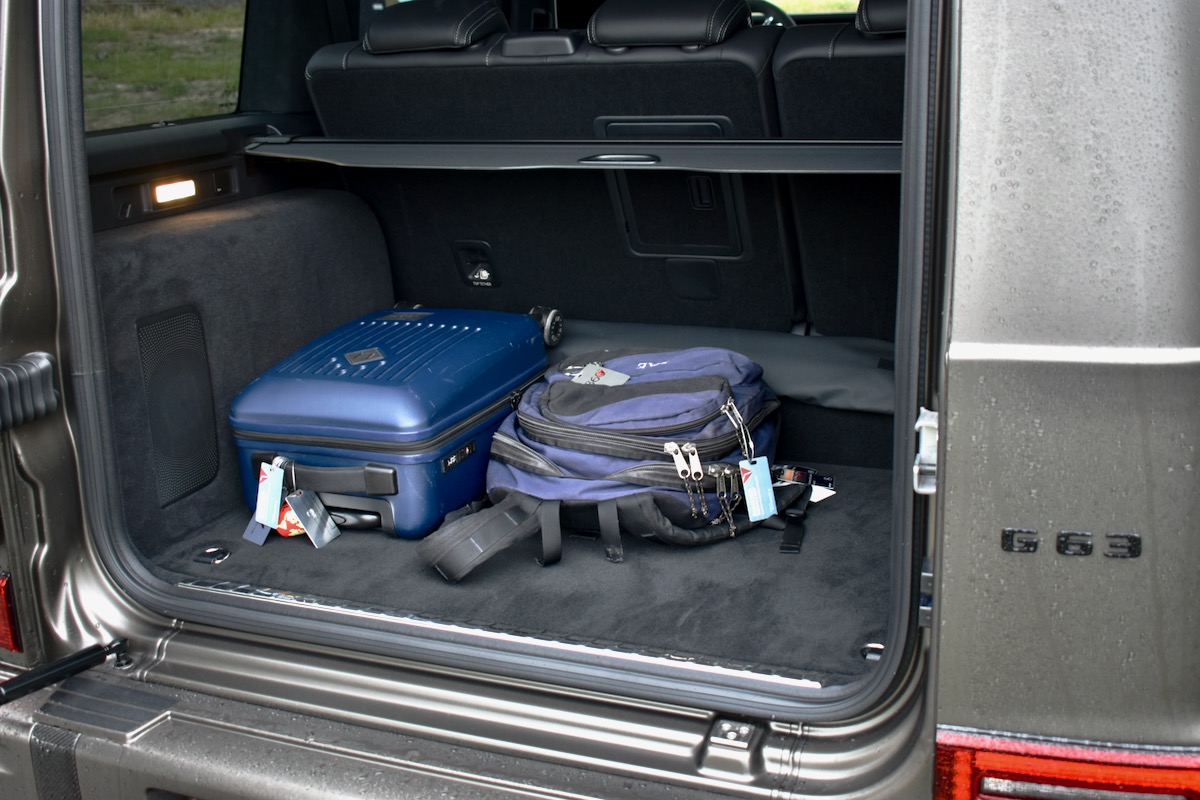
Mercedes commitment to the traditional G-Class design also impacts cargo space. The 640 litres Mercedes quotes with the rear seats in place is dwarfed by the 1,152 litres available in a standard-wheelbase Range Rover, or the 1,322 litres of a Lexus LX. A side-hinged tailgate means you won’t have to worry about low garage ceilings, but it could make loading and unloading cargo when street parked a bit more complicated.
A maximum towing capacity of 3,500 kilograms (7,716 pounds) for both the G 550 and AMG G 63 variants also puts the Mercedes behind the Range Rover, which can tow up to 3,720 kilograms (8,200 pounds) in some specs. Still, a luxury SUV with a towing capacity to rival current midsize pickup trucks is nothing to sneer at. While it may not have a palatial interior, the G-Class is also a bit easier to live with than some of its larger rivals. It still provides the commanding view of the road that most drivers expect, but with reasonable forward visibility thanks to thin roof pillars, a fairly low hood, and short overhangs. You can also use the trademark corner lamps to keep track of where the hood ends. The relatively short overall length and narrow width also make parking the G-Class much less of a chore than its rivals.
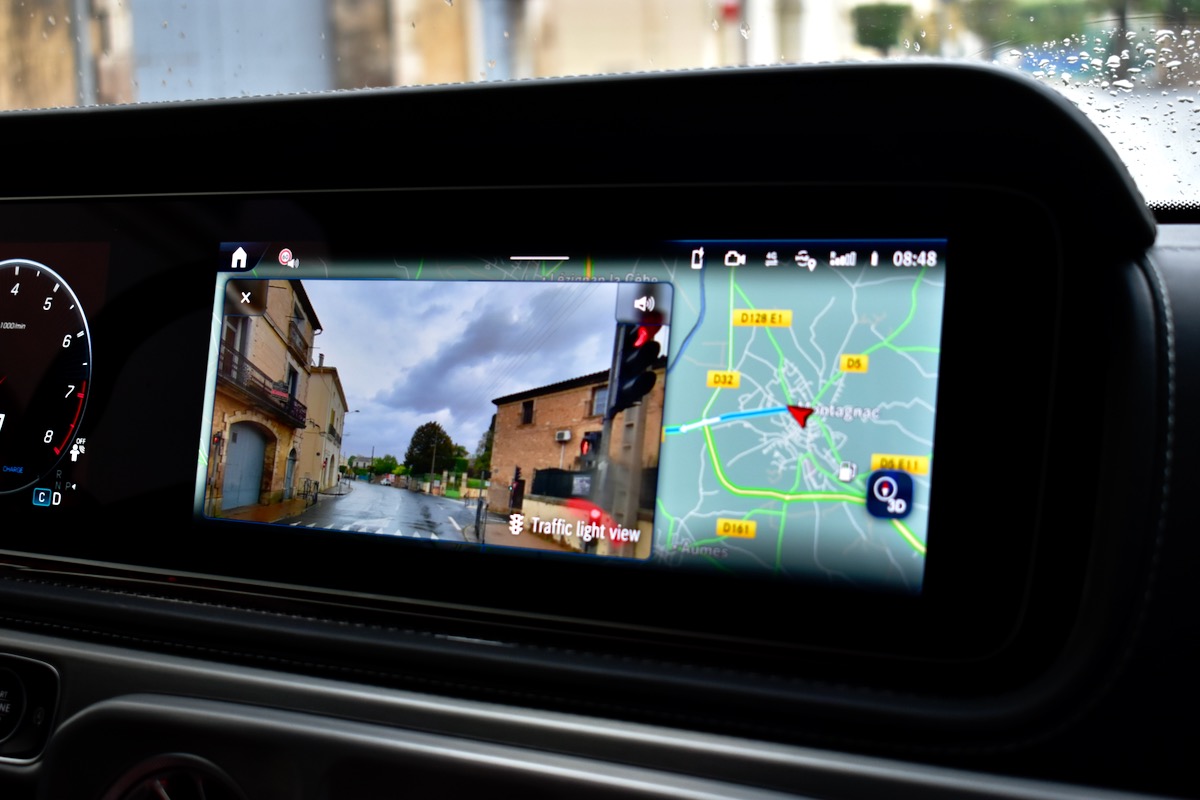
The G-Class may have an old school design and on-road driving dynamics, but it’s still very much a modern Mercedes when it comes to tech. It features the same Mercedes-Benz User Experience (MBUX) infotainment system as other vehicles wearing the three-pointed star, with wireless Apple CarPlay and Android Auto expected to be standard in Canada.
Also standard are a pair of 12.3-inch screens. One serves as the gauge cluster while the other serves as the infotainment touchscreen, but they’re placed side by side to create the impression of one continuous screen spanning roughly half the dashboard. An off-road menu includes information like a compass, tire pressure and temperature, and an inclinometer. Another handy feature is the “Transparent Hood,” which uses a forward-facing camera to show what’s directly in front of the vehicle at low angles—useful for avoiding rocks on trails or curbs in suburbia.
Notable MBUX features shared with other Mercedes models include augmented reality navigation, which projects arrows over a camera view of turns and junctions to highlight exactly where you need to go, and excellent voice recognition. It responds to the command “Hey Mercedes” by default, and understands colloquial speech much better than most rival systems. Mercedes also claims to have created approximately 20 new voice commands specifically for the G-Class and its unique features.
A Burmester 3D surround sound system with Dolby Atmos audio enhancement tech is expected to be standard as well. Notable features include a dashcam and a rear-seat entertainment system with dual 11.6-inch touchscreens. Users can stream content from their own devices, as well as move it from the rear displays up to the front.
The Insurance Institute for Highway Safety (IIHS) and National Highway Traffic Safety Administration (NHTSA) hadn’t released safety ratings for the G-Class at the time of publication. That’s typical for expensive, low-volume models like the G-Class.
Expected standard driver-assistance features include: forward-collision warning, automatic emergency braking, lane-keep assist, adaptive cruise control, park assist, a 360-degree camera system, blind-spot monitoring, rear cross-traffic alert, safe exit assist, and traffic sign recognition.
Like other Mercedes models, the G-Class also features the automaker’s Pre-Safe system. If the vehicle’s sensors determine that a crash is imminent, the G-Class will automatically take measures like engaging seatbelt tensioners and closing windows to prepare.
Three new features were also added globally for the 2025 model year. A route-based speed adaptation function for the adaptive cruise control automatically lowers the speed when approaching curves, junctions, tolls, or exits, and then automatically re-accelerates. Automated lane centring has been added as well, along with an emergency-stop feature that will automatically brake the G-Class to a standstill in its lane if the driver becomes incapacitated.
Natural Resources Canada fuel economy ratings for 2025 G-Class models were not available at the time of publication. The new mild-hybrid systems and the G 550’s downsized engine might yield some improvements over the 2024 G-Class’s 16.3 litres per 100 kilometres combined rating, but this SUV will never be frugal when it comes to fuel consumption.
Expect the 2025 G-Class to receive the same four-year, 80,000-kilometre, new-vehicle warranty as other Mercedes models.
For reference, the 2024 G 550 and G 63 are priced in Canada at $183,500 and $247,000 respectively, before fees. Expect the 2025 models to be in the same ballpark.
From a purely practical standpoint, the G-Class doesn’t make sense. Full-size luxury SUVs like the Cadillac Escalade, Lincoln Navigator, and even the Mercedes GLS are better at hauling people and stuff. And a Land Rover Defender or Lexus LX offers nearly the same combination of off-road capability or everyday usability for less money.
A G-Class isn’t a rational purchase, though. Its real selling points are its specialness and its potency as a status symbol. Even if it’s never driven off-road (and it’s likely most won’t be), the G-Class is something different that always grabs attention. It’s almost more appropriate to compare it to a sports car or other flashy high-dollar conveyance than to other SUVs. But Mercedes makes sure the G-Class is still the real deal when it comes to capability and luxury rather than just a showpiece—and it definitely deserves credit for that.
Note: Images show a US model.

User reviews for 2025 Mercedes-Benz G-Class
Write a review2025 Mercedes-Benz G-Class Pricing
Trims & specs
Air Conditioning
Air filtration: ionizing · Automatic climate control front air conditioning · Dual front air conditioning zones · Automatic climate control rear air conditioning · Single rear air conditioning zones
Airbags
Dual front airbags · Dual front knee airbags · Passenger airbag deactivation: occupant sensing deactivation · Rear side airbags · Front side curtain airbags
Audio System
Antenna Type: diversity · Voice recognition audio system · Bluetooth auxiliary audio input · Internet radio app: Spotify · Premium Brand: Burmester · HD radio · Satellite Radio: SiriusXM · 1 subwoofer · Surround audio: 5.1 · Total Number of Speakers: 17 · Watts: 760
Brakes
ABS: 4-wheel · Braking assist: hill start assist · Electronic parking brake: auto off · Front brake diameter: 13.9 · Front brake width: 1.26 · Front brakes: ventilated disc · Rear brake diameter: 13.6 · Rear brake width: 0.87 · Rear brakes: ventilated disc
Comfort Features
Armrests: rear center with cupholders · Center console trim: wood · Dash trim: aluminum · Door trim: wood · Floor Mat Material: carpet · Floor Material: carpet · Floor Mats: front · Foot pedal trim: stainless steel · Headliner trim: microfiber · Steering wheel trim: leather
Convenience Features
Active parking system: fully automated · Adaptive stop and go cruise control: fully automated · Ambient lighting: color-adjustable · Assist handle: rear · Autonomous lane guidance: lane centering · Cargo area power outlet: 12V · Cargo cover: retractable · Center console: front console with armrest and storage · Cruise control: adaptive · Cupholders: cooled · Dimming rearview mirror: auto-dimming · Easy entry: power steering wheel · Footwell lights: color-adjustable · Memorized settings: side mirrors · Multi-function remote: proximity entry system · One-touch windows: 4 · Power outlet(s): USB-C front · Power steering: speed-proportional · Power windows: lockout button · Reading lights: front · Steering wheel: power tilt and telescopic · Steering wheel mounted controls: paddle shifter · Storage: cargo net · Universal garage door opener: Homelink · Vanity mirrors: dual illuminating
Driver Seat
Adjustable lumbar support: 4-way power · Power adjustments: 14
Drivetrain
4WD Type: full time · Axle ratio: 3.45 · Locking differential: center · Transfer Case: electronic hi-lo gear selection
Engine
Battery: lithium ion · Electric Motor HP: 20 · Electric Motor Power Output (Kilowatts): 15 · Electric Motor Torque: 148 · Hybrid Gas Engine HP: 443 · Hybrid Gas Engine HP@RPM: 6100 · Hybrid Gas Engine Torque: 413 · Hybrid gas Engine Torque@RPM: 1950
Exterior Features
Body side moldings: chrome accents · Brush guard: grille · Bumper detail: front underguard · Door handle color: black · Fender lip moldings: body-color · Front bumper color: body-color · Grille color: black with chrome accents · Mirror color: body-color · Rear bumper color: body-color · Rear trunk/liftgate: side-hinged · Running boards: stainless steel · Skid plate(s): front · Window trim: black
Headrests
Front headrests: adjustable · Number of front headrests: 2 · Number of rear headrests: 3
Hybrid
Starter Type: motor/generator
In Car Entertainment
Connected in-car apps: Google search · Infotainment screen size: 12.3 in. · Smartphone integration: wireless Android Auto
Instrumentation
Fuel economy display: range · Instrument cluster screen size: 12.3 in. · Warnings and reminders: lamp failure
Lights
Daytime running lights: LED · Exterior entry lights: security approach lamps · Headlights: Auto on/off · Tail and brake lights: LED
Mirrors
Exterior mirrors: integrated turn signals
Passenger Seat
Power adjustments: 14
Rear Seats
Type: 60-40 split bench
Roof
Moonroof: sliding sunshade
Safety
Automatic emergency braking: rear · Camera system: surround view · Child seat anchors: LATCH system · Cross Traffic Alert: rear · Crumple zones: rear · Impact sensor: door unlock · Parking sensors: front · Pre-Collision Warning System: vibrating steering wheel · Pre-collision warning system: pedestrian detection · Rearview monitor: in dash
Seatbelts
Emergency locking retractors: front · Front seatbelts: 3-point · Seatbelt force limiters: front and rear · Seatbelt pretensioners: front and rear · Seatbelt warning sensor: driver and passenger · Second row seatbelts: 3-point
Seats
Driver seat power adjustments: height · Front seat type: bucket · Passenger seat power adjustments: height · Rear headrests: adjustable · Rear seat folding: split · Upholstery: leather
Spare Tire
Mount Location: outside
Spare Wheel
Rim type: aluminum alloy
Stability and Traction
Traction control: with trailer stability control
Suspension
Front Shock Type: gas shock absorbers · Front Spring Type: coil springs · Front Suspension Classification: solid live axle · Front Suspension Type: double wishbones · Rear Shock Type: gas shock absorbers · Rear Spring Type: coil springs · Rear Suspension Classification: solid live axle · Rear suspension type: trailing arms · Stabilizer bar(s): front
Telematics
Driver assistance app: roadside assistance · Electronic messaging assistance: with read function · Navigation system: augmented reality · Phone: voice activated · Phone wireless data link: Bluetooth · Smart device app compatibility: Mercedes me · Smart device app function: maintenance status · Wifi: hotspot compatible
Tires
Type: all season
Tires and Rims
Spare tire size: full-size matching · Wheel type: aluminum alloy
Wheels
Wheel spokes: 5
Windows
Front wipers: rain sensing · Laminated glass: acoustic · Liftgate window: fixed · Power windows: with safety reverse · Rear wiper: auto-on in reverse
Air Conditioning
Air filtration: ionizing · Automatic climate control front air conditioning · Dual front air conditioning zones · Rear air conditioning: with independent controls · Single rear air conditioning zones
Airbags
Dual front airbags · Dual front knee airbags · Passenger airbag deactivation: occupant sensing deactivation · Front side airbags · Front side curtain airbags
Audio System
Antenna Type: diversity · Voice recognition audio system · Memory card slot auxiliary audio input · Internet radio app: TIDAL · Premium Brand: Burmester · Touch screen display radio · Satellite Radio: SiriusXM · 1 subwoofer · Surround audio: 5.1 · Total Number of Speakers: 17 · Watts: 760
Brakes
ABS: 4-wheel · Braking assist: hill start assist · Electronic parking brake: auto off · Front brakes: ventilated disc · Rear brakes: ventilated disc
Comfort Features
Armrests: rear center with cupholders · Center console trim: aluminium · Dash trim: leather · Door trim: aluminum · Floor Mat Material: carpet · Floor Material: carpet · Floor Mats: front · Foot pedal trim: stainless steel · Headliner trim: microfiber · Steering wheel trim: leather
Convenience Features
Active parking system: fully automated · Adaptive stop and go cruise control: fully automated · Ambient lighting: color-adjustable · Assist handle: front · Autonomous lane guidance: lane centering · Cargo area power outlet: 12V · Cargo cover: retractable · Center console: front console with armrest and storage · Cruise control: adaptive · Cupholders: heated · Dimming rearview mirror: auto-dimming · Easy entry: power driver seat · Footwell lights: color-adjustable · Memorized settings: side mirrors · Multi-function remote: trunk release · One-touch windows: 4 · Power outlet(s): 12V front · Power steering: electric · Power windows: lockout button · Reading lights: front · Steering wheel: power tilt and telescopic · Steering wheel mounted controls: voice recognition controls · Storage: front seatback · Universal garage door opener: Homelink · Vanity mirrors: dual illuminating
Driver Seat
Adjustable lumbar support: 4-way power · Power adjustments: 14
Drivetrain
4WD Type: full time · Transfer Case: electronic hi-lo gear selection
Engine
Battery: maintenance-free · EV on-board charger rating: 9.6 kW · Electric Motor Battery Type: lithium ion · Electric Motor HP: 579 · Electric Motor Power Output (Kilowatts): 432 · Electric Motor Torque: 859 · Electric charge cord: autoswitching 110V/240V · Electric motor charger: DC fast charging · Electric motor charger connector: SAE Combo CCS · Electric motor miles per charge: 239
Exterior Features
Body side moldings: chrome accents · Brush guard: grille · Door handle color: black · Fender lip moldings: body-color · Front bumper color: body-color · Grille color: black with chrome accents · Mirror color: black · Rear bumper color: body-color · Rear trunk/liftgate: side-hinged · Running boards: stainless steel · Skid plate(s): front · Window trim: black
Headrests
Front headrests: adjustable · Number of front headrests: 2 · Number of rear headrests: 3
Hybrid
EV battery capacity: 122 kWh · Electric motor charging time (240V): 13.6 hours
In Car Entertainment
Connected in-car apps: Apple Music · Infotainment screen size: 12.3 in. · Smartphone integration: wireless Apple CarPlay
Instrumentation
Fuel economy display: MPG · Instrument cluster screen size: 12.3 in. · Warnings and reminders: lamp failure
Lights
Daytime running lights: LED · Exterior entry lights: puddle lamps · Headlights: cornering · Tail and brake lights: LED
Mirrors
Exterior mirrors: power folding
Passenger Seat
Power adjustments: 14
Rear Seats
Type: 60-40 split bench
Roof
Moonroof: sliding sunshade
Safety
Automatic emergency braking: front · Camera system: surround view · Child seat anchors: LATCH system · Cross Traffic Alert: rear · Crumple zones: front · Impact sensor: door unlock · Parking sensors: front · Pre-Collision Warning System: vibrating steering wheel · Pre-collision warning system: pedestrian detection · Rearview monitor: in dash
Seatbelts
Emergency locking retractors: front · Front seatbelts: 3-point · Seatbelt force limiters: front and rear · Seatbelt pretensioners: front · Seatbelt warning sensor: driver and passenger · Second row seatbelts: 3-point
Seats
Driver seat power adjustments: reclining · Front seat type: bucket · Passenger seat power adjustments: reclining · Rear headrests: adjustable · Rear seat folding: split · Upholstery: premium leather
Spare Tire
Kit: tire sealant
Suspension
Front Shock Type: gas shock absorbers · Front Spring Type: coil springs · Front Suspension Classification: solid live axle · Front Suspension Type: double wishbones · Rear Shock Type: gas shock absorbers · Rear Spring Type: coil springs · Rear Suspension Classification: solid live axle · Rear Suspension Type: de Dion tube · Stabilizer bar(s): front
Telematics
Driver assistance app: roadside assistance · Electronic messaging assistance: with read function · Navigation system: hard drive navigation system · Phone: voice activated · Phone wireless data link: Bluetooth · Smart device app compatibility: Mercedes me · Smart device app function: send destination to vehicle · Wifi: hotspot compatible
Tires
Type: summer performance
Tires and Rims
Wheels: aluminum with painted accents
Wheels
Wheel spokes: 10
Windows
Front wipers: speed sensitive · Laminated glass: acoustic front side · Liftgate window: fixed · Power windows: with safety reverse · Rear wiper: auto-on in reverse
Air Conditioning
Active charcoal air filtration · Automatic climate control front air conditioning · Dual front air conditioning zones · Automatic climate control rear air conditioning · Single rear air conditioning zones
Airbags
Dual front airbags · Dual front knee airbags · Passenger airbag deactivation: occupant sensing deactivation · Rear side airbags · Rear side curtain airbags
Audio System
Antenna Type: diversity · Voice recognition audio system · Bluetooth auxiliary audio input · Internet radio app: TIDAL · Premium Brand: Burmester · AM/FM radio · Satellite Radio: SiriusXM · 1 subwoofer · Surround audio: 5.1 · Total Number of Speakers: 17 · Watts: 760
Brakes
ABS: 4-wheel · Braking assist: hill start assist · Electronic parking brake: auto off · Front brake diameter: 14.8 · Front brakes: ventilated disc · Rear brake diameter: 13.0 · Rear brakes: ventilated disc
Comfort Features
Armrests: rear center folding with pass-thru · Center console trim: wood · Dash trim: leather · Door trim: wood · Floor Mat Material: carpet · Floor Material: carpet · Floor Mats: front · Foot pedal trim: stainless steel · Headliner trim: microfiber · Steering wheel trim: leather
Convenience Features
Active parking system: fully automated · Adaptive stop and go cruise control: fully automated · Ambient lighting: color-adjustable · Assist handle: rear · Autonomous lane guidance: lane centering · Cargo area power outlet: 12V · Cargo cover: retractable · Center console: front console with armrest and storage · Cruise control: adaptive · Cupholders: rear · Dimming rearview mirror: auto-dimming · Easy entry: power driver seat · Footwell lights: color-adjustable · Memorized settings: 3 driver · Multi-function remote: proximity entry system · One-touch windows: 4 · Power outlet(s): USB-C front · Power steering: speed-proportional · Power windows: lockout button · Reading lights: rear · Steering wheel: power tilt and telescopic · Steering wheel mounted controls: paddle shifter · Storage: door pockets · Universal garage door opener: Homelink · Vanity mirrors: dual illuminating
Driver Seat
Adjustable lumbar support: 4-way power · Power adjustments: 14
Drivetrain
4WD Type: full time · Locking differential: front · Transfer Case: electronic hi-lo gear selection
Engine
Battery: maintenance-free · Electric Motor HP: 20 · Electric Motor Power Output (Kilowatts): 15 · Electric Motor Torque: 148 · Exhaust: performance · Hybrid Gas Engine HP: 577 · Hybrid Gas Engine HP@RPM: 6000 · Hybrid Gas Engine Torque: 627 · Hybrid gas Engine Torque@RPM: 2500
Exterior Features
Body side moldings: black · Brush guard: grille · Bumper detail: front underguard · Door handle color: black · Exhaust: quad exhaust tips · Exhaust tip color: chrome · Fender lip moldings: body-color · Front bumper color: body-color · Grille color: black with chrome accents · Mirror color: body-color · Rear bumper color: body-color · Rear trunk/liftgate: side-hinged · Running boards: stainless steel · Window trim: black
Headrests
Front headrests: adjustable · Number of front headrests: 2 · Number of rear headrests: 3
Hybrid
Starter Type: motor/generator
In Car Entertainment
Connected in-car apps: Google search · Infotainment screen size: 12.3 in. · Smartphone integration: wireless Apple CarPlay
Instrumentation
Fuel economy display: range · Instrument cluster screen size: 12.3 in. · Warnings and reminders: maintenance reminder
Lights
Daytime running lights: LED · Exterior entry lights: security approach lamps · Headlights: Auto on/off · Tail and brake lights: LED
Mirrors
Exterior mirrors: integrated turn signals
Passenger Seat
Power adjustments: 14
Rear Seats
Type: 60-40 split bench
Roof
Moonroof: power glass
Safety
Automatic emergency braking: front pedestrian · Camera system: surround view · Child seat anchors: LATCH system · Cross Traffic Alert: rear · Crumple zones: front · Impact sensor: post-collision safety system · Parking sensors: front · Pre-Collision Warning System: audible warning · Pre-collision warning system: pedestrian detection · Rearview monitor: in dash
Seatbelts
Emergency locking retractors: front · Front seatbelts: 3-point · Seatbelt force limiters: front and rear · Seatbelt pretensioners: front · Seatbelt warning sensor: driver and passenger · Second row seatbelts: 3-point
Seats
Driver seat power adjustments: reclining · Front seat type: sport bucket · Passenger seat power adjustments: 4-way power lumbar · Rear headrests: adjustable · Rear seat folding: split · Upholstery: premium leather
Spare Tire
Mount Location: outside
Spare Wheel
Rim type: aluminum alloy
Stability and Traction
Traction control: with trailer stability control
Suspension
Driver Adjustable Suspension: ride control · Front Shock Type: gas shock absorbers · Front Spring Type: coil springs · Front Suspension Classification: solid live axle · Front Suspension Type: double wishbones · Leveling: self leveling suspension · Rear Shock Type: gas shock absorbers · Rear Spring Type: coil springs · Rear Suspension Classification: solid live axle · Rear suspension type: trailing arms · Stabilizer bar(s): rear · Suspension control: electronic
Telematics
Driver assistance app: roadside assistance · Electronic messaging assistance: with read function · Navigation system: with voice recognition · Phone: voice activated · Phone wireless data link: Bluetooth · Smart device app compatibility: Mercedes me · Smart device app function: maintenance status · Wifi: hotspot compatible
Tires
Type: summer performance
Tires and Rims
Spare tire size: full-size matching · Wheel type: aluminum alloy
Wheels
Wheel spokes: 5
Windows
Front wipers: variable intermittent · Laminated glass: acoustic rear side · Liftgate window: fixed · Power windows: with safety reverse · Rear wiper: with washer
