2025 Toyota Sequoia Reviews, Pricing & Specs
Write a reviewPros
Stylish design
Powerful engine
Easy-to-use technology
Cons
Poor fuel economy
Cramped third row
Not much cargo space
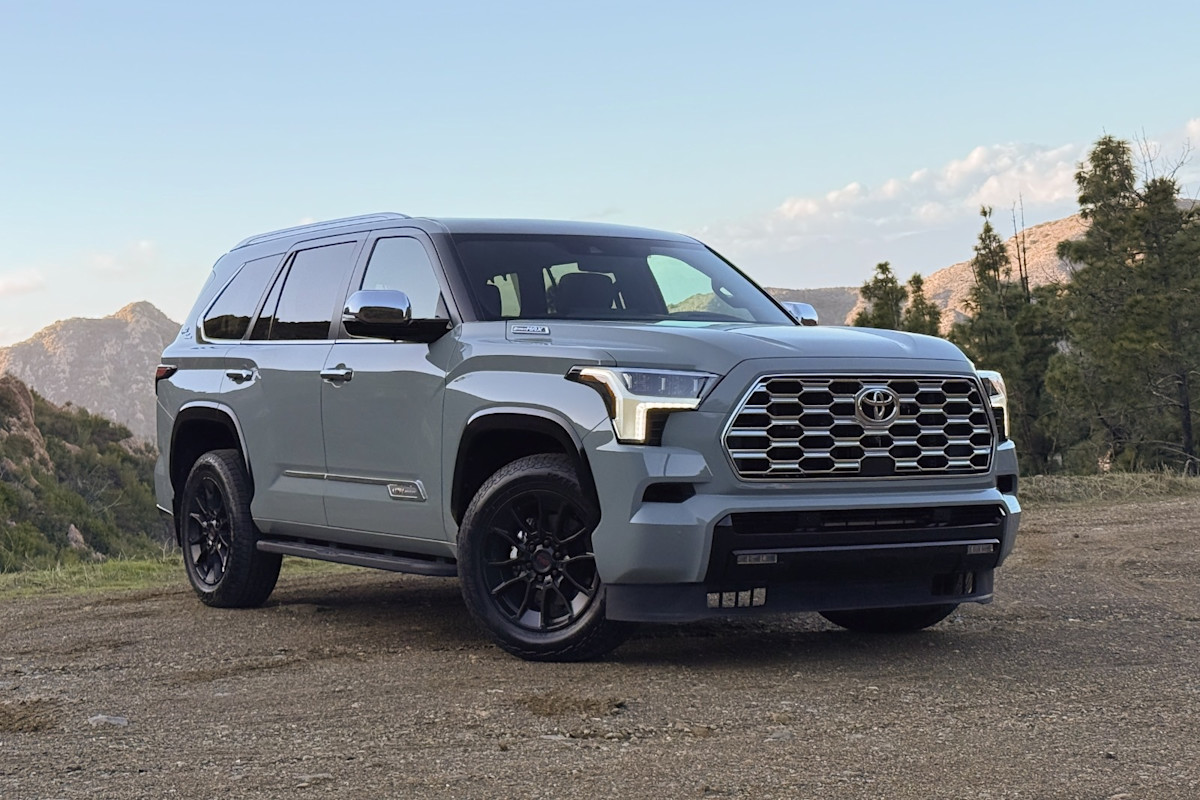
Toyota’s largest SUV is a workhorse, though it comes with fundamental flaws.
The 2025 Sequoia is Toyota’s full-size SUV, based on the same platform as the Tundra pickup truck and using the same i-Force Max hybrid powertrain. It seats up to eight people, holds up to 2,460 litres of cargo, carries up to 640 kilograms (1,411 pounds) of payload, and tows up to 4,080 kilograms (9,000 pounds) of trailer. But the Toyota Sequoia comes with some fundamental flaws.
Verdict: People buy full-size SUVs to carry lots of people, haul lots of cargo, and tow lots of weight. However, due to its packaging requirements, the Sequoia is a rock star only if you’re attaching a trailer to it, and even then, it’s not class-leading in capability.

Our test unit for this review is a U.S.-only trim, the Sequoia 1794 Edition. It’s equivalent to the Canadian Sequoia Platinum trim, but our version has dark grey painted 20-inch wheels and less exterior chrome, and the Saddle Tan leather upholstery and open-pore walnut wood trim are not offered in our market.
In Canada, the Sequoia lineup includes the base SR5 TRD Off-road, Limited (in Nightshade Edition as standard, with an available TRD Pro package), Platinum, and Capstone. The latter two trims are offered with available towing mirrors. Prices range from $87,174 to $106,175, including the $1,930 destination charge and other fees. Note that the federal government’s luxury tax, which applies to the portion of a vehicle price above $100,000, will be additional on the highest Sequoia trims.
Dipped in Lunar Rock paint (offered only on lower trims in Canada), our Sequoia grabbed attention everywhere we went. That was surprising since the current-generation Sequoia has been out for a few years. However, it is a rarity on the road, and the test vehicle looked pretty cool. Apart from the leather upholstery in our tester, the rest of the cabin is covered in typical Toyota-grade plastic, which is not a compliment.

The Sequoia comes standard with what Toyota calls an i-Force Max hybrid powertrain. It includes a twin-turbocharged 3.4-litre V6 engine, an electric motor, a 1.87-kilowatt-hour nickel metal hydride battery pack, and a 10-speed automatic transmission.
Output measures 437 horsepower and 583 pound-feet of torque. In Canada, a part-time four-wheel-drive (4WD) system with 2-Hi, 4-Hi, and 4-Lo settings is standard. In addition, drivers can choose from Eco, Normal, Sport, and Tow/Haul driving modes.
Weighing 2,790 kilograms (6,150 pounds), the Sequoia requires plenty from its twin-turbo hybrid drivetrain. Still, it is undeniably muscular, offering quick acceleration and a terrific engine note. However, this hybrid is about supplying competitive power, not getting good fuel economy.
In our experience, the fuel economy falls short of expectations. According to Natural Resources Canada, a Sequoia should average 11.7 litres per 100 kilometres in combined driving. However, when running the SUV in rear-wheel drive (RWD) 2-Hi and the Normal driving mode, the test vehicle could only manage 14.5 L/100 km on the evaluation loop.
Maximum towing comes from the base SR5 TRD Off-road trim in Canada and comes in at 4,137 kilograms (9,121 pounds). Peak payload is 640 kilograms (1,411 pounds) across all trims. Those figures beat several rivals, and Toyota offers a digital rearview mirror, Trailer Backup Guide system, and Straight Path Assist technology on the Platinum and Capstone trims, along with extra-cost towing mirrors. A self-leveling rear air suspension is also equipped on the Platinum trim only and is recommended for towing.
But the Sequoia suffers from compromised packaging and, in turn, driving dynamics. The battery pack is mounted under the rear seats, adding weight at the rear. And Toyota elected to use a solid rear axle, which cuts into rear-sear room and cargo space.
When driving in urban areas, the added mass at the rear axle produces unwanted body motion when traveling over speed humps and through drainage dips. On smaller and sharper bumps, the ride is jittery and truck-like. Mid-curve undulations on two-lane roads produce excessive lateral weight transfer. You might want to upgrade to the Platinum trim for its adaptive suspension with rear self-leveling to reduce these undesirable characteristics.
Ground clearance is 22.1 centimetres across the board, but the standard front air dam limits the approach angle to 15 degrees. The base SR5 TRD Off-Road trim and the Limited’s TRD Pro package install black 18-inch TRD Off-Road wheels, an off-road-tuned suspension, a 2.8-centimetre lift, a locking rear differential, and all the off-roading tech Toyota can put on a Sequoia. But with that silly air dam and less ground clearance than a base Subaru Crosstrek, this writes a cheque the Sequoia can’t cash.
Due to that air dam, we thought it was a bad idea to venture anywhere a RAV4 couldn’t go. Therefore, we can’t comment on any of the trick tech, such as Crawl Control and Multi-Terrain Select. However, as with the Toyota Tacoma pickup, owners can remove the air dam and chuck it into the garage to collect dust. It’s not like it’s helping much with fuel economy.
Steering is light and fluid like a Lexus, and the Sequoia boasts a tight turning radius. Switch to Sport mode, and the steering firms up but doesn’t offer much feel.
We didn’t like the brakes, which offer poor initial bite and are hard to modulate. Specifically, the pedal feel is too firm sometimes, requiring extra effort to depress. In heavy traffic, the pedal just doesn’t feel good underfoot. Also, after a hard braking test from a high speed, fade was a problem as we wound down a mountain. It’s best if you always leave yourself some extra room.

Like other full-size SUVs, the Sequoia carries up to eight people (seven with the second-row captain’s chairs available on Limited and standard on Platinum and Capstone). However, seven (or six) will be happier, and the people riding in the third row should be shorter in stature.
10-way power adjustable seats with heating, ventilation, and massage are standard on the Platinum and Capstone trims. Heated front seats, a heated steering wheel, and heated outboard mirrors are standard across the board on the 2025 Sequoia in Canada. Both the driver and front passenger are sure to find their accommodations comfortable.
Long rear doors make it easier to access the second- and third-row seats, but only when you have plenty of room on either side. The doors were a liability in cramped parking situations. Platinum and Capstone trims have standard second-row heated and ventilated captain’s chairs, which proved comfortable. They do not slide forward and back or offer a console between them. Instead, middle-row occupants get a floor-mounted set of cupholders and a tray. Toyota carves additional storage space into the rear door panels, and rear window sunshades cover most of the glass.
Our test vehicle had step rails, which are helpful primarily for accessing the third-row seats or tying things down to the roof rack. To enter the third row, you can fold and tumble the standard second-row bench seat or crawl between the two captain’s chairs, if so equipped. The Sequoia’s high floor and low roof make it awkward for adults to enter and exit this seating area, though.
Due to the high floor, the third row’s stadium-style seating offers a good view forward, but headroom is in short supply. Also, passengers can easily bounce when the SUV goes over a speed hump or a drainage dip, hitting their heads on the roof. Adults can fit, but the shorter they are, the happier they’ll be.
With the third-row seats in use, the Sequoia offers no more than 325 litres of cargo space. An adjustable shelf helps you make the most of it, but there simply isn’t much space. The rear window glass opens independently of the liftgate, and with the shelf in a high position, you can load the upper portion that way.
Most Sequoia owners will fold the third row down and slide it forward to enjoy the resulting 1,387 litres of cargo space. The maximum cargo volume, with both the third and second rows folded, measures 2,460 litres. All three figures are less than rival full-size SUVs, and even Toyota’s own Grand Highlander midsize SUV offers more room. The more affordable Toyota 4Runner is on par with the Sequoia in five-passenger format, and the Land Cruiser is not far behind.

Our test vehicle was equipped with a 12.3-inch digital instrumentation panel, which is standard in Canada, and a 14-inch touchscreen infotainment system, which is equipped beginning at the Limited trim. Four different connected services plans are available, with complementary trial subscriptions ranging from three to ten years.
Many of the Toyota Audio Multimedia system’s advanced features depend on active subscriptions to these plans. For example, the cloud-based navigation system with natural voice recognition relies on Drive Connect. Safety Connect provides an emergency assistance button and automatic collision notification. Remote Connect offers remote engine starting and the ability to find where you parked the SUV. The tech also supports a subscription to SiriusXM satellite radio.
If you’d rather not pay for these subscriptions when the free trials end, wireless Apple CarPlay and Android Auto are standard. In addition, you can charge your device on the wireless charging pad, which comes in at the Limited trim, but it doesn’t hold phones securely. A 14-speaker JBL premium sound system is included in the Limited’s TRD Pro package and on the Platinum and Capstone trims.
Toyota provides an oversized volume knob on the dashboard, making it easy to adjust sound levels. Opposite the volume knob, there isn’t a tuning knob. That’s maddening. Not only does it throw off the visual balance, but the USB port located there could move to any number of places. You can tune radio stations using the steering wheel controls, the touchscreen, or the voice recognition system, but we still want a simple, easy knob to twist without looking away from the road.
Drive Connect’s natural voice recognition system, Intelligent Assistant, responds to a “Hey Toyota” wake command. From there, you can request different things. It is reasonably capable but cannot execute some commands. We asked for a different cabin temperature to no avail, and the Intelligent Assistant could not activate the driver’s seat massage. It also did not respond to a request to listen to reggae music on SiriusXM. An urgent request for directions to a hospital was mostly successful.
In addition to the Toyota Audio Multimedia infotainment system, our tester had a surround-view camera system and a digital rearview mirror. Both were helpful, particularly the surround-view cameras when parking in close quarters.

Every 2025 Sequoia has Toyota Safety Sense 2.5 (TSS 2.5), a collection of driving assistance features. They include adaptive cruise control, forward collision warning with pedestrian detection, automatic emergency braking, lane departure warning, lane keep assist, lane-centring assist, and automatic high-beam headlights. Blind-spot monitoring and rear cross-traffic alert are also standard but aren’t branded as part of TSS 2.5.
In short, TSS 2.5 provides everything you expect to find in a modern vehicle without any frivolous extras. The tech is helpful, but as is often the case, the lane assist features cause aggravation. The Sequoia suffered many false lane departure warnings vibrating through the steering wheel rim, and the lane keep assist is frequently too obvious about its activity. Turn those off, and you might find the Sequoia more satisfying, if not as safe, to drive.
Neither the Insurance Institute for Highway Safety (IIHS) nor the National Highway Traffic Safety Administration (NHTSA) had released crash-test ratings for the Sequoia at the time of publication.

There is one reason to choose a Sequoia over a Toyota 4Runner, Grand Highlander, or Land Cruiser, and that reason is towing capacity. If you’re not planning to tow anything, Toyota’s other, smaller, SUVs are better bets.
Let’s start with the 4Runner. In its five-passenger configuration, it offers just as much cargo room as the Sequoia and a rear window that powers down into the liftgate. The 4Runner is narrower and its optional third-row seat is less accommodating, but it is nimbler on trails. The 4Runner is also substantially more affordable than the Sequoia.
Similarly, the five-passenger Land Cruiser offers nearly as much cargo capacity wrapped in a retro design at a lower price. Like the 4Runner, the Land Cruiser is off-road capable, and its smaller dimensions make it better to drive on a trail.
If you aren’t heading off-road, consider the three-row Grand Highlander. It offers more cargo room than the Sequoia but limits maximum seating capacity to seven people. On pavement, the ride and handling are more agreeable, and the Grand Highlander is more efficient, especially with its optional hybrid powertrain, which returns an estimated 7.0 to 8.8 L/100 km in combined driving. If you require more than 5,000 to 6,000 pounds of towing capacity, then the Sequoia is the only Toyota SUV that can deliver. But it competes against numerous rivals that also tow significant weight without its packaging compromises. The Chevrolet Tahoe, Ford Expedition, GMC Yukon, and Jeep Wagoneer all boast more comfortable third-row seats and significantly more cargo space. The redesigned 2025 Nissan Armada is also an appealing alternative.
Overall, the 2025 Toyota Sequoia is synonymous with compromise, making it a rare miss from an automaker known for best-selling home runs like the Camry, Corolla, RAV4, and Tacoma.

User reviews for 2025 Toyota Sequoia
Write a review2025 Toyota Sequoia Pricing
Trims & specs
Air Conditioning
Automatic climate control front air conditioning · Dual front air conditioning zones · Rear air conditioning: with independent controls · Single rear air conditioning zones · Second and third row rear heat vents
Airbags
Dual front airbags · Dual front knee airbags · Passenger airbag deactivation: occupant sensing deactivation · Front side airbags · Rear side curtain airbags
Audio System
Antenna Type: mast · Voice recognition audio system · USB auxiliary audio input · HD radio · Satellite Radio: SiriusXM · Total Number of Speakers: 8
Brakes
ABS: 4-wheel · Braking assist: hill start assist · Electronic parking brake: auto off · Front brake diameter: 13.9 · Front brakes: ventilated disc · Rear brake diameter: 13.6 · Rear brakes: ventilated disc
Comfort Features
Armrests: rear center with cupholders · Center console trim: simulated alloy · Dash trim: simulated alloy · Door trim: simulated alloy · Floor Material: carpet · Shift knob trim: leather · Steering wheel trim: leather
Convenience Features
Adaptive stop and go cruise control: semi-automatic · Assist handle: front · Autonomous lane guidance: lane centering · Cargo cover: hard · Center console: front console with armrest and storage · Cruise control: adaptive · Cupholders: front · Dimming rearview mirror: auto-dimming · Easy entry: manual rear seat · Multi-function remote: keyless entry with panic alarm · One-touch windows: 4 · Power outlet(s): 12V front · Power steering: electric · Power windows: lockout button · Reading lights: third row · Steering wheel: tilt and telescopic · Steering wheel mounted controls: multi-function screen controls · Storage: front seatback · Universal garage door opener: Homelink · Vanity mirrors: dual illuminating
Driver Seat
Adjustable lumbar support: power · Power adjustments: 8
Drivetrain
Axle ratio: 3.31
Engine
Battery: maintenance-free · EV battery capacity: 1.9 kWh · Electric Motor Battery Type: nickel-metal hydride · Electric Motor HP: 48 · Electric Motor Power Output (Kilowatts): 36 · Electric Motor Torque: 184 · Hybrid Gas Engine HP: 389 · Hybrid Gas Engine HP@RPM: 5200 · Hybrid Gas Engine Torque: 479 · Hybrid gas Engine Torque@RPM: 2400
Exterior Features
Door handle color: body-color · Exhaust tip color: black · Fender lip moldings: black · Front bumper color: black · Grille color: chrome surround · Mirror color: body-color · Mudguards: rear · Rear bumper color: black · Rear spoiler: roofline spoiler · Rear spoiler color: body-color · Rear trunk/liftgate: liftgate · Rocker panel color: body-color · Running boards: black · Window trim: chrome
Headrests
Front headrests: adjustable · Number of front headrests: 2 · Number of rear headrests: 3 · Number of third row headrests: 3
Hybrid
Starter Type: starter/belt alternator
In Car Entertainment
Connected in-car apps: Google search · Infotainment: Toyota Audio Multimedia · Infotainment screen size: 8 in. · Smartphone integration: wireless Android Auto
Instrumentation
Fuel economy display: MPG · Instrument cluster screen size: 12.3 in. · Warnings and reminders: low battery
Lights
Daytime running lights: LED · Exterior entry lights: security approach lamps · Front fog lights: LED · Headlights: auto delay off · Tail and brake lights: LED
Mirrors
Exterior mirrors: auto-dimming
Passenger Seat
Adjustable lumbar support: power · Power adjustments: 8
Rear Seats
Type: 60-40 split bench
Roof
Moonroof: tilt/slide · Roof rails: black
Safety
Active head restraints: driver · Automatic emergency braking: intersection/junction turn · Camera system: surround view · Child seat anchors: LATCH system · Cross Traffic Alert: rear · Impact sensor: fuel cut-off · Parking sensors: front · Pre-Collision Warning System: audible warning · Pre-collision warning system: intersection/junction turn · Rearview monitor: in dash
Seatbelts
Emergency locking retractors: front, rear, third, and fourth row · Front seatbelts: 3-point · Seatbelt force limiters: front · Seatbelt pretensioners: front and rear · Seatbelt warning sensor: driver and passenger · Second row seatbelts: 3-point · Third row seatbelts: 3-point
Seats
Driver seat power adjustments: reclining · Front seat type: bucket · Passenger seat power adjustments: reclining · Rear headrests: adjustable · Rear seat folding: split · Rear seat manual adjustments: reclining · Third row headrests: adjustable · Third row seat folding: flat · Upholstery: cloth
Security
Power door locks: anti-lockout
Spare Tire
Mount Location: underbody · Size: full-size
Spare Wheel
Rim Type: steel
Stability and Traction
Traction control: with trailer stability control
Steering
Turns lock-to-lock: 3.40
Suspension
Front Shock Type: twin-tube gas shock absorbers · Front Spring Type: coil springs · Front Suspension Classification: independent · Front Suspension Type: strut · Rear Shock Type: twin-tube gas shock absorbers · Rear Spring Type: coil springs · Rear Suspension Classification: solid live axle · Rear Suspension Type: multi-link · Stabilizer bar(s): front
Telematics
Driver assistance app: roadside assistance · Electronic messaging assistance: with voice recognition · Phone: voice activated · Phone wireless data link: Bluetooth · Smart device app compatibility: Toyota Connected Services · Smart device app function: maintenance status · Wifi: hotspot
Third Row Seat
Type: 40-60 split bench
Tires
Type: all season
Tires and Rims
Wheel type: aluminum alloy
Towing and Hauling
Trailer hitch: Class IV · Trailer wiring: 4-pin
Windows
Front wipers: variable intermittent · Laminated glass: acoustic · Liftgate window: manual flip-up · Power windows: with safety reverse · Rear wiper: with washer
Air Conditioning
Automatic climate control front air conditioning · Dual front air conditioning zones · Rear air conditioning: with independent controls · Single rear air conditioning zones · Second and third row rear heat vents
Airbags
Dual front airbags · Dual front knee airbags · Passenger airbag deactivation: occupant sensing deactivation · Front side airbags · Rear side curtain airbags
Audio System
Antenna Type: mast · Voice recognition audio system · Bluetooth auxiliary audio input · Touch screen display radio · Satellite Radio: SiriusXM · Total Number of Speakers: 8
Brakes
ABS: 4-wheel · Braking assist: hill start assist · Electronic parking brake: auto off · Front brake diameter: 13.9 · Front brakes: ventilated disc · Rear brake diameter: 13.6 · Rear brakes: ventilated disc
Comfort Features
Armrests: rear center with cupholders · Center console trim: simulated alloy · Dash trim: simulated alloy · Door trim: simulated alloy · Floor Material: carpet · Shift knob trim: leather · Steering wheel trim: leather
Convenience Features
Adaptive stop and go cruise control: semi-automatic · Assist handle: front · Autonomous lane guidance: lane centering · Cargo cover: hard · Center console: front console with armrest and storage · Cruise control: adaptive · Cupholders: front, rear and third row · Dimming rearview mirror: auto-dimming · Easy entry: manual rear seat · Multi-function remote: proximity entry system · One-touch windows: 4 · Power outlet(s): USB front · Power steering: speed-proportional · Power windows: lockout button · Reading lights: front · Steering wheel: tilt and telescopic · Steering wheel mounted controls: voice recognition controls · Storage: sunglasses holder · Universal garage door opener: Homelink · Vanity mirrors: dual illuminating
Driver Seat
Adjustable lumbar support: power · Power adjustments: 8
Drivetrain
4WD Type: part time · Axle ratio: 3.31 · Transfer Case: electronic hi-lo gear selection
Engine
Battery: maintenance-free · EV battery capacity: 1.9 kWh · Electric Motor Battery Type: nickel-metal hydride · Electric Motor HP: 48 · Electric Motor Power Output (Kilowatts): 36 · Electric Motor Torque: 184 · Hybrid Gas Engine HP: 389 · Hybrid Gas Engine HP@RPM: 5200 · Hybrid Gas Engine Torque: 479 · Hybrid gas Engine Torque@RPM: 2400
Exterior Features
Door handle color: body-color · Exhaust tip color: black · Fender lip moldings: black · Front bumper color: black · Grille color: black · Mirror color: body-color · Mudguards: front · Rear bumper color: black · Rear spoiler: roofline spoiler · Rear spoiler color: body-color · Rear trunk/liftgate: liftgate · Rocker panel color: body-color · Running boards: black · Window trim: chrome
Headrests
Front headrests: adjustable · Number of front headrests: 2 · Number of rear headrests: 3 · Number of third row headrests: 3
Hybrid
Starter Type: starter/belt alternator
In Car Entertainment
Connected in-car apps: Google POIs · Infotainment: Toyota Audio Multimedia · Infotainment screen size: 8 in. · Smartphone integration: wireless Apple CarPlay
Instrumentation
Fuel economy display: range · Instrument cluster screen size: 12.3 in. · Warnings and reminders: low fuel level
Lights
Daytime running lights: LED · Exterior entry lights: security approach lamps · Front fog lights: LED · Headlights: Auto on/off · Tail and brake lights: LED
Mirrors
Exterior mirrors: power
Passenger Seat
Adjustable lumbar support: power · Power adjustments: 8
Rear Seats
Type: 60-40 split bench
Roof
Moonroof: power glass · Roof rails: black
Safety
Active head restraints: driver · Automatic emergency braking: front · Camera system: surround view · Child seat anchors: LATCH system · Cross Traffic Alert: rear · Impact sensor: fuel cut-off · Parking sensors: rear · Pre-Collision Warning System: visual warning · Pre-collision warning system: intersection/junction turn · Rearview monitor: in dash
Seatbelts
Emergency locking retractors: front · Front seatbelts: 3-point · Seatbelt force limiters: front · Seatbelt pretensioners: front · Seatbelt warning sensor: driver and passenger · Second row seatbelts: 3-point · Third row seatbelts: 3-point
Seats
Driver seat power adjustments: height · Front seat type: bucket · Passenger seat power adjustments: height · Rear headrests: adjustable · Rear seat folding: split · Rear seat manual adjustments: reclining · Third row headrests: adjustable · Third row seat folding: split · Upholstery: cloth
Security
Power door locks: anti-lockout
Spare Tire
Mount Location: underbody · Size: full-size
Spare Wheel
Rim Type: steel
Stability and Traction
Traction control: with trailer stability control
Steering
Turns lock-to-lock: 3.40
Suspension
Front Shock Type: twin-tube gas shock absorbers · Front Spring Type: coil springs · Front Suspension Classification: independent · Front Suspension Type: strut · Rear Shock Type: twin-tube gas shock absorbers · Rear Spring Type: coil springs · Rear Suspension Classification: solid live axle · Rear Suspension Type: multi-link · Stabilizer bar(s): front
Telematics
Driver assistance app: roadside assistance · Electronic messaging assistance: with read function · Phone: voice activated · Phone wireless data link: Bluetooth · Smart device app compatibility: Toyota Connected Services · Smart device app function: vehicle location · Wifi: hotspot
Third Row Seat
Type: 40-60 split bench
Tires
Type: all season
Tires and Rims
Wheel type: aluminum alloy
Towing and Hauling
Trailer hitch: Class IV · Trailer wiring: 7-pin
Windows
Front wipers: variable intermittent · Laminated glass: acoustic · Liftgate window: manual flip-up · Power windows: with safety reverse · Rear wiper: with washer
Air Conditioning
Automatic climate control front air conditioning · Dual front air conditioning zones · Rear air conditioning: with independent controls · Single rear air conditioning zones · Second and third row rear heat vents
Airbags
Dual front airbags · Dual front knee airbags · Passenger airbag deactivation: occupant sensing deactivation · Front side airbags · Front side curtain airbags
Audio System
Antenna Type: diversity · Voice recognition audio system · Bluetooth auxiliary audio input · HD radio · Satellite Radio: SiriusXM · Total Number of Speakers: 8
Brakes
ABS: 4-wheel · Braking assist: hill start assist · Electronic parking brake: auto off · Front brake diameter: 13.9 · Front brakes: ventilated disc · Rear brake diameter: 13.6 · Rear brakes: ventilated disc
Comfort Features
Armrests: rear center with cupholders · Center console trim: simulated alloy · Dash trim: simulated alloy · Door trim: simulated alloy · Floor Material: carpet · Shift knob trim: leather · Steering wheel trim: leather
Convenience Features
Adaptive stop and go cruise control: semi-automatic · Assist handle: rear · Autonomous lane guidance: lane centering · Cargo area power outlet: 115V · Cargo cover: hard · Center console: front console with armrest and storage · Cruise control: adaptive · Cupholders: front, rear and third row · Dimming rearview mirror: auto-dimming · Easy entry: manual rear seat · Memorized settings: side mirrors · Multi-function remote: vehicle and key memory · One-touch windows: 4 · Power outlet(s): USB-C rear · Power steering: speed-proportional · Power windows: lockout button · Reading lights: front · Rear power outlet: 115V · Steering wheel: tilt and telescopic · Steering wheel mounted controls: cruise controls · Storage: cargo tie-down anchors and hooks · Sunshade: side window · Universal garage door opener: Homelink · Vanity mirrors: dual illuminating
Driver Seat
Adjustable lumbar support: power · Power adjustments: 8
Drivetrain
Axle ratio: 3.31
Engine
Battery: maintenance-free · EV battery capacity: 1.9 kWh · Electric Motor Battery Type: nickel-metal hydride · Electric Motor HP: 48 · Electric Motor Power Output (Kilowatts): 36 · Electric Motor Torque: 184 · Hybrid Gas Engine HP: 389 · Hybrid Gas Engine HP@RPM: 5200 · Hybrid Gas Engine Torque: 479 · Hybrid gas Engine Torque@RPM: 2400
Exterior Features
Door handle color: chrome · Exhaust tip color: black · Fender lip moldings: black · Front bumper color: black · Grille color: black · Mirror color: body-color · Mudguards: front · Rear bumper color: black · Rear spoiler: roofline spoiler · Rear spoiler color: body-color · Rear trunk/liftgate: sensor-activated · Rocker panel color: body-color · Running boards: black · Window trim: chrome
Headrests
Front headrests: adjustable · Number of front headrests: 2 · Number of rear headrests: 3 · Number of third row headrests: 3
Hybrid
Starter Type: starter/belt alternator
In Car Entertainment
Connected in-car apps: Google search · Infotainment: Toyota Audio Multimedia · Infotainment screen size: 14 in. · Smartphone integration: wireless Android Auto
Instrumentation
Fuel economy display: range · Instrument cluster screen size: 12.3 in. · Warnings and reminders: maintenance reminder
Lights
Daytime running lights: LED · Exterior entry lights: security approach lamps · Front fog lights: LED · Headlights: LED · Tail and brake lights: LED
Mirrors
Exterior mirrors: power folding
Passenger Seat
Adjustable lumbar support: power · Power adjustments: 8
Rear Seats
Type: 60-40 split bench
Roof
Moonroof: one-touch open/close · Roof rails: chrome
Safety
Active head restraints: driver · Automatic emergency braking: rear · Camera system: surround view · Child seat anchors: LATCH system · Cross Traffic Alert: rear · Impact sensor: door unlock · Parking sensors: rear · Pre-Collision Warning System: visual warning · Pre-collision warning system: pedestrian detection · Rearview monitor: in dash
Seatbelts
Emergency locking retractors: front · Front seatbelts: 3-point · Seatbelt force limiters: front · Seatbelt pretensioners: front · Seatbelt warning sensor: driver and passenger · Second row seatbelts: 3-point · Third row seatbelts: 3-point
Seats
Driver seat power adjustments: reclining · Front seat type: bucket · Passenger seat power adjustments: reclining · Rear headrests: adjustable · Rear seat folding: flat · Rear seat manual adjustments: reclining · Third row headrests: adjustable · Third row seat folding: flat · Upholstery: leatherette
Security
Power door locks: anti-lockout
Spare Tire
Mount Location: underbody · Size: full-size
Spare Wheel
Rim Type: steel
Stability and Traction
Traction control: with trailer stability control
Steering
Turns lock-to-lock: 3.40
Suspension
Front Shock Type: twin-tube gas shock absorbers · Front Spring Type: coil springs · Front Suspension Classification: independent · Front Suspension Type: double wishbones · Rear Shock Type: twin-tube gas shock absorbers · Rear Spring Type: coil springs · Rear Suspension Classification: solid live axle · Rear Suspension Type: multi-link · Stabilizer bar(s): front
Telematics
Driver assistance app: roadside assistance · Electronic messaging assistance: with read function · Navigation system: over-the-air map updates (OTA) · Phone: voice activated · Phone wireless data link: Bluetooth · Smart device app compatibility: Amazon Alexa · Smart device app function: lock operation · Wifi: hotspot
Third Row Seat
Type: 40-60 split bench
Tires
Type: all season
Tires and Rims
Wheels: aluminum with painted accents
Towing and Hauling
Trailer hitch: Class IV · Trailer wiring: 4-pin
Windows
Front wipers: variable intermittent · Laminated glass: acoustic · Liftgate window: manual flip-up · Power windows: with safety reverse · Rear wiper: intermittent
Air Conditioning
Automatic climate control front air conditioning · Dual front air conditioning zones · Automatic climate control rear air conditioning · Single rear air conditioning zones · Second and third row rear heat vents
Airbags
Dual front airbags · Dual front knee airbags · Passenger airbag deactivation: occupant sensing deactivation · Front side airbags · Front side curtain airbags
Audio System
Antenna Type: mast · Voice recognition audio system · Bluetooth auxiliary audio input · HD radio · Satellite Radio: SiriusXM · Total Number of Speakers: 8
Brakes
ABS: 4-wheel · Braking assist: hill start assist · Electronic parking brake: auto off · Front brake diameter: 13.9 · Front brakes: ventilated disc · Rear brake diameter: 13.6 · Rear brakes: ventilated disc
Comfort Features
Armrests: rear center with cupholders · Center console trim: simulated alloy · Dash trim: simulated alloy · Door trim: simulated alloy · Floor Material: carpet · Shift knob trim: leather · Steering wheel trim: leather
Convenience Features
Adaptive stop and go cruise control: semi-automatic · Assist handle: front · Autonomous lane guidance: lane centering · Cargo area power outlet: 115V · Cargo cover: hard · Center console: with lighting · Cruise control: adaptive · Cupholders: rear · Dimming rearview mirror: auto-dimming · Easy entry: manual rear seat · Memorized settings: side mirrors · Multi-function remote: proximity entry system · One-touch windows: 4 · Power outlet(s): USB-C rear · Power steering: speed-proportional · Power windows: lockout button · Reading lights: front · Rear power outlet: 115V · Steering wheel: tilt and telescopic · Steering wheel mounted controls: multi-function screen controls · Storage: grocery bag holder · Sunshade: side window · Universal garage door opener: Homelink · Vanity mirrors: dual illuminating
Driver Seat
Adjustable lumbar support: power · Power adjustments: 8
Drivetrain
4WD Type: part time · Axle ratio: 3.31 · Transfer Case: electronic hi-lo gear selection
Engine
Battery: maintenance-free · EV battery capacity: 1.9 kWh · Electric Motor Battery Type: nickel-metal hydride · Electric Motor HP: 48 · Electric Motor Power Output (Kilowatts): 36 · Electric Motor Torque: 184 · Hybrid Gas Engine HP: 389 · Hybrid Gas Engine HP@RPM: 5200 · Hybrid Gas Engine Torque: 479 · Hybrid gas Engine Torque@RPM: 2400
Exterior Features
Door handle color: chrome · Exhaust tip color: black · Fender lip moldings: black · Front bumper color: black · Grille color: black · Mirror color: body-color · Mudguards: rear · Rear bumper color: chrome accents · Rear spoiler: roofline spoiler · Rear spoiler color: body-color · Rear trunk/liftgate: liftgate · Rocker panel color: body-color · Running boards: black · Window trim: chrome
Headrests
Front headrests: adjustable · Number of front headrests: 2 · Number of rear headrests: 3 · Number of third row headrests: 3
Hybrid
Starter Type: starter/belt alternator
In Car Entertainment
Connected in-car apps: Google POIs · Infotainment: Toyota Audio Multimedia · Infotainment screen size: 14 in. · Smartphone integration: wireless Android Auto
Instrumentation
Fuel economy display: range · Instrument cluster screen size: 12.3 in. · Warnings and reminders: low oil pressure
Lights
Daytime running lights: LED · Exterior entry lights: security approach lamps · Front fog lights: LED · Headlights: Auto on/off · Tail and brake lights: LED
Mirrors
Exterior mirrors: heated
Passenger Seat
Adjustable lumbar support: power · Power adjustments: 8
Rear Seats
Type: 60-40 split bench
Roof
Moonroof: power glass · Roof rails: chrome
Safety
Active head restraints: driver · Automatic emergency braking: rear · Camera system: surround view · Child seat anchors: LATCH system · Cross Traffic Alert: rear · Impact sensor: door unlock · Parking sensors: front · Pre-Collision Warning System: audible warning · Pre-collision warning system: pedestrian detection · Rearview monitor: in dash
Seatbelts
Emergency locking retractors: front and rear · Front seatbelts: 3-point · Seatbelt force limiters: front · Seatbelt pretensioners: front and rear · Seatbelt warning sensor: driver and passenger · Second row seatbelts: 3-point · Third row seatbelts: 3-point
Seats
Driver seat power adjustments: height · Front seat type: bucket · Passenger seat power adjustments: height · Rear headrests: adjustable · Rear seat folding: flat · Rear seat manual adjustments: reclining · Third row headrests: adjustable · Third row seat folding: split · Upholstery: leatherette
Security
Power door locks: anti-lockout
Spare Tire
Mount Location: underbody · Size: full-size
Spare Wheel
Rim Type: steel
Stability and Traction
Traction control: with trailer stability control
Steering
Turns lock-to-lock: 3.40
Suspension
Front Shock Type: twin-tube gas shock absorbers · Front Spring Type: coil springs · Front Suspension Classification: independent · Front Suspension Type: strut · Rear Shock Type: twin-tube gas shock absorbers · Rear Spring Type: coil springs · Rear Suspension Classification: solid live axle · Rear Suspension Type: multi-link · Stabilizer bar(s): front
Telematics
Driver assistance app: roadside assistance · Electronic messaging assistance: with read function · Navigation system: with voice recognition · Phone: voice activated · Phone wireless data link: Bluetooth · Smart device app compatibility: Toyota Connected Services · Smart device app function: maintenance status · Wifi: hotspot
Third Row Seat
Type: 40-60 split bench
Tires
Type: all season
Tires and Rims
Wheels: aluminum with painted accents
Towing and Hauling
Trailer hitch: Class IV · Trailer wiring: 7-pin
Windows
Front wipers: variable intermittent · Laminated glass: acoustic · Liftgate window: manual flip-up · Power windows: with safety reverse · Rear wiper: auto-on in reverse
Air Conditioning
Automatic climate control front air conditioning · Dual front air conditioning zones · Rear air conditioning: with independent controls · Single rear air conditioning zones · Second and third row rear heat vents
Airbags
Dual front airbags · Dual front knee airbags · Passenger airbag deactivation: occupant sensing deactivation · Front side airbags · Third row side curtain airbags
Audio System
Antenna Type: mast · Voice recognition audio system · Bluetooth auxiliary audio input · Premium Brand: JBL · AM/FM radio · Satellite Radio: SiriusXM · 1 subwoofer · Total Number of Speakers: 13 · Watts: 800
Brakes
ABS: 4-wheel · Braking assist: hill start assist · Electronic parking brake: auto off · Front brake diameter: 13.9 · Front brakes: ventilated disc · Rear brake diameter: 13.6 · Rear brakes: ventilated disc
Comfort Features
Armrests: rear outboard seats · Center console trim: simulated alloy · Dash trim: simulated alloy · Door trim: simulated alloy · Floor Material: carpet · Shift knob trim: leather · Steering wheel trim: leather
Convenience Features
Adaptive stop and go cruise control: semi-automatic · Assist handle: front · Autonomous lane guidance: lane centering · Cargo area power outlet: 115V · Cargo cover: hard · Center console: front console with armrest and storage · Cruise control: adaptive · Cupholders: rear · Easy entry: power steering wheel · Memorized settings: steering wheel · Multi-function remote: proximity entry system · One-touch windows: 4 · Power outlet(s): USB-C front · Power steering: speed-proportional · Power windows: lockout button · Reading lights: rear · Rear power outlet: 115V · Rearview mirror: camera-based · Steering wheel: power tilt and telescopic · Steering wheel mounted controls: audio · Storage: dual level cargo area · Sunshade: side window · Universal garage door opener: Homelink · Vanity mirrors: dual illuminating
Driver Seat
Adjustable lumbar support: 4-way power · Power adjustments: 10
Drivetrain
4WD Type: part time · Axle ratio: 3.31 · Transfer Case: electronic hi-lo gear selection
Engine
Battery: maintenance-free · EV battery capacity: 1.9 kWh · Electric Motor Battery Type: nickel-metal hydride · Electric Motor HP: 48 · Electric Motor Power Output (Kilowatts): 36 · Electric Motor Torque: 184 · Hybrid Gas Engine HP: 389 · Hybrid Gas Engine HP@RPM: 5200 · Hybrid Gas Engine Torque: 479 · Hybrid gas Engine Torque@RPM: 2400
Exterior Features
Body side moldings: black · Door handle color: body-color · Exhaust tip color: black · Fender lip moldings: black · Front bumper color: black · Grille color: black · Mirror color: body-color · Mudguards: rear · Rear bumper color: black · Rear spoiler: roofline spoiler · Rear spoiler color: body-color · Rear trunk/liftgate: power operated · Rocker panel color: body-color · Running boards: black · Window trim: black
Headrests
Front headrests: adjustable · Number of front headrests: 2 · Number of rear headrests: 2 · Number of third row headrests: 3
Hybrid
Starter Type: starter/belt alternator
In Car Entertainment
Connected in-car apps: Google search · Infotainment: Toyota Audio Multimedia · Infotainment screen size: 14 in. · Smartphone integration: wireless Apple CarPlay
Instrumentation
Fuel economy display: MPG · Instrument cluster screen size: 12.3 in. · Warnings and reminders: maintenance reminder
Lights
Daytime running lights: LED · Exterior entry lights: security approach lamps · Front fog lights: LED · Headlights: wiper activated · Tail and brake lights: LED
Mirrors
Exterior mirrors: integrated turn signals
Passenger Seat
Power adjustments: 10
Rear Seats
Type: captains chairs
Roof
Moonroof: power panoramic · Moonroof / Sunroof: power sunshade · Roof rails: black
Safety
Active head restraints: driver · Automatic emergency braking: intersection/junction turn · Camera system: surround view · Child seat anchors: LATCH system · Cross Traffic Alert: rear · Impact sensor: post-collision safety system · Parking sensors: front · Pre-Collision Warning System: visual warning · Pre-collision warning system: intersection/junction turn · Rearview monitor: in dash
Seatbelts
Emergency locking retractors: front and rear · Front seatbelts: 3-point · Seatbelt force limiters: front · Seatbelt pretensioners: front and rear · Seatbelt warning sensor: driver and passenger · Second row seatbelts: 3-point · Third row seatbelts: 3-point
Seats
Driver seat power adjustments: height · Front seat type: bucket · Passenger seat power adjustments: 4-way power lumbar · Rear headrests: adjustable · Rear seat: ventilated · Rear seat folding: flat · Rear seat manual adjustments: reclining · Third row headrests: adjustable · Third row seat folding: power · Upholstery: contrast stitching
Security
Power door locks: anti-lockout
Spare Tire
Mount Location: underbody · Size: full-size
Spare Wheel
Rim Type: steel
Stability and Traction
Traction control: with trailer stability control
Steering
Turns lock-to-lock: 3.40
Suspension
Front Shock Type: twin-tube gas shock absorbers · Front Spring Type: coil springs · Front Suspension Classification: independent · Front Suspension Type: strut · Rear Shock Type: twin-tube gas shock absorbers · Rear Spring Type: coil springs · Rear Suspension Classification: solid live axle · Rear Suspension Type: multi-link · Stabilizer bar(s): front
Telematics
Driver assistance app: roadside assistance · Electronic messaging assistance: with voice recognition · Navigation system: with voice recognition · Phone: voice activated · Phone wireless data link: Bluetooth · Smart device app compatibility: Toyota Connected Services · Smart device app function: vehicle location · Wifi: hotspot
Third Row Seat
Type: 40-60 split bench
Tires
Type: all season
Tires and Rims
Wheels: painted aluminum
Towing and Hauling
Automated trailer backup steering: straight line · Trailer hitch: Class IV · Trailer wiring: 7-pin
Windows
Front wipers: rain sensing · Laminated glass: acoustic · Liftgate window: manual flip-up · Power windows: with safety reverse · Rear wiper: with washer
Air Conditioning
Automatic climate control front air conditioning · Dual front air conditioning zones · Rear air conditioning: with independent controls · Single rear air conditioning zones · Second and third row rear heat vents
Airbags
Dual front airbags · Dual front knee airbags · Passenger airbag deactivation: occupant sensing deactivation · Front side airbags · Rear side curtain airbags
Audio System
Antenna Type: diversity · Voice recognition audio system · Bluetooth auxiliary audio input · Premium Brand: JBL · AM/FM radio · Satellite Radio: SiriusXM · 1 subwoofer · Total Number of Speakers: 13 · Watts: 800
Brakes
ABS: 4-wheel · Braking assist: hill start assist · Electronic parking brake: auto off · Front brake diameter: 13.9 · Front brakes: ventilated disc · Rear brake diameter: 13.6 · Rear brakes: ventilated disc
Comfort Features
Armrests: rear outboard seats · Floor Mat Material: vinyl/rubber · Floor Material: carpet · Floor Mats: front · Foot pedal trim: aluminum · Shift knob trim: leather · Steering wheel trim: leather
Convenience Features
Adaptive stop and go cruise control: semi-automatic · Assist handle: rear · Autonomous lane guidance: lane centering · Cargo area power outlet: 115V · Cargo cover: hard · Center console: front console with armrest and storage · Cruise control: adaptive · Cupholders: front, rear and third row · Easy entry: manual rear seat · Memorized settings: 2 driver · Multi-function remote: proximity entry system · One-touch windows: 4 · Power outlet(s): USB rear · Power steering: electric · Power windows: lockout button · Reading lights: third row · Rear power outlet: 115V · Rearview mirror: camera-based · Steering wheel: tilt and telescopic · Steering wheel mounted controls: phone · Storage: accessory hook · Sunshade: side window · Universal garage door opener: Homelink · Vanity mirrors: dual illuminating
Driver Seat
Adjustable lumbar support: power · Power adjustments: 8
Drivetrain
4WD Type: part time · Axle ratio: 3.31 · Locking differential: rear · Transfer Case: electronic hi-lo gear selection
Engine
Battery: maintenance-free · EV battery capacity: 1.9 kWh · Electric Motor Battery Type: nickel-metal hydride · Electric Motor HP: 48 · Electric Motor Power Output (Kilowatts): 36 · Electric Motor Torque: 184 · Hybrid Gas Engine HP: 389 · Hybrid Gas Engine HP@RPM: 5200 · Hybrid Gas Engine Torque: 479 · Hybrid gas Engine Torque@RPM: 2400
Exterior Features
Door handle color: body-color · Exhaust: dual exhaust tips · Exhaust tip color: black · Fender lip moldings: black · Front bumper color: black · Grille color: black surround · Illuminated accent: grille · Mirror color: black · Mudguards: front · Rear bumper color: black · Rear spoiler: roofline spoiler · Rear spoiler color: body-color · Rear trunk/liftgate: liftgate · Rocker panel color: body-color · Running boards: black · Skid plate(s): front · Window trim: black
Headrests
Front headrests: adjustable · Number of front headrests: 2 · Number of rear headrests: 2 · Number of third row headrests: 3
Hybrid
Starter Type: starter/belt alternator
In Car Entertainment
Connected in-car apps: Google POIs · Infotainment: Toyota Audio Multimedia · Infotainment screen size: 14 in. · Smartphone integration: wireless Apple CarPlay
Instrumentation
Fuel economy display: range · Instrument cluster screen size: 12.3 in. · Warnings and reminders: low battery
Lights
Daytime running lights: LED · Exterior entry lights: security approach lamps · Front fog lights: LED · Headlights: Auto on/off · Tail and brake lights: LED
Mirrors
Exterior mirrors: reverse gear tilt
Passenger Seat
Adjustable lumbar support: power · Power adjustments: 8
Rear Seats
Type: captains chairs
Roof
Moonroof: power glass · Roof rack color: black · Roof rails: black
Safety
Active head restraints: driver · Automatic emergency braking: rear pedestrian · Camera system: surround view · Child seat anchors: LATCH system · Cross Traffic Alert: rear · Impact sensor: fuel cut-off · Parking sensors: front · Pre-Collision Warning System: visual warning · Pre-collision warning system: pedestrian detection · Rearview monitor: in dash
Seatbelts
Emergency locking retractors: front · Front seatbelts: 3-point · Seatbelt force limiters: front · Seatbelt pretensioners: front · Seatbelt warning sensor: driver and passenger · Second row seatbelts: 3-point · Third row seatbelts: 3-point
Seats
Driver seat power adjustments: height · Front seat type: bucket · Passenger seat power adjustments: height · Rear headrests: adjustable · Rear seat folding: flat · Rear seat manual adjustments: reclining · Third row headrests: adjustable · Third row seat folding: power · Upholstery: contrast stitching
Security
Power door locks: anti-lockout
Spare Tire
Mount Location: underbody · Size: full-size
Spare Wheel
Rim Type: steel
Stability and Traction
Traction control: with trailer stability control
Steering
Turns lock-to-lock: 3.2
Suspension
Front Shock Type: gas shock absorbers · Front Spring Type: coil springs · Front Suspension Classification: independent · Front Suspension Type: strut · Rear Shock Type: gas shock absorbers · Rear Spring Type: coil springs · Rear Suspension Classification: solid live axle · Rear Suspension Type: multi-link · Stabilizer bar(s): front
Telematics
Driver assistance app: roadside assistance · Electronic messaging assistance: with voice recognition · Navigation system: with voice recognition · Phone: voice activated · Phone wireless data link: Bluetooth · Smart device app compatibility: Toyota Connected Services · Smart device app function: maintenance status · Wifi: hotspot
Third Row Seat
Type: 40-60 split bench
Tires
Type: all terrain
Tires and Rims
Wheels: painted aluminum
Towing and Hauling
Automated trailer backup steering: straight line · Trailer hitch: Class IV · Trailer wiring: 7-pin
Windows
Front wipers: variable intermittent · Laminated glass: acoustic · Liftgate window: manual flip-up · Power windows: with safety reverse · Rear wiper: with washer
Air Conditioning
Automatic climate control front air conditioning · Dual front air conditioning zones · Rear air conditioning: with independent controls · Single rear air conditioning zones · Second and third row rear heat vents
Airbags
Dual front airbags · Dual front knee airbags · Passenger airbag deactivation: occupant sensing deactivation · Front side airbags · Rear side curtain airbags
Audio System
Antenna Type: diversity · Voice recognition audio system · Bluetooth auxiliary audio input · Premium Brand: JBL · AM/FM radio · Satellite Radio: SiriusXM · 1 subwoofer · Total Number of Speakers: 13 · Watts: 800
Brakes
ABS: 4-wheel · Braking assist: hill start assist · Electronic parking brake: auto off · Front brake diameter: 13.9 · Front brakes: ventilated disc · Rear brake diameter: 13.6 · Rear brakes: ventilated disc
Comfort Features
Armrests: rear outboard seats · Center console trim: wood · Dash trim: simulated alloy · Door trim: simulated alloy · Floor Mat Material: vinyl/rubber · Floor Material: carpet · Floor Mats: front · Interior accents: wood · Shift knob trim: leather · Steering wheel trim: leather
Convenience Features
Adaptive stop and go cruise control: semi-automatic · Assist handle: rear · Autonomous lane guidance: lane centering · Cargo area power outlet: 115V · Cargo cover: hard · Center console: second row · Cruise control: adaptive · Cupholders: rear · Easy entry: power driver seat · Memorized settings: 2 driver · Multi-function remote: vehicle and key memory · One-touch windows: 4 · Power outlet(s): USB-C front · Power steering: speed-proportional · Power windows: lockout button · Reading lights: rear · Rear power outlet: 115V · Rearview mirror: camera-based · Steering wheel: power tilt and telescopic · Steering wheel mounted controls: audio · Storage: dual level cargo area · Sunshade: side window · Universal garage door opener: Homelink · Vanity mirrors: dual illuminating
Driver Seat
Adjustable lumbar support: 4-way power · Power adjustments: 10
Drivetrain
4WD Type: part time · Axle ratio: 3.31 · Transfer Case: electronic hi-lo gear selection
Engine
Battery: maintenance-free · EV battery capacity: 1.9 kWh · Electric Motor Battery Type: nickel-metal hydride · Electric Motor HP: 48 · Electric Motor Power Output (Kilowatts): 36 · Electric Motor Torque: 184 · Hybrid Gas Engine HP: 389 · Hybrid Gas Engine HP@RPM: 5200 · Hybrid Gas Engine Torque: 479 · Hybrid gas Engine Torque@RPM: 2400
Exterior Features
Body side moldings: chrome · Door handle color: chrome · Exhaust tip color: black · Fender lip moldings: black · Front bumper color: black · Grille color: chrome · Mirror color: chrome · Mudguards: rear · Rear bumper color: black · Rear spoiler: roofline spoiler · Rear spoiler color: body-color · Rear trunk/liftgate: sensor-activated · Rocker panel color: body-color · Window trim: chrome
Headrests
Front headrests: adjustable · Number of front headrests: 2 · Number of rear headrests: 2 · Number of third row headrests: 3
Hybrid
Starter Type: starter/belt alternator
In Car Entertainment
Connected in-car apps: Google POIs · Infotainment: Toyota Audio Multimedia · Infotainment screen size: 14 in. · Smartphone integration: wireless Apple CarPlay
Instrumentation
Fuel economy display: MPG · Instrument cluster screen size: 12.3 in. · Warnings and reminders: coolant temperature warning
Lights
Daytime running lights: LED · Exterior entry lights: security approach lamps · Front fog lights: LED · Headlights: Auto on/off · Tail and brake lights: LED
Mirrors
Exterior mirrors: integrated turn signals
Passenger Seat
Power adjustments: 10
Rear Seats
Type: captains chairs
Roof
Moonroof: power panoramic · Moonroof / Sunroof: power sunshade · Roof rails: chrome
Safety
Active head restraints: driver · Automatic emergency braking: intersection/junction turn · Camera system: surround view · Child seat anchors: LATCH system · Cross Traffic Alert: rear · Impact sensor: door unlock · Parking sensors: front · Pre-Collision Warning System: visual warning · Pre-collision warning system: intersection/junction turn · Rearview monitor: in dash
Seatbelts
Emergency locking retractors: front, rear, third, and fourth row · Front seatbelts: 3-point · Seatbelt force limiters: front · Seatbelt pretensioners: front and rear · Seatbelt warning sensor: driver and passenger · Second row seatbelts: 3-point · Third row seatbelts: 3-point
Seats
Driver seat power adjustments: reclining · Front seat type: bucket · Passenger seat power adjustments: reclining · Rear headrests: adjustable · Rear seat: ventilated · Rear seat folding: flat · Rear seat manual adjustments: reclining · Third row headrests: adjustable · Third row seat folding: power · Upholstery: contrast stitching
Security
Power door locks: anti-lockout
Spare Tire
Mount Location: underbody · Size: full-size
Spare Wheel
Rim Type: steel
Stability and Traction
Traction control: with trailer stability control
Steering
Turns lock-to-lock: 3.40
Suspension
Front Shock Type: twin-tube gas shock absorbers · Front Spring Type: coil springs · Front Suspension Classification: independent · Front Suspension Type: strut · Rear Shock Type: twin-tube gas shock absorbers · Rear Spring Type: coil springs · Rear Suspension Classification: solid live axle · Rear Suspension Type: multi-link · Stabilizer bar(s): front
Telematics
Driver assistance app: roadside assistance · Electronic messaging assistance: with read function · Navigation system: touch screen display · Phone: voice activated · Phone wireless data link: Bluetooth · Smart device app compatibility: Toyota Connected Services · Smart device app function: vehicle location · Wifi: hotspot
Third Row Seat
Type: 40-60 split bench
Tires
Type: all season
Tires and Rims
Wheels: painted aluminum
Towing and Hauling
Automated trailer backup steering: straight line · Trailer hitch: Class IV · Trailer wiring: 7-pin
Windows
Front wipers: variable intermittent · Laminated glass: acoustic · Liftgate window: manual flip-up · Power windows: with safety reverse · Rear wiper: with washer
Air Conditioning
Automatic climate control front air conditioning · Dual front air conditioning zones · Automatic climate control rear air conditioning · Single rear air conditioning zones · Second and third row rear heat vents
Airbags
Dual front airbags · Dual front knee airbags · Passenger airbag deactivation: occupant sensing deactivation · Front side airbags · Front side curtain airbags
Audio System
Antenna Type: mast · Voice recognition audio system · Bluetooth auxiliary audio input · Premium Brand: JBL · Touch screen display radio · Satellite Radio: SiriusXM · 1 subwoofer · Total Number of Speakers: 13 · Watts: 800
Brakes
ABS: 4-wheel · Braking assist: hill start assist · Electronic parking brake: auto off · Front brake diameter: 13.9 · Front brakes: ventilated disc · Rear brake diameter: 13.6 · Rear brakes: ventilated disc
Comfort Features
Armrests: rear outboard seats · Center console trim: simulated wood · Dash trim: simulated wood · Door trim: simulated wood · Floor Mat Material: carpet · Floor Material: carpet · Floor Mats: front · Shift knob trim: leather · Steering wheel trim: leather
Convenience Features
Adaptive stop and go cruise control: semi-automatic · Assist handle: rear · Autonomous lane guidance: lane centering · Cargo area power outlet: 115V · Cargo cover: hard · Center console: front console with armrest and storage · Cruise control: adaptive · Cupholders: front, rear and third row · Easy entry: manual rear seat · Memorized settings: side mirrors · Multi-function remote: trunk release · One-touch windows: 4 · Power outlet(s): 12V front · Power steering: electric · Power windows: lockout button · Reading lights: third row · Rear power outlet: 115V · Rearview mirror: camera-based · Steering wheel: power tilt and telescopic · Steering wheel mounted controls: audio · Storage: cargo tie-down anchors and hooks · Sunshade: side window · Universal garage door opener: Homelink · Vanity mirrors: dual illuminating
Driver Seat
Adjustable lumbar support: 4-way power · Power adjustments: 10
Drivetrain
4WD Type: part time · Axle ratio: 3.31 · Transfer Case: electronic hi-lo gear selection
Engine
Battery: maintenance-free · EV battery capacity: 1.9 kWh · Electric Motor Battery Type: nickel-metal hydride · Electric Motor HP: 48 · Electric Motor Power Output (Kilowatts): 36 · Electric Motor Torque: 184 · Hybrid Gas Engine HP: 389 · Hybrid Gas Engine HP@RPM: 5200 · Hybrid Gas Engine Torque: 479 · Hybrid gas Engine Torque@RPM: 2400
Exterior Features
Body side moldings: chrome · Door handle color: chrome · Exhaust tip color: black · Fender lip moldings: body-color · Front bumper color: chrome accents · Grille color: chrome · Lower body step rails: power-retractable · Mirror color: chrome · Mudguards: rear · Rear bumper color: black · Rear spoiler: roofline spoiler · Rear spoiler color: body-color · Rear trunk/liftgate: power operated · Rocker panel color: body-color · Running boards: black · Window trim: chrome
Headrests
Front headrests: adjustable · Number of front headrests: 2 · Number of rear headrests: 2 · Number of third row headrests: 3
Hybrid
Starter Type: starter/belt alternator
In Car Entertainment
Connected in-car apps: Google search · Infotainment: Toyota Audio Multimedia · Infotainment screen size: 14 in. · Smartphone integration: wireless Apple CarPlay
Instrumentation
Fuel economy display: range · Instrument cluster screen size: 12.3 in. · Warnings and reminders: low battery
Lights
Daytime running lights: LED · Exterior entry lights: security approach lamps · Front fog lights: LED · Headlights: automatic high beam dimmer · Tail and brake lights: LED
Mirrors
Exterior mirrors: heated
Passenger Seat
Power adjustments: 10
Rear Seats
Type: captains chairs
Roof
Moonroof: tilt/slide · Moonroof / Sunroof: power sunshade · Roof rails: chrome
Safety
Active head restraints: driver · Automatic emergency braking: rear · Camera system: surround view · Child seat anchors: LATCH system · Cross Traffic Alert: rear · Impact sensor: door unlock · Parking sensors: front · Pre-Collision Warning System: audible warning · Pre-collision warning system: pedestrian detection · Rearview monitor: in dash
Seatbelts
Emergency locking retractors: front, rear, third, and fourth row · Front seatbelts: 3-point · Seatbelt force limiters: front · Seatbelt pretensioners: front · Seatbelt warning sensor: driver and passenger · Second row seatbelts: 3-point · Third row seatbelts: 3-point
Seats
Driver seat power adjustments: height · Front seat type: bucket · Passenger seat power adjustments: height · Rear headrests: adjustable · Rear seat: ventilated · Rear seat folding: flat · Rear seat manual adjustments: reclining · Third row headrests: adjustable · Third row seat folding: flat · Upholstery: semi-aniline leather
Security
Power door locks: anti-lockout
Spare Tire
Mount Location: underbody · Size: full-size
Spare Wheel
Rim Type: steel
Stability and Traction
Traction control: with trailer stability control
Steering
Turns lock-to-lock: 3.40
Suspension
Front Shock Type: twin-tube gas shock absorbers · Front Spring Type: coil springs · Front Suspension Classification: independent · Front Suspension Type: double wishbones · Rear Shock Type: twin-tube gas shock absorbers · Rear Spring Type: coil springs · Rear Suspension Classification: solid live axle · Rear Suspension Type: multi-link · Stabilizer bar(s): front
Telematics
Driver assistance app: roadside assistance · Electronic messaging assistance: with voice recognition · Navigation system: over-the-air map updates (OTA) · Phone: voice activated · Phone wireless data link: Bluetooth · Smart device app compatibility: Amazon Alexa · Smart device app function: security event/collision alert · Wifi: hotspot
Third Row Seat
Type: 40-60 split bench
Tires
Type: all season
Tires and Rims
Wheels: aluminum with painted accents
Towing and Hauling
Automated trailer backup steering: straight line · Trailer hitch: Class IV · Trailer wiring: 4-pin
Windows
Front wipers: variable intermittent · Laminated glass: acoustic · Liftgate window: manual flip-up · Power windows: with safety reverse · Rear wiper: auto-on in reverse
