2026 Toyota Camry Reviews, Pricing & Specs


Pros & cons
What we like
Fuel-efficient
Easy-to-use technology
Great safety ratings
What to consider
Uninspired styling
Not much cargo space
Stereo is lacking
The CarGurus verdict
Affordable, efficient, and safe, the 2026 Toyota Camry is all about practicality.
Available in four trim levels in Canada, each equipped with a standard hybrid powertrain, the Camry is one of the few remaining midsize sedans for sale in North America. Toyota stopped just short of a complete redesign for the 2025 model year. The 2026 Camry lineup continues mostly unchanged, adding a sporty new Nightshade Edition package for the SE Upgrade AWD and a paint colour called Cosmos Blue.
Verdict: The Toyota Camry is cheap to own, safe, and known for its dependability. Is that exciting? No. But fortunately, a 2026 Camry is also comfortable and good to drive.
out of 10 expert review
Look & feel
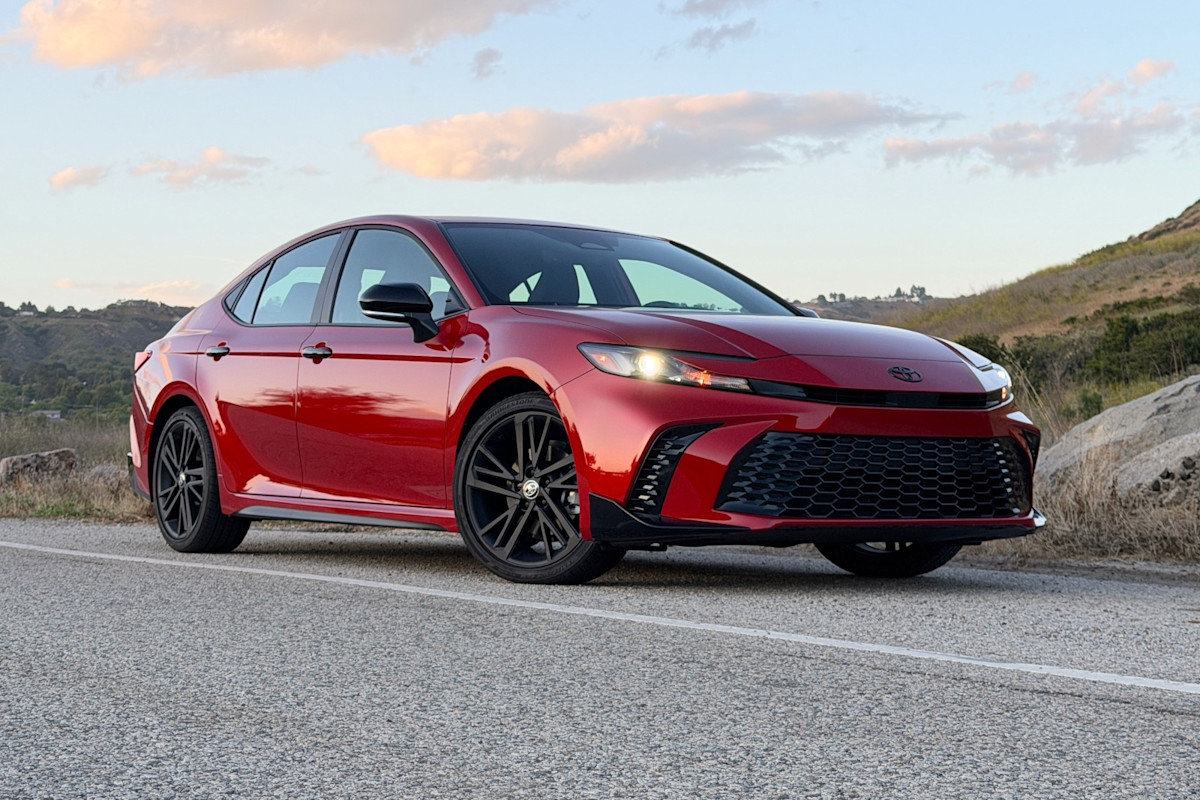
For the 2026 model year, the Camry is offered in Canada in four trim levels: SE FWD (with an available SE Upgrade FWD package), SE Upgrade AWD (with an available Nightshade package), XLE AWD, and XSE AWD. Prices range from $36,935 to $47,690, including the $1,860 destination charge. Our test vehicle arrived in the U.S. equivalent of the SE Upgrade AWD trim with the Nightshade package wearing extra-cost Supersonic Red paint. In Canada, this configuration is priced at $40,630 with destination. (Note that some features pictured may not be available in the Canadian model.)
For 2025, the Camry received significant updates to its styling, powertrain, and technology, but Toyota didn't do a ground-up redesign. That means the 2026 Camry can trace its lineage to the 2018 model, which is evident in the overall proportions, the door skins, and the windows. That’s why, despite well-executed front and rear styling, a new Camry looks a little old.
This year’s Nightshade version should prove popular thanks to its trendy satin black 19-inch wheels and gloss black exterior detailing. Unfortunately, it’s only available in white, Midnight Black, or the extra-cost Supersonic Red.
Inside, the Nightshade mirrors the Camry SE Upgrade, including its black interior. It looks smart with Toyota’s SofTex artificial leather upholstery and matching fabric accents on the dashboard, the door panels, and the seats. Though it’s easy to find the typical inexpensive Toyota plastic in this car, it’s now less obvious. That makes the 2026 Camry a more pleasing place to spend time.

Performance
The Camry ditched its 2.5-litre four-cylinder and 3.5-litre V6 engines as part of the 2025 model year update, leaving a tried-and-true hybrid system as the only powertrain.
It combines a 2.5-litre four-cylinder engine with a pair of electric motors (one for propulsion, one a generator to recharge the lithium-ion battery pack) to produce 225 horsepower in front-wheel-drive (FWD) models. All-wheel drive (AWD) versions add a third electric motor to power the rear wheels when extra traction is required, bumping total output to 232 hp.
Fuel economy ranges from 5.0 to 5.5 litres per 100 kilometres in combined city and highway driving, depending on the trim level and drivetrain configuration. Our U.S.-spec Nightshade test car came with FWD (AWD is standard with the Nightshade package in Canada). FWD Camrys have an official Natural Resources Canada rating of 5.0 L/100 km combined, and ours averaged 5.3 L/100 km on our new 50-kilometre fuel economy test loop that evenly splits city and highway driving. On our usual mountainous testing loop, it returned 6.4 L/100 km.
The SE and XSE versions of the Camry have a sport-tuned suspension. Driving modes are the same across the lineup, though, and drivers can choose from Eco, Normal, Sport, and EV. The EV mode works at low speeds as long as the battery has enough charge, allowing the car to creep in traffic or look for parking at a shopping centre without running the gasoline engine.
The Camry is still based on the Toyota New Global Architecture (TNGA) vehicle platform introduced in 2018. Championed by the company’s then president and CEO Akio Toyoda — an avowed driving enthusiast — the TNGA platform aimed to make Toyota (and Lexus) models more pleasurable to drive, and it shows.
We’re not saying the Camry is fun, but it demonstrates a remarkable balance of ride and handling, soaking up unpleasant surface irregularities while remaining poised and predictable when hustled. In our opinion, it doesn’t offer quite the same level of communication and sophistication as its chief rival, the Honda Accord Hybrid. But it’s close enough that most people won’t notice — or care.
Not only that, but thanks to its robust electric motor, that 225–232 hp feels like more. This car is quick enough that many owners won’t wish it were quicker.
They might wish Toyota had used a traditional automatic transmission. The Japanese automaker’s hybrid system relies on a planetary gearset and the two front motors in place of a traditional transmission, an arrangement marketed as an “electronic continuously variable transmission” or “eCVT.” But the Hyundai Sonata Hybrid also gets 5.0 L/100 km combined with a conventional automatic, so the efficiency payoff doesn’t seem worth the Camry’s drone under hard acceleration.
During our test drive, we switched from Normal to Sport mode for a portion of the mountain road testing. It makes the steering heavier and adds slightly quicker throttle response, but it’s not enough to make a big difference. Paddle shifters are available but not terribly satisfying to use.
While it’s not powerful and doesn’t ride firmly or come equipped with performance tires, the Camry Nightshade nevertheless proved deceptively fast on a winding mountain road. That TNGA platform, engineered to lower the Camry’s centre of gravity, coupled with the added weight of the battery and electric-assist motor, undoubtedly contributed to how quickly the car covered ground. And it did so effortlessly as if the achievement were no big deal.
We still prefer the fine-tuned communication from the similarly capable Accord Sport and Touring, but the Camry isn’t far behind.

Form & function
We also prefer the Honda Accord's size. It seems larger from the driver’s seat with more passenger space in the back seat and a larger trunk. What the Accord lacks, though, are the Camry Nightshade’s comfortable front seats with power height adjustment for both the driver and the passenger. In the Honda, the front passenger may feel like they’re sitting on the floor.
Not only are the Camry’s front seats more comfortable, but they’re wrapped in SofTex artificial leather with stylish fabric inserts that match those on the dashboard and the door panels. There’s also enough seat-track travel that taller people won’t feel squished behind the steering wheel as they do in the Accord. Heated front seats, a heated steering wheel, and heated side mirrors are standard on every new Camry in Canada, but getting ventilated front seats requires upgrading past the Nightshade package.
The Camry’s back seat may not feel as roomy and as supportive as the Accord's, but adults will be happy enough thanks to adequate leg and foot room, decent thigh support, and a supportive backrest angle. Our Nightshade also offered rear air conditioning vents, USB-A and USB-C ports, and a centre armrest with cupholders. Storage space was in short supply, though.
That’s not a problem up front, where the Camry offers large, useful places to stash things, and that’s especially true of the huge bin beneath the padded centre armrest. Notably, the front door panel pockets are shaped in a way that we suspect will make them difficult to thoroughly clean.
Trunk space is small for a midsize car, measuring only 428 litres. Compare that to the compact Honda Civic Hybrid, which holds 419 litres, and the Honda Accord Hybrid, which offers 473 litres. The luggage-crusher trunk lid hinges are a hazard when packing. Also, there’s no inside grab handle to swing the lid shut, so your fingertips will get as dirty as the car.

Technology
Toyota equips the more affordable Camry models, including our Nightshade test car, with an 8-inch touchscreen infotainment system. It features wireless Apple CarPlay and Android Auto, SiriusXM with a three-month trial, and four connected services plans, three of which come with complimentary subscriptions that vary in length. The only audio system for this trim level is an adequate six-speaker setup.
Our U.S. test car was optioned with the larger 12.3-inch touchscreen, which only comes in the XLE and XSE models in Canada. The Drive Connect subscription is optional on lower grades, while a three-year trial comes with the 12.3-inch screen. It adds cloud-based navigation, destination assistance, and an Intelligent Assistant conversational voice recognition system. Though it sometimes had trouble hearing the wake phrase, “Hey Toyota,” the Intelligent Assistant passed nearly all our testing prompts with flying colours.
Toyota includes a volume knob to the left of the touchscreen but no matching radio tuning knob, even though there is room for one. Drivers can use the touch-sensing virtual buttons on the screen, buttons on the steering wheel, or Intelligent Assistant to select a station, though. That didn’t keep us from wishing for a tuning knob every time we drove the Camry.
In addition to Drive Connect, several other connected services plans are available with a free trial. They include Service Connect (five-year trial), Safety Connect (five-year trial), and Remote Connect (three-year trial). Drive Connect comes with a three-year trial, but only with XLE and XSE trims.
We think Safety Connect is the most important. It includes automatic collision notification, an emergency assistance button to summon help, access to roadside assistance, and a stolen vehicle locator. Remote Connect offers remote engine starting, remote door locking and unlocking, guest driver monitoring, and car finding capability. We like Drive Connect, too, but it doesn’t offer anything buyers can’t get via the standard wireless Apple CarPlay and Android Auto.

Safety
Toyota Safety Sense 3.0 (TSS 3.0) is standard on every 2026 Camry and includes adaptive cruise control, forward collision warning, automatic emergency braking, pedestrian detection, lane departure warning, lane keep assist, lane centring assist, road sign assist, and high beam assist. Blind spot monitoring, rear cross-traffic alert, and safe exit warning are also standard.
Proactive Driving Assist (PDA) is also part of TSS 3.0. This technology, which can be turned on or off, actively monitors following distances and can help to avoid obstacles even when the driver is not actively using the adaptive cruise control.
Historically, we’ve found PDA intermittently helpful or irritating, depending on the vehicle and the situation. During a week driving the Camry it wasn’t too bothersome, so we kept it active except when hustling it on our favourite mountain roads. In that environment, it was aggravating.
During testing, a stopping assist system engaged on the highway. Toyota doesn’t list this as a feature anywhere. We only identified it by the warning message that appeared in the instrument cluster. But apparently, when it determines the driver has become unresponsive it disengages adaptive cruise control and begins slowing the car.
The braking event was momentary. As soon as it happened, we stepped on the accelerator pedal, which canceled the action. As far as we could tell, it happened in the first place because the Camry Nightshade does not have a touch-sensing steering wheel, so the only way the tech knows drivers are alert and paying attention is for them to make subtle steering inputs whether they’re needed or not.
Otherwise, we have only two minor complaints about the Camry’s driving assistance tech. First, like many lane-centring systems, it sometimes chooses a line through a curve that the driver would not, so it can feel unnatural and argumentative in those situations. Second, in anything more than a gentle bend in the road, the adaptive cruise control scrubs off too much speed, making drivers behind unhappy.
The 2026 Camry has impressive crash-test ratings. The U.S. National Highway Traffic Safety Administration (NHTSA) gives it a five-star overall rating and five-star scores in every individual assessment.
The Insurance Institute for Highway Safety (IIHS) agrees, naming the 2026 Camry a Top Safety Pick+ for the calendar year.

Cost-effectiveness
The past decade hasn’t been kind to the midsize family car segment. In 2016, any serious car company looking to sell vehicles in North America had one. Today, survivors include the Honda Accord, Hyundai Sonata, and Toyota Camry. All three are available with hybrid powertrains. Honda charges a premium for its Accord Hybrids, which start at $45,630 including destination, and doesn’t offer AWD. Shoppers can save thousands by choosing the more powerful and more efficient Camry, which has a standard hybrid along with that AWD option.
On the other hand, the Accord has better rear seat room, trunk space, interior quality, and driving dynamics. Its impressive hybrid powertrain is refined and sophisticated, and combined with excellent steering and suspension tuning, it helps to make the Accord more rewarding to drive.
The Hyundai Sonata is available with AWD, but it can’t be paired with the hybrid powertrain. The Sonata Hybrid offers significant value, though, with a starting price of $38,299 including destination. It’s well-equipped out of the box and has a larger trunk than the Camry at 441 litres, can match the Toyota’s 5.0 L/100 km rating in combined driving, and is an IIHS Top Safety Pick+ for 2026. Plus, the Sonata Hybrid has a traditional automatic transmission that provides more refined driving dynamics. But the Sonata Hybrid still isn’t as enjoyable to drive as the Honda and Toyota.
Any of these hybrid family cars will be a safe, fuel-efficient, and practical addition to a driveway. The Toyota Camry’s sheer ubiquity can make it seem familiar and boring, but when life is constantly throwing curveballs, a simple, frugal, and dependable car is a blessing, not a curse.

What owners say
I was surprisingly impressed with the 2026 Toyota Camry XLE. The performance, quality, and features are great. Lots of value. Loving the car.
July 12, 2026Trims & specs
Base MSRP N/A | Seating N/A |
Engine N/A | Cargo Capacity N/A |
Combined MPG N/A | Drivetrain N/A |
Base MSRP N/A | Seating N/A |
Engine N/A | Cargo Capacity N/A |
Combined MPG N/A | Drivetrain N/A |
Base MSRP N/A | Seating 5 |
Engine 2.5L 232 hp I4 Hybrid | Cargo Capacity 428 L |
Combined MPG 46 | Drivetrain AWD |
Base MSRP N/A | Seating 5 |
Engine 2.5L 225 hp I4 Hybrid | Cargo Capacity 428 L |
Combined MPG 46 | Drivetrain FWD |
Base MSRP N/A | Seating 5 |
Engine 2.5L 232 hp I4 Hybrid | Cargo Capacity 428 L |
Combined MPG 46 | Drivetrain AWD |
Base MSRP N/A | Seating 5 |
Engine 2.5L 225 hp I4 Hybrid | Cargo Capacity 428 L |
Combined MPG 46 | Drivetrain FWD |
Base MSRP N/A | Seating 5 |
Engine 2.5L 225 hp I4 Hybrid | Cargo Capacity 428 L |
Combined MPG 51 | Drivetrain FWD |
Base MSRP N/A | Seating 5 |
Engine 2.5L 232 hp I4 Hybrid | Cargo Capacity 428 L |
Combined MPG 50 | Drivetrain AWD |
Base MSRP N/A | Seating 5 |
Engine 2.5L 225 hp I4 Hybrid | Cargo Capacity 428 L |
Combined MPG 46 | Drivetrain FWD |
Base MSRP N/A | Seating 5 |
Engine 2.5L 232 hp I4 Hybrid | Cargo Capacity 428 L |
Combined MPG 46 | Drivetrain AWD |
Base MSRP N/A | Seating 5 |
Engine 2.5L 225 hp I4 Hybrid | Cargo Capacity 428 L |
Combined MPG 46 | Drivetrain FWD |
Base MSRP N/A | Seating 5 |
Engine 2.5L 232 hp I4 Hybrid | Cargo Capacity 428 L |
Combined MPG 43 | Drivetrain AWD |




Pricing trends
Current avg. market price
$41,867
Trending down by 1.4% this month
May 2026 - November 2026


